In the late 1930s, Charles and Maggie Daily were living in Watertown, South Dakota, in a duplex that they had bought in 1935. Their grandsons Lee and James Bevers, sons of their deceased daughter Gladys, came to live with them in order to attend high school.1 (As of 1935, the boys’ family was living on a farm about 15 miles southwest of Watertown.) Decades later, Lee remembered his grandmother as a tall woman, probably 5’ 9,’’ and he reported that when Lee was 15 years old, Maggie had given each of the boys a watch.
When the U. S. Census was taken in 1940, Charles was 83 years old and Maggie was 72.2 Their daughter Oranna Mills, age 43, and her 14 year-old son George, who had been living with Charles and Maggie for at least 10 years, were still living with them. The census record indicates that both Charles and Maggie were unable to work, and Oranna was engaged in home housework. All three noted that in 1939 they had received $50.00 or more in income that was not wages or salary. (Their son Robert Daily stated in an interview that Charles and Maggie received $10.00 per month for renting out the opposite half of the duplex that they owned.)3 George was in school and had completed 7th grade. In addition to the regular census questions, Charles was selected to answer supplementary questions. In answer to a question regarding his usual occupation during the previous 10 years, Charles stated he had been a common laborer and had worked on his own account. Oranna’s eldest son Guy, who had been living with Charles and Maggie for much of his life, was working as a “hired worker” on a farm in Oxford Township, Hamlin County, South Dakota.4
At the time of the census, Charles and Maggie’s other three children were living in townships surrounding Watertown. Robert and Ruby Daily had four children and were living in Lake Township, west of Watertown.5 Iona and Robert Zick also had four children. They were living in Rauville Township, north of Watertown.6 Elizabeth and Willis Bevers had seven children and were living in Pelican Township,7 southwest of Watertown, which was not far from Arthur and Elsie Bevers who were living in Kampeska Township.8 Arthur had been the husband of Charles and Maggie’s eldest daughter Gladys who had died in 1934. (Incidentally, Arthur’s eldest son Lee was living with Elizabeth and Willis and working as a farm hand.) Thus, along with Arthur and Gladys’ eight children, Charles and Maggie had 25 living grandchildren.
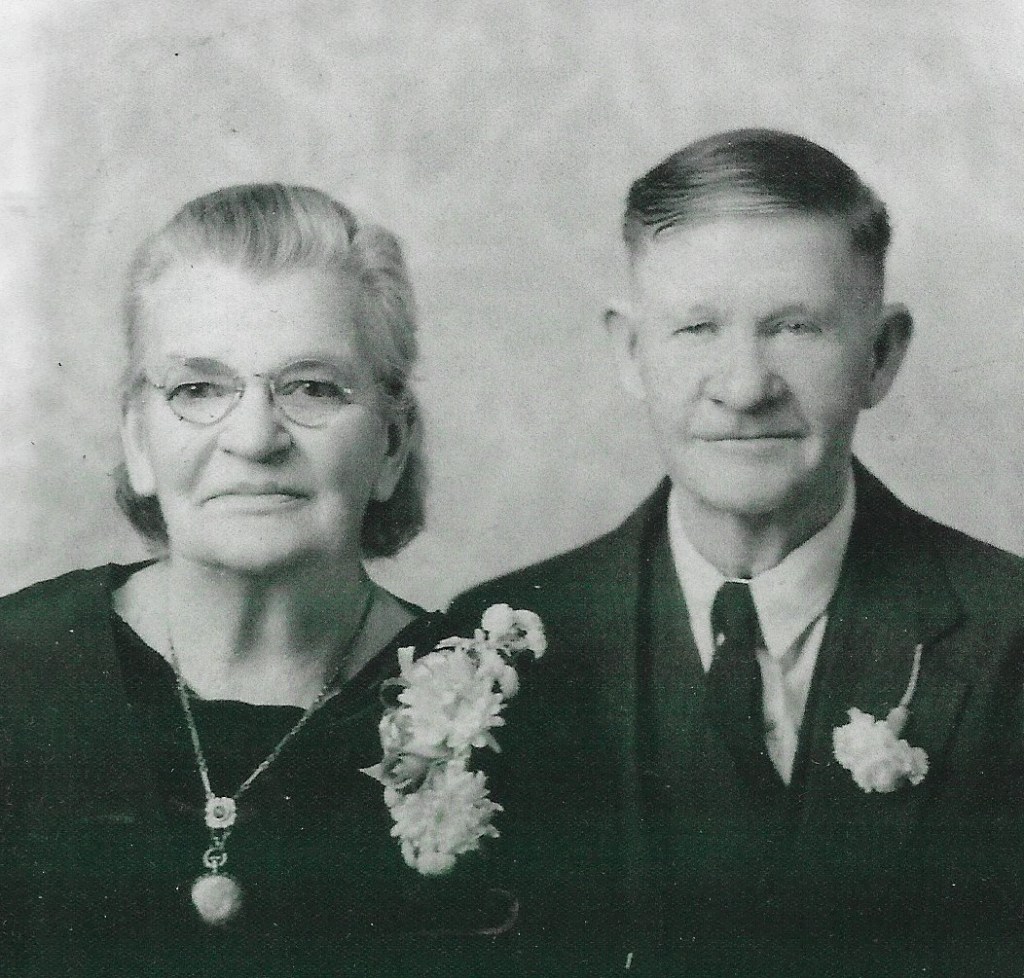
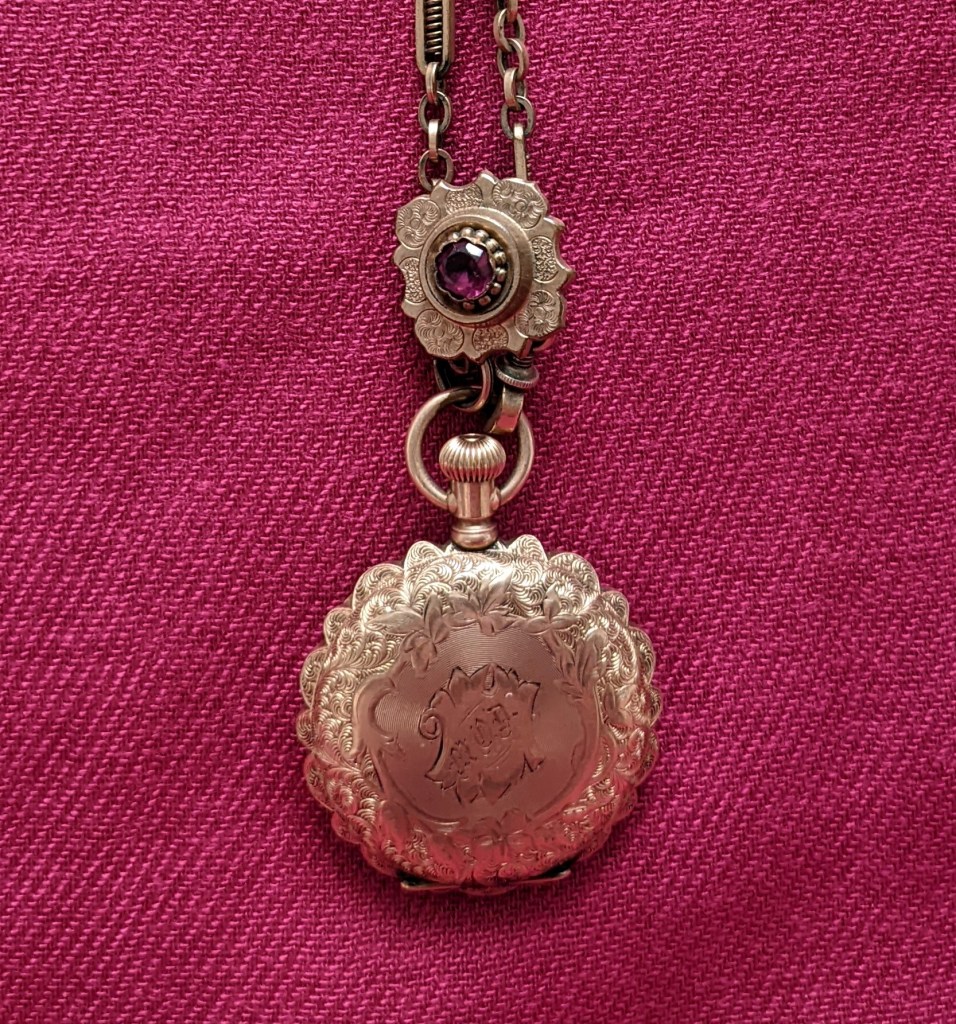
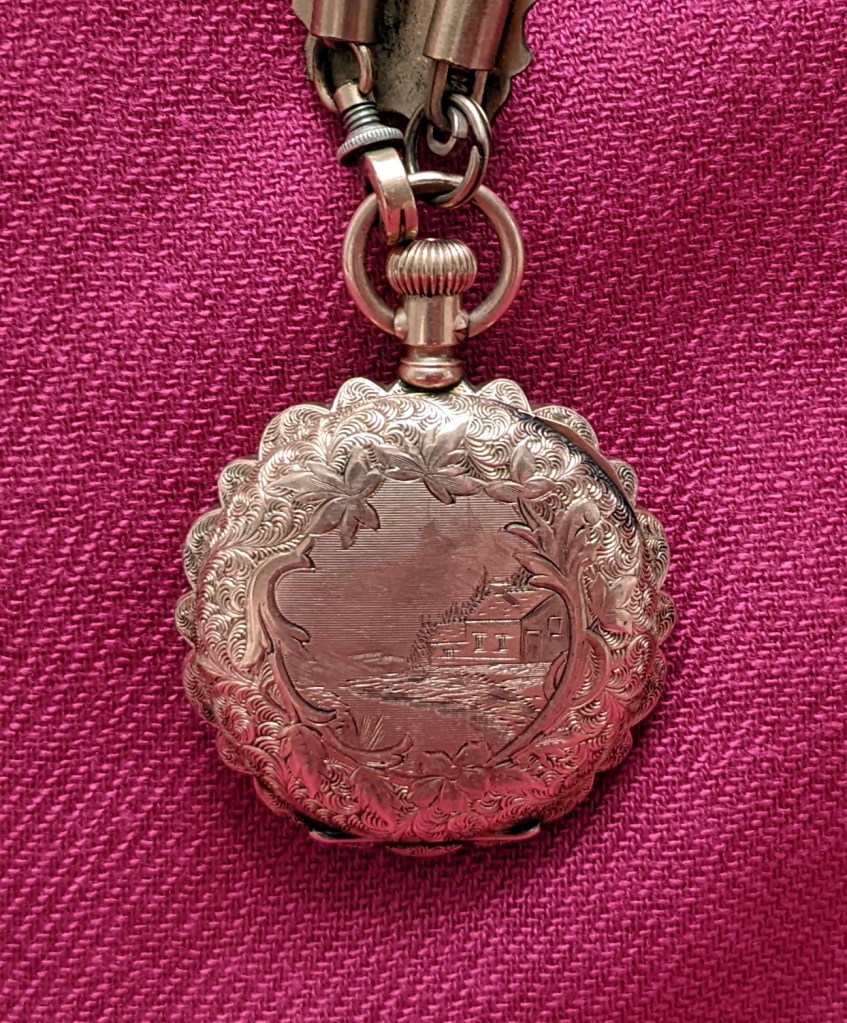
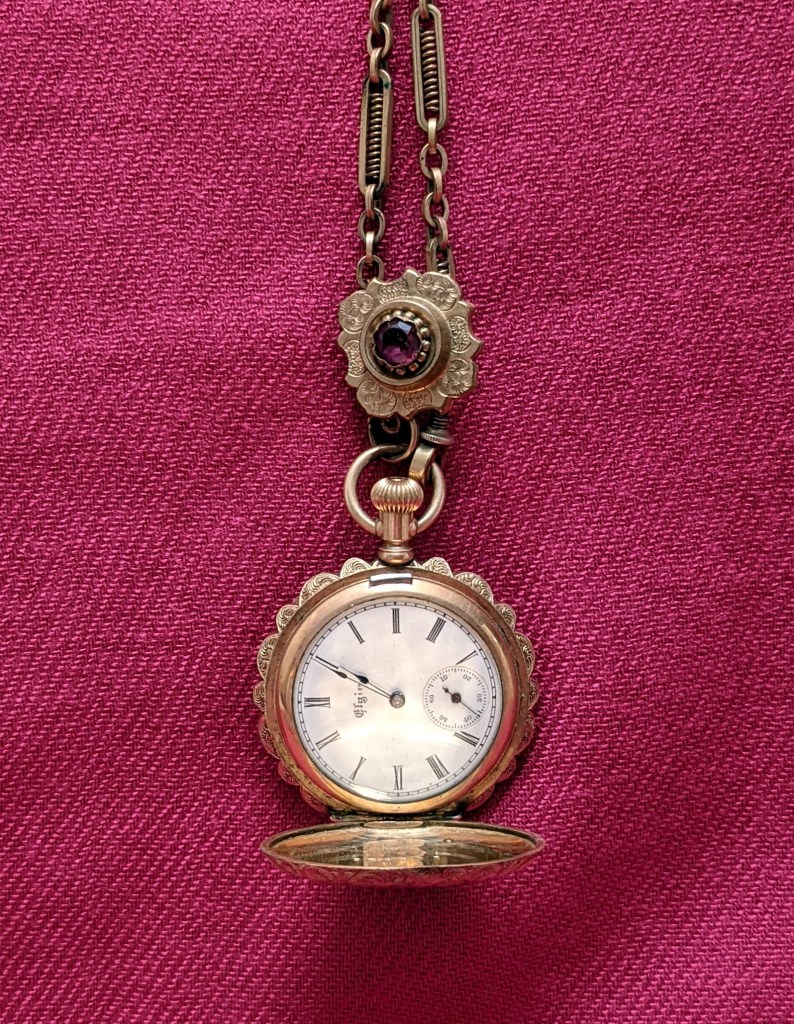
In order to attend Watertown High School, in the fall of 1939 Charles and Maggie’s granddaughter Virginia, daughter of Elizabeth and Willis, moved in with her paternal grandparents, Herbert and Lena Bevers. They were living just a few blocks away from the Dailys. Two years later, still living with the Bevers, Virginia became ill and developed pneumonia. Within two weeks she succumbed to the illness, passing away on November 13. This tragedy occurred only a few days before Charles and Maggie were to celebrate a momentous occasion in their lives, the 50th anniversary of their wedding day, November 18, 1941. To commemorate their 50th wedding anniversary, Maggie and Charles sat for a portrait. The pendant watch that Maggie is wearing in the photograph below is in the possession of one of Maggie’s granddaughters.
Less than three weeks later, on December 7, 1941, Pearl Harbor in Hawaii was bombed by Japanese aircraft. The next day the United States declared war on Japan. A week later Germany declared war on the United States. During the next several years, six of Charles and Maggie’s grandsons would serve in the military. Their eldest grandson Guy Mills entered the army in September 1942, listing his home address as Charles and Maggie’s home.9 He served until November 1945. Guy’s brother, George Mills, who also gave his home address as Charles and Maggie’s home, enlisted in the Navy in July 1943.10 He trained to be an aviation radioman and gunner, and was assigned to the aircraft carrier USS Bismarck Sea in the western Pacific.11 He flew on 23 combat missions from the flight deck of the Bismarck Sea, including observation patrols over Iwo Jima on D-Day (February 19, 1945). When the Bismarck Sea was sunk by a Japanese aerial attack in February 1945, George survived and spent leave at his home in Watertown before resuming flying duty.
Over time, the term “D-Day” has become associated with the beginning of the World War II invasion of Normandy, France by the Allied Forces, because that military event turned the war in Europe in favor of the Allies. But during both World War I and World War II, the term “D-Day” was a military term used for a variety of operations. The definition of “D-Day” was in question even the week following the invasion of Normandy. A reader of Time magazine wrote, “Everybody refers to D-Day, H-Hour. Can you please tell me what they stand for or how they originated?” The Time editor replied:
D for Day, H for Hour means the undetermined (or secret) day and hour for the start of a military operation. Their use permits the entire timetable for the operation to be scheduled in detail and its various steps prepared by subordinate commanders long before a definite day and time for the attack have been set. When the day and time are fixed, subordinates are so informed.12
The other four grandsons that served in World War II were sons of Arthur Bevers:
Lee was in the Air Force in England, flying over Germany until he was shot down and spent the last year of the war in a prison camp. James and Dale, in the Navy, saw action under fire of the Japanese in the Pacific. James was on a mine sweeper while Dale served on a cruiser. Arthur, Jr. was with the Army in Hawaii until the end of the war.13
When asked about his grandparents, Lee Bevers stated that when he was in the Army Air Corp, Maggie wrote to him every week.14 Lee himself was an avid letter writer as well, as evidenced in a diary that Lee kept when he was in the military. The first entry is dated October 29, 1943 in Grand Island, Nebraska, from which he began traveling to the base he was assigned overseas. On his way to the base in England, there were stops in Wilmington (Delaware), Newfoundland, Ireland, Scotland and a few towns in England. It was December 6th when he finally arrived at the base from which he would fly over northern Europe. Lee noted in his diary when he wrote letters and when he received letters. Sometimes the mail was delayed, and when it was finally delivered, he would get more than one letter from the same person, though the letters had been written several days apart. On November 25, 1943, Thanksgiving Day, he wrote letters to both sets of grandparents, which would be Charles and Maggie Daily and Herbert and Lena Bevers.15 His diary indicates that he wrote to “Grandma D” on December 27, 1943, January 9, 14, 28, February 5, 11, 18, 27, March 4, 16, 26 and April 7, 1944. In the March 4th letter which he sent to Maggie, he included $40.00. The entries in Lee’s diary abruptly end on April 12, 1944. The following day while he was flying his 26th mission, his plane was shot down and he was taken prisoner. For the remainder of the war, Lee was held in a prison camp near Frankfort, Germany.
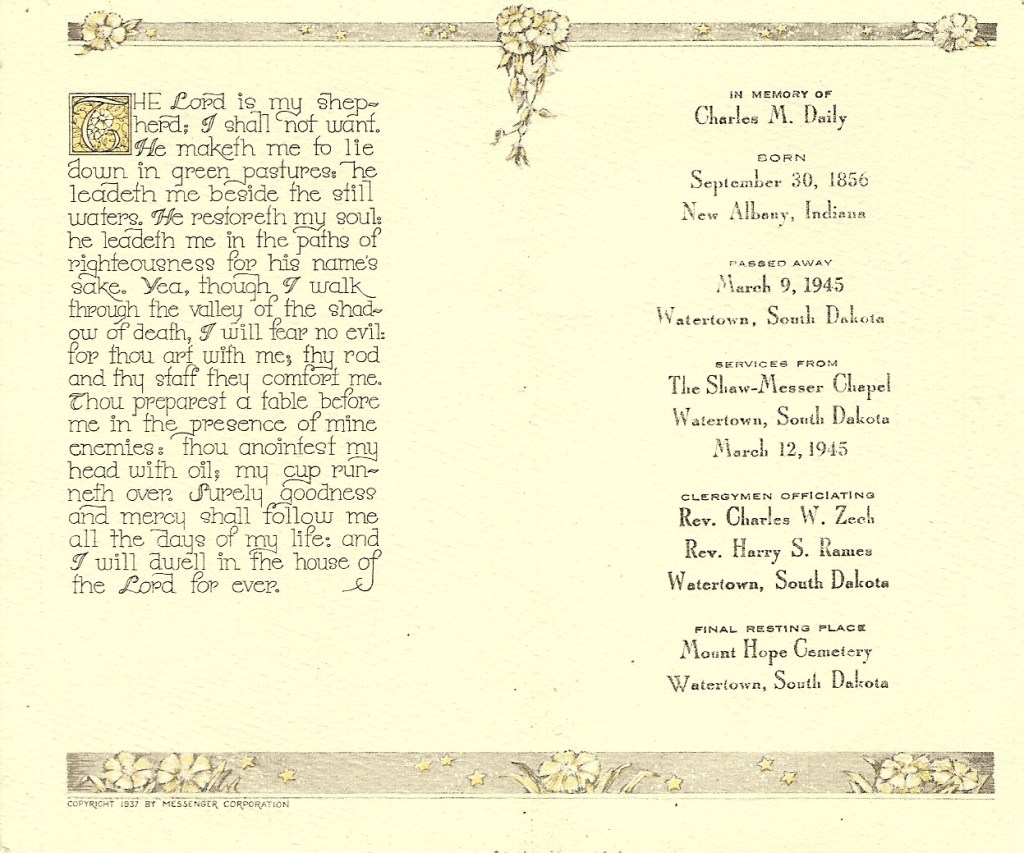
In the winter of 1945, Charles fractured his hip. According to his granddaughter Phyllis (nee Bevers) DeBoer, he spent his last days in the living room of his home in a bed that was like a hospital bed (it was on wheels), while Maggie took care of him.16 He also developed bronchio-pneumonia which led to his death on March 9th.17 He was 88 years-old. His funeral service was held on March 12 and he was buried in Mount Hope Cemetery in Watertown.
On Sundays, Elizabeth and her children would often go to dinner at her parents’ home. One of Elizabeth’s children remembers regularly going to the Daily’s duplex after going to church. All the children would sit on the open stairway of the front room to eat their mid-day dinner.18 During one of those Sunday visits in August 1946, Maggie enjoyed the company of her four living children and many of her grandchildren. Everyone in attendance gathered in front of the house to take photographs.
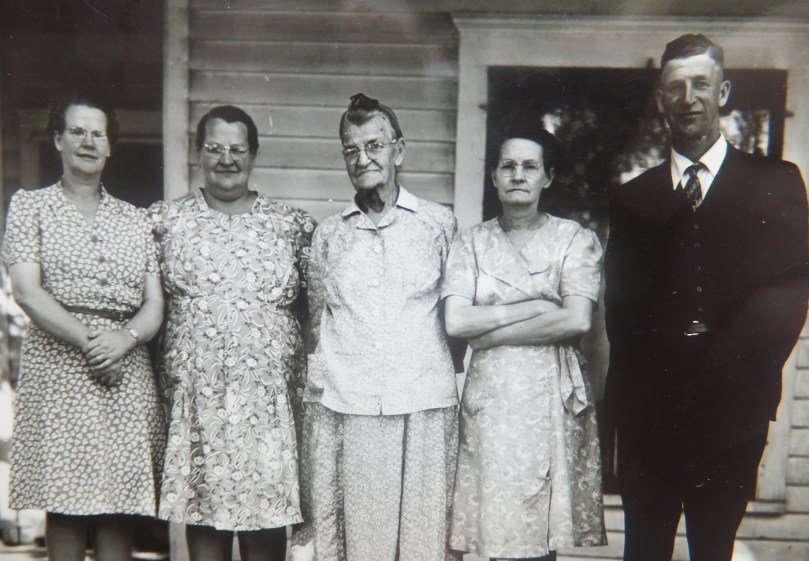
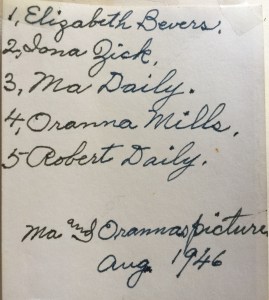
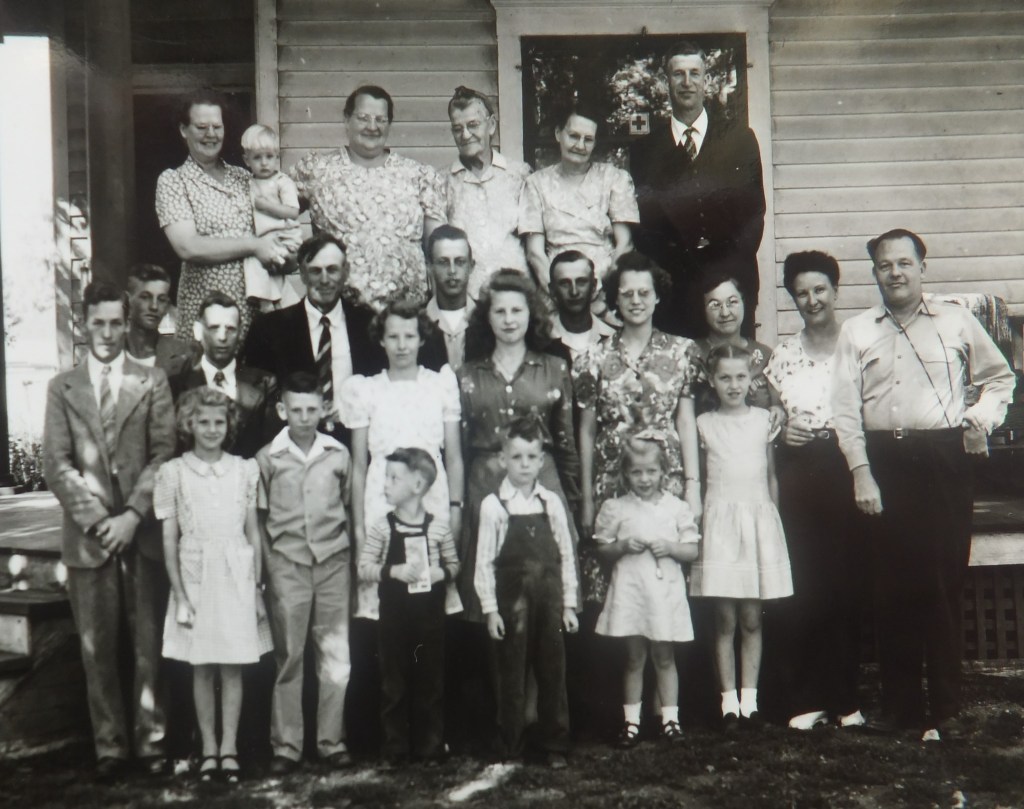
Between 1940 and 1946, Iona gave birth to her last child, and Elizabeth gave birth to three more children, the last one, Maggie’s 31st grandchild, arriving in November following the family gathering in the above photograph. In April 1942, Robert’s first granddaughter was born, giving Charles and Maggie their first great-grandchild. Lee Bevers had married in the summer of 1943 and a son was born to them in April 1944, only eight days after Lee had become a prisoner of war. This was Charles and Maggie’s second great-grandchild. Their third great-grandchild arrived when Robert’s second grandchild was born in January 1945. Then in 1946, two of Robert’s daughters each had a baby – two more great-grandchildren.
During the fall of 1946 and winter of 1947, Maggie experienced “declining health,” eventually passing away at her home on March 11, 1947.19 She was 79 years-old. The causes of death cited on her death certificate are melano carcinoma of the skin with metastasis to liver, pernicious anemia and senility. She was survived by her daughters Oranna, Iona and Elizabeth and her son Robert and by twenty-eight grandchildren and five great-grandchildren. Maggie was buried beside Charles in Mount Hope Cemetery in Watertown.
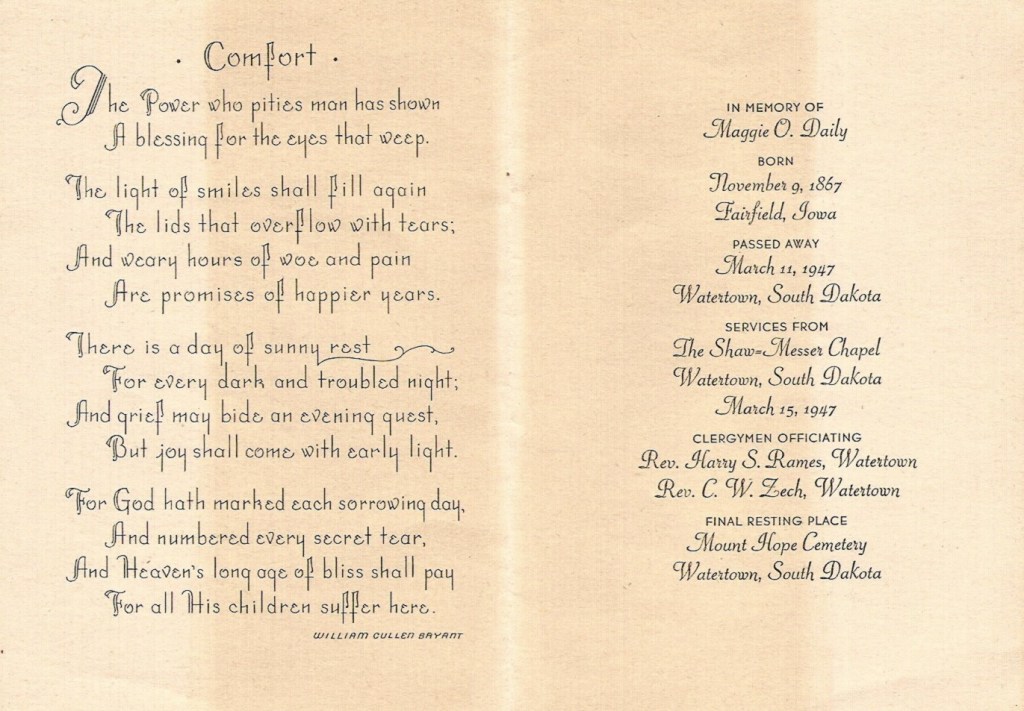
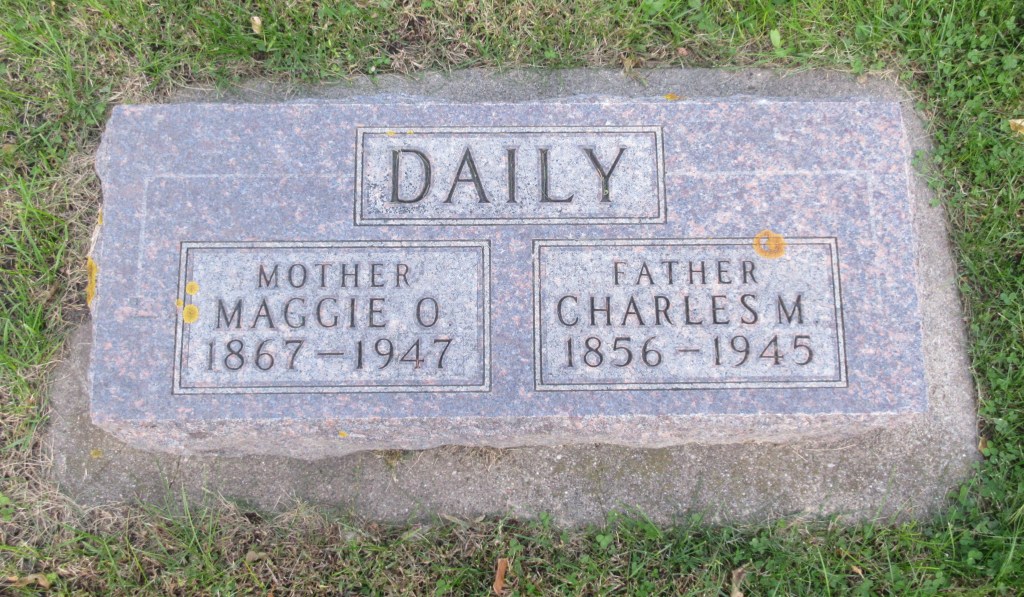
To conclude the series of blogposts about Charles and Maggie Daily which feature the reminiscences of their son Robert L. Daily, here is one more excerpt from the interview he gave about 1984:
Uncle Bob: … well, Dad had made a deed out for Mother, when he bought the place. Yeah, that’s the way he done it, handled things that way. But he made a deed out –
Interviewer: Um hmm.
Uncle Bob: — for Mother to have. So, when Mother lived alone …. Figured I’d talk to Willis and to Rob. An’ ‘course Arthur was otherwise ….
[These were Charles and Maggie’s sons-in-law who were married to Elizabeth, Iona and Gladys, respectively.]
Interviewer: Um hm, um hm.
Uncle Bob: … so Mother made a deed out for me.
Interviewer: Um hm.
Uncle Bob: An’ that helped like ev’rythin’ because when Mother passed away, instead of having a probate, or have to go through all that stuff that way, why, they had somebody to do –
Interviewer: Yeah, then it was all taken care of. Right.
Uncle Bob: Yeah, … then I cleared up that debt. An’ then I … modernized it after that. In other words, I had to, I had the whole thing re-wired, top to bottom, because it was, when I went up in the attic an’ seen them, all bare wires up in the attic.
Interviewer: Oh, I’m sure it was –
Uncle Bob: Y’know in those days they didn’t, they didn’t have no plug-ins down at the bottom.
Interviewer: No.
Uncle Bob: Ever’thin’ come off one o’ them socket, see, an’ they put too many, too many appliances on a socket. An’ it took the insulation off the wires up there.
Interviewer: I remember the oil parlor furnace in the living room.
Uncle Bob: Yeah, yeah.
Interviewer: Yeah, that’s the only house I remember grandma being in.
Uncle Bob: Then I had to, had to bring the water and sewer all in.
Interviewer: Yah, we used a – there’s a cistern under there, isn’t there?
Uncle Bob: Well, they, we had two uh, two uh, sand points. One for each side.
Interviewer: Okay, it was sand point, it was not cistern.
Uncle Bob: No, no. We had the out, the toilets outside.
Interviewer: That’s right, that’s right.
Uncle Bob: Yeah, the toilets outside. Sometime I brought that all in. An’ I paid twenty-five hundred dollars for, for bringin’ the water in, the water – to modernize it, that way.
Interviewer: Um hm, um hm.
Uncle Bob: An’ paid Roger sixteen hundred dollars for, uh, to re-wire the whole thing.
Interviewer: Oh, I’m sure that it cost quite a bit.20
- L. A. Bevers, interview with M. R. Wilson, August 2, 2010.
- “United States Census, 1940,” database with images, FamilySearch (https://familysearch.org/ark:/61903/3:1:3QSQ-G9M1-5855?cc=2000219&wc=QZFM-WRZ%3A791611401%2C793270701%2C793367301%2C793379401 : accessed 22 November 2021), South Dakota > Codington > Watertown City, Watertown, Ward 3 > 15-24B Watertown City Ward 3 bounded by (N) 4th Av S; (E) Maple, ward line; (S) city limits;
 city limits, ward line > image 3 of 24; citing Sixteenth Census of the United States, 1940, NARA digital publication T627. Records of the Bureau of the Census, 1790 – 2007, RG 29. Washington, D.C.: National Archives and Records Administration, 2012.
 - M. R. Wilson, transcription of Robert Lee Daily Interview by R. Thiele, recording (ca. 1984): 28.
- “United States Census, 1940,” database with images, FamilySearch (https://familysearch.org/ark:/61903/3:1:3QS7-L9M1-5833?cc=2000219&wc=QZFM-3CZ%3A791611401%2C795183601%2C790385801%2C795237102 : accessed 12 March 2022), South Dakota > Hamlin > Oxford Township > 29-19 Oxford Township (Township 115 Range 53 and Township 115 Range 54 (part)) > image 11 of 14; citing Sixteenth Census of the United States, 1940, NARA digital publication T627. Records of the Bureau of the Census, 1790 – 2007, RG 29. Washington, D.C.: National Archives and Records Administration, 2012.
- “United States Census, 1940,” database with images, FamilySearch (https://familysearch.org/ark:/61903/3:1:3QSQ-G9M1-588Q?cc=2000219&wc=QZFM-3RR%3A791611401%2C793270701%2C790542101%2C951343301 : accessed 16 December 2021), South Dakota > Codington > Lake Township > 15-12 Lake Township (Townships 117 and 118 Range 52 inside Old Sisseton and Wahpeton Indian Reservation and Township 117 Range 53 (part)) outside Watertown City > image 6 of 11; citing Sixteenth Census of the United States, 1940, NARA digital publication T627. Records of the Bureau of the Census, 1790 – 2007, RG 29. Washington, D.C.: National Archives and Records Administration, 2012.
- “United States Census, 1940,” database with images, FamilySearch (https://familysearch.org/ark:/61903/3:1:3QS7-89M1-588J?cc=2000219&wc=QZFM-3DS%3A791611401%2C793270701%2C793332701%2C951346101 : accessed 16 December 2021), South Dakota > Codington > Rauville Township > 15-16 Rauville Township (Township 118 Ranges 52 and 53 outside Old Sisseton and Wahpeton Indian Reservation Line and Townships 118 and 119 Range 52 (part) inside Old Sisseton and Wahpeton Indian Reservation Line) > image 8 of 11; citing Sixteenth Census of the United States, 1940, NARA digital publication T627. Records of the Bureau of the Census, 1790 – 2007, RG 29. Washington, D.C.: National Archives and Records Administration, 2012.
- “United States Census, 1940,” database with images, FamilySearch (https://familysearch.org/ark:/61903/3:1:3QS7-89M1-5864?cc=2000219&wc=QZFM-36G%3A791611401%2C793270701%2C793326301%2C793326302 : accessed 16 December 2021), South Dakota > Codington > Pelican Township > 15-14 Pelican Township (Township 116 Range 53 (part)) outside Watertown City > image 4 of 9; citing Sixteenth Census of the United States, 1940, NARA digital publication T627. Records of the Bureau of the Census, 1790 – 2007, RG 29. Washington, D.C.: National Archives and Records Administration, 2012.
- “United States Census, 1940,” database with images, FamilySearch (https://familysearch.org/ark:/61903/3:1:3QSQ-G9M1-588N?cc=2000219&wc=QZFM-QC9%3A791611401%2C793270701%2C793309301%2C793309302 : accessed 16 December 2021), South Dakota > Codington > Kampeska Township > 15-10 Kampeska Township (Township 116 Range 54) > image 4 of 13; citing Sixteenth Census of the United States, 1940, NARA digital publication T627. Records of the Bureau of the Census, 1790 – 2007, RG 29. Washington, D.C.: National Archives and Records Administration, 2012.
- “U. S., World War II Draft Cards Young Men, 1940-1947” (Ancestry.com Operations, Inc., Lehi, Utah, USA, 2011).
- “U. S., World War II Draft Cards Young Men, 1940-1947” (Ancestry.com Operations, Inc., Lehi, Utah, USA, 2011).
- __________, “Survives” (news article), source unknown.
- K. Moon, “What Does the ‘D’ in ‘D-Day’ Stand For? Experts Disagree With Eisenhower’s Answer,” Time (June 4, 2019): https://time.com/5599811/d-day-meaning/.
- Hamlin Historical Committee, “Bevers Family,” Hamlin County 1878-1979: 141.
- Bevers, interview with M. R. Wilson.
- L. A. Bevers, personal diary, October 29, 1943 – April 13, 1944.
- P. I. DeBoer, interview with M. R. Wilson, August 3, 2010.
- M. A. Bevers, notes about the death certificate of Charles M. Daily, accessed from “Bevers-Daily-McFerran-Nelson Families” on Ancestry.com.
- E. J. Jones, interview with M. R. Wilson, ca. July 2010.
- “Maggie Daily Dies At Home Here, Illness,” (published obituary, publication unknown).
- Wilson, Robert Lee Daily Interview: 29-30.
 Sojourners, Settlers & Other Legacy Conveyors
[…] Charles and Maggie lived out their final years in this duplex in Watertown. Some of the events of those years will be shared in the next blogpost. […]
LikeLike
[…] Died on March 9, 1945 at the age of 88 and is buried in Mount Hope Cemetery, Watertown, South Dakota […]
LikeLike