Maude and Alfred Waters were travellers – for pleasure, for business and for civic responsibilities (such as the trips Alfred made, mentioned in Part Two, to Portland, Oregon and Kansas City, Missouri as a delegate to the Trans-Mississippi Commercial Congress). During the nearly twenty years of his first marriage, Alfred and his wife Josie made frequent trips to their hometown in New York, where Alfred as a real estate agent often convinced friends and acquaintances to resettle in Kingsbury County.1 After Maude and Alfred married, their first journey together was reported in the May 1904 news article announcing their marriage. The article stated that the wedding guests left “the banquet hall only in time to accompany the happy couple to the train to see them started upon a trip to the eastern cities, which is to occupy about two weeks’ time.”2 The depot from which they departed is not the depot that currently stands in the town of De Smet. The original two-storey building stood on the north side of the railroad tracks. Nearly a year after the Waters took their wedding trip, that building burned to the ground on Easter Sunday, April 1905.3 A one-storey train station was built in 1906 on the south side of the railroad tracks. The latter building no longer serves as a train station, it is presently an historical museum, Depot Museum.
Some of Maude and Alfred’s trips which were recorded in the local newspaper include the following:
- May 30, 1905 A trip to Winona, Minnesota for a short visit with friends.4
- July 16, 1909 A week visiting the John Hayden family near Wasta, a town in western South Dakota.5 Mrs. Hayden was Alfred’s cousin, nee Ella M. Fairchild. Alfred’s and Ella’s mothers were sisters.
- November 1, 1909 A trip to Wisconsin to visit friends.6
- May 26, 1911 The return from an extended trip to the Pacific coast.7
- September 16, 1916 A train trip to Chicago, using the Rock Island rail line.8
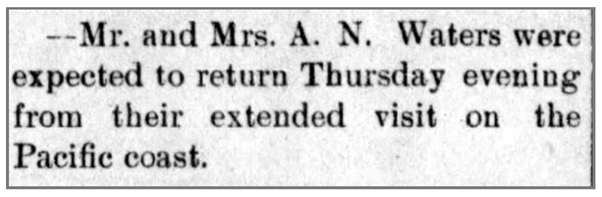
May 26, 1911
About seven years after the first trip that Maude and Alfred made together, the local newspaper reported that they had begun a trip by auto, rather than by train, on July 17, 1911.9 Alfred had registered a 40-horsepower Buick with a horn and lights on September 15, 1909.10 Those accompanying the Waters on the automobile trip were Mr. and Mrs. George Moody and Miss Bertha Eggleston. George Moody and his wife Margaret arrived in Kingsbury County about 1882, not long after Alfred had arrived. For a number of years George worked as a field representative for Alfred’s real estate business.11 During this auto trip, the party drove to Big Stone and stayed for a day or two, then drove to Detroit Lake, where they joined Dr. Coulter, of Winnipeg, and his family, who were vacationing. Big Stone was on the border of South Dakota and Minnesota, approximately 110 miles northeast of De Smet. Detroit Lake was another 130 miles northeast in northwestern Minnesota. Their trip to and from Detroit Lake took about two weeks.
In the summer of 1912, the Waters and a recently graduated high school student, Edith Mitchell, completed “a three-month automobile tour back to Alfred Waters’s boyhood home in Durham, New York. Driving over roads that much of the way consisted of nothing more than dirt paths and stopping at nearly every town to obtain directions to the next one made the excursion quite an adventure.”12 The Waters were described as Edith Mitchell’s benefactors. A birthday party for Edith had been held in the Waters home in March 1912 (see a photograph of the guests gathered in the Waters’ home in Part One). In addition, the Waters enabled Edith to attend university.
Seven years after the Waters made their automobile trip to New York, Maude’s brother Herbert Bevers embarked with his family on an automobile journey from Watertown, South Dakota to Raymondville, Texas. It took 27 days to travel on primarily unpaved auto trails that had been designated during the 1910s. On their first day of travel, they took a transcontinental highway named Meridian Highway to Black and Yellow Trail, a road which passed through De Smet, connecting Chicago with Yellowstone National Park. The Bevers family did not enter De Smet, which was several miles west of the intersection where they arrived at the Black and Yellow Trail, rather they turned east toward Arlington. Herbert’s wife Lena kept a travel log during their trip which can be seen on the Legacy Page entitled: 1919 Lena Huppler Bevers’ Travel Log. To read about re-tracing the approximately 1900-mile journey in 2019, see the blogposts listed on the Legacy Page entitled: 2019 Retracing Lena Bevers’ Travel Log.
An historian of South Dakota and the Midwest has described the setting of the time and place in which the Waters lived as follows:
De Smet itself … stood unknowingly on the brink of a new era. In 1912, the town still retained many of the characteristics of an “island community,” which, according to historian Robert Wiebe, had dominated American society after the Civil War. Local affairs and concerns overshadowed events in distant urban areas. People felt remote from cities, comfortable within the cocoons they spun around themselves. Agriculture constituted the lifeblood of the community as people’s activities moved to the rhythms of seasonal agricultural processes. Citizens could easily assume that what happened in far-off cities and factories bore little relevance for them. The isolation that characterized little towns like De Smet in 1912, however, would soon recede as the national culture began to bear down upon the local.13
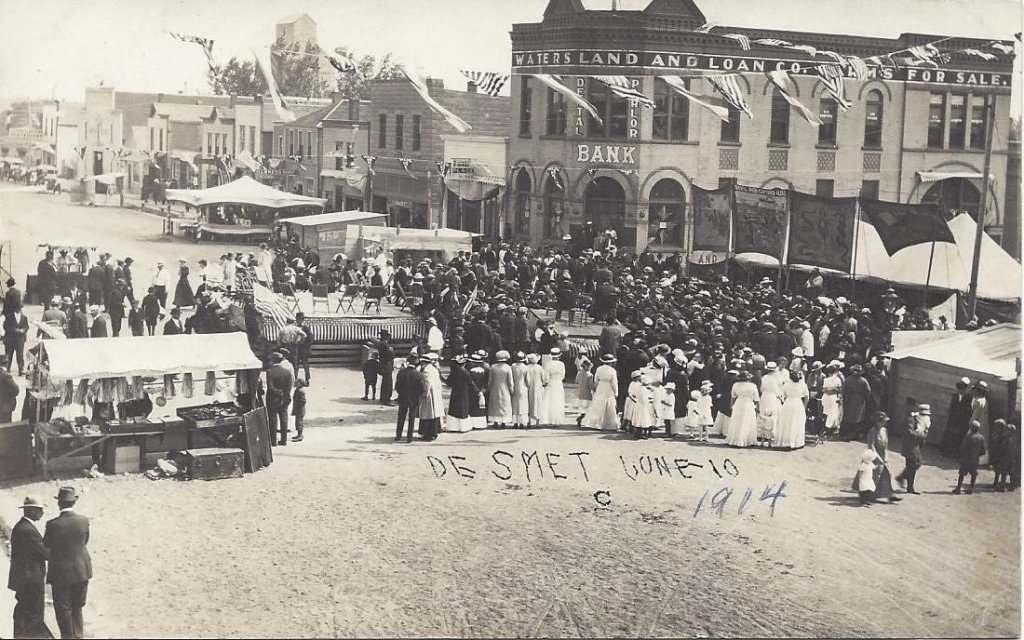
In May 1916, Maude and her sister Gertrude made a trip to Mitchell, South Dakota, to attend the wedding of their sister Ada’s son, W. Arthur Mankey.14 The wedding was held in the home of the bride, Birdella Carhart, and the officiating minister was the bride’s father, Rev. A. E. Carhart. Also, in attendance were Arthur’s brother G. Floyd Mankey and his cousin Lester Mankey.
In a previous blogpost about Maude and her sisters, it was noted that Maude’s grandfather, father and sisters were involved in the temperance movement (see Ada, Gertie and Maude). Now we learn that her husband may have had a role to play – or he may not have – in a related public debate, the regulation of liquor sales. First some background: when the South Dakota constitution was created in 1889, its Article 24 banned individuals and corporations from manufacturing intoxicating liquor and from selling intoxicating liquor as a beverage. It did not address personal possession or consumption. Only seven years later, in 1896, the voters of South Dakota repealed Article 24. The following year, in order to regulate alcohol in the state, a local option law was adopted which “prohibited the sale of alcoholic beverages within the limits of an incorporated city, town, or township without a license from the municipal government. Local governments could issue liquor licenses only with the approval of voters at a municipal general election.”15
Nearly twenty years later, the controversy over alcohol use and commerce in South Dakota was still highly debated, as well as in the nation. The voters in South Dakota were evenly matched, dry voters favoring prohibition of alcohol and wet voters opposing prohibition.16 For the election in November 1916, the voters were asked to consider a referendum regarding a state constitutional amendment, which was referred to as Amendment 7. “The measure sought to end the ‘sale, manufacture for sale, transportation for sale, importation for sale, and exportation for sale of intoxicating liquors for beverage purposes.’ The amendment did not address personal possession and consumption ….”17
In the lead-up to the election, an organization presenting the wet argument and an organization presenting the dry argument vied for the voters’ attention by submitting advertisements to local newspapers. The wet organization, called South Dakota Local Option League, supported the existing local option law. S. D. Local Option League “distributed literature in 1916 urging voters to reject state prohibition and leave alcohol regulation a matter of local jurisdiction.”18 An advertisement printed in a county adjacent to Kingsbury County listed A. N. Waters as the president of the Kingsbury County branch of S. D. Local Option League.19 The advertisement claimed that the local option law was a temperance measure, and at its adoption in 1897 the local option law was supported by clergymen and businessmen. The advertisement also stated that under prohibition prior to 1897 “the illegal sale of liquor was a common practice in nearly every city and town in South Dakota” and the enforcement of the prohibitory law in small towns was impossible “because of the domination of illegal dealers over the law enforcement officials.20
The argument in favor of prohibition was presented by the Anti-Saloon League. “While total prohibition was the organization’s ultimate goal, it preferred to work gradually. As its name indicated, the league focused on eliminating saloons, thereby avoiding the much more divisive issue of regulating personal alcohol consumption.”21
The uncertainty about whether Waters was publicly participating in the debate about alcohol regulation arises because S. D. Local Option League apparently used questionable tactics when declaring who was in support of its argument. The list of the county presidents of S. D. Local Option League was not entirely truthful. An article in the Brookings Register stated:
Some of the men whose names are given as officers of the so-called Local Option League are denying any connection with that organization. Hugo Cook, whose name has been printed in the ads as county president of Turner county, says, in a signed article in the Marion Record: “I want to say most emphatically that I have no connection with this organization in any manner whatsoever, and that the use of my name by them in the manner above mentioned, or in any other manner was and is done without my knowledge or consent and contrary to my wishes, and I have already taken steps, through my attorney, to bring legal action against the parties responsible for this fraud and imposition upon myself and the public. And I wish to state, further, that I am not in sympathy with the campaign methods employed by this organization and they need expect no assistance from me or any of my friends.”22
Amendment 7 passed with 55% of the votes cast.23 The next step was for the state legislature to create a law to regulate alcohol. Even though Amendment 7 was not a strict prohibition referendum, in that it did not prohibit personal possession and consumption of alcohol, in February 1917, the state legislature, which had been pressured by advocates of prohibition, created a law that banned liquor in commercial settings and also prohibited personal possession of liquor. This was followed nationally by both houses of Congress passing an amendment to the United States Constitution in December 1917. The national amendment prohibited manufacture, sale, or transportation of intoxicating liquors for beverage purposes, as well as importation and exportation of intoxicating liquor. It was ratified by three-fourths of the states in January 1919. Prohibition of the alcohol industry was outlawed in the United States until 1933. It is the only amendment of U. S. Constitution that has been repealed.
The First World War had broken out in Europe in 1914 and the United States entered the war in April 1917. Maude’s nephews, Edgar and Clarence Bevers, sons of her brother Herbert, registered for the draft about June 1917. Edgar served in the military from July 1918 to October 1919. Clarence also served in the military. Herbert’s son, Arthur registered for the draft in September 1918, but the war came to an end in November 1918.
On Friday, May 4, 1917, representatives of the Brookings Chapter of Red Cross motored to De Smet in order to address “a mass meeting in the Episcopal Guild hall, called to organize a chapter of Red Cross. The meeting was well attended and much interest and enthusiasm were shown by both men and women in De Smet.”24 Temporary officers of an organizing committee were chosen at this meeting. Maude was chosen to be the treasurer. Later she would hold the office of secretary.25 One month prior to this meeting there was only one chapter of Red Cross in South Dakota. The following text about the Brookings Chapter provides information about the challenges that the chapter was facing, the De Smet Chapter would have faced the same challenges:
The [Brookings] chapter’s attention has been called to the appeal from headquarters for home knitted woolen socks for our soldiers in training. The home-made woolen socks are easier on the feet while on the march and wear better. It seems to be the general impression both among our people and our merchants that sock knitting has become a lost art among the women of our population. Woolen yarn has advanced so much in price and quotations for the winter have advanced so much over old prices that the Brookings Chapter does not feel warranted at the present time in making any extensive purchase of woolen yarns, without knowing how many women would pledge themselves to do the knitting. …
The efficiency and value of our local chapter will depend upon the means at their command. The prices of cotton and woolen goods for the hospital and trench supplies are so high it will be necessary to find some means of raising revenue, or the loyal and patriotic women willing to sew and knit and roll bandages will soon run out of materials.26
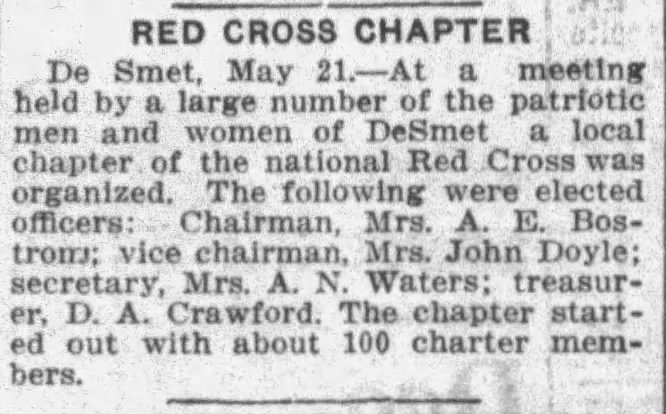
May 21, 1917
The United States census taken in January 1920 recorded that the Waters’ residence was on “Second Street South Side.”27 Alfred was 64 years old and he was working on his own account in the occupation of real estate. Maude was 44 years old and did not have an occupation. She was a naturalized citizen. Besides Maude and Alfred there was a servant living at their home, named Kirstin Lunde, who was an alien from Norway. She was 27 years old and single, she could read and write, and she spoke English.
For several years prior to 1921, Maude’s father had suffered from an illness that initially confined him to a wheelchair and later confined him to his bed.28 Eventually, Alfred Bevers was moved to the Waters’ home, and Maude and her sister Gertrude cared for him. His illness was severe for about a year and he died on Monday, September 19, 1921. Possibly after her father’s death, Maude took possession of his walking stick and the Bevers Family Bible. (See more: Bevers Family Bible and Alfred & Mary Bevers Bible.)
In May 1922, Brookings Register reported: “Tuesday morning a large delegation of P. E. O. members from De Smet stepped off the passenger train and spent the day in Brookings as guests of the local chapter.”29 Maude was among this group of 15 women who were members of Chapter R of the Philanthropic Educational Organization sisterhood, which had been formed in De Smet in November 1920.30 This organization was an international women’s organization of the Methodist Church. A news article seven years later announced that Maude was vice-president of the chapter and explained:
The De Smet chapter of the P. E. O. is neither a lodge nor a club, … although it has some of the ear-marks of both. … They take a decided interest in educational progress and have a large … educational fund that is constantly growing. This fund is available to girls meeting certain requirements, at a small rate of interest, to finish their higher education and to date 2,796 girls have received loans of varying amounts. …
The chapter has a number of social events during the year but the one they feature most prominently is their annual Mother’s party in May when they entertain their mothers and others.31
As Waters health declined in the 1920s, he spent more time at home. “He called it ‘the western office,’ and there he met business callers the latter years of his life. From that living room he directed business, encouraged others and planned for the future looking to the good of the community, politically, morally and financially.”32 One of the transactions he very likely handled at home was an extension of the lease of the post office. On January 30, 1925, Waters Land and Loan Company, with Waters as President, made a five-year lease with the United States of America. The consideration was $900.00 per annum for the occupation of the “one story brick premises known as the Waters Building situated in the north side of Second Street between Calumet and Joliet Avenues.”33 The lease was signed by the Post Master General and the Post Office Department seal was attached. There has also been a report made of another transaction occurring that year: “Waters deeded the property [their home on Second Street] to his second wife Maude Waters on June 8, 1925, in consideration of love and affection.”34
Waters took ill on Thursday morning, August 25, 1927, sleeping peacefully part of the day and dying that afternoon. His funeral was held at the Waters’ home on Sunday, August 28. The officiating minister was Reverend Marcus Chase, who was the minister of De Smet Episcopal Methodist Church, the congregation of which Maude was a member. Philo Hall, a long-time friend of Waters and a former U. S. congressman from South Dakota, gave a tender funeral address.
Some of Waters’ friends and business associates who attended the funeral were:
- Merle Sasse – a pharmacist in De Smet whose father arrived in the town a year after Waters did
- Otto Altfillisch – the full-time secretary of Waters Land and Loan and the person who made the funeral arrangements
- D. A. Crawford – a director of Waters Land and Loan when it was incorporated twenty years earlier
- Delbert W. Wilmarth – one of the early owners of a merchandise store in De Smet
- Charles L. Dawley – one of Waters’ partners of Dakota Loan and Investment Company and Kingsbury County Abstract Company, both of which were founded in the 1880s
- Charles H. Tinkham – the owner of the furniture and houseware store in De Smet, which opened in 1880
- Frank Schaub – early harness-maker and general merchant of De Smet
- John H. Hall – a dentist whose office was in the building owned by Waters Land and Loan Company
- Henry Hinz – owner of a billiard hall in De Smet
- Carter P. Sherwood – the publisher of a local newspaper since 1885
Attendees from out of town included:
- Herbert and Lena Bevers – Maude’s brother and his wife who lived in Clear Lake, South Dakota
- Edgar and Charlotte Bevers – Herbert Bevers’ son and his wife who lived in Watertown, South Dakota
- Joseph B. Fairchild and wife – A son of a sister (Juliette Newman Fairchild) of Waters’ mother, who lived in Bryant, South Dakota
- Harry Fairchild –Joseph B. Fairchild’s son, who lived in Watertown, South Dakota
- John and Jessie Glendenning – who lived in Arlington, South Dakota; Jessie was a granddaughter of Maude’s mother’s brother (James Bridges).
- Burt Glendenning, an acquaintance who had been a student at South Dakota Agricultural College while Maude attended there; Burt was John Glendenning’s younger brother
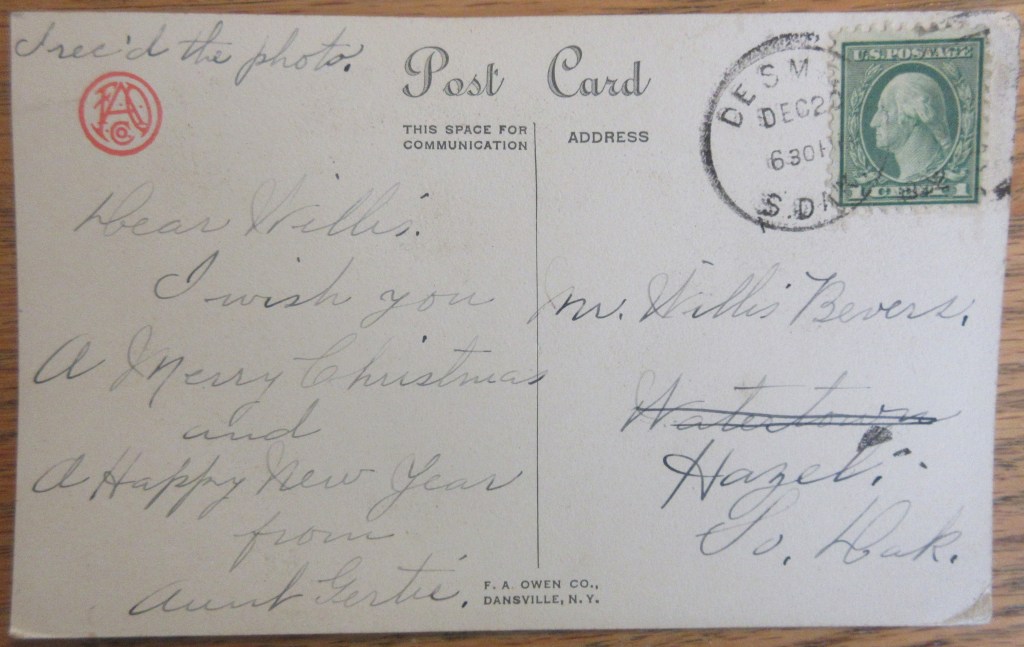
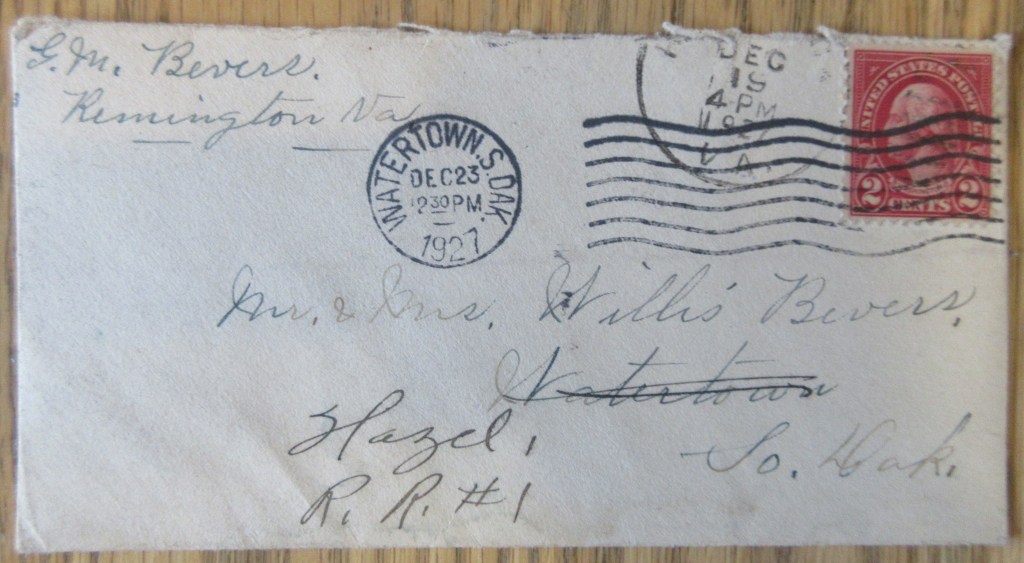
It is curious that Maude’s sister Gertrude is not listed as attending the funeral of her brother-in-law. One possibility is that she was not in De Smet at the time of Waters’ funeral. It is known that in December 1927 Gertrude was in Remington, Virginia, the town of her sister Ada. (See a Christmas greeting sent by Gertrude in Aunt Gertie) Perhaps Gertrude had stayed in Virginia for a lengthy period, beginning before late August 1927.
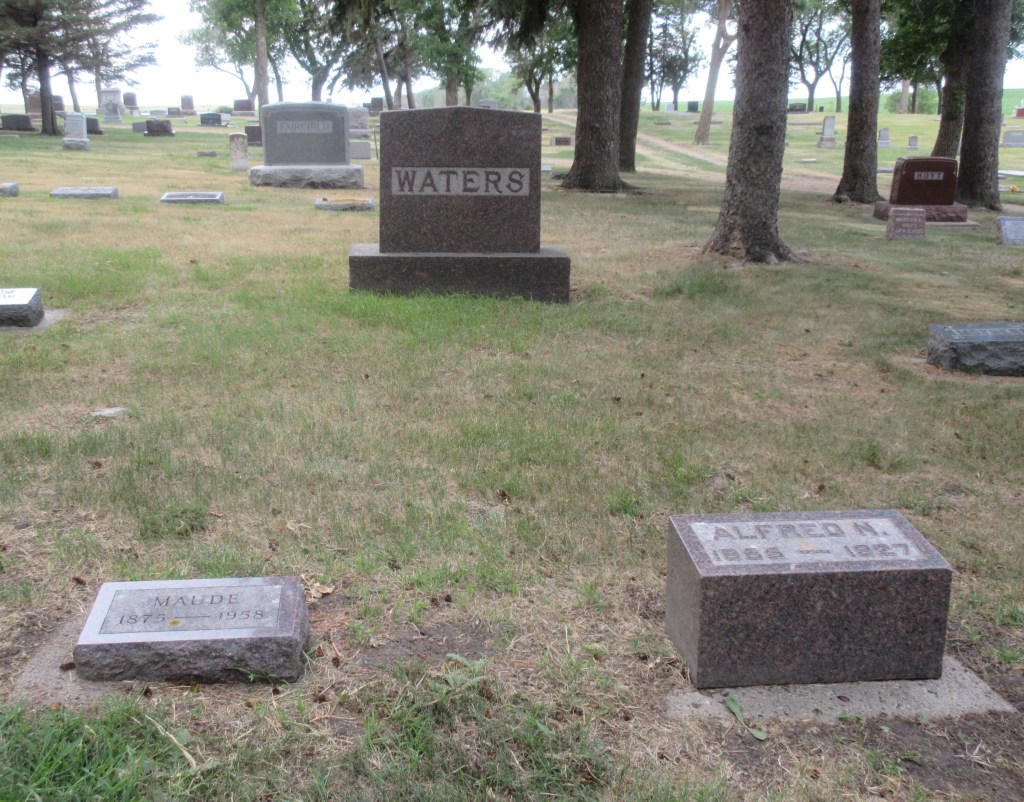
(Photograph taken by M. Wilson, June 28, 2021)
The De Smet News gave Waters a lengthy tribute, recounting his contributions to the county and town since their foundings.
A. N. Waters, Pioneer, Laid to Rest Here Sunday.
Death came suddenly to Mr. Waters after years of ill health; active in development of county and large holder of farm lands.
A. N. Waters died at his home here last Thursday afternoon without warning of a serious condition of health. He had not felt well that morning and a physician had been called. The day was spent in bed, asleep part of the time. Mrs. Waters talked with him during a waking spell in the afternoon and some time later he passed away quietly in his sleep. Death is attributed to heart trouble.
Mr. Waters was laid to rest in the local cemetery Sunday afternoon after services at the home, with the Rev. Marcus Chase officiating. Philo Hall of Brookings delivered a funeral address. The funeral was the occasion for a gathering of friends from many points in this state, and from others.
Death came at the age of 71 years and closed a lifetime spent in this community. Mr. Waters came here a young man, prospered in real estate, served his community in many ways, and even when ill health forced him from active business, he continued his home here. He was a factor for development in Kingsbury County and will be remembered as one of the town’s biggest men.
Alfred N. Waters came to De Smet from the East, born at Cornwallsville, N. Y., November 15, 1855. His mother died when he was but a few weeks old and he was reared by her people, the Newman family. Supreme Court Judge Alfred W. Newman of Wisconsin was his uncle. In a later marriage Mr. Waters’ father had a son and daughter. His childhood chums, however, were his cousins, two of whom, Mrs. John Hayden [nee Ella M. Fairchild] of this city and Joe [Joseph] Fairchild of Bryant, he came to cherish more as sister and brother.
Mr. Waters was graduated from Albany Law School and admitted to the bar, but when he came to Dakota Territory in August, 1880, it was development and not law that attracted him and he devoted himself to real estate.
Life in the pioneer torn appealed to the young lawyer from the East. He spent his first night in the [Amos] Whiting shanty on the farm six miles east of town. Later he boarded with the Arthur Sherwood family, “Sixteen of them in a house sixteen feet square,” he called it. He lived here through the Hard Winter and in the spring of 1881 made his famed hike along the railroad track in company with a brother of Mrs. Arthur Sherwood. The whole country had been snow-bound for months and the two young men struck out for the East, hauling a sled, and in four days reached Tracy, secured a team and floundered thru to Sleepy Eye, where they were again disappointed in train service and Mr. Waters continued on alone to New Ulm.
The trip east was for his marriage, which occurred in April, 1881, to Josie E. Humphrey, who died in 1900. He was married to Miss Maude Bevers of De Smet on May 11, 1904.
In engaging in real estate Mr. Waters first had Will E. Whiting associated with him. Later there was A. A. Anderson, and in 1885 the Dakota Loan and Investment company was formed, with C. L. Dawley and Al Thomas as associates. Two years later the Kingsbury County Abstract Company was formed, with J. C. Gibson, A. W. Mullen, Mr. Dawley, Mr. Thomas and Mr. Waters as members. It was this company that built the brick building occupied by the Peoples State Bank and Waters Land & Loan company today.
The present company was organized in 1905, with John Diamond and D. A. Crawford as associates, Mr. Waters being president. Tom Tandy, George Moody and C.L. Dawley were among those who took stock. D. A. Crawford and I.F. Altfillisch successively served as secretary before Otto Altfillisch became full-time secretary.
The company and Mr. Waters in his personal holdings became the largest holders of real estate in Kingsbury County. Its president was recognized as one of the leaders in promotion of immigration and development of the new state and his company years ago attained the position of the town’s leading institution. Mr. Waters served as vice president of the De Smet National Bank, but never actively engaged in banking.
Mr. Waters served his town as mayor and against considerable opposition he fathered the institution of city gas and water and the parkings along De Smet streets. Later he lent his efforts in the sewer project and improvement of water system. He served the creamery company as president, a community service. In later years he was one of a small group, including Mrs. Waters, who brought about the improvement of the cemetery.
“Judge” was the title applied to Mr. Waters by some friends. He served as probate judge, elected in 1889. A Republican and interested in politics, he had no political aspirations. He was a member of the A. O. U. W. and Elk orders.
The Waters residence was built in 1905 and has been maintained as one of the city’s best homes. In addition to the building that houses his company’s office Mr. Waters built the post-office building, and the excavation fronting on two streets is evidence of his further ambition in building De Smet.
It was to his home that Mr. Waters went a few years ago as his health failed him. He called it “the western office,” and there he met business callers the latter years of his life. From that living room he directed business, encouraged others and planned for the future looking to the good of the community, politically, morally and financially.
It was a life-long friend and admirer, Philo Hall, who paid tribute to Mr. Waters Sunday. The former congressman spoke feelingly of De Smet’s pioneer, as he stood in the home on the sad occasion, surrounded by others who had come to pay respects to the memory of a man with whom they had enjoyed business and social associations.
Active pallbearers Sunday were J. R. Andrews, F. W. Wright, Merle E. Sasse, James McCaskell, Wm. Robinson, Wm. H. Warren. Otto Altfillisch was in charge of funeral arrangements.
Honorary pallbearers were John T. Stafford, A. L. Fisher, Judge Nicholson, Dr. J. B. Egan, Al Johnson, A. H. Cornwell, C. H. Clay, from out of town, and D. A. Crawford, D. W. Wilmarth, C. L. Dawley, C. H. Tinkham, Ed Whalen, Frank Schaub, J. H. Hall, Henry Hinz, C. P. Sherwood, Hod Perry, from De Smet.
Out of town people at the A. N. Waters funeral were: Mr. and Mrs. H. J. Bevers, of Clear Lake, S.D.,; Mr. and Mrs. Edgar Bevers, Harry Fairchild, Judge John F. Nicholson and wife, and A. H. Cornwell, from Watertown; Mr. and Mrs. J. B. Fairchild, of Bryant; Mr. and Mrs. John Glendenning, Burt Glendenning and Mrs. Hopkins, Arlington; Mrs. A. L. Fisher, Madison, Wis.; Mr. and Mrs. W. F. Brennan, Miss Molly Brennan, Miss Mary Brennan and Waters & Anderson, Attorneys at Law. A. A. Anderson married a sister of Sarah Lyngbye, who married David A. Gilbert, Mrs. Leighton, Lake Preston; Mr. and Mrs. Walter Webb, of Mitchell; Mr. and Mrs. C. H Clay, Karl and Louise Clay, of Bancroft; Mr. Strand, of Clark; Mrs. V. D. Bassart, Brookings; Mrs. Frank Warring, Yankton; John T. Stafford, of Rock Island; and Dr. J. B. Egan and wife, from Dell Rapids.35
The final years of Maude Waters’ life will be the topic of the next blogpost.
1 Nancy S. Cleaveland and Gina Terrana, Waters (2015): http://www.pioneergirl.com/waters_cemetery.pdf.
2 “Waters-Bevers Nuptials,” Kingsbury County (South Dakota) Independent (May 13, 1904), in Nancy S. Cleaveland and Gina Terrana, Waters (2015): http://www.pioneergirl.com/waters_cemetery.pdf.
3 Nancy S. Cleaveland, “depot/station,” Laura Ingalls Wilder A-Z, http://www.pioneergirl.com/blog/archives/6910.
4 _____, Kingsbury County Independent (De Smet, South Dakota), June 2, 1905, 5, Newspapers.com.
5 _____, Kingsbury County Independent (De Smet, South Dakota), July 16, 1909, 5, Newspapers.com.
6 _____, Kingsbury County Independent (De Smet, South Dakota), November 5, 1909, 5, Newspapers.com.
7 _____, Kingsbury County Independent (De Smet, South Dakota), May 26, 1911, 5, Newspapers.com.
8 _____, Argus-Leader (Sioux Falls, South Dakota), September 16, 1916, 3, Newspapers.com.
9 _____, Kingsbury County Independent (De Smet, South Dakota), July 14, 1911, 4, Newspapers.com.
10 South Dakota State Historical Society, “Motor Vehicle Registration/Automobile Dealer License,” https://history.sd.gov/archives/data/autolicense/85133/Motor%20Vehicle%20Registration%2019051911lastname.pdf.
11 Nancy S. Cleaveland, “James Glover family,” Laura Ingalls Wilder A-Z, http://www.pioneergirl.com/blog/archives/8403.
12 John E. Miller, “End of an Era: De Smet High School Class of 1912,” South Dakota History Volume 20 Number 3 (South Dakota Historical Society Press, September 26, 1990): 202, https://www.sdhspress.com/journal/south-dakota-history-20-3/end-of-an-era-de-smet-high-school-class-of-1912/vol-20-no-3-end-of-an-era.pdf.
13 Miller, “End of an Era:” 192.
14 _____, “Society,” Mitchell (South Dakota) Capital, May 4, 1916, 5, Newspapers.com.
15 Chuck Vollan, “Bone Dry” (Pierre, South Dakota: South Dakota State Historical Society, 2015): 193-94, https://www.sdhspress.com/journal/south-dakota-history-45-3/bone-dry-south-dakotas-flawed-adoption-of-alcohol-prohibition/4503_bone-dry_vollan.pdf.
16 Chuck Vollan, “Bone Dry:” 190.
17 Chuck Vollan, “Bone Dry:” 197-98.
18 Chuck Vollan, “Bone Dry:” 203.
19 _____, “South Dakota Local Option League,” Brookings (South Dakota) Register, September 7, 1916, 2, Newspapers.com.
20 _____, “South Dakota Local Option League,” September 7, 1916.
21 Chuck Vollan, “Bone Dry:” 205.
22 _____, Brookings (South Dakota) Press, September 28, 1916, 2.
23 Chuck Vollan, “Bone Dry:” 211.
24 _____, “Red Cross Notes,” Brookings (South Dakota) Register, May 10, 1917, 11, Newspapers.com.
25 _____, Argus-Leader (Sioux Falls, South Dakota), May 21, 1917, 10, Newspapers.com.
26 _____, “Red Cross Notes,” Brookings (South Dakota) Register.
27 “United States, Census, 1920”, FamilySearch (https://www.familysearch.org/ark:/61903/1:1:M6JQ-V9W : Wed Jan 15 12:36:57 UTC 2025), Entry for Alfred Waters and Maude Waters, 1920.
28 _____, De Smet (South Dakota) News, September 23, 1921 in Nancy S. Cleaveland and Gina Terrana, Waters (2015): http://www.pioneergirl.com/waters_cemetery.pdf.
29 Brookings (South Dakota) Register, May 11, 1922, 5, Newspapers.com.
30 _____, “PEO” in De Smet Yesterday and Today by Caryl Lynn Meyer Poppen, ed. (De Smet, South Dakota: De Smet Bicentennial Committee, 1976): 379.
31 _____, “De Smet P. E. O. Has Helped School Girls,” Daily Plainsman (Huron, South Dakota), November 23, 1929, 7, Newspapers.com.
32 _____, “A. N. Waters, Pioneer, Laid to Rest Here Sunday,” De Smet (South Dakota) News (September 2, 1927) in Nancy S. Cleaveland and Gina Terrana, Waters (2015): http://www.pioneergirl.com/waters_cemetery.pdf.
33 The Heritage House, LLC, “Abstract of Title,” Transfer Number 32.
34 Mike Siefker, “Hof’s stately home has history as a hospital,” Kingsbury Journal, May 4, 2022, 13.
35 _____, “A. N. Waters, Pioneer, Laid to Rest Here Sunday,” in Waters: http://www.pioneergirl.com/waters_cemetery.pdf.