Born in August 1872, Gertrude Mary Bevers was the eighth child of Alfred C. and Mary N. (nee Bridges) Bevers, although at the time of her birth only three of her siblings had lived past the age of one. She was born in a small town in England and during her childhood her family moved every few years, including emigrating to the United States when she was 12 years old. (A summary of the young lives of Gertrude and her sisters can be found in Ada, Gertie and Maude Bevers, and an article about her brother George is found in George C. Bevers, Bookkeeper.)
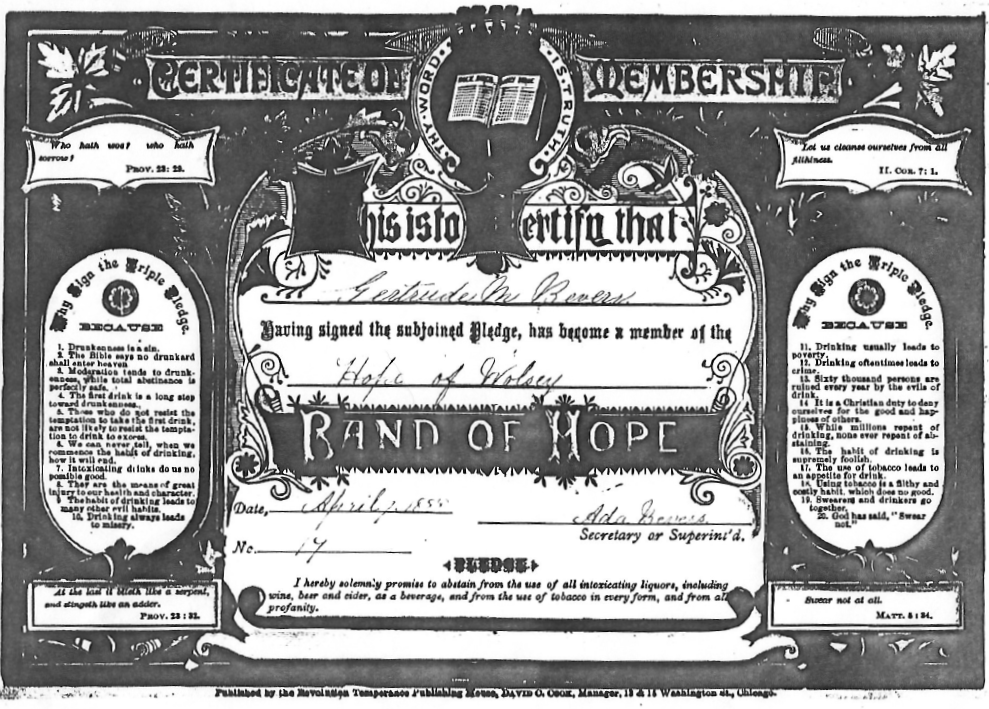
There is evidence that at a young age Gertrude began following in the footsteps of her parents. One example is that at the age of 15, Gertrude along with her 20 year-old sister Ada embraced a tenet of her father and her father’s father, William Bevers, who “had been a total abstainer over 60 years … [and] was an ardent temperance advocate.”1 Gertrude’s father participated in the temperance movement in England by giving lectures, one of which proposed that alcohol gave no assistance to the health of one’s body.2 When Gertrude’s family was living in Wolsey, South Dakota, she and Ada were involved in the Hope of Wolsey, an offshoot of a temperance organization that had risen up in England called the Band of Hope. (More about the Band of Hope’s history and mission can be found in Ada, Gertie and Maude Bevers.) In April 1888, Gertrude was issued a certificate of membership in the Hope of Wolsey, which was signed by Ada. It certified that she had made a pledge of temperance, which was printed on the certificate: “I hereby solemnly promise to abstain from the use of all intoxicating liquors, including wine, beer and cider, as a beverage, and from the use of tobacco in every form, and from all profanity.” Appendix 1 below provides the text of the certificate.
In the year that Gertrude turned 26 years-old, she moved with her parents and younger sister Maude to De Smet, South Dakota, where she would reside for the rest of her life, about 55 years. Their residence in 1900 was on First Street.3 The town of De Smet had been established when the Dakota Central Railway Company laid tracks through Kingsbury County. (Soon afterward, in 1881, the railroad was bought by Chicago Northwestern Railroad Company).4
“The first family of De Smet was that of Charles P. Ingalls. He was the timekeeper for the railway construction crew at his camp on the shore of Silver Lake, a mile east of where De Smet was to be built. As construction work ceased in the fall of 1879, he and his wife, along with four daughters remained in the timekeeper’s building through the winter and spring and built what was to become Ingalls’ store.
“By 1883, De Smet was a typical early prairie town. De Smet had about 60 buildings including grocery and provision stores, wagon shops, lumber yards, banks, a drug store, newspaper companies, a flour mill, a church, a school, an elevator, two attorneys, a harness shop, one hotel and two real estate dealers.”5
One of the early real estate dealers was Alfred N. Waters, who would be a prominent land developer and citizen of the town. Two decades after establishing himself in De Smet, he would marry Gertrude’s sister Maude.
On November 26, 1898, Gertude with her parents and sister were received, by letter from the Willow Lake congregation, into membership of First Methodist Episcopal Church of De Smet.6 The De Smet congregation was small, having dropped in size from 100 members in 1891 to 60 members in 1900.7 The history of the church traces its beginning to the founding of the town.
“In 1880, all of the Protestant people of this area met for their worship services in the Chicago & Northwestern Railway depot, part of the time in the town’s public school house. Many families of the community cooperated to build a church edifice in 1882 under the chartered name of First Congregational Church and this was used by both Methodist and Baptist organizations for services, by alternating Sundays and hours.
“The Methodist organization, including the Ladies’ Aid Society, was formed in 1881 under the leadership of V. P. Neary. A separate building was not erected until 1885. It was then The Methodist Episcopal Church. …”8
Never marrying, Gertrude’s role would be housekeeper while living in her parent’s home, as well as while living in her sister’s home after her parents passed away.9,10 In the community, Gertrude was active in several organizations. Some of what is known about her life has been extracted from minutes of meetings of women’s groups. Known as Gertie in the records of the Ladies Aid Society, she is found on its membership roll as of May 19, 1899, along with her mother. Sometimes Gertie served as the secretary or secretary pro tem of the aid society. She also served as its treasurer in 1902. Her name and her parents’ names were often mentioned in the minutes, as seen in these summarized examples:
July 11, 1899. “The Ladies Aid of the First M. E. Church met with Mrs. Crane.”
The scripture reading was Psalm 115. Mrs. Bevers gave the opening prayer. It was moved “that the Ladies serve a gallon of ice-cream each day at the church, during Institute.” Gertie seconded the motion and she signed the minutes of the meeting as the “sec pro tem.” There were 21 in attendance, not including children. Lastly, ice cream and cake were served.
August 23, 1899. “The Ladies Aid met with Mrs. O. E. Sterns.”
Gertrude signed the minutes of the meeting as secretary. The scripture reading, John 15:18, and opening prayer were given by Rev. Bevers. It was moved and carried that the society give Brother Akers, their minister, $5.00 for his salary. Rev. Bevers on behalf of the society presented Sister Akers, the minister’s wife, with a monetary gift ($5.00) for her birthday, and he sang a birthday song at the end of his presentation of the gift. This was followed by music and a social time. There were 10 members, seven visitors and eight children present.
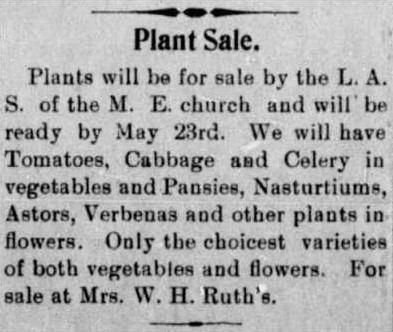
May 20, 1904
One of the aims of the Ladies Aid Society was to raise money for the church. According to the 1965 history of the Methodist Church of De Smet: “The money paid in for the minister’s salary was never enough, so the Ladies’ Aid Society always put on big public chicken suppers. The group published a cook book, Kitchen Echoes, in 1909 with tried recipes from the women of the town. This brought in quite a bit of money for the church.” Both Gertie and Maude contributed recipes which were printed in Kitchen Echoes, which sold for 50 cents per copy.
“Potato Salad.—Two teacups cold sliced potato, two hard boiled eggs, one good sized onion. Dressing for same: one egg, two tablespoons sugar, one-half cup vinegar, one tablespoon of butter, one teaspoon of mustard dissolved in a little milk, a pinch of salt. Heat until it thickens, but do not let it boil.—Gertie Bevers.”
“Sugar Cookies.—Two cups sugar, one cup butter, one cup sour cream, two eggs, one teaspoon soda, one teaspoon essence of lemon, flour to mix just stiff enough to roll easily.—Gertie Bevers”
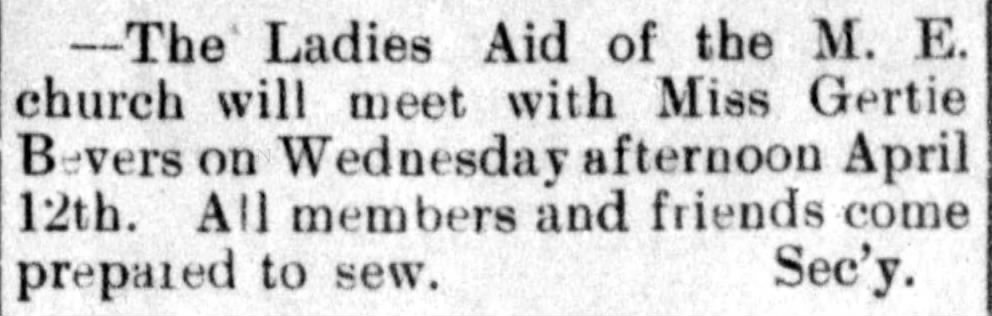
April 7, 1911
Another organization in which Gertie held an office was the Woman’s Christian Temperance Union (W. C. T. U.). Although this organization was originally established to advocate for temperance, it later adopted the stance that local branches could advocate for other social causes, such as women’s suffrage. In April 1905, the Kingsbury County Independent announced the re-organization of the chapter in De Smet by Miss Grace Van Vleet, who was the state secretary of Y. W. C. T. U. (the young women’s branch) and a temperance lecturer. Gertie was elected to be the Correspondence Secretary of the local chapter.11 In March of the following year, the district convention of W. C. T. U. was held in De Smet.12 Most of the meetings on the 27th and 28th were held at the Methodist Episcopal Church.
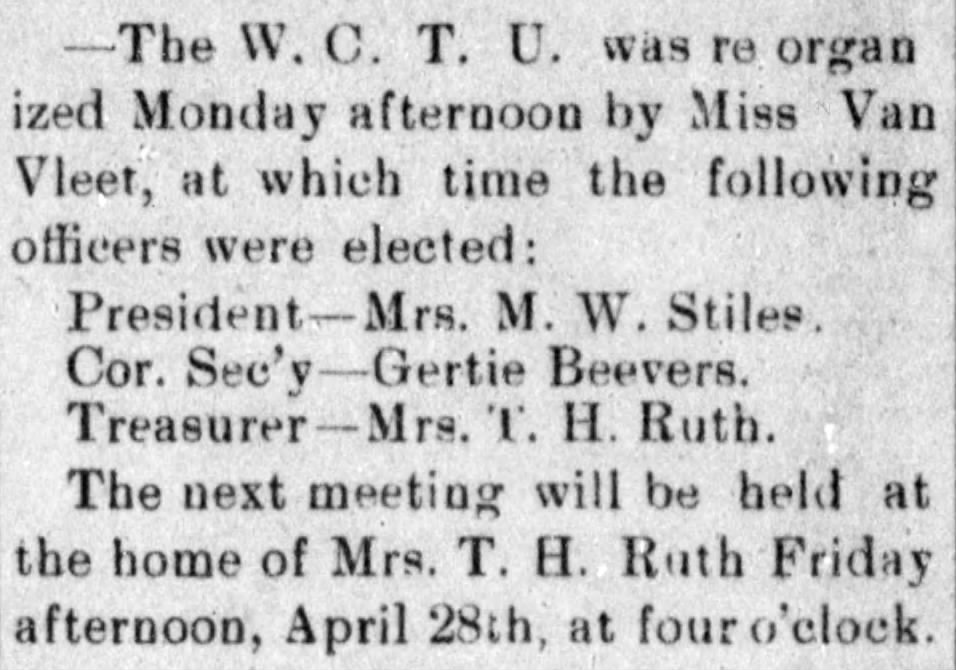
April 21, 1905
A third organization in which Gertie participated was the Epworth League, which had been founded in 1889 as a merger of several young people’s organizations of Methodist Episcopal churches.13 Epworth League was made up of primarily young adults. There were six departments of social service: Spiritual Life, Social Work, Literary Work, Correspondence, Mercy and Help, and Finance. At the Methodist Episcopal church in De Smet, there were two Epworth League meetings held on Sundays, one was called the junior league and the other was the senior league.14 Gertie at the age of 39 was a delegate to an Epworth League convention in Brookings, South Dakota in September 1911.15
Additionally, Gertie was a dues-paying member of the Methodist women’s group. She served on a committee in 1902 and was assistant to the 1st Vice in 1905. She held a supper at her house in December 1910 to raise funds, $4.60 was collected. On December 26, 1911, the minutes recorded: “Resolved Miss Bevers assist Evelyn in social work.” She held another supper in April 1912, which raised $3.85.
On May 11, 1904, Gertie was a bridesmaid at her sister’s wedding. Maude married her employer Alfred N. Waters, whose first wife had passed away in 1900.16 One of the earliest businessmen of De Smet, Waters was the president of Waters Land and Loan, as well as being the mayor of De Smet. He had hired Maude to be his stenographer in 1898.17 The groomsman at the wedding was Professor C. E. Swanson, who was the superintendent of the De Smet schools, and the officiating minister was Rev. Henry Preston of the Methodist church. The wedding was held at Syndicate Hotel which had opened in De Smet in 1887. After an addition to the hotel was constructed in 1902, it was one of the largest hotels in South Dakota.18
As of the date of this blogpost, digitized versions of the issues of Kingsbury County Independent are only available for the years 1904 to 1929, which is when the Independent merged with the De Smet News.19 The succeeding issues are not available online. From the issues that are digitized some of Gertie’s personal life can be envisioned because the local newspapers often reported on the events and travels of the Bevers family.
Sometimes Gertie’s sister Ada or her children made a trip to visit the Bevers family, but during the latter half of June 1906, Gertie spent two weeks with Ada, who lived with her husband William Mankey on a farm near Garden City, South Dakota.20 When the 1910 United States census was taken, Gertie was 37 years-old and still living with her parents who were 72 and 69.21 That year, Gertie’s mother passed away on July 14, and a lengthy obituary was published.22 It explained that Mary had had an operation six years earlier, from which she never fully recovered. A couple of years later, she developed diabetes, and during this illness, Gertie and her family lovingly cared for Mary until her death. Soon after the funeral, Gertie accompanied her father to Arlington, South Dakota to visit friends.23 And a month later, Mrs. James Bridges (the wife of Gertie’s mother’s nephew) came from Minneapolis to spend five days as a guest at the Bevers’ home.24 Shortly after that, both Gertie and her father took trips, in part separately and partly together. Gertie went to Arlington for two weeks, then joined her father at Ada’s home.25
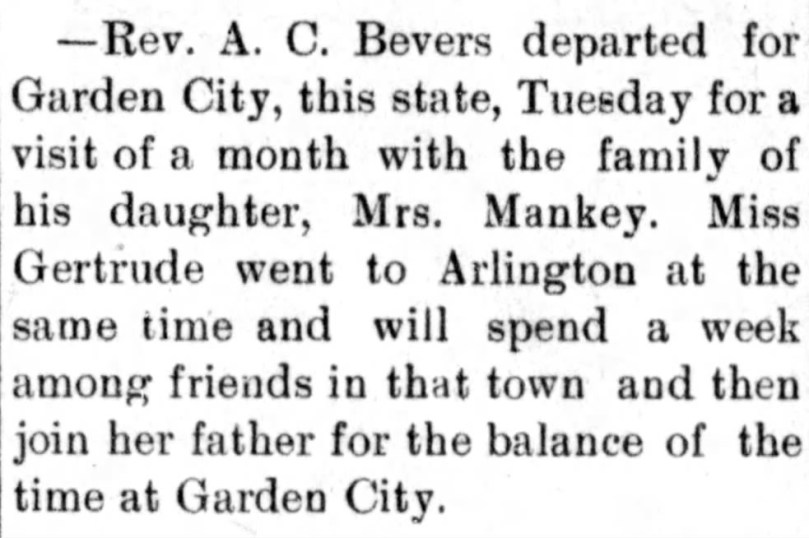
Aug. 26, 1910
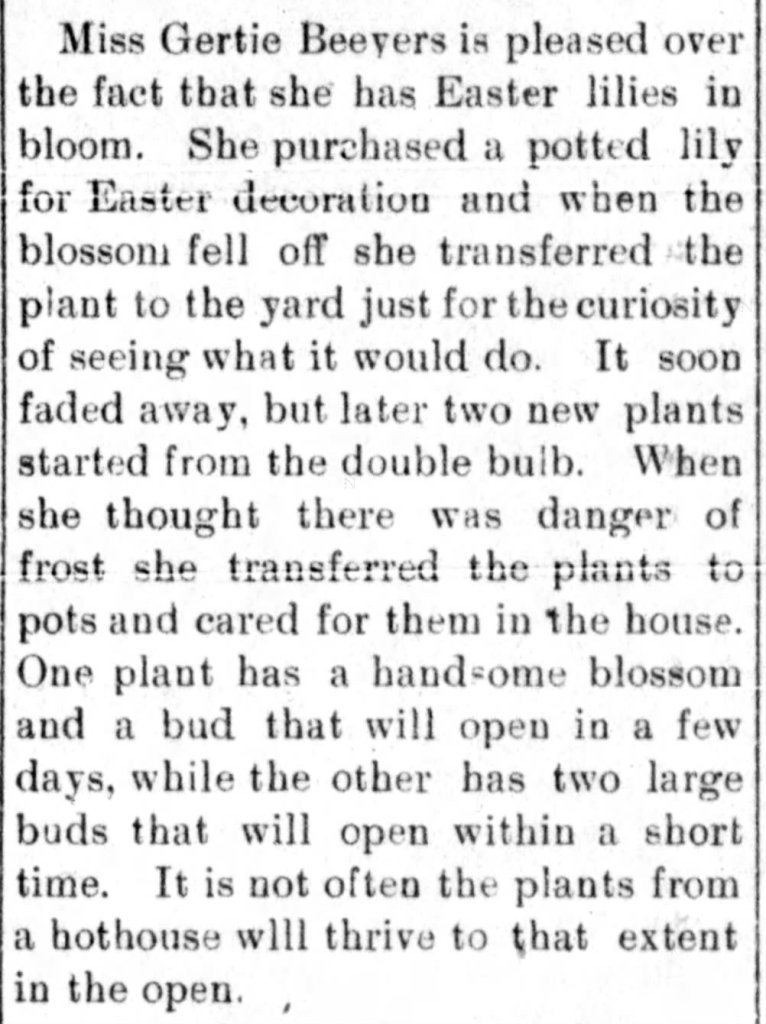
In March 1911, Gertie went again to Arlington to visit friends,26 and in August 1911, Mrs. John Glendenning came from Arlington to visit Gertie.27 Mrs. Glendenning was the daughter of Mrs. James Bridges and the granddaughter of Mathias Bridges, who was Gertie’s mother’s brother. A month later, the newspaper reported about an experiment that Gertie conducted with an Easter lily she had purchased.28
Gertie and Maude made a trip to Mitchell, South Dakota, in May 1916 to attend the wedding of their nephew W. Arthur Mankey, who was their sister Ada’s son.29 The wedding was held in the home of the bride, Birdella Carhart, and the officiating minister was the bride’s father, Rev. A. E. Carhart. Also, in attendance were Arthur’s brother G. Floyd Mankey and his cousin Lester Mankey.
When Gertie was in her thirties and forties, suffrage for women was a fiercely contended political issue on both the state and federal levels. In 1918, the men of South Dakota were asked to consider the question of amending the South Dakota state constitution, granting women the right to vote. That November the amendment passed by approximately 63% of the vote.30 Six months later, the congress of the United States passed a suffrage amendment. During subsequent months, the individual states either ratified or rejected the amendment. South Dakota ratified it “without a dissenting vote in either house on Dec. 4, 1919, being the 21st state to act.”31 Ratification by the final state that was needed to adopt the 19th Amendment to the Constitution of the United States occurred on August 18, 1920. The next day, a newspaper in Sioux Falls, South Dakota, declared, “Thus the political freedom for which women have contended since the founding of the republic has been attained and 27,000,000 women, half the population of the United States, accorded the right to vote under the constitution.”32
In January 1920 when the United States census was taken, 47-year-old Gertie and her 82-year-old father were living on Second Street in De Smet.33 Gertie’s father lived nearly two more years. A news article dated September 23, 1921 included the following:
“For a number of years, the elderly gentleman had been in poor health, first being confined to a wheel chair, but later to his bed. His continued illness made it advisable for him to be moved from the Bevers home to A.N. Waters’ home, where his two daughters, Mrs. Waters and Gertrude Bevers, have cared for him.”34
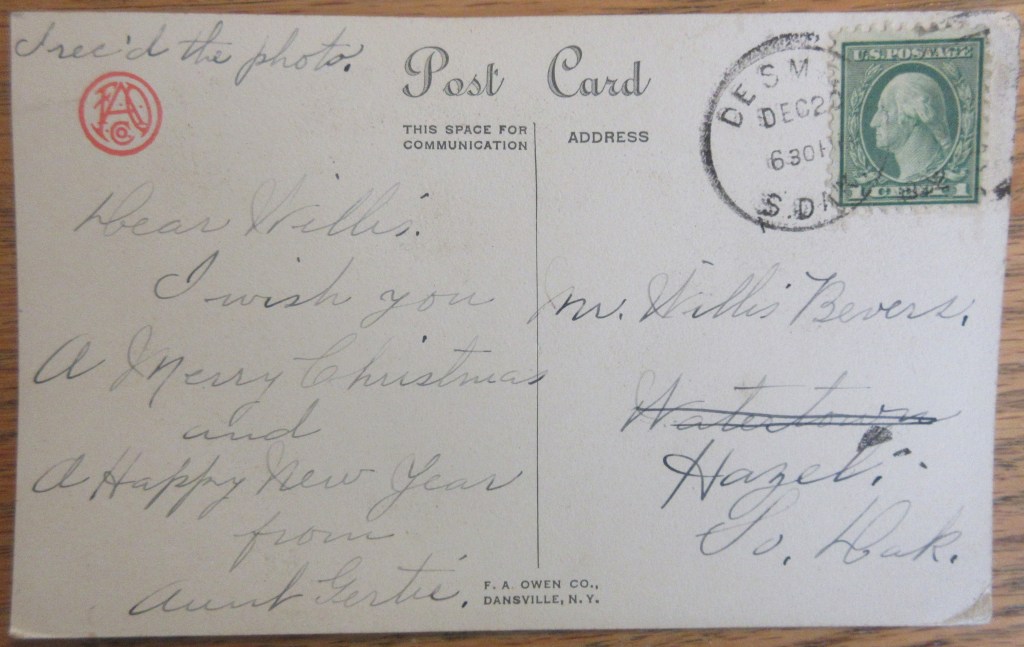
A couple of Gertie’s correspondences have survived for about 100 years. In December 1922, she mailed a postcard to her nephew Willis Bevers, son of her brother Herbert. Willis and his parents and six of his siblings had gone to southern Texas in the fall of 1919. The travel log of Willis’ mother has also survived. After finding that they didn’t like farming in Texas, his parents with most of his siblings returned to South Dakota in 1920. Willis stayed in Texas for another year but also returned to South Dakota about 1921.

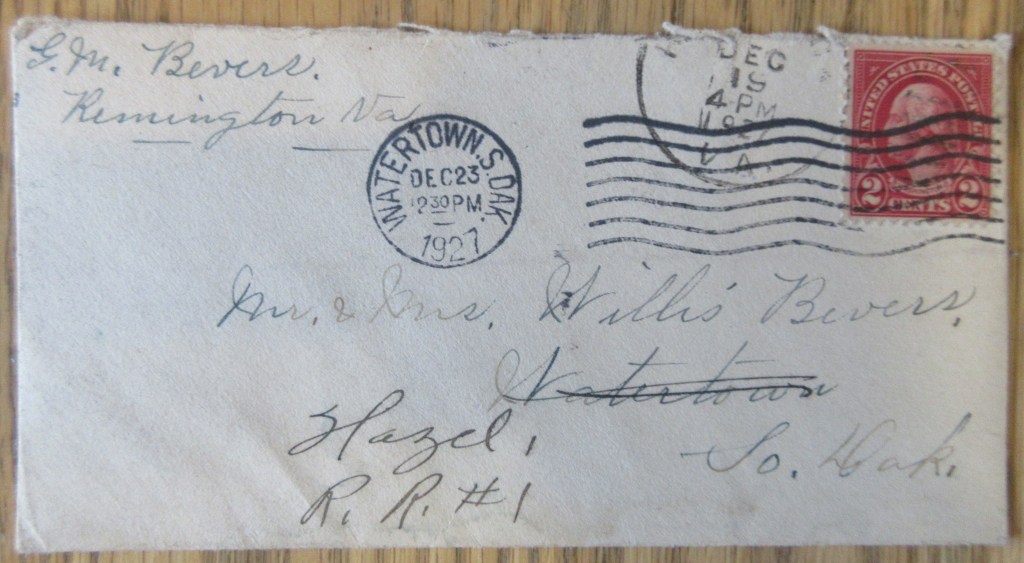
In 1927, apparently, Gertie made a cross-country trip to visit her sister Ada. Ada with her husband and two daughters had moved to Virginia, near Remington, between 1915 and 1920. Gertie’s trip is known because she mailed a Christmas greeting from Remington to Mr. and Mrs. Willis Bevers who were living in Hazel, South Dakota. Postage for the letter was two cents and it took five days to travel from Virginia to Watertown, South Dakota.
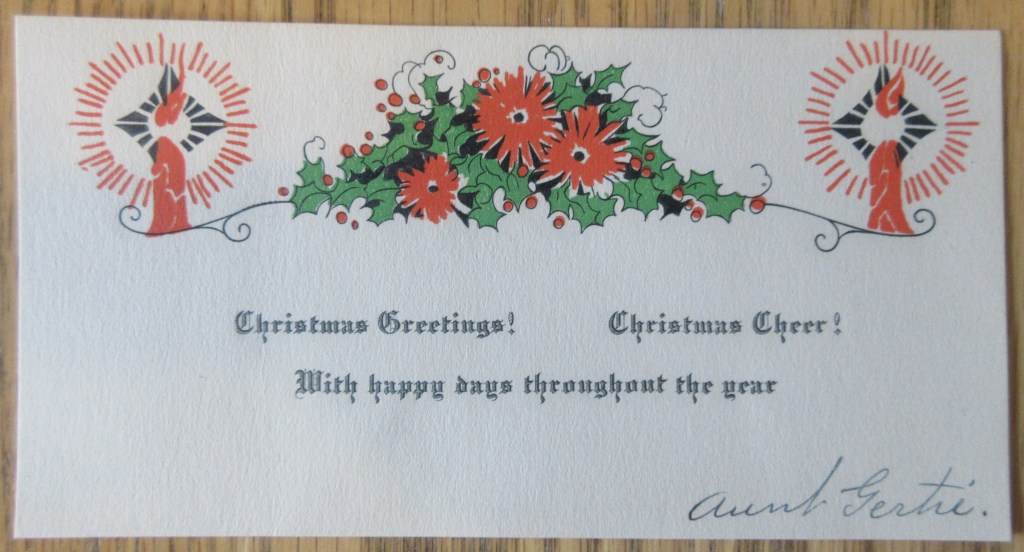
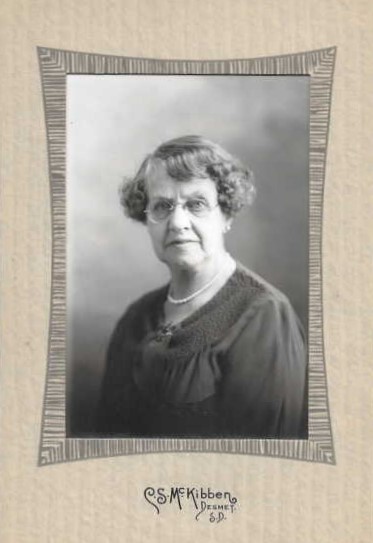
Little is known about Gertie’s personal life during the remaining years of her life. In 1930, 1940 and 1950, when the United States censuses were taken, she was living with her widowed sister Maude, whose house was on 3rd Street in De Smet. In 1930, Gertie was 57 years-old, Maude was 54 years-old and both of them were naturalized citizens.35 In 1940, both of them were engaged in home housework and they both received “income of $50 or more from sources other than money wages or salary.”36 Gertie’s brother George passed away in June 1943 in Los Angeles, California, and a month later Ada passed away in Washington, D. C. About a year and a half later, her brother Herbert died in November 1944 in Watertown, South Dakota.
One miscellaneous item known about Gertie is that she continued to be active in the community in her sixties and seventies. She and Maude were members of the Friendly Garden Club in De Smet. In May 1939, they each participated in the program of the garden club by reading papers to the group. Gertrude read “Garden Verse” and Maude read “Gardening in all Countries and All Ages.”37 Nearly 10 years later, the sisters hosted a garden club meeting at Maude’s house.38
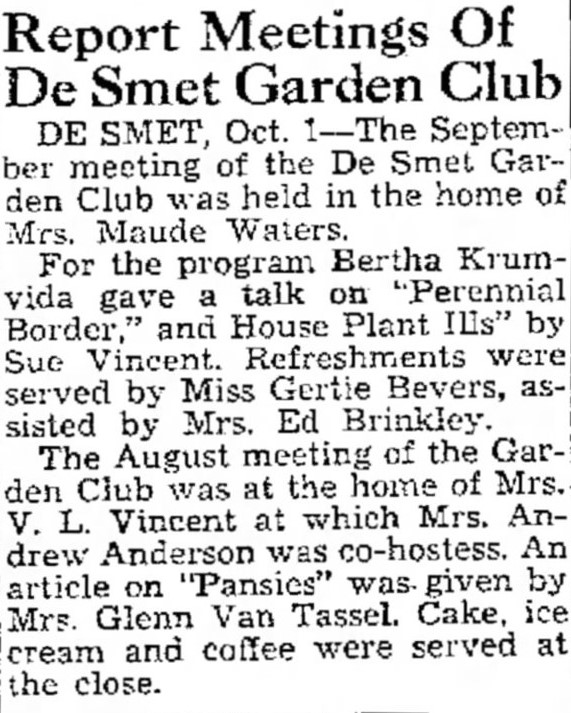
October 1, 1948
In April 1950 the record of the United States census designates Gertie and Maude’s residence as Block 2 of “Original Town” of De Smet City.39 They were 77 and 74 years-old, respectively. To the question, “What was this person doing most of last week – working, keeping house, or something else?” the answer for both of them was keeping house. Gertie was selected to answer additional questions. Her responses included that she was living in the same house a year earlier. Her education level was recorded as “S7” (seventh grade), and she didn’t finish that grade. She had not worked any weeks outside of her home in the previous year. She didn’t receive money by working as an employee, or by working in her own business. And to the question, “How much money did he receive from interest, dividends, veteran’s allowances, pensions, rents or other income (aside from earnings)?” she answered “none.”
Aunt Gertie passed away in De Smet on October 3, 1953, at the age of 81, after a “lingering illness” of stomach cancer.40 Her remains are buried in De Smet Cemetery beside her parents. Nearby, her sister Maude and her brother-in-law Alfred N. Waters are also buried.
APPENDIX 1
Text of the certificate of membership of the Band of Wolsey:
Thy Word is Truth
This is to certify that
Gertrude M. Bevers
Having signed the subjoined Pledge, has become a member of the
Hope of Wolsey
BAND OF HOPE
PLEDGE
I hereby solemnly promise to abstain from the use of all intoxicating liquors, including wine, beer and cider, as a beverage, and from the use of tobacco in every form, and from all profanity.
Thy Sign the Triple Pledge
BECAUSE
- Drunkenness is a sin.
- The Bible says no drunkard shall enter heaven
- Moderation tends to drunkenness, while total abstinence is perfectly safe.
- The first drink is a long step toward drunkenness.
- Those who do not resist the temptation to take the first drink, are not likely to resist the temptation to drink to excess.
- We can never tell, when we commence the habit of drinking, how it will end.
- Intoxicating drinks do us no possible good.
- They are the means of great injury to our health and character.
- The habit of drinking leads to many other evil habits.
- Drinking always leads to misery.
- Drinking usually leads to poverty.
- Drinking oftentimes leads to crime.
- Sixty thousand persons are ruined every year by the evils of drink.
- It is a Christian duty to deny ourselves for the good and happiness of others.
- While millions repent of drinking, none ever repent of abstaining.
- The habit of drinking is supremely foolish.
- The use of tobacco leads to an appetite for drink.
- Using tobacco is a filthy and costly habit, which does no good.
- Swearers and drinkers go together.
- God has said, “Swear not.”
Published by the Revolution Temperance Publishing House, David C. Cook, Manager, 13 & 15 Washington st., Chicago.
Bible verses printed in each corner of the certificate:
Proverbs 23:29 Who hath woe? Who hath sorrow?
II Corinthians 7:1 Let us cleanse ourselves from all filthiness.
Proverbs 23:32 At the last it biteth like a serpent, and stingeth like an adder.
Matthew 5:34 Swear not at all.
1 “RIPON. Death of an Old Temperance Advocate,” The Yorkshire Herald and the York Herald (York, North Yorkshire, England), February 17, 1894, page 11, Newspapers.com.
2 “Longwood Temperance Society,” Weekly Examiner (Huddersfield, West Yorkshire, England), April 24, 1869, page 6, Newspapers.com.
3 “United States Census, 1900”, , FamilySearch (https://www.familysearch.org/ark:/61903/1:1:MMRW-TKS : Sat Aug 17 18:09:29 UTC 2024), Entry for Alfred C Peevers and Mary N Peevers, 1900.
4 City of De Smet, South Dakota, “Depot Museum / Harvey Dunn School,” https://cityofdesmet.com/depot-museum.
5 Caryl Lynn Meyer Poppen, ed., excerpt from De Smet Yesterday and Today “Little Town on the Prairie” in “History,” De Smet, South Dakota, https://desmetsd.com/history.
6 First Methodist Church of DeSmet, “Record of Members.”
7 First Methodist Church, “A History of the Church,” Consecration Service of the Remodeled First Methodist Church (De Smet, South Dakota: First Methodist Church, September 26, 1965).
8 First Methodist Church, “A History of the Church.”
9 “South Dakota State Census, 1905”, , FamilySearch (https://www.familysearch.org/ark:/61903/1:1:MM42-JWN : Sun Mar 10 20:39:28 UTC 2024), Entry for Gertrude M Bevers.
10 “United States Census, 1940”, , FamilySearch (https://www.familysearch.org/ark:/61903/1:1:V19L-5LM : Fri Mar 08 09:56:34 UTC 2024), Entry for Maude Waters and Gertrude Bevers, 1940.
11“Local News,” Kingsbury County Independent (De Smet, South Dakota), April 21, 1905, page 5, Newspapers.com.
12 Kingsbury County Independent (De Smet, South Dakota), March 23, 1906, page 4, Newspapers.com.
13 Case Western Reserve University, “Epworth League,” Encyclopedia of Cleveland History, https://case.edu/ech/articles/e/epworth-league.
14 “Church Services,” Kingsbury County Independent (De Smet, South Dakota), September 15, 1911, page 5, Newspapers.com.
15 “Local News,” Kingsbury County Independent (De Smet, South Dakota), September 15, 1911, page 5, Newspapers.com.
16 Nancy S. Cleaveland, “Alfred N. Waters,” Laura Ingalls Wilder A-Z, http://www.pioneergirl.com/blog/archives/7204.
17 “College News,” The Brookings Register (Brookings, South Dakota), March 29, 1898, page 2, Newspapers.com.
18 Nancy S. Cleaveland, “Syndicate Hotel,” Laura Ingalls Wilder A-Z, http://www.pioneergirl.com/blog/archives/9165.
19 Library of Congress, Kingsbury County Independent (Desmet, Kingsbury County, S.D.) 1894-1929, https://www.loc.gov/item/sn00065130/.
20 “Local News,” Kingsbury County Independent (De Smet, South Dakota), June 15, 1906, page 5, Newspapers.com.
21 “United States Census, 1910”, , FamilySearch (https://www.familysearch.org/ark:/61903/1:1:MPX1-9J6 : Sun Mar 10 11:44:32 UTC 2024), Entry for Alfred C Bevers and Mary N Bevers, 1910.
22 Kingsbury County Independent (De Smet, South Dakota), July 22, 1910, page 4, Newspapers.com.
23 “Local News,” Kingsbury County Independent (De Smet, South Dakota), July 22, 1910, page 5, Newspapers.com.
24 “Local News,” Kingsbury County Independent (De Smet, South Dakota), August 19, 1910, page 5, Newspapers.com.
25 “Local News,” Kingsbury County Independent (De Smet, South Dakota), August 26, 1910, page 5, Newspapers.com.
26 “Local News,” Kingsbury County Independent (De Smet, South Dakota), March 24, 1911, page 5, Newspapers.com.
27 Kingsbury County Independent (De Smet, South Dakota), August 11, 1911, page 4, Newspapers.com.
28 “Local News,” Kingsbury County Independent (De Smet, South Dakota), September 15, 1911, page 5, Newspapers.com.
29 “Society,” Mitchell Capital (Mitchell, South Dakota), May 4, 1916, page 5, Newspapers.com.
30 Forest City Press (Forest City, South Dakota), December 5, 1918, page 2, Newspapers.com.
31 Argus-Leader (Sioux Falls, South Dakota), August 19, 1920, page 4, Newspapers.com.
32 Argus-Leader, August 19, 1920.
33 “United States Census, 1920”, , FamilySearch (https://www.familysearch.org/ark:/61903/1:1:M6JQ-J85 : Thu Mar 07 04:17:06 UTC 2024), Entry for Alfred C Bevers and Gertrude Bevers, 1920.
34 Nancy Cleaveland and Gina Terrana, Waters (2015), http://www.pioneergirl.com/waters_cemetery.pdf.
35 “United States Census, 1930”, , FamilySearch (https://www.familysearch.org/ark:/61903/1:1:XQVH-29Z : Thu Jul 11 05:02:51 UTC 2024), Entry for Maude A Waters and Gertrude V Bevers, 1930.
36 “United States Census, 1940”, Entry for Maude Waters and Gertrude Bevers, 1940.
37 The Daily Plainsman, (Huron, South Dakota), May 12, 1939, page 5, Newspapers.com.
38 The Daily Plainsman, (Huron, South Dakota), October 1, 1948, page 5, Newspapers.com.
39 “United States Census, 1950”, , FamilySearch (https://www.familysearch.org/ark:/61903/1:1:6F9N-CQQP : Wed Oct 04 18:17:08 UTC 2023), Entry for Agnes Maude Katers and Gertrude M Bevers, 10 April 1950.
40 K. and M. Bevers, notes attached to Gertrude Mary Bevers in Ancestral Quest program file dated June 29, 2022.
 Sojourners, Settlers & Other Legacy Conveyors
This is terrific! Thank you for your hard work and dedication to chronicaling Bevers’ history, Michelle.
>
LikeLike
Thanks, Faith. I’m glad you liked it.
LikeLike
[…] (For more about Maude’s professional training, see Maude Bevers, Career Woman.) Maude’s sister Gertrude was the bridesmaid at the wedding and C. E. Swanson, who was the county superintendent of schools, […]
LikeLike
[…] Gertrude’s recipes were for Potato Salad and Sugar Cookies. (See Gertrude’s recipes in Aunt Gertie.) Maude’s entries were for Angel Custard and Mrs. Power’s Ginger Snaps. The recipe […]
LikeLike