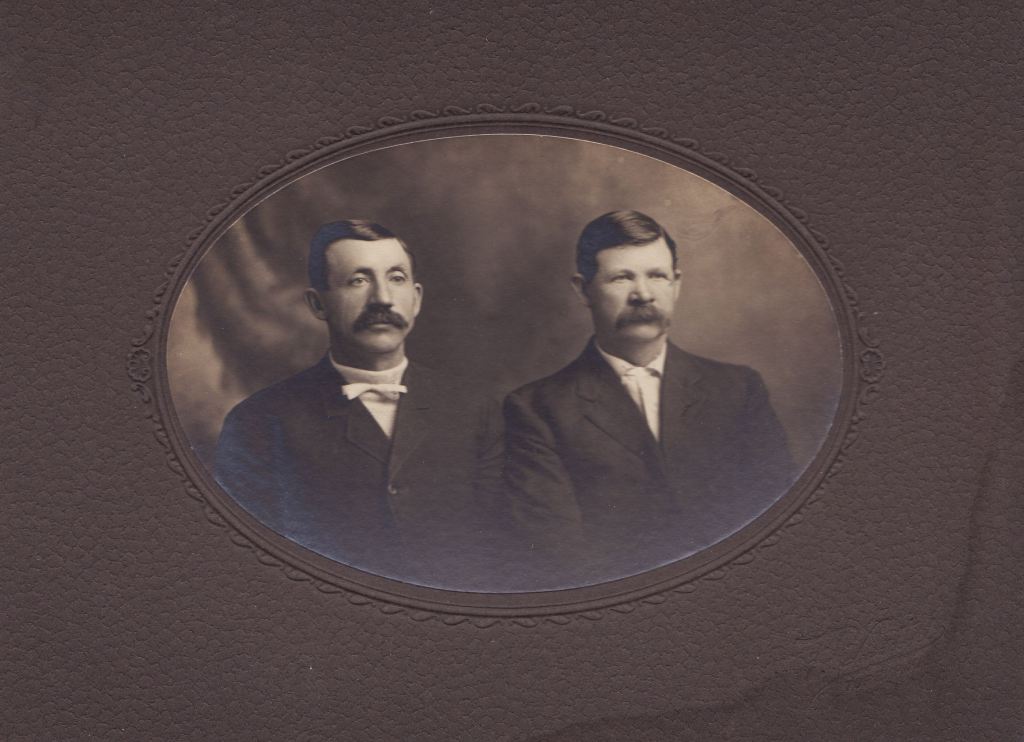
Maude and Alfred Waters, Part Two

The May 1904 news article announcing the marriage of Maude Bevers and Alfred N. Waters described the two of them as “prominent people” of the small town of De Smet, South Dakota.  (You can see the news article in Part One.) Each of them was involved in a variety of social groups and community pursuits.  For example, Maude was active in the Methodist Episcopal Church, the Red Cross and a philanthropic educational society.  Waters held civic roles and promoted improvements in their county (Kingsbury) and in their town, which as of 1906 had “a population a little in excess of 1,000 souls.”1

After her wedding, even though her husband was not a member of the church, Maude continued her activities in the Methodist church, having become a member in November 1898.  The records of the women’s group of the church noted that Maude served as secretary and 4th Vice in 1904 and 1905, respectively.  Another role in which she served was the leader of the choir, this she did for years before and after her marriage.2  In addition, “… for many years [she] was a member of a mixed quartet that sang for funerals in various churches of the town and area.”3

On a Friday night in March 1907, there was a Demorest medal contest held at the church, six young ladies competing for a Silver medal.4  Throughout the evening, musical selections were performed as well as the orations by the contestants.  One of the selections, which was entitled “David and Goliath,” was performed by a ladies’ quartette in which Maude sang a part. 


The Demorest Medal program was an educational program through which young people and community members learned about the tenets of the prohibition movement.  In 1886, W. Jennings Demorest inaugurated oratory contests, utilizing subject matter promoting the prohibition of liquor traffic.  The work began in New York City, then was introduced in California and within three years had spread throughout the United States and into several foreign nations.

Six to eight contestants competed at the local level and the winner would be awarded a Silver medal.  At the next level, six Silver medalists would compete for a Gold medal, then six Gold medalists would compete for a Grand Gold medal.  At the highest level six Grand Gold medalists competed for a Diamond medal.

In 1895, the Woman’s Christian Temperance Union (W. C. T. U.) adopted the Demorest Medal program and in the following years expanded the topics of the oratory books.  “Recitation books, embracing orations on Prohibition, Total Abstinence, Scientific Temperance, Anti-Narcotics, Franchise, Social Purity, etc., were published; medals were designed with mottoes and emblems of the W. C. T. U., and circulars setting forth the plans of this new system sent out to all the States in the Union.”5  As of January 1907, the contest publications had been disseminated into Australia, South Africa, India, Canada, Mexico and the Philippine Islands as well.
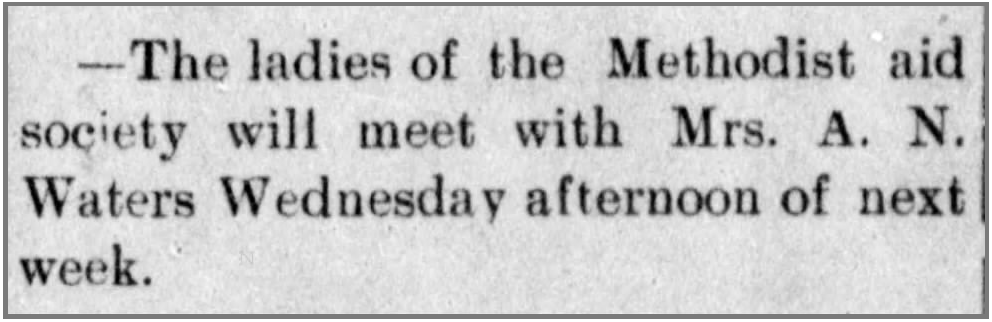

News clipping from the January 29, 1909 issue of Kingsbury County Independent

The Ladies Aid Society of the Methodist church rotated its meetings among its members.  In the first week of February 1909 the society met at Maude’s home.6  For a fundraising project that year, they produced a cookbook, entitled Kitchen Echoes.  “The venture was a very profitable one,”7 as it included advertisements for local businesses in addition to its recipe entries.  Waters Land and Loan Company, the real estate company of Maude’s husband, was one of the business sponsors, advertising that the company had the “Best Bargains in Grain, Dairy and Stock Farms.”  Maude and her sister Gertrude both submitted recipes.  Gertrude’s recipes were for Potato Salad and Sugar Cookies.  (See Gertrude’s recipes in Aunt Gertie.)  Maude’s entries were for Angel Custard and Mrs. Power’s Ginger Snaps.  The recipe for Ginger Snaps honored Elizabeth Power, a former resident and pioneer settler of De Smet, arriving in June 1880 along with her husband and four children.  Shortly before the recipe was published in Kitchen Echoes, Mrs. Power had passed away on February 11, 1909.  Her obituary stated: “Mrs. Power was one of those motherly women who everybody likes, always ready to answer sick calls, and never so happy as when doing some kind deed.  She was a life long and consistent member of the Roman Catholic church, and her remains lie in the Catholic cemetery at Bellingham [Washington].”8  Two years later, in January 1911, the Methodist aid society met again at Maude’s house.9  An entry in the treasurer’s book of the church’s women’s group indicates that Maude hosted a supper in that same month which brought in $6.60.  In 2025, an equivalent amount of money is approximately $225.00.


Angel Custard.—Separate the yolks and whites of two eggs, beat the whites to a stiff froth, adding a few drops of flavoring.  Beat the yolks, add two teaspoons corn starch wet with a little cold milk, and stir into a pint of boiling milk which has been sweetened to taste (about two-thirds cup of sugar), adding a pinch of salt the last thing.  When thickened and boiling pour the custard over the beaten whites of eggs and stir rapidly a few moments.  Delicious either hot or cold.—Maude Waters.

Mrs. Powers’ Ginger Snaps.—One-half cup butter (scant), one-half cup lard (scant), one cup white sugar, one cup molasses, one teaspoon soda dissolved in one tablespoon water, one egg, one tablespoon ginger, a pinch of salt.  Flour to mix quite stiff.—Maude Waters.
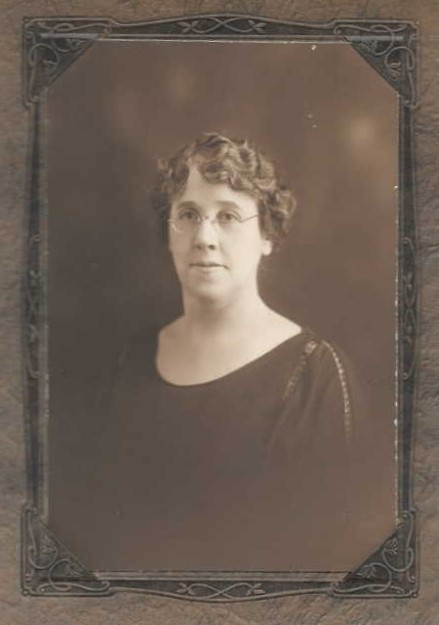
Maude (nee Bevers) Waters, estimated date 1910

From the time that A. N. Waters settled in De Smet, he served in numerous civic capacities and promoted improvements in the town, county and state.  A few of his responsibilities during the year 1905 give us a glimpse of his involvements in the local community at that time, as well as in the broader region.

  • April 1905 – At a meeting of the stockholders, Waters was elected to be a director on the board of the Athletic Association.10  Two years later, he was elected to be the president of the association, which was reported to have a large membership.11
  • August 1905 – While serving as mayor of De Smet, Waters was appointed by the South Dakota governor to be a delegate to the Trans-Mississippi Commercial Congress which met at Portland, Oregon from August 16 to 19.12  This congress was organized to promote the commercial interests of the states and territories west of the Mississippi River.  The following year, Waters was appointed again to the congress which met November 20 to 23 in Kansas City, Missouri.13
  • September 1905 – The county commissioners made Waters the chairman of a committee for the purpose of creating an agricultural exhibit to represent Kingsbury County at the state fair held in Huron, South Dakota.14  He consented to procure the materials for the exhibit and was authorized to appoint members to the committee from different parts of the county.  Waters and the committee members did not receive a salary, but the county commissioners authorized payment for the cost of transporting the materials for the exhibit to Huron.  
  • November 1905 – A real estate dealers association was formed to which Waters was elected secretary of the board.  The purpose of the association was “promoting and advancing the interests of [South Dakota] by devising ways and means to advertise its resources and encourage immigration, etc.”15  Four months later, at the March 1906 meeting of the association, which had about 250 member firms by that time, Waters gave a speech during the evening banquet which was entitled, “Had We Better Hang Together or Hang Seperate.“ [sp.]16  Moving ahead with their aims, in March 1907, Waters and about 25 members of the association met with the governor of South Dakota and the Immigration Commissioner “to consider co-operative advertisement of the state. … The association indorsed a proposition made by the Minneapolis and St. Louis railway to furnish a car and superintend and bear the expense of making a traveling exhibit of products of South Dakota farms on its line, provided the exhibit be furnished by the real estate men.”17

Waters had begun his career in real estate investment in 1880 when he arrived in De Smet, the same year that the town was founded. Thirty years later, he was continuing his career in that profession. A few of Waters’ transactions are noteworthy:

  • On April 16, 1909, Waters Land and Loan Company made a ten-year lease with the United States for the use of “the first floor of the one story … brick premises, known as ‘Waters Building’ situated on the North side of Second Street between Calumet and Joliet avenues.”18 (The consideration was $325.00 per annum in quarter yearly payments.) The Waters Building had been built in 1888-89 by the Kingsbury Abstract Company and Waters Land and Loan Company had purchased it in 1906. (More about this transfer is in Part One.) The De Smet post office had occupied a space in the building since at least 1893.19 In 1909, an extension was built onto the Waters building and the post office moved into it. The lease described above commenced the occupation of the post office in the extension. “The new post office was of fireproof construction, 25×45 feet and fitted with the latest style of furnishings. The building was heated by steam and supplied with gas and water….”20
  • About 1910, Waters owned a house at the corner of Lyle Avenue and Front Street NE.  It was the former home of Fred Dow but had been relocated from its original site.  Fred Dow had sold his farmstead and grove of trees to Waters in the early 1900s.  Waters had moved the house from the Dow farm to the corner lot across the road on Front Street NE.21 Fred Dow’s farmstead was the location of the “surveyors house” in which the Charles Ingalls’ family lived when Ingalls was hired by Dakota Central Railway in 1879. The surveyors’ house was moved in 188422 to its current site in the town of De Smet. Therefore, it had not been sitting on the property when Waters purchased the Dow farm. The surveyors’ house was purchased by the Laura Ingalls Wilder Memorial Society in 1967 and placed on the National Register of Historic Places in 1974.23
  • On September 28, 1915, Alfred purchased lot #32 of De Smet from Caroline A. Swanzey (formerly Caroline A. Ingalls) for $62.50.24  This was author Laura Ingalls Wilder’s sister, known as Carrie in Wilder’s Little House books.  In Standard Atlas of Kingsbury County, South Dakota, published in 1909, the owner of lot #32 of De Smet is noted as C. P. Ingalls, Caroline’s father who had passed away in 1902.
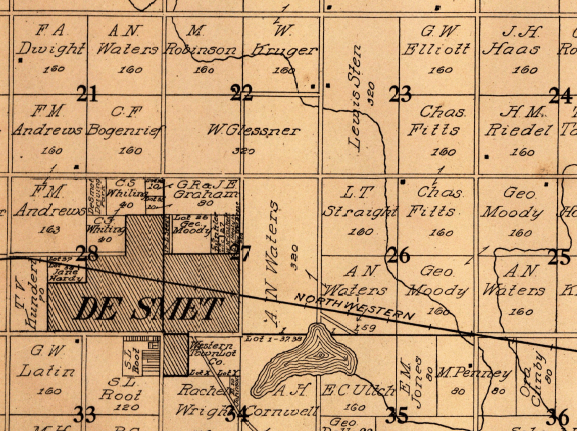
The above clipping is from a map in the 1909 edition of Standard Atlas of Kingsbury County, South Dakota.  It shows that Waters owned 320 acres directly east of De Smet.  The lower half of this property had been a tree claim filed by Fred N. Dow, and to the east of F. N. Dow’s claim, his father, James C. Dow, had filed a claim on a quarter section, which in 1909 Waters also owned.25  Through a cursory examination of the 1909 atlas, 14 properties in the county were found with Waters’ name on them (in the townships of Le Seur, Spirit, Manchester, De Smet, Esmond and Mathews).  One of the properties that Waters owned had been the homestead of Almanzo Wilder (Laura Ingalls Wilder’s husband); Wilder had sold the property to Dakota Loan and Investment in 1891, a company in which Waters was a partner.26  It is not known at this time when Waters became the sole owner.  That property can be seen on the above clipping in the upper left corner.  In addition to her husband’s properties, the atlas also indicated that Maude owned two adjoining quarters in Manchester Township.


The United States census taken in April 1910 recorded Alfred as 54 years old and working on his own account in his own real estate office.27  Maude was 35 years old and did not have an occupation.  In the record, besides Maude and Alfred, there was a housekeeper living in their home, named Izora Youmans [sp.], who was 37 years old, single and had been born in New York.

For six years, Maude’s mother, who lived a half block to the east of the Waters home with Maude’s father and sister Gertrude, had been impaired following an operation from which she did not completely heal.  Two years after the operation, her mother developed diabetes.  “All during her illness, and especially during the last months when almost helpless and suffering great pain everything that could be done to relieve and give pleasure was done for her by loving hands of her own family and friends.”28  No doubt Maude had been involved in her mother’s care until her passing on July 14, 1910.29


On the last Saturday of May 1910, Waters was invited to dine at the home of Mr. and Mrs. Charles H. Tinkham. Along with Waters and Tinkham, the other five guests were men of De Smet who had lived through the “hard winter” of 1880-81. They all had arrived in Kingsbury County in the winter and spring of 1880, except Waters who hadn’t arrived until August. When early snow storms commenced in the fall, the men stayed in the newly built buildings of the fledgling town, which had about 14 businesses.30 Recurring blizzards would cover the railroad tracks that winter, eventually closing the track altogether from January to May. About 50 families (including single men) wintered in the town. Thirty years later at the gathering held in the Tinkham home:
The varied experiences of that hard winter were all recounted. Of one thing our readers can be certain, however, and that is the dinner served on this occasion was not on the half-ration plan of some of the dinners eaten by the gentleman [sp.]during that never to be forgotten winter of [1880-81]when supplies ran low and wheat had to be ground in coffee mills, and when sugar for coffee was kept in a jewel case.31

During that trying winter, Waters boarded in the home of Arthur and Jennie Sherwood. A. S. Sherwood “is mentioned in the Laura Ingalls Wilder book The Long Winter as one of the few families wintered in for that historic experience. He and his wife … were among the few married couples in the town that winter. Some of the bachelors roomed and boarded there including A. N. Waters, in a house so small that blankets separated the beds in a sleeping room.”32 Waters himself was not mentioned in Wilder’s The Long Winter but he was mentioned in her autobiographical manuscript, Pioneer Girl, which relates the following story:
There was in town a lawyer named Waters who had expected to go east early in the winter to be married but had got caught by the storms.

Now the wedding day was drawing near and no way to get transportation out. He decided to walk and … he started before daylight one morning as the blizzard wind was dying down and the sky cleared.

It was a scant day’s calm this time and we were afraid he was caught in the next storm, but he walked the miles to Brookins [sic] safely and after resting walked on to Tracy.

The next spring we learned that he arrived safely in time for his wedding, but both feet were so badly frozen that he was unable to walk on that day. However his feet recovered and he came back in the spring, bringing his wife with him.33

The above story, of course, refers to Waters’ first wife, Josephine E. Humphrey, whereas Maude was his second wife. Waters obituary adds details to this account of the winter of 1881:
… he boarded with the Arthur Sherwood family, “Sixteen of them in a house sixteen feet square,” [Waters] called it. He lived here through the Hard Winter and in the spring of 1881 made his famed hike along the railroad track in company with a brother of Mrs. Arthur Sherwood. The whole country had been snow-bound for months and the two young men struck out for the East, hauling a sled, and in four days reached Tracy, secured a team and floundered thru to Sleepy Eye, where they were again disappointed in train service and Mr. Waters continued on alone to New Ulm.34

Another perspective on this event was recounted by the editor of De Smet News in 1921:
… The big snows of the winter of 1880-1881 caused such a blockade thruout the country that after the first of January there was no train from De Smet east until the following May. Along in March Mr. Waters became anxious to get out of the country and keep a date in the east, so he started on foot over the snow banks, carrying a hundred letters from De Smet people to their relatives and friends back home. He walked as far as Tracy, covering the distance in four days. There a team of mules hitched to a sleigh was secured and several men made use of the outfit to get as far as Sleepy Eye. At that point a train was boarded and they were scheduled to leave next morning; but a storm prevented and they were there a whole week. Mr. Waters became uneasy at the delay and started out alone, hoofing it to New Ulm. There the road was open and he was soon on his way east.35

Charles H. Tinkham, the host of the 1910 gathering of De Smet pioneers, had arrived in De Smet in the spring of 1880.  Soon after his arrival Tinkham opened a furniture and houseware store, and he also engaged in undertaking.36   During the “hard winter,” “Tinkham was a member of the ‘bachelor’s club’ who lived with William Crook, sleeping on boards laid across the ceiling joists.”37 

Among the guests attending the dinner was Charles L. Dawley, who settled in De Smet in May 1880.  As an agent for a lumber company, he began “selling loads of lumber to the new settlers. He set up an office tent and sold lumber from railroad cars until an office and shed could be built. During the Hard Winter, he boarded with Mrs. Garland, and began courting her daughter Florence.”38  Florence was Laura Ingalls Wilder’s teacher during that winter.  Within a few years, Dawley left the lumber business to go into real estate with Waters, a partnership which lasted 15 years.  Waters, Dawley and Alfred Thomas were associates who established the Dakota Loan and Investment Company, “which continued the loan business previously run by Alfred Waters, doing a general real estate and chattel loan business.”39 Waters and Dawley took full control of the business in 1887.

The other guests were Charles E. Ely, Edward H. Couse, Daniel H. Loftus and John H. Carroll.  About April 1880, Ely was a lumber agent also, selling lumber in De Smet from a rail car.  Subsequently, he established the town’s first lumber yard.40  He was married, but had not yet moved his family to De Smet when the winter storms came later that year.  Couse, who was also married when he came to De Smet and a Civil War veteran, was the owner of a hardware store.41  Loftus was a partner in a general merchandise store in 1880, and in February 1881 in the midst of the “hard winter”, a local newspaper reported, “the first grist of wheat was ground in De Smet on the 5th, by Dan Loftus. Dan makes a fine miller.”42

John H. Carroll was the first clerk of courts in Kingsbury County (April 1880) and he was the first postmaster, later he would become the first mayor of De Smet.43 His homestead adjoined the town of De Smet. On that property, Carroll would plat 10 blocks as residence blocks which became an addition to the original town. Waters would eventually purchase lots in Carroll’s addition, and on those lots, in 1905, build the home in which he and Maude would live. Another property that Carroll at one point owned was the northeast corner lot at Calumet Avenue and Second Street. Waters and his partners of the Kingsbury Abstract Company purchased it from Carroll and then constructed the building that many years later, through a series of transactions, would be owned by Waters Land and Loan in 1906. (See more about the Waters residence and the business building in Part One.)

Part Three will continue the community activities of Maude and Alfred Waters.


1 “The Growth of De Smet,” Sioux Falls (South Dakota) Argus-Leader, March 23, 1906.

2 Caryl Lynn Meyer Poppen, ed., “A History of the Methodist Church,” De Smet Yesterday and Today (De Smet, South Dakota: De Smet News, printer, 1976): 144.

3 “Mrs. A. N. Waters, Native of England, Resident 60 Years,” De Smet (South Dakota) News (July 10, 1958) in Nancy S. Cleaveland and Gina Terrana, Waters (2015): http://www.pioneergirl.com/waters_cemetery.pdf.

4 “Items from De Smet,” Sioux Falls (South Dakota) Argus-Leader, March 22, 1907, 3, Newspapers.com.

5 Cornelia T. Jewett, “History of Contest Work,” The National Advocate (New York, January 1907): 1-2, https://books.google.com/books?id=HwFQAAAAYAAJ&pg=RA1#v=onepage&q&f=false.

6 Kingsbury County Independent (De Smet, South Dakota), January 29, 1909, 5, Newspapers.com.

7 Poppen, “A History of the Methodist Church,” 144.

8 Gina Terrana, “Biography of Thomas P. Power,” http://www.pioneergirl.com/blog/archives/7859.

9 Kingsbury County Independent (De Smet, South Dakota), December 30, 1910, 8, Newspapers.com.

10 Kingsbury County Independent (De Smet, South Dakota), April 21, 1905, 5, Newspapers.com.

11 Citizen-Republican (Scotland, South Dakota), April 4, 1907, 2, Newspapers.com.

12 Kingsbury County Independent (De Smet, South Dakota), August 11, 1905, 5, Newspapers.com.

13 Hot Springs (South Dakota) Weekly Star, November 9, 1906, 2, Newspapers.com.

14 Kingsbury County Independent (De Smet, South Dakota), September 15, 1905, 4, Newspapers.com.

15 “Real Estate Dealers,” Sioux Falls (South Dakota) Argus-Leader, January 5, 1906, 3, Newspapers.com.

16 “Real Estate Men Meet,” Sioux Falls (South Dakota) Argus-Leader, March 15, 1906, 3, Newspapers.com.

17 “To Exhibit Car Load of South Dakota Products,” Citizen-Republican (Scotland, South Dakota), April 4, 1907, 2, Newspapers.com.

18 The Heritage House, LLC, “Abstract of Title,” Transfer Number 31.

19 Nancy S. Cleaveland, “post office/post-office,” Laura Ingalls Wilder A-Z, http://www.pioneergirl.com/blog/archives/13454.

20 Cleaveland, “post office/post-office.”

21 “Life’s End Comes at 103 for Mrs. Fred Dow, Oldest Resident County,” De Smet (South Dakota) News (April 26, 1973) in Nancy Cleaveland and Gina Terrana, Dow/Glover (2015): http://www.pioneergirl.com/dow_f_cemetery.pdf.

22 De Smet Leader (March 22, 1884) in Nancy S. Cleaveland, “surveyors’ house,” Laura Ingalls Wilder A-Z, http://www.pioneergirl.com/blog/archives/13817.

23 Cleaveland, “surveyors’ house.”

24 State of South Dakota, Kingsbury County, Deed Record No. 50, 77.

25 Nancy S. Cleaveland, “surveyors’ house.”

26 Nancy S. Cleaveland, “claim,” Laura Ingalls Wilder A-Z, http://www.pioneergirl.com/blog/archives/10912.

27 “United States, Census, 1910”, FamilySearch (https://www.familysearch.org/ark:/61903/1:1:MPXB-BGS : Wed Oct 15 05:57:53 UTC 2025), Entry for Alfred N Waters and Maud Waters, 1910.

28 Kingsbury County Independent (De Smet, South Dakota), July 22, 1910, 4, Newspapers.com.  

29 Ancestry.com. South Dakota, U.S., Death Index, 1879-1955 [database on-line]. Provo, UT, USA: Ancestry.com Operations, Inc., 2004.

30 Nancy S. Cleaveland, “The Long Winter – historical perspective,” Laura Ingalls Wilder A-Z, http://www.pioneergirl.com/blog/archives/5096.
31 Kingsbury County Independent (De Smet, South Dakota), June 3, 1910, 5, Newspapers.com.
32 Aubrey Sherwood, “The Sherwoods of De Smet” in De Smet Yesterday and Today by Caryl Lynn Meyer Poppen, ed. (De Smet, South Dakota: De Smet Bicentennial Committee, 1976): 116.
33 Laura Ingalls Wilder, “Hard Winter,” Pioneer Girl (unpublished manuscript) in Nancy S. Cleaveland and Gina Terrana, Waters (2015): http://www.pioneergirl.com/waters_cemetery.pdf.
34 “A. N. Waters, Pioneer, Laid to Rest Here Sunday,” De Smet (South Dakota) News (September 2, 1927) in Nancy S. Cleaveland and Gina Terrana, Waters (2015): http://www.pioneergirl.com/waters_cemetery.pdf.
35 Carter Sherwood, ed., De Smet (South Dakota) News (November 4, 1921) in Nancy S. Cleaveland and Gina Terrana, Waters (2015): http://www.pioneergirl.com/waters_cemetery.pdf.

36 “Charles H. Tinkham,” Memorial and Biographical Record (Chicago: George A. Ogle and Co., publisher, 1898): 435.

37 Nancy S. Cleaveland and Gina Terrana, Tinkham (2015): http://www.pioneergirl.com/tinkham_cemetery.pdf.

38 Nancy S. Cleaveland and Gina Terrana, Dawley (2015): http://www.pioneergirl.com/dawley_cemetery.pdf.

39 Nancy S. Cleaveland, “bank,” Laura Ingalls Wilder A-Z, http://www.pioneergirl.com/blog/archives/15076.

40 De Smet (South Dakota) News (August 25, 1916) in Nancy S. Cleaveland and Gina Terrana, Ely (2015): http://www.pioneergirl.com/ely_cemetery.pdf.

41 George W. Kingsbury, “Edward H. Couse,” History of Dakota Territory, vol. 4 (Chicago: S. J. Clarke Publishing Co., 1915): 1048.

42 Kingsbury County (South Dakota) News (February 24, 1881) in Nancy S. Cleaveland and Gina Terrana, Loftus / Fritzel (2015): http://www.pioneergirl.com/loftus_cemetery.pdf.

43 Nancy S. Cleaveland and Gina Terrana, Carroll/Imus (2015): http://pioneergirl.com/carroll_cemetery.pdf.
Maude and Alfred Waters, Part One

On May 11, 1904, the Syndicate Hotel–which had been enlarged two years earlier, making it one of the largest hotels in South Dakota1–hosted the wedding of two distinguished citizens of De Smet. The groom was the town’s widowed mayor, Alfred Newman Waters, who had lived in De Smet since 1880, the year it was founded. The bride was Maude Bevers, his secretary, according to Bevers family historians.2 She had been hired six years earlier by A. N. Waters to work in his office, following a course in Commercial Science at South Dakota Agricultural College. (For more about Maude’s professional training, see Maude Bevers, Career Woman.) Maude’s sister Gertrude was the bridesmaid at the wedding and C. E. Swanson, who was the county superintendent of schools, was the groomsman. The officiating minister, Rev. Henry Preston, was the minister of De Smet Episcopal Methodist Church.

The local newspaper reported on the event:

Wednesday evening at 7:30 occurred the marriage of two of De Smet’s prominent people, Mr. A. N. Waters and Miss Maude Bevers, at Syndicate Hotel parlors, Rev. Henry Preston officiating. The ceremony was performed in presence of only a few invited guests, together with the bride’s relatives. Miss Gertie Bevers acted as bridesmaid and Mr. C. E. Swanson as groomsman. The bride was becomingly attired in white silk. After the ceremony the wedding party was ushered into the dining room where covers were laid, for thirty and an elaborate banquet of eight courses was served, the party leaving the banquet hall only in time to accompany the happy couple to the train to see them started upon a trip to the eastern cities, which is to occupy about two weeks’ time. Little need be said by us concerning the contracting parties. The groom has been prominent in De Smet circles for many years. He has held many positions of trust and is now serving as mayor of our city for the second term. He has been a leading spirit in all affairs and undertakings, looking toward the upbuilding of our city. Time and money have been freely given by him for this purpose. No one man has done more to advance the interests of De Smet and Kingsbury County than has Mr. A. N. Waters. The bride has been a resident of this city for some seven years past. She has been prominent in social and church circles and is held in high esteem by all acquaintances because of the many fine qualities of character which constitute the true woman. She never failed to command the respect of all, even upon slight acquaintance. The people of De Smet unite in extending to Mr. and Mrs. Waters their best wishes for a long and happy married life.3

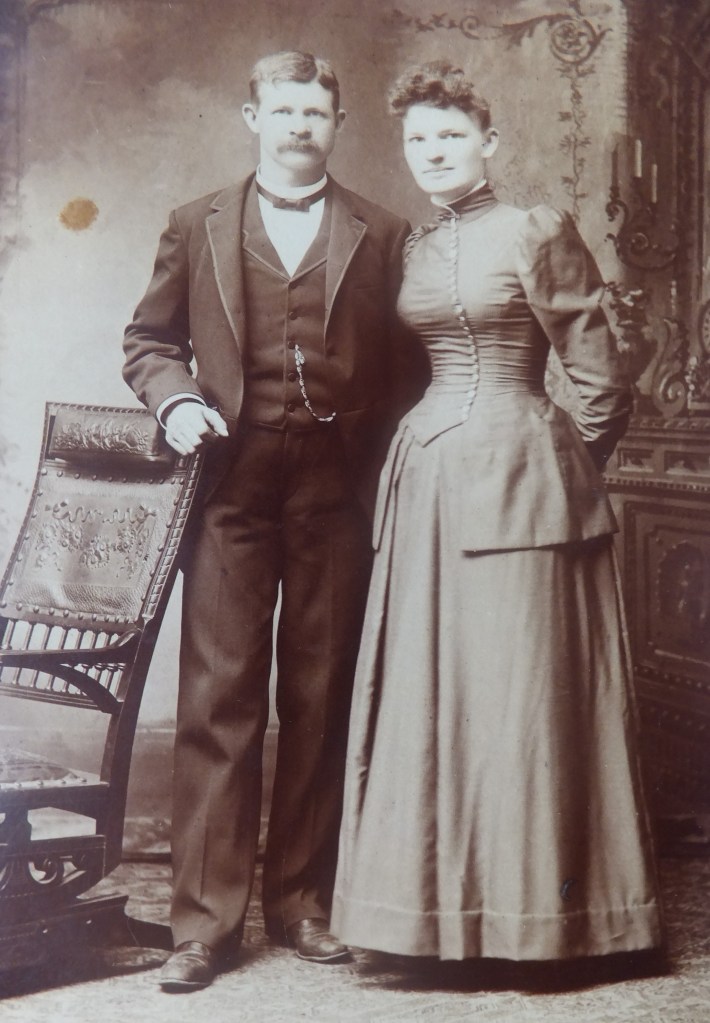
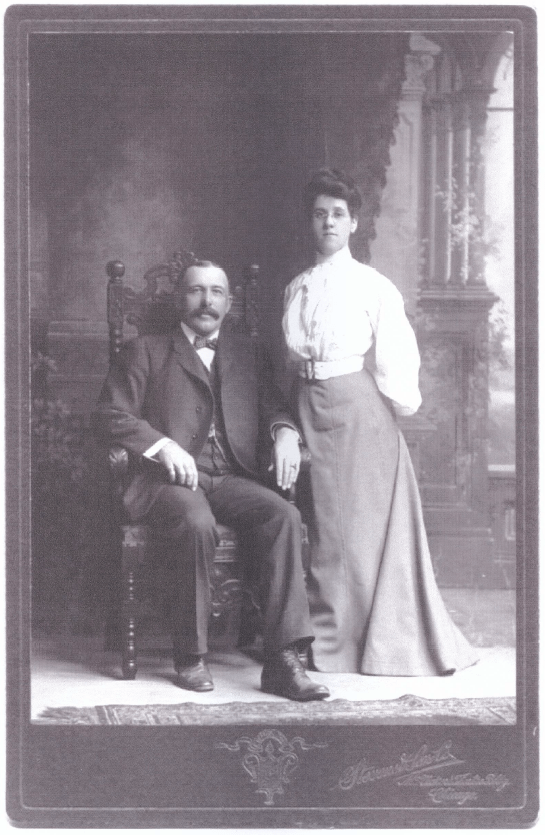
Alfred and Maude Waters
(The photographer appears to be located in Chicago)

Only a few days after their wedding, a meeting was held at De Smet City Hall at which Waters was appointed to a committee that was charged with organizing the Old Settler’s Celebration that would be held on June 10, 1904.4  Waters himself was one of the old settlers of the county, having “arrived in De Smet at the age of twenty-four during the summer of 1880, fresh out of law school.”5  On the day of the Old Settler’s Celebration, horse racing was one of the events held.  It was reported that “the free-for-all trotting race on the 10th was won by A. N. Waters’ horse.”6

In the month following the Old Settler’s Celebration, the newlyweds were visited by Waters’ aunts and cousins from Wisconsin and New York: Mrs. Alfred W. Newman, Mrs. Emory E. Newman and Mr. & Mrs. Isaac U. Tripp.  Mrs. A. W. Newman (Celia), who was the widow of Waters’ mother’s brother, came from Madison, Wisconsin, where her husband had been a judge on the state supreme court from 1894 until his death in 1898.  Mrs. E. E. Newman (Cordelia), arriving from Durham, New York, was the widow of another brother of Waters’ mother.  Because Waters’ mother had died when he was only a few weeks old, Waters grew up in his maternal grandparents’ home.7  Waters’ uncle Emory was 19 at the time of Waters’ mother’s death in 1855.  Following the passing of his grandfather, Waters was included in his uncle Emory’s household.8  Mrs. Isaac U. Tripp (Addie) was the daughter of one of Waters’ mother’s sisters, Lucilia (nee Newman) Winchell.

When the South Dakota census was taken in 1905, Maude was 30 years-old and her occupation was housewife.9  The census record for her husband has an incorrect first name, it is written as “Albert” instead of “Alfred.”  Waters was 49 years-old and his occupation was land agent.10  Later that year, Waters’ birthday (November 14, 1855) was noted by the local newspaper:

A. N. Waters celebrated his 50th birthday anniversary Tuesday. Twenty-five years and four months of that time have been spent in the city of De Smet. He has labored all these years for the upbuilding of this city and vicinity and has accomplished much for the community and built up a large business for himself. Here’s hoping that he spends the next fifty years right here in De Smet.11


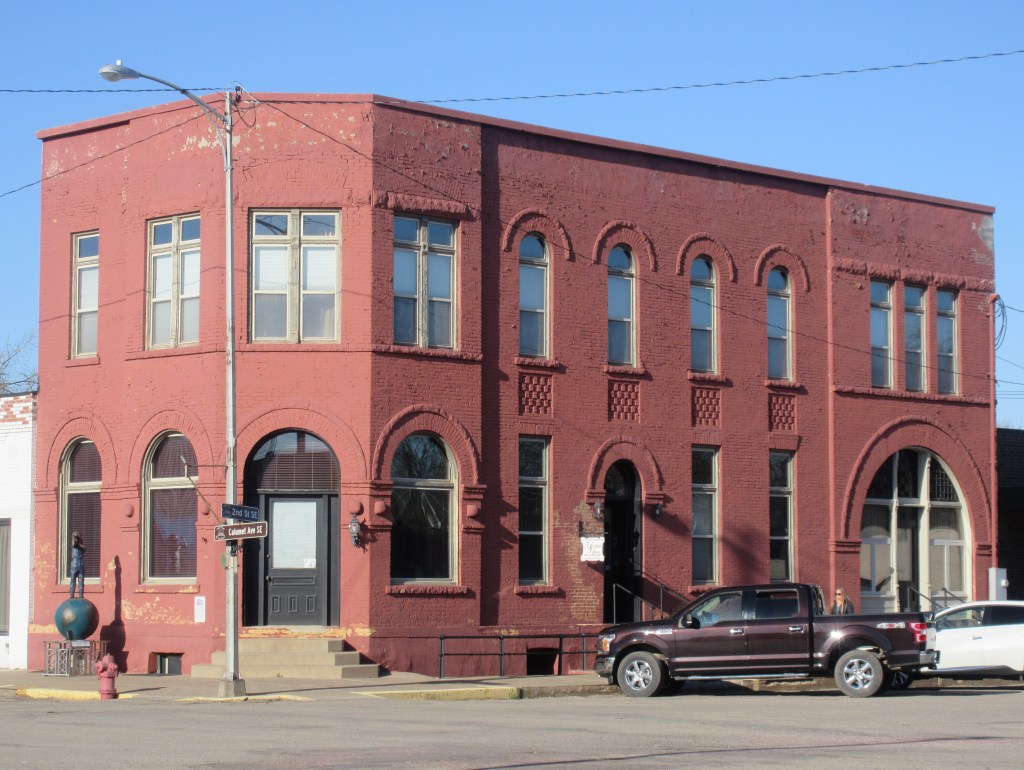
Since his arrival in De Smet, Waters was very active as a real estate broker, and he partnered with other businessmen in land development businesses.  “During the early days, lawyers tended to involve themselves as much in the business of land as in the law, and Waters reaped a small fortune from shrewd land investments, eventually becoming one of the largest landholders in [Kingsbury County].”12  One of the businesses with which Waters was associated was Kingsbury Abstract Company, whose members in addition to Waters were J. C. Gibson, A. W. Miller, C. L. Dawley and Al Thomas.13  The abstract company built a two-story building in 1888-89 on the northeast corner of the intersection of Calumet Avenue (the main street) and Second Street. The construction costs were seven to ten thousand dollars.14 “This building had the historical importance of being a place where the pioneers would come to stake their claims.”15  About four years prior to the construction of the abstract company’s building, Charles P. Ingalls, the father of Laura Ingalls Wilder who wrote Little Town on the Prairie, a novel set in De Smet, owned the property on the southeast corner of the same intersection.16

... [The two-story building] was solid brick with white stone trimmings. The front office was 22×33 feet, connected to an office in the rear 15×16 feet, with another room not connected to the front part of the building, it being 19×22 feet. Upstairs was a lodge hall and meeting room, accessed via exterior stairs at the rear of the building. The front office downstairs housed the Dakota Loan and Investment Company; the middle part housed the Abstract Company. The separate room to the east – with an entrance on Second Street – became the De Smet Post Office.17

From 1904 to 1906, several business dealings were made by Waters, which resulted in the transfer of the Calumet building to Waters Land and Loan Company.  These dealings included:

  • April 1904 – A couple of weeks before Maude and Alfred married, for $2,500 Alfred purchased from one of the members of the Kingsbury Abstract Company (C. L. Dawley) and his wife: “An Undivided one half interest in Lot Numbered 8, Block Numbered 2.”18 This was the lot on which the abstract company had built the two-story building.
  • November 1905 – Waters and two associates incorporated the Waters Land and Loan Company. The purpose of the corporation was to transact a general real estate, brokerage and loan business. “The amount of the capital stock of this Corporation shall be and is Fifty Thousand ($50,000) Dollars divided into Five Hundred (500) shares of the par value of One Hundred (100.) dollars each.”19
  • December 1905 – Waters was given title to the entire lot (Lot Numbered 8, Block Numbered 2) for consideration of “$1.00 and other val.” from Kingsbury County Abstract Company.20
  • February 1906 – The city lot with the two-story building was sold by Waters and his wife Maude to Waters Land and Loan for $10,000.21
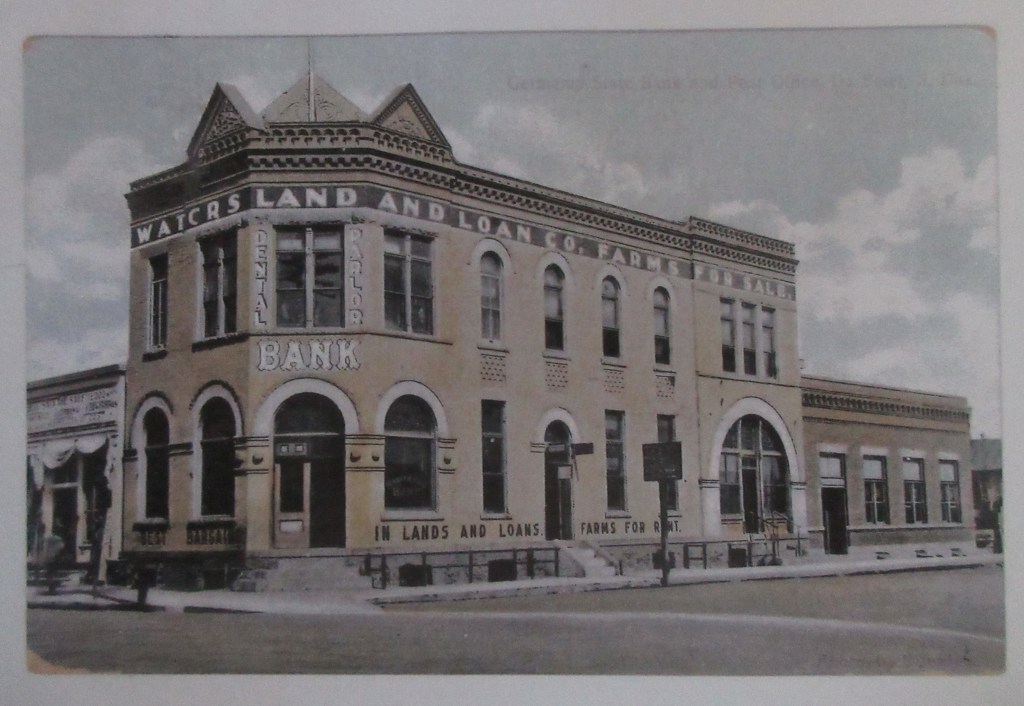
Postcard photograph of the building of Waters Land and Loan Company

Through the years the building has housed many offices, including the Germania State Bank, Peoples State Bank, a doctors office and dental office.  The building exchanged hands again in 1997, and after three years of extensive restoration, was opened as The Heritage House Bed and Breakfast.22

Heritage Bed and Breakfast, photographed by the author, April 2025

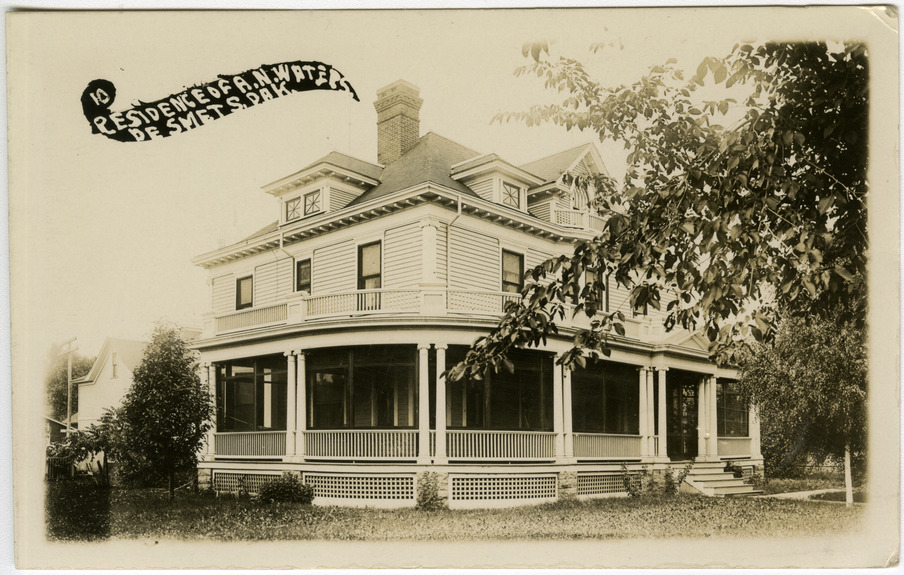
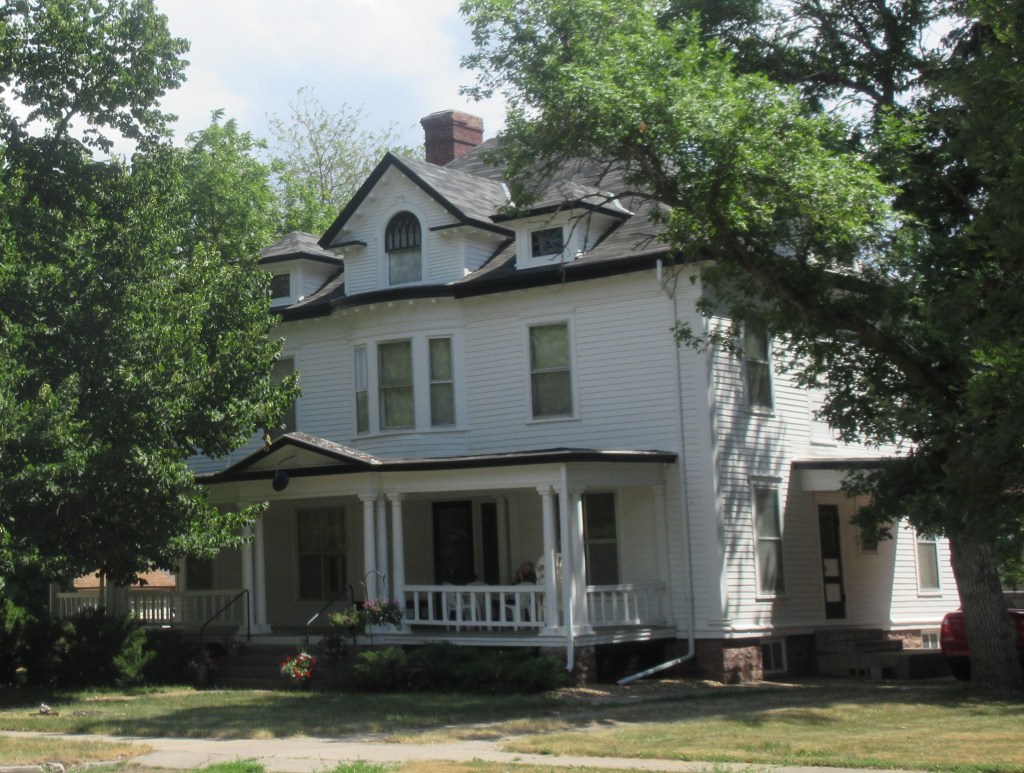
It appears that simultaneously to his business dealings involving the Calumet property above, Waters was involved in another project, which was the construction of his and Maude’s personal residence.  In 1905, a large home was built on Second Street,23 two and a half blocks west of Waters’ building at Calumet.  The house has been described as “the most elegant in town.”24

[It] was a gathering place for many of the town’s social elite.  The Waters hosted many dinners, parties and get-togethers in the large house.  It featured a full basement and an attic with enough headroom, it could be converted to another level.  There were plenty of rooms on the first and second floor which had all the modern amenities for its time.25

Postcard photograph of Waters’ residence, 1912

More than a century after the Waters’ home was built, a descendant of Maude’s brother Herbert and his wife were in De Smet and stopped at the house. Upon striking up a conversation with the owner at that time, they were given permission to take a look inside.  Subsequently, the wife described their brief tour:

As you walk in there is a visiting room with a big brick fireplace to the left.  To the right are a couple small bedrooms.  At the end is the kitchen.  Behind the fireplace was a hall way with 2 or three small rooms.  They were where the vet had his office and other items.  Long stairway going upstairs ….26

Maude and Alfred’s home in De Smet, South Dakota, photographed by the author, June 2021

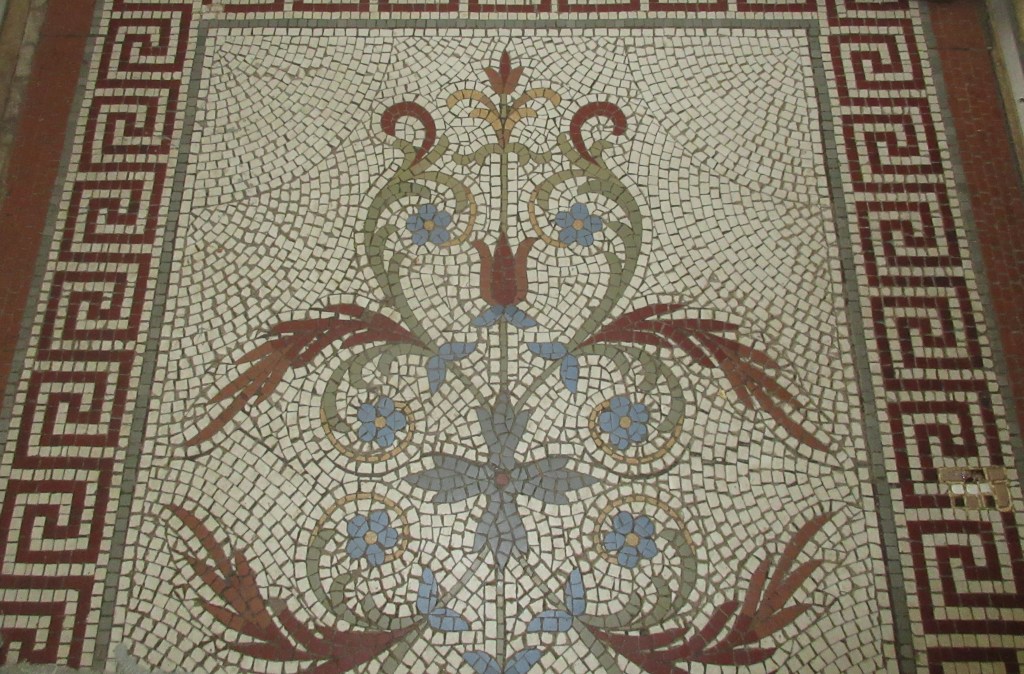
Another of Herbert’s descendants visited De Smet in June 2021.  Seeing the large wrap-around front porch, she recalled playing on that porch as a young child.  She and the group with her were also invited to enter the home to look around.  Below is a picture of the tiled front entry.

Front entry of Waters’ home (this partial view is from the side of the entryway, not the front), photographed by the author, June 2021

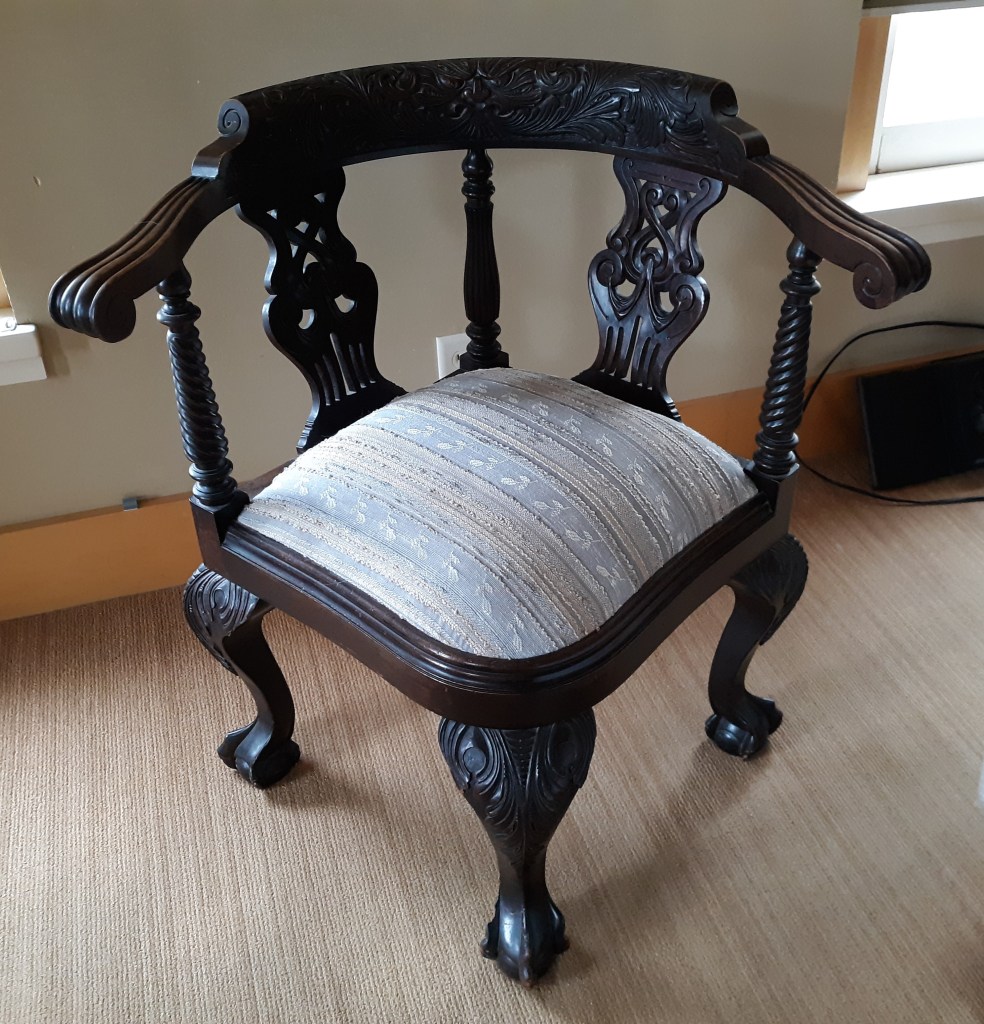
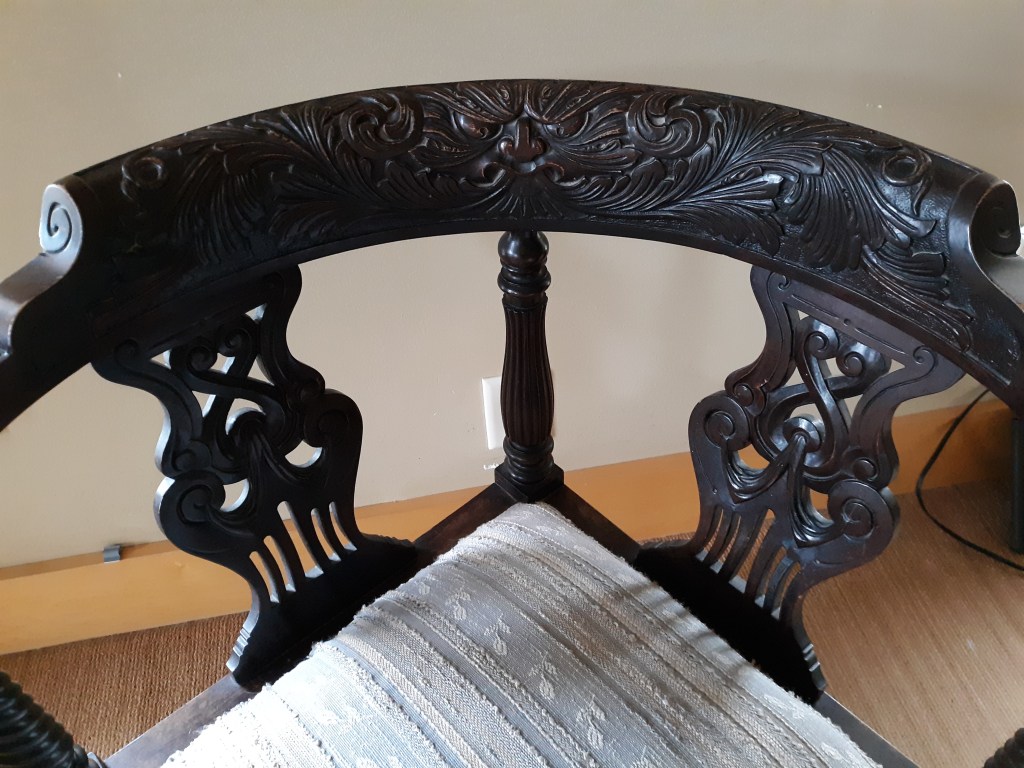
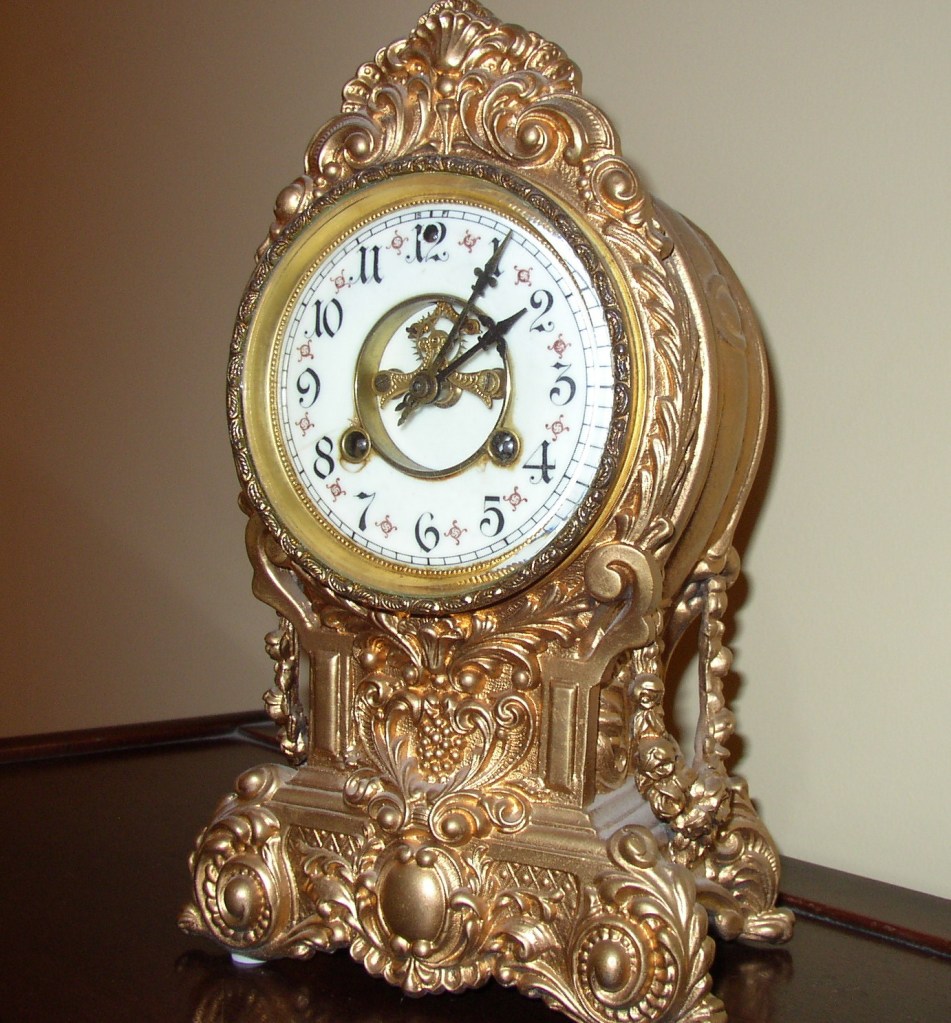
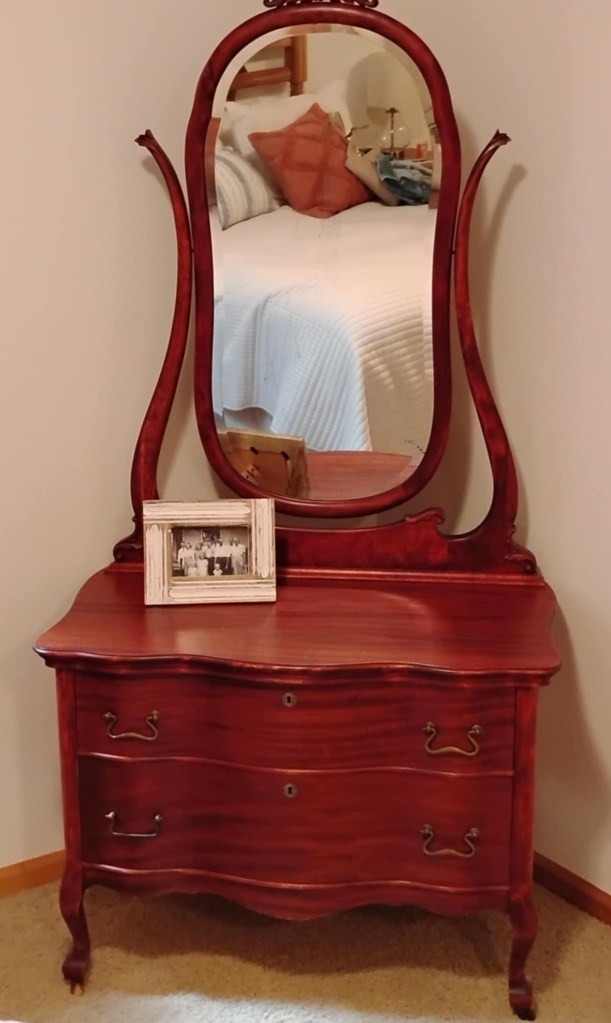
Some of the furnishings of the Waters’ home are still in the possession of Herbert’s descendants.

An antique chair, dated 1825
Close-up of the engraving
A “Verona” model clock manufactured by Waterbury Clock Company; approximate date, 1910
This dresser with beveled mirror had a darker finish when it was owned by Maude’s nephew Arthur Bevers and his wife Elsie. One of their sons had it re-finished to this natural red oak finish. The photograph sitting on the dresser is of the Arthur Bevers, Sr. family taken about 1943.

Several news items in the Kingsbury County Independent highlight the hospitality and generosity of Maude and Alfred Waters. On August 17, 1906, the newspaper reported, “Mrs. A. N. Waters entertained a number of young ladies in honor of her guest, Miss Eggleson Friday last.”27 The same edition of the newspaper reported that on the following day, a former resident of De Smet, Mrs. James T. Cooley, had arrived from New York City and was a guest at the Waters’ residence. In June 1909, the wedding of Dr. John H. Hall and Tillie Nelson was held at the Waters’ home. Hall was a dentist whose office was in the building owned by Waters Land and Loan Company. (On the postcard above, one of Hall’s office windows is demarked with the words “Dental Parlor.”) Hall was a member of the Methodist Episcopal Church, singing in the choir for many years as tenor.28 His bride had been living with the Waters. The write-up about the wedding follows:

At the home of Mr. and Mrs. A. N. Waters in this city Monday evening, June 14th, occured the marriage of Miss Tillie Nelson to Dr. J. H. Hall, both of this city, Rev. J. E. Booth officiating.  The ceremony was performed in the presence of a few relatives of the bride and a small number of mutual friends of the contracting parties.  After the ceremony an elaborate wedding dinner was served by Mrs. Waters.  The happy couple took the evening train east for points in Wisconsin where they will visit for two weeks.

The bride is a young lady who has made her home with the Waters family for some time and is well known and highly esteemed by our people.  The groom is so well known that no words of introduction are needed.  He has been engaged in the practice of dentistry in this city for about fourteen years and is regarded as one of our leading citizens.  Everyone has a good word for John Hall.  The happy couple have a host of friends in and about De Smet who unite in wishing them a happy married life.29

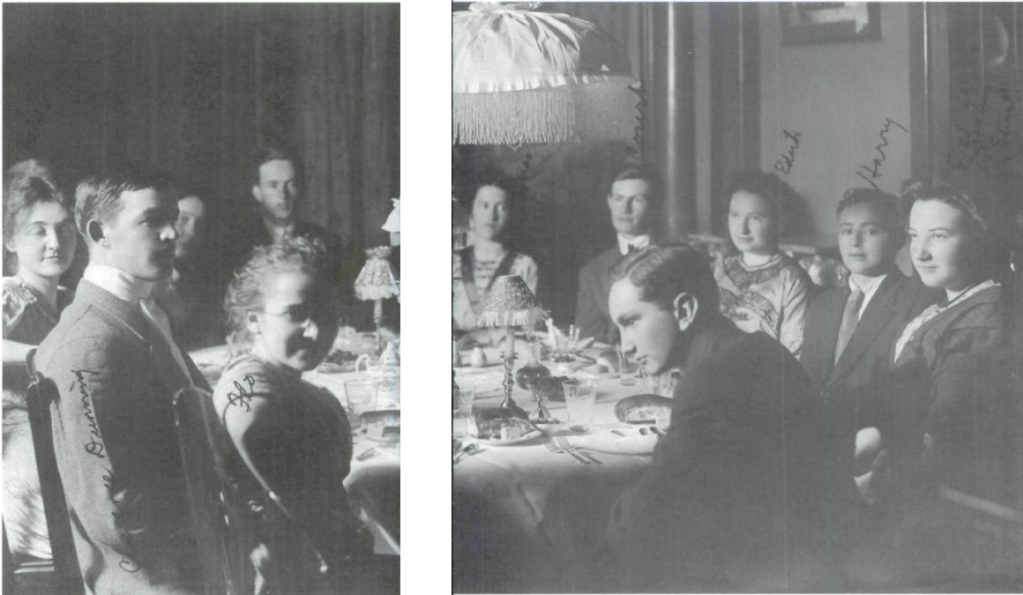
Before movies and cinema theaters became popular, “Parties and informal gatherings in people’s homes constituted most of the social swirl for high-school students in De Smet.”30  One such example was reported in the local news: a gathering held at the Waters’ home on Friday night, March 1, 1912, starting at 8:00 pm.  The guests included all the members of the senior class of the high school and their instructors, and their purpose was to celebrate the birthday of Edith Mitchell; the news report concluded: “A most delightful evening was spent and the occasion will long be remembered by all.  An elaborate lunch was served at midnight.”31  Two of the members of the senior class, Edith Mitchell and Evelyn Keating, were noted to have been attendees of the Epworth League, a young people’s group which met at the Methodist Episcopal Church on Sunday evenings.32

De Smet High School Class of 1912
Celebrating Edith Mitchell’s birthday at the Waters’ home, March 191233

Edith Mitchell’s “family, who lived in a house north of the railroad tracks, had gone through some difficult times, and the Waterses had taken her in to live with them.”34  In addition, they would make it possible for Edith to attend college, the only girl in her class to do so.  She started out at South Dakota State College in Brookings, which is the college that Maude had attended, and later she transferred to the University of Minnesota.35 In the summer of 1912, prior to going off to college, Edith “accompanied her benefactors, the Waterses, on a three-month automobile tour back to Alfred Waters’s boyhood home in Durham, New York.  Driving over roads that much of the way consisted of nothing more than dirt paths and stopping at nearly every town to obtain directions to the next one made the excursion quite an adventure.”36 

The Brookings Register announced the marriage of Edith in June 1917: “Another former State College student has joined the ranks of the ‘Newly Weds.’  Miss Edith Mitchell was united in marriage at De Smet, last Wednesday, to Randle Toland, by the Rev. Paul Roberts.  The ceremony occured at the home of Judge and Mrs. A. N. Waters and a large company was assembled, with many out of town guests present.  After a trip east the couple will reside in De Smet, where Mr. Toland is in the real estate business.”37

Highlights of Maude and Alfred Waters’ social and civic lives will continue in the next blogpost.


1 Nancy S. Cleaveland, “Syndicate Hotel,” Laura Ingalls Wilder A-Z, http://www.pioneergirl.com/blog/archives/9165.

2 K. and M. Bevers, notes attached to Agnes Maude Bevers in Ancestral Quest program file dated June 29, 2022.

3 “Waters-Bevers Nuptials,” Kingsbury County (South Dakota) Independent (May 13, 1904), in Nancy S. Cleaveland and Gina Terrana, Waters (2015): http://www.pioneergirl.com/waters_cemetery.pdf.
4 _____, “June 10th Celebration,” Kingsbury County Independent (De Smet, South Dakota), May 20, 1904, 6, Newspapers.com.

5 John E. Miller, “End of an Era: De Smet High School Class of 1912,” South Dakota History Volume 20 Number 3 (South Dakota Historical Society Press, September 26, 1990): 190, https://www.sdhspress.com/journal/south-dakota-history-20-3/end-of-an-era-de-smet-high-school-class-of-1912/vol-20-no-3-end-of-an-era.pdf.

6 _____, Kingsbury County Independent (De Smet, South Dakota), June 17, 1904, 1, Newspapers.com.  

7 _____, “A. N. Waters, Pioneer, Laid to Rest Here Sunday,” De Smet (South Dakota) News (September 2, 1927) in Nancy S. Cleaveland and Gina Terrana, Waters (2015): http://www.pioneergirl.com/waters_cemetery.pdf.
8 “New York, United States records,” images, FamilySearch (https://www.familysearch.org/ark:/61903/3:1:33SQ-GYBK-KDN?view=explore : Jul 26, 2025), image 447 of 706; United States. National Archives and Records Administration.  Image Group Number: 005161473

9 “South Dakota, State Census, 1905”, FamilySearch (https://www.familysearch.org/ark:/61903/1:1:MMH3-NNS : Sat Mar 09 19:18:13 UTC 2024), Entry for Maud Waters.

10 “South Dakota, State Census, 1905”, FamilySearch (https://www.familysearch.org/ark:/61903/1:1:MMH3-NXC : Sun Jul 20 06:06:04 UTC 2025), Entry for Alfred N.

11 _____, Kingsbury County (South Dakota) Independent, (November 17, 1905), in Nancy S. Cleaveland and Gina Terrana, Waters, (2015): http://www.pioneergirl.com/waters_cemetery.pdf.
12 Miller, “End of an Era:” 190-91.

13 _____, Historical sign posted on the outside wall of Heritage House Bed and Breakfast, De Smet, South Dakota.

14 Nancy S. Cleaveland, “post office/post-office,” Laura Ingalls Wilder A-Z, http://www.pioneergirl.com/blog/archives/13454.

15 _______, Heritage House Bed and Breakfast, https://heritagehousesd.com.

16 Laura Ingalls Wilder Memorial Society, Inc., Heritage Plat of De Smet (De Smet, South Dakota, 1994).

17 Cleaveland, “post office/post-office.”

18 The Heritage House, LLC, “Abstract of Title,” Transfer Number 26.

19 State of South Dakota, Articles of Incorporation of the Waters Land and Loan Company, November 15, 1905.

20 The Heritage House, LLC, “Abstract of Title,” Transfer Number 27.

21 The Heritage House, LLC, “Abstract of Title,” Transfer Number 28.

22 Historical sign posted on the outside wall of Heritage House Bed and Breakfast, De Smet, South Dakota.

23 “A. N. Waters, Pioneer, Laid to Rest Here Sunday,” in Cleaveland and Terrana, Waters: http://www.pioneergirl.com/waters_cemetery.pdf.
24 Miller, “End of an Era:” 185.

25 Mike Siefker, “Hof’s stately home has history as a hospital,” Kingsbury Journal (May 4, 2022): 13.

26 S. Bevers, Facebook post of Bevers Family and Reunions private group, July 8, 2023.

27 _____, “Local News,” Kingsbury County (South Dakota) Independent (August 17, 1906): 5, Newspapers.com.

28 Caryl Lynn Meyer Poppen, ed., “A History of the Methodist Church,” De Smet Yesterday and Today (De Smet, South Dakota: De Smet News, printer, 1976): 144.

29 _____, “Nelson—Hall,” Kingsbury County (South Dakota) Independent (June 18, 1909): 4, Newspapers.com.

30 Miller, “End of an Era”: 185.

31 _____, De Smet (South Dakota) News (March 8, 1912), in MIller, “End of an Era”: 185.

32 First Methodist Church, “A History of the Church,” Consecration Service of the Remodeled First Methodist Church (De Smet, South Dakota: First Methodist Church, September 26, 1965).

33 From Evelyn Keating’s class book, School-Girl Days: A Memory Book in Miller, “End of an Era:” 186-87.

34 Miller, “End of an Era:” 190.

35 Miller, “End of an Era:”: 202.

36 Miller, “End of an Era:” 202.

37 J. F. Brooke, ed., “Local and Personal,” Brookings (South Dakota) Register (June 28, 1917): 7, Newspapers.com.

Maude Bevers, Career Woman

In September 1883, 8-year-old Maude Bevers, living near Liverpool, England, wrote a letter to her father Alfred C. Bevers, who had traveled to Dakota Territory in America.  One of the things she reported to her father was: “Mama say’s that I am getting on very well at school.”  (See the full letter in Ada, Gertie and Maude) About fifteen months later, Maude emigrated to Dakota Territory with her mother and two older sisters, joining her father.  Because Maude’s father was a supply pastor for the Methodist Episcopal Conference in Dakota Territory and in South Dakota when it became a state, Maude continued her education in several small towns.  Eventually, she would be the first among her siblings to attend and complete high school.  According to the reports her siblings gave for the 1940 United States census, the highest grades they had attended were 6th, 7th or 8th grade.

Not only did Maude complete high school, in her early twenties, Maude attended college. An agricultural college had been established by the Dakota Territorial Legislature in 1881, and in Brookings the first building was built in 1884.1  A college catalog explained the history and purpose of the college, including the following statements:

Upon the division of the territory of Dakota into the states of North and South Dakota when admitted into the Union in 1889, the agricultural and mechanical college of Dakota became known as the South Dakota Agricultural College [SDAC].

… The college is devoted to advancing the interests of practical education and its purpose is to give men and women such training as will best fit them for the active duties of life, whether it be in the fields, the shops, the house, or in the class or counting rooms.2

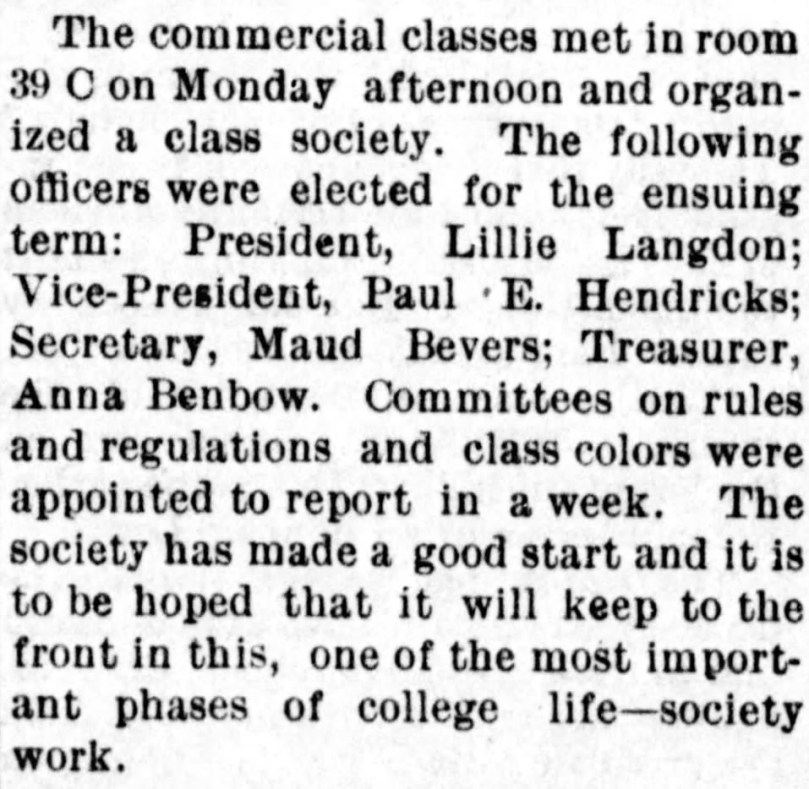
Even though the college was initially established as an agricultural and mechanical college, by 1896 it had broadened its curriculum to include 24 departments.  Maude’s name is listed in the SDAC catalog dated 1897-98, which indicated she was studying Commercial Science and her address was Willow Lakes.3  Her father had been assigned to the Willow Lakes Methodist Episcopal charge in 1896.4  With a population of approximately 220, in 1897-98, Willow Lakes sent 10 young men and women to the agricultural college, five of whom studied Commercial Science.  Other subjects studied by these students were Domestic Science, Mechanical Engineering and Agriculture.

News item of The Brookings Register
May 8, 18975

During the 1897-98 school year, there were about 550 students attending SDAC.  Two-thirds of them were men and one-third women.  The college catalog explained the affordability for students to attend the state-established college:

No young person should be deterred from obtaining a liberal education when such advantages as this college offers can be had at a nominal price.  The aggregate of all the regular fees is only four dollars per quarter and is payable at the time of registration.  Books and stationery are furnished by the student.  A laboratory fee of one dollar is charged for the use of each laboratory in which a student takes work.6

Due to the expansion of the educational departments during the first decade and a half, the dormitories had been converted into classrooms and teaching labs.  By 1896, there was only one cottage available for lodging on the campus.  It held about 20 young women.  The rest of the student population boarded in Brookings—a town with a population of nearly 2000—in private homes or hotels, starting at about 50 cents per week.7  It is not known whether Maude lodged on or off campus. The expenses of the average student who attended three quarters of the school year were: $6.00 for tuition, $90.00 for board and room, $45.00 for clothes, $15.00 for laundry, $25.00 for books and stationery, and $10.00 for traveling expenses.8

About fifteen percent of the SDAC students of the 1897-98 school year were majoring in Commercial Science.  The college catalog described the aim of the department:

Appreciating the fact that business men are governed largely by certain specific and established rules, it becomes necessary that this department keep in touch with these usages and impart the same to the student in such definite and concise terms as shall prepare him for successful entrance to the business world.

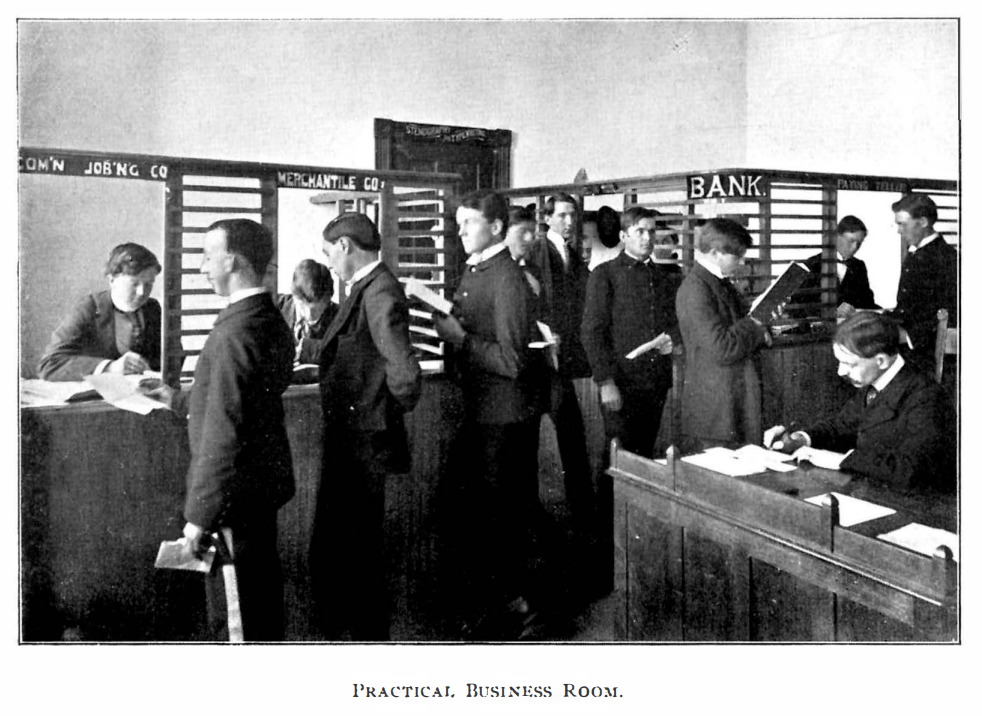
The rooms for the department are exceptionally well suited and adapted to the work of the business student.  The amanuensis room is supplied with fifteen typewriting machines and ample table and black board surface.  The offices such as the Bank, Post Office and Mercantile are well fitted for giving the student actual practice in business methods.  The college library affords good opportunity for references and collateral reading. …9

Note: The 1886 edition of Webster’s Dictionary defines amanuensis as “A person whose employment is to write what another dictates, or to copy what another has written; a copyist.”10

A simulated business center at SDAC11

Based on the dates that news items reported about when Maude was at the college or left the college, it appears that Maude attended for two years.  Therefore, she would not have earned a bachelor’s degree, but she may have completed the coursework to earn a certificate of graduation in Commercial Science. To earn this certificate, a student had to complete the courses of shorthand, penmanship, advanced dictation, commercial law, bookkeeping, business practice, correspondence, typewriting, commercial arithmetic and English words.  The description of the course in English Words was: “A study of Anglo-Saxon, Latin, French and Greek derivatives and synonyms.  This course is designed to form an intermediate step between grammar and rhetoric, and aims to make the student familiar with the elements entering into the growth and present use of the English language.”12

News item of The Brookings Register
October 2, 189713

In June 1897, The Brookings Register reported “Rev. Bevers, of Willow Lakes, led chapel devotionals Thursday noon.”14  This was Maude’s father.  The SDAC students were not required to attend the chapel exercises, instead the college catalog stated:

The Young Men’s and Young Women’s Christian Associations are important elements in retaining a strong christian fellowship among the student body.  Their relations to the State and Inter-National organizations assist in keeping the college in touch with other educational institutions.  … [T]hese student organizations are allowed to take the religious lead by holding prayer and devotional meetings nearly every day to which all are invited.15

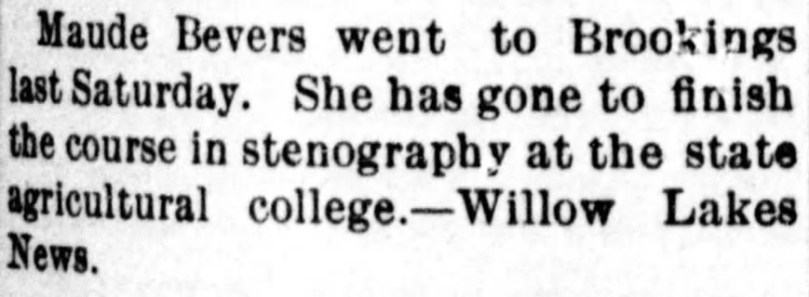
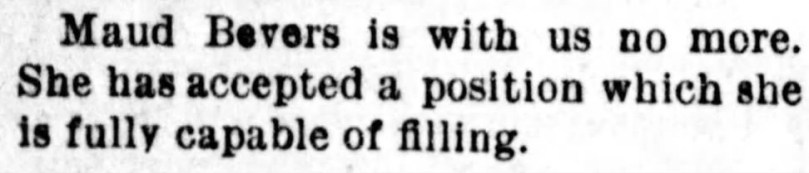
Another item in The Brookings Register reported that Maude left the college in March 1898, stating that she had “accepted a position which she [was] fully capable of filling.“16 According to a family historian, she was hired by Alfred Newman Waters, an attorney and realtor, doing business in De Smet, South Dakota.17  A. N. Waters was one of the pioneer settlers of Kingsbury County, arriving in August 1880.18  He had been a prominent citizen of De Smet since its founding.  Besides being a businessman, a few of the capacities in which he served the community were as a notary public, a director on the boards of financial businesses, and a county court judge. When Maude became an office worker in De Smet, she joined the nearly eighteen percent of gainfully employed workers in the United States who were women.19  Also, among the gainfully employed women, she joined the nine percent of women engaged in nonagricultural pursuits who were working in the clerical field.20

News item of The Brookings Register
March 29, 1898

Traditionally, rather than pursue an occupation in the community, most women have worked within the home.  The percentage of women that were gainfully employed in 1870 was less than 10 percent.21  The three occupations most often held by women between 1870 and 1900 were domestic service worker, teacher, and nurse.  As the industrial revolution advanced, more women entered the workforce.  By 1900, the percentage of women that were gainfully occupied was over 14 percent22 and the percentage of single women that were gainfully occupied was nearly 41 percent.23 One of the reasons for this growth was an increase in the demand for professional and semi-professional workers, including clerical workers, due to “the need by business and industry for accurate record-keeping, with the development of large-scale business practices, and with modern methods used in distributing the output of a vastly expanded economy.”24  A report of the United States Department of Labor provides additional information on this point:

The invention of the typewriter and other office machines, in response to the growing needs of business, made it possible to carry out record keeping, communication, and related activities on a tremendous scale.  The result was the creation of entirely new occupations many of which women perform.25

The greatest rate of increase for women “office workers” in any decade occurred from 1880 to 1890.  Women in these selected office occupations [referring to stenographers, typists, and secretaries; shipping and receiving clerks; clerical and kindred workers; and office machine operators] multiplied nearly 20 times – a testament to the growing acceptance of the typewriter and of the trained woman typist.26

In 1900, the percentage of office workers that were women was about 29%.27 “In taking on the functions of clerical workers, women did not replace men.  Rather they found entirely new opportunities.”28


By the fall of 1898, Maude’s parents and sister Gertrude had moved to De Smet as well.  In 1900, Maude and her family lived on First Street.29  The Methodist Episcopal church was only a few blocks away.  Records of the church state that all of them became members on November 26, 1898.30  Maude was the church choir leader for many years.31  In addition, the minutes of the women’s group noted that in December 1902 she was the organist at the Epworth League meeting (an organization for young adults), and she was the secretary pro tem at the women’s meeting on April 16, 1903.

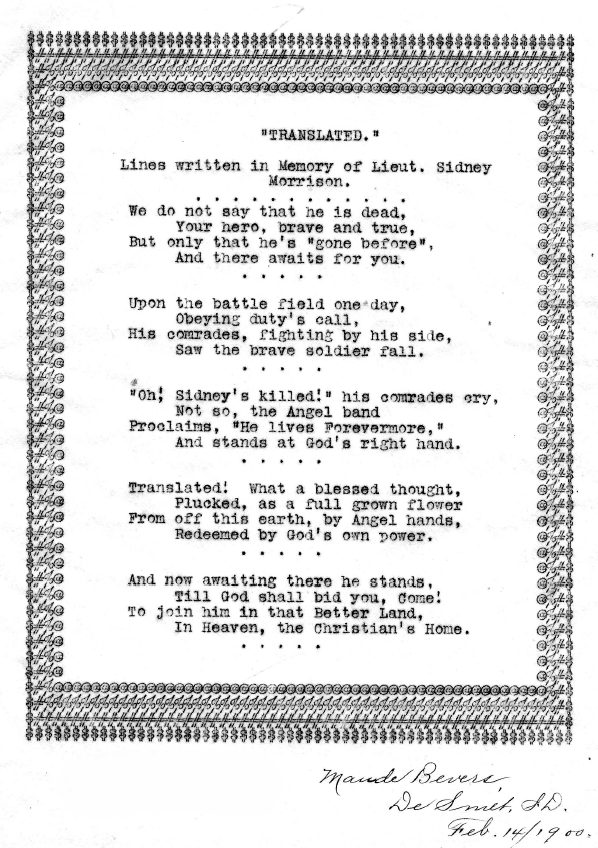
Maude had a poetic and artistic side to her.  On February 14, 1900, she created a tribute to Lieutenant Sidney Ellsworth Morrison.  It is not known what the relationship was between Maude and Lieutenant Morrison, but it is noteworthy that the tribute was dated on Valentine’s Day.  An item in The Christian Advocate, dated April 27, 1899, reads: “Lieutenant Sidney Morrison, who was killed in the recent charge of the South Dakota Regiment at Mariloa, was a brother of the Rev. J. G. Morrison, Pastor of Franklin Avenue Church, Minneapolis, Minn.”

Sidney Morrison was a member of Company E of First South Dakota Infantry and his rank was 2nd Lieutenant.  He died in the Philippines on March 27, 1899,32 but it wasn’t until January 25, 1900, that his remains were transported on the ship “City of Peking” to his father James Morrison, whose residence was De Smet, South Dakota.33

Maude’s tribute, entitled Translated, is typewritten.  As far as is known, this is the earliest piece of family memorabilia that was written using a typewriter.  The keys $, #, % and @ were used to create the decorative border.

More about Maude’s life will be continued in another blogpost.


1 South Dakota Agricultural College [SDAC], “The South Dakota Agricultural College Catalog 1897-1898 with Announcements for 1898-1899” (1898). Campus Course Catalogs and Bulletins. Paper 15, https://openprairie.sdstate.edu/cgi/viewcontent.cgi?article=1011&context=archives_catalogs, page 31.

2 SDAC, “SDAC Catalog 1897-1898,” page 31.

3 SDAC, “SDAC Catalog 1897-1898,” page 14.

4 United Methodist Church, Dakotas Conference, Commission on Archives and History, personal communication with M. R. Wilson, June 20, 1995.

5 “Items of Local Interest,” The Brookings Register (Brookings, South Dakota), May 8, 1897, page 3, Newspapers.com.

6 SDAC, “SDAC Catalog 1897-1898,” page 56.

7 SDAC, “SDAC Catalog 1897-1898,” page 57.

8 SDAC, “SDAC Catalog 1897-1898,” page 57.

9 SDAC, “SDAC Catalog 1897-1898,” page 83.

10 Noah Webster, Webster’s complete dictionary of the English language (London: George Bell & Sons, 1886): 42, https://archive.org/details/websterscomplete00webs/page/42/mode/2up.

11 SDAC, “SDAC Catalog 1897-1898,” following page 82.

12 SDAC, “SDAC Catalog 1897-1898,” page 89.

13 “College News,” The Brookings Register (Brookings, South Dakota), October 2, 1897, page 4, Newspapers.com.

14 “College Chestnuts,” The Brookings Register (Brookings, South Dakota), June 16, 1897, page 4, Newspapers.com.

15 SDAC, “SDAC Catalog 1897-1898,” page 43.

16 “College News,” The Brookings Register (Brookings, South Dakota), March 29, 1898, page 2, Newspapers.com.

17 K. and M. Bevers, notes attached to Agnes Maude Bevers in Ancestral Quest program file dated June 29, 2022.

18 The De Smet News, “A. N. Waters, Pioneer, Laid to Rest Here Sunday” (De Smet, South Dakota), September 2, 1927, in Waters, http://www.pioneergirl.com/waters_cemetery.pdf.
19 Joseph A. Hill, Women in Gainful Occupations 1870 to 1920 (Washington, D. C., USA: United States Government Printing Office, 1929): 52, https://babel.hathitrust.org/cgi/pt?id=hvd.hba9kx&seq=1.

20 Joseph A. Hill, Women in Gainful Occupations 1870 to 1920: 40.

21 Janet M. Hooks, Women’s Occupations Through Seven Decades (Washington, D. C., USA: United States Government Printing Office, 1947): 34, https://babel.hathitrust.org/cgi/pt?id=uiug.30112104139180&seq=1.

22 Janet M. Hooks, Women’s Occupations Through Seven Decades: 34.

23 Janet M. Hooks, Women’s Occupations Through Seven Decades: 39. 

24 Janet M. Hooks, Women’s Occupations Through Seven Decades: 72.

25 Janet M. Hooks, Women’s Occupations Through Seven Decades: 72.

26 Janet M. Hooks, Women’s Occupations Through Seven Decades: 74.

27 Janet M. Hooks, Women’s Occupations Through Seven Decades: 76.

28 Janet M. Hooks, Women’s Occupations Through Seven Decades: 75.

29 “United States Census, 1900”, , FamilySearch (https://www.familysearch.org/ark:/61903/1:1:MMRW-TKS : Sat Aug 17 18:09:29 UTC 2024), Entry for Alfred C Peevers and Mary N Peevers, 1900.

30 First Methodist Church of De Smet, “Record of Members.”

31 First Methodist Church, “A History of the Church,” Consecration Service of the Remodeled First Methodist Church (De Smet, South Dakota: First Methodist Church, September 26, 1965).

32 “LT Sidney Ellsworth Morrison,” Find a Grave, https://www.findagrave.com/memorial/154931201/sidney-ellsworth-morrison.

33 Ancestry.com, U.S., National Cemetery Interment Control Forms, 1928-1962 [database on-line] (Lehi, UT, USA: Ancestry.com Operations, Inc., 2012): http://www.Ancestry.com.

The Oldest Mementos of “The Breitenstein Bible”

“The Breitenstein Bible” came into possession of our family when my mother-in-law passed away.  For a dozen years, it remained packed away, undisturbed.  Finally, when down-sizing our belongings and upon deciding to pass the Bible on to our son, I took the time to look through the Bible.  Turning the leaves, I found news clippings, obituaries and funeral folders dispersed between its more than 2000 pages.  Another dozen years would pass before I had the opportunity to peruse those pages and mementos again.  In December 2023, I examined the Bible and photographed the mementos it has safe-guarded for decades, a few items for more than a century.  This blogpost is devoted to the oldest items in “The Breitenstein Bible” and the people with whom they are connected.  A description of the Bible itself, which was published about 1900, can be found on the Legacy Page entitled “The Breitenstein Bible.”

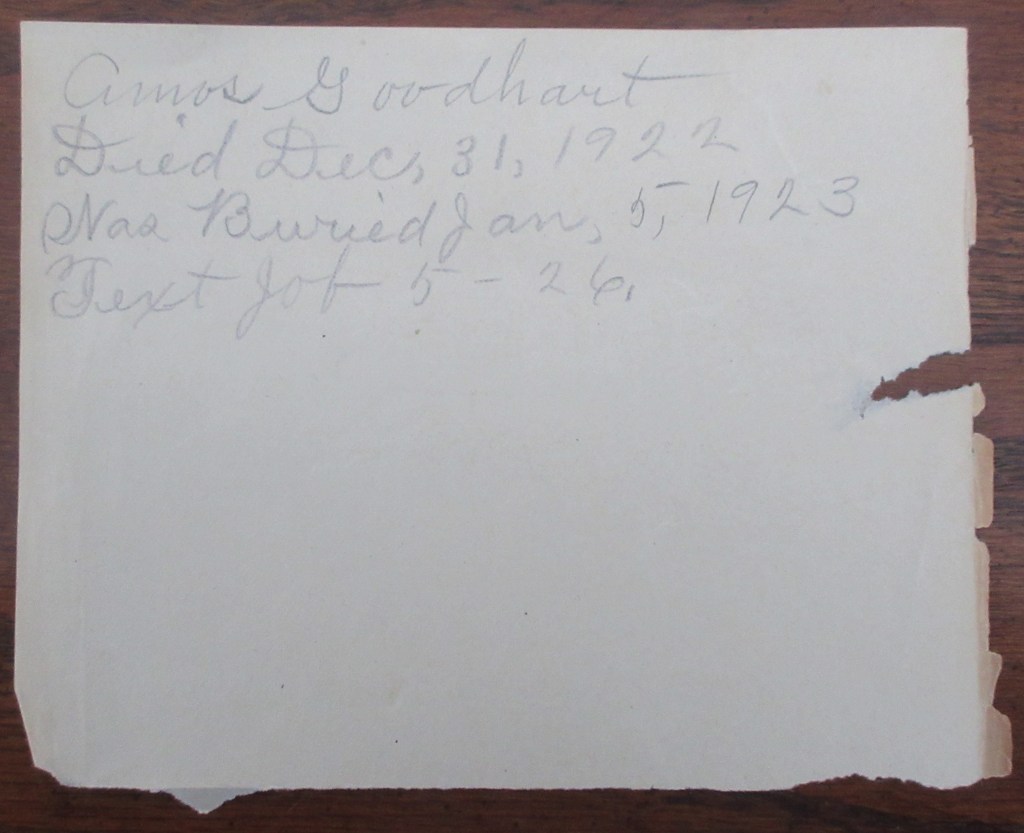
The Bible had been passed down to my mother-in-law through her father, who was a Breitenstein, but the oldest mementos would suggest that the Bible came to him from his mother’s line not his father’s. The oldest identifiable item is a handwritten note about Amos Goodhart. My mother-in-law’s ancestry can be traced to Amos K. Goodhart, so perhaps the Bible should be called “The Goodhart Bible.”

The original owner of the Bible is unknown.  None of the family register pages are filled in.  Besides the note about Amos Goodhart, there are two other handwritten notes which appear to be written in the same handwriting.  Since Amos’ wife had already passed away when he died, I propose that it was his daughter Sarah (Sallie) that wrote the notes.  Sallie married Jacob B. Breitenstein; they were my mother-in-law’s grandparents.

The oldest handwritten note found in “The Breitenstein Bible”

Amos’ ancestors had been living in Berks County, Pennsylvania, since at least 1754, when it was still a province.  His 2nd great-grandfather Fredrick Goodhart was recorded as residing in the district (or township) of Alsace when a tax list was created for the first assessment of taxes of the newly organized Berks County (which had been carved out of Philadelphia County).1  Fredrick Goodhart’s son, Frederick, acquired a homestead in Exeter Township.2  At the time of Amos’ death, the Goodharts had been residing in Exeter Township for roughly 130-140 years. Amos K. Goodhart, born February 23, 1852, was the son of John Newkirk Goodhart (1821-1898) and Sophia Kline (1827-1902).  As a child his family lived in Exeter Township3 and upon marrying Ellen Levan, they began raising their family on a farm in the township,4 remaining in Exeter Township their whole lives.

This handwritten note documents the dates of Amos’ death and burial, and very likely the text that was used at his funeral.  He was buried in the Schwarzwald Cemetery on January 5, 1923, having died on December 31, 1922 of “complications” according to the death register of Schwarzwald Reformed Church.5  In addition to his death, the church records also have an entry about his baptism and confirmation, which didn’t occur until he was 43 years old.6  Having been catechized, Amos was baptized on October 12, 1895 and then confirmed on the following day. Amos’ son Victor and his daughter Sarah were confirmed on that very same day. 

Job 5:26 as printed in “The Breitenstein Bible,” which is the text recorded along with Amos Goodhart’s death and burial dates.

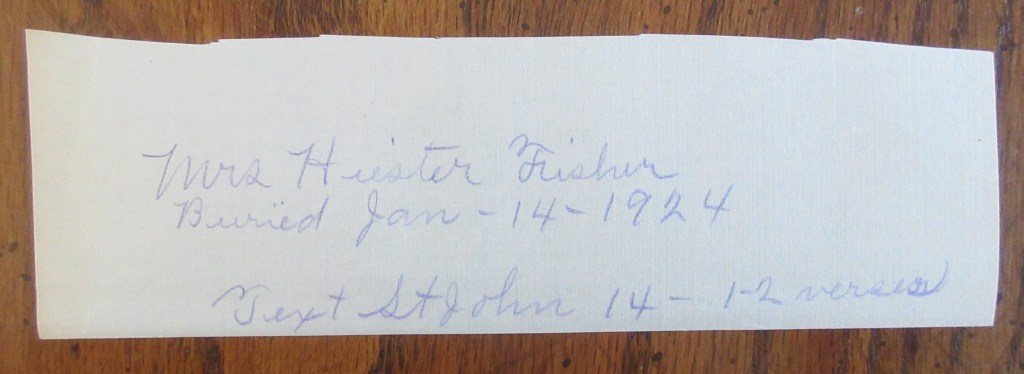
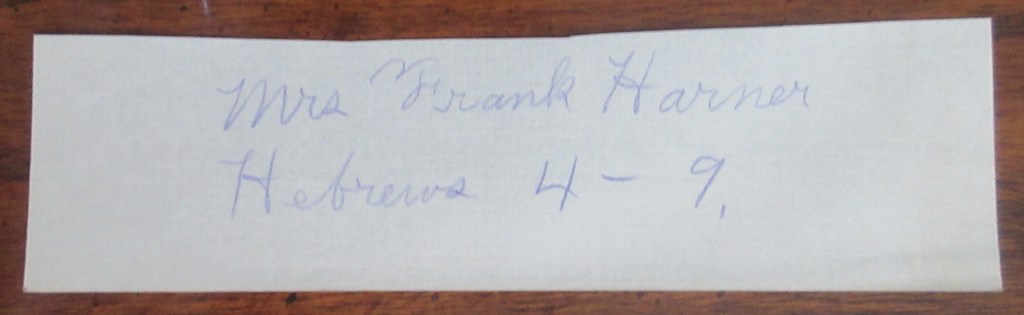
Of the two other handwritten notes in “The Breitenstein Bible,” one note gives the burial date of Mrs. Hiester Fisher and the reference to a scripture text.  The other note simply states the name Mrs. Frank Harner and a scripture reference.  Over the years, as I’ve compiled a genealogy of my husband’s family, I have never seen the name Fisher nor Harner.  So, I proceeded to try to identify who Mrs. Hiester Fisher and Mrs. Frank Harner were.

In my search for someone named Hiester Fisher, I came up with no likely candidates.  But a search using the spelling Heister (e before i) led me to someone that could be the husband of the woman commemorated in “The Breitenstein Bible.”  In 1920, Sallie Breitenstein (Amos’ daughter) and her husband were living in Amity Township in Berks County.7  There was also living in this township a Heister Fisher with his wife Ellen.8  A few years later Ellen and subsequently Heister were buried in Saint Paul’s Church Cemetery in Amity Township.  The date of death engraved on Ellen’s gravestone is January 10, 1924,9 which would correspond to the burial date listed on the handwritten note, January 14.  A search in family trees on Ancestry.com leads to the conclusion that her maiden name was most likely Ellen Wise or Weise or Weiss.  She would have been in the generation of Sallie’s mother. Incidentally, Saint Paul’s Church Cemetery is where Sallie and her husband would later be buried. 

Presumably, the second-oldest handwritten note in “The Breitenstein Bible”
John 14:1-2 as printed in “The Breitenstein Bible,” which is the text recorded along with Mrs. Hiester Fisher’s burial date

Since the handwritten note about Mrs. Frank Harner doesn’t have a death or burial date, it is difficult to determine with any certainty who she was.  My guess is that she was Catherine (Kate) S. Rhoads who is buried in Saint Paul’s Church Cemetery with her husband, Franklin, but the last name on the gravestone is Herner, instead of Harner.  Kate Rhoads was also of the generation of Sallie’s mother.  Her death date was April 8, 1925.10  Kate’s sister, Rosa Ellen Rhoads, had married a man named Wellington Wise,11 who was possibly a relation of Ellen Wise (Mrs. Heister Fisher above.)

Presumably, the third-oldest handwritten note in “The Breitenstein Bible”
Hebrews 4:9 as printed in “The Breitenstein Bible,” which is the text noted with Mrs. Frank Harner’s name

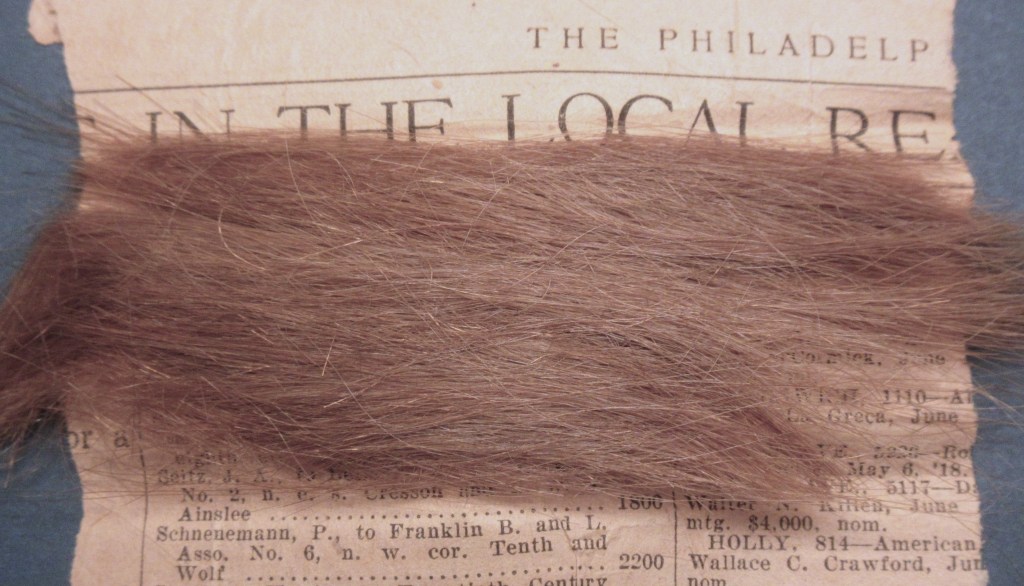
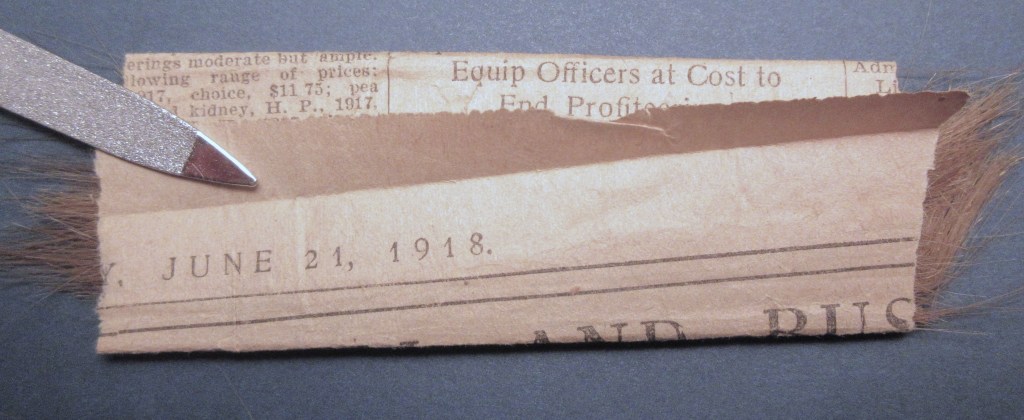
There is an item in “The Breitenstein Bible” that is older than the three handwritten notes.  It is a lock of hair wrapped in a scrap of newsprint dated June 21, 1918.  Perhaps this could be the hair of Ellen S. Goodhart, saved as a memento by her husband Amos or her daughter Sallie.  Born March 29, 1849, Ellen was the daughter of Peter S. Levan (1822-1894) and Sarah E. Snyder (1825-1898).  One historian of Berks County made this statement in 1886: “The Levan family have occupied a prominent position in [Exeter] township for one hundred and fifty years, having, during this time, owned a large area of farming land where the members of that family are now located.  They gave much encouragement to the Schwartzwald Church by liberal contributions.”12  The Levan family can be traced back to three brothers whose father Daniel Levan was a French Huguenot.  “The Huguenots were French Protestants most of whom eventually came to follow the teachings of John Calvin, and who, due to religious persecution, were forced to flee France to other countries in the sixteenth and seventeenth centuries.”13  Daniel Levan fled from France to Amsterdam, Holland, which is where Isaac Levan was born, Ellen Levan’s 4th great-grandfather.14  Isaac and his brothers emigrated from Amsterdam to America and Isaac eventually settled in Exeter Township about 1730.

A lock of hair, which was wrapped in a scrap of newsprint, found in “The Breitenstein Bible”
The scrap of newsprint dated June 21, 1918

Ellen Goodhart died on October 19, 1918 and was buried in Schwarzwald Cemetery.15  Like her husband, her death was recorded in the death register of Schwarzwald Reformed Church.  During that time period, the usual number of burials per month in that cemetery was one or two, or sometimes three.  But in October 1918, the death register lists seven people dying between October 14 and October 27.  Although the causes of death were recorded as heart disease, pneumonia, tuberculosis, and influenza, consideration should be given to an historic event that was taking place in Pennsylvania during the fall of 1918.  An epidemic of influenza had begun in Philadelphia in late September and travelled from the city west through the state, reaching Berks County.

In The Great Influenza, author John M. Barry thoroughly relates the events and timelines of many of the outbreaks of influenza in the United States, and a few places abroad, from 1917 to 1919.  He devotes a portion of his book to the rise of the epidemic in Philadelphia.16  The details and quotes below are from Barry’s book.  In 1918 influenza spread to Pennsylvania when on “September 7, three hundred sailors arrived from Boston at the Philadelphia Navy Yard.”  Four days later, “nineteen sailors reported ill with symptoms of influenza.”  Knowing that influenza was wreaking havoc in Boston:

Lieutenant Commander R. W. Plummer, a physician and chief health officer for the Philadelphia naval district … ordered the immediate quarantine of the men’s barracks and the meticulous disinfecting of everything the men had touched. …

… The next day eighty-seven sailors reported ill.  By September 15, … the virus had made six hundred sailors and marines sick enough to require hospitalization, and more men were reporting ill every few minutes”.

On September 18, “…the Evening Bulletin assured its readers that influenza posed no danger, was as old as history ….”  The first two sailors dying of influenza in Philadelphia occurred the next day.  “…Plummer declared, ‘The disease has about reached its crest.  We believe the situation is well in hand.  From now on the disease will decrease.’”  The city’s director of public health, Dr. Wilmer Krusen insisted that “the dead were not victims of an epidemic; he said that they had died of influenza but insisted it was only ‘old-fashioned influenza or grip.’”  The next day fourteen sailors died and the first civilian died.  The following day there were more than twenty deaths.

On September 21, the city’s Board of Health “assured the city that it was ‘fully convinced that the statement issued by Director Krusen that no epidemic of influenza prevails in the civil population at the present time is absolutely correct.’”

Seven days later, on September 28, a great Liberty Loan parade, designed to sell millions of dollars of war bonds, was scheduled.  Weeks of organizing had gone into the event, and it was to be the greatest parade in Philadelphia history, with thousands marching in it and hundreds of thousands expected to watch it.

Influenza continued spreading through the city, “… the day before the parade, hospitals admitted two hundred more people – 123 of them civilians ….”  Even though several doctors urged Krusen to cancel the parade, “Krusen declared that the Liberty Loan parade and associated rallies would proceed.”

On September 28, marchers in the greatest parade in the city’s history proudly stepped forward.  The paraders stretched at least two miles, two miles of bands, flags, Boy Scouts, women’s auxiliaries, marines, sailors, crushing against each other to get a better look, the ranks behind shouting encouragement over shoulders and past faces to the brave young men.  It was a grand sight indeed.

Two days after the parade, Krusen issued a somber statement: ‘The epidemic is now present in the civilian population and is assuming the type found in naval stations and cantonments.’

… Within seventy-two hours after the parade, every single bed in each of the city’s thirty-one hospitals was filled.  And people began dying.

… On October 1, the third day after the parade, the epidemic killed more than one hundred people – 117 – in a single day.

From Philadelphia the epidemic spread west into Pennsylvania.  Three weeks after the parade, people in Berks County were dying of influenza.  The Schwarzwald Reformed Church death register documents that two of its members succumbed to influenza.  A question lingers over the other five deaths recorded that month – was the influenza virus a contributing factor in their deaths; for example, in Ellen Goodhart’s death which was recorded as heart disease?


In October 2018 Surgeon General Rupert Blue of the U. S. Public Health Service issued the following information about the epidemic:

The disease now occurring in this country and called ‘Spanish Influenza’ resembles a very contagious kind of ‘cold’ accompanied by fever, pains in the head, eyes, ears, back or other parts of the body and a feeling of severe sickness.  In most of the cases the symptoms disappear after three or four days, the patient then rapidly recovering.  Some of the patients, however, develop pneumonia, or inflammation of the ear, or meningitis, and many of these complicated cases die. …

There is as yet no certain way in which a single case of ‘Spanish influenza’ can be recognized.  On the other hand, recognition is easy where there is a group of cases.  In contrast to the outbreaks of ordinary coughs and colds, which usually occur in the cold months, epidemics of influenza may occur at any season of the year.  Thus the present epidemic raged most intensely in Europe in May, June and July.  Moreover, in the case of ordinary colds, the general symptoms (fever, pain, depression) are by no means as severe or as sudden in their onset as they are in influenza.  Finally, ordinary colds do not spread through the community so rapidly or so extensively as does influenza. …

No matter what particular kind of germ causes the epidemic, it is now believed that influenza is always spread from person to person, the germs being carried with the air along with the very small droplets of mucus, expelled by coughing or sneezing, forceful talking, and the like by one who already has the germs of the disease.  They may also be carried about in the air in the form of dust coming from dried mucus, from coughing and sneezing, or from careless people who spit on the floor and on the sidewalk.  As in most other catching diseases, a person who has only a mild attack of the disease himself may give a very severe attack to others. …

It is very important that every person who becomes sick with influenza should go home at once and go to bed.  This will help keep away dangerous complications and will, at the same time, keep the patient from scattering the disease far and wide.  It is highly desirable that no one be allowed to sleep in the same room with the patient.  In fact, no one but the nurse should be allowed in the room. …

… Only such medicine should be given as is prescribed by the doctor.  It is foolish to ask the druggist to prescribe and may be dangerous to take the so-called ‘safe, sure and harmless’ remedies advertised by patent medicine manufacturers.

If the patient is so situated that he can be attended only by some one who must also look after others in the family, it is advisable that such attendant wear a wrapper, apron or gown over the ordinary house clothes while in the sick room and slip this off when leaving to look after the others.

Nurses and attendants will do well to guard against breathing in dangerous disease germs by wearing a simple fold of gauze or mask while near the patient. …

When crowding is unavoidable, as in street cars, care should be taken to keep the face so turned as not to inhale directly the air breathed out by another person.

“It is especially important to beware of the person who coughs or sneezes without covering his mouth and nose.  It also follows that one should keep out of crowds and stuffy places as much as possible, keep homes, offices and workshops well aired, spend some time out of doors each day, walk to work if at all practicable – in short, make every possible effort to breathe as much pure air as possible.

In all health matters follow the advice of your doctor and obey the regulations of your local and state health officers.

Cover up each cough and sneeze,

 if you don’t you’ll spread disease.17


1. __________, “Erection of County” in Historical and Biographical Annals of Berks County Pennsylvania, vol. 1, ed. Morton L. Montgomery (Chicago: J. H. Beers & Co., 1909), 8.

2. __________, “Daniel B. Keehn” in Historical and Biographical Annals of Berks County Pennsylvania, vol. 2, ed. Morton L. Montgomery (Chicago: J. H. Beers & Co., 1909), 999.

3. “United States Census, 1860”, , FamilySearch (https://www.familysearch.org/ark:/61903/1:1:MXPZ-BTN : Thu Mar 07 06:01:10 UTC 2024), Entry for John Newkirk Goodhart and Sufiah Goodhart, 1860.

4. “United States Census, 1880”, , FamilySearch (https://www.familysearch.org/ark:/61903/1:1:MW6B-F7D : Sun Mar 10 10:50:22 UTC 2024), Entry for Amos Goodhart and Ellen Goodhart, 1880.

5. Schwarzwald Reformed Church, Protocol of the German Reformed Church at Schwartzwald commencing with the ministry of Rev. Aaron S. Leinbach in Pennsylvania and New Jersey, Church and Town Records, 1708-1985 [microfilm collection of Historical Society of Pennsylvania] (Provo, UT, USA: Ancestry.com Operations, Inc., 2011), image 115, http://www.Ancestry.com.

6. Schwarzwald Reformed Church, German Reformed Church at Schwartzwald, image 75.

7. “United States Census, 1920”, , FamilySearch (https://www.familysearch.org/ark:/61903/1:1:M6BG-RV5 : Fri Mar 08 15:45:19 UTC 2024), Entry for Jacob Breitinstine and Sallie Breitinstine, 1920.

8. “United States Census, 1920”, , FamilySearch (https://www.familysearch.org/ark:/61903/1:1:M6BP-24K : Sat Mar 09 08:45:24 UTC 2024), Entry for Heister Fisher and Ellen Fisher, 1920.

9. Find a Grave, “Ellen G. Weiss Fisher,” https://www.findagrave.com/memorial/59396049/ellen-g-fisher.

10. Find a Grave, “Catherine S. “Kate” Rhoads Herner,” https://www.findagrave.com/memorial/59239221/catherine_s-herner.

11. __________, “Wellington L. Wise” in Historical and Biographical Annals of Berks County Pennsylvania, vol. 2, ed. Morton L. Montgomery (Chicago: J. H. Beers & Co., 1909), 1101.

12. M. L. M., “Townships of Berks County,” History of Berks County, Pennsylvania (location unknown: Everts, Peck & Richards, 1886), 973.

13. National Huguenot Society, Who Were the Huguenots? (2024), https://nationalhuguenotsociety.org/who-were-the-huguenots/.

14. __________, “Henry B. Levan” in Historical and Biographical Annals of Berks County Pennsylvania, vol. 1, ed. Morton L. Montgomery (Chicago: J. H. Beers & Co., 1909), 494.

15. Schwarzwald Reformed Church, German Reformed Church at Schwartzwald

16. John M. Barry, The Great Influenza (New York: Viking Press, 2004): 197-220.

17. “Uncle Sam’s Advice on Flu,” Saturday News (Watertown, South Dakota), October 10, 1918, 5, Newspapers.com.

Reminiscences of Uncle Bob, Part Three

After his family spent 15 months in Omaha, Nebraska (see Reminiscences of Uncle Bob, Part Two), Robert L. Daily reported in an interview when he was about 84 years-old that his family moved to Kansas because “Mother wanted to get back to the farm again, so Dad went lookin’ around again,” and Robert gives a date: “We moved down to Kansas in 1909.  So, that was, see, when I was comin’ nine years old.  We landed down in March, and ‘course, I was nine years old in May, see.”1  Robert also said that in that year his father’s brother William brought his oldest daughter Inez to live with Robert’s family when they were living in Kansas, and Robert said that Inez looked like her father.2

In the trunk that holds many Daily memorabilia, the portrait below can be found.  The photograph is labeled “Wm. J. Daily and C. M. Daily” and in the lower right corner of the image the words “Topeka, Kansas” are embossed below the photographer’s name.  It is most likely that this portrait was taken when William brought his daughter to Kansas.  William would have been about 47 years-old and Charles, 53 years-old.

Wm. J. Daily and C. M. Daily

One of Charles’ grandsons recalled what his mother Gladys and grandmother Maggie said about the farm: “I can remember my mother talking about a farm in Kansas which had lots of walnuts on it” and they cracked a lot of walnuts.3  Robert identified the location of the farm in his interview:

Uncle Bob:  … Kilmer, Kansas was where it was at. It was just a flag station.

Interviewer:  It wasn’t Topeka?

Uncle Bob:  Topeka was, was 8 miles from us.

Interviewer:  Oh, I see.

Uncle Bob:  It was our —

Interviewer:  Mom always said Topeka.

Uncle Bob:  No, that’s our post office.

Interviewer: Uh huh.

Uncle Bob: We were, we were 8 miles out from Topeka at Kilmer, just a flag station.  And uh, we generally went to Meriden, that went the other direction, four miles to Meriden.  For, up to, uh —

Interviewer:  For shopping?

Uncle Bob:  Yeah.  ‘Course, we’d go to Topeka for circus or for, and the capitol, see.  I can remember going through the capitol in Topeka, Kansas, y’see.  Yeah, yeah.4


A section of a Shawnee County, Kansas, map showing Soldier Township5

A flag station is “a railroad station where trains stop only when a flag or other signal is displayed or when passengers are to be discharged.”6  Northeast of Topeka, Kilmer was a small station on the Atchison, Topeka and Santa Fe Railroad which crossed the southeast corner of Soldier Township in Shawnee County.7  The Daily family may have ridden a train into Topeka to see a circus performance.  One of the circuses that was scheduled to perform in Topeka was the Barnum and Bailey Circus.  It came to Topeka on September 7, 1909, but the city newspaper reported that the circus couldn’t be set up because of the weather.8  Record-breaking rain (over eight inches) fell that day, flooding the site where the circus was to be set up.9 The following year, the Ringling Brothers Circus arrived on September 5.  In the Monday evening issue of the Topeka State Journal, which sold for 2 cents, the following article described the spectacle that the circus provided.

Cropped image from The Topeka State Journal, September 5, 1910

Ringlings’ “Big Top” today is the attraction in Topeka.  Sunday the interest was hardly less.  Thousands of persons watched the parade which came on time nothwithstanding the rain, with hardly less interest than did an almost equal number see the unloading and transfer of the circus from the Rock Island yards to the Kenwood tract near Fourth and Buchanan streets.

As the pageant was a chain of novel surprises likewise was the trail of wagons and the animals following the arrival.  The parade was nearly three miles long and the aforementioned surprises extended from the twenty-four horse band chariot in the lead to the tail end.  The rain fell all right and continued during the forenoon, making it difficult for the wagons to leave the grounds.

The show arrived here Sunday morning after some delay, in coming from St. Joseph.  About 9 o’clock the first wagon reached Kenwood.  Immediately the work of putting up the huge cook tent was started.  Stands began to spring up on adjacent property to the main entrance to the grounds between Buchanan and Lincoln streets on Fourth street.

Most of the paraphernalia was transferred in wagons, the majority of them being pulled by six horses each.  These were driven out Sixth avenue after having left the Rock Island yards.  Arriving at Buchanan street they again turned north to the Kenwood tract.  As soon as the wagons left the Buchanan street pavement going onto Fourth street difficulty was experienced.  The recent rains had made the unpaved street soft and the wagons mired to the hubs.  It was necessary to unload some of them before they could be moved.  Others were moved with 22, 24 and even 32 horses.

No sooner than the work of pitching the cook tent was started, crowds began to arrive from all directions.  From noon on there was a steady stream of humanity down Buchanan street from Sixth avenue to Kenwod.  A baby carriage brigade seemed to have been formed.  For two or three hours the day seemed to have been set apart for their display alone.  There was grandpa and papa and mamma and uncle and even forty-seventh cousin of each of them.  All had a baby.  In fact every woman who had a baby to loan was in great demand.  That condition seemed not to abate.

Crowd Gets a Ducking.

Pedestrians were not alone in their evidenced curiosity.  Car after car reached the tract, all of them packed.  Extras were put on and these, too, were filled to capacity.  Twenty or thirty spectators got wet when the circus employes stopped at Fifth and Buchanan streets to cool and water the elephants and the polar bears.  A hose was attached to the water plug and the operation started.  No sooner had the bears been given a bath than the hippopotamus arrived.  He had to have a bath, too.

Then was when the fun started.  An “accident” occurred.  Mr. Keeper intentionally or not allowed the water hose to get away from him.  He struggled with the rubber tube which under the pressure of water lunged and pulled and drenched a number of nearby onlookers.  Still he struggled manfully.  The hose got him down.  More persons were drenched.  Finally when the crowd had retired to a safe distance he gained control of it again.

Noticeable about the circus aggregation was that of all the employees none of them was given to loud talking or profanity in the time required to get the paraphernalia in its place.  Another noticeable thing was that the usual number of hardened men were conspicuously absent.  Most of the following was represented in young men appearing to be college students and others of that character.

Features of the Parade.

In the parade some of the remarkable features were teams of elephants, camels, zebras and llamas hitched to ornate tableau floats and driven like horses.  It has been supposed that the zebra could not be driven.  The Ringlings have proved otherwise.  In all nearly 700 horses were exhibited, the most of them Norman Percherons.  Many of them were white.

More than 1,200 men, women and children from Australian bushwackers to those advertised as the royalty of Asia and Europe took part.  Music was provided by six brass bands, a cathedral organ, a calliope, barbarian orchestras, fife and drum corps, church chimes, trumpeters and Oriental string and reed musicians.10


Besides the circus, Robert mentioned that he had visited the capitol of Kansas in Topeka.

This sepia colored photograph [below] shows the capitol in Topeka, Kansas. Located on twenty acres of land once owned by Cyrus K. Holliday, work began on October 17, 1855 when the cornerstone was laid for the east wing. Thirty-seven years later the statehouse, an example of French Renaissance architecture and Corinthian details, was completed at a total cost of $3,200,588.92.”11

Kansas State Capitol, Topeka, Kansas

On April 26, 1910 a census taker visited the Daily family at the farm they were renting in Soldier Township, Shawnee County, Kansas.  Charles is mistakenly recorded as being 56 years-old (he was 53), Maggie was 42 years-old.  Their five children were living with them:  Gladys, age 17; Oranna, 14; Robert, 9; Iona, 7 and Elizabeth, 5.12  In addition, there were also in the household Inez Daily, age 16 and Alpha Bailey, age 20.  Inez was the daughter of William Daily, noted above.  Alpha was Charles’ nephew, the son of his sister Cynthia, who had come to live with the Dailys in 1908.  All of the children, including Gladys and Inez, attended school for a period of time between September 1, 1909 and the end of April 1910.  Robert said that Inez went to school for a couple of years and then got married in Kansas.13  Charles and Maggie kept ownership of their house in Omaha and according to the 1910 U. S. census of Omaha, the house was being rented by a bartender named Samuel J. Barth.  In the Barth household were his wife Sophia and daughter Edith.14

The same census taker that visited the Daily family also visited a farmer named Lawson Bonnewitz, who owned a farm in Soldier Township.15  Maggie and Lawson were cousins.  Jacob Bonewitz (b. 1761) was their great-grandfather.  Two of Jacob’s sons were Joseph Bonewitz (b. 1790), who was Lawson’s grandfather, and John Adam Bonewitz (b. 1792), who was Maggie’s grandfather.  


One event in Kansas that Robert related was the baptism of two of his sisters:

Uncle Bob:  … When we lived in Kansas we was able to go to church more than any place else.  ‘Course, we, we had, uh, afternoon services, see.

Interviewer:  Oh, uh, circuit rider type.

Uncle Bob:  Yeah, and o’ course, a minister came out from, I don’t know where.  Meriden or Topeka, one o’ the two.  An’ I guess he was a Baptist minister, see, ‘cuz Gladys and Oranna were both, uhh, immersed in the river.

Interviewer:  Oh!  Uh huh.

Uncle Bob:  At that time, … ‘course, they were old enough to be baptized.  An’ I think Baptists, when you get right down to it

Interviewer:  I suppose that they —

Uncle Bob:  … that they don’t believe, didn’t believe in baptizing before 12 years old, see.

Interviewer:  Um hmm, um hmm.

Uncle Bob:  An’ Oranna an’ Gladys were still o’ that age.  I didn’t get in on it.  See, it was still before I was 12 years-old.  Either ten or eleven is what I was.  I can remember it so well.  We, uh, like the, like the song goes, “Shall we gather at the river,” see.

Interviewer:  Um hmm, um hmm.

Uncle Bob:  An’ that’s when we gathered at the river an’ the minister walked in. This’s out in the pasture, down in the pasture of our neighbors.

Interviewer:  Um hmm.

Uncle Bob:  That’s where we had our meeting there, went through there.  An’ that’s where Gladys and Oranna —

Interviewer:  Was it Omaha then?  This would be the Missouri River? 

Uncle Bob:  No, no, this was just a creek [pronounced crick].

Interviewer:  Oh, okay.

Uncle Bob:  Creek that went through the pasture, down in Kansas.16


Robert may have been referring to a hymn written by Robert Lowry in 1864, entitled, “Shall We Gather at the River?”

  1. Shall we gather at the river,
    Where bright angel feet have trod,
    With its crystal tide forever
    Flowing by the throne of God?
  2. On the margin of the river,
    Washing up its silver spray,
    We will talk and worship ever,
    All the happy golden day.
  3. Ere we reach the shining river,
    Lay we every burden down;
    Grace our spirits will deliver,
    And provide a robe and crown.
  4. At the smiling of the river,
    Mirror of the Savior’s face,
    Saints, whom death will never sever,
    Lift their songs of saving grace.
  5. Soon we’ll reach the silver river,
    Soon our pilgrimage will cease;
    Soon our happy hearts will quiver
    With the melody of peace.

Refrain:
Yes, we’ll gather at the river,
The beautiful, the beautiful river;
Gather with the saints at the river
That flows by the throne of God.
17


Joseph Esli Daily’s birth announcement which is stored in the trunk that holds Daily memorabilia

On February 8, 1911, Maggie gave birth to another son, Joseph Esli.  Sadly, the boy didn’t live to his first birthday.  Charles and Maggie buried Joseph in Evergreen Memorial Park in Omaha, where they had buried their first son, who had died in 1899.  Robert gives a few details about Joseph’s short life.

Interviewer:  But, the baby boy —

Uncle Bob:  Oh, Joseph?

Interviewer:  Joseph — was born and died in Topeka.

Uncle Bob:  Yeah, yeah.  … Mother always came up to see Grandma, once a year, around Christmas time, see.  And ‘course, other years Iona an’ Elizabeth, … would come up, too.  But when Joseph was born, a baby, she wanted the baby to, Grandma to see the baby, see.  Joseph.  And o‘ course, ah, that year was the time that I, Joseph and I came up with her.

Interviewer:  You mean up to Omaha.

Uncle Bob:  Yeah, up to Omaha.  See, he was born in 1911.  Passed away in January 1912.

Interviewer:  Oh, okay.

Uncle Bob:  That was Joseph, he was just ‘leven months old.  … but we’d been up to Omaha, and got back, and then he got the croup.  And ah, he was a little weak anyway in the spine.  He never had set up, really.  He was happy.  He’d lay on the lounge and watch us kids play on the floors and that.  But when it come to this here getting the croup.  So, why, that’s when —

Interviewer:  Went into pneumonia, I suppose.

Uncle Bob:  Yeah, suppose.  In those days, that’s what they’d call it.  Lungs filled up some, I guess.18


For years the details were somewhat of a mystery regarding when and how Charles and Maggie’s youngest daughter’s name came to be Elizabeth J. Best Viola Daily.  Since no one has been able to locate a birth record for Elizabeth, it is unclear whether she had that name at her birth or if she acquired the name later.  One of Elizabeth’s children thought that she had been given money to carry on the name of a woman named Elizabeth J. Best, another thought the woman’s name was J. Best and that property was involved.

Early in 2019 one of Elizabeth’s children was searching through old items that are kept in the trunk which has been previously mentioned and “… he came across some interesting info.  Mom stayed with someone in Indiana and went to school.  He came up with the name Stults and money being passed back and forth.  I suggested this may be the money Mom received for being named after Elizabeth J Best.  This morning I typed Elizabeth J Best in the internet search line and came up with Elizabeth J Stults Best.”19  The source of this name was the Find-a-Grave memorial page of Elizabeth J. Best (nee Stults) of Huntington County, Indiana.20  The webpage identifies the cemetery where she was buried, it is the same cemetery where one of Maggie’s brothers is buried,21 as well as her maternal grandparents Harman and Barbara Smith22,23 and her great-grandfather Jacob Flora (Barbara’s father).24

In August 2019, I found a document accessible on Ancestry.com that revealed some intriguing details.  It is the will of Elizabeth J. Best, dated October 26, 1910.  In the will, Elizabeth J. Best Daily of Omaha, Nebraska, is named as an heir.  Additionally, in March 2020, when listening to Robert’s interview, additional details came to light:

Uncle Bob:  … Elizabeth was heir to some money back East.

Interviewer:  I heard about that.

Uncle Bob:  See, she uh, Elizabeth Best was her name. And, Grandma’s name was Josephine Smith, as they went to school together.

Interviewer:  Ohhh.

Uncle Bob:  But they didn’t have no, no middle names, see.  So, Grandma took the name of — Elizabeth’s initial, E.  She was Josephine E. Bonewitz, that’s her married [name].  And Best took, took, uhh —

Interviewer:  Josephine, took the J.

Uncle Bob:  Yeah, took the J.  And she was, that’s the reason, she got the name Elizabeth J. Best, see.

Interviewer:  Okaaay.

Uncle Bob:  So, that’s the way she picked that up, see.

Interviewer:  And this was a school friend of Josephine Smith?  Okay.

Uncle Bob:  Yes, that’s right, and she was very wealthy.  O’ course, as I mentioned, ever’thin’ ended up, why, she [Robert’s sister Elizabeth] lived with the woman at that time in 1912.  Elizabeth was born in 1905, 7 years old.

Interviewer:  Um hmm.

Uncle Bob:  And, o’ course, uh then, ahh, all the time she was goin’ to school afterwards – the Elizabeth Best, or Elizabeth J. Best, ahh, had a friend, I can’t say what his name was, the lawyer, the lawyer, a friend lawyer.  And he was bound and determined that her word was law, see, ever’thin’ she said.  And Elizabeth’s other relatives tried to, tried to break the, uh —

Interviewer:  The will.

Uncle Bob:  — the will.  But he stuck in there and o’ course all the while she was goin’ to school, up ‘til she was 18, why, anythin’ needed for school, that’d come off the, off of her inheritance.

Interviewer:  Well, she had quite an inheritance, then!

Uncle Bob:  I don’t know what it was, I never knew what it was.  I know, I just know that she uh, afterwards when she come home, why, ‘course that’s what really put Willis on his feet there, because he, ahh, when she inherited that money, why ‘o course, uh, they bought out, uh — I can’t say what his name was down there —

Interviewer:  He bought down in that Grover area.

Uncle Bob:  Down in Grover area, see.  An’ o’ course, she gave each of us fifty dollars.  ‘Course, I think somewhere roun’ twenty-five hundred dollars is what she got.  ‘Course, at that time, was pretty good money.25

Elizabeth Stults was born in Stark County, Ohio,26 the same county in which Josephine Smith was born.  Both of their families moved to Huntington County, Indiana.27,28  Robert explains that they were school mates.  When Elizabeth Stults got married, she added a middle initial “J” to her name, becoming Elizabeth J. Best.  And when Josephine Smith got married, she added the middle initial “E” to her name, becoming Josephine E. Bonewitz.

Best’s husband Joseph C. Best had passed away seven years before she wrote her will and their only two children had died in infancy.29  So, at the time of the writing of her will, Best had no direct heirs.  Her will names 11 people as heirs, including Josephine’s granddaughter, Elizabeth J. Best Daily.

The date that the will was probated was April 21, 1911.  Along the edges of the will there is an accounting of when funds were distributed to the heirs.  The first distribution was October 24, 1914 and the last was December 23, 1916.  Each time a distribution is noted for Elizabeth J. Best Daily, it is received by a person named M. B. Stults.  It appears that this was the guardian for young Elizabeth.  Perhaps this is the friend or lawyer to which Robert referred in the interview.  Robert’s explanation clears up some questions, including the name of the woman, and confirmation that there was money given, and he also provides information as to why property was attached to the mystery.

Last will and testament of Elizabeth J. Best,
a friend of Elizabeth Daily’s grandmother Josephine Bonewitz

On May 1, 1912, Charles and Maggie’s third daughter Iona was honored by the Shawnee County School Superintendent.  She was in the third grade and had earned seven monthly Certificates of Perfect Attendance.  This achievement entitled her to receive a Certificate of Award for Punctual and Regular Attendance.

Certificate for Punctual and Regular Attendance awarded to third grade student, Iona Daily

On January 5, 1913, Maggie mailed a postcard to her daughter Elizabeth at their home north of Topeka. The text of the postcard indicates that Maggie had been in Omaha during the Christmas holidays. Maggie wrote: “How is my little lady getting along. Are you as busy since Christmas. I told grandma about your Xmas piece. She thought it was very nice. I hope I get some word from home tomorrow. good by with love to all. mama”

Front of Maggie’s postcard postmarked January 5, 1913
Back of Maggie’s postcard postmarked January 5, 1913

Apparently, Maggie was in Omaha because her father was seriously ill. On January 12, 1913, Maggie’s father, John Esli Bonewitz, passed away.  About thirteen years earlier, when Charles and Maggie’s baby died two days after its birth, Charles had bought a lot in Evergreen Memorial Park (Section A, Block 26, Lot 3).  Their son Joseph Esli was buried in that lot on January 5, 1912, and Maggie’s father was buried there on January 14, 1913 alongside the two sons.

Interment record of the cemetery lot owned by C. M. Dailey
in Evergreen Memorial Park, Omaha, Nebraska

Presently, in the cemetery lot, there are no grave markers for the un-named baby nor for Joseph Esli.  The interment record states that Joseph Esli was buried in grave #7 and John Esli was buried in grave #4.  It doesn’t indicate the location of the un-named baby, but a very helpful employee of the cemetery diagramed the lot, and there is a high probability that the baby was buried in grave #8. 

Two months after Maggie’s father passed away, the Daily family moved back to Omaha again.  In the next blogpost, Uncle Bob will continue his reminiscences of the next two years while they resumed living there.


1 M. R. Wilson, transcription of Robert Lee Daily Interview by R. Thiele, recording (ca. 1984): 6.

2 Wilson, Robert Lee Daily Interview: 13 & 16.

3 L. A. Bevers, personal communication with M. R. Wilson, August 10, 2010 and November 24, 2010.

4 Wilson, Robert Lee Daily Interview: 22-23.

5 The Kenyon Company, Inc., Atlas and Plat Book of Shawnee County Kansas (Topeka, Kansas: Kansas Farmer and Mail & Breeze, 1921): 5, https://www.kansasmemory.org/item/224002/page/7.

6 “Flag station,” Dictionary.com, https://www.dictionary.com/browse/flag-station.

7 James L. King, ed., History of Shawnee County, Kansas and Representative Citizens (Chicago: Richmond & Arnold, 1905): 55, https://ia902604.us.archive.org/7/items/historyofshawnee00king/historyofshawnee00king.pdf.
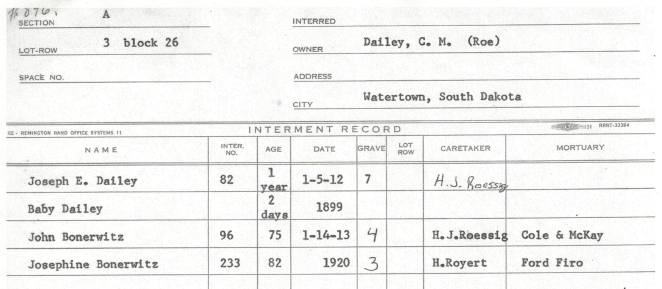
8 “Big Show Goes By,” The Topeka State Journal, September 7, 1909, https://chroniclingamerica.loc.gov/lccn/sn82016014/1909-09-07/ed-1/seq-1/.
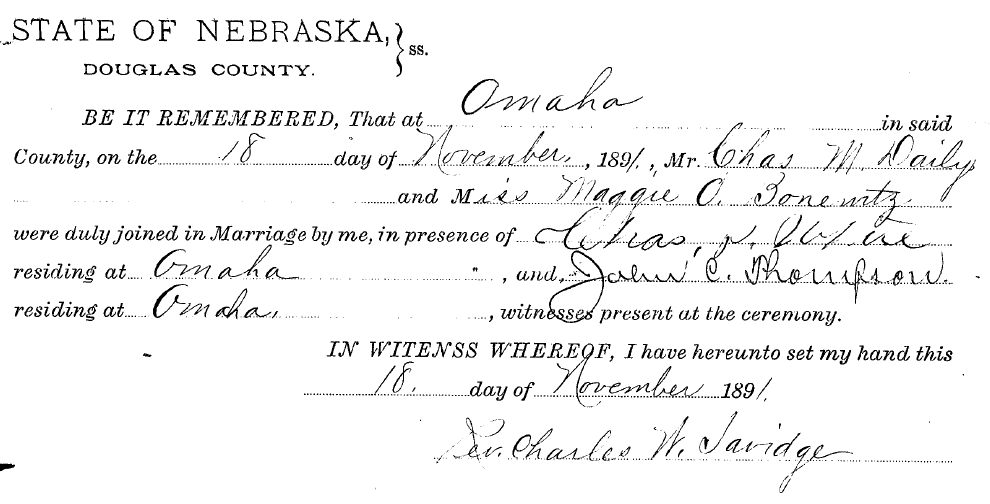
9 “Eight-Inch Rain,” The Topeka State Journal, September 7, 1909, https://chroniclingamerica.loc.gov/lccn/sn82016014/1909-09-07/ed-1/seq-1/.

10 “Big Show Is Here,” The Topeka State Journal, September 5, 1910, https://chroniclingamerica.loc.gov/lccn/sn82016014/1910-09-05/ed-1/seq-5/.

11 Capitol, Topeka, Kansas, postcard, ca. 1910, https://www.kansasmemory.org/item/215285.

12 “United States Census, 1910,” database with images, FamilySearch (https://familysearch.org/ark:/61903/3:1:33SQ-GRJZ-GJ1?cc=1727033&wc=QZZQ-PF3%3A133640801%2C140502701%2C134349501%2C1589089094 : 24 June 2017), Kansas > Shawnee > Soldier > ED 140 > image 8 of 22; citing NARA microfilm publication T624 (Washington, D.C.: National Archives and Records Administration, n.d.).

13 Wilson, Robert Lee Daily Interview: 14-15.

14 “United States Census, 1910,” database with images, FamilySearch (https://familysearch.org/ark:/61903/3:1:33S7-9RVD-94BH?cc=1727033&wc=QZZW-D1C%3A133641701%2C133718401%2C136867001%2C1589089011 : 24 June 2017), Nebraska > Douglas > Omaha Ward 11 > ED 81 > image 15 of 30; citing NARA microfilm publication T624 (Washington, D.C.: National Archives and Records Administration, n.d.).

15 “United States Census, 1910,” database with images, FamilySearch (https://familysearch.org/ark:/61903/3:1:33S7-9RJZ-GRH?cc=1727033&wc=QZZQ-PF3%3A133640801%2C140502701%2C134349501%2C1589089094 : 24 June 2017), Kansas > Shawnee > Soldier > ED 140 > image 20 of 22; citing NARA microfilm publication T624 (Washington, D.C.: National Archives and Records Administration, n.d.).

16 Wilson, Robert Lee Daily Interview: 21-22.

17 Robert Lowry, “Shall We Gather at the River?,” 1864, Timeless Truths, https://library.timelesstruths.org/music/Shall_We_Gather_at_the_River/.

18 Wilson, Robert Lee Daily Interview: 6.

19 E. J. Jones, email communication with M. R. Wilson, February 2, 2019.

20 “Elizabeth J Stults Best,” https://www.findagrave.com/memorial/63599577/elizabeth-j-best.

21 “Rosco Neff Bonewitz,” https://www.findagrave.com/memorial/62071397/rosco-neff-bonewitz.

22 “Harman Smith,” https://www.findagrave.com/memorial/62815250/harman-smith.

23 “Barbara Marguet Flora Smith,” https://www.findagrave.com/memorial/62071353/barbara-marguet-smith.

24 “Jacob Flora,” https://www.findagrave.com/memorial/62852349/jacob-flora.

25 Wilson, Robert Lee Daily Interview: 7-8.

26 “Joseph C. Best,” Biographical Memoirs of Huntington County, Ind. (Chicago: B. F. Bowen, 1901): 587.

27 “United States Census, 1850,” database with images, FamilySearch (https://familysearch.org/ark:/61903/3:1:S3HY-6QMQ-QDH?cc=1401638&wc=95RX-2JQ%3A1031336301%2C1031975601%2C1031975602 : 9 April 2016), Indiana > Huntington > Huntington county > image 49 of 194; citing NARA microfilm publication M432 (Washington, D.C.: National Archives and Records Administration, n.d.).

28 “United States Census, 1860,” database with images, FamilySearch (https://familysearch.org/ark:/61903/3:1:33S7-9YBY-65K?cc=1473181&wc=7QK5-RD2%3A1589426070%2C1589426540%2C1589423705 : 24 March 2017), Indiana > Huntington > Huntington > image 41 of 41; from “1860 U.S. Federal Census – Population,” database, Fold3.com (http://www.fold3.com : n.d.); citing NARA microfilm publication M653 (Washington, D.C.: National Archives and Records Administration, n.d.).

29 “Joseph C Best,” https://www.findagrave.com/memorial/61993911/joseph-c-best.

Four Weddings in Omaha

On October 14, 1882, a young man named Charles W. Savidge arrived in Omaha to begin serving as the pastor of First Methodist Church.1   Located at Seventeenth and Davenport, the congregation had been established in September 1855,2 a year and a half after the village of Omaha had been incorporated in Nebraska Territory.  When Rev. Savidge wrote his autobiography in 1914, he had served as a minister in Omaha for 31 years, having left the city for only one year to minister in Grand Island, Nebraska.  Regarding one of his accomplishments, Rev. Savidge stated, “I have now married nearly three thousand couples.  I have married all kinds of people, all colors, nearly all nationalities and all ages; some have been young, some old and others middle-aged.”3

Nearly six months after beginning his ministry in Omaha, Rev. Savidge performed the marriage ceremony of John C. Thompson and Emma V. Bonewitz.  The groom was the 22 year-old son of Benjamin and Elizabeth Thompson and was a newspaper editor, residing in Brownville, Nebraska, a city about 75 miles south of Omaha.  Thompson is mentioned in a history of Brownville:

“April, 1882, J. Thompson, a young man who learned the printer’s trade in the Advertiser office, purchased an office in Fullerton, Neb., and established a Republican paper in the old Advertiser office, on the north side of Main street, between First and Second. He has named his paper the Brownville Republican.”4

The bride was the 18 year-old daughter of John E. and Josie Bonewitz, whose family had moved to Omaha in 1880.  The wedding was performed on May 6, 1883, at Emma’s parents’ home and announced in one of the city newspapers, Omaha Daily Bee:

“At 4 p. m. Sunday, at the residence of the bride’s parents, No. 1623 Dodge street, Mr. John C. Thompson, editor of the Brownville Republican, was united in Marriage to Miss Emma V. Bonewitz, Rev. Savidge, of First M. E. church, officiating.  Only the relatives and intimate friends of the high contracting parties were present, but the affair was a most auspicious one, and the presents received were both costly and beautiful.  The happy couple left Sunday evening for their home in Brownville.”5


Rev. Savidge had performed his first wedding in 1879.  He has related that at the time he did not know what to do in that ceremony, so he asked a Presbyterian pastor who served in the same area and he was given some instructions.6  Thirty-five years later, Rev. Savidge wrote:

Some ministers have a very long and tedious marriage service, but my service is short and to the point.  There is not so much dependent on the length of the service and the minister as there is upon the contracting parties themselves.

“It is up to them whether they will be happy or miserable.  Here is a copy of my brief marriage ceremony:

“ ‘Will thou have this woman to be thy wedded wife to live together after God’s ordinance in the holy state of matrimony?

“ ‘Wilt thou have this woman to be thy wedded wife in health, and forsaking all others, cleave thee only unto her?’

“The bridegroom answers, ‘I will.’

“I then ask the bride the same questions concerning the groom.  She answers, ‘I will.’

“I then direct the bridegroom to place the ring on the third finger of his lady’s left hand and, holding the hand, to repeat after me these words:

“ ‘With this ring I thee wed, and with my worldly goods I thee endow; in the name of the Father, the Son and the Holy Ghost.’

“I then close that part of the service with these words: ‘For as much as this man and this woman have consented together in holy wedlock, have witnessed the same before God and this company, and signified the same by joining of hands, I pronounce that they are husband and wife together, in the name of the Father, the Son and the Holy Ghost.’

“I then offer the following brief prayer: ‘And now may God, the Father, and the Son and the Holy Ghost bless, preserve and keep you.  The Lord mercifully look upon you; so fill you with all benediction and grace that ye may so live together in this life that in the world to come ye may have life everlasting.’

“Sometimes I add this prayer: ‘Lord, bless this man and woman, now this husband and wife.  Bind them together Thyself and may they never be separated by any discord or difference or rent apart by the action of any divorce court, but may death alone break this bond.  In order that they may live long and prosper, we pray they may believe in Thee, the living God, as much as Daniel ever did.  That they may take the Bible as the inspired word of God and Man of their counsel, thus laying the foundation of happiness here and felicity forever.  For the sake of Jesus Christ, our Lord.  Amen.’ ”7


A year after John and Emma’s wedding, Rev. Savidge performed the marriage ceremony of Emma’s 23 year-old sister, Carrie Bonewitz, who had arrived in Omaha with her family in 1880.  Carrie married 25 year-old Charles P. White, the son of S. M. and Anna White, on June 12, 1884.  At least six years prior to their marriage and before Carrie had moved to Omaha, White and Carrie’s brother Orlando were boarding at the same boarding house, Donovan House, in Omaha.8  White resided in Omaha for a few years between 1878 and 1884, but on his marriage license his residence is recorded as Tobias, Nebraska.  Tobias was a new railroad village that had been platted and incorporated in the early spring of 1884.9

One of the witnesses of this marriage was S. H. Buffett.  This was White’s employer, a grocer whose name, Sidney H. Buffett, can be found in the Omaha city directories starting at 1870.  Initially, White had worked as a teamster for Buffett,10 later he worked as a clerk.11  The other witness who signed the marriage license was William T. Lyons, who was probably White’s mother’s brother.

Marriage Record of Charles P. White and Carrie Bonewitz

In 1886, Rev. Savidge performed a third wedding for a member of the Bonewitz family.  This time, 27 year-old Harman (sometimes called by his middle name Finley) married a 25 year-old dressmaker, Cornelia B. Higley, on December 29.  When the 1880 U. S. census was taken, both the Bonewitz family and the Higley family resided in Fairfield, Iowa.12,13  Harman and his father and brother Orlando had gone to Omaha for work as early as 1878, but apparently, Harman didn’t permanently move to Omaha until 1880 when his entire family moved there.  In 1885, Cornelia was still living with her parents, Judson and Ruah Higley, in Fairfield when the Iowa state census was taken,14 but in 1887 Cornelia and her parent’s names appear in the Omaha city directory.  One of the signatures of the witnesses on Harman and Cornelia’s marriage license is possibly Cornelia’s father’s signature.  The other signature is very difficult to read, but may be the signature of Harman’s brother-in-law, Charles P. White.

Marriage License of Harman Bonewitz and Cornelia Higley

In his autobiography, Rev. Savidge had some sage words regarding “The Marriage Fee”:

“The true minister of the Gospel does not charge a regular fee for his services at the marriage.  He depends upon the generosity of the bridegroom and his appreciation of his bride.

“The minister has many avenues for his surplus change and his income is generally limited.  Don’t forget the preacher, boys!

“It is very poor taste indeed for the bridegroom after the ceremony to ask the minister what his bill is or what the charges are.  This is often done, but it is not the thing to do; it throws a sort of coldness over the meeting.

“The bridegroom ought to have his offering for the minister in his vest pocket, or better still, in an envelope, and then quietly hand it to him.

“That sum ought not to fall below $5.00.  A ten-dollar bill looks better to me!

“The groom who remembers the minister liberally will not lose in the long run.  A man ought not to be married often during this earthly life and he can afford to be manly and generous at this time.

“This whole transaction from start to finish is a test of manhood.  Brother, walk up and stand the test!

“I have often married people where I received no fee at all, but it seemed to me a good deal like tying up cattle.

“The largest fee I ever received was $50.00, but I prayed eight hours for that fellow.  I said, ‘Lord, work him up and help him give me a good fee, for I need the “dough.” ’

“He gave me, sealed in an envelope, ten five-dollar bills.  I praised the Lord and used the money.  One of the smallest, meanest fees I ever got, was some shade trees for the church and the trees died.  I guess they got ashamed and quit.”15

After serving at First Methodist Church for six years, Rev. Savidge was assigned to Grand Island, Nebraska in 1888.  He only served there one year, because during that year Rev. Savidge felt a conviction that his work in Omaha was not done.  He has written: “God seemed to pull on me and put a message from Himself in my very soul, that He had plans for me in this city, and the past twenty-four years have proved that my convictions at that time were from God.”16  So Rev. Savidge requested to be assigned to Omaha again and to found his own church, which would be called the People’s Church.  He has explained how he started the new work in Omaha:

“I … hired Boyd’s Opera House on Fifteenth and Farnum Streets for twenty-five dollars every Sunday.

“… The congregation was made up of the unchurched masses.  Men and women who never went to any regular church went there.  Harlots, drunkards and gamblers came to see and to hear: Many of these were benefited.

“I started a Sunday School in the lower part of the city and we instructed children of all nationalities and colors.

“… When the hot weather came on, I was compelled to give up the opera house and transfer my services to the Newman M. E. Church.”17

In the fall of 1891, Rev. Savidge decided to discontinue his association with the Methodist Episcopal denomination.18  He determined to be an independent minister and once again established the People’s Church, purchasing the old United Presbyterian Church building located on 18th Street near California for $1,000.19


That same fall, Rev. Savidge performed a fourth marriage ceremony for the Bonewitz family.  In about 1886, the family had moved to West Side, a developing addition to Omaha.  At some point in the late 1880s, Josephine Bonewitz began running a boarding house in that area, and a man named Charles M. Daily became one of the boarders and became acquainted with Maggie Bonewitz, the youngest daughter of John and Josephine Bonewitz.20  The son of Joseph and Amanda Daily, Charles Daily had worked his way from Indiana, across Illinois and Iowa for about 15 years, and finally settled in Omaha.  His first known employer in Omaha was Charles P. White,21 who was operating a feed and coal business, and was the brother-in-law of Maggie.  Daily worked for several years for White and on November 18, 1891 when 35 year-old Daily married 24 year-old Maggie, White signed the marriage certificate as a witness.  The other witness was Maggie’s other brother-in-law John C. Thompson.

Signed Marriage License of Charles M. Daily and Maggie O. Bonewitz
Charles Monroe Daily and Maggie Oranna (Bonewitz) Daily on their wedding day, November 18, 1891

The dress that Maggie wore on her wedding day was passed down to one of her daughters and then to one of her grandsons.  About ninety years after Maggie wore the dress for her wedding photograph, one of her great granddaughters posed for a photograph wearing Maggie’s dress.  The dress is still brought out for display at the biennial reunions of the combined Daily and Bevers families.

Maggie Daily’s wedding dress, modeled by a great granddaughter

As time went by, Rev. Savidge began to be consulted by many families regarding marriageable prospects.  In his autobiography, he writes:

“I am a firm believer in marriage.  We can never beat the evils of the present day except the people enter the marriage relation and establish their own homes.  God says, ‘He setteth the solitary in families.’

“Marriage is the order of God, the foundation of society, the church and the state.  Many people among us who have their own homes do not know the intense desire of those who are not so situated.  Our cities are crowded with women, good women, who have no chance to meet agreeable gentlemen, and there are many good men on ranches, farms and in mining, and even in our crowded cities who have small opportunity to meet good women.

“In recent years, on account of my age and experience, many come to consult with me on this subject.  Mothers bring their daughters and beg me to use my influence to have them properly settled in life.  It might do the skeptical on this subject much good to read some of the letters I receive.  One lady said, ‘The desire for a home and love is with me constantly; it haunts my every waking hour.’

“In the Bible you may read a very beautiful story of how Isaac got his wife, in Genesis, twenty-fourth chapter.

“Abraham’s eldest and most trusted servant attended to this business with alacrity and devotion, and with the evident blessing of God.

“Other people can dip in a little to help others if they have the skill and ability.  I have a bureau of information on marriage in my downtown office, which in the past year has worked wonders.  I have a most competent secretary who takes the details off of me and I hope to assist many worthy people in the future.”22

One last quote from Rev. Charles W. Savidge: “It is a perfectly natural thing to marry.  Man never got up this scheme; it is a plan of God.  It is folly to try to beat it.”23

Resources:

  1. Charles W. Savidge, Have faith in God (Omaha, Nebraska: Beacon Press, 1914):38-39, http://www.usgennet.org/usa/ne/topic/religion/MECHURCH/faith/pages/hfig0038.htm.
  2. David Marquette, History of Nebraska Methodism: First Half-Century (1904): 56, http://www.usgennet.org/usa/ne/topic/religion/MECHURCH/hmec/pages/honm0052.htm.
  3. Charles W. Savidge, Have faith in God: 89, http://www.usgennet.org/usa/ne/topic/religion/MECHURCH/faith/pages/hfig0083.htm#ch25.
  4. John McCoy, transcriber, History of the State of Nebraska by William Cutler (Chicago: The Western Historical Company, 1882): https://www.kancoll.org/books/andreas_ne/nemaha/nemaha-p6.html#press.
  5. Omaha Daily Bee (Omaha, Nebraska: Omaha Daily Bee, May 8, 1883):8, https://www.newspapers.com/image/466624152.
  6. Charles W. Savidge, Have faith in God: 89.
  7. Charles W. Savidge, Have faith in God: 89, 91.
  8. J. M. Wolfe, publisher, Wolfe’s Omaha City Directory 1878-1879 (Omaha, Nebraska: Herald Publishing House and Book Bindery, 1878): 97 & 286.
  9. Helen Kottas, “Nebraska…Our Towns, Tobias — Saline County”: https://casde.unl.edu/history/counties/saline/tobias/.
  10. J. M. Wolfe, publisher, Wolfe’s Omaha City Directory 1878-1879: 286.
  11. J. M. Wolfe, publisher, Wolfe’s Omaha City Directory 1881-1882 (Omaha, Nebraska: Herald Printing, Binding and Electrotyping House, 1881): 421.
  12. “United States Census, 1880,” database with images, FamilySearch (https://familysearch.org/ark:/61903/3:1:33SQ-GYYV-9R3L?cc=1417683&wc=XHBX-C68%3A1589394762%2C1589396075%2C1589395491%2C1589396695 : 24 December 2015), Iowa > Jefferson > Fairfield > ED 81 > image 60 of 64; citing NARA microfilm publication T9, (National Archives and Records Administration, Washington, D.C., n.d.)
  13. “United States Census, 1880,” database with images, FamilySearch (https://familysearch.org/ark:/61903/3:1:33SQ-GYYV-9RN5?cc=1417683&wc=XHBX-C68%3A1589394762%2C1589396075%2C1589395491%2C1589396695 : 24 December 2015), Iowa > Jefferson > Fairfield > ED 81 > image 19 of 64; citing NARA microfilm publication T9, (National Archives and Records Administration, Washington, D.C., n.d.)
  14. “Iowa State Census, 1885,” database with images, FamilySearch (https://familysearch.org/ark:/61903/3:1:939Z-YGHT-J?cc=1803643&wc=M6L6-Q23%3A145017901%2C145048501 : 1 April 2016), Jefferson > Fairfield, Fairfield > image 67 of 152; State Historical Society, Des Moines.
  15. Charles W. Savidge, Have faith in God: 92-93, http://www.usgennet.org/usa/ne/topic/religion/MECHURCH/faith/pages/hfig0092.htm.
  16. Charles W. Savidge, Have faith in God: 51, http://www.usgennet.org/usa/ne/topic/religion/MECHURCH/faith/pages/hfig0045.htm.
  17. Charles W. Savidge, Have faith in God: 51-52.
  18. Charles W. Savidge, Have faith in God: 55.
  19. Charles W. Savidge, Have faith in God: 56, http://www.usgennet.org/usa/ne/topic/religion/MECHURCH/faith/pages/hfig0056.htm.
  20. E. J. B. V. Bevers, personal communication with M. R. Wilson, ca. 1976.
  21. Omaha City and South Omaha City Directory for 1889 (Omaha, Nebraska: J. M. Wolfe & Co., Publishers, 1889): 194.
  22. Charles W. Savidge, Have faith in God: 93-94.
  23. Charles W. Savidge, Have faith in God: 92.

What Became of the Huppler Orphans?

Immigrants John and Anna Huppeler1, with their six children, arrived at the Port of New York in April 1874.2  Two months later, at the Circuit Court of Monroe County, Wisconsin, a declaration of intention to become a citizen of the United States was signed by John Huppler.3  Then nearly a year later, the name John Huppler appears on the Wisconsin state census.  As of June 1, 1875, he and his household were residing in Burns Township, La Crosse County.4  The census record indicates that there were four males and four females in the household, presumably these are John and his sons Christian, John and Friedrich and his wife Anna and daughters Rosetta, Anna Elizabeth5 and Lena.  This census of Burns Township also includes the household of John’s brother Jacob Hueppler, which had two males and three females.6  There is also a David Hueppler, which is probably another brother of John, having two males and two females in the household.7

Tragically, both John and Anna Huppler lose their lives within several months of being recorded on the 1875 Wisconsin census.  A century after their deaths, in a tribute to their daughter Anna Elizabeth’s 105th birthday, a statement is made: “When she was 6 her mother died and 6 mo. later, her father died. The 6 kids were placed with different families.”8  (According to other documentation of her age, Anna Elizabeth was actually eight years old when her parents died.)  The ages of the other children were: Christian, about 12; Rosetta, age 10; John, age 6 or 7; Friedrich, age 5 and Lena, age 3.

So, what became of these six children?  There is some family lore and a few documents that lead us to some possibilities of where the children were placed.  One family historian, a descendant of Lena, obtained from a descendant of Christian a copy of a document dated March 4, 1876, signed by two Supervisors of the town of Burns in La Crosse County, Wisconsin.  The document bound Christian as an indentured servant to William Sawyer of Burns until Christian reached the age of 21 years-old.  A portion of the document reads as follows:

“… Whereas Christian Huppler now 13 years of age, a minor son of John Huppler and his wife Anna, late of said Burns, both deceased, is a resident of said town of Burns and destitute of means of support and has become a charge whom said town for support ….  The Supervisors of the town of Burns have and by these presents do put and bind this said Christian Huppler unto the said William Sawyer as a servant for and until he shall have attained the full age of 21 years which will be on 22 Aug 1884 during which time the said servant shall serve his master faithfully, honestly and industriously….  The said William Sawyer hereby covenants, promises and agrees to and with said Board of Supervisors that he will furnish and provide said Christian Huppler with suitable and sufficient clothing, board and food and proper care, medical attendance in case of sickness and cause him within the said term to be instructed to read and write and in the general rules of mathematics and use him with proper care and extend to him suitable treatment and at the end of said terms he will give to said Christian Huppler the sum of $100.  And for the time performance of all and singular this covenants and agreements aforesaid, the said parties bind themselves each unto the other firmly by these presents.  In witness whereof the parties have set their hands and seals 4 Mar 1876.”9

William Sawyer was a farmer who had been living in La Crosse County since at least 1860 (his name is on the 1860 U. S. Census of the town of Bangor).10  According to the 1870 U. S. Census for Burns, William Sawyer’s household included his wife and three children, as well as another child, two farm laborers and a domestic servant.11  Christian himself can be found on the 1880 U. S. Census as part of the William Sawyer household, which was still residing in Burns.12  This census record identifies 16 year-old Christian’s relationship to the head of the household as “servant” and his occupation as “farm hand.”  Christian also attended school within the census year and he could read and write.  The birth place listed for Christian and his parents is “Switland” (this is assumed to be Switzerland).

1880 U. S. Census record of the William Sawyer household, which includes “Criss Huppler.”

According to the widow of one of Christian Huppler’s sons, the Huppler girls were raised by families with the name of McIntyre, Campbell and Christians, and she said that young John Huppler was raised by his uncle Jacob Huppler.13   She also said that “one boy died young of malaria after moving south.”  As yet I have not been able to locate the placements of Rosetta nor Friedrich Huppler, but I have collected some information about Anna Elizabeth, John and Lena.

Sorting out who Anna Elizabeth was raised by and when she left Wisconsin has been difficult to determine.  According to the above-mentioned article written when Anna Elizabeth turned 105-years-old, as an orphaned child “she lived and worked with the Alex McIntyre family” and the article also states that “two of her … brothers came to South Dakota and when she was 16 she joined them.”14  Alternatively, the text of the funeral folder of Anna Elizabeth seems to contradict the article, stating, “In 1880 she came to South Dakota with the William MacIntyre family.”15  William McIntyre was an early settler and businessman in Codington County, South Dakota (one source states that his arrival in Dakota Territory was in 1877, not 1880).16

“William and Adelaide [his wife] came to the tree claim he had staked two miles west of what is now Watertown.  They were accompanied by a large contingent of settlers including two of his brothers.  …They were very active in the early years of the city.  He served as mayor and was appointed to the group authorized to organize Codington County.”17

Anna Elizabeth might not have actually moved to South Dakota at the same time as William McIntyre.  In the 1880 U. S. Census of Sparta, Wisconsin, there is a record of a 13 year-old girl by the name of Annie in the household of Ester McIntyre who was married (not widowed), but her husband wasn’t in the household at the time the census was taken.18  The relationship of Annie to the head of the household (Ester) is recorded as “adopted.”  According to a posting about Esther McIntyre on the Find-a-Grave website, Esther’s husband was Alexander McIntyre and they had adopted Annie.19  Perhaps this is Anna Elizabeth Huppler.  Another posting on this website indicates that Alexander McIntyre moved to Watertown, South Dakota in 1886.20  If Anna Elizabeth did go to South Dakota when she was sixteen (which was 1883), then she may have left from the Alex McIntyre home, three years before he moved to South Dakota.

1880 U. S. Census record of the Ester McIntyre household, which includes adopted 13-year-old “Annie.”

Possible confirmation of the statement that young John Huppler was raised by his uncle Jacob comes from a census record that actually leaves us with some uncertainty due to spelling inconsistencies.  There is an 1880 U. S. Census record of a man named Jacob Hipler, living in Burns, Wisconsin21, the same town where Jacob Huppler was living when the Wisconsin state census was taken in 1875.  The Jacob of this 1880 census record is from Switzerland, as well as the two children in the household.  One of the children is named John, but the other is listed as Laura.  Yet both of the children are in the age range of John and Lena Huppler.  In the census record, their relationships to the head of the household are: son and daughter.

1880 U. S. Census record of Jacob Hipler household, which includes John and Laura.
(I propose that this is actually Jacob Huppler with his nephew John and niece Lena Huppler.)

After eight and a half years, the indenture of Christian Huppler was completed on August 23, 1884 when he turned 21 years-old.  Two years later he made his way to Codington County, South Dakota and began farming.22  Apparently, Christian’s relationship with his master William Sawyer was a good one, and after settling in South Dakota, Christian wrote to William.  This fact is known due to the existence of a letter written by William’s daughter Lena Sawyer to Christian.  Lena Sawyer’s letter states that she was writing a week after William Sawyer received a letter from Christian.  In her letter dated September 15, 1889, she calls herself his friend, she tells him of her impressions of South Dakota and informs him of the doings of the members of her family.  According to the wife of a family historian who is a descendant of Lena, the text of the letter reads:

“Father received your letter last week.  We are glad to know that you keep well and like Dakota.  I think it is just the place for young men and women too if they have plenty of courage.  I have often thought that I would like to own a piece of land in Dakota but could not well take a homestead. What kind did you get and are there any claims near yours.  I want land for speculation, not for a home for I could not stand Dakota winters.  I think some of taking a trip to Huron this fall to visit the cousins there.  Susie and Johnnie have moved to Mankato, MN.  Mother went East the middle of July.  She returned last week and brought a niece with her from NY.  Frank went to CA the first of July.  He thinks of spending a year in a law school at San Francisco then will settle in Stockton.  Said he would not be back for 10 years.  Allie has been home a month.  She is going to teach in the Graded School at Long Prairie next year.  Helen is at home. She is very anxious to learn short-hand and type-writing.  Edgar has moved to LaCrosse and working at carpentry.  Your friend, Lena”23

The 1915 South Dakota state census record of Lena Bevers indicates that she had been living in South Dakota for 29 years, which would mean that she moved to South Dakota in 1886, when she was 14-years-old.24  This is the same year that Lena’s cousin Kate Huppler Dellman moved to South Dakota with her husband J. H. Dellman.25  Kate was the second daughter of Jacob Huppler.  If it is true that three-year-old orphaned Lena was taken in by Jacob Huppler, then Kate would have been sixteen-years-old at the time.  Around five years later, in December 1880, Kate married Julius Dellman.26  Then, in the same year that Christian Huppler moved to Codington County, the Dellmans moved to Watertown, South Dakota.  Perhaps young Lena Huppler had joined the Dellmans during their move to South Dakota.

According to family lore learned by one of Christian Huppler’s descendants, Christian was instrumental in bringing all of his siblings to South Dakota.27  Briefly, the following information is known about the residences of Christian and his siblings as young adults.

  • “Christian’s name is one of 22 settlers who signed a petition filed April 16, 1889 asking that the area be organized into a civil township known as Phipps Township.”28
  • It is not yet known which family took in Rosetta Huppler when her parents died, nor when and how she made her way to South Dakota.  But she was living in Phipps Township, Codington County, South Dakota when she married Gottlieb Christian in 1900.29
  • Anna Elizabeth “had her own homestead near the McIntyre home which was north of Watertown and just west of Rauville.”30  Also, she and her husband Dougal Campbell were living in Phipps Township in 1900.31
  • As a young man John Huppler must have lived in South Dakota for a short time.  He was there in 1892 when his sister Lena married Herbert Bevers.  John and his sister Anna Elizabeth were witnesses who signed Lena and Herbert’s marriage certificate.32  John must have returned to Wisconsin about 1893 because he was married there about 1894.
  • Little is known about Friedrich.  As yet, no record has been found of his living in South Dakota.  Some family historians give him a death date of about the year 1900.  Perhaps he died in the south of malaria, as one story reports about one of the Huppler boys.33
  • According to Lena’s marriage license dated November 1892, she was a resident of Watertown, Codington County, South Dakota at that time.34

Notes:

  1. The Huppler name is spelled in a variety of ways on different documents.  When a document is referenced, the name is spelled as it is written in the document.
  2. “New York Passenger Lists, 1820-1891,” database with images, FamilySearch (https://familysearch.org/ark:/61903/1:1:QK97-V815 : 11 March 2018), John Huppeler, 1874; citing Immigration, New York City, New York, United States, NARA microfilm publication M237 (Washington, D.C.: National Archives and Records Administration, n.d.), FHL microfilm 175,744.
  3. “Declaration of John Huppler,” (Circuit Court, Monroe County, Wisconsin: June 12, 1874).
  4. Wisconsin Historical Society; Madison, Wisconsin; Census Year: 1875; Roll: 3 (https://ancestry.com. Wisconsin, State Censuses, 1855-1905 [database on-line]. Provo, UT, USA: Ancestry.com Operations Inc, 2007).
  5. Both names (Anna Elizabeth) are used throughout this article because some resources refer to her as Anna and some refer to her as Elizabeth, Liz or Lizzie.
  6. Wisconsin Historical Society; Census Year: 1875.
  7. Wisconsin Historical Society; Census Year: 1875.
  8. Jenkins Methodist Home News, v. 6 no. 3, “105th Birthday” (Watertown, South Dakota: Jenkins Methodist Home, August 1972), 1.
  9. M. A. Bevers, email communication to M. Wilson, April 20, 2020.
  10. “United States Census, 1860”, database with images, FamilySearch (https://familysearch.org/ark:/61903/1:1:MW9S-VXG : 18 March 2020), William Sawyer, 1860.
  11. “United States Census, 1870”, database with images, FamilySearch (https://familysearch.org/ark:/61903/1:1:MN9L-331 : 19 March 2020), William Sawyer, 1870.
  12. “United States Census, 1880,” database with images, FamilySearch (https://familysearch.org/ark:/61903/1:1:MN4R-LFZ : 17 September 2017), William P Sowyer, Burns, La Crosse, Wisconsin, United States; citing enumeration district ED 44, sheet 335A, NARA microfilm publication T9 (Washington, D.C.: National Archives and Records Administration, n.d.), FHL microfilm 1,255,432.
  13. M. A. Bevers, notes of an interview with Geraldine Huppler, widow of Jim Huppler, July 1991 (posted to Johannes Hüpperle in “Bevers-Daily-McFerran-Nelson Families” family tree on Ancestry.com, n.d.).
  14. Jenkins Methodist Home News, “105th Birthday.”
  15. Shaw-Messer Funeral Home, “Anna E. Campbell, 1867-1972” (Watertown, South Dakota: Shaw-Messer Funeral Home, January 3, 1973).
  16. “William McIntyre Family,” In The First 100 Years in Codington County, South Dakota, 1879-1979, by Codington County History Book Committee (Watertown, South Dakota: Watertown Public Opinion Print, 1979): 264.
  17. “William McIntyre Family,” In The First 100 Years in Codington County, South Dakota, 1879-1979: 264.
  18. “United States Census, 1880,” database with images, FamilySearch (https://familysearch.org/ark:/61903/1:1:MNHW-FTG : 23 August 2017), Ester Mcintyre, Sparta, Monroe, Wisconsin, United States; citing enumeration district ED 29, sheet 93A, NARA microfilm publication T9 (Washington, D.C.: National Archives and Records Administration, n.d.), FHL microfilm 1,255,439.
  19. Find a Grave, database and images (https://www.findagrave.com : accessed 28 March 2020), memorial page for Esther E Husted McIntyre (27 May 1837–8 Jul 1912), Find a Grave Memorial no. 88550806, citing Leon Cemetery, Sparta, Monroe County, Wisconsin, USA; Maintained by Susan Hunt Williams (contributor 47664730).
  20. Find a Grave, database and images (https://www.findagrave.com : accessed 28 March 2020), memorial page for Alexander “Alex” McIntyre (18 Jun 1838–18 Nov 1907), Find a Grave Memorial no. 88523698, citing Leon Cemetery, Sparta, Monroe County, Wisconsin, USA; Maintained by Susan Hunt Williams (contributor 47664730).
  21. “United States Census, 1880,” database with images, FamilySearch (https://familysearch.org/ark:/61903/1:1:MN4R-RN5 : 17 September 2017), Jacob Kipher, Burns, La Crosse, Wisconsin, United States; citing enumeration district ED 44, sheet 341B, NARA microfilm publication T9 (Washington, D.C.: National Archives and Records Administration, n.d.), FHL microfilm 1,255,432.
  22. “Christian Huppler Family,” In The First 100 Years in Codington County, South Dakota, 1879-1979, by Codington County History Book Committee (Watertown, South Dakota: Watertown Public Opinion Print, 1979): 208.
  23. M. A. Bevers, email communication to M. Wilson, April 20, 2020.
  24. “South Dakota State Census, 1915,” database with images, FamilySearch (https://familysearch.org/ark:/61903/1:1:MMHW-WHC : 29 July 2017), Lena Bevers; citing State Historical Society, Pierre; FHL microfilm 2,283,122.
  25. “J. H. Dellman Family,” In The First 100 Years in Codington County, South Dakota, 1879-1979, by Codington County History Book Committee (Watertown, South Dakota: Watertown Public Opinion Print, 1979): 156.
  26. “J. H. Dellman Family,” In The First 100 Years in Codington County, South Dakota, 1879-1979: 156.
  27. M. L. Winzenburg, email communication with K. Bevers, Apr. 19, 2017.
  28. “Christian Huppler Family,” In The First 100 Years of Codington County, South Dakota, 1879-1979: 208.
  29. M. A. Bevers, notes of the marriage record of Rosa Huppler and Gotlip (sp?) Christian (posted to Rosetta Huppler in “Bevers-Daily-McFerran-Nelson Families” family tree on Ancestry.com, n.d.).
  30. Jenkins Methodist Home News, “105th Birthday.”
  31. “United States Census, 1900,” database with images, FamilySearch (https://familysearch.org/ark:/61903/1:1:MMRS-CZZ : accessed 15 April 2020), Anna E Campbell in household of Degald Campbell, Fuller, Richland & Phipps Townships, Codington, South Dakota, United States; citing enumeration district (ED) 102, sheet 7B, family 131, NARA microfilm publication T623 (Washington, D.C.: National Archives and Records Administration, 1972.); FHL microfilm 1,241,548.
  32. “Marriage License of Herbert J. Beavers and Lena Huppler” (Circuit Court, Codington County, South Dakota: November 23, 1892).
  33. M. A. Bevers, notes of an interview with Geraldine Huppler.
  34. “Marriage License of Herbert J. Beavers and Lena Huppler.”

Day Twenty-Seven: Raymondville, Texas

November 8, 2019

Retracing Lena Huppler Bevers’ Travel Log

Sat. – Nov. 8.

Started out and got in Raymondville about 10 o’clock A. M. and went into our new home.

We crossed 4 toll bridges and was ferried across the Canadian river. – Lena Bevers

On the twenty-seventh day after leaving Watertown, South Dakota, Lena Bevers recorded that her family arrived in Raymondville, Texas about 10:00 AM. Her daughter Florence wrote in her travel log that they had driven 50 miles that morning.1 They were still traveling about 15 miles per hour.

Raymondville was only 15 years old when Herbert and Lena arrived there.  It was a small town.  By 1914 the population was only 350, but there were “four general stores, a bank, a newspaper, a hotel, a cotton gin, and a lumber company. Agriculture, primarily the raising of sorghum, cotton, citrus fruits, vegetables, and corn, drove the town’s growth in its early years.”2  Today, my mother and I didn’t find any dated historical buildings of the early 1900s.

Raymondville, Texas (Photograph by MRW November 8, 2019)
Courtyard in downtown Raymondville, Texas (Photograph by MRW November 8, 2019)
A mural in the courtyard in downtown Raymondville, Texas (Photograph by MRW November 8, 2019)
A mural in downtown Raymondville, Texas (Photograph by MRW November 8, 2019)

On January 5th, 1920 a U. S. census taker visited the Bevers family.  At that time, Raymondville was in Cameron County, then in 1921 Willacy and Cameron Counties were reorganized.  Raymondville became the county seat for Willacy County.  According to the census record, Herbert was a farmer and he and his family were living on a rented farm.3  Herbert was 50 years old and Lena was 48.  The six children that rode with them in the car are listed on the census record, as well as their son Willis who had accompanied the livestock on the train.  Today, my mother and I spent a couple hours at the Cameron County Archives Office in Brownsville, Texas.  We uncovered enough information that we believe will lead us to the area where Herbert Bevers was farming and we will go there tomorrow.

Willacy County Courthouse completed in 1923, Raymondville, Texas (Photograph by MRW November 8, 2019)

Notes:

  1. B. Winkelmann, Our Trip to Texas [Transcription of Our Trip to Texas by Florence Bevers, 1919] (unpublished, n. d.): 5.
  2. Handbook of Texas Online, Stanley Addington, “RAYMONDVILLE, TX,” http://www.tshaonline.org/handbook/online/articles/hfr02.
  3. “United States Census, 1920,” database with images, FamilySearch (https://familysearch.org/ark:/61903/3:1:33S7-9RX1-KXK?cc=1488411&wc=QZJT-MQX%3A1037034201%2C1036604401%2C1037078301%2C1589332571 : 14 September 2019), Texas > Cameron > Justice Precinct 8 > ED 38 > image 3 of 25; citing NARA microfilm publication T625 (Washington, D.C.: National Archives and Records Administration, n.d.).

Day Twenty-Six: Alice to Raymondville, Texas

November 7, 2019

Retracing Lena Huppler Bevers’ Travel Log

Fri. Nov. 7.

Left San Diego and drove for miles through timber.  Stayed all night on the praire in the car. – Lena Bevers

November 7, 1919 was a very similar day for the Bevers family as the day before.  They continued their drive south through timber.  For my mother and I, the landscape today was also similar to yesterday’s: fields and pastures with patches of woods, especially at the edges of the fields and along the highway.

A grove at a roadside park could be similar to the type of timber that the Bevers family traveled through. (Photograph by MRW November 7, 2019)

From Alice, Texas there are two routes that we could take to get to Raymondville.  U. S. Highway 281 runs south from Alice to Linn, then Highway 186 goes east to Raymondville. An alternative route would be driving to Kingsville, then take U. S. Highway 77 south to Raymondville.  On a 1924 Rand McNally map there are roads at the location of U. S. Hwy 281 and Highway 186.1  There is also a road to Kingsville, but about 15 miles south of Kingsville the road doesn’t extend to Raymondville.  Therefore, the highways we drove today were U. S. Highway 281 and Highway 186.

At Falfurrias, we decided to visit the Heritage Museum.  One picture on the display wall seems to represent what Herbert was doing in Texas.

A photograph of a real estate office in Falfurrias, Texas in 1920, hanging in the Falfurrias Heritage Museum. (Photograph by MRW November 7, 2019)

In Florence Bevers’ travel log, in the entry for November 8, 1919, she states that they had 50 miles to drive to get to Raymondville.2  Based on this statement, I propose that the Bevers and McElhanys spent the night in the vicinity of Encino or Rachal, Texas.  The place where my mother and I stopped for a picnic lunch at a roadside park is close to the point where Lena wrote that they spent the night on the prairie in their cars.

A beautiful roadside park in the center median of U. S. Highway 291, south of Falfurrias, Texas (Photograph by MRW November 7, 2019)

Instead of staying on the prairie, my mother and I continued south to Raymondville.  After 26 days of traveling, I drove into Raymondville at 1:50 PM.  Our first stop was at the Register of Deeds for Willacy County, where we searched the deed indexes to locate a transaction by Herbert purchasing property in the Raymondville area.  We were not successful in finding Herbert’s deed, nor did we find one for McElhany.  But we did find the deed of Frederick Kammrath, who in 1919 was Florence’s future father-in-law.  After our research at the Register of Deeds, we checked into our motel about 4:00 PM.

Notes:

Day Twenty-Five: Sinton to Alice, Texas

November 6, 2019

Retracing Lena Huppler Bevers’ Travel Log

Thurs. Nov. 6.

Left Skidmore and drove through Tynan, Mathis, George West, Cleggs P.O. and stayed all night in San Diego.  Drove through timber all the way. – Lena Bevers

Having had to return to Skidmore on the previous day, on November 6, 1919 Herbert Bevers and Mr. McElhany had to find a way to cross the Nueces River.  First, they head southwest toward Mathis, traveling through Tynan on the way.  Apparently, there was no way to cross there either, so they drove northwest to the town of George West, where they were able to cross the river and begin driving in a southerly direction again.

Since my mother and I stayed in Sinton for the night instead of Skidmore, we needed to return to Skidmore on U. S. Highway 181.  When we turned out of the driveway of our motel, we assumed the highway we were getting on was the highway that would take us to Skidmore.  It wasn’t until 10 miles later that we realized we were not on U. S. Highway 181, so we turned around and found the intersection where we could head in the right direction.  At Skidmore we took Route 359 to Tynan and Mathis, then followed a service road beside Interstate Highway 37, which at one point was closed, so we drove on the interstate for part of the way.

Tynan was a very small town in the midst of crop fields and windmills.  We didn’t find any historical buildings.  Mathis is also a small town and we found a few old buildings, but it didn’t appear that they were in use.  We continued on Interstate Highway 37 until we came to U. S. Highway 59, which took us to the town of George West. This town was only seven years old when the Bevers family drove through it. George West became the county seat of Live Oak County in 1919.  Although it is a small town, it was the largest one we visited today.

Tynan was surrounded by windmills (Photograph by MRW November 6, 2019)
Mathis only had a few old buildings; the date of these buildings is unknown. (Photograph by MRW November 6, 2019)
Live Oak County Courthouse, George West, Texas (Photograph by MRW November 6, 2019)
Geronimo, a favorite longhorn of its owner George West, preserved and encased in glass in 1927, Town of George West, Texas (Photograph by MRW November 6, 2019)

To get to Clegg, we took U. S. Highway 59 southwest to a farm road that the navigation program on my mother’s phone directed us to take.  Then we traveled east among shrubs and short trees.  At the point were the navigator said that we had arrived at Clegg, there were only a couple ranch houses and some farm buildings.

The landscape was not what we envisioned it would be like based on Lena Bever’s statement that they “drove through timber all the way.”  Much of the land that we drove through today had been cleared of trees for crop fields and pastures.  There were sections of trees, but the trees were not as tall or as old as we expected them to be.

An unimproved road near Clegg, Texas, is more similar to the road Herbert Bevers and Mr. McElhany drove in 1919 than most of the roads that we have driven in 2019. (Photograph by MRW November 6, 2019)
An example of the “timber” we saw in Live Oak County, Texas (Photograph by MRW November 6, 2019)

From Clegg, the navigation program directed us to U. S. Highway 281 and Highway 44 in order to get to San Diego, which is the county seat of Duval County.  The courthouse in San Diego was only three years old when the two-car caravan drove through the town.  “Duval County’s first courthouse was built shortly after county organization in the late 1870s.  It burned down on August 11, 1914. It was replaced by the current Classical Revival style red brick courthouse which was built in 1916.”1

The Bevers family stayed overnight in San Diego, Texas.  We didn’t find a motel there so we drove to Alice for the night, arriving there about 2:45 PM.

Duval County Courthouse, San Diego, Texas (Photograph by MRW November 6, 2019)
This 1909 Building is now the Duval County Public Library. (Photograph by MRW November 6, 2019)
San Diego, Texas (Photograph by MRW November 6, 2019)

Notes:

  1. Terry Jeanson, “Photographer’s note,” Duval County Courthouse, http://www.texasescapes.com/SouthTexasTowns/SanDiegoTexas/Duval-County-Courthouse-San-Diego-Texas.htm