Reminiscences of Uncle Bob, Part Seven

In the late 1930s, Charles and Maggie Daily were living in Watertown, South Dakota, in a duplex that they had bought in 1935.  Their grandsons Lee and James Bevers, sons of their deceased daughter Gladys, came to live with them in order to attend high school.1  (As of 1935, the boys’ family was living on a farm about 15 miles southwest of Watertown.) Decades later, Lee remembered his grandmother as a tall woman, probably 5’ 9,’’ and he reported that when Lee was 15 years old, Maggie had given each of the boys a watch.

 When the U. S. Census was taken in 1940, Charles was 83 years old and Maggie was 72.2 Their daughter Oranna Mills, age 43, and her 14 year-old son George, who had been living with Charles and Maggie for at least 10 years, were still living with them.  The census record indicates that both Charles and Maggie were unable to work, and Oranna was engaged in home housework.  All three noted that in 1939 they had received $50.00 or more in income that was not wages or salary.  (Their son Robert Daily stated in an interview that Charles and Maggie received $10.00 per month for renting out the opposite half of the duplex that they owned.)3 George was in school and had completed 7th grade.  In addition to the regular census questions, Charles was selected to answer supplementary questions.  In answer to a question regarding his usual occupation during the previous 10 years, Charles stated he had been a common laborer and had worked on his own account.  Oranna’s eldest son Guy, who had been living with Charles and Maggie for much of his life, was working as a “hired worker” on a farm in Oxford Township, Hamlin County, South Dakota.4

At the time of the census, Charles and Maggie’s other three children were living in townships surrounding Watertown.  Robert and Ruby Daily had four children and were living in Lake Township, west of Watertown.5 Iona and Robert Zick also had four children.  They were living in Rauville Township, north of Watertown.6 Elizabeth and Willis Bevers had seven children and were living in Pelican Township,7 southwest of Watertown, which was not far from Arthur and Elsie Bevers who were living in Kampeska Township.8 Arthur had been the husband of Charles and Maggie’s eldest daughter Gladys who had died in 1934.  (Incidentally, Arthur’s eldest son Lee was living with Elizabeth and Willis and working as a farm hand.)  Thus, along with Arthur and Gladys’ eight children, Charles and Maggie had 25 living grandchildren.

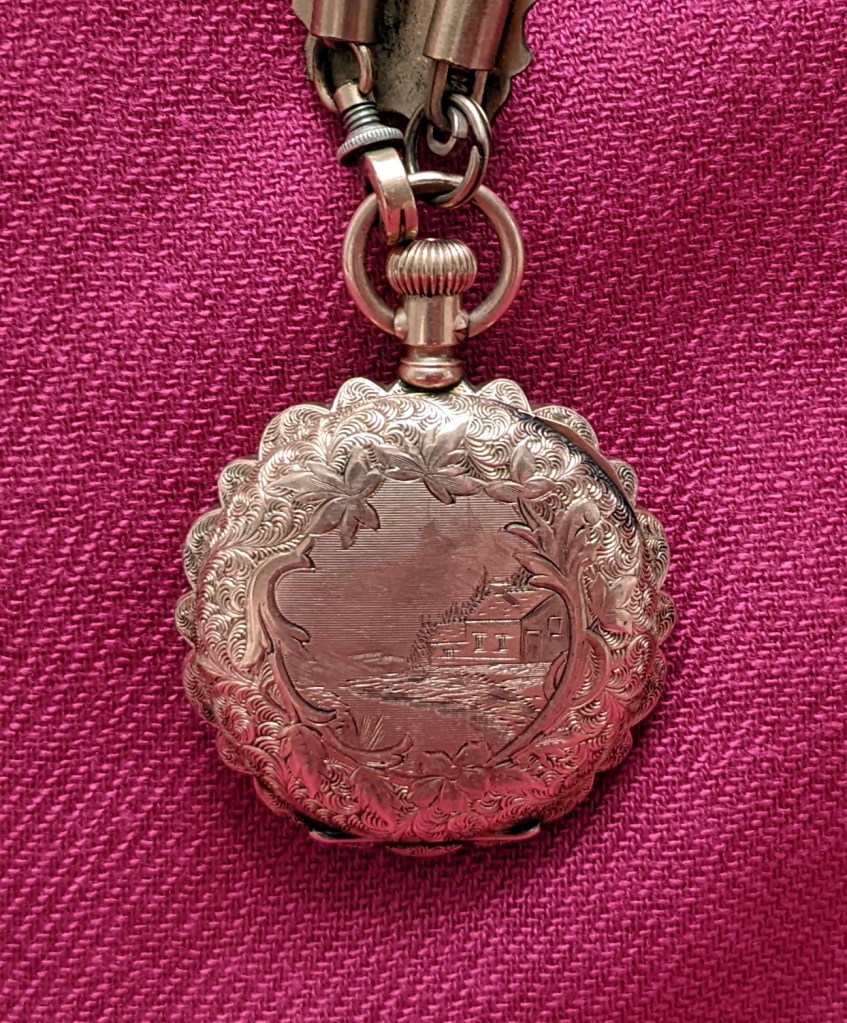
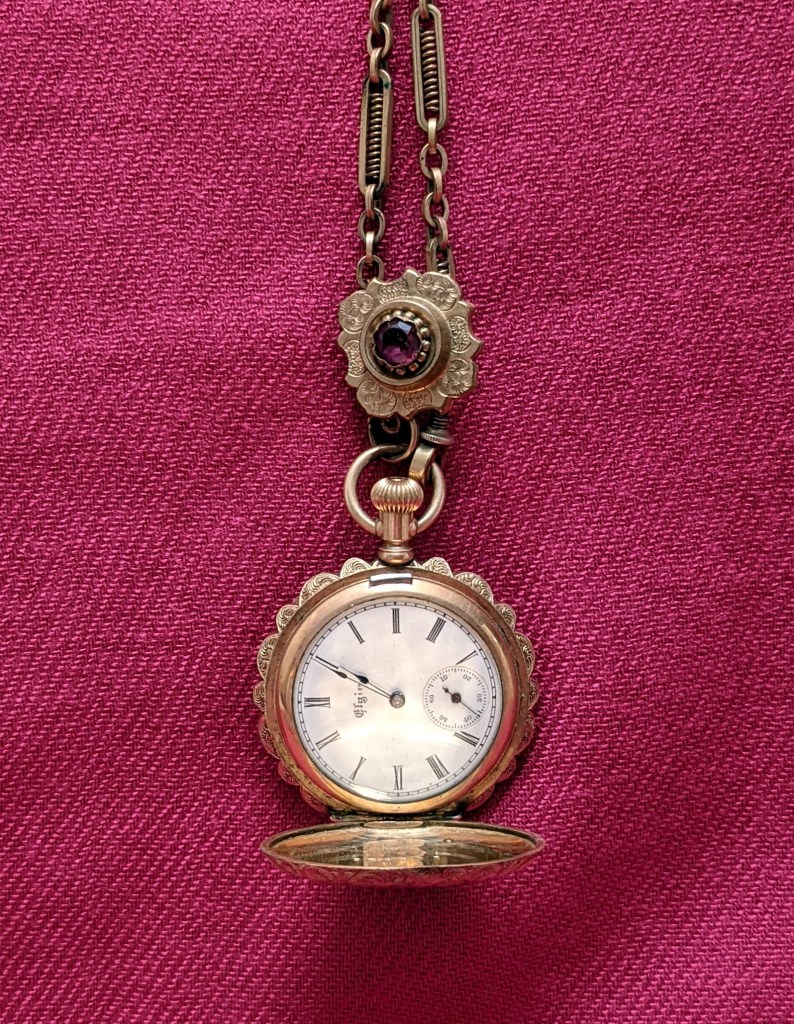
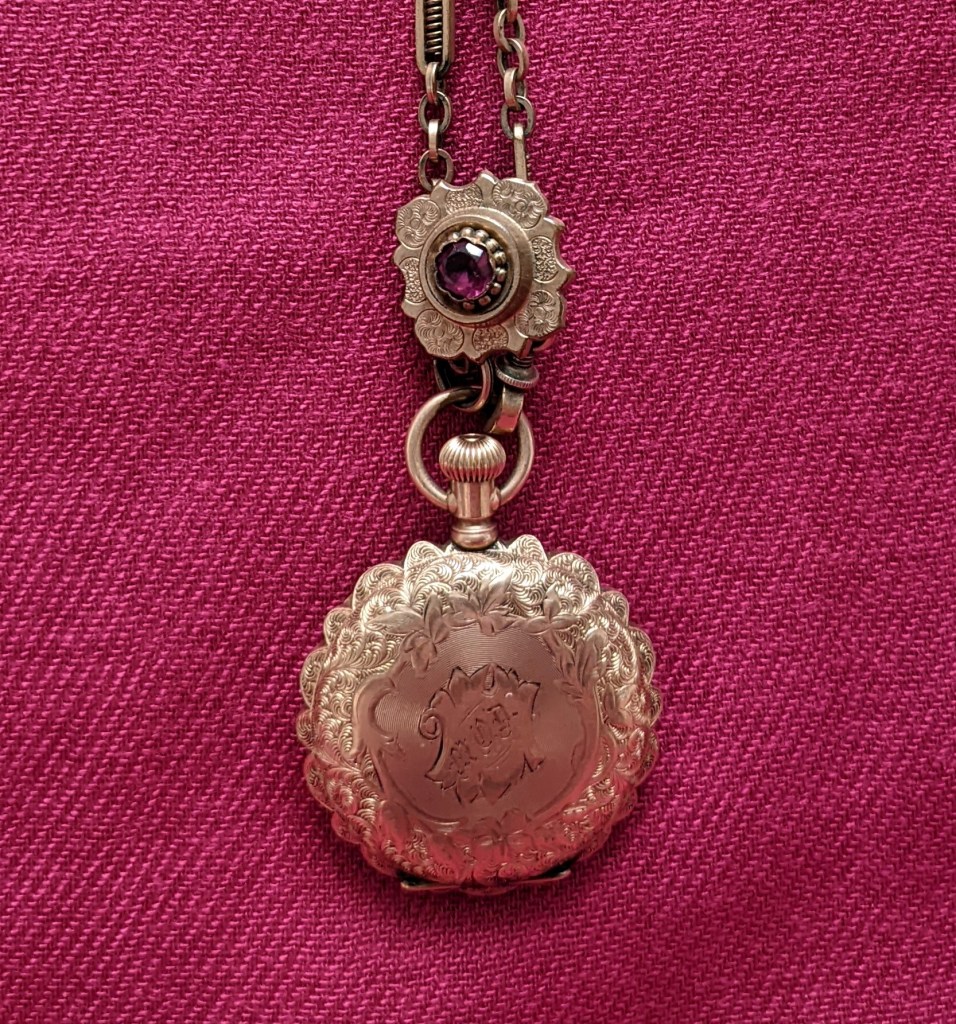
In order to attend Watertown High School, in the fall of 1939 Charles and Maggie’s granddaughter Virginia, daughter of Elizabeth and Willis, moved in with her paternal grandparents, Herbert and Lena Bevers.  They were living just a few blocks away from the Dailys.  Two years later, still living with the Bevers, Virginia became ill and developed pneumonia.  Within two weeks she succumbed to the illness, passing away on November 13.  This tragedy occurred only a few days before Charles and Maggie were to celebrate a momentous occasion in their lives, the 50th anniversary of their wedding day, November 18, 1941.  To commemorate their 50th wedding anniversary, Maggie and Charles sat for a portrait.  The pendant watch that Maggie is wearing in the photograph below is in the possession of one of Maggie’s granddaughters.
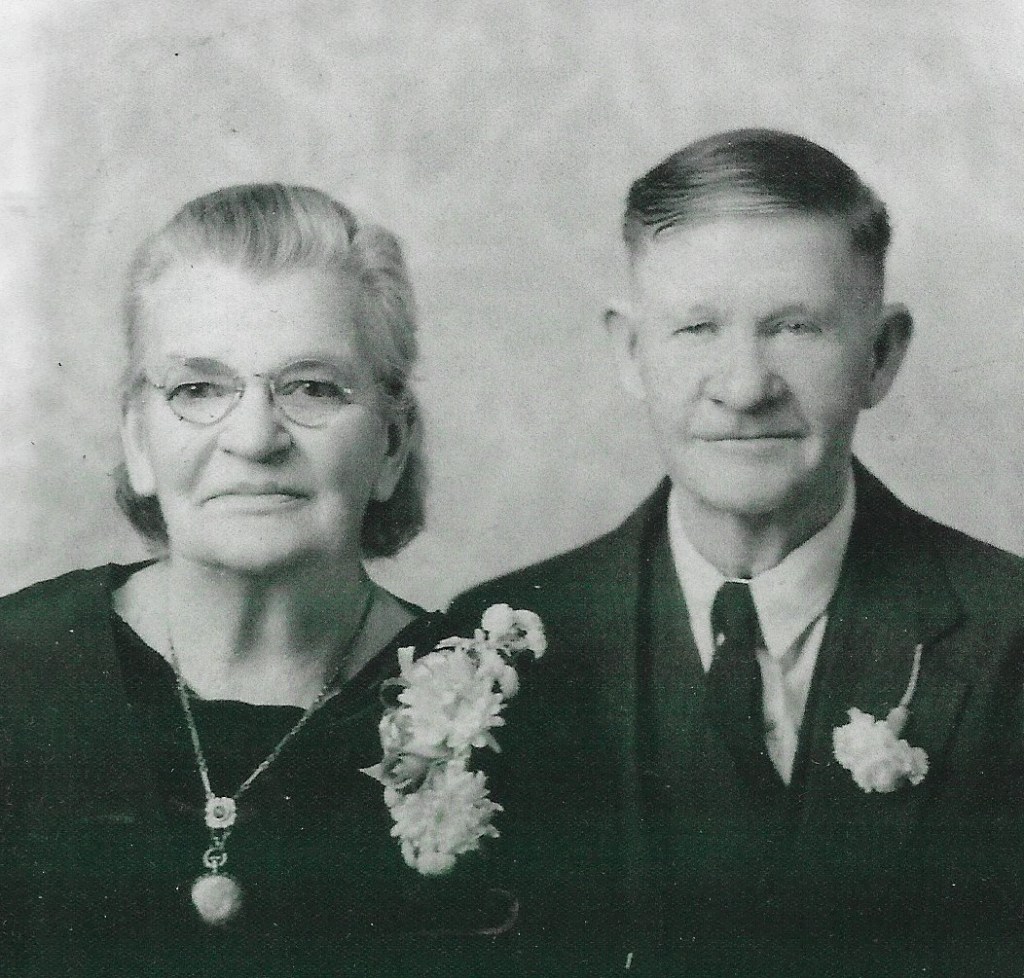
50th Wedding Anniversary Portrait (November 18, 1941)
Pendant Watch with Maggie’s Initials, M. O. D., in the center
Back of Maggie’s Pendant Watch
Open Pendant Watch

Less than three weeks later, on December 7, 1941, Pearl Harbor in Hawaii was bombed by Japanese aircraft.  The next day the United States declared war on Japan.  A week later Germany declared war on the United States.  During the next several years, six of Charles and Maggie’s grandsons would serve in the military.  Their eldest grandson Guy Mills entered the army in September 1942, listing his home address as Charles and Maggie’s home.9 He served until November 1945.  Guy’s brother, George Mills, who also gave his home address as Charles and Maggie’s home, enlisted in the Navy in July 1943.10 He trained to be an aviation radioman and gunner, and was assigned to the aircraft carrier USS Bismarck Sea in the western Pacific.11 He flew on 23 combat missions from the flight deck of the Bismarck Sea, including observation patrols over Iwo Jima on D-Day (February 19, 1945).  When the Bismarck Sea was sunk by a Japanese aerial attack in February 1945, George survived and spent leave at his home in Watertown before resuming flying duty.


Over time, the term “D-Day” has become associated with the beginning of the World War II invasion of Normandy, France by the Allied Forces, because that military event turned the war in Europe in favor of the Allies.  But during both World War I and World War II, the term “D-Day” was a military term used for a variety of operations.  The definition of “D-Day” was in question even the week following the invasion of Normandy.  A reader of Time magazine wrote, “Everybody refers to D-Day, H-Hour. Can you please tell me what they stand for or how they originated?”  The Time editor replied:

D for Day, H for Hour means the undetermined (or secret) day and hour for the start of a military operation. Their use permits the entire timetable for the operation to be scheduled in detail and its various steps prepared by subordinate commanders long before a definite day and time for the attack have been set. When the day and time are fixed, subordinates are so informed.12


The other four grandsons that served in World War II were sons of Arthur Bevers:

Lee was in the Air Force in England, flying over Germany until he was shot down and spent the last year of the war in a prison camp.  James and Dale, in the Navy, saw action under fire of the Japanese in the Pacific.  James was on a mine sweeper while Dale served on a cruiser.  Arthur, Jr. was with the Army in Hawaii until the end of the war.13

When asked about his grandparents, Lee Bevers stated that when he was in the Army Air Corp, Maggie wrote to him every week.14  Lee himself was an avid letter writer as well, as evidenced in a diary that Lee kept when he was in the military.  The first entry is dated October 29, 1943 in Grand Island, Nebraska, from which he began traveling to the base he was assigned overseas.  On his way to the base in England, there were stops in Wilmington (Delaware), Newfoundland, Ireland, Scotland and a few towns in England.  It was December 6th when he finally arrived at the base from which he would fly over northern Europe.  Lee noted in his diary when he wrote letters and when he received letters.  Sometimes the mail was delayed, and when it was finally delivered, he would get more than one letter from the same person, though the letters had been written several days apart. On November 25, 1943, Thanksgiving Day, he wrote letters to both sets of grandparents, which would be Charles and Maggie Daily and Herbert and Lena Bevers.15  His diary indicates that he wrote to “Grandma D” on December 27, 1943, January 9, 14, 28, February 5, 11, 18, 27, March 4, 16, 26 and April 7, 1944.  In the March 4th letter which he sent to Maggie, he included $40.00.  The entries in Lee’s diary abruptly end on April 12, 1944.  The following day while he was flying his 26th mission, his plane was shot down and he was taken prisoner.  For the remainder of the war, Lee was held in a prison camp near Frankfort, Germany.


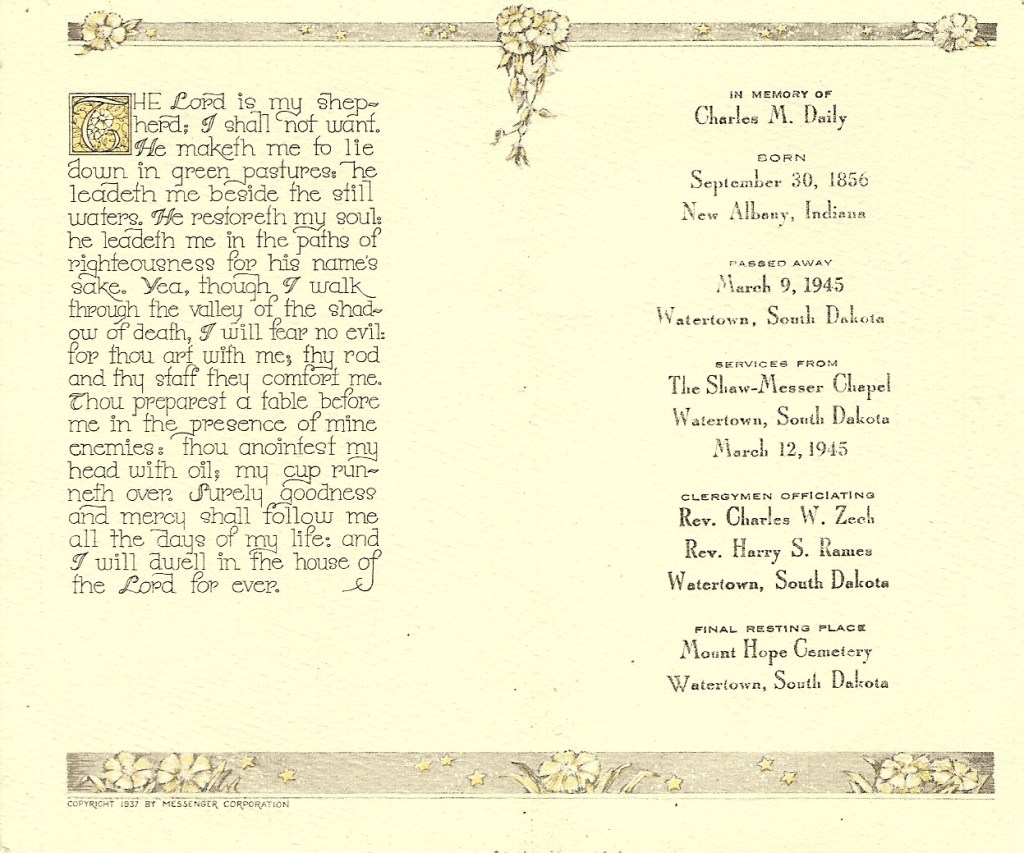
In the winter of 1945, Charles fractured his hip.  According to his granddaughter Phyllis (nee Bevers) DeBoer, he spent his last days in the living room of his home in a bed that was like a hospital bed (it was on wheels), while Maggie took care of him.16  He also developed bronchio-pneumonia which led to his death on March 9th.17  He was 88 years-old.  His funeral service was held on March 12 and he was buried in Mount Hope Cemetery in Watertown.

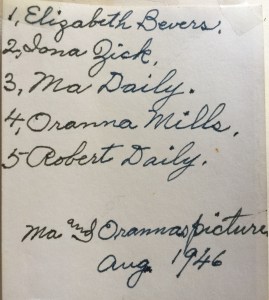
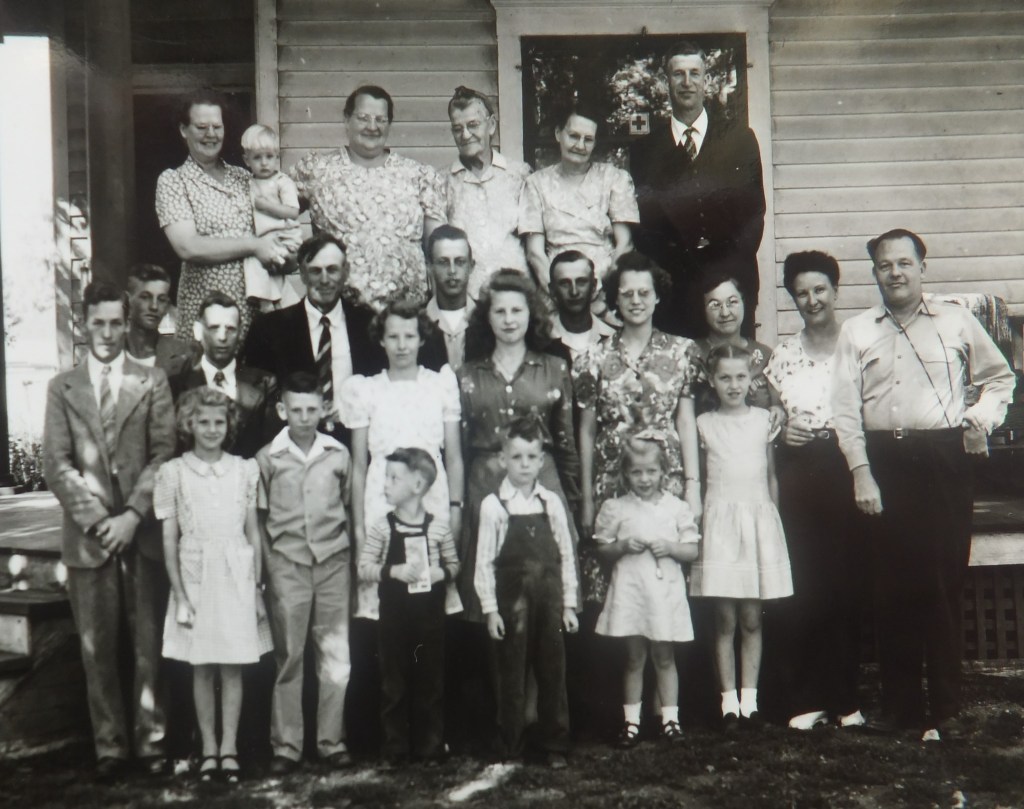
On Sundays, Elizabeth and her children would often go to dinner at her parents’ home.  One of Elizabeth’s children remembers regularly going to the Daily’s duplex after going to church.  All the children would sit on the open stairway of the front room to eat their mid-day dinner.18  During one of those Sunday visits in August 1946, Maggie enjoyed the company of her four living children and many of her grandchildren.  Everyone in attendance gathered in front of the house to take photographs.
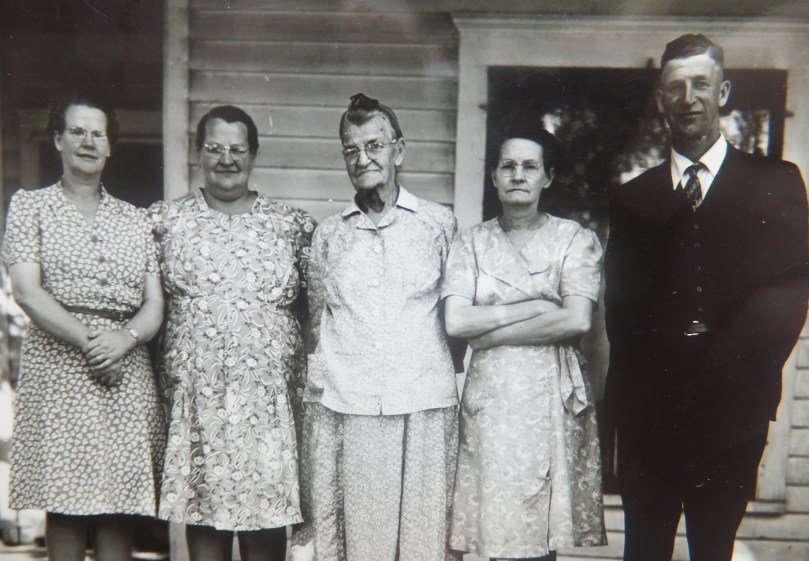
Elizabeth Bevers, Iona Zick, Maggie Daily, Oranna Mills, Robert Daily
Written on the back of the above photograph
Maggie in center of top row with many of her descendants.

Between 1940 and 1946, Iona gave birth to her last child, and Elizabeth gave birth to three more children, the last one, Maggie’s 31st grandchild, arriving in November following the family gathering in the above photograph.  In April 1942, Robert’s first granddaughter was born, giving Charles and Maggie their first great-grandchild.  Lee Bevers had married in the summer of 1943 and a son was born to them in April 1944, only eight days after Lee had become a prisoner of war.  This was Charles and Maggie’s second great-grandchild.  Their third great-grandchild arrived when Robert’s second grandchild was born in January 1945.  Then in 1946, two of Robert’s daughters each had a baby – two more great-grandchildren.

During the fall of 1946 and winter of 1947, Maggie experienced “declining health,” eventually passing away at her home on March 11, 1947.19  She was 79 years-old.  The causes of death cited on her death certificate are melano carcinoma of the skin with metastasis to liver, pernicious anemia and senility.  She was survived by her daughters Oranna, Iona and Elizabeth and her son Robert and by twenty-eight grandchildren and five great-grandchildren.  Maggie was buried beside Charles in Mount Hope Cemetery in Watertown.
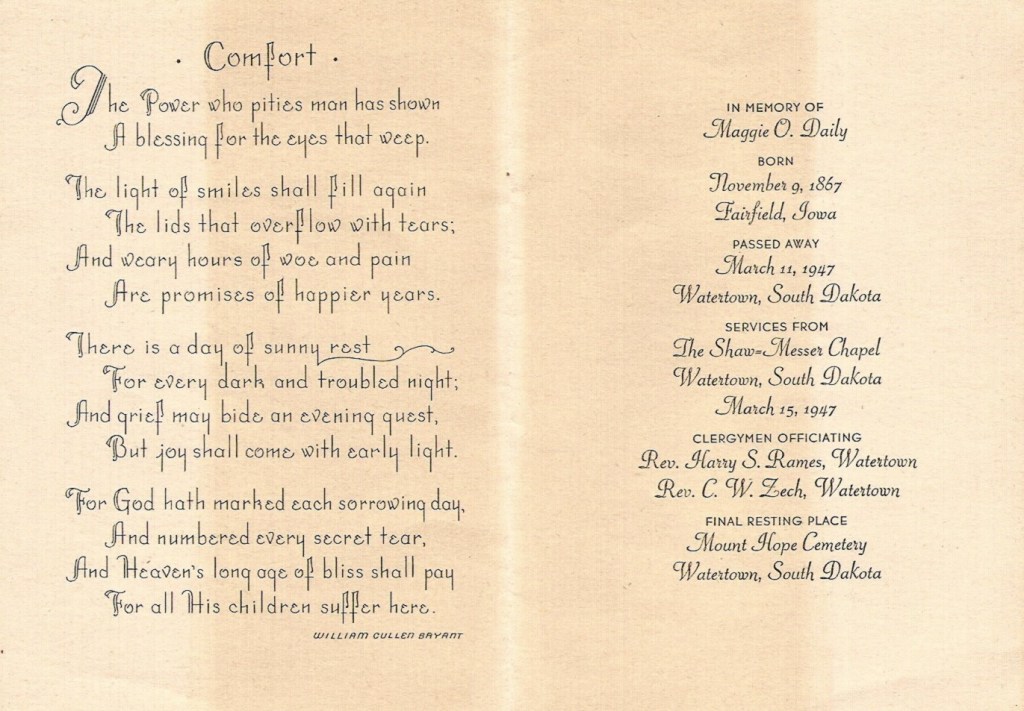
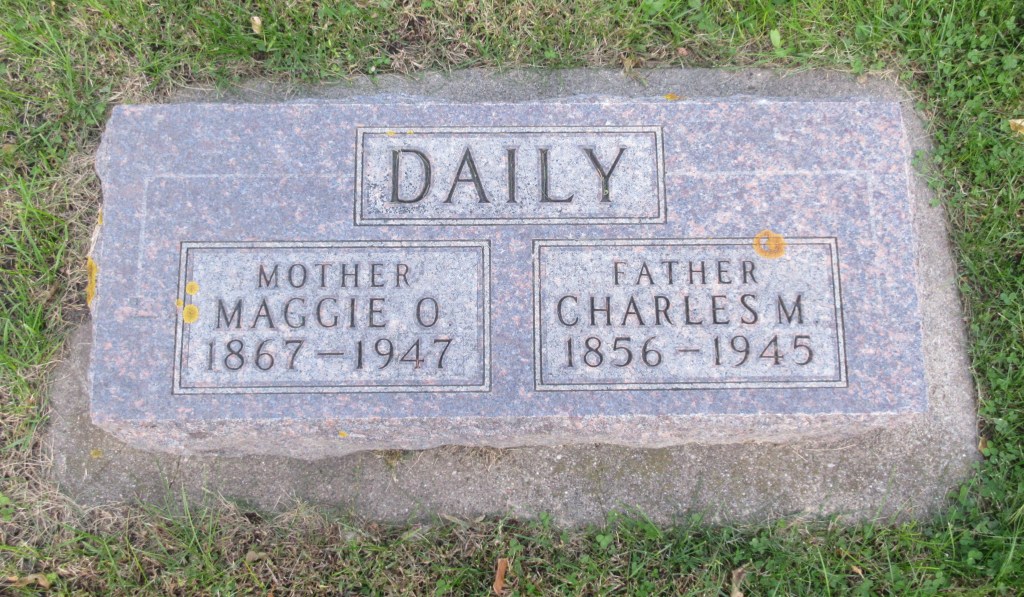
Maggie and Charles Daily are buried in Mount Hope Cemetery, Watertown, South Dakota

To conclude the series of blogposts about Charles and Maggie Daily which feature the reminiscences of their son Robert L. Daily, here is one more excerpt from the interview he gave about 1984:

Uncle Bob:  … well, Dad had made a deed out for Mother, when he bought the place.  Yeah, that’s the way he done it, handled things that way.  But he made a deed out –

Interviewer:  Um hmm.

Uncle Bob:  — for Mother to have.  So, when Mother lived alone …. Figured I’d talk to Willis and to Rob. An’ ‘course Arthur was otherwise ….

[These were Charles and Maggie’s sons-in-law who were married to Elizabeth, Iona and Gladys, respectively.]

Interviewer:  Um hm, um hm.

Uncle Bob:  … so Mother made a deed out for me.

Interviewer:  Um hm.

Uncle Bob:  An’ that helped like ev’rythin’ because when Mother passed away, instead of having a probate, or have to go through all that stuff that way, why, they had somebody to do –

Interviewer:  Yeah, then it was all taken care of.  Right.

Uncle Bob:  Yeah, … then I cleared up that debt.  An’ then I … modernized it after that.  In other words, I had to, I had the whole thing re-wired, top to bottom, because it was, when I went up in the attic an’ seen them, all bare wires up in the attic.

Interviewer:  Oh, I’m sure it was –

Uncle Bob:  Y’know in those days they didn’t, they didn’t have no plug-ins down at the bottom.

Interviewer:  No.

Uncle Bob:  Ever’thin’ come off one o’ them socket, see, an’ they put too many, too many appliances on a socket.  An’ it took the insulation off the wires up there.

Interviewer:  I remember the oil parlor furnace in the living room.

Uncle Bob:  Yeah, yeah.

Interviewer:  Yeah, that’s the only house I remember grandma being in.

Uncle Bob:  Then I had to, had to bring the water and sewer all in.

Interviewer:  Yah, we used a – there’s a cistern under there, isn’t there?

Uncle Bob:  Well, they, we had two uh, two uh, sand points.  One for each side.

Interviewer:  Okay, it was sand point, it was not cistern.

Uncle Bob:  No, no.  We had the out, the toilets outside.

Interviewer:  That’s right, that’s right. 

Uncle Bob:  Yeah, the toilets outside.  Sometime I brought that all in.  An’ I paid twenty-five hundred dollars for, for bringin’ the water in, the water – to modernize it, that way.

Interviewer:  Um hm, um hm.

Uncle Bob:  An’ paid Roger sixteen hundred dollars for, uh, to re-wire the whole thing.

Interviewer:  Oh, I’m sure that it cost quite a bit.20


  1. L. A. Bevers, interview with M. R. Wilson, August 2, 2010.
  2. “United States Census, 1940,” database with images, FamilySearch (https://familysearch.org/ark:/61903/3:1:3QSQ-G9M1-5855?cc=2000219&wc=QZFM-WRZ%3A791611401%2C793270701%2C793367301%2C793379401 : accessed 22 November 2021), South Dakota > Codington > Watertown City, Watertown, Ward 3 > 15-24B Watertown City Ward 3 bounded by (N) 4th Av S; (E) Maple, ward line; (S) city limits; (W) city limits, ward line > image 3 of 24; citing Sixteenth Census of the United States, 1940, NARA digital publication T627. Records of the Bureau of the Census, 1790 – 2007, RG 29. Washington, D.C.: National Archives and Records Administration, 2012.
  3. M. R. Wilson, transcription of Robert Lee Daily Interview by R. Thiele, recording (ca. 1984): 28.
  4. “United States Census, 1940,” database with images, FamilySearch (https://familysearch.org/ark:/61903/3:1:3QS7-L9M1-5833?cc=2000219&wc=QZFM-3CZ%3A791611401%2C795183601%2C790385801%2C795237102 : accessed 12 March 2022), South Dakota > Hamlin > Oxford Township > 29-19 Oxford Township (Township 115 Range 53 and Township 115 Range 54 (part)) > image 11 of 14; citing Sixteenth Census of the United States, 1940, NARA digital publication T627. Records of the Bureau of the Census, 1790 – 2007, RG 29. Washington, D.C.: National Archives and Records Administration, 2012.
  5. “United States Census, 1940,” database with images, FamilySearch (https://familysearch.org/ark:/61903/3:1:3QSQ-G9M1-588Q?cc=2000219&wc=QZFM-3RR%3A791611401%2C793270701%2C790542101%2C951343301 : accessed 16 December 2021), South Dakota > Codington > Lake Township > 15-12 Lake Township (Townships 117 and 118 Range 52 inside Old Sisseton and Wahpeton Indian Reservation and Township 117 Range 53 (part)) outside Watertown City > image 6 of 11; citing Sixteenth Census of the United States, 1940, NARA digital publication T627. Records of the Bureau of the Census, 1790 – 2007, RG 29. Washington, D.C.: National Archives and Records Administration, 2012.
  6. “United States Census, 1940,” database with images, FamilySearch (https://familysearch.org/ark:/61903/3:1:3QS7-89M1-588J?cc=2000219&wc=QZFM-3DS%3A791611401%2C793270701%2C793332701%2C951346101 : accessed 16 December 2021), South Dakota > Codington > Rauville Township > 15-16 Rauville Township (Township 118 Ranges 52 and 53 outside Old Sisseton and Wahpeton Indian Reservation Line and Townships 118 and 119 Range 52 (part) inside Old Sisseton and Wahpeton Indian Reservation Line) > image 8 of 11; citing Sixteenth Census of the United States, 1940, NARA digital publication T627. Records of the Bureau of the Census, 1790 – 2007, RG 29. Washington, D.C.: National Archives and Records Administration, 2012.
  7. “United States Census, 1940,” database with images, FamilySearch (https://familysearch.org/ark:/61903/3:1:3QS7-89M1-5864?cc=2000219&wc=QZFM-36G%3A791611401%2C793270701%2C793326301%2C793326302 : accessed 16 December 2021), South Dakota > Codington > Pelican Township > 15-14 Pelican Township (Township 116 Range 53 (part)) outside Watertown City > image 4 of 9; citing Sixteenth Census of the United States, 1940, NARA digital publication T627. Records of the Bureau of the Census, 1790 – 2007, RG 29. Washington, D.C.: National Archives and Records Administration, 2012.
  8. “United States Census, 1940,” database with images, FamilySearch (https://familysearch.org/ark:/61903/3:1:3QSQ-G9M1-588N?cc=2000219&wc=QZFM-QC9%3A791611401%2C793270701%2C793309301%2C793309302 : accessed 16 December 2021), South Dakota > Codington > Kampeska Township > 15-10 Kampeska Township (Township 116 Range 54) > image 4 of 13; citing Sixteenth Census of the United States, 1940, NARA digital publication T627. Records of the Bureau of the Census, 1790 – 2007, RG 29. Washington, D.C.: National Archives and Records Administration, 2012.
  9. “U. S., World War II Draft Cards Young Men, 1940-1947” (Ancestry.com Operations, Inc., Lehi, Utah, USA, 2011).
  10. “U. S., World War II Draft Cards Young Men, 1940-1947” (Ancestry.com Operations, Inc., Lehi, Utah, USA, 2011).
  11. __________, “Survives” (news article), source unknown.
  12. K. Moon, “What Does the ‘D’ in ‘D-Day’ Stand For? Experts Disagree With Eisenhower’s Answer,” Time (June 4, 2019): https://time.com/5599811/d-day-meaning/.
  13. Hamlin Historical Committee, “Bevers Family,” Hamlin County 1878-1979: 141.
  14. Bevers, interview with M. R. Wilson.
  15. L. A. Bevers, personal diary, October 29, 1943 – April 13, 1944.
  16. P. I. DeBoer, interview with M. R. Wilson, August 3, 2010.
  17. M. A. Bevers, notes about the death certificate of Charles M. Daily, accessed from “Bevers-Daily-McFerran-Nelson Families” on Ancestry.com.
  18. E. J. Jones, interview with M. R. Wilson, ca. July 2010.
  19. “Maggie Daily Dies At Home Here, Illness,” (published obituary, publication unknown).
  20. Wilson, Robert Lee Daily Interview: 29-30.
Reminiscences of Uncle Bob, Part Six

At about the age of 75, Charles M. Daily retired from farming, and with his wife Maggie, they moved into a house in east Watertown. Their son Robert Daily said in an interview, “… it was downtown.  It was about somewhere around six, seven, eight hundred block.”1 Later they rented a house in southwest Watertown at 620 2nd Street SW.  One of the things that Charles did following his retirement was to make a trip to Omaha to sell the two houses that they owned there.2

Charles and Maggie’s family continued to grow as their daughters Gladys Bevers, Iona Zick and Elizabeth Bevers and their daughter-in-law Ruby Daily gave them more grandchildren.  As of August 1934, they had 22 living grandchildren.  Tragically, the birth of Gladys’ eighth child left her weak and unable to recover.  In an interview about fifty years later, her brother Robert recounted some details of Gladys’ illness and subsequent death.

Interviewer:  Um, Aunt Gladys, um, she died in October of ‘34? [1934]

Uncle Bob:   Yeah, it’s in ’34, all right, I know.  I don’t know what the date is on there.  [He was referring to a paper they were looking at.]

Interviewer:  On this here.

Uncle Bob:  She, she was born in ’92.  She was, uh, eight and 34 made it 42, didn’t it?  Yeah. She was 42 years-old when she passed away.

Interviewer:  Um hmm.  But it was, it was more or less complications after [the baby] was born?  She never really regained her strength after [the baby] was born.

Uncle Bob:  Yeah, she, she was, when –

Interviewer:  [The baby] was born in August.

Uncle Bob:  When [the baby’s older sibling] was born in 19–, August 7.

Interviewer:  In ’29.

Uncle Bob:  Yeah, why, Dr. Hammond told them they shouldn’t have any more children because it would be either the mother or the child, see.

Interviewer:  I see, uh huh.

Uncle Bob:  And five years to the day was when [the baby] was born.  It was enlargement of the liver.  The liver had enlarged so much she couldn’t get her breath, see. 

Interviewer:  Ohhh.

Uncle Bob:  That’s the reason –

Interviewer:  So, it was what they call liver disease now?  Or?

Uncle Bob:  Well, I don’t know.  But I would have thought that — what could ha’ been the cause of it?  But Doc Hammond knew too well.  He said –

Interviewer:  Hm.

Uncle Bob:  See, she got through with, uh, [the baby’s older sibling] –

Interviewer:  Um hmm.

Uncle Bob:  — he said they shouldn’t have any more family anymore because it’d be either the mother or the child.

Interviewer:  Well, she did – [the baby] was born, it was two months later but –  

Uncle Bob:  Well, yeah.

Interviewer:  — she was jus’ too weak then.

Uncle Bob:  Yeah, she never – I know she told mother, Gladys told mother that she – I guess she kinda realized in that way.  An’ she said, “If it happens to me, I want you to take care of [the baby].”  That’s the reason [the baby], Mother took care of, from that time on until, until Elsie and Arthur took her.

Interviewer:  Um huh.

Uncle Bob:  Took her from there.   Mother … at her age, at that time ….  Oh, at that time she was in her –.  Well, ah, see, thirty, uh – 

Interviewer:  33 and 34, she was already 60.  Close to 70.

Uncle Bob:  Yeah, she didn’t want the job of raising her up and keeping her.  She, she didn’t feel able to do that.3

Maggie was nearly 67 years-old when Gladys passed away and she began caring for her infant granddaughter.  Her son-in-law Arthur Bevers, having seven children ranging in age from 14 to 4 (excluding the infant), secured the help of an 18 year-old young lady named Elsie Ludtke.  The Ludtke family had been living in Rauville Township when the Daily family moved to Rauville in 19154 and the Ludtkes lived there until after 1920,5 so it is possible that the two families knew each other.  By 1925, the Ludtkes had moved to Kampeska Township, Codington County,6 and by 1930 Arthur and his family were also living in Kampeska Township.7 Kampeska Township is approximately 13 miles southwest of Watertown.

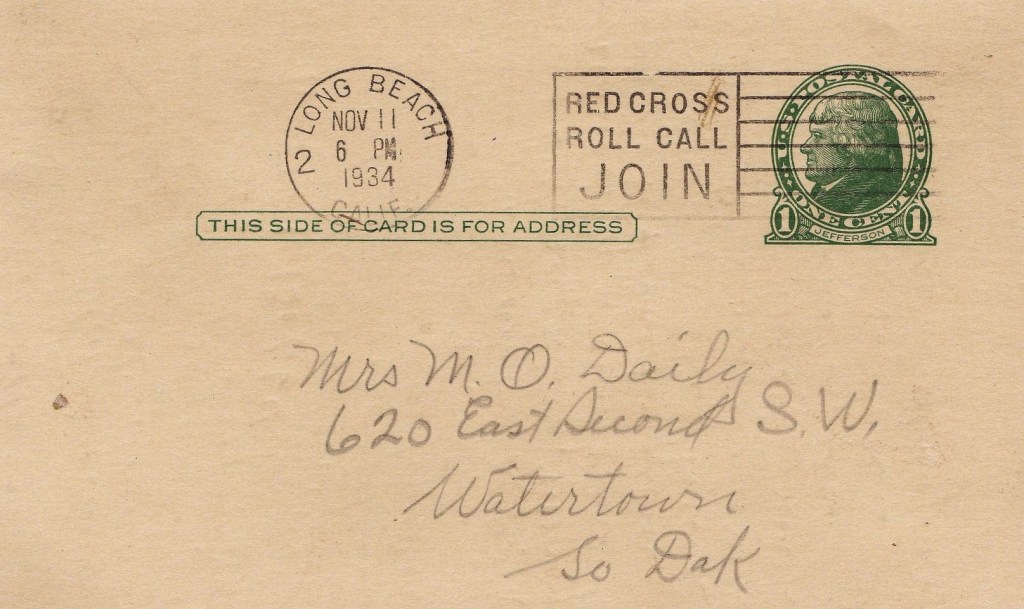
Undoubtedly, the news of Maggie taking on the care of her granddaughter reached her relations who were in California.  One of Maggie’s grandsons has stated that Maggie was an avid letter writer and that she wrote to her three siblings once a week, and occasionally, Maggie would receive a box from California that held trinkets.8 In November 1934, Maggie received a postcard and a letter from her brothers Sidney and Harman Finley Bonewitz, interestingly, both postmarked on the 11th of the month in Long Beach, California.  In Finley’s letter, he expressed his hopes that the baby was “getting along fine.”

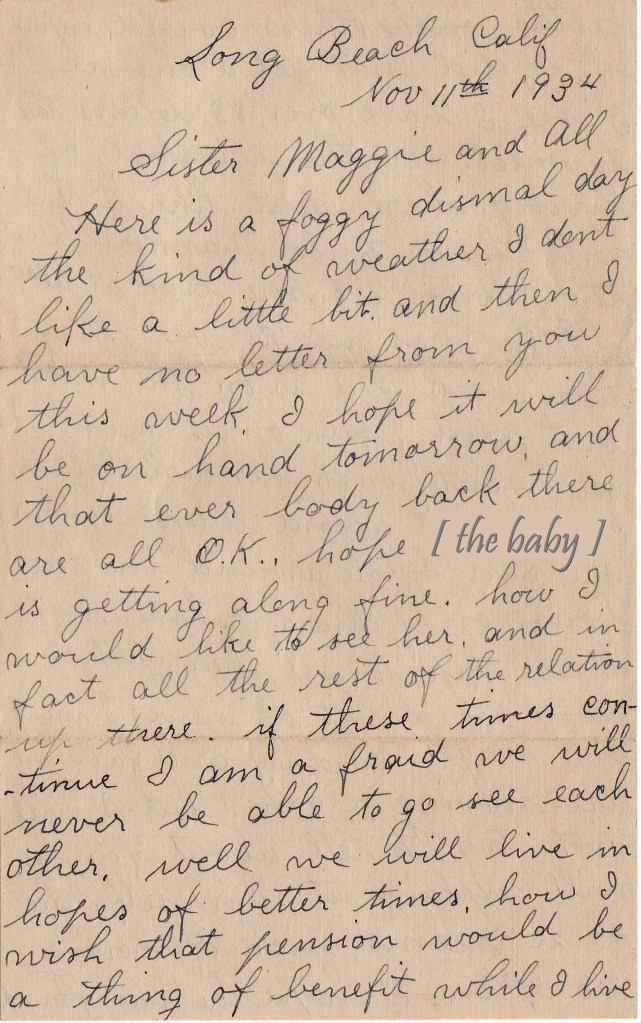
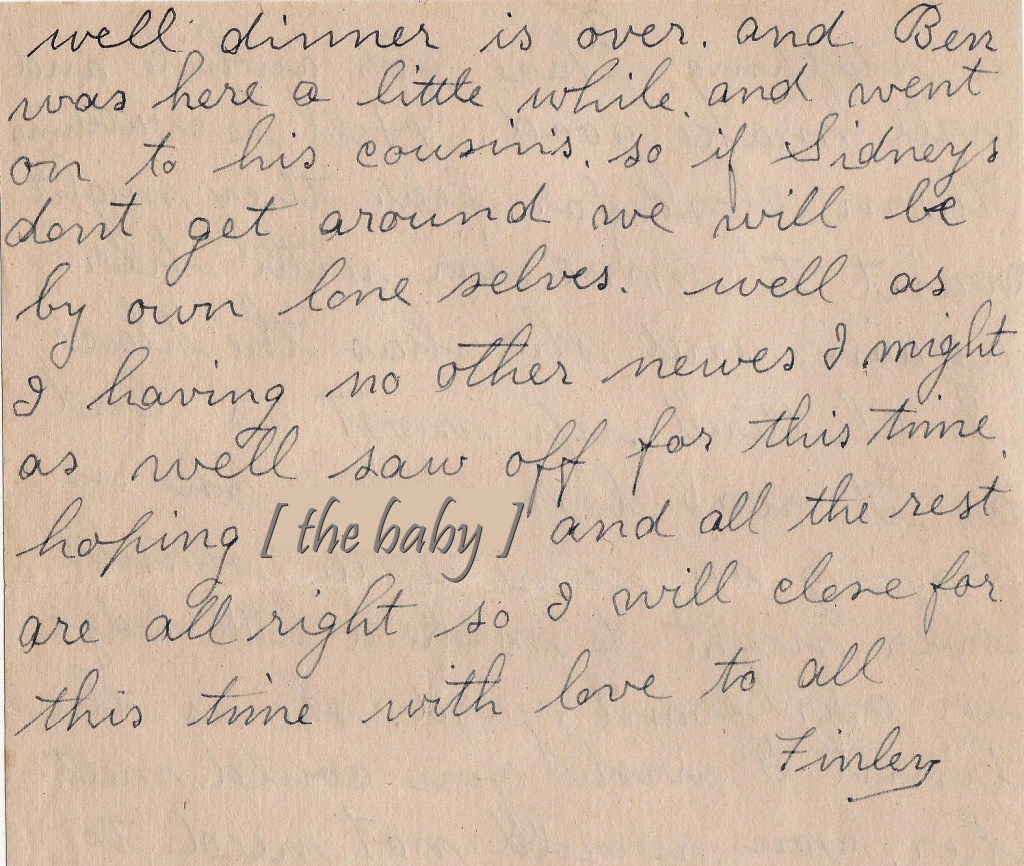
Finley had left Omaha following the death of his wife Cornelia who died in 1920, and when he married again in 1922, he was in California.  In Finley’s letter, which was posted with a three-cent stamp, he notes that he was awaiting a letter from Maggie that week and he mentions the difficult times they were in, as well as news about himself and others in California:

Sister Maggie and All

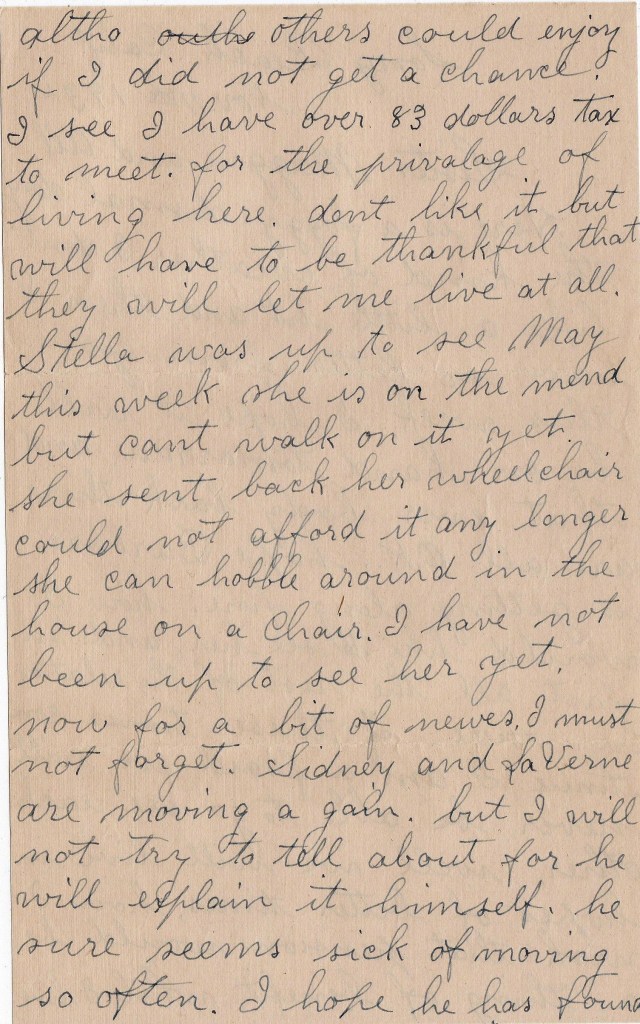
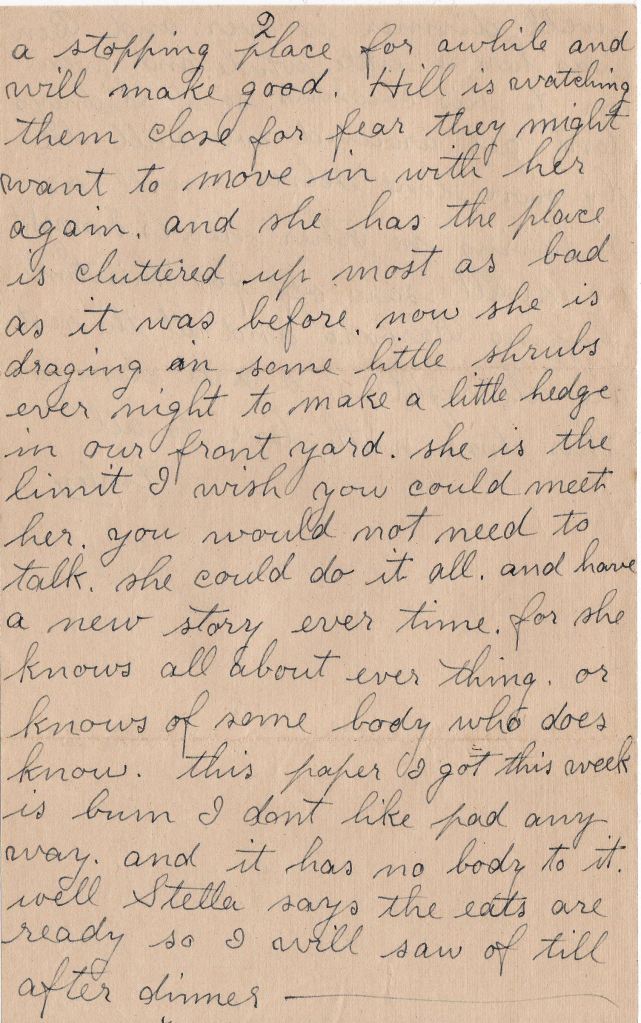
Here is a foggy dismal day  the kind of weather I don’t like a little bit.  and then I have no letter from you this week.  I hope it will be on hand tomorrow, and that ever body back there are all O.K., hope [the baby] is getting along fine.  how I would like to see her, and in fact all the rest of the relation up there.  if these times continue I am a fraid we will never be able to go see each other.  well we will live in hopes of better times.  how I wish that pension would be a thing of benefit while I live altho others could enjoy if I did not get a chance.  I see I have over 83 dollars tax to meet.  for the privalage of living here.  don’t like it but will have to be thankful that they will let me live at all.  Stella was up to see May this week  she is on the mend but cant walk on it yet.  she sent back her wheelchair  could not afford it any longer  she can hobble around in the house on a chair.  I have not been up to see her yet.  now for a bit of newes, I must not forget.  Sidney and LaVerne are moving a gain.  but I will not try to tell about for he will explain it himself.  he sure seems sick of moving so often.  I hope he has found a stopping place for awhile and will make good.  Hill is watching them close for fear they might want to move in with her again.  and she has the place is cluttered up most as bad as it was before.  now she is draging in some little shrubs ever night to make a little hedge in our front yard.  she is the limit  I wish you could meet her.  you would not need to talk.  she could do it all.  and have a new story ever time.  for she knows all about ever thing.  or knows of some body who does know.  this paper I got this week is bum  I don’t like pad any way.  and it has no body to it.  well Stella says the eats are ready so I will saw of till after dinner –

well dinner is over.  and Ben was here a little while and went on to his cousin’s, so if Sidneys dont get around we will be by own lone selves.  well as I having no other newes I might as well saw off for this time.  hoping [the baby] and all the rest are all right so I will close for this time with love to all

Finley


Envelope dated November 11, 1934, sent from Harman Finley Bonewitz

Finley shared that Stella had gone to visit May.  Stella would be his wife and May could be his sister Carrie Mae Belle White.  Carrie and her husband Charles White and their possibly widowed daughter Mabel Day were living in Tujunga, a town 40 miles north of Long Beach.

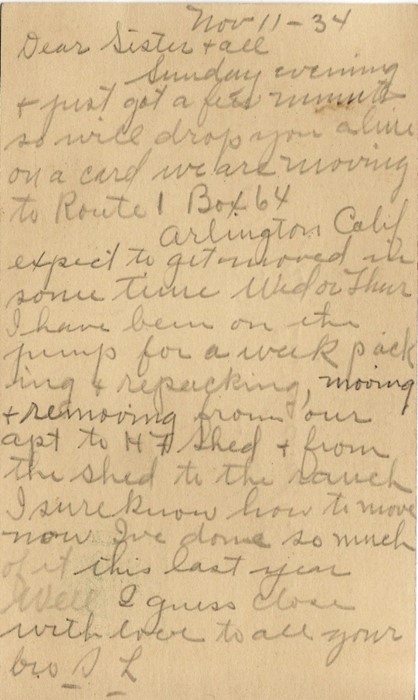
Sidney had probably moved to California about 1927.  According to the message on his one-cent postcard, he and his wife La Verne were going to be moving to a ranch in a rural area 55 miles west of Long Beach.  In addition, the message briefly told about the moves that he had made during that week and he gave Maggie his new address:

Dear Sister & all

Sunday evening & just got a few minutes so will drop you a line on a card  we are moving to Route 1 Box 64  Arlington Calif

expect to get moved in some time Wed or Thur  I have been on the jump for a week packing & repacking, moving & removing from our apt to HF shed & from the shed to the ranch  I sure know how to move now  Ive done so much of it this last year

Well I guess close with love to all your bro S L


The year 1934 was in the midst of the Great Depression.  In his letter, Finley alluded to the difficult times the nation was experiencing.  When Finley expressed, “How I wish that pension would be a thing of benefit while I live,” he may have been referring to one of several insurance programs that were being proposed by various individuals and organizations (including the United States President).  A survey of 12,076 newspaper and farm journal editors, revealed that 64% of the editors believed “… that public opinion favors a compulsory governmental system of old age pensions ….”9

Mrs. [Eleanor] Roosevelt devoted one of her widely-syndicated columns to a discussion of old age pensions. “Old age pensions,” she wrote, “have been brought very much to the fore again in the Congressional campaigns on the coast this year, and there is no doubt that some type of this form of relief will be a part of the social program proposed to the next Congress ….

There is no question in my mind but that old people who have given of their strength and youth to the bringing up of a family and have been unable to save should not in their old age have to live off their children’s bounty or on charity. Older civilizations have long conceded this right and I feel that taking this group out of industry a little earlier would be a great help to another group which is now very much menaced–these men and women between 45 and 60 who are finding it harder and harder to get jobs. Every citizen, it seems to me, should study this question and give his support to discussions of it in Congress in the hope that some really workable plan may be found and established in every state in the Union.”10

On June 8, 1934, President Franklin D. Roosevelt, in a message to the Congress, announced his intention to provide a program for Social Security.  Subsequently, the President created by Executive Order the Committee on Economic Security, which was composed of five top cabinet-level officials. The committee was instructed to study the entire problem of economic insecurity and to make recommendations that would serve as the basis for legislative consideration by the Congress.11

This Committee was established … to develop a comprehensive social insurance system covering all major personal economic hazards with a special emphasis on unemployment and old age insurance.  The Committee’s legislative recommendations were presented to the President in January 1935, and introduced to Congress for consideration shortly thereafter.  A compromise Social Security Bill was signed by the President on August 14, 1935.12


Finley made a comment to Maggie in his letter that “the times” could prevent them from seeing each other again.  His letter gave no outright indication of him being in poor health, although perhaps that could be inferred from his statement that he might not experience the benefit of the pension.  In actuality, Finley did not see his relations in South Dakota again.  Three weeks after writing the November 11th letter, at 75 years of age, Finley passed away on December 1, 1934.

When the South Dakota census was taken in the spring of 1935, Elsie Ludtke was recorded with Arthur Bevers’ family and her occupation was listed as housekeeper.13 Two census records were completed for Arthur’s 9 month-old infant in Codington County: one at the home of her father in Kampeska Township14 and the other at 620 2nd Street SW, Watertown which was Charles and Maggie’s home.15 In addition to the infant, Charles and Maggie’s daughter Oranna Mills and her three children, aged 9, 12 & 17, were also living with them.16 Later that year, a year after losing his wife, Arthur married Elsie.  In his interview, Uncle Bob reported that the infant then went to live with Arthur and Elsie.17

In the summer of 1935, the Daily family experienced a sudden loss.  Uncle Bob related that Charles and Maggie’s 12-year-old granddaughter Florence, who was living with them, “went out to Van’s” (most likely Florence’s uncle Van Mills’ farm in Germantown, Codington County)18 and “she had a severe headache.  … When she come in, she, they tried aspirin and things like that, in order to try to relieve her that way.”19 Sadly, by the end of the day, July 15, Florence had departed this life.  Uncle Bob stated that the illness was caused in some way by her brain.  He and his interviewer speculated that it could have been caused by sun stroke, cerebral hemorrhage or a tumor.


Charles and Maggie made a third move in Watertown in 1935.  They purchased a duplex at 219 5th Avenue SW.  Uncle Bob explained the purchase and also how they supported themselves during their retirement years:

Uncle Bob:  ‘Course, they got a chance to buy the duplex in ‘35.

Interviewer:  Yeah, that’s the only place I remember.

Uncle Bob:  An‘ o’course they lived there til ’47.  That’s twelve years.

Interviewer:  Um hm, um hm.  Yeah, right.

Uncle Bob:  Yep, then o’course, oh, I took it over.  Why, course Dad’d bought it for a thousand fifty dollars, the duplex in ‘35.

Interviewer:  In ’35, i’n’t that somethin’.

Uncle Bob:  Yeah.  Herman Michael wanted to sell it.  An’ he was land poor, property poor, see.  An’ he wanted to sell it.  ‘Course, taxes wasn’t bad.  But rent at that time was only $10 a month, see.

Interviewer:  It sounds unreal, isn’t it?  What –

Uncle Bob:  And they bought the duplex and that way they got $10 from the other side.

Interviewer:  Umm hmm.

Uncle Bob:  And o‘course, folks had, had old-age, got old-age assistance that way. 

Interviewer:  Uh-huh.

Uncle Bob:  An’ I, it always hurt me to think, how they, they had to know ever-, ev’rythin’, all expenditures.  Uh, an’ account for ‘em.  Dad shingled the duplex.  Aw, painted it and he had to do that on his, either on his own money or off that $10 that he got from the other side.  (chuckling)  An’ yet, when they passed on, it was against the property, see.  All the –

Interviewer:  Was it?  Ohhh.

Uncle Bob:  All the, their old-age assistance was, was all against the property, see.

Interviewer:  Hmmm.

Uncle Bob:  If, if you didn’t own anything, the old-age assistance paid your rent.

Interviewer:  But they owned –

Uncle Bob:  But now why, cuz they had a home –

Interviewer:  Huh.

Uncle Bob:  — why, why did they have to be so tight.  And it, whatever they got, all the money they got they – see, when Dad – they were getting old-age assistance, an’ Dad went down, that was in ’35 or ’34, Dad went back down to Omaha an’ sold his property.  Well, then he paid back the old-age assistance.

Interviewer:  Um hmm.

Uncle Bob:  An’ what he had got up to that time.

Interviewer:  Um hm.

Uncle Bob:  An’ they told ‘im that he could keep, uh, when they got – they were allowed to keep $250 a piece for burial expenses, see.  When they got down to close to that, then they could re–

Interviewer:  Re-apply.

Uncle Bob:  — re-apply, see.  Well then, o’course from that time on they had got, but they had to ‘count for everythin’.  The other side had to be accounted for, see.

Interviewer:  Ohhh, yeah.

Uncle Bob:  Well, they got over sixteen hundred dollars, see.  Course that was against the property.  I had to pay that off.20

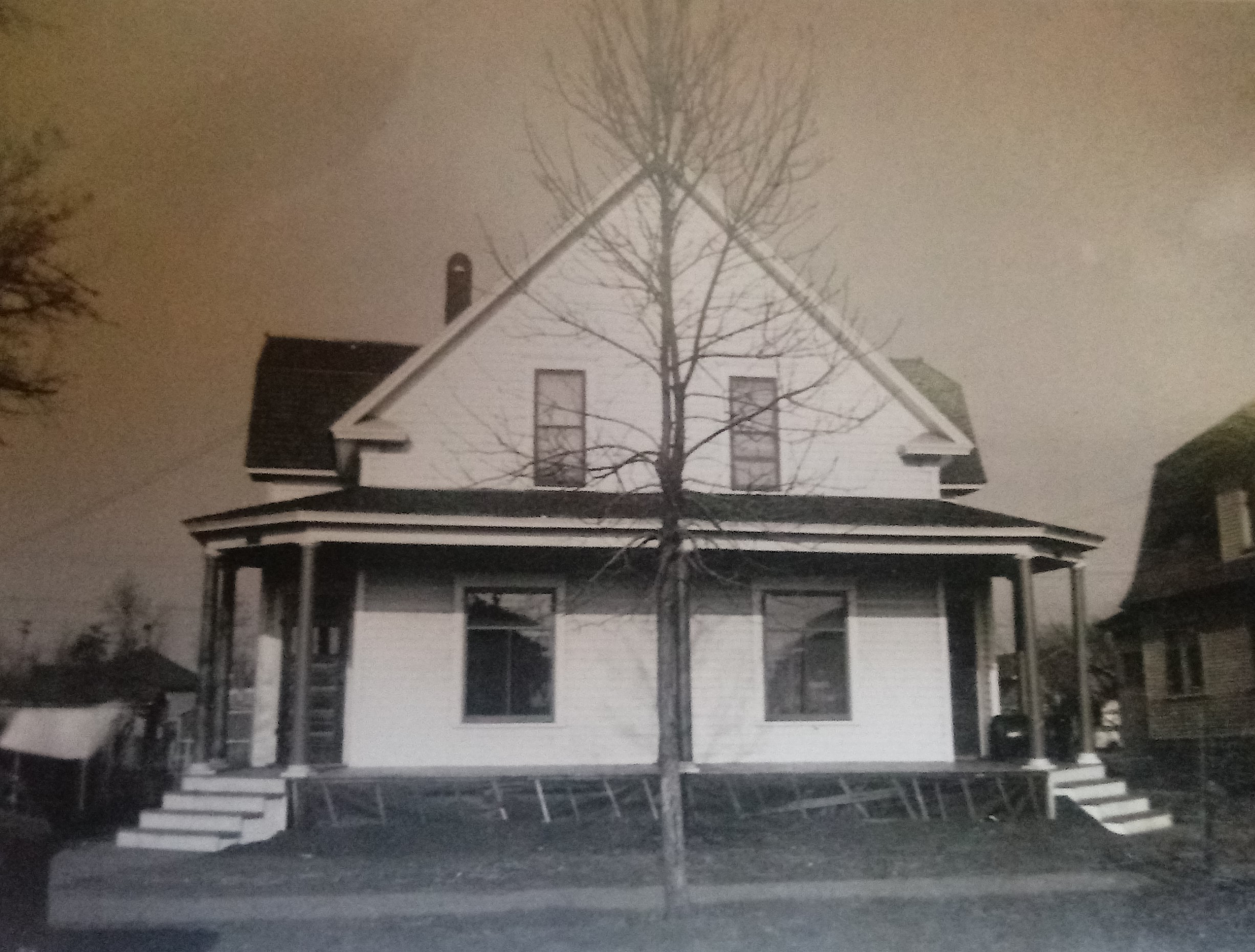
Charles and Maggie lived in the left side of this duplex and rented out the right side.

One of Charles and Maggie’s grandchildren described their house as follows:

The duplex had three rooms downstairs and two bedrooms and hallway upstairs with an open stairway.  Grandma and Grandpa’s bedroom was the front room.  The middle room was the dining room with a large table, cupboard and the oil stove.  In one corner was Grandpa’s wicker rocker where he always sat with the paper or leaned close to the small radio to hear the progress of the war.  When we had Sunday dinner there with some of the cousins, we (the cousins) filled our plates and sat on the stairs to eat.

The back room was the kitchen with stove (and kerosine stove for summer cooking), cupboard, washing machine and large single sink.  A cistern pump was over the sink for getting water for washing dishes and clothes.  There was also a small pantry and the back porch.  The basement stairway led off of the kitchen under the stairs to the upstairs.  I was never down the basement more than once or twice.  I recall it was dark and damp down there.  I was told there was a sand point well there but can’t tell more than that.

The east half of the duplex was identical but in reverse.  And oh yes, the bathroom was out the back door and down the walk to the two identical small buildings at the alley called the “outhouses.”

Grandpa always had a large beautiful garden that filled all of their half of the back yard.  The fresh peas were always so tempting but we better not let Grandpa see us pick any and pop them into our mouths. My Aunt Oranna and children, Guy and George, also lived with Grandma and Grandpa. … Aunt Oranna was epileptic and unable to live alone so spent some time living with each of her sisters and then with Grandma and Grandpa.21

Charles and Maggie lived out their final years in this duplex in Watertown. Some of the events of those years will be shared in the next blogpost.


  1. M. R. Wilson, transcription of Robert Lee Daily Interview by R. Thiele, recording (ca. 1984): 27.
  2. L. A. Bevers, personal correspondence with M. R. Wilson, November 24, 2010.
  3. Wilson, Robert Lee Daily Interview: 22-23.
  4. “South Dakota State Census, 1915,” database with images, FamilySearch (https://familysearch.org/ark:/61903/3:1:S3HT-6LCJ-1L?cc=1476041&wc=MJQK-N38%3A1041734401 : 21 May 2014), 004245360 > image 3042 of 3102; State Historical Society, Pierre, South Dakota.
  5. “United States Census, 1920,” database with images, FamilySearch (https://familysearch.org/ark:/61903/3:1:33SQ-GRVM-DZJ?cc=1488411&wc=QZJB-434%3A1036874501%2C1039011801%2C1039036701%2C1589332505 : 13 September 2019), South Dakota > Codington > Rauville > ED 94 > image 4 of 7; citing NARA microfilm publication T625 (Washington, D.C.: National Archives and Records Administration, n.d.).
  6. South Dakota State Census, 1925,” database with images, FamilySearch (https://familysearch.org/ark:/61903/3:1:S3HY-DZ2S-88Z?cc=1476077&wc=MJ7S-T38%3A1041768301 : 21 May 2014), 004246371 > image 1862 of 3407; State Historical Society, Pierre, South Dakota.
  7. “United States Census, 1930,” database with images, FamilySearch (https://familysearch.org/ark:/61903/3:1:33SQ-GRCF-HB3?cc=1810731&wc=QZF7-6VX%3A648803701%2C649380801%2C649388101%2C1589282323 : 8 December 2015), South Dakota > Codington > Kampeska > ED 10 > image 1 of 8; citing NARA microfilm publication T626 (Washington D.C.: National Archives and Records Administration, 2002).
  8. L. A. Bevers, interview with M. R. Wilson, August 2, 2010.
  9. M. B. Schnapper, “Trend of Interest in Economic Security,” https://www.ssa.gov/history/reports/ces/cesvol9trend.html.
  10. Schnapper, “Economic Security,” https://www.ssa.gov/history/reports/ces/cesvol9trend.html.
  11. Social Security Administration, Historical Background and Development of Social Security, “The Committee on Economic Security (CES),” https://www.ssa.gov/history/briefhistory3.html.
  12. Congressional Panel on Social Security Organization, Organizational History of SSA, “Committee on Economic Security (1934),” https://www.ssa.gov/history/orghist.html.
  13. “South Dakota State Census, 1935,” database with images, FamilySearch (https://familysearch.org/ark:/61903/3:1:S3G9-DVBD-6?cc=1614831&wc=MJ4G-PTL%3A1041689201 : 21 May 2014), 004447442 > image 481 of 3547; State Historical Society, Pierre, South Dakota.
  14. “South Dakota State Census, 1935,” database with images, FamilySearch (https://familysearch.org/ark:/61903/3:1:S3G3-DKPS-FM?cc=1614831&wc=MJ4R-N38%3A1041633301 : 21 May 2014), 004443899 > image 2284 of 3338; State Historical Society, Pierre, South Dakota.
  15. “South Dakota State Census, 1935,” database with images, FamilySearch (https://familysearch.org/ark:/61903/3:1:S3G3-DKPS-F9?cc=1614831&wc=MJ4R-N38%3A1041633301 : 21 May 2014), 004443899 > image 2285 of 3338; State Historical Society, Pierre, South Dakota.
  16. “South Dakota State Census, 1935,” database with images, FamilySearch (https://familysearch.org/ark:/61903/3:1:S3HT-DW5Q-MN3?cc=1614831&wc=MJ4L-DP8%3A1041680801 : 21 May 2014), 004447088 > image 653 of 3506; State Historical Society, Pierre, South Dakota.
  17. Wilson, Robert Lee Daily Interview: 22.
  18. “South Dakota State Census, 1935,” database with images, FamilySearch (https://familysearch.org/ark:/61903/3:1:S3HT-DW53-YLN?cc=1614831&wc=MJ4L-DP8%3A1041680801 : 21 May 2014), 004447088 > image 693 of 3506; State Historical Society, Pierre, South Dakota.
  19. Wilson, Robert Lee Daily Interview: 10.
  20. Wilson, Robert Lee Daily Interview: 29.
  21. ___ Zick, “Daily,” (n. d.).

Reminiscences of Uncle Bob, Part Five

On the 10th of April, 1915, Charles and Maggie Daily left Omaha and headed with their family to South Dakota because Maggie “wanted to get back to the farm” (according to their son Robert1), and possibly wanting to get away from the tornadoes (according to one of their grandsons2). They moved to a farm in Rauville Township in Codington County.3  Rauville was “a station on the [Great Northern Railway], 6 miles N of Watertown,” and primarily the site of two grain companies.4 

The Daily family had been in South Dakota for two months when the state census was taken.  At that time, Charles was 58 years-old, Maggie was 47, Gladys was 22, Oranna, 19, Robert, 15, Iona, 12 and Elizabeth, 10.  The census forms of Charles and Maggie reveal that they had received a common education and the forms of Gladys and Oranna indicate that they had attended high school.  Also, the forms of Maggie, Gladys, Oranna and Robert note that their church affiliation was Methodist.


At about the age of 84, during an interview, Robert explained a little about settling in Rauville Township:

Interviewer:  When you came up here then [South Dakota], you prob’ly had a quarter to start with.

Uncle Bob:  Yeah, a quarter up here.  Across from Rauville Hall.

Interviewer:  Okay.

Uncle Bob:  Rauville Hall out there, eight miles north [of Watertown].

Interviewer:  And then you moved a mile south.

Uncle Bob:  Yeah, a mile south.  ‘Course, then we had the three quarters.

Interviewer:  And then didn’t you live further, uh, to the northwest of there?

Uncle Bob:  Ahh, not northwest.  But we come on down in ’29.  See Dad was on that place from 1917.  When we lived on the [Brent? or Brandt?] farm two years –

Interviewer:  Okay.

Uncle Bob:  ’15 and ’16.  Come down to Gunther’s in the fall of ’16.

Interviewer:  Um hmm.

Uncle Bob:  And o’ course, an’ then we lived there.  We lived there for 13 years, up to ’29.

Interviewer:  Oh!  You lived there quite a while.5


Charles’ name was in the Farmers’ List of the 1916 Watertown City and Codington County Directory, which indicated that he was a farm tenant of a 160-acre farm in section SW 17 of Rauville Township.6 In the 1919 edition of the directory, the entry for Charles noted that he was renting in section NE 30 of Rauville.7

Another thing Uncle Bob related was that in 1917 Charles’ brother William visited them while they were living at the Gunther farm and that was the last time that they saw William.  (He passed away in 1925 in or near Lovelock, Nevada.) Uncle Bob expounded, “I know he, when he went back through Chicago, why he, uh, bought a watch, a Waltham watch, for Dad. Sent it to him.  An’ Dad wore it, oh, clear up ‘til he was gone.  An’ I had it an’ I give it to [my son] for — to take care of, see.  Well, it’s in’resting, it’s right here in Watertown, it’s in [my son’s] lockbox right here in Watertown.”8  This would have been about 65 years after the purchase of the watch.

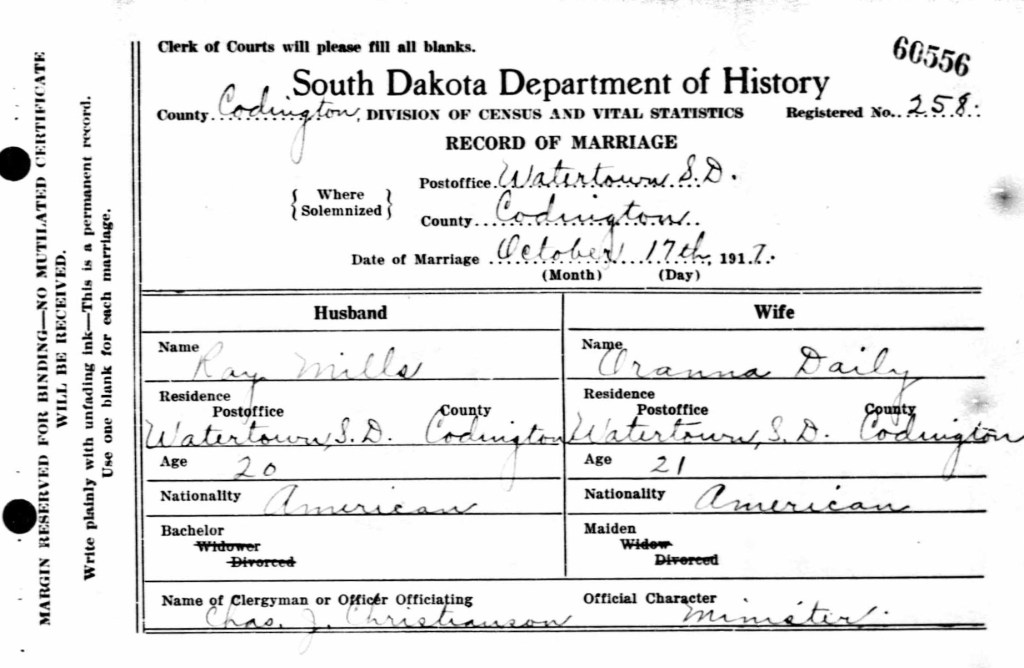
During the next several years, one by one Charles and Maggie’s children began moving out of their home, either by marrying or by finding work in a different location or by moving to Watertown to go to high school.  On October 17, 1917, 21 year-old Oranna married 20 year-old G. Ray Mills.  They were married by Charles J. Christianson, the pastor of First Congregational Church, which was located in Watertown.9  The following year, Oranna gave birth to Charles and Maggie’s first grandchild.  By 1919, Ray had begun farming near Rauville.10

Marriage record of G. Ray Mills and Oranna J. Daily, October 17, 19179

Newspaper items in the Watertown Public Opinion reveal that the Daily family became friends with the Herbert J. Bevers family.  On October 11, 1917, the newspaper reported: “Mr. and Mrs. Herbert Bevers, family and Miss Strombotne were dinner guests at the C. M. Daley [sp.] residence, near Rauville, Sunday.”11  The same issue also stated, “The Bever [sp.] and Daley [sp.] families autoed to Hazel and Grover Thursday on a combined business and pleasure trip.”12  On March 14, 1918, it was reported that “The Herbert Bevers family had as their guests, Sunday, Mr. and Mrs. Raymond Mills, Robert Dailey [sp.] and the Misses Iona and Elizabeth Dailey [sp.], of Rauville, and Miss Verna Edwards of Hazel.”13  Later that year, on July 11, a short article recounted that “Mr. and Mrs. H. J. Bevers of Elmira township, accompanied by Messrs Dailey [sp.] of Rauville and Wells of [Watertown], returned last week from a trip through portions of Minnesota and North Dakota. … [In the] valley of the Red River…, north of Big Stone City, S. D. … ‘it impressed [them] as having crops enough to feed the world, judging by the looks of the fields of grain.’”14


The First World War had broken out in Europe in 1914 and the United States entered the war in April 1917.  In June of that year the U. S. Congress authorized President Woodrow Wilson to institute a military draft of men from the age of 21 to 30.15  The purpose of this Selective Service Act was to increase the size of the army to 500,000 men.  A year later the army still was not large enough, so in August 1918, the Selective Service Act was amended to include all men between 18 and 45.16  Uncle Bob who turned 18 years old in May 1918 registered for the draft in September of that year.17  Mercifully, the war came to an end in November 1918 and Uncle Bob never served in the military.18 By 1920 Uncle Bob was boarding in Watertown at the home of Harold and Lula Nordaker, and working for a transfer company as a drayman (a driver of a cart or vehicle without fixed sides).19

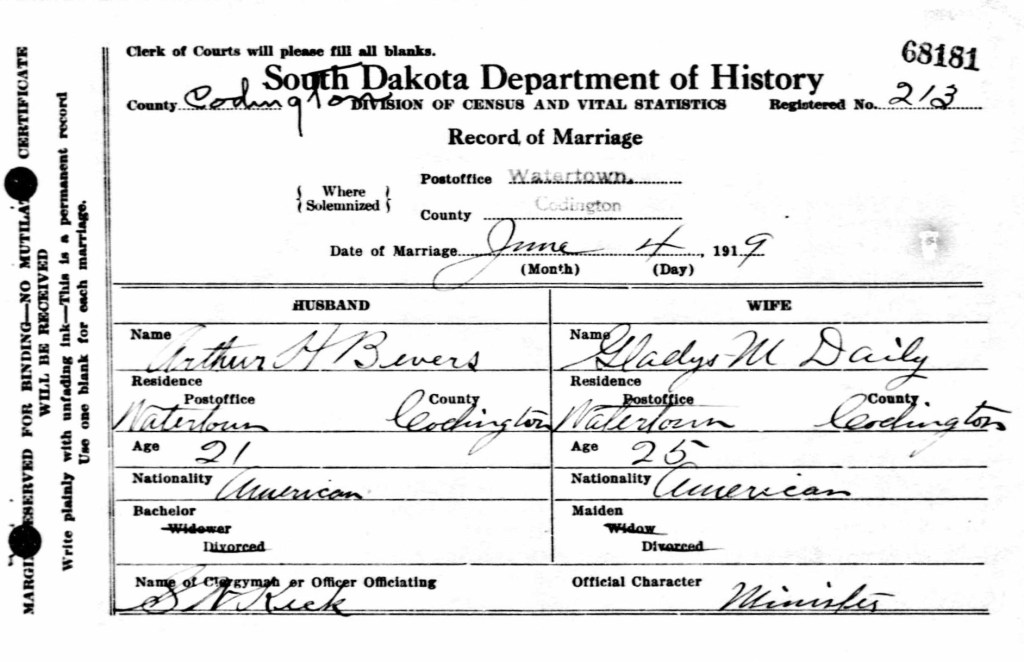
The Daily family and the Bevers family became linked in 1919 when 25 year-old Gladys married 21 year-old Arthur on June 4th.  The marriage was officiated by S. W. Keck, the pastor of First Congregational Church.20  On February 18, 1920, when the U. S. census was taken, Arthur and Gladys were living with Charles and Maggie on the farm in Rauville.21  Two months later, Arthur and Gladys’ first son was born on that farm,22 giving Charles and Maggie a second grandchild.  Iona and Elizabeth were also recorded on the 1920 census sheet.

Marriage record of Arthur H. Bevers and Gladys M. Daily, June 4, 191920

In the 1919 Watertown directory, Iona was identified as a student and she was boarding at 215 4th Street SW, which was the address of George and Hattie Baxter.23  At the age of 17, she was attending Watertown High School.  Iona graduated in May 1921 and three months later, after obtaining a South Dakota Second Grade Teacher’s Certificate, she entered into a two-year contract with Richland School District No. Six and began teaching on September 5th.24 Elizabeth would also attend Watertown High School, graduating in 1923 at the age of 18.


The 1920 U. S. census indicated that the farm that the Dailys were renting was on Meridian Road, also known as Meridian Highway.  In 1911, a road development association, the International Meridian Road Association, had organized for the purpose of building a transcontinental road, on which “a full wagon-box load or a car at high gear can pass, except in wet weather.”25  The name of the highway was “derived from the Sixth Principal Meridian, which extends north-south through the Great Plains region.”26 The route that was designated as the Meridian Road had a starting point in Winnipeg, Manitoba, Canada and ending points in Galveston, Texas and Mexico City.  Traveling along the eastern border of North Dakota, this highway entered South Dakota, veered west a short ways, then headed south and passed through Rauville and Watertown.  Presently, from the northern border of North Dakota to Watertown, Interstate Highway 29 and U. S. Highway 81 roughly follow the route that was once called the Meridian Highway.

The Meridian Highway evolved primarily as a farm-to-market road, important to the rural areas, small towns, and cities through which it passed.  The original route followed section line roads, running perpendicular to historic east–west transportation corridors.  Reflecting its creation from existing farm-to-market rural roads, the original highway passed through each county seat along its route.  In 1911 the Meridian Road Association was formed to mark, map, and promote the highway; in 1919 it became the Meridian Highway Association.  Similar to contemporaneous good roads organizations, the Meridian Highway Association consisted of representatives from the states, counties, and cities along the route.  The Meridian Highway promoters, however, perhaps in recognition of its divergence from more established routes, emphasized the absence of mountain passes and proclaimed that motorists could travel from Canada to Mexico without shifting gears.  The association sold memberships and instituted widely publicized tours.  When the association was a year old, in 1912, an automobile caravan was organized to travel the route south to Mexico, an event that was irregularly repeated in subsequent years.27


According to the U. S. census of Omaha, in 1920 Maggie’s mother Josephine (nee Smith) Bonewitz was living with Maggie’s niece Maggie (nee Thompson) Stier.28  Maggie Stier and her husband Fred were renting one of the two homes that the Dailys still owned in Omaha.29  In his interview, Uncle Bob mentioned a trip that Maggie Daily made to visit her 83 year-old mother in Omaha:

Uncle Bob: October 7, 1920. Yeah, that’s right there. I can remember that, oh, [like] it was yesterday. Mother was — Mother went down to, uh. ‘Course, I had a date with Ruby and Mother was away, at the time, see.

Interviewer:  Um hmm.

Uncle Bob:  An’ ‘course, Grandma passed away.  I don’t know what this date was, far as it was in 1920.  An’ she come home on the train an’ I was suppose t’ meet her.  An’ I didn’t. 

Interviewer:  And you didn’t.  [squealing laughter]

Uncle Bob:  I didn’t [pass] that too well.

Interviewer:  And you were in trouble!

Uncle Bob:  Yeah.  Didn’t think much of me.  [chuckling]30


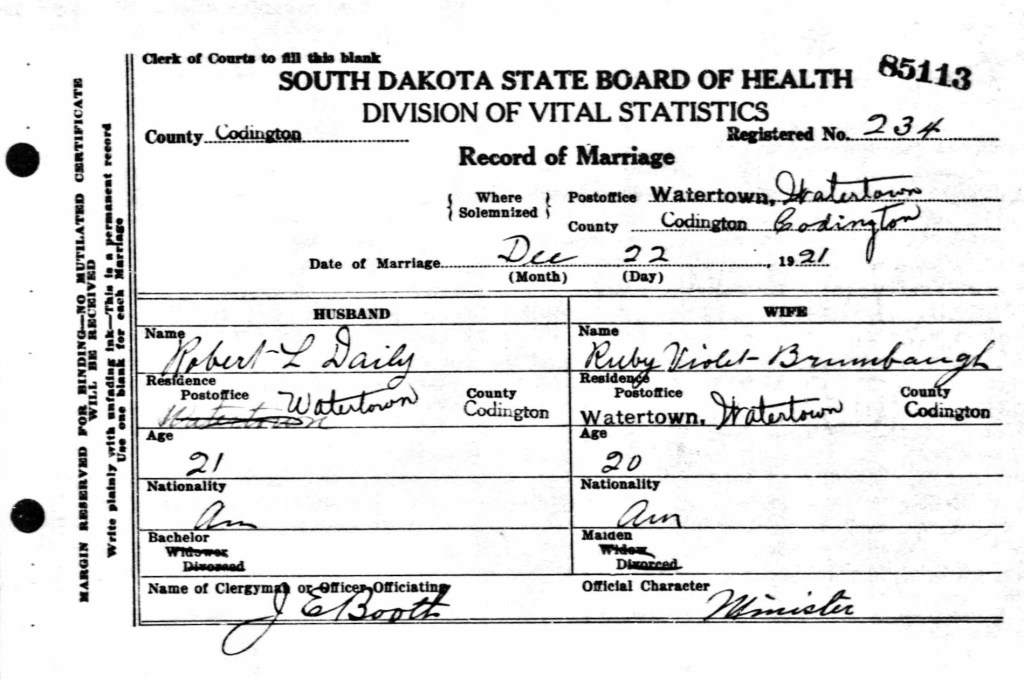
Just over a year later, Robert married Ruby Brumbaugh on December 22, 1921.31  The following December, Ruby gave birth to Charles and Maggie’s fourth grandchild.  Gladys had had her second child in August 1921 (the third grandchild) and Oranna would have her second child eight days after Ruby (the fifth grandchild).

Marriage record of Robert L. Daily and Ruby V. Brumbaugh, December 22, 192131

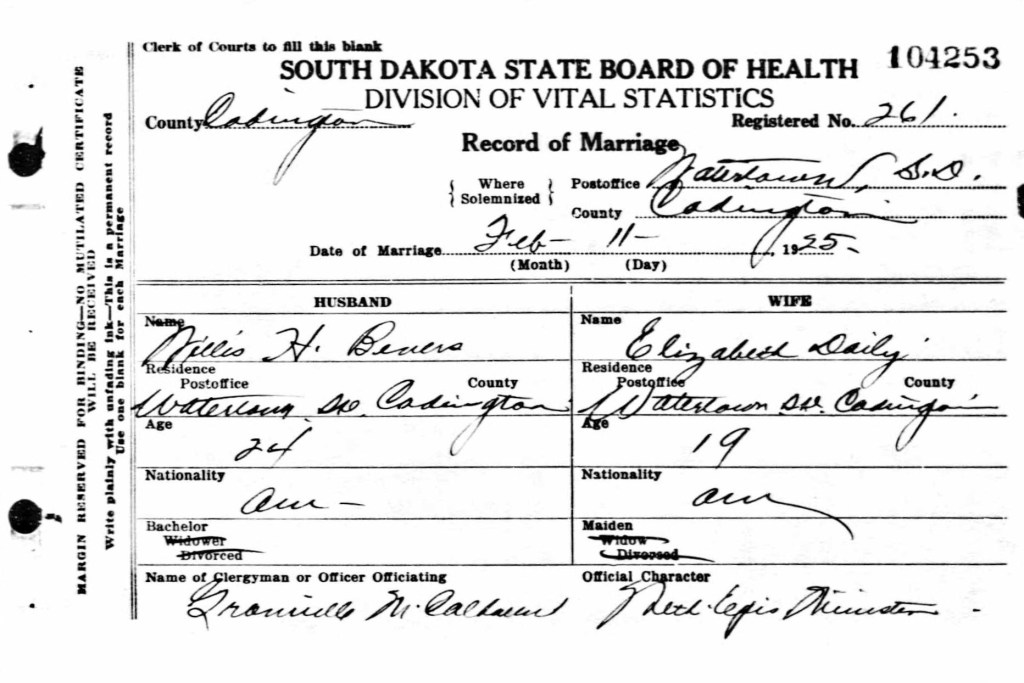
When Gladys’ in-laws, Herbert and Lena Bevers, moved their family to Raymondville, Texas in the fall of 1919, Elizabeth and Iona kept in touch with their son Willis.  The Bevers family returned to South Dakota a year later, but Willis stayed and worked on a road crew for another year.32  About three years after Willis returned to South Dakota, Elizabeth and Willis would marry.  The letters that they had exchanged during those two years are in the possession of one of their sons.  They were married on February 11, 1925, by Granville M. Calhoun, the minister of the Methodist Episcopal Church in Watertown.33 They set up their household in Watertown for a few months and later moved to a farm southwest of Grover.34 Their first child was born in December 1925 and was the tenth grandchild of Charles and Maggie.  Gladys had born two more children, and Oranna and Ruby had each born one more by this time.

Marriage record of Willis H. Bevers and Elizabeth J. B. V. Daily, February 11, 192533

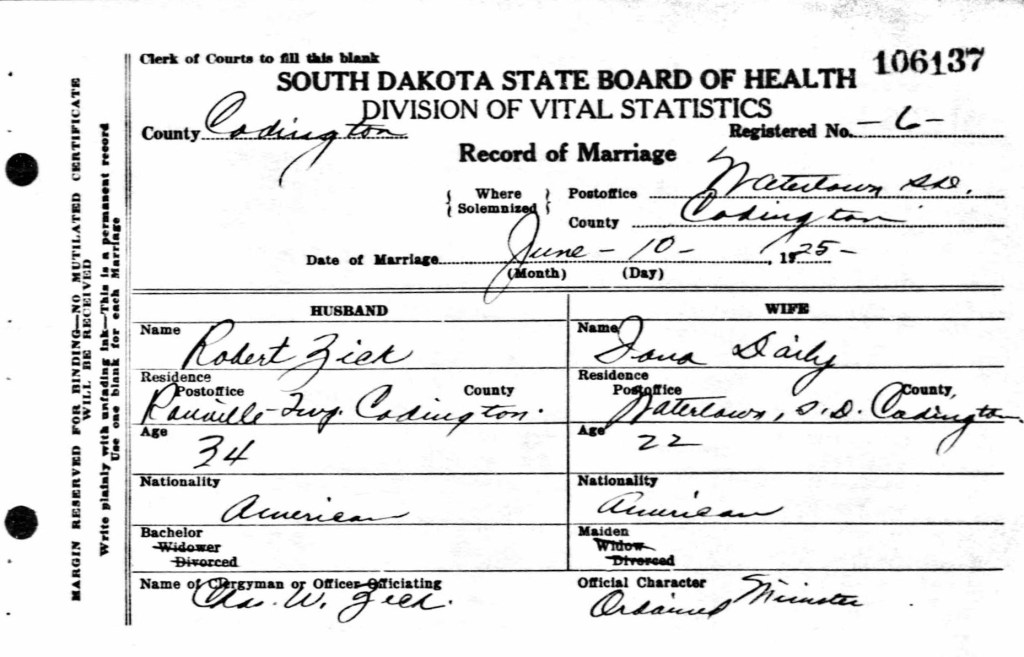
When the 1925 South Dakota Census was conducted, the only child that was living with Charles and Maggie in Rauville was 22 year-old Iona.  She would get married soon afterward, marrying Robert Zick on June 10.35  The officiating minister was Charles W. Zech [sp.?], who was likely the pastor of First Church Evangelical Association.36  Charles and Maggie’s daughter Gladys and her family were living in Rauville, but they may have been living on a different farm than Charles and Maggie.  Oranna and her husband were also still in Rauville.37  Robert had moved with his family to a farm in Germantown Township, Codington County.38


Marriage record of Robert Zick and L. Iona Daily, June 10, 192535

After living and working for 13 years on the Gunther farm, Charles and Maggie moved to another farm in the fall of 1929.  Uncle Bob explained the circumstances around their move:

Uncle Bob:  So, I went out there in the spring of ’29 on [Longstocker?] place.  An’ then Dad had a sale that fall in ’29, up on Gunther farm. 

Interviewer:  Uh huh.

Uncle Bob:  Now ‘o course, he had, he had the hay and he had his cows yet.  He kept his cows.

Interviewer: Um hmm.

Uncle Bob:  I had him come down, with me there.  That house was able – we had two different entrances.  So, so, we lived in two rooms there for ’29, and uh, oh, in the fall of ’29, that’s when Dad come down and moved in there.  Why, we had our — I had cows and he had cows.  Took ’em there.  But then I got a chance in the fall of ‘30 to buy Faragher [sp.?] out.  And, uh, ‘course, I had 1300 head o’ cattle and Faragher [sp.?] had 1700 head o’ cattle.  And uh, I moved down there.  Well, Dad figured maybe I was bitin’ off more – see, the bank was willing to loan me the money because he, Faragher [sp.?] was on there and he owed ‘em $500.  And uh, it was willing to, uh, take the loan over, oh, the mortgage over on a younger man.

Interviewer:  Um hmm.

Uncle Bob:  That’s the way I come in on it.

Interviewer:  Ahhh.  Uh huh.

Uncle Bob:  The bank loaned me all the money to buy Faragher [sp.?] out —

Interviewer:  Sure, sure.

Uncle Bob:  — and then they get their money.  They got their money, see.  …

Interviewer:  That must have been about when, when Grandpa moved to town then?  In ’30?

Uncle Bob:  Well, no.  No, he stayed there one more.  He stayed there one year and he handled the place ….  He put up the hay and fed cattle, out there.  … And so uh, when I come down here in the fall of ’30 to Longstocker’s [perhaps he meant Faragher’s instead], he stayed on one more year, and then he, uh, sold out.  And uh, moved into east Watertown, there.  That’s where he moved to then at that time.  Moved out there.39


On April 10, 1930 a census taker visited the home of Charles and Maggie in Lake Township, Codington County, also visiting the home of Robert and Ruby and their two daughters .40  Charles was 73 years-old and Maggie was 62 years-old.  Both Charles and Robert were farmers and they were actually working on the day before the census taker visited.  Oranna and her three children, aged eleven, seven and four, were living with Charles and Maggie.  Two hardships had afflicted Oranna in the 1920s: she began having epileptic seizures and her husband had deserted her.41  The census record indicates that she was divorced by 1930.
Gladys and Arthur had seven children by this time and were living on a farm very close to Elizabeth and Willis who were also living on a farm, both farms being in Kampeska Township, Codington County.42  Elizabeth had born three children, but one daughter had only lived for four months.  Living with Elizabeth and Willis were his parents Herbert and Lena Bevers.  Iona and Robert had two children prior to 1930 and would have another child a couple months after the census was taken.  They were still living on a farm in Rauville.43  So, as of the end of 1930, Charles and Maggie had 17 living grandchildren. 

In 1930, the United States government wanted to determine the extent of ownership of radio sets in the nation, so one of the questions on the 1930 census was whether the householder owned a radio set.  Between 1905 and 1920, radio broadcasting had been primarily a hobby of amateur radio operators.  During the early 1920s, broadcast stations began to be established in cities and they began providing live programs of music and information for public audiences.  At the time of the census, Charles did not own a radio set and the only ones among his children that owned a radio set were Elizabeth and Willis. 

In the next blogpost of Uncle Bob’s reminiscences, we will learn about Charles and Maggie’s years of living in Watertown, South Dakota.


1. M. R. Wilson, transcription of Robert Lee Daily Interview by R. Thiele, recording (ca. 1984): 8-9.

2. E. M. Bevers, email communication with M. R. Wilson, January 28, 2018.

3. _________, “Charles Monroe Daily Family,” in The First 100 Years in Codington County, South Dakota, 1879-1979, by Codington County History Book Committee (Watertown, South Dakota: Watertown Public Opinion Print, 1979): 150.
4. H. L. Hill (Ed.), Watertown City and Codington County Directory 1916-1917 (Watertown, South Dakota: Watertown Printing and Binding Co., 1916): 317.
5. Wilson, Robert Lee Daily Interview: 25.

6. Hill, Watertown City and Codington County Directory 1916-1917: 336.

7. H. L. Hill (Ed.), Watertown City and Codington County Directory 1919-1920 (Watertown, South Dakota: Watertown Printing and Binding Co., 1919): 323.

8. Wilson, Robert Lee Daily Interview: 14.

9. Ancestry.com, “Record of marriage of Ray Mills and Oranna Daily,” South Dakota Marriages, 1905-1949 (Provo, Utah: Ancestry.com Operations Inc., 2005).

10. Hill, Watertown City and Codington County Directory 1919-1920: 345.

11. ________, Saturday News (Watertown, South Dakota, Oct. 11, 1917), https://www.newspapers.com/image/466193821.

12. ________, Saturday News (Watertown, South Dakota, Oct. 11, 1917), https://www.newspapers.com/image/466193821.

13. ________, Saturday News (Watertown, South Dakota, Mar. 14, 1918), https://www.newspapers.com/image/465662336.

14. ________, Saturday News (Watertown, South Dakota, Jul. 11, 1918), https://www.newspapers.com/image/465664742.

15. 65th Congress, “Congressional Act H. R. 3545,” in United States of America, Public Laws of the Sixty-Fifth Congress (Washington, D. C., 1917): 76-83, http://legisworks.org/congress/65/publaw-12.pdf

16. 65th Congress, “Congressional Act H. R. 12731,” in United States of America, Public Laws of the Sixty-Fifth Congress (Washington, D. C., 1918}: 955-957, http://legisworks.org/congress/65/publaw-210.pdf.

17. “United States World War I Draft Registration Cards, 1917-1918,” database with images, FamilySearch (https://familysearch.org/ark:/61903/3:1:33S7-81WF-YWR?cc=1968530&wc=9FC7-FM9%3A928420501%2C928501301 : 9 September 2019), South Dakota > Codington County; A-Z > image 630 of 3493; citing NARA microfilm publication M1509 (Washington, D.C.: National Archives and Records Administration, n.d.).

18. “United States Census, 1930,” database with images, FamilySearch (https://familysearch.org/ark:/61903/3:1:33S7-9RCF-HX1?cc=1810731&wc=QZF7-DBF%3A648803701%2C649380801%2C648842001%2C1589282340 : 8 December 2015), South Dakota > Codington > Lake > ED 12 > image 2 of 6; citing NARA microfilm publication T626 (Washington D.C.: National Archives and Records Administration, 2002).

19. “United States Census, 1920,” database with images, FamilySearch (https://familysearch.org/ark:/61903/3:1:33SQ-GRVM-Z27?cc=1488411&wc=QZJB-QKD%3A1036874501%2C1039011801%2C1039046901%2C1589332554 : 13 September 2019), South Dakota > Codington > Watertown Ward 4 > ED 101 > image 17 of 41; citing NARA microfilm publication T625 (Washington, D.C.: National Archives and Records Administration, n.d.).

20. Ancestry.com, “Record of marriage of Arthur H. Bevers and Gladys M. Daily,” South Dakota Marriages, 1905-1949 (Provo, Utah: Ancestry.com Operations Inc, 2005).

21. “United States Census, 1920,” database with images, FamilySearch (https://familysearch.org/ark:/61903/3:1:33S7-9RVM-D6Z?cc=1488411&wc=QZJB-434%3A1036874501%2C1039011801%2C1039036701%2C1589332505 : 13 September 2019), South Dakota > Codington > Rauville > ED 94 > image 2 of 7; citing NARA microfilm publication T625 (Washington, D.C.: National Archives and Records Administration, n.d.).

22. L. A. Bevers, personal interview with M. R. Wilson, August 2, 2010.

23. Hill, Watertown City and Codington County Directory 1919-1920: 62, 242.

24. Teacher’s Contract of Richland School District No. Six with Iona Daily, August 11, 1921.

25. ________, Meridian Highway, https://web.archive.org/web/20070924192054/http://www.drivetheost.com/meridianhighway.html.

26. D. Moore, et al., The Meridian Highway in Texas (Austin, Texas: Texas Historical Commission, May 27, 2016): 1.

27. C. Ahlgren, The Meridian Highway (2011), http://plainshumanities.unl.edu/encyclopedia/doc/egp.tra.020.xml.

28. “United States Census, 1920,” database with images, FamilySearch (https://familysearch.org/ark:/61903/3:1:33SQ-GRXW-XQR?cc=1488411&wc=QZJ5-LMG%3A1036473301%2C1036471902%2C1037747101%2C1589333009 : 12 September 2019), Nebraska > Douglas > Omaha Ward 9 > ED 105 > image 11 of 30; citing NARA microfilm publication T625 (Washington, D.C.: National Archives and Records Administration, n.d.).

29. ________, City Directory of Greater Omaha 1920 (Omaha, Nebraska: R. L. Polk & Co., 1920): 1229.

30. Wilson, Robert Lee Daily Interview: 19.

31. Ancestry.com, “Record of marriage of Robert L. Daily and Ruby Violet Brumbaugh,” South Dakota Marriages, 1905-1949 (Provo, Utah: Ancestry.com Operations Inc, 2005).

32. D. L. Bevers, Herbert and Lena Bevers trip to Raymondville Texas [Transcription of Our Trip to Texas by Lena Bevers, 1919] (unpublished, n.d.): 4.

33. Ancestry.com, “Record of marriage of Willis H. Bevers and Elizabeth Daily,” South Dakota Marriages, 1905-1949 (Provo, Utah: Ancestry.com Operations Inc, 2005).

34. ________, “Willis Herbert Bevers,” in The First 100 Years in Codington County, South Dakota, 1879-1979, by Codington County History Book Committee (Watertown, South Dakota: Watertown Public Opinion Print, 1979): 116.

35. Ancestry.com, “Record of marriage of Robert Zick and Iona Daily,” South Dakota, U. S., Marriages, 1905-2017 (Lehi, Utah: Ancestry.com Operations Inc, 2005).

36. H. L. Hill (Ed.), Watertown City and Codington County Directory 1926-1927 (Watertown, South Dakota: Peck-Hill Company): 9.

37. Hill, Watertown City and Codington County Directory 1926-1927: 347.

38. “South Dakota State Census, 1925,” database with images, FamilySearch (https://familysearch.org/ark:/61903/3:1:S3HY-DCR9-M87?cc=1476077&wc=MJ7S-C68%3A1041724801 : 21 May 2014), 004245665 > image 2963 of 3379; State Historical Society, Pierre.

39. Wilson, Robert Lee Daily Interview: 25-26.

40. “United States Census, 1930,” database with images, FamilySearch (https://familysearch.org/ark:/61903/3:1:33S7-9RCF-HX1?cc=1810731&wc=QZF7-DBF%3A648803701%2C649380801%2C648842001%2C1589282340 : 8 December 2015), South Dakota > Codington > Lake > ED 12 > image 2 of 6; citing NARA microfilm publication T626 (Washington D.C.: National Archives and Records Administration, 2002).

41. Wilson, Robert Lee Daily Interview: 10.

42. “United States Census, 1930,” database with images, FamilySearch (https://familysearch.org/ark:/61903/3:1:33SQ-GRCF-HB3?cc=1810731&wc=QZF7-6VX%3A648803701%2C649380801%2C649388101%2C1589282323 : 8 December 2015), South Dakota > Codington > Kampeska > ED 10 > image 1 of 8; citing NARA microfilm publication T626 (Washington D.C.: National Archives and Records Administration, 2002).

43. “United States Census, 1930,” database with images, FamilySearch (https://familysearch.org/ark:/61903/3:1:33S7-9RCF-8C9?cc=1810731&wc=QZF7-DT9%3A648803701%2C649380801%2C649393801%2C1589282372 : 8 December 2015), South Dakota > Codington > Rauville > ED 16 > image 5 of 8; citing NARA microfilm publication T626 (Washington D.C.: National Archives and Records Administration, 2002).

Reminiscences of Uncle Bob, Part Four

In March 1913, Charles and Maggie Daily moved their family from a farm near Topeka, Kansas (see Reminiscences of Uncle Bob, Part 3) back to Omaha, Nebraska.  Charles probably took employment at a company he had worked for previously, in the 1890s.  Whether he started working there immediately or later in the year, by the time the 1914 Omaha city directory was issued, he was a foreman at West Omaha Coal and Ice Company.1 When the Dailys arrived in Omaha, they intended to move into the home that they owned in the neighborhood called West Side.  Renters were still living in their house so they had to wait until the first of April to move into it.  During the interim, tragedy struck the city.  At about age 84, their son Robert recounted the event:

Interviewer:  … Let’s see, the tornado in Omaha —

Uncle Bob:  That was on the 23rd of March.

Interviewer:  And I believe your house was damaged?

Uncle Bob:  Yeah, it was. Our home was completely gone except one side wall of our own home.  We were, we moved up there just, see, 10 days before the, uh, tornado and we had to wait till the first of the month.  Easter Sunday, see, uh, the tornado was on Easter Sunday, and we had to wait till the first of the month to be able to get in our own home.  So, we stored all our household goods in Grandma’s basement.  She had a 13-room house, a full basement apartment underneath.  An’ o’ course, when the storm hit, why, it took a lot.  But when it finally did move, why it just crushed the foundation down and we just lost all our household goods, see.

Interviewer:  Ohhh!

Uncle Bob:  It set that big house down.  An’ our own home was two blocks north of there and all that was left was just one side wall.  The house went completely away from there.  We never found it, see.2


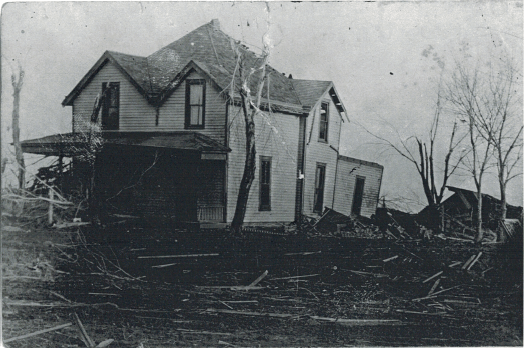
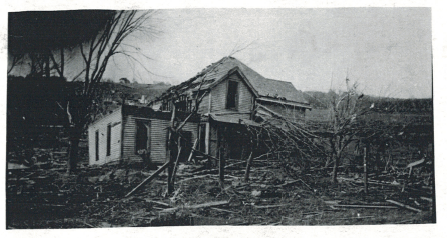
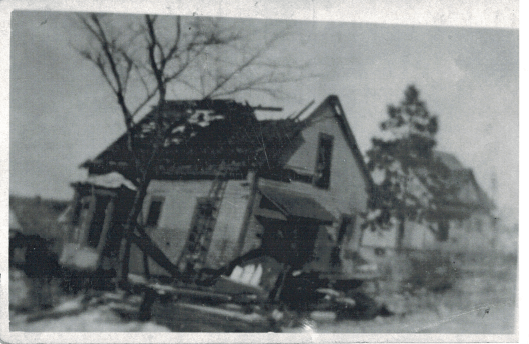
The following photographs of damaged homes are from the interviewer’s collection.  They are not labeled, so it is not known whose homes these are.


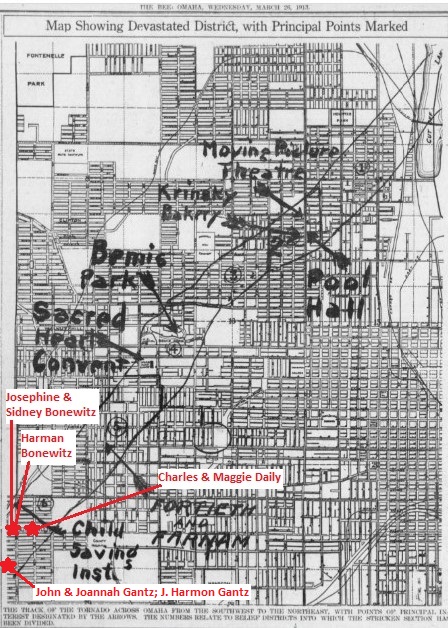
On the evening of Easter Sunday, six tornadoes struck eastern Nebraska and southwestern Iowa. The most destructive of these raced through Omaha, striking 2000 homes and demolishing 750 of them, thus displacing over 2000 residents and killing 94 people.3  The tornado entered the city from the southwest, immediately striking the workers’ cottage area of West Side where the Daily home was located as well as the homes of relations of the Dailys:

As the whirlwind raced over West Lawn and the Bohemian cemeteries toppling tombstones, it struck the worker cottage area from 53rd and Francis to 51st and Center and on to Leavenworth Street.  It splintered a long strip of houses, killing eight people in the 48th and Pacific neighborhood.  A score of fires broke out due to ruptured gas lines.  The amount of debris in the streets, at times concealing fire hydrants, prevented firefighters from responding effectively.  Fortuitously, evening rains squelched the fires throughout the city.4


Within the path of the twister were the homes of:

Charles and Maggie Daily at 1022 S. 46th.5

Maggie’s brother Harman Bonewitz at 1048 S. 48th with his wife Cornelia and son Roscoe.6

Maggie’s mother Josephine (nee Smith) Bonewitz at 4817 Pacific (where Maggie’s brother Sidney Bonewitz was also living).7

Maggie’s aunt Joanna Gantz at 4909 Hickory with her husband John and daughter Adda.8

Joanna Gantz’ son, J. Harmon Gantz at 4850 Hickory, with his wife Helen and two daughters, Dorothy and Bernice.9

Thankfully, none of these families lost lives to the whirlwind. But unfortunately, West Omaha Coal and Ice, Charles’ employer, which was located at 4801 Leavenworth10 would also have been in the path of the tornado.

A map of the tornado’s path through the city,
published by The Omaha Daily Bee11

Soon after the tornado passed through the city, Omaha’s Mayor James C. Dahlman issued a proclamation:

To the People of Omaha: A great calamity has struck our city.  Many lives and homes have been destroyed.  The authorities, with the assistance of Major C. F. Hartman of Fort Omaha, with 200 troops, are doing all that can be done tonight in guarding property and rescuing the dead and injured.

Tomorrow it will be necessary to properly patrol this district, which extends over several miles of territory, and until matters can be adjusted, so that property may be protected and men have an opportunity to clear the wreckage.  No one will be allowed inside the lines unless properly authorized, so I call on the public generally to be patient.

Thousands of volunteers are doing all they can tonight.  I appeal to the people in this hour of distress to house and feed all that need help until other arrangements can be made.12

Throughout the night, reporters were busy gathering information and by the time the printing presses started at about 4:00 A. M., the front page of the Morning World-Herald was full of descriptions of the destruction caused by the tornado, as well as preliminary lists of the deceased and the injured, stating where the injured were recovering.  Portions of the front-page article follows:

Cyclonic conditions, unknown to all, prevailed over the Missouri valley during the day, and a gigantic twister suddenly appeared, at 5:45 o’clock, as a manifestation of this disturbance.

The wind demon came careening over the prairies from the southwest and drove a diagonal course through the residence district to the north east ….

The huge, fashionable residences of the denizens of West Farnam hill suffered alike with the simple cottages of West Side and the substantial homes of Bemis Park and northern Omaha. …

Omaha has long been regarded as tornado-proof, on account of its barricade of surrounding hills, but this imaginary protection was swiftly proven a flimsy fabric indeed.  The twister, reaping a harvest over half a mile wide, swept over the hilltops and down the valleys with the neat and deadly precision of some omnipotent mowing machine. …

… Streets and boulevards are so enmeshed in wreckage that travel, even on foot, is practically impossible, while street car and telephone service is almost nil.  Automobiles and other vehicles are likewise nearly helpless ….13

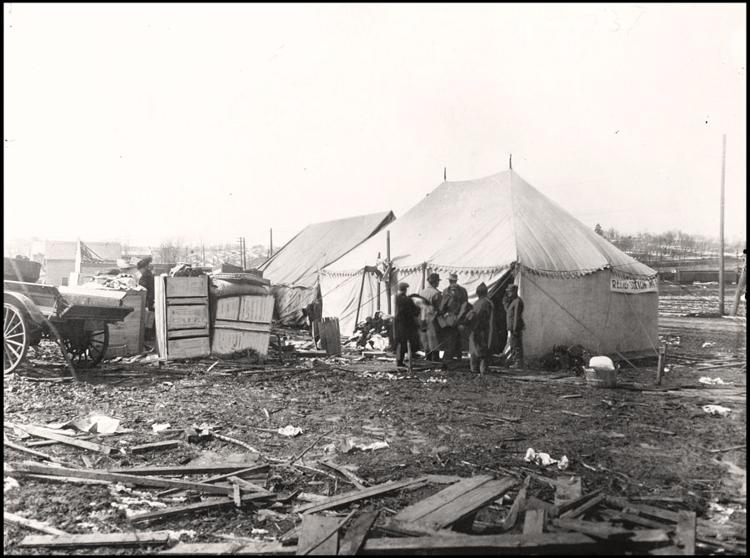
Relief efforts began immediately, including the organization of a Citizens Relief Committee, which had the responsibility of disbursing funds and supplies, such as food, clothing, fuel and other necessities.  “A sub-committee investigated aid requests using vehicles donated by wealthy Omahans; upon verification, requisitions sped to the destination in trucks loaned by businesses and in horse-drawn wagons lent by the Army.”14 During the following months, over $350,000 in aid was dispensed.

The city established neighborhood relief stations to distribute donated food and clothing; teachers opened additional stations in schools for relief and to act as shelters and congregants did so in their churches.  The state contributed $100,000, some of which went for low-interest reconstruction loans.  The Omaha World-Herald resurrected its “Tow Line” appeal and collected approximately $50,000 towards the relief effort.  Several hotels offered free lodging to the poor, and the Real Estate Exchange worked to prevent gouging on rents.15

A relief station at 48th and Leavenworth,16 near the Daily property

Everyone in the city was involved in cleaning up after the tornado because of “a fine, brownish dust that entered homes through the smallest of openings and settled on furniture and carpets.”17 Organized clean-up efforts began the first weekend of April in order to remove the wreckage in the streets and lots:

Over 10,000 volunteers met at 27 locations in the affected areas to pitch debris into trucks that removed it to designated dumping areas.  Groups volunteered in units of college students, school children and factory workers.  The newspapers praised the heroic effort that cleared the ruble, made the streets passable and precipitated a rapid rebuilding effort.18

A Restoration Committee handled the reconstruction effort:

This body secured large amounts of money from local financiers and likewise made trips to Chicago, where they secured additional funds from the railroads running into Omaha.  For the purposes of restoration they loaned money without interest for a term of years and in some instances practically gave it away.19


Robert explained how his family rebuilt their homes:

Uncle Bob:  So, Uncle Finley, that’s mother’s brother, older brother, he was a carpenter. [Harman was his first name, Finley was his middle name.]  Always had carpentry.  In the first place was, we had to build up Grandma’s home, see.

Interviewer:  Um hmm.

Uncle Bob:  Build up a cottage, we built up a cottage for Grandma.  An’ that’s where I worked all the time that summer, ten cents an hour, cleaning bricks and cleaning – [chuckling]

Interviewer:  You’d’ve been 13?

Uncle Bob:  Yeah, I was coming on 13, not til May, see. …  Built Grandma’s house.  And uh, then built, well, first we built a, uh, called it a barn, but when it come right down, it was just about the size of a one stall garage, see.

Interviewer:  Mmm.  Um hmm.

Uncle Bob:  We lived in it.  There was a loft in it ….  An’ that’s where we lived while uncle was building Grandma’s house, and then built our house. … We had a nine-room house.  Took that out, see.

Interviewer:  So, you left a new house in Omaha when you moved up here?

Uncle Bob:  Well, it [wasn’t] that new.  From 1913 to 1915.  Yeah.

Interviewer:  Two years.

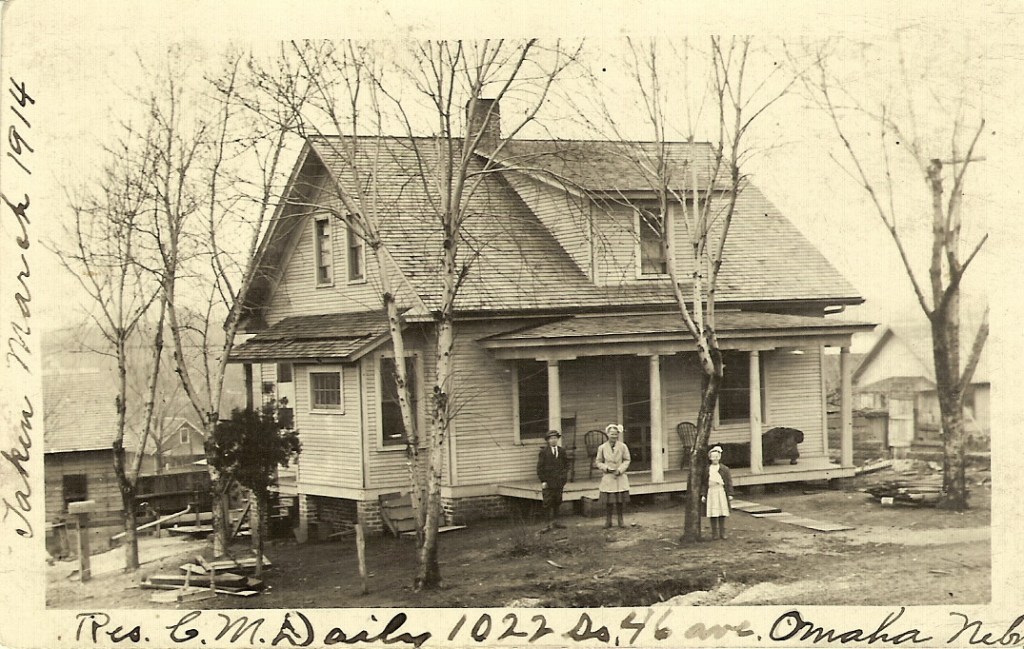
Uncle Bob:  … An’ we built another house in 1914 there.  Uncle had a, had a house in lot, just in the second lot, uh, can’t tell you the direction, got different direction down there.  But then there was a house in between our home and his, one that he rented.  Of course, it [the tornado] damaged that one there, so he sold it to dad an’ then he tore that down to build a cottage up there, jus’ small four-room cottage.20

The newly built home of Charles and Maggie Daily one year after the tornado. (March 1914)

Besides helping to re-build homes, Robert continued attending public school.  Robert related the difficulties he encountered during his schooling because the curriculums of various schools were not comparable.

Interviewer:  Now, would you, you would have been through school, or you would have been through 8th grade?

Uncle Bob:  No, I’d been through so much, I’d had so much free schooling, see.  I didn’t, I didn’t graduate until 1915 from the seventh grade. …

Interviewer:  I see.  Okay.

Uncle Bob:  ‘Cause I’d had free schooling.  From moving in from the farm, coming into town, they sent me back. [The Dailys moved from a farm west of Omaha into the city in 1908 when Robert was 7 years old.]

Interviewer:  Um hmm.

Uncle Bob:  Well, I was only in there 15 months, and then we moved to Kansas.  When we moved to Kansas, Kansas had a different set up, see.  So, I had to pick up that.  Well, I was [down there] four years, an’ then come back to Omaha, and they sent me back again, because I didn’t have the education ….  I had lots of free schooling, though.

Interviewer:  Did you, did you ever finish eighth grade?

Uncle Bob:  No.

Interviewer:  You didn’t.

Uncle Bob:  Just 7th grade.  … after I graduated from the 7th grade, I did put in from September until 1st of March, that’s how much, in 8th grade.

Uncle Bob:  And Oranna, she started in – at that time we had a two-year high school and a four-year high school.  One was more of a business [school] and Oranna wasn’t cut out for that kind of work.  After she went there, well, she wasn’t interested in educating, she was always interested in more, want’n t’raise a family and –

Interviewer:  Housework.

Uncle Bob:  That was her turf.21

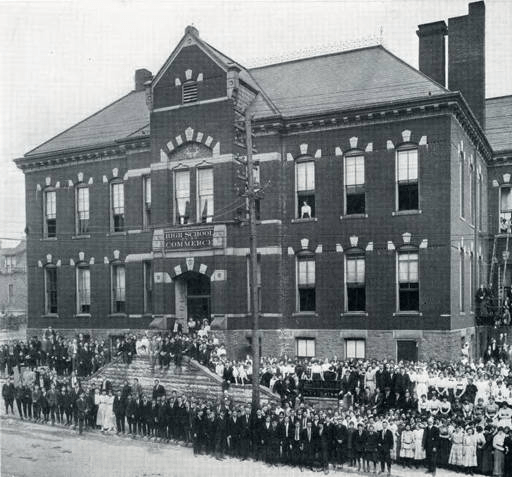
A high school Robert’s older sister Oranna may have attended was the High School of Commerce.

At this time, many students’ school careers ended with eighth grade graduation. Students who went on to high school were preparing to enter a profession that required college and generally came from more well-to-do families. The High School of Commerce offered classes in typing, stenography, telegraphy, bookkeeping, commerce law, etc., that prepared students for opportunities for better paying jobs in the business field. The program originated in the basement of Omaha’s Central High School in 1911, but the response was so great that within a year, classes were moved to the old Leavenworth Elementary School building at 17th and Leavenworth Streets. The school quickly became overcrowded and was replaced in 1922 by Technical High School.22

High School of Commerce, Omaha, Nebraska, 191222

After the Dailys had lived in Omaha for two years, at Maggie’s urging Charles found another farm for them and on April 10, 1915, the family headed to northeast South Dakota.23  Robert’s reminiscences will continue.


  1. __________, Omaha City Directory Including South Omaha 1914 (Omaha, Nebraska: Omaha Directory Co., 1914): 250.
  2. M. R. Wilson, transcription of Robert Lee Uncle Bob Interview by R. Thiele, recording (ca. 1984): 7-8.
  3. D. Mihelich (Ed.), Ribbon of Destruction (Omaha, Nebraska: Douglas County Historical Society, n. d.): 3.
  4. Mihelich, Ribbon of Destruction: 8.
  5. Omaha City Directory 1914: 250.
  6. __________, Omaha City Directory Including South Omaha 1913 (Omaha, Nebraska: Omaha Directory Co., 1913): 133.
  7. Omaha City Directory 1913: 133-134.
  8. Omaha City Directory 1913: 333.
  9. Omaha City Directory 1913: 333.
  10. Omaha City Directory 1913: 954.
  11. “Map Showing Devastated District, with Principal Points Marked,” The Omaha Daily Bee, March 26, 1913, morning edition, https://nebnewspapers.unl.edu/lccn/sn99021999/1913-03-26/ed-1/seq-2/.
  12. J. C. Dahlman, “Mayor’s proclamation,” Morning World-Herald, March 24, 1913.
  13. __________, “Tornado kills 60, injures 152, in Omaha,” Morning World-Herald, March 24, 1913.
  14. Mihelich, Ribbon of Destruction: 46.
  15. Mihelich, Ribbon of Destruction: 42.
  16. S. Jones, “Back in the day, March 23, 1913: Monster tornado rips a scar across Omaha on Easter,” Omaha World-Herald, Mar. 23, 2021, https://omaha.com/news/local/history/back-in-the-day-march-23-1913-monster-tornado-rips-a-scar-across-omaha-on/article_53e17c40-74b1-11eb-a848-4b45501f7435.html.
  17. Mihelich, Ribbon of Destruction: 46.
  18. Mihelich, Ribbon of Destruction: 46.
  19. Mihelich, Ribbon of Destruction: 47.
  20. Wilson, Robert Lee Daily Interview: 8.
  21. Wilson, Robert Lee Daily Interview: 9-10.
  22. Nebraska Memories, “Omaha High School of Commerce,” http://memories.nebraska.gov/cdm/singleitem/collection/ops/id/2/rec/13.
  23. Wilson, Robert Lee Daily Interview: 9.

Reminiscences of Uncle Bob, Part Three

After his family spent 15 months in Omaha, Nebraska (see Reminiscences of Uncle Bob, Part Two), Robert L. Daily reported in an interview when he was about 84 years-old that his family moved to Kansas because “Mother wanted to get back to the farm again, so Dad went lookin’ around again,” and Robert gives a date: “We moved down to Kansas in 1909.  So, that was, see, when I was comin’ nine years old.  We landed down in March, and ‘course, I was nine years old in May, see.”1  Robert also said that in that year his father’s brother William brought his oldest daughter Inez to live with Robert’s family when they were living in Kansas, and Robert said that Inez looked like her father.2

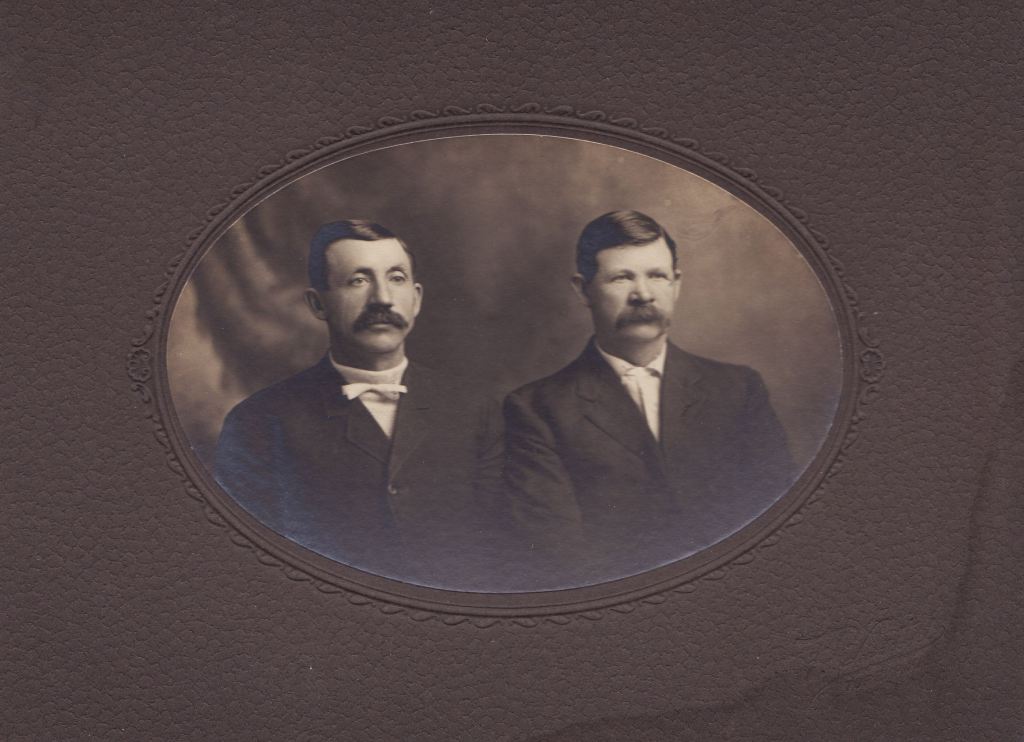
In the trunk that holds many Daily memorabilia, the portrait below can be found.  The photograph is labeled “Wm. J. Daily and C. M. Daily” and in the lower right corner of the image the words “Topeka, Kansas” are embossed below the photographer’s name.  It is most likely that this portrait was taken when William brought his daughter to Kansas.  William would have been about 47 years-old and Charles, 53 years-old.

Wm. J. Daily and C. M. Daily

One of Charles’ grandsons recalled what his mother Gladys and grandmother Maggie said about the farm: “I can remember my mother talking about a farm in Kansas which had lots of walnuts on it” and they cracked a lot of walnuts.3  Robert identified the location of the farm in his interview:

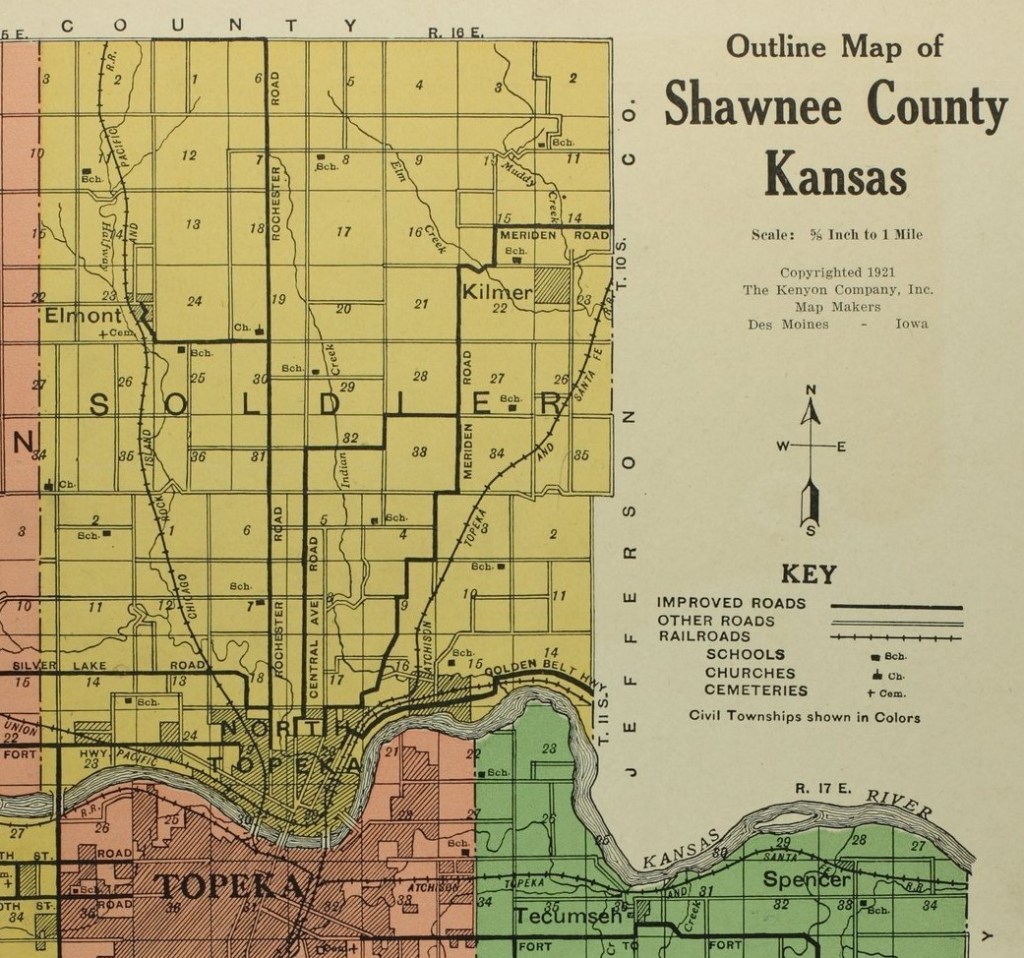
Uncle Bob:  … Kilmer, Kansas was where it was at. It was just a flag station.

Interviewer:  It wasn’t Topeka?

Uncle Bob:  Topeka was, was 8 miles from us.

Interviewer:  Oh, I see.

Uncle Bob:  It was our —

Interviewer:  Mom always said Topeka.

Uncle Bob:  No, that’s our post office.

Interviewer: Uh huh.

Uncle Bob: We were, we were 8 miles out from Topeka at Kilmer, just a flag station.  And uh, we generally went to Meriden, that went the other direction, four miles to Meriden.  For, up to, uh —

Interviewer:  For shopping?

Uncle Bob:  Yeah.  ‘Course, we’d go to Topeka for circus or for, and the capitol, see.  I can remember going through the capitol in Topeka, Kansas, y’see.  Yeah, yeah.4


A section of a Shawnee County, Kansas, map showing Soldier Township5

A flag station is “a railroad station where trains stop only when a flag or other signal is displayed or when passengers are to be discharged.”6  Northeast of Topeka, Kilmer was a small station on the Atchison, Topeka and Santa Fe Railroad which crossed the southeast corner of Soldier Township in Shawnee County.7  The Daily family may have ridden a train into Topeka to see a circus performance.  One of the circuses that was scheduled to perform in Topeka was the Barnum and Bailey Circus.  It came to Topeka on September 7, 1909, but the city newspaper reported that the circus couldn’t be set up because of the weather.8  Record-breaking rain (over eight inches) fell that day, flooding the site where the circus was to be set up.9 The following year, the Ringling Brothers Circus arrived on September 5.  In the Monday evening issue of the Topeka State Journal, which sold for 2 cents, the following article described the spectacle that the circus provided.

Cropped image from The Topeka State Journal, September 5, 1910

Ringlings’ “Big Top” today is the attraction in Topeka.  Sunday the interest was hardly less.  Thousands of persons watched the parade which came on time nothwithstanding the rain, with hardly less interest than did an almost equal number see the unloading and transfer of the circus from the Rock Island yards to the Kenwood tract near Fourth and Buchanan streets.

As the pageant was a chain of novel surprises likewise was the trail of wagons and the animals following the arrival.  The parade was nearly three miles long and the aforementioned surprises extended from the twenty-four horse band chariot in the lead to the tail end.  The rain fell all right and continued during the forenoon, making it difficult for the wagons to leave the grounds.

The show arrived here Sunday morning after some delay, in coming from St. Joseph.  About 9 o’clock the first wagon reached Kenwood.  Immediately the work of putting up the huge cook tent was started.  Stands began to spring up on adjacent property to the main entrance to the grounds between Buchanan and Lincoln streets on Fourth street.

Most of the paraphernalia was transferred in wagons, the majority of them being pulled by six horses each.  These were driven out Sixth avenue after having left the Rock Island yards.  Arriving at Buchanan street they again turned north to the Kenwood tract.  As soon as the wagons left the Buchanan street pavement going onto Fourth street difficulty was experienced.  The recent rains had made the unpaved street soft and the wagons mired to the hubs.  It was necessary to unload some of them before they could be moved.  Others were moved with 22, 24 and even 32 horses.

No sooner than the work of pitching the cook tent was started, crowds began to arrive from all directions.  From noon on there was a steady stream of humanity down Buchanan street from Sixth avenue to Kenwod.  A baby carriage brigade seemed to have been formed.  For two or three hours the day seemed to have been set apart for their display alone.  There was grandpa and papa and mamma and uncle and even forty-seventh cousin of each of them.  All had a baby.  In fact every woman who had a baby to loan was in great demand.  That condition seemed not to abate.

Crowd Gets a Ducking.

Pedestrians were not alone in their evidenced curiosity.  Car after car reached the tract, all of them packed.  Extras were put on and these, too, were filled to capacity.  Twenty or thirty spectators got wet when the circus employes stopped at Fifth and Buchanan streets to cool and water the elephants and the polar bears.  A hose was attached to the water plug and the operation started.  No sooner had the bears been given a bath than the hippopotamus arrived.  He had to have a bath, too.

Then was when the fun started.  An “accident” occurred.  Mr. Keeper intentionally or not allowed the water hose to get away from him.  He struggled with the rubber tube which under the pressure of water lunged and pulled and drenched a number of nearby onlookers.  Still he struggled manfully.  The hose got him down.  More persons were drenched.  Finally when the crowd had retired to a safe distance he gained control of it again.

Noticeable about the circus aggregation was that of all the employees none of them was given to loud talking or profanity in the time required to get the paraphernalia in its place.  Another noticeable thing was that the usual number of hardened men were conspicuously absent.  Most of the following was represented in young men appearing to be college students and others of that character.

Features of the Parade.

In the parade some of the remarkable features were teams of elephants, camels, zebras and llamas hitched to ornate tableau floats and driven like horses.  It has been supposed that the zebra could not be driven.  The Ringlings have proved otherwise.  In all nearly 700 horses were exhibited, the most of them Norman Percherons.  Many of them were white.

More than 1,200 men, women and children from Australian bushwackers to those advertised as the royalty of Asia and Europe took part.  Music was provided by six brass bands, a cathedral organ, a calliope, barbarian orchestras, fife and drum corps, church chimes, trumpeters and Oriental string and reed musicians.10


Besides the circus, Robert mentioned that he had visited the capitol of Kansas in Topeka.

This sepia colored photograph [below] shows the capitol in Topeka, Kansas. Located on twenty acres of land once owned by Cyrus K. Holliday, work began on October 17, 1855 when the cornerstone was laid for the east wing. Thirty-seven years later the statehouse, an example of French Renaissance architecture and Corinthian details, was completed at a total cost of $3,200,588.92.”11

Kansas State Capitol, Topeka, Kansas

On April 26, 1910 a census taker visited the Daily family at the farm they were renting in Soldier Township, Shawnee County, Kansas.  Charles is mistakenly recorded as being 56 years-old (he was 53), Maggie was 42 years-old.  Their five children were living with them:  Gladys, age 17; Oranna, 14; Robert, 9; Iona, 7 and Elizabeth, 5.12  In addition, there were also in the household Inez Daily, age 16 and Alpha Bailey, age 20.  Inez was the daughter of William Daily, noted above.  Alpha was Charles’ nephew, the son of his sister Cynthia, who had come to live with the Dailys in 1908.  All of the children, including Gladys and Inez, attended school for a period of time between September 1, 1909 and the end of April 1910.  Robert said that Inez went to school for a couple of years and then got married in Kansas.13  Charles and Maggie kept ownership of their house in Omaha and according to the 1910 U. S. census of Omaha, the house was being rented by a bartender named Samuel J. Barth.  In the Barth household were his wife Sophia and daughter Edith.14

The same census taker that visited the Daily family also visited a farmer named Lawson Bonnewitz, who owned a farm in Soldier Township.15  Maggie and Lawson were cousins.  Jacob Bonewitz (b. 1761) was their great-grandfather.  Two of Jacob’s sons were Joseph Bonewitz (b. 1790), who was Lawson’s grandfather, and John Adam Bonewitz (b. 1792), who was Maggie’s grandfather.  


One event in Kansas that Robert related was the baptism of two of his sisters:

Uncle Bob:  … When we lived in Kansas we was able to go to church more than any place else.  ‘Course, we, we had, uh, afternoon services, see.

Interviewer:  Oh, uh, circuit rider type.

Uncle Bob:  Yeah, and o’ course, a minister came out from, I don’t know where.  Meriden or Topeka, one o’ the two.  An’ I guess he was a Baptist minister, see, ‘cuz Gladys and Oranna were both, uhh, immersed in the river.

Interviewer:  Oh!  Uh huh.

Uncle Bob:  At that time, … ‘course, they were old enough to be baptized.  An’ I think Baptists, when you get right down to it

Interviewer:  I suppose that they —

Uncle Bob:  … that they don’t believe, didn’t believe in baptizing before 12 years old, see.

Interviewer:  Um hmm, um hmm.

Uncle Bob:  An’ Oranna an’ Gladys were still o’ that age.  I didn’t get in on it.  See, it was still before I was 12 years-old.  Either ten or eleven is what I was.  I can remember it so well.  We, uh, like the, like the song goes, “Shall we gather at the river,” see.

Interviewer:  Um hmm, um hmm.

Uncle Bob:  An’ that’s when we gathered at the river an’ the minister walked in. This’s out in the pasture, down in the pasture of our neighbors.

Interviewer:  Um hmm.

Uncle Bob:  That’s where we had our meeting there, went through there.  An’ that’s where Gladys and Oranna —

Interviewer:  Was it Omaha then?  This would be the Missouri River? 

Uncle Bob:  No, no, this was just a creek [pronounced crick].

Interviewer:  Oh, okay.

Uncle Bob:  Creek that went through the pasture, down in Kansas.16


Robert may have been referring to a hymn written by Robert Lowry in 1864, entitled, “Shall We Gather at the River?”

  1. Shall we gather at the river,
    Where bright angel feet have trod,
    With its crystal tide forever
    Flowing by the throne of God?
  2. On the margin of the river,
    Washing up its silver spray,
    We will talk and worship ever,
    All the happy golden day.
  3. Ere we reach the shining river,
    Lay we every burden down;
    Grace our spirits will deliver,
    And provide a robe and crown.
  4. At the smiling of the river,
    Mirror of the Savior’s face,
    Saints, whom death will never sever,
    Lift their songs of saving grace.
  5. Soon we’ll reach the silver river,
    Soon our pilgrimage will cease;
    Soon our happy hearts will quiver
    With the melody of peace.

Refrain:
Yes, we’ll gather at the river,
The beautiful, the beautiful river;
Gather with the saints at the river
That flows by the throne of God.
17


Joseph Esli Daily’s birth announcement which is stored in the trunk that holds Daily memorabilia

On February 8, 1911, Maggie gave birth to another son, Joseph Esli.  Sadly, the boy didn’t live to his first birthday.  Charles and Maggie buried Joseph in Evergreen Memorial Park in Omaha, where they had buried their first son, who had died in 1899.  Robert gives a few details about Joseph’s short life.

Interviewer:  But, the baby boy —

Uncle Bob:  Oh, Joseph?

Interviewer:  Joseph — was born and died in Topeka.

Uncle Bob:  Yeah, yeah.  … Mother always came up to see Grandma, once a year, around Christmas time, see.  And ‘course, other years Iona an’ Elizabeth, … would come up, too.  But when Joseph was born, a baby, she wanted the baby to, Grandma to see the baby, see.  Joseph.  And o‘ course, ah, that year was the time that I, Joseph and I came up with her.

Interviewer:  You mean up to Omaha.

Uncle Bob:  Yeah, up to Omaha.  See, he was born in 1911.  Passed away in January 1912.

Interviewer:  Oh, okay.

Uncle Bob:  That was Joseph, he was just ‘leven months old.  … but we’d been up to Omaha, and got back, and then he got the croup.  And ah, he was a little weak anyway in the spine.  He never had set up, really.  He was happy.  He’d lay on the lounge and watch us kids play on the floors and that.  But when it come to this here getting the croup.  So, why, that’s when —

Interviewer:  Went into pneumonia, I suppose.

Uncle Bob:  Yeah, suppose.  In those days, that’s what they’d call it.  Lungs filled up some, I guess.18


For years the details were somewhat of a mystery regarding when and how Charles and Maggie’s youngest daughter’s name came to be Elizabeth J. Best Viola Daily.  Since no one has been able to locate a birth record for Elizabeth, it is unclear whether she had that name at her birth or if she acquired the name later.  One of Elizabeth’s children thought that she had been given money to carry on the name of a woman named Elizabeth J. Best, another thought the woman’s name was J. Best and that property was involved.

Early in 2019 one of Elizabeth’s children was searching through old items that are kept in the trunk which has been previously mentioned and “… he came across some interesting info.  Mom stayed with someone in Indiana and went to school.  He came up with the name Stults and money being passed back and forth.  I suggested this may be the money Mom received for being named after Elizabeth J Best.  This morning I typed Elizabeth J Best in the internet search line and came up with Elizabeth J Stults Best.”19  The source of this name was the Find-a-Grave memorial page of Elizabeth J. Best (nee Stults) of Huntington County, Indiana.20  The webpage identifies the cemetery where she was buried, it is the same cemetery where one of Maggie’s brothers is buried,21 as well as her maternal grandparents Harman and Barbara Smith22,23 and her great-grandfather Jacob Flora (Barbara’s father).24

In August 2019, I found a document accessible on Ancestry.com that revealed some intriguing details.  It is the will of Elizabeth J. Best, dated October 26, 1910.  In the will, Elizabeth J. Best Daily of Omaha, Nebraska, is named as an heir.  Additionally, in March 2020, when listening to Robert’s interview, additional details came to light:

Uncle Bob:  … Elizabeth was heir to some money back East.

Interviewer:  I heard about that.

Uncle Bob:  See, she uh, Elizabeth Best was her name. And, Grandma’s name was Josephine Smith, as they went to school together.

Interviewer:  Ohhh.

Uncle Bob:  But they didn’t have no, no middle names, see.  So, Grandma took the name of — Elizabeth’s initial, E.  She was Josephine E. Bonewitz, that’s her married [name].  And Best took, took, uhh —

Interviewer:  Josephine, took the J.

Uncle Bob:  Yeah, took the J.  And she was, that’s the reason, she got the name Elizabeth J. Best, see.

Interviewer:  Okaaay.

Uncle Bob:  So, that’s the way she picked that up, see.

Interviewer:  And this was a school friend of Josephine Smith?  Okay.

Uncle Bob:  Yes, that’s right, and she was very wealthy.  O’ course, as I mentioned, ever’thin’ ended up, why, she [Robert’s sister Elizabeth] lived with the woman at that time in 1912.  Elizabeth was born in 1905, 7 years old.

Interviewer:  Um hmm.

Uncle Bob:  And, o’ course, uh then, ahh, all the time she was goin’ to school afterwards – the Elizabeth Best, or Elizabeth J. Best, ahh, had a friend, I can’t say what his name was, the lawyer, the lawyer, a friend lawyer.  And he was bound and determined that her word was law, see, ever’thin’ she said.  And Elizabeth’s other relatives tried to, tried to break the, uh —

Interviewer:  The will.

Uncle Bob:  — the will.  But he stuck in there and o’ course all the while she was goin’ to school, up ‘til she was 18, why, anythin’ needed for school, that’d come off the, off of her inheritance.

Interviewer:  Well, she had quite an inheritance, then!

Uncle Bob:  I don’t know what it was, I never knew what it was.  I know, I just know that she uh, afterwards when she come home, why, ‘course that’s what really put Willis on his feet there, because he, ahh, when she inherited that money, why ‘o course, uh, they bought out, uh — I can’t say what his name was down there —

Interviewer:  He bought down in that Grover area.

Uncle Bob:  Down in Grover area, see.  An’ o’ course, she gave each of us fifty dollars.  ‘Course, I think somewhere roun’ twenty-five hundred dollars is what she got.  ‘Course, at that time, was pretty good money.25

Elizabeth Stults was born in Stark County, Ohio,26 the same county in which Josephine Smith was born.  Both of their families moved to Huntington County, Indiana.27,28  Robert explains that they were school mates.  When Elizabeth Stults got married, she added a middle initial “J” to her name, becoming Elizabeth J. Best.  And when Josephine Smith got married, she added the middle initial “E” to her name, becoming Josephine E. Bonewitz.

Best’s husband Joseph C. Best had passed away seven years before she wrote her will and their only two children had died in infancy.29  So, at the time of the writing of her will, Best had no direct heirs.  Her will names 11 people as heirs, including Josephine’s granddaughter, Elizabeth J. Best Daily.

The date that the will was probated was April 21, 1911.  Along the edges of the will there is an accounting of when funds were distributed to the heirs.  The first distribution was October 24, 1914 and the last was December 23, 1916.  Each time a distribution is noted for Elizabeth J. Best Daily, it is received by a person named M. B. Stults.  It appears that this was the guardian for young Elizabeth.  Perhaps this is the friend or lawyer to which Robert referred in the interview.  Robert’s explanation clears up some questions, including the name of the woman, and confirmation that there was money given, and he also provides information as to why property was attached to the mystery.

Last will and testament of Elizabeth J. Best,
a friend of Elizabeth Daily’s grandmother Josephine Bonewitz

On May 1, 1912, Charles and Maggie’s third daughter Iona was honored by the Shawnee County School Superintendent.  She was in the third grade and had earned seven monthly Certificates of Perfect Attendance.  This achievement entitled her to receive a Certificate of Award for Punctual and Regular Attendance.

Certificate for Punctual and Regular Attendance awarded to third grade student, Iona Daily

On January 5, 1913, Maggie mailed a postcard to her daughter Elizabeth at their home north of Topeka. The text of the postcard indicates that Maggie had been in Omaha during the Christmas holidays. Maggie wrote: “How is my little lady getting along. Are you as busy since Christmas. I told grandma about your Xmas piece. She thought it was very nice. I hope I get some word from home tomorrow. good by with love to all. mama”

Front of Maggie’s postcard postmarked January 5, 1913
Back of Maggie’s postcard postmarked January 5, 1913

Apparently, Maggie was in Omaha because her father was seriously ill. On January 12, 1913, Maggie’s father, John Esli Bonewitz, passed away.  About thirteen years earlier, when Charles and Maggie’s baby died two days after its birth, Charles had bought a lot in Evergreen Memorial Park (Section A, Block 26, Lot 3).  Their son Joseph Esli was buried in that lot on January 5, 1912, and Maggie’s father was buried there on January 14, 1913 alongside the two sons.

Interment record of the cemetery lot owned by C. M. Dailey
in Evergreen Memorial Park, Omaha, Nebraska

Presently, in the cemetery lot, there are no grave markers for the un-named baby nor for Joseph Esli.  The interment record states that Joseph Esli was buried in grave #7 and John Esli was buried in grave #4.  It doesn’t indicate the location of the un-named baby, but a very helpful employee of the cemetery diagramed the lot, and there is a high probability that the baby was buried in grave #8. 

Two months after Maggie’s father passed away, the Daily family moved back to Omaha again.  In the next blogpost, Uncle Bob will continue his reminiscences of the next two years while they resumed living there.


1 M. R. Wilson, transcription of Robert Lee Daily Interview by R. Thiele, recording (ca. 1984): 6.

2 Wilson, Robert Lee Daily Interview: 13 & 16.

3 L. A. Bevers, personal communication with M. R. Wilson, August 10, 2010 and November 24, 2010.

4 Wilson, Robert Lee Daily Interview: 22-23.

5 The Kenyon Company, Inc., Atlas and Plat Book of Shawnee County Kansas (Topeka, Kansas: Kansas Farmer and Mail & Breeze, 1921): 5, https://www.kansasmemory.org/item/224002/page/7.

6 “Flag station,” Dictionary.com, https://www.dictionary.com/browse/flag-station.

7 James L. King, ed., History of Shawnee County, Kansas and Representative Citizens (Chicago: Richmond & Arnold, 1905): 55, https://ia902604.us.archive.org/7/items/historyofshawnee00king/historyofshawnee00king.pdf.

8 “Big Show Goes By,” The Topeka State Journal, September 7, 1909, https://chroniclingamerica.loc.gov/lccn/sn82016014/1909-09-07/ed-1/seq-1/.

9 “Eight-Inch Rain,” The Topeka State Journal, September 7, 1909, https://chroniclingamerica.loc.gov/lccn/sn82016014/1909-09-07/ed-1/seq-1/.

10 “Big Show Is Here,” The Topeka State Journal, September 5, 1910, https://chroniclingamerica.loc.gov/lccn/sn82016014/1910-09-05/ed-1/seq-5/.

11 Capitol, Topeka, Kansas, postcard, ca. 1910, https://www.kansasmemory.org/item/215285.

12 “United States Census, 1910,” database with images, FamilySearch (https://familysearch.org/ark:/61903/3:1:33SQ-GRJZ-GJ1?cc=1727033&wc=QZZQ-PF3%3A133640801%2C140502701%2C134349501%2C1589089094 : 24 June 2017), Kansas > Shawnee > Soldier > ED 140 > image 8 of 22; citing NARA microfilm publication T624 (Washington, D.C.: National Archives and Records Administration, n.d.).

13 Wilson, Robert Lee Daily Interview: 14-15.

14 “United States Census, 1910,” database with images, FamilySearch (https://familysearch.org/ark:/61903/3:1:33S7-9RVD-94BH?cc=1727033&wc=QZZW-D1C%3A133641701%2C133718401%2C136867001%2C1589089011 : 24 June 2017), Nebraska > Douglas > Omaha Ward 11 > ED 81 > image 15 of 30; citing NARA microfilm publication T624 (Washington, D.C.: National Archives and Records Administration, n.d.).

15 “United States Census, 1910,” database with images, FamilySearch (https://familysearch.org/ark:/61903/3:1:33S7-9RJZ-GRH?cc=1727033&wc=QZZQ-PF3%3A133640801%2C140502701%2C134349501%2C1589089094 : 24 June 2017), Kansas > Shawnee > Soldier > ED 140 > image 20 of 22; citing NARA microfilm publication T624 (Washington, D.C.: National Archives and Records Administration, n.d.).

16 Wilson, Robert Lee Daily Interview: 21-22.

17 Robert Lowry, “Shall We Gather at the River?,” 1864, Timeless Truths, https://library.timelesstruths.org/music/Shall_We_Gather_at_the_River/.

18 Wilson, Robert Lee Daily Interview: 6.

19 E. J. Jones, email communication with M. R. Wilson, February 2, 2019.

20 “Elizabeth J Stults Best,” https://www.findagrave.com/memorial/63599577/elizabeth-j-best.

21 “Rosco Neff Bonewitz,” https://www.findagrave.com/memorial/62071397/rosco-neff-bonewitz.

22 “Harman Smith,” https://www.findagrave.com/memorial/62815250/harman-smith.

23 “Barbara Marguet Flora Smith,” https://www.findagrave.com/memorial/62071353/barbara-marguet-smith.

24 “Jacob Flora,” https://www.findagrave.com/memorial/62852349/jacob-flora.

25 Wilson, Robert Lee Daily Interview: 7-8.

26 “Joseph C. Best,” Biographical Memoirs of Huntington County, Ind. (Chicago: B. F. Bowen, 1901): 587.

27 “United States Census, 1850,” database with images, FamilySearch (https://familysearch.org/ark:/61903/3:1:S3HY-6QMQ-QDH?cc=1401638&wc=95RX-2JQ%3A1031336301%2C1031975601%2C1031975602 : 9 April 2016), Indiana > Huntington > Huntington county > image 49 of 194; citing NARA microfilm publication M432 (Washington, D.C.: National Archives and Records Administration, n.d.).

28 “United States Census, 1860,” database with images, FamilySearch (https://familysearch.org/ark:/61903/3:1:33S7-9YBY-65K?cc=1473181&wc=7QK5-RD2%3A1589426070%2C1589426540%2C1589423705 : 24 March 2017), Indiana > Huntington > Huntington > image 41 of 41; from “1860 U.S. Federal Census – Population,” database, Fold3.com (http://www.fold3.com : n.d.); citing NARA microfilm publication M653 (Washington, D.C.: National Archives and Records Administration, n.d.).

29 “Joseph C Best,” https://www.findagrave.com/memorial/61993911/joseph-c-best.

Reminiscences of Uncle Bob, Part Two

In the blogpost, Reminiscences of Uncle Bob, Part One, the focus was on the life of Charles and Maggie Daily while they lived on two farms 13 miles outside of Omaha, Nebraska.  Today’s post continues to reveal aspects of their life through the stories that their son Robert told during an interview when he was about 84 years-old.

Robert related that in January of 1908, when he was seven years-old, his family moved from the farm back to the house in Omaha where they had lived prior to 1901.1  Robert’s cousin Bill Bailey, who had been living with them on the farm since about 19052, had returned to Floyd County, Indiana.  Bill’s 18 year-old brother Alpha (Joseph A. Bailey) came to live with the Dailys in Omaha and Robert states, “Alpha was, well, I said brother, ‘cause he was with us for eight years.”3

In his interview, Robert tells about his father’s occupation at that time:

Interviewer:  Was he back into the coal and ice business then?

Uncle Bob:  Yeah, he, well, no.  I’ll take it back, take it back.  He went into the potato chip business.

Interviewer:  Now, that was something new to me that I just discovered recently.  What, he …

Uncle Bob:  That would ha’ been in the, in the year of 1908.

Interviewer:  Well, uh, did he manage the potato chip factory?

Uncle Bob:  Yeah, it was just a home [business].  Well, he had one o’ these here, like the old-fashion, uh, mail carrier wagons and one horse.

Interviewer:  Uh huh.

Uncle Bob:  I know, uh, my cousin was with us.  See, my cousin come to our place in 1908.

Interviewer:  And what cousin was that?

Uncle Bob:  That was Alpha, Alpha Bailey.

Interviewer:  Alpha Bailey, okay.

Uncle Bob:  …I know Alpha worked in the, in the factory.  It was just a big vat, you know, and they had the potato slices.

Interviewer:  Well, you made ‘em?  It was a family operation, then?

Uncle Bob:  Yeah, well, Dad and …, even Ruth Thompson.  She was Ruth Thompson then. 

Interviewer:  Um hmm.  Um hmm.

Uncle Bob:  That was Mother’s sister’s girl.  She worked in there too.  That’s when she was just out of high school at the time.

Interviewer:  Well, that was something I had never heard of before, I didn’t know about this potato chip factory.

Uncle Bob:  Oh, Dad’d load up his wagon that way.  He had routes to go.  ‘Course he had help to make the chips, you know.

Interviewer:  Um hmm.  Um hmm.

Uncle Bob:  I remember Alpha workin’ in there, and stirring the potatoes in a big vat that way and, uh, get’n ’em ready for next day’s delivery.

Interviewer:  Sure, sure, delivering the next morning.

Uncle Bob:  Then when night’d come, why, he’d bring home, oh, anywhere from eight to ten sacks, and I’d peddle ‘em in the, around our, where we lived, see.

Interviewer:  Um hmm.  How much did a package of potato chips cost?

Uncle Bob:  Ten cents.

Interviewer:  Ten cents!  (Chuckling)

Uncle Bob:  An’ course, they was big ones, you see, they was half pounders.

Interviewer:  I’m sure they were.  Ohhh!  Now, how long did he do that?

Uncle Bob:  Well, that, I suppose …we was only in Omaha 15 months at that time, so it was in that there length of time, see.

Interviewer:  In about a year’s time.

Uncle Bob:  But Mother wanted to get back to the farm again, so Dad went lookin’ around again.  Then’s when we landed down in Kansas, see.4

The 1909 Omaha City directory has an entry for Charles which reads: “Daily Chas M, Potato Chip Factory 935 N 24th, r 1022 S 46th av.”5  The address of the Potato Chip Factory (935 N 24th) was the same address as Maggie’s brother-in-law’s residence and printing company (John C. Thompson & Son).6  In the business directory, there was a listing in the section for “Potato Chip Factories” which read: “THOMPSON’S U-CAN-ET-A POTATO CHIPS, 935 N 24th.”7 In the 1910 edition of the business directory, Thompson’s was not listed, instead there was a listing under Charles’ name. Robert states: “…the potato chip factory was on the back end, back end of the building where Uncle John had his printing shop. … He had his printing press set type, y’know.  An’ a big board, you could see that. There was a big board with all the set type, y’know, he printed.”8  When asked, “Did you raise a lot of potatoes on the farm and that’s why you made potato chips?,” Robert responded, “No, no, that wadn’t it.  You don’t raise potatoes down there, anyway.  Whate’er there was, are just for eatin’, y’know.  I don’t know how he come to get into that, but he – little one-horse outfit, y’see.”9

Robert mentions that Ruth Thompson was just out of high school when she started working at the potato chip factory.  In the spring of 1908, Ruth was 14 years-old, a year younger than Robert’s eldest sister Gladys.  According to Robert, Gladys went to high school in Omaha while their family was still living on the farm.10  In the early 1900s, there were not very many options for education beyond grammar school in Omaha.  A perusal of the 1908 Omaha city directory reveals there were a few trade schools, such as barber, dressmaking or railway training; a few business schools; several Catholic or other religion-affiliated schools; Creighton High School for young men; and Brownell Hall (a residential school).  One of the possibilities of where Gladys and Ruth could have attended was Omaha High School (a public school), located a few blocks from the Thompson home.  


The newly-built east section of Omaha High School, completed in 1902.11

“Omaha High School was located at 20th and Dodge Streets. In the late 1890s, the original brick building was deemed unsafe and unhealthy. Construction began on the replacement building in 1900. The east section was completed and in use by 1902. The south section was completed in 1905, and the west section was completed in 1910. The last section was completed in 1912. Parts of the original building were used until 1910. The old building was then removed, leaving an open courtyard at the center of the new building.”12


While the Daily family lived in Omaha, Charles rented a farm.  Robert told a story of an event that occurred at that farm:

Interviewer:  Mom used to tell the story about somebody that set the barn on fire.  Now, who was that?  And where?

Uncle Bob:  Well, oh, the barn we had, uh, burn, that was out in Grand Isle, Nebraska.  Y’see, when we lived in Omaha, my cousin was with us still.  And Dad rented a, out at Grand Isle, Nebraska, rented a quarter out there.  That was sweet corn country at that time, and raised a lot o’ sweet corn.  An’ the barn, ‘o course, was, uh, never knew how.  Cousin never smoked or anything like that.  An’ he got up an’ been out an’ got the horses ready an’ back in gettin’ breakfast. … They always figured that some, some, uh, let’s say tramp or man, slept in the barn that night.

Interviewer:  Oh, I thought maybe it was, I thought it was, uh, kids playing with matches.

Uncle Bob:  No, never knew just how it happened.

Interviewer:  I see.

Uncle Bob:  Alpha run out right away quick.  ‘Course, one horse broke, broke loose.  The fire seemed to be in, right near, in front of the horses, something like that.  An’ o’ course, when he got right there, opened the barn door, the horse come out an’ knocked him down.  It could ha’ been, it could ha’ a been such a thing, that he would ha’, uh, wouldn’t ha’ been able to get out there.13


On one of Charles’ trips, he mailed a postcard from Broken Bow, Nebraska, to his three-and-a-half year-old daughter Elizabeth. The upper left corner notes his name as “Papa” and the cost of the postage stamp was one cent. Although the penciled address is extremely faded, the postcard was addressed to their home in Omaha.


One of Charles and Maggie’s grandsons is the keeper of a trunk which holds many mementos of the Daily family.  One item is an invitation to the Commencement Exercises of Bassett High School in Bassett, Nebraska.  Maggie’s cousin’s (Viola J. Griffith) children were two of the nine graduates in the Class of 1908, graduating on May 28.  For a period of time during Maggie’s childhood, Viola and her brother William and their mother Malissa Griffith (nee Smith) lived in Maggie’s home in Iowa.14  Five years after their mother died in 1880,15 Viola married John G. Van Winkle in Keya Paha County, Nebraska, with William standing as a witness of the marriage.16  Viola’s children who graduated from Bassett High School 23 years later were Josie and Orlando Van Winkle whose ages (based on their ages in the 1900 U. S. census) were 20 and 17, respectively.17  Josie may have been named after Maggie’s mother Josephine Smith and Orlando may have been named after Maggie’s uncle Orlando Smith.  Bassett was about 230 miles from Omaha in north central Nebraska.

Josephine Van Winkle, estimated date about 1908

During this period when the Daily family lived in Omaha, there are a few additional things that can be noted.  Robert mentions that he and his sisters would often visit their grandmother’s sister Joannah (nee Smith) Gantz.  He said the Gantz family “lived just over the hill from us.  Oh, we’d stop at Aunt Joannah’s quite often.  They lived just a block from the church we went to for Sunday School when we was kids.”18  The church to which Robert is referring is probably South West Methodist Episcopal Church.  Robert also mentions that his father took a trip to visit his brother William who was living in Nevada, but Robert is unsure of the timing of the trip, saying: “Dad’d been out there while we lived in Omaha the first time.  He’d been out there, went out there a few months.  I don’t know where Dad got all his time, but that’s, that’s when he had the potato chip factory.  Whether he didn’t have it very long or not, why.  I remember it so well, bringing potato chips home and I’d deliver ‘em, some around the neighborhood. … Yeah, he done that back in, sometime in 1908.  Maybe, maybe he’d been out before that.  See, it could ha’ been.  I don’t know when it was.”19  And lastly, Maggie’s sister Emma passed away in November 1908.  An announcement in the Omaha Daily Bee stated: “The body of Mrs. Emma Thomson [sp.], wife of J. C. Thomson [sp.], an Omaha printer, will arrive in Omaha, Wednesday and fureral services are to be held, Thursday.  Mrs. Thomson died at Loveland, Colo., from which place the body is being brought. The Thomsons live at 935 north Twenty-fourth street, Omaha.  Mrs. Thomson was 43 years old.”20

Uncle Bob’s reminiscences to be continued in part three.


1 M.R. Wilson, transcription of Robert Lee Daily Interview by R. Thiele, recording (ca. 1984): 4.

2 M.R. Wilson, transcription of Robert Lee Daily Interview: 19.

3 M.R. Wilson, transcription of Robert Lee Daily Interview: 11.

4 M.R. Wilson, transcription of Robert Lee Daily Interview: 4-6.

5 Omaha Directory Company, Omaha City Directory 1909 (Omaha, Nebraska: Omaha Directory Company, 1909): 291.

6 Omaha Directory Company, Omaha City Directory 1909: 1133 & 1384.

7 Omaha Directory Company, Omaha City Directory 1909: 1383.

8 M.R. Wilson, transcription of Robert Lee Daily Interview: 19.

9 M.R. Wilson, transcription of Robert Lee Daily Interview: 19.

10 M.R. Wilson, transcription of Robert Lee Daily Interview: 9.

11 Nebraska Memories, “Omaha High School’s new east wing and original building,” http://memories.nebraska.gov/cdm/singleitem/collection/ops/id/4/rec/14.

12 Nebraska Memories, “Omaha High School’s new east wing and original building,” http://memories.nebraska.gov/cdm/singleitem/collection/ops/id/4/rec/14.

13 M.R. Wilson, transcription of Robert Lee Daily Interview: 10-11.

14 “United States Census, 1870,” database with images, FamilySearch (https://familysearch.org/ark:/61903/3:1:S3HY-6W2S-T6C?cc=1438024&wc=KKTP-FM9%3A518655701%2C518688401%2C519561701 : 11 June 2019), Iowa > Jefferson > Fairfield, ward 3 > image 6 of 14; citing NARA microfilm publication M593 (Washington, D.C.: National Archives and Records Administration, n.d.).

15 Find a Grave, database and images (https://www.findagrave.com : accessed 07 March 2021), memorial page for Melissa Smith Parsons (23 Apr 1843–14 Nov 1880), Find a Grave Memorial no. 43065696, citing Bethesda Cemetery, Fairfield, Jefferson County, Iowa, USA.

16 “Nebraska Marriages, 1855-1995,” database, FamilySearch (https://familysearch.org/ark:/61903/1:1:Q2ZP-D7Y9 : 28 November 2018), John Graber Van Winkle and Viola Griffith, 24 Dec 1886; citing Marriage, Springview, Keya Paha, Nebraska, United States, Nebraska State Historical Society, Lincoln; FHL microfilm 2,078,763.

17 “United States Census, 1900,” database with images, FamilySearch (https://familysearch.org/ark:/61903/3:1:S3HT-68N9-4VJ?cc=1325221&wc=9B7H-CXX%3A1030896901%2C1032582501%2C1032587901 : 5 August 2014), Nebraska > Keya Paha > ED 140 Keya Paha, Pine, Mills & Simpson Precincts > image 27 of 29; citing NARA microfilm publication T623 (Washington, D.C.: National Archives and Records Administration, n.d.).

18 M.R. Wilson, transcription of Robert Lee Daily Interview: 20.

19 M.R. Wilson, transcription of Robert Lee Daily Interview: 14.

20 “Mrs. Emma Thompson,” Omaha Daily Bee (November 5, 1908): 2, https://nebnewspapers.unl.edu/lccn/sn99021999/1908-11-05/ed-1/seq-2.pdf.

Reminiscences of Uncle Bob, Part One

In 2010 and 2017, I went to the Douglas County Historical Society (Nebraska) to search for records of the families of John and Josephine Bonewitz and Charles and Maggie Daily.  I found several birth and marriage records, but one record that was most important to me was not found, the birth record of my grandmother, Elizabeth (nee Daily) Bevers.  Of the seven children of Charles and Maggie, four births are recorded in Douglas County: Gladys, Oranna, an un-named baby boy and Lillian Iona.  Robert and Elizabeth’s records aren’t in the Douglas County birth register and their last child Joseph was born in Kansas. 

Nine months ago, a Daily descendant gave me an audio file which provides a clue as to why Elizabeth’s birth record can’t be found in the Douglas County birth register.  The audio file is an 80-minute recording of an interview given by Robert Lee Daily, Charles and Maggie’s son, when he was about 84 years old.  Robert relates, “… I was born in Omaha and only in Omaha for one year, and then we moved out on the farm, 13 miles out, … and lived out there seven years.  …we went out there and we stayed there ‘til 19-, well it’d ‘ve to been, ah, I think we left the farm in the spring of 1908, in January of 1908.”1  Elizabeth would have been born when the Daily family was living on a farm west of Omaha.

When the 1900 United States census was taken in Ward 7 on the west side of Omaha, Robert was three weeks old, having been born on May 10, 1900.2  The census, dated June 1, records that Charles and Maggie’s family was living at 1022 South 46th Avenue in a home that they owned, without a mortgage.  Charles was 43 years-old and working as a teamster (driving freight).  Maggie was 32 years-old.  They had been married eight years.  Their daughter Gladys was seven years-old and had attended school for 9 months, and their daughter Oranna was four years-old.

The census taker that visited the Dailys also visited a few of Maggie’s relations:

Maggie’s parents John and Josephine Bonewitz, along with their son Sidney and a cousin Sidney Smith and their nephew and niece Barry and Nellie May Howlara [sp. ?], lived one and a half blocks away from the Dailys.3

Harman Bonewitz (Maggie’s brother) with his wife Cornelia and son Rosco lived on the same street as the Dailys, two houses away.4

Judson and Anna Higley (Harman Bonewitz’ parents-in-law) lived one block away.5

John and Joannah Gantz (Maggie’s mother’s sister and her husband) with their children Anna, Adda and Harman lived about eight blocks away.6

The 1900 Omaha city directory has an entry for Charles in the classified business directory.  Under the heading “Feed, Hay and Grain. (Retail.),” the entry reads: “Dailey C. M. 3901 Leavenworth.”7  One of Charles’ business cards having this same address has survived and its image has been provided to me by one of Charles’ great grandsons.

A business card of Charles Monroe Daily, most likely dated about 1900.

In the interview that Robert gave, he related some information and a few stories about his family’s stint of farming west of Omaha: “… it was two different places there.  … for one year, one place and then the rest of the time up ‘til I, uh, well, just before I was eight years old, see.”8  He stated that for a couple of years, starting about 1905, one of Robert’s cousins, Bill Bailey, worked on the farm with them.9  Bill was the son of Charles’ sister Cynthia.  The Bailey family lived in Franklin Township, Floyd County, Indiana when the 1900 U. S. census was taken.10  At that time, Bill Bailey was 15 years old and he was not attending school.  It’s not known which years Bill worked at the Daily farm, but he probably would have been between 19 and 23 years-old.  One of Robert’s stories about the farm follows:

Interviewer:  How big a farm did you have?  You say, you went to the farm.

Uncle Bob:  Quarter, quarter section.  Well, since the second one.  We didn’t farm too much.  The first one was a quarter.

Interviewer:  Outside of Omaha.

Uncle Bob:  No, that was, oh, in Omaha, that was a quarter, yeah.  At the most it’d ha’ been a quarter.  Yeah, I can remember.  I can remember, like I said, uh, I went down, we went down after the cows.  Alfalfa is a very poisonous thing when the, when the dew’s on the ground.  An’ I know, going down to the pasture and that o’ course when I was pretty small.  We all went down there.  An’ course, see, the bull had got over in the alfalfa field an’ a cow got over there an’ o’ course they were swelled up so big, from bloat.

Interviewer:  Um hmm, um hmm.

Uncle Bob:  And they were dead, at that time.  That’s one thing I had to fight so hard.  From that time on, since little, I knew alfalfa was dangerous, see.

Interviewer:  Um hmm, they overeat.  Uh huh.

Uncle Bob:  They won’t eat very much.  If you fill a cow up, if it’d filled up first, then they can eat alfalfa on top of it.   But if they get nothin’ but alfalfa, it turns to gas and just.

Interviewer: Right.11

Robert identified the location of the farm: “…West Dodge, is what we called it.  It was out 13 miles.  That place used to be about, well I guess, pretty near right where the, ah, where the Flanigan’s Home is.”12  Flanagan’s Home was not in existence when the Dailys lived in that area.  It wasn’t until about 13 years after the Dailys left that farm that Father Flanagan acquired a farm for his ministry of caring for boys.

“In 1917, a young Irish priest named Father Edward J. Flanagan grew discouraged in his work with homeless men in Omaha, Nebraska.  In December of that year, he shifted his attention and borrowed $90 to pay the rent on a boarding house that became Father Flanagan’s Home for Boys.  Flanagan welcomed all boys, regardless of their race or religion.  By the next spring, 100 boys were living at the home.”

“In 1921, Father Flanagan purchased Overlook Farm on the outskirts of Omaha and moved his Boys’ home there.  In time, the Home became known as the Village of Boys Town.  By the 1930s, hundreds of boys lived at the Village, which grew to include a school, dormitories and administration buildings.  The boys elected their own government, including a mayor, council and commissioners.  In 1936, the community became an official village in the state of Nebraska.”13

One of the stories that Robert tells is about how he lost his toddler curls:

Interviewer:  Oh, that’s right, you used to have lot of curls!

Uncle Bob:  Yeah, oh, curly head when I was, up until I was, I’d say somewhere around four years-old or older.  That’s when I got, just had to cut the hair off of it.  Dad had a bumble bees’ nest underneath the salt trough out in the yard, out in the barnyard.  And o’ course, Dad was gonna get, get those bumble bees.  Course, I had to be on the job to see it done. [chuckling]  And uh, he’d take a jug of water out there, you know, and set up a trough.  Bump the trough and ‘course when they’d come out, why they uh, buzz around that jug.  Course … like that when they could pass over that … edge, just one right after the other they’d go right down that jug, see.

Interviewer:  Ohhh!

Uncle Bob:  But I had to be so close that way an’ they’d come too close an’ I went to fight them.  And then they’d come on to me.

Interviewer:  Uh huh.

Uncle Bob:  An’ got tangled up in my hair an’ I got belted!

Interviewer:  And that’s when you decided the curls had to go.

Uncle Bob:  (chuckling)  Well, that’s when Mother decided.

Interviewer:  (Laughter)  Ahhh.

Uncle Bob:  You’ve probably seen my picture when I, when I was a girl, didn’t you?  When I had curls.

Interviewer:  Um hmm, um hmm.  Yes, I have seen pictures of that.

Uncle Bob:  That’s when I had, I had curls, that way, my head was full of curls.  Yep.14

Robert truly did have a head full of curls.  A portrait of Charles and Maggie’s children attests to this fact.  On June 10, 1903, the Daily children posed for the portrait.  This was about six months after Maggie had given birth to their third daughter, Iona, who was born on November 20, 1902.  The ages of the children are written on the back of the portrait.

Oranna (7 years, 2 months old), standing on left
Robert (3 years, 1 month old), sitting on left
Gladys (10 years, 8 months old), sitting on right and holding Iona (6 ½ months old)

In his interview, Robert mentions that there are two trunks that hold documents and mementos of the Daily family.  One of the trunks is in possession of one of Charles and Maggie’s grandsons. 

A trunk which holds many historical documents and mementos of Charles and Maggie Daily and their children.

One of the mementos in the trunk is Robert’s locks which Robert says were kept in a Cascarets box.15  Cascarets Candy Cathartic was created by the Sterling Remedy Company in 1894 and it included the ingredient cascara, a potent remedy prescribed, as early as 1877, for constipation and other intestinal illnesses.16  A Cascarets box was a rectangular tin box nearly the size of a pocket watch, so it fit easily in a vest pocket.  The box held six brown lozenges, which had a taste comparable to chocolate.

Cascarets advertisement from the Omaha Daily Bee, April 14, 190117

Another memento in the trunk is the wedding invitation of Maggie’s cousin Anna Belle Gantz (the daughter of Maggie’s aunt Joannah Gantz).  Anna Belle married Warren A. Rider, whose family lived in Fairfield, Iowa when Maggie’s family and her aunt Joannah’s family lived there in 1880.18  The marriage ceremony was on Thursday, September 8, 1904 at South West Methodist Episcopal Church in Omaha.  The church was only two blocks from the home of John and Joannah Gantz.

Two family events occurred in early 1905.  Maggie gave birth to their fourth daughter, Elizabeth, on February 26.  Within two weeks, Charles’ father Joseph S. Daily passed away, on March 4 in Fredericksburg, Indiana.  Joseph had commented to Charles about his poor health in letters written in the late 1890s.

Robert relates that when Elizabeth was one year old, Maggie became sick and was nursed back to health by her sister Emma (nee Bonewitz) Thompson:

Uncle Bob: … Y’ see, their mother Emma, she was a, she had to make the living all the time an’ she was a nurse.  Couldn’t take care of the family, like that.  She was the one that pulled Mother through when Elizabeth was a baby.  Mother had double pneumonia at that time, see.

Interviewer:  Ohh, uh huh.

Uncle Bob:  An’ Elizabeth was just a year old.  And uh, she pulled through the crisis …

Interviewer:  With the pneumonia. Um hmm.

Uncle Bob:  Course, Emma came to our place and stayed with Mother.

Interviewer:  Oh, uh huh.

Uncle Bob:  Stayed right with her all the time, ‘til she pulled her through.  That’s the reason Mother was always, had to be careful, ‘cause her lungs were a little weak.19

An additional item that is in the previously-mentioned trunk is a letter addressed to Mrs. C. M. Daily.  The envelope was postmarked August 13, 1907 in North Manchester, Indiana.  It cost two cents to mail and it was addressed to R #1 Box 71, Benson, Nebraska.  The Benson Post Office was about four miles to the northwest of downtown Omaha20 and it was about nine miles from the location that Robert identified as the location of the farm where the Dailys lived.

A letter addressed to Maggie postmarked August 13, 1907

In 1907 Benson was a small town which had begun to be developed 20 years earlier.  A streetcar line ran from the business district of Omaha to Benson.21

“Some people were in the town founding business just to make money.  One of the earliest in Omaha was Erastus Benson and his partner Clifton Mayne.  Together, they speculated by buying a chunk of land from one of the Creighton brothers, platting lots and opening businesses, and flipping their land for jacked up prices.  It worked!”

“Benson Place was a village founded in 1887 by a land speculator named Erastus A. Benson.  He was a banker and land speculator who ran a streetcar line all the way to his village northwest of Omaha.  Soon after renamed simply as Benson, the area grew in leaps and bounds after 1900 by attracting residents with good land values and exclusive properties.”22

The letter that Maggie received was from her paternal grandfather’s second wife, Amelia Mary Bonewitz.  Maggie’s paternal grandfather was John Adam Bonewitz.  His first wife Mary Margaret Rider died in 1859, eight years before Maggie was born.  A year later, John married a widow named Amelia Mary (nee Hower) Noftzger.  At the time of writing the letter to Maggie, Amelia was about ninety years old and she was suffering from dropsy which refers to “swelling caused by fluid retention” (now called edema) and it usually occurs in the feet, ankles and legs.23  The text of Amelia’s letter follows:

1

North Manchester August 13th 1907

My dear faraway Granddaughter

I will try to pencil a few lines to you in my weakness not fit to write as I am very poorly havent been able to get out of my chair without help since February 8th had been very near deaths door sick all this year feeling a little relieved of a hard cough lasting several months my great trouble now is dropsy from that I find no relief an as have been trying for several weeks to sew a little to help time to pass more easily as I cant read as much as I would like on account of severe head trouble am on my sewing which is poorly done I made a little block for you

2

the centre pieces are of some you sent me some years ago the other pieces my Granddaughter sent from California if I had goods to fill the block then I would work the seams but will send it as it is hope it will reach you in due time but will need pressing on the wrong side as it may be pretty messy [?] my children are all in usual health as far as I know would write more but dea child I am in so much pain I must stop had a hard night of suffering I often do havent heard from any of your folks since the wedding time fear they are ill some of them

3

please excuse this scribbled rambling letter now may God bless you and all yours is the prayer of your

Grandmother

                A M Bonewitz

P S I mad the block week before last waited to feel better before writing but am worse so will do this before I go away which may be any day now with much love I will say good bye for the present   A M B

Uncle Bob’s reminiscences to be continued in part two.

Notes:

  1. M.R. Wilson, transcription of Robert Lee Daily Interview by R. Thiele, recording (ca. 1984): 4.
  2. “United States Census, 1900,” database with images, FamilySearch (https://familysearch.org/ark:/61903/3:1:S3HY-DHWQ-CT6?cc=1325221&wc=9B7F-6T5%3A1030896901%2C1030788401%2C1031517601 : 5 August 2014), Nebraska > Douglas > ED 75 Precinct 3 Omaha city Ward 7 > image 17 of 37; citing NARA microfilm publication T623 (Washington, D.C.: National Archives and Records Administration, n.d.).
  3. “United States Census, 1900,” FamilySearch, Nebraska > Douglas > ED 75 Precinct 3 Omaha city Ward 7 > image 16 of 37.
  4. “United States Census, 1900,” FamilySearch, Nebraska > Douglas > ED 75 Precinct 3 Omaha city Ward 7 > image 17 of 37.
  5. “United States Census, 1900,” FamilySearch, Nebraska > Douglas > ED 75 Precinct 3 Omaha city Ward 7 > image 17-18 of 37.
  6. “United States Census, 1900,” FamilySearch, Nebraska > Douglas > ED 75 Precinct 3 Omaha city Ward 7 > image 25 of 37.
  7. McAvoy’s Omaha City Directory for 1900 (Omaha, Nebraska: Omaha Directory Company, 1900): 867.
  8. M.R. Wilson, transcription of Robert Lee Daily Interview: 4.
  9. M.R. Wilson, transcription of Robert Lee Daily Interview: 12 & 20.
  10. “United States Census, 1900,” database with images, FamilySearch (https://familysearch.org/ark:/61903/3:1:S3HY-6WNQ-44?cc=1325221&wc=9BWQ-ZJ8%3A1030552501%2C1031971001%2C1032575501 : 5 August 2014), Indiana > Floyd > ED 52 Franklin Township > image 5 of 15; citing NARA microfilm publication T623 (Washington, D.C.: National Archives and Records Administration, n.d.).
  11. M.R. Wilson, transcription of Robert Lee Daily Interview: 22.
  12. M.R. Wilson, transcription of Robert Lee Daily Interview: 11-12.
  13. “Boys Town History,” https://www.boystown.org/about/our-history/Pages/default.aspx.
  14. M.R. Wilson, transcription of Robert Lee Daily Interview: 12.
  15. M.R. Wilson, transcription of Robert Lee Daily Interview: 12.
  16. Samira Kawash, “Cascarets Candy Cathartic,” March 15, 2010, https://candyprofessor.com/2010/03/15/cascarets-candy-cathartic/.
  17. Omaha Daily Bee (Omaha, Nebraska, April 14, 1901): 7, https://nebnewspapers.unl.edu/lccn/sn99021999/1901-04-14/ed-1/seq-7/.
  18. “United States Census, 1880,” database with images, FamilySearch (https://familysearch.org/ark:/61903/3:1:33S7-9YYV-9GKJ?cc=1417683&wc=XHBX-4WL%3A1589394762%2C1589396075%2C1589395491%2C1589396321 : 24 December 2015), Iowa > Jefferson > Fairfield > ED 80 > image 16 of 23; citing NARA microfilm publication T9, (National Archives and Records Administration, Washington, D.C., n.d.)
  19. M.R. Wilson, transcription of Robert Lee Daily Interview: 17.
  20. 1892 Omaha City Directory: front map.
  21. 1892 Omaha City Directory: front map.
  22. Adam F. C. Fletcher, https://northomahahistory.com/2017/03/30/the-lost-towns-in-north-omaha/.
  23. David Heitz, What You Should Know About Edema (Healthline Media, September 19, 2019): https://www.healthline.com/health/edema.