On the northeast coast of England lies the town of Bridlington. Alfred C. Bevers and his wife Mary (nee Bridges) with their infant son George (see George C. Bevers, Bookkeeper) arrived in the town sometime between late 1865 and late 1866. Mary gave birth to a daughter in November 1866 but the newborn only lived 16 days. The following fall, on October 10, 1867, she gave birth to another daughter, which they named Ada Berry Bevers, according to the entry in Alfred and Mary Bevers’ Family Bible (see Alfred and Mary Bevers’ Family Bible). The name Berry was the maiden name of the second wife of Ada’s grandfather William Bevers. William had married Susanna Berry in the first quarter of 1865.1 Even though the Family Bible indicates that her name was Ada Berry Bevers, most of Ada’s genealogical records use a middle initial of “N” which stands for Naomi, her mother’s middle name.
Within a year and a half of Ada’s birth, her family moved to a village called Sheepridge in the township of Huddersfield in central northern England, which was the birthplace of Ada’s father. In March 1869 Ada’s mother gave birth to her brother Herbert (see An Introduction to Herbert James Bevers). Three more siblings would be born in Sheepridge, but none of them survived past their first year of life. When the 1871 census was recorded in the ecclesiastical district of Christ Church Woodhouse, Ada’s 33-year-old father was a collector and canvasser for Prudential Insurance Company.2 Her mother was 30 years-old and Herbert was two years-old. Ada at the age of three and George at the age of five were listed as scholars.
By the time Ada was five years-old, her family had moved to Barnsley, an agricultural market and coal-mining town southeast of Sheepridge. Barnsley is the hometown of J. Hudson Taylor, a missionary who spent many years in China in the mid-1800s and upon his return to England he founded China Inland Mission; then in 1866, Taylor and his wife traveled to China with 20 missionaries to establish Christian missions in every province of China.3 In Barnsley Ada gained a sister on August 22, 1872 when Gertrude Mary was born. Before two years had passed, the Bevers family returned to Sheepridge, and on April 25, 1875 Agnes Maude was born. She was baptized in June of that year at Christ Church in Woodhouse Parish.4
Within a couple of years, the family had relocated to the city of Liverpool, on the northwest coast of England. The port of Liverpool was the second largest in the country, the largest being at London. In Liverpool, another brother was born in May 1877 and lived for about 14 months. On July 22, 1877, Gertrude was baptized at St. Mary, Kirkdale,5 which was a ward of Liverpool. In a town three miles north of Liverpool called Bootle, one more brother was born in November 1881, who lived about 9 months. In total, there had been 11 children born to Alfred and Mary, only five of which survived past infancy.
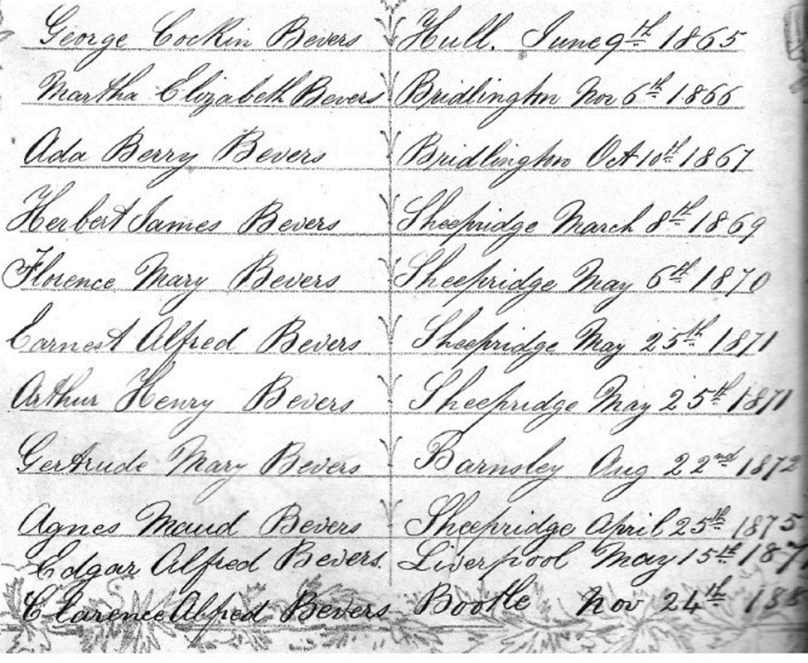
When the census was taken in 1881, the Bevers family resided at 97 Derby Road, Kirkdale.6 Forty-three year-old Alfred was a tailor’s cutter. Tailoring had been a trade of the Bevers family for generations. Mary was 40 years-old and George, at 15 years-old and having completed his education through the 8th grade,7 was a “pupil teacher” at a Church of England school. Ada was 13 years-old and she would also complete the 8th grade.8 She and her younger siblings were scholars. Herbert was 12, Gertrude was eight and Maude was five years-old.
In 1883 Alfred decided to travel to America “to determine if they would like it.”9 He made his way to Dakota Territory and wrote to his family about his experiences on board the ship and in the new country, which included killing a snake. On September 29, eight year-old Maude replied to her father’s letter:
13 Orlando St.
Sep. 29/1883
My Dear Papa
I am very glad to hear that you like that country and I hope we will all like it to, I wish I was with you, please I would like you to set a apple-tree for me ready for me when I get over I heard that you had some fun on board the ship and I was very glad to hear that you got there all safe. I saw that you sent some flowers to us and plucked them where you killed a snake and you sent a card to us. Gerty has got two cards from school they are so pretty. I am quiet well and so Is Gerty. Mama say’s that I am getting on very well at school that I am getting a very good writer I have not told you what Gerty’s cards are for one is for the best sewing the other is for the best dictation book. Please Papa will you excuse these lines because I drew them and I hav drawn them crooked I could not draw them straight. I would like to know how you are. when you go to Cousin Ben’s house well that is if you go there I want you to tell me how he is and Estella and little Clarence and little Gerty May. now I must bring it to a close. I must send you some Kisses.
Your loving Maud
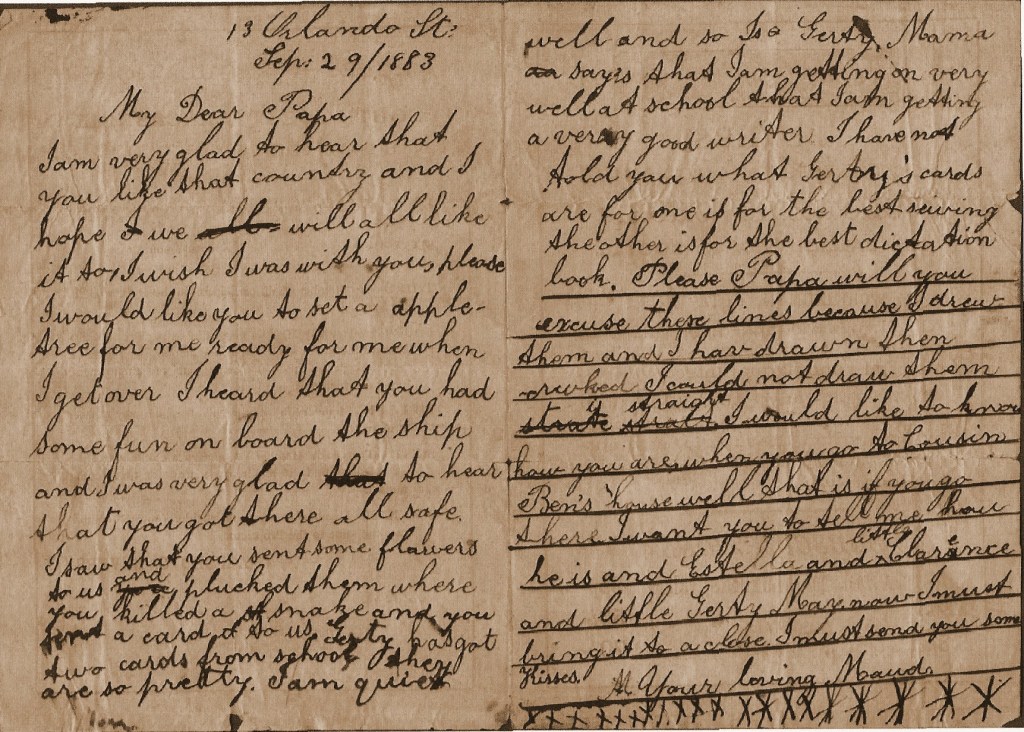
The person Maude identified in her letter as “Cousin Ben” was probably Benjamin T. Bridges, a son of Mathias Bridges, Maude’s mother’s brother. In 1895, it was recorded that Benjamin had moved to Minnesota in 1872 and he had lived in Minneapolis since about 1882.10 His wife was Helen Estella (nee Huntley) and they had a son Clarence, a daughter Gertie and a daughter Nellie. At the time of Maude’s letter Clarence would have been about two years-old and Gertie would have been just months old.
A year and a half after their father’s departure, Ada, Gertrude and Maude emigrated with their mother, arriving at the port of Philadelphia on December 17, 1884,11 and subsequently joining their father in Dakota Territory. The girls were 17, 12 and nine years-old, respectively. Their brother George would emigrate to the United States in 1885 but he settled in Philadelphia. Later, their brother Herbert also emigrated, which is recorded as occurring in 1888.12 Herbert may have spent time in Philadelphia and in Virginia but eventually he would settle in South Dakota.
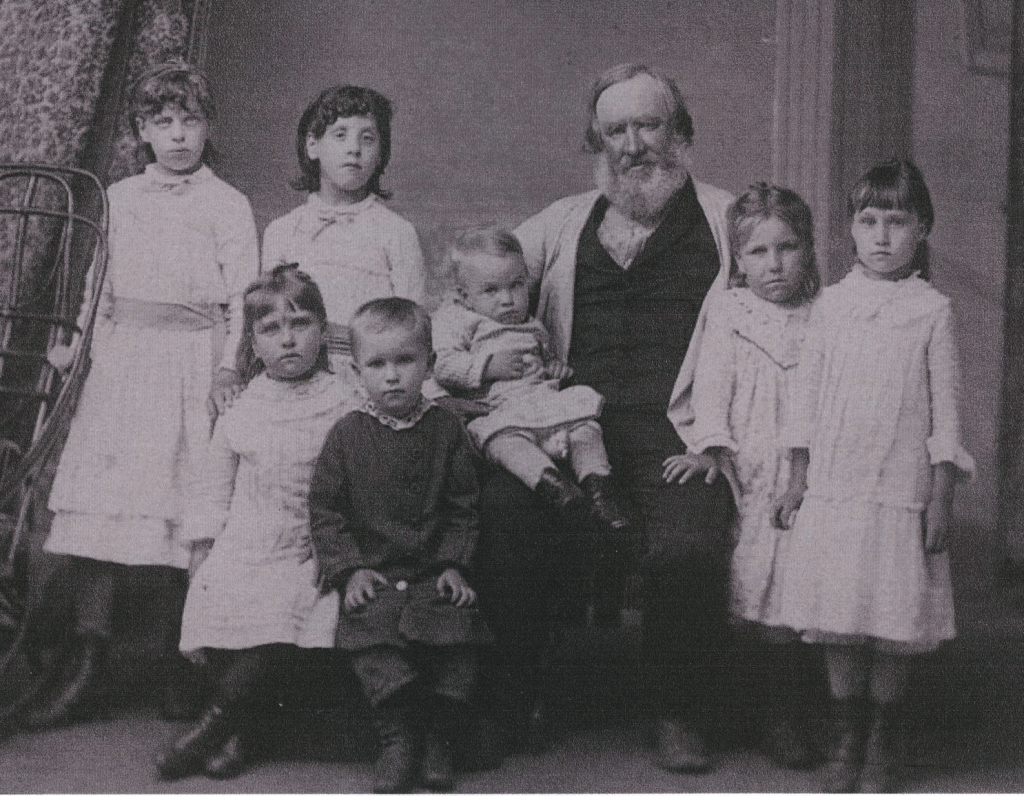
Not long after arriving in the United States, Gertrude and Maude were photographed with an elderly man and other youngsters. These were possibly their uncle Mathias Bridges and his grandchildren. It is believed that the portrait was taken in Worthington, Minnesota.
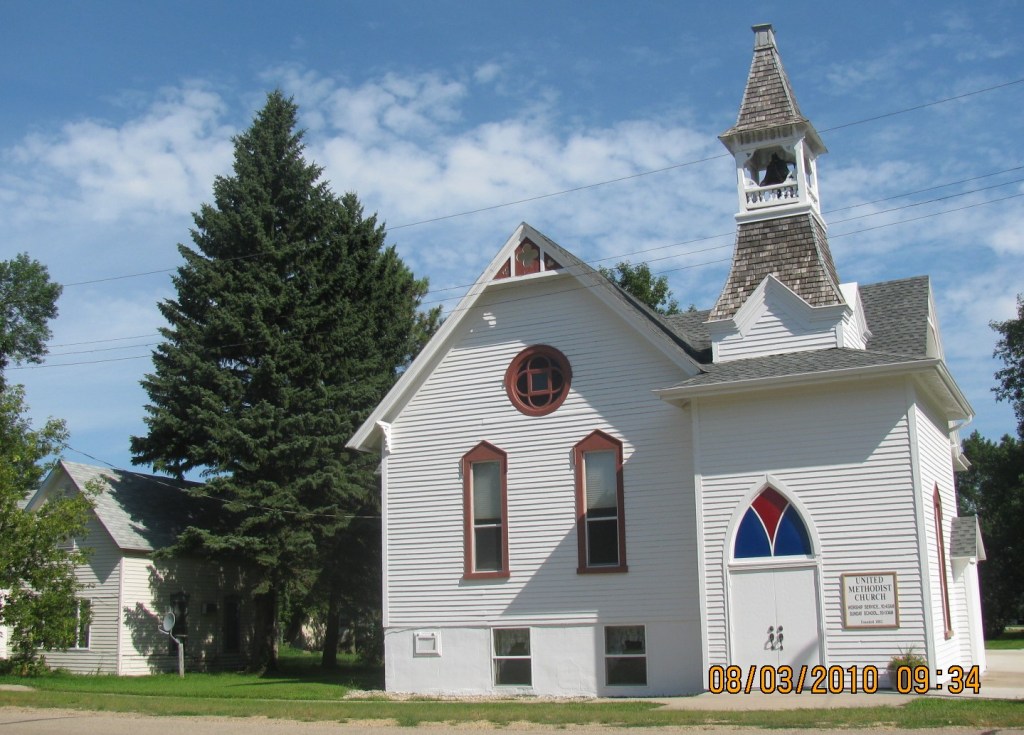
When Ada, Gertrude and Maude arrived in Dakota Territory, their father had been assigned, as of October 1884, as a supply pastor to the Methodist Episcopal Church in Castlewood,13 which that year had become the county seat of Hamlin County. A short history of Castlewood M. E. Church includes the following:
… it was the Northwestern Railway which built a branch line through the Big Sioux Valley to a point 40 miles north and a little west of Brookings. Here they built a turn table so that the engines which had been backing up to Brookings could turn around at this spot and so here is the beginning of Castlewood. This was in 1882 and the railway built a depot here too. That started the wealthy men coming to this spot and homesteading and also building business places. The building boom had started, soon hotels, livery stables, horses and rigs for rent for persons to look over the land. Many homesteaded and also set up business places. The Depot was used as a gathering place for religious services and in summer tents were set up near [the] depot to hold services as well. When a store building was built on [the] south side of main street this was [the] first two story one so [the] upstairs room was used for church services and the first school held here in 1883. … Before any church was built services were also held in school houses. Methodist E. people held services in Caverhill School House and Swift School House.14
Due to their father’s assignments to many Methodist congregations in Dakota Territory (and in South Dakota after it gained statehood), Ada, Gertrude and Maude lived in many small towns. It is uncertain whether Gertrude attended school in any of these small towns. There are conflicting statements in the 1940 and 1950 United States censuses which reveal that Gertrude completed either seventh or eighth grade. Possibly she had completed her education in England before immigrating. On the other hand, Maude would have attended school after immigrating. She went on to complete high school.
Following the one-year assignment in Castlewood, their father served as the pastor of Henry M. E. Church, Codington County, for two years (October 1885 to October 1887).15 There is the possibility that their father was simultaneously serving as the pastor of the Garden City congregation which was about 10 miles away. In 1886, the town of Henry had 149 inhabitants.16 While the family lived in Henry, the girls’ father secured a parsonage for the church for $500.00.17
In about May 1886, Alfred chaired the committee that organized a Sunday School at Henry M. E. Church.18 Each week Sunday School was opened with singing a hymn and with prayer, often followed by a responsive reading from a scripture lesson sheet. A scripture lesson was given and the meeting was closed with singing a hymn. According to the minutes of the Sunday School dated March 6, 1887, it appears that an essay was read by the secretary discussing the use of questions and answers in Sunday School classes. The following week the minutes state: “Question given out who were punished for lying and how.” On March 20, 1887, it is recorded in the minutes: “Last Sunday’s question answered by Gertie Bevers Acts 5 for Ananias and Sapphira.” Gertie was 14 years-old at this time. During the summer months of 1887, each week a different word was assigned and the attendees were expected to find a text of scripture that had that word in it. On the following Sunday, the texts were read by individuals or by class groups. For example, on June 26, the texts contained the word “Holiness” and on September 11, the word was “Kingdom.”
Following the Henry appointment, the girls’ father was appointed for one year (October 1887 to October 1888)19 to Wolsey M. E. Church, a church of 67 members.20 Then he was assigned to the Bradley Charge for an unknown period beginning in October 1888.21 While in Wolsey, Ada and Gertrude were involved in an association called the Band of Wolsey, a local branch of a temperance organization that had its origins in England called Band of Hope. Temperance was a lifestyle that had been followed by their grandfather William Bevers, who has been described as “an ardent temperance advocate” and at his death he “had been a total abstainer over 60 years.”22
An explanation of the setting of the Temperance Movement and the birth of the Band of Hope follows:
One of the evils of Victorian society was cheap and grossly abused child labour – small children were regarded as ideal for working in coal mines, in cotton mills and as chimney sweeps. Some children, employed as chimney sweeps, were as young as 8 years. Life, both for them and their parents, was wretched; physical and emotional pain oppressed them all the time, prospects of escaping from this drudgery were nil – and their only solace was in the alehouse. Beer was cheap, spirits were plentiful and there were no restrictions on children visiting alehouses. …
For many children, the alehouse was the only place where they could escape from the wretchedness of their environment. Some Sunday schools existed in fashionable churches but most of the prosperous city churches catered for the children of gentry rather than for the scruffy, dirty urchins who frequented the gin palaces, and they would certainly not have been welcomed into these fashionable churches.
It was against this backdrop of juvenile misery and deprivation that the Temperance Movement was born. …
The pioneer of the Temperance Movement in England was Joseph Livesey, himself from poor surroundings. He was orphaned and worked as a cottage weaver as a child. Livesey was concerned by the excessive drinking he saw in Preston and founded both an adults’ and a children’s Sunday School in the town. In 1832, he, together with six other men, founded the Preston Temperance Society. The seven men felt that they had to be totally committed to abstinence and on September 1st 1832 they all signed the following pledge; “We agree to abstain from all liquor of an intoxicating quality whether ale, porter, wine or ardent spirits, except as medicines.” Others joined them in this pledge and one of the seven, Dicky Turner, blurted out “Nothing but the tee-total will do” – and the expression tee-total stuck.
The idea of total abstinence quickly gained popularity. Mrs Ann Carlile, the widow of a Presbyterian Minister, was challenged by the dreadful conditions of the women in Newgate Prison, Dublin, most of whom blamed cheap whiskey for their downfall. At the mature age of 72, she resolved to devote the rest of her life to total abstinence. She joined forces with the Reverend Jabez Tunnicliff, who in 1842 became minister of the influential South Parade Baptist Church in Leeds. On one occasion he was asked to visit a former Sunday School teacher dying from a sickness brought about by alcohol. Turning to Mr Tunnicliff, he pleaded with him “Warn young people against the danger of the first glass”. Jabez Tunnicliff persuaded Ann Carlile to come to Leeds in 1847 to address a number of mass meetings. This was the providential meeting that saw the birth of the ‘Band of Hope’ (a name for which both Ann Jane and the Rev Tunnicliff took credit), a temperance organisation specifically for children who suffered as much as adults from the consequences of unregulated alcohol consumption. She is supposed to have said, “What a happy Band these children are – they are the Hope for the future.” …
Band of Hope meetings used techniques that aimed to press home their strong belief in total abstinence. Their meetings were lively, child-centred (in a Victorian context!), involved much singing, often including the Band of Hope theme song “Come, all ye children, sing a song”, Magic Lantern slides were always popular; many a Band of Hope speaker took with him a Magic Lantern carbide for producing a strong beam and a set of slides. The children were shown slides illustrating the dreadful ways in which alcohol could affect their lives and the stability of their family lives, not to mention the damage to their own health, and this would have been accompanied by stirring speeches from the team. The climax of most meetings would have been an invitation to the children to sign the pledge of total abstinence. This part of the Band of Hope service would always be taken very seriously (parents were sometimes asked to sign their permission for this act of public commitment to total abstinence). Other popular activities might have included model making, spelling tests, an annual Temperance Knowledge exam, and a wide circulation of books and pamphlets.23
On May 22, 1889, at the age of 21, Ada appeared before the Clerk of the District Court in Codington County, Dakota Territory. She declared her intention to become a citizen of the United States of America. Near the end of that year, Dakota Territory was divided and two states were accepted into the United States, North Dakota and South Dakota.
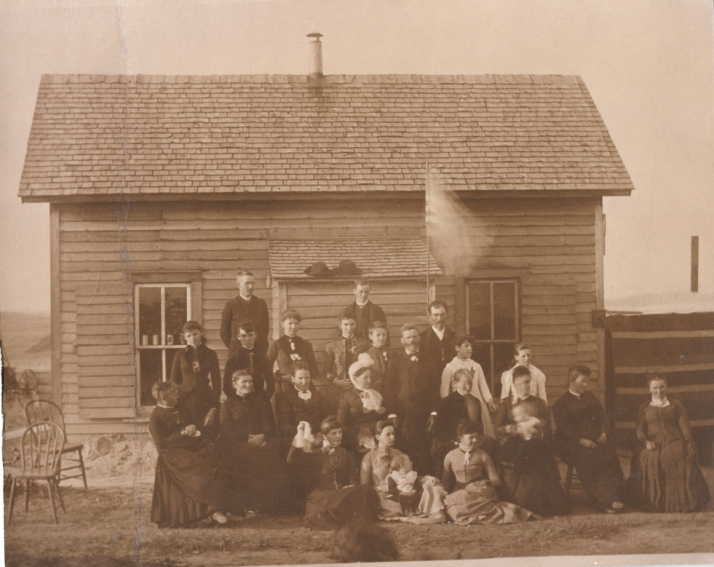
Late in the 1880s, the girls’ father filed a claim for a homestead a few miles northeast of Henry in Phipps Township, Codington County. In front of the small frontier house that was built on the homestead, family and friends gathered to celebrate the 25th wedding anniversary of their parents which occurred on September 19, 1889. A photograph was taken of the gathering. Maude (age 14) and Gertrude (age 17) can be seen standing in white dresses on the right of the group. Ada (age 21) is sitting on the ground on the left. Their parents are in the center, Mary wearing a white hat with Alfred standing to the right of her. Their brother Herbert is standing in the back row on the far left. It is believed that Lena Huppler, who would become Herbert’s wife, is standing on the far left in the row in front of Herbert. It is also believed that William Mankey, who would become Ada’s husband, is standing in the back row on the far right.
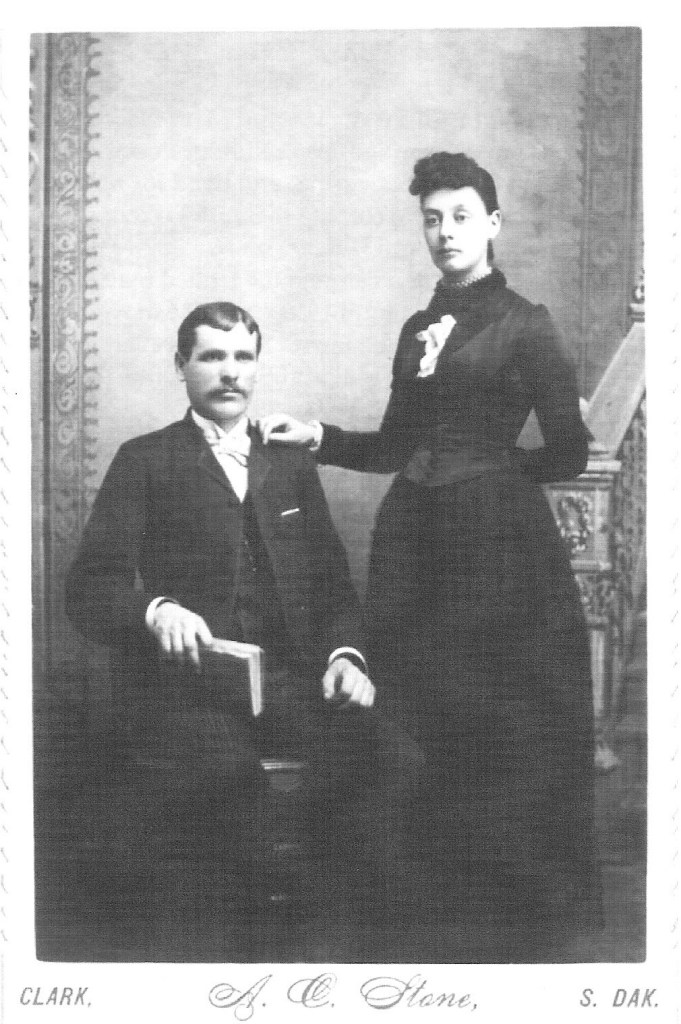
On October 28, 1891, 24 year-old Ada married William Mankey.24 Quite certainly, she had met William during the time that her father was the supply pastor of the Henry M. E. Church. In 1887-88, William was involved in the church in a few capacities. He was approved as one of the Sunday School Superintendents, he was appointed to the Missions Committee, and he was a Steward.25 William had emigrated from England to the United States in 1875 with his mother and siblings,26 presumably his father had arrived prior to their emigration. When the 1871 census of England was taken, William was a tin miner at the age of 12 years old,27 and in 1880 he was a coal miner in Illinois, along with his father and younger brother James.28
After several years of improving the land of his homestead, in January 1893 Gertrude and Maude’s father submitted his final proof for his claim. Three years later the homestead was sold. At the time of the sale, their parents’ residence was recorded as Clark County. Their father had once again begun serving as a supply pastor, being assigned to Waubay in Day County in October 1895.29 Then from October 1896 to October 1899, he served the Willow Lake (Clark County), Hazel (Hamlin County) and Vienna (Clark County) congregations.
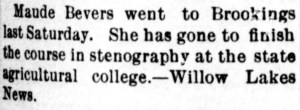
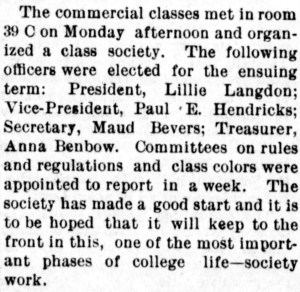
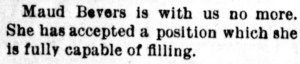
In May 1897 the local newspaper reported that Maude had gone to Brookings to finish a stenography course at the state agricultural college.30 That fall, Maude was elected Secretary of a class society at the college.31 Several months later, it was reported that Maude had left the college and accepted a position.32 Family historians of the Bevers family have stated that Maude began working as a secretary for Alfred N. Waters, a prominent businessman of De Smet in Kingsbury County.33 Possibly that is the position she took when she left the college. In 1898, Gertrude and Maude moved with their parents to De Smet. That year Gertrude turned 26 years-old and Maude turned 23. They would spend the rest of their lives, over half a century, in De Smet.
1 FreeBMD, England & Wales, FreeBMD Marriage Index, 1837-1915, (Provo, Utah, USA: Ancestry.com Operations Inc., 2006): 138.
2 Ancestry.com, 1871 England Census [Class: RG10; Piece: 4372; Folio: 86; Page: 19; GSU roll: 848087], (Provo, Utah, USA: Ancestry.com Operations Inc., publisher, 2004): http://www.Ancestry.com.
3 G. H. Anderson, “Taylor, James Hudson (1832-1905),” Biographical Dictionary of Christian Missions (New York: MacMillan Reference USA, 1998): https://www.bu.edu/missiology/missionary-biography/t-u-v/taylor-j-hudson-1832-1905/.
4 Ancestry.com, West Yorkshire, England, Church of England Births and Baptisms, 1813-1910 [database on-line] (Provo, UT, USA: Ancestry.com Operations, Inc., 2011): http://www.Ancestry.com.
5 Ancestry.com, England, Select Births and Christenings, 1538-1975 [database on-line] (Provo, UT, USA: Ancestry.com Operations, Inc., 2014): http://www.Ancestry.com.
6 Ancestry.com, 1881 England Census [Class: RG11; Piece: 3684; Folio: 133; Page: 23; GSU roll: 1341882] (Provo, Utah, USA: Ancestry.com Operations Inc., publisher, 2004): http://www.Ancestry.com.
7 “United States Census, 1940”, database with images, FamilySearch (ark:/61903/1:1:K975-B84 : Thu Mar 16 16:18:54 UTC 2023), Entry for Dorothy Bevers and George S Bevers, 1940.
8 “United States Census, 1940”, database with images, FamilySearch (ark:/61903/1:1:K73M-H7C : Fri Jun 09 01:27:49 UTC 2023), Entry for Ada N Mankey, 1940.
9 “Mrs. Alfred C. Bevers,” Kingsbury County Independent, Jul 22, 1910 [accessed from Newspapers.com].
10 Ancestry.com, Minnesota, U.S., Territorial and State Censuses, 1849-1905 [database on-line] (Provo, UT, USA: Ancestry.com Operations Inc, 2007): http://www.Ancestry.com.
11 United States of America [1st Naturalization Paper of Ada N. Bevers], (Codington County, Dakota Territory: District Court, May 22, 1889).
12 “United States Census, 1900,” database with images, FamilySearch (https://familysearch.org/ark:/61903/3:1:S3HT-68DY-PH?cc=1325221&wc=9B7H-9LQ%3A1031648401%2C1033119401%2C1033119402 : 5 August 2014), South Dakota > Roberts > ED 282 Agency, One Road & Spring Grove Townships > image 4 of 11; citing NARA microfilm publication T623 (Washington, D.C.: National Archives and Records Administration, n.d.).
13 Annual Conference of Dakota Mission, Minutes of the Fifth Session of the Annual Conference of Dakota Mission of the Methodist Episcopal Church (Mitchell, Dakota Territory, USA: S. D. Cook, Printer and Binder, 1884): 61.
14 __________, History of the Methodist Episcopal Church – Castlewood So. Dak. (The First Methodist Episcopal Church of Castlewood, n. d.).
15 United Methodist Church, Dakotas Conference, Commission on Archives and History, personal communication with M. R. Wilson, June 20, 1995.
16 Henry Historical Book Committee, Glimpses of our Town 1882-1982 (1982): 4.
17 J. G. Palmer, “Henry,” Palmer’s Directory of the Methodist Episcopal Church for Dakota Conference (1888): 127-8.
18 Minutes of Henry E. M. Church Sunday School (Henry, South Dakota: Henry Episcopal Methodist Church, May 1886-October 1887).
19 Dakota Conference, Minutes of the Third Session of the Dakota Conference (Sioux Falls, Dakota Territory, USA: Dakota Bell Publishing Co., 1887): 136.
20 J. G. Palmer, “Wolsey,” Palmer’s Directory of the Methodist Episcopal Church for Dakota Conference (1888): 63.
21 Dakota Conference, Minutes of the Fourth Session of the Dakota Conference (Yankton, Dakota Territory, USA: Press and Dakotaian, 1888): 176.
22 __________, The Yorkshire Herald and the York Herald, 17 Feb 1894 [accessed from Newspapers.com].
23 D. Edgington, Hope UK – a walk through history (2010):1-3, https://www.hopeuk.org/wp-content/uploads/Walk-Through-History-PDF.pdf.
24 A. & M. Bevers Family Bible, “Marriages.”
25 Minutes of the Fourth Quarterly Conference for Henry, Huron District, Dakota Conference (August 20, 1887).
26 Ancestry.com, New York, Passenger Lists, 1820-1957 (Provo, Utah, USA: Ancestry.com Operations Inc, 2010): http://www.Ancestry.com.
27 Ancestry.com, 1871 England Census (Provo, Utah, USA: Ancestry.com Operations Inc, 2004). [Original data – Census Returns of England and Wales, 1871. Kew, Surrey, England: The National Archives of the UK (TNA): Public Record Office (PRO), 1871.]
28 “United States Census, 1880”, database with images, FamilySearch (https://www.familysearch.org/ark:/61903/1:1:MXV4-9J7 : Thu Aug 03 04:50:54 UTC 2023), Entry for Thomas Mankey and Mary Mankey, 1880.
29 United Methodist Church, personal communication with M. R. Wilson.
30 The Brookings Register, May 8, 1897.
31 The Brookings Register, October 2, 1897.
32 The Brookings Register, March 29, 1898.
33 K. and M. Bevers, notes attached to Agnes Maude Bevers in Ancestral Quest program file dated June 29, 2022.
 Sojourners, Settlers & Other Legacy Conveyors