Ada, Gertie and Maude Bevers, Daughters of a Methodist Supply Pastor

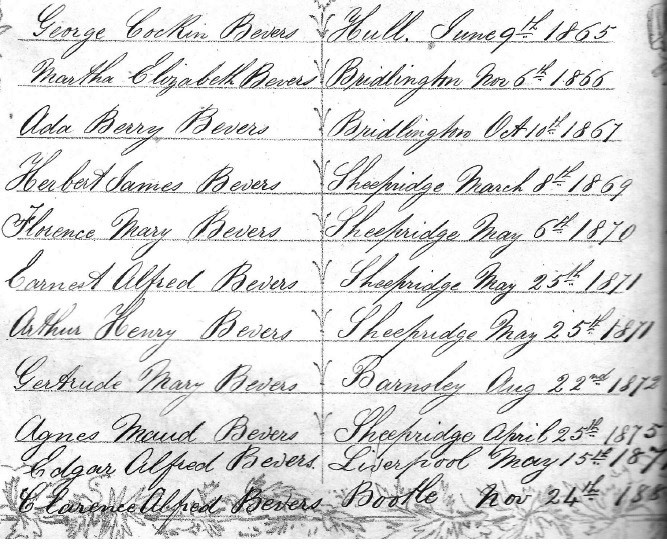
On the northeast coast of England lies the town of Bridlington.  Alfred C. Bevers and his wife Mary (nee Bridges) with their infant son George (see George C. Bevers, Bookkeeper) arrived in the town sometime between late 1865 and late 1866.  Mary gave birth to a daughter in November 1866 but the newborn only lived 16 days.  The following fall, on October 10, 1867, she gave birth to another daughter, which they named Ada Berry Bevers, according to the entry in Alfred and Mary Bevers’ Family Bible (see Alfred and Mary Bevers’ Family Bible).  The name Berry was the maiden name of the second wife of Ada’s grandfather William Bevers.  William had married Susanna Berry in the first quarter of 1865.1  Even though the Family Bible indicates that her name was Ada Berry Bevers, most of Ada’s genealogical records use a middle initial of “N” which stands for Naomi, her mother’s middle name.

Within a year and a half of Ada’s birth, her family moved to a village called Sheepridge in the township of Huddersfield in central northern England, which was the birthplace of Ada’s father.  In March 1869 Ada’s mother gave birth to her brother Herbert (see An Introduction to Herbert James Bevers).  Three more siblings would be born in Sheepridge, but none of them survived past their first year of life.  When the 1871 census was recorded in the ecclesiastical district of Christ Church Woodhouse, Ada’s 33-year-old father was a collector and canvasser for Prudential Insurance Company.2  Her mother was 30 years-old and Herbert was two years-old.  Ada at the age of three and George at the age of five were listed as scholars.

By the time Ada was five years-old, her family had moved to Barnsley, an agricultural market and coal-mining town southeast of Sheepridge.  Barnsley is the hometown of J. Hudson Taylor, a missionary who spent many years in China in the mid-1800s and upon his return to England he founded China Inland Mission; then in 1866, Taylor and his wife traveled to China with 20 missionaries to establish Christian missions in every province of China.3  In Barnsley Ada gained a sister on August 22, 1872 when Gertrude Mary was born.  Before two years had passed, the Bevers family returned to Sheepridge, and on April 25, 1875 Agnes Maude was born.  She was baptized in June of that year at Christ Church in Woodhouse Parish.4

Within a couple of years, the family had relocated to the city of Liverpool, on the northwest coast of England.  The port of Liverpool was the second largest in the country, the largest being at London.  In Liverpool, another brother was born in May 1877 and lived for about 14 months.  On July 22, 1877, Gertrude was baptized at St. Mary, Kirkdale,5 which was a ward of Liverpool. In a town three miles north of Liverpool called Bootle, one more brother was born in November 1881, who lived about 9 months.  In total, there had been 11 children born to Alfred and Mary, only five of which survived past infancy.
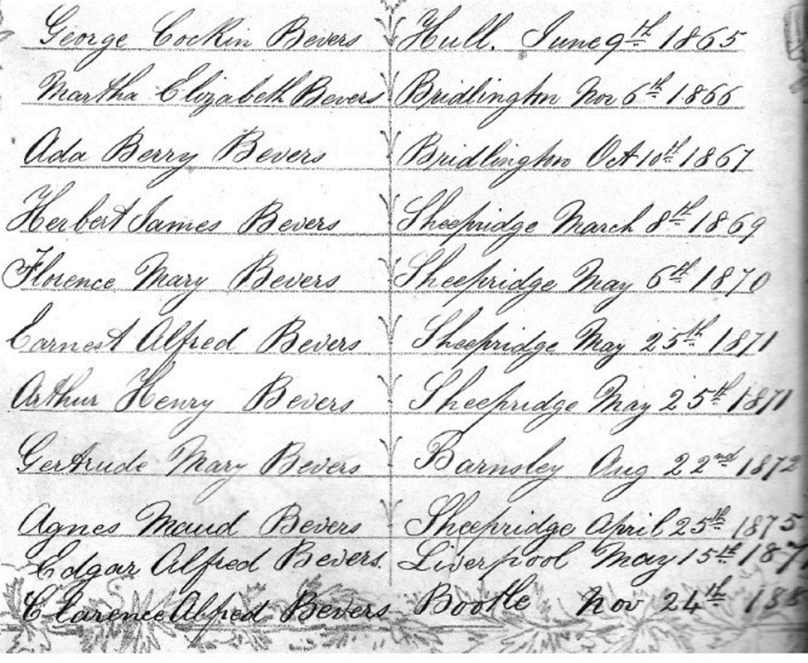
List of “Children’s Names” with their birthplace and birthdate in the Family Bible of Alfred C. and Mary N. Bevers

When the census was taken in 1881, the Bevers family resided at 97 Derby Road, Kirkdale.6  Forty-three year-old Alfred was a tailor’s cutter.  Tailoring had been a trade of the Bevers family for generations.  Mary was 40 years-old and George, at 15 years-old and having completed his education through the 8th grade,7 was a “pupil teacher” at a Church of England school.  Ada was 13 years-old and she would also complete the 8th grade.8  She and her younger siblings were scholars.  Herbert was 12, Gertrude was eight and Maude was five years-old.

In 1883 Alfred decided to travel to America “to determine if they would like it.”9  He made his way to Dakota Territory and wrote to his family about his experiences on board the ship and in the new country, which included killing a snake.  On September 29, eight year-old Maude replied to her father’s letter:

13 Orlando St.

Sep. 29/1883

My Dear Papa

I am very glad to hear that you like that country and I hope we will all like it to, I wish I was with you, please I would like you to set a apple-tree for me ready for me when I get over   I heard that you had some fun on board the ship and I was very glad to hear that you got there all safe.  I saw that you sent some flowers to us and plucked them where you killed a snake and you sent a card to us.  Gerty has got two cards from school   they are so pretty.  I am quiet well and so Is Gerty.  Mama say’s that I am getting on very well at school   that I am getting a very good writer   I have not told you what Gerty’s cards are for   one is for the best sewing   the other is for the best dictation book.  Please Papa will you excuse these lines because I drew them and I hav drawn them crooked   I could not draw them straight.  I would like to know how you are.  when you go to Cousin Ben’s house   well that is if you go there   I want you to tell me how he is and Estella and little Clarence and little Gerty May.  now I must bring it to a close.  I must send you some Kisses.

                Your loving Maud
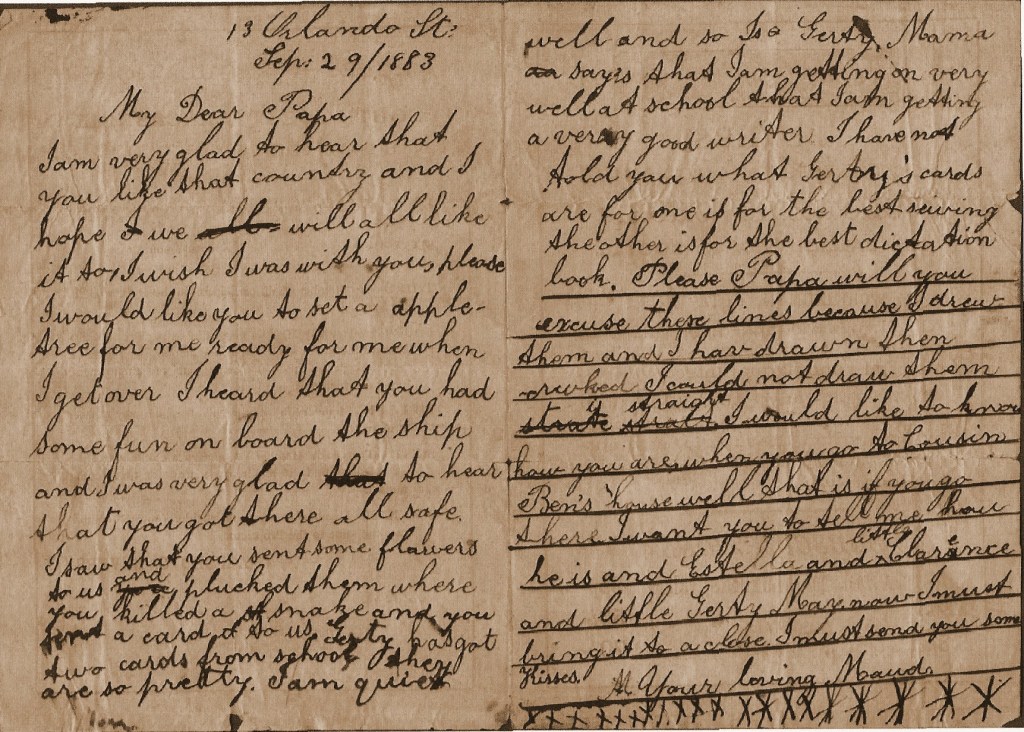
The letter eight year-old Maude wrote to her father when he went to Dakota Territory ahead of his family

The person Maude identified in her letter as “Cousin Ben” was probably Benjamin T. Bridges, a son of Mathias Bridges, Maude’s mother’s brother.  In 1895, it was recorded that Benjamin had moved to Minnesota in 1872 and he had lived in Minneapolis since about 1882.10  His wife was Helen Estella (nee Huntley) and they had a son Clarence, a daughter Gertie and a daughter Nellie.  At the time of Maude’s letter Clarence would have been about two years-old and Gertie would have been just months old.

A year and a half after their father’s departure, Ada, Gertrude and Maude emigrated with their mother, arriving at the port of Philadelphia on December 17, 1884,11 and subsequently joining their father in Dakota Territory.  The girls were 17, 12 and nine years-old, respectively.  Their brother George would emigrate to the United States in 1885 but he settled in Philadelphia.  Later, their brother Herbert also emigrated, which is recorded as occurring in 1888.12  Herbert may have spent time in Philadelphia and in Virginia but eventually he would settle in South Dakota.

Not long after arriving in the United States, Gertrude and Maude were photographed with an elderly man and other youngsters.  These were possibly their uncle Mathias Bridges and his grandchildren.  It is believed that the portrait was taken in Worthington, Minnesota. 
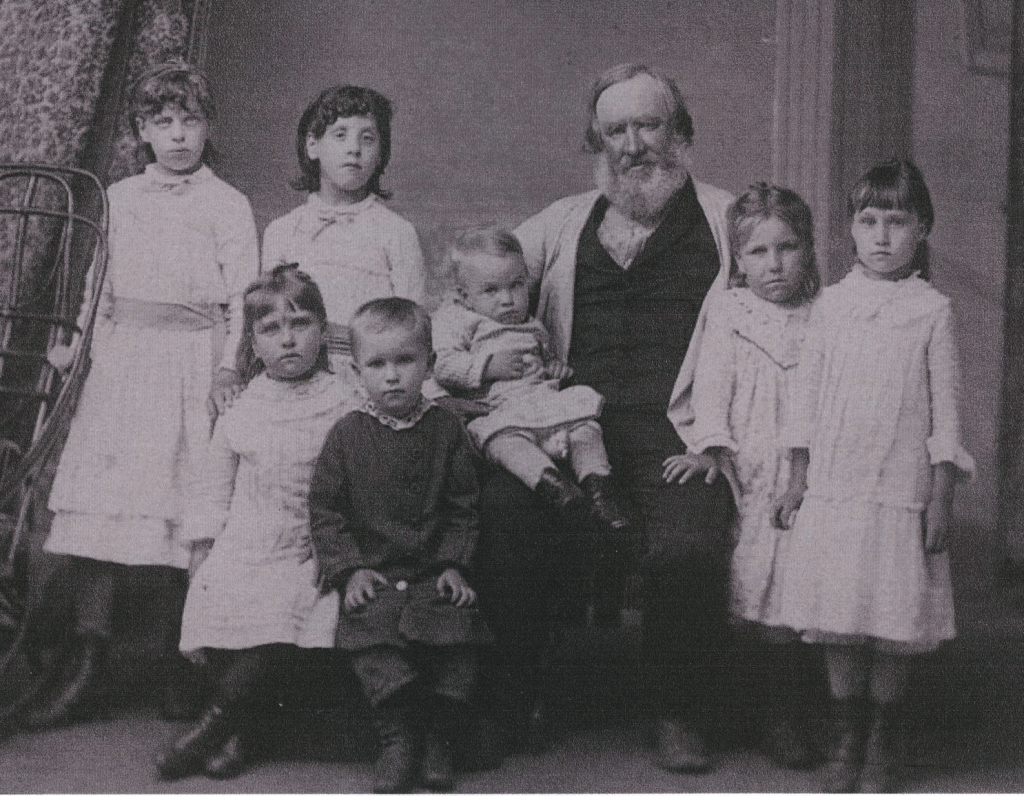
Standing on left are Gertrude and Maude Bevers. The man is probably their mother’s brother Mathias Bridges. (The photograph is believed to have been taken in Worthington, Minnesota; estimated date of 1885.)

When Ada, Gertrude and Maude arrived in Dakota Territory, their father had been assigned, as of October 1884, as a supply pastor to the Methodist Episcopal Church in Castlewood,13 which that year had become the county seat of Hamlin County. A short history of Castlewood M. E. Church includes the following:

… it was the Northwestern Railway which built a branch line through the Big Sioux Valley to a point 40 miles north and a little west of Brookings.  Here they built a turn table so that the engines which had been backing up to Brookings could turn around at this spot and so here is the beginning of Castlewood.  This was in 1882 and the railway built a depot here too.  That started the wealthy men coming to this spot and homesteading and also building business places.  The building boom had started, soon hotels, livery stables, horses and rigs for rent for persons to look over the land.  Many homesteaded and also set up business places.  The Depot was used as a gathering place for religious services and in summer tents were set up near [the] depot to hold services as well.  When a store building was built on [the] south side of main street this was [the] first two story one so [the] upstairs room was used for church services and the first school held here in 1883. … Before any church was built services were also held in school houses.  Methodist E. people held services in Caverhill School House and Swift School House.14

Due to their father’s assignments to many Methodist congregations in Dakota Territory (and in South Dakota after it gained statehood), Ada, Gertrude and Maude lived in many small towns.  It is uncertain whether Gertrude attended school in any of these small towns. There are conflicting statements in the 1940 and 1950 United States censuses which reveal that Gertrude completed either seventh or eighth grade. Possibly she had completed her education in England before immigrating. On the other hand, Maude would have attended school after immigrating. She went on to complete high school.

Following the one-year assignment in Castlewood, their father served as the pastor of Henry M. E. Church, Codington County, for two years (October 1885 to October 1887).15  There is the possibility that their father was simultaneously serving as the pastor of the Garden City congregation which was about 10 miles away.  In 1886, the town of Henry had 149 inhabitants.16  While the family lived in Henry, the girls’ father secured a parsonage for the church for $500.00.17

In about May 1886, Alfred chaired the committee that organized a Sunday School at Henry M. E. Church.18  Each week Sunday School was opened with singing a hymn and with prayer, often followed by a responsive reading from a scripture lesson sheet.  A scripture lesson was given and the meeting was closed with singing a hymn.  According to the minutes of the Sunday School dated March 6, 1887, it appears that an essay was read by the secretary discussing the use of questions and answers in Sunday School classes.  The following week the minutes state: “Question given out who were punished for lying and how.”  On March 20, 1887, it is recorded in the minutes: “Last Sunday’s question answered by Gertie Bevers  Acts 5 for Ananias and Sapphira.”  Gertie was 14 years-old at this time.  During the summer months of 1887, each week a different word was assigned and the attendees were expected to find a text of scripture that had that word in it.  On the following Sunday, the texts were read by individuals or by class groups.  For example, on June 26, the texts contained the word “Holiness” and on September 11, the word was “Kingdom.”
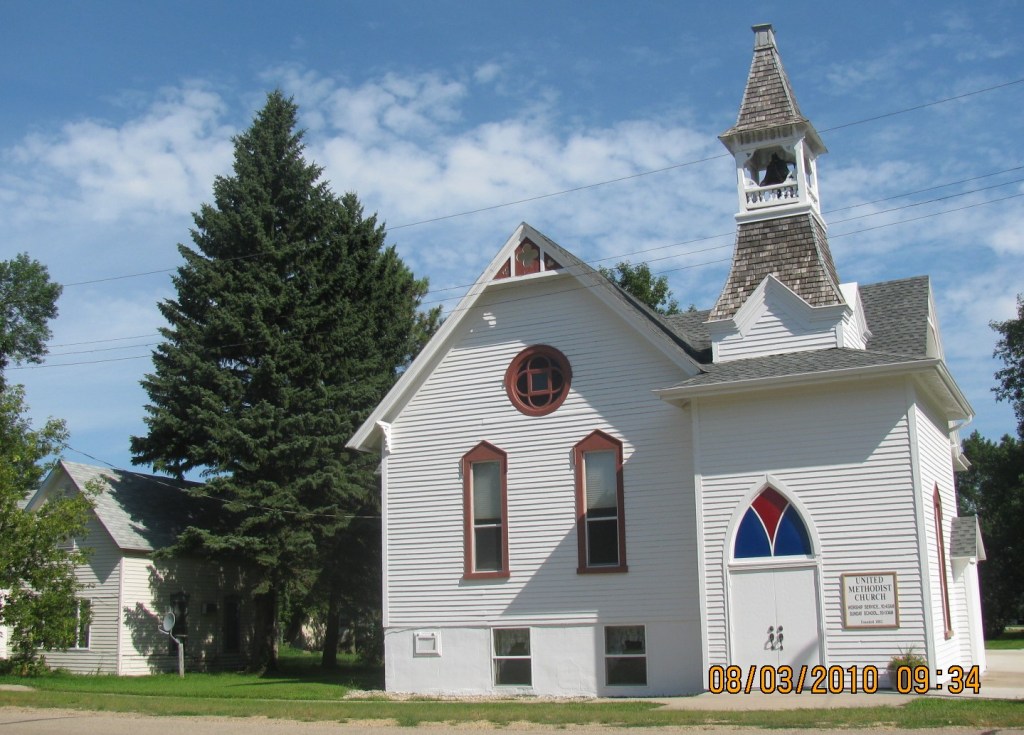
Henry United Methodist Church (formerly Henry Methodist Episcopal Church); the building to the left appears to be the original parsonage (Photographed by MRW August 2010)

Following the Henry appointment, the girls’ father was appointed for one year (October 1887 to October 1888)19 to Wolsey M. E. Church, a church of 67 members.20  Then he was assigned to the Bradley Charge for an unknown period beginning in October 1888.21  While in Wolsey, Ada and Gertrude were involved in an association called the Band of Wolsey, a local branch of a temperance organization that had its origins in England called Band of Hope.  Temperance was a lifestyle that had been followed by their grandfather William Bevers, who has been described as “an ardent temperance advocate” and at his death he “had been a total abstainer over 60 years.”22


An explanation of the setting of the Temperance Movement and the birth of the Band of Hope follows:

One of the evils of Victorian society was cheap and grossly abused child labour – small children were regarded as ideal for working in coal mines, in cotton mills and as chimney sweeps. Some children, employed as chimney sweeps, were as young as 8 years. Life, both for them and their parents, was wretched; physical and emotional pain oppressed them all the time, prospects of escaping from this drudgery were nil – and their only solace was in the alehouse. Beer was cheap, spirits were plentiful and there were no restrictions on children visiting alehouses. …

For many children, the alehouse was the only place where they could escape from the wretchedness of their environment. Some Sunday schools existed in fashionable churches but most of the prosperous city churches catered for the children of gentry rather than for the scruffy, dirty urchins who frequented the gin palaces, and they would certainly not have been welcomed into these fashionable churches.

It was against this backdrop of juvenile misery and deprivation that the Temperance Movement was born. …

The pioneer of the Temperance Movement in England was Joseph Livesey, himself from poor surroundings. He was orphaned and worked as a cottage weaver as a child. Livesey was concerned by the excessive drinking he saw in Preston and founded both an adults’ and a children’s Sunday School in the town. In 1832, he, together with six other men, founded the Preston Temperance Society. The seven men felt that they had to be totally committed to abstinence and on September 1st 1832 they all signed the following pledge; “We agree to abstain from all liquor of an intoxicating quality whether ale, porter, wine or ardent spirits, except as medicines.” Others joined them in this pledge and one of the seven, Dicky Turner, blurted out “Nothing but the tee-total will do” – and the expression tee-total stuck.

The idea of total abstinence quickly gained popularity. Mrs Ann Carlile, the widow of a Presbyterian Minister, was challenged by the dreadful conditions of the women in Newgate Prison, Dublin, most of whom blamed cheap whiskey for their downfall. At the mature age of 72, she resolved to devote the rest of her life to total abstinence. She joined forces with the Reverend Jabez Tunnicliff, who in 1842 became minister of the influential South Parade Baptist Church in Leeds. On one occasion he was asked to visit a former Sunday School teacher dying from a sickness brought about by alcohol. Turning to Mr Tunnicliff, he pleaded with him “Warn young people against the danger of the first glass”. Jabez Tunnicliff persuaded Ann Carlile to come to Leeds in 1847 to address a number of mass meetings. This was the providential meeting that saw the birth of the ‘Band of Hope’ (a name for which both Ann Jane and the Rev Tunnicliff took credit), a temperance organisation specifically for children who suffered as much as adults from the consequences of unregulated alcohol consumption. She is supposed to have said, “What a happy Band these children are – they are the Hope for the future.” …

Band of Hope meetings used techniques that aimed to press home their strong belief in total abstinence. Their meetings were lively, child-centred (in a Victorian context!), involved much singing, often including the Band of Hope theme song “Come, all ye children, sing a song”, Magic Lantern slides were always popular; many a Band of Hope speaker took with him a Magic Lantern carbide for producing a strong beam and a set of slides. The children were shown slides illustrating the dreadful ways in which alcohol could affect their lives and the stability of their family lives, not to mention the damage to their own health, and this would have been accompanied by stirring speeches from the team. The climax of most meetings would have been an invitation to the children to sign the pledge of total abstinence. This part of the Band of Hope service would always be taken very seriously (parents were sometimes asked to sign their permission for this act of public commitment to total abstinence). Other popular activities might have included model making, spelling tests, an annual Temperance Knowledge exam, and a wide circulation of books and pamphlets.23


On May 22, 1889, at the age of 21, Ada appeared before the Clerk of the District Court in Codington County, Dakota Territory.  She declared her intention to become a citizen of the United States of America.  Near the end of that year, Dakota Territory was divided and two states were accepted into the United States, North Dakota and South Dakota.

Late in the 1880s, the girls’ father filed a claim for a homestead a few miles northeast of Henry in Phipps Township, Codington County.  In front of the small frontier house that was built on the homestead, family and friends gathered to celebrate the 25th wedding anniversary of their parents which occurred on September 19, 1889.  A photograph was taken of the gathering.  Maude (age 14) and Gertrude (age 17) can be seen standing in white dresses on the right of the group.  Ada (age 21) is sitting on the ground on the left.  Their parents are in the center, Mary wearing a white hat with Alfred standing to the right of her.  Their brother Herbert is standing in the back row on the far left.  It is believed that Lena Huppler, who would become Herbert’s wife, is standing on the far left in the row in front of Herbert.   It is also believed that William Mankey, who would become Ada’s husband, is standing in the back row on the far right.
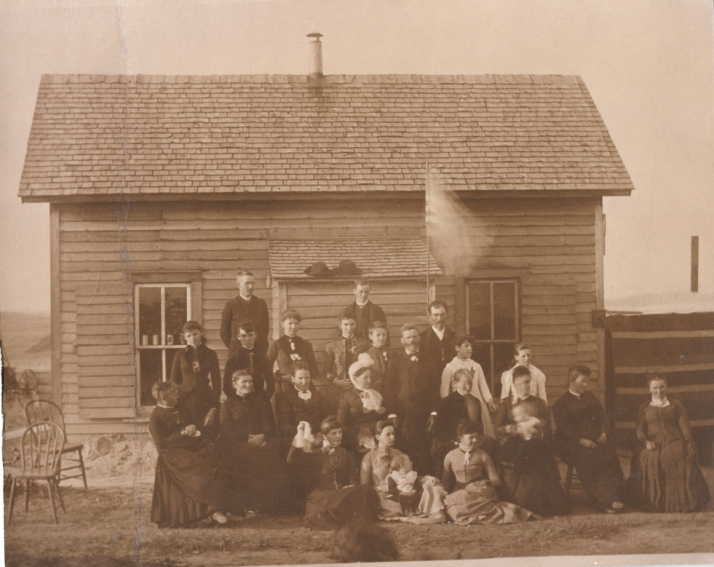
The 25th wedding anniversary of Alfred and Mary Bevers (1889), photo taken on their homestead in Phipps Township, Codington County.  Sitting on the ground on the left is Ada, standing on the right in white dresses are Maude and Gertrude, to the left of Maude is Alfred and sitting in the center with a white hat is Mary.

On October 28, 1891, 24 year-old Ada married William Mankey.24 Quite certainly, she had met William during the time that her father was the supply pastor of the Henry M. E. Church.  In 1887-88, William was involved in the church in a few capacities.  He was approved as one of the Sunday School Superintendents, he was appointed to the Missions Committee, and he was a Steward.25  William had emigrated from England to the United States in 1875 with his mother and siblings,26 presumably his father had arrived prior to their emigration.  When the 1871 census of England was taken, William was a tin miner at the age of 12 years old,27 and in 1880 he was a coal miner in Illinois, along with his father and younger brother James.28
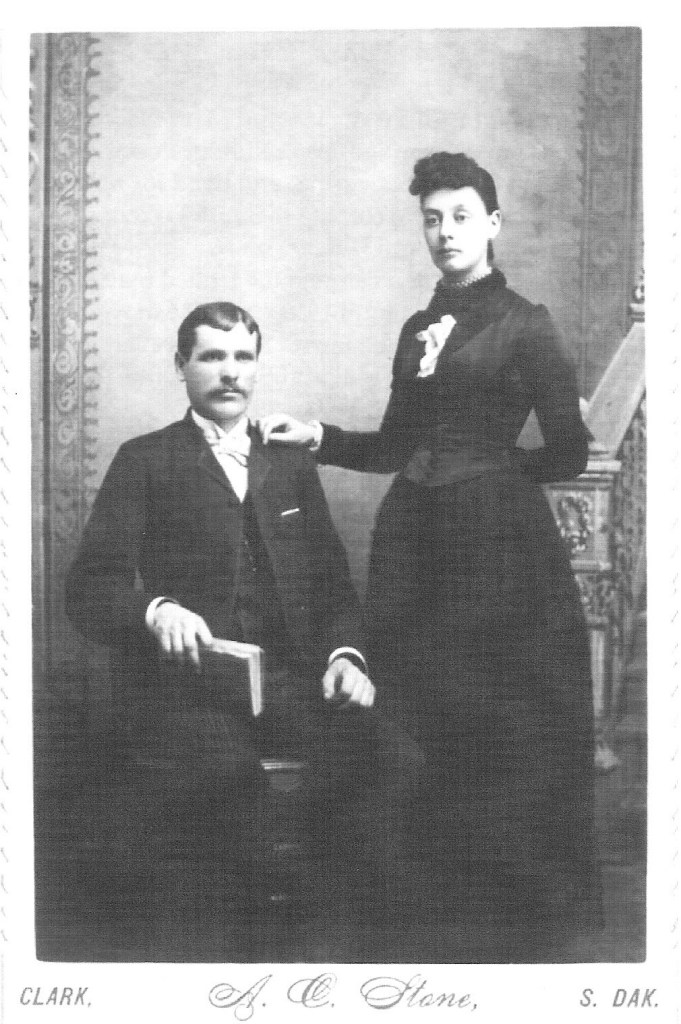
William Mankey and Ada N. Bevers

After several years of improving the land of his homestead, in January 1893 Gertrude and Maude’s father submitted his final proof for his claim.  Three years later the homestead was sold.  At the time of the sale, their parents’ residence was recorded as Clark County.  Their father had once again begun serving as a supply pastor, being assigned to Waubay in Day County in October 1895.29  Then from October 1896 to October 1899, he served the Willow Lake (Clark County), Hazel (Hamlin County) and Vienna (Clark County) congregations.

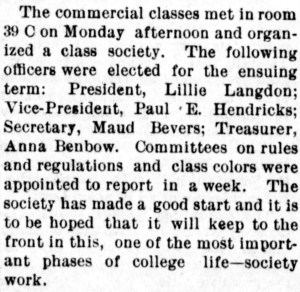
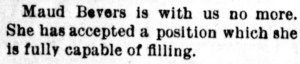
In May 1897 the local newspaper reported that Maude had gone to Brookings to finish a stenography course at the state agricultural college.30  That fall, Maude was elected Secretary of a class society at the college.31  Several months later, it was reported that Maude had left the college and accepted a position.32  Family historians of the Bevers family have stated that Maude began working as a secretary for Alfred N. Waters, a prominent businessman of De Smet in Kingsbury County.33  Possibly that is the position she took when she left the college.  In 1898, Gertrude and Maude moved with their parents to De Smet.  That year Gertrude turned 26 years-old and Maude turned 23.  They would spend the rest of their lives, over half a century, in De Smet.
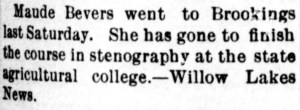
The Brookings Register news clipping dated May 8, 1897
The Brookings Register news clipping dated October 2, 1897
The Brookings Register news clipping dated March 29, 1898

1 FreeBMD, England & Wales, FreeBMD Marriage Index, 1837-1915, (Provo, Utah, USA: Ancestry.com Operations Inc., 2006): 138.

2 Ancestry.com, 1871 England Census [Class: RG10; Piece: 4372; Folio: 86; Page: 19; GSU roll: 848087], (Provo, Utah, USA: Ancestry.com Operations Inc., publisher, 2004): http://www.Ancestry.com.

3 G. H. Anderson, “Taylor, James Hudson (1832-1905),” Biographical Dictionary of Christian Missions (New York: MacMillan Reference USA, 1998): https://www.bu.edu/missiology/missionary-biography/t-u-v/taylor-j-hudson-1832-1905/.

4 Ancestry.com, West Yorkshire, England, Church of England Births and Baptisms, 1813-1910 [database on-line] (Provo, UT, USA: Ancestry.com Operations, Inc., 2011): http://www.Ancestry.com.

5 Ancestry.com, England, Select Births and Christenings, 1538-1975 [database on-line] (Provo, UT, USA: Ancestry.com Operations, Inc., 2014): http://www.Ancestry.com.

6 Ancestry.com, 1881 England Census [Class: RG11; Piece: 3684; Folio: 133; Page: 23; GSU roll: 1341882] (Provo, Utah, USA: Ancestry.com Operations Inc., publisher, 2004): http://www.Ancestry.com.

7 “United States Census, 1940”, database with images, FamilySearch (ark:/61903/1:1:K975-B84 : Thu Mar 16 16:18:54 UTC 2023), Entry for Dorothy Bevers and George S Bevers, 1940.

8 “United States Census, 1940”, database with images, FamilySearch (ark:/61903/1:1:K73M-H7C : Fri Jun 09 01:27:49 UTC 2023), Entry for Ada N Mankey, 1940.

9 “Mrs. Alfred C. Bevers,” Kingsbury County Independent, Jul 22, 1910 [accessed from Newspapers.com].

10 Ancestry.com, Minnesota, U.S., Territorial and State Censuses, 1849-1905 [database on-line] (Provo, UT, USA: Ancestry.com Operations Inc, 2007): http://www.Ancestry.com.

11 United States of America [1st Naturalization Paper of Ada N. Bevers], (Codington County, Dakota Territory: District Court, May 22, 1889).

12 “United States Census, 1900,” database with images, FamilySearch (https://familysearch.org/ark:/61903/3:1:S3HT-68DY-PH?cc=1325221&wc=9B7H-9LQ%3A1031648401%2C1033119401%2C1033119402 : 5 August 2014), South Dakota > Roberts > ED 282 Agency, One Road & Spring Grove Townships > image 4 of 11; citing NARA microfilm publication T623 (Washington, D.C.: National Archives and Records Administration, n.d.).

13 Annual Conference of Dakota Mission, Minutes of the Fifth Session of the Annual Conference of Dakota Mission of the Methodist Episcopal Church (Mitchell, Dakota Territory, USA: S. D. Cook, Printer and Binder, 1884): 61.

14 __________, History of the Methodist Episcopal Church – Castlewood So. Dak. (The First Methodist Episcopal Church of Castlewood, n. d.).

15 United Methodist Church, Dakotas Conference, Commission on Archives and History, personal communication with M. R. Wilson, June 20, 1995.

16 Henry Historical Book Committee, Glimpses of our Town 1882-1982 (1982): 4.

17 J. G. Palmer, “Henry,” Palmer’s Directory of the Methodist Episcopal Church for Dakota Conference (1888): 127-8.

18 Minutes of Henry E. M. Church Sunday School (Henry, South Dakota: Henry Episcopal Methodist Church, May 1886-October 1887).

19 Dakota Conference, Minutes of the Third Session of the Dakota Conference (Sioux Falls, Dakota Territory, USA: Dakota Bell Publishing Co., 1887): 136.

20 J. G. Palmer, “Wolsey,” Palmer’s Directory of the Methodist Episcopal Church for Dakota Conference (1888): 63.

21 Dakota Conference, Minutes of the Fourth Session of the Dakota Conference (Yankton, Dakota Territory, USA: Press and Dakotaian, 1888): 176.

22 __________, The Yorkshire Herald and the York Herald, 17 Feb 1894 [accessed from Newspapers.com].

23 D. Edgington, Hope UK – a walk through history (2010):1-3, https://www.hopeuk.org/wp-content/uploads/Walk-Through-History-PDF.pdf

24 A. & M. Bevers Family Bible, “Marriages.”

25 Minutes of the Fourth Quarterly Conference for Henry, Huron District, Dakota Conference (August 20, 1887).

26 Ancestry.com, New York, Passenger Lists, 1820-1957 (Provo, Utah, USA: Ancestry.com Operations Inc, 2010): http://www.Ancestry.com.

27 Ancestry.com, 1871 England Census (Provo, Utah, USA: Ancestry.com Operations Inc, 2004). [Original data – Census Returns of England and Wales, 1871. Kew, Surrey, England: The National Archives of the UK (TNA): Public Record Office (PRO), 1871.]

28 “United States Census, 1880”, database with images, FamilySearch (https://www.familysearch.org/ark:/61903/1:1:MXV4-9J7 : Thu Aug 03 04:50:54 UTC 2023), Entry for Thomas Mankey and Mary Mankey, 1880.

29 United Methodist Church, personal communication with M. R. Wilson.

30 The Brookings Register, May 8, 1897.

31 The Brookings Register, October 2, 1897.

32 The Brookings Register, March 29, 1898.

33 K. and M. Bevers, notes attached to Agnes Maude Bevers in Ancestral Quest program file dated June 29, 2022.
Reminiscences of Uncle Bob, Part Five

On the 10th of April, 1915, Charles and Maggie Daily left Omaha and headed with their family to South Dakota because Maggie “wanted to get back to the farm” (according to their son Robert1), and possibly wanting to get away from the tornadoes (according to one of their grandsons2). They moved to a farm in Rauville Township in Codington County.3  Rauville was “a station on the [Great Northern Railway], 6 miles N of Watertown,” and primarily the site of two grain companies.4 

The Daily family had been in South Dakota for two months when the state census was taken.  At that time, Charles was 58 years-old, Maggie was 47, Gladys was 22, Oranna, 19, Robert, 15, Iona, 12 and Elizabeth, 10.  The census forms of Charles and Maggie reveal that they had received a common education and the forms of Gladys and Oranna indicate that they had attended high school.  Also, the forms of Maggie, Gladys, Oranna and Robert note that their church affiliation was Methodist.


At about the age of 84, during an interview, Robert explained a little about settling in Rauville Township:

Interviewer:  When you came up here then [South Dakota], you prob’ly had a quarter to start with.

Uncle Bob:  Yeah, a quarter up here.  Across from Rauville Hall.

Interviewer:  Okay.

Uncle Bob:  Rauville Hall out there, eight miles north [of Watertown].

Interviewer:  And then you moved a mile south.

Uncle Bob:  Yeah, a mile south.  ‘Course, then we had the three quarters.

Interviewer:  And then didn’t you live further, uh, to the northwest of there?

Uncle Bob:  Ahh, not northwest.  But we come on down in ’29.  See Dad was on that place from 1917.  When we lived on the [Brent? or Brandt?] farm two years –

Interviewer:  Okay.

Uncle Bob:  ’15 and ’16.  Come down to Gunther’s in the fall of ’16.

Interviewer:  Um hmm.

Uncle Bob:  And o’ course, an’ then we lived there.  We lived there for 13 years, up to ’29.

Interviewer:  Oh!  You lived there quite a while.5


Charles’ name was in the Farmers’ List of the 1916 Watertown City and Codington County Directory, which indicated that he was a farm tenant of a 160-acre farm in section SW 17 of Rauville Township.6 In the 1919 edition of the directory, the entry for Charles noted that he was renting in section NE 30 of Rauville.7

Another thing Uncle Bob related was that in 1917 Charles’ brother William visited them while they were living at the Gunther farm and that was the last time that they saw William.  (He passed away in 1925 in or near Lovelock, Nevada.) Uncle Bob expounded, “I know he, when he went back through Chicago, why he, uh, bought a watch, a Waltham watch, for Dad. Sent it to him.  An’ Dad wore it, oh, clear up ‘til he was gone.  An’ I had it an’ I give it to [my son] for — to take care of, see.  Well, it’s in’resting, it’s right here in Watertown, it’s in [my son’s] lockbox right here in Watertown.”8  This would have been about 65 years after the purchase of the watch.

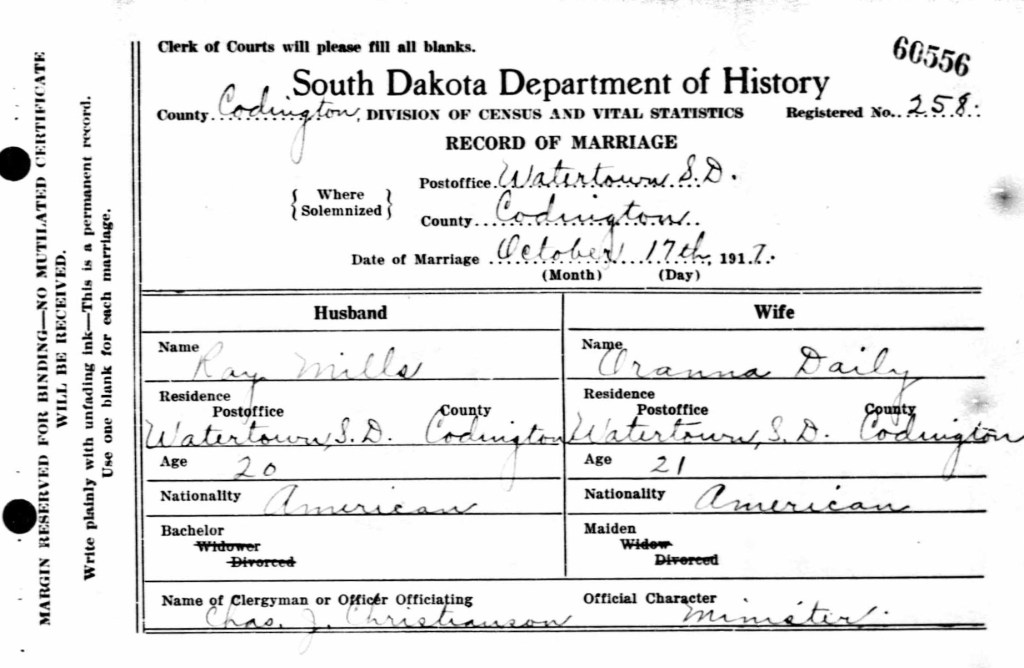
During the next several years, one by one Charles and Maggie’s children began moving out of their home, either by marrying or by finding work in a different location or by moving to Watertown to go to high school.  On October 17, 1917, 21 year-old Oranna married 20 year-old G. Ray Mills.  They were married by Charles J. Christianson, the pastor of First Congregational Church, which was located in Watertown.9  The following year, Oranna gave birth to Charles and Maggie’s first grandchild.  By 1919, Ray had begun farming near Rauville.10

Marriage record of G. Ray Mills and Oranna J. Daily, October 17, 19179

Newspaper items in the Watertown Public Opinion reveal that the Daily family became friends with the Herbert J. Bevers family.  On October 11, 1917, the newspaper reported: “Mr. and Mrs. Herbert Bevers, family and Miss Strombotne were dinner guests at the C. M. Daley [sp.] residence, near Rauville, Sunday.”11  The same issue also stated, “The Bever [sp.] and Daley [sp.] families autoed to Hazel and Grover Thursday on a combined business and pleasure trip.”12  On March 14, 1918, it was reported that “The Herbert Bevers family had as their guests, Sunday, Mr. and Mrs. Raymond Mills, Robert Dailey [sp.] and the Misses Iona and Elizabeth Dailey [sp.], of Rauville, and Miss Verna Edwards of Hazel.”13  Later that year, on July 11, a short article recounted that “Mr. and Mrs. H. J. Bevers of Elmira township, accompanied by Messrs Dailey [sp.] of Rauville and Wells of [Watertown], returned last week from a trip through portions of Minnesota and North Dakota. … [In the] valley of the Red River…, north of Big Stone City, S. D. … ‘it impressed [them] as having crops enough to feed the world, judging by the looks of the fields of grain.’”14


The First World War had broken out in Europe in 1914 and the United States entered the war in April 1917.  In June of that year the U. S. Congress authorized President Woodrow Wilson to institute a military draft of men from the age of 21 to 30.15  The purpose of this Selective Service Act was to increase the size of the army to 500,000 men.  A year later the army still was not large enough, so in August 1918, the Selective Service Act was amended to include all men between 18 and 45.16  Uncle Bob who turned 18 years old in May 1918 registered for the draft in September of that year.17  Mercifully, the war came to an end in November 1918 and Uncle Bob never served in the military.18 By 1920 Uncle Bob was boarding in Watertown at the home of Harold and Lula Nordaker, and working for a transfer company as a drayman (a driver of a cart or vehicle without fixed sides).19

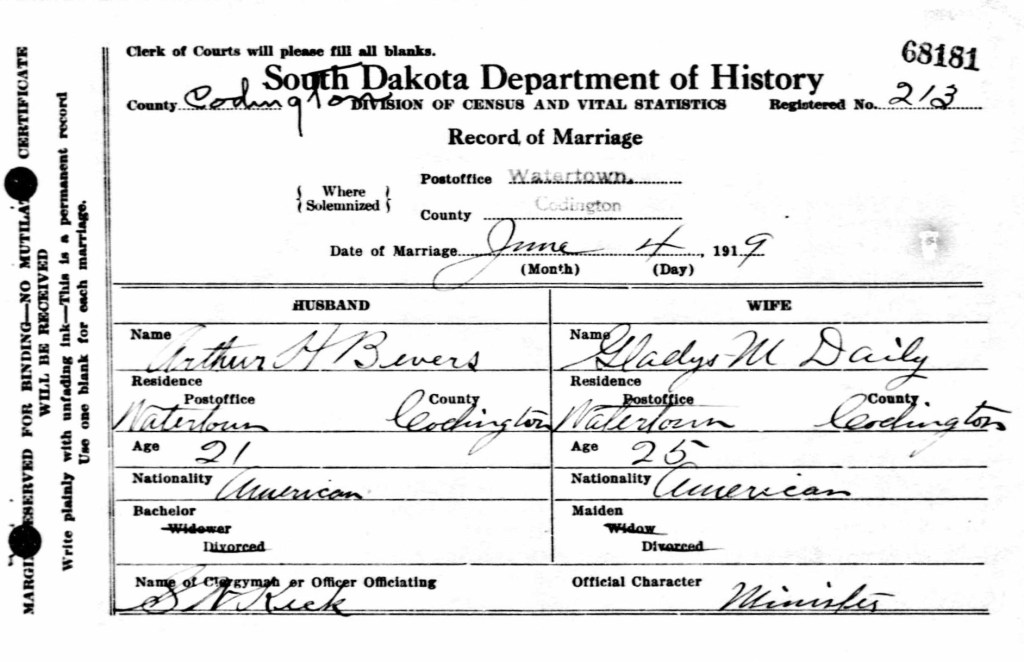
The Daily family and the Bevers family became linked in 1919 when 25 year-old Gladys married 21 year-old Arthur on June 4th.  The marriage was officiated by S. W. Keck, the pastor of First Congregational Church.20  On February 18, 1920, when the U. S. census was taken, Arthur and Gladys were living with Charles and Maggie on the farm in Rauville.21  Two months later, Arthur and Gladys’ first son was born on that farm,22 giving Charles and Maggie a second grandchild.  Iona and Elizabeth were also recorded on the 1920 census sheet.

Marriage record of Arthur H. Bevers and Gladys M. Daily, June 4, 191920

In the 1919 Watertown directory, Iona was identified as a student and she was boarding at 215 4th Street SW, which was the address of George and Hattie Baxter.23  At the age of 17, she was attending Watertown High School.  Iona graduated in May 1921 and three months later, after obtaining a South Dakota Second Grade Teacher’s Certificate, she entered into a two-year contract with Richland School District No. Six and began teaching on September 5th.24 Elizabeth would also attend Watertown High School, graduating in 1923 at the age of 18.


The 1920 U. S. census indicated that the farm that the Dailys were renting was on Meridian Road, also known as Meridian Highway.  In 1911, a road development association, the International Meridian Road Association, had organized for the purpose of building a transcontinental road, on which “a full wagon-box load or a car at high gear can pass, except in wet weather.”25  The name of the highway was “derived from the Sixth Principal Meridian, which extends north-south through the Great Plains region.”26 The route that was designated as the Meridian Road had a starting point in Winnipeg, Manitoba, Canada and ending points in Galveston, Texas and Mexico City.  Traveling along the eastern border of North Dakota, this highway entered South Dakota, veered west a short ways, then headed south and passed through Rauville and Watertown.  Presently, from the northern border of North Dakota to Watertown, Interstate Highway 29 and U. S. Highway 81 roughly follow the route that was once called the Meridian Highway.

The Meridian Highway evolved primarily as a farm-to-market road, important to the rural areas, small towns, and cities through which it passed.  The original route followed section line roads, running perpendicular to historic east–west transportation corridors.  Reflecting its creation from existing farm-to-market rural roads, the original highway passed through each county seat along its route.  In 1911 the Meridian Road Association was formed to mark, map, and promote the highway; in 1919 it became the Meridian Highway Association.  Similar to contemporaneous good roads organizations, the Meridian Highway Association consisted of representatives from the states, counties, and cities along the route.  The Meridian Highway promoters, however, perhaps in recognition of its divergence from more established routes, emphasized the absence of mountain passes and proclaimed that motorists could travel from Canada to Mexico without shifting gears.  The association sold memberships and instituted widely publicized tours.  When the association was a year old, in 1912, an automobile caravan was organized to travel the route south to Mexico, an event that was irregularly repeated in subsequent years.27


According to the U. S. census of Omaha, in 1920 Maggie’s mother Josephine (nee Smith) Bonewitz was living with Maggie’s niece Maggie (nee Thompson) Stier.28  Maggie Stier and her husband Fred were renting one of the two homes that the Dailys still owned in Omaha.29  In his interview, Uncle Bob mentioned a trip that Maggie Daily made to visit her 83 year-old mother in Omaha:

Uncle Bob: October 7, 1920. Yeah, that’s right there. I can remember that, oh, [like] it was yesterday. Mother was — Mother went down to, uh. ‘Course, I had a date with Ruby and Mother was away, at the time, see.

Interviewer:  Um hmm.

Uncle Bob:  An’ ‘course, Grandma passed away.  I don’t know what this date was, far as it was in 1920.  An’ she come home on the train an’ I was suppose t’ meet her.  An’ I didn’t. 

Interviewer:  And you didn’t.  [squealing laughter]

Uncle Bob:  I didn’t [pass] that too well.

Interviewer:  And you were in trouble!

Uncle Bob:  Yeah.  Didn’t think much of me.  [chuckling]30


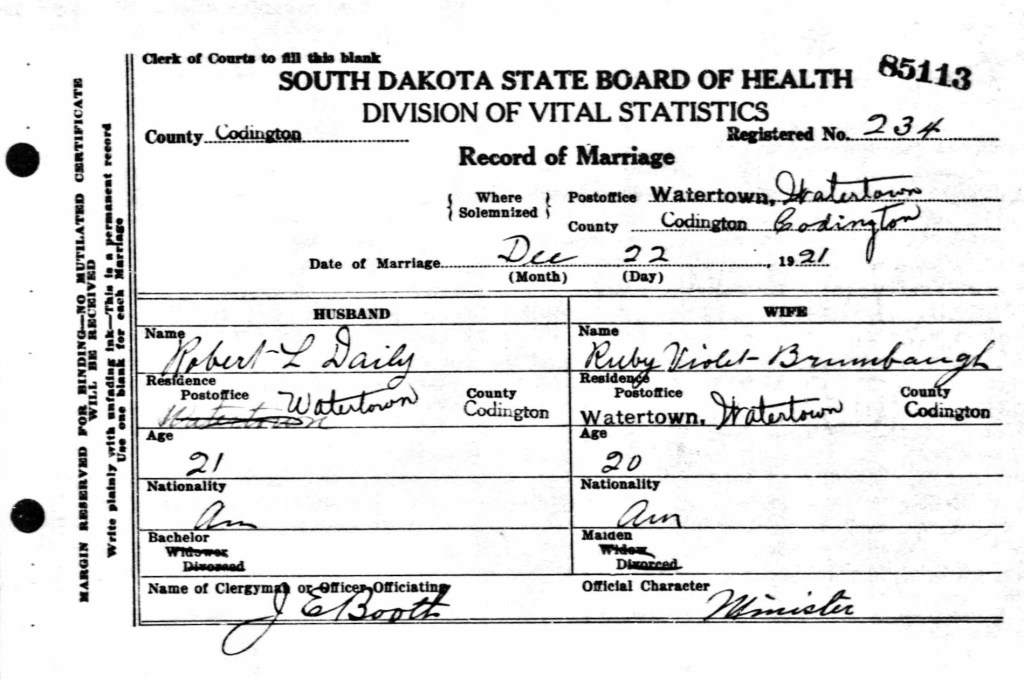
Just over a year later, Robert married Ruby Brumbaugh on December 22, 1921.31  The following December, Ruby gave birth to Charles and Maggie’s fourth grandchild.  Gladys had had her second child in August 1921 (the third grandchild) and Oranna would have her second child eight days after Ruby (the fifth grandchild).

Marriage record of Robert L. Daily and Ruby V. Brumbaugh, December 22, 192131

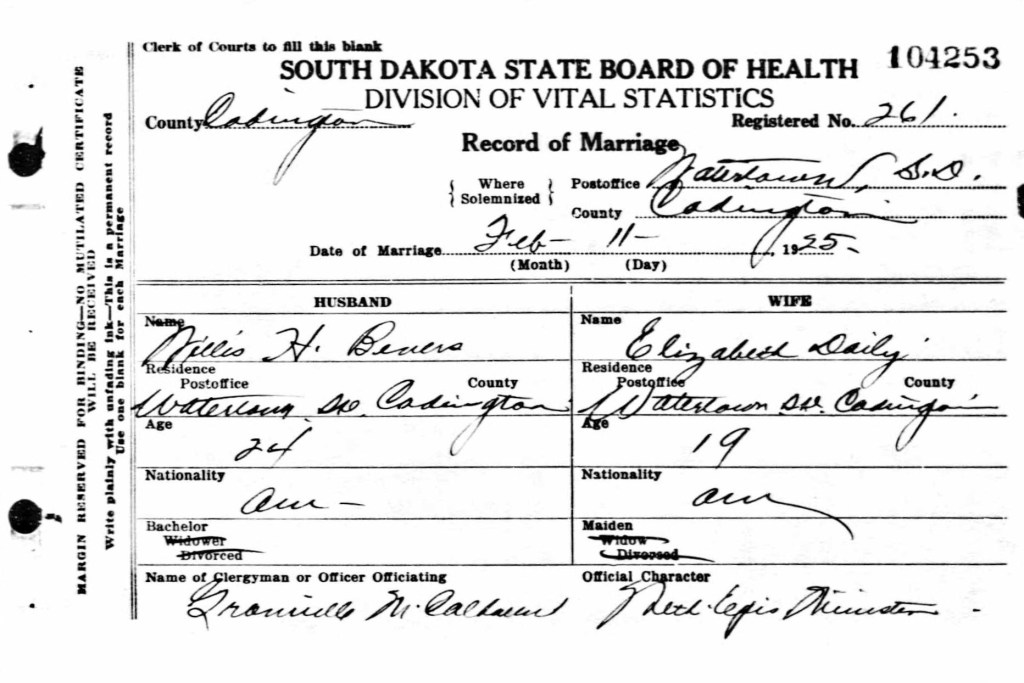
When Gladys’ in-laws, Herbert and Lena Bevers, moved their family to Raymondville, Texas in the fall of 1919, Elizabeth and Iona kept in touch with their son Willis.  The Bevers family returned to South Dakota a year later, but Willis stayed and worked on a road crew for another year.32  About three years after Willis returned to South Dakota, Elizabeth and Willis would marry.  The letters that they had exchanged during those two years are in the possession of one of their sons.  They were married on February 11, 1925, by Granville M. Calhoun, the minister of the Methodist Episcopal Church in Watertown.33 They set up their household in Watertown for a few months and later moved to a farm southwest of Grover.34 Their first child was born in December 1925 and was the tenth grandchild of Charles and Maggie.  Gladys had born two more children, and Oranna and Ruby had each born one more by this time.

Marriage record of Willis H. Bevers and Elizabeth J. B. V. Daily, February 11, 192533

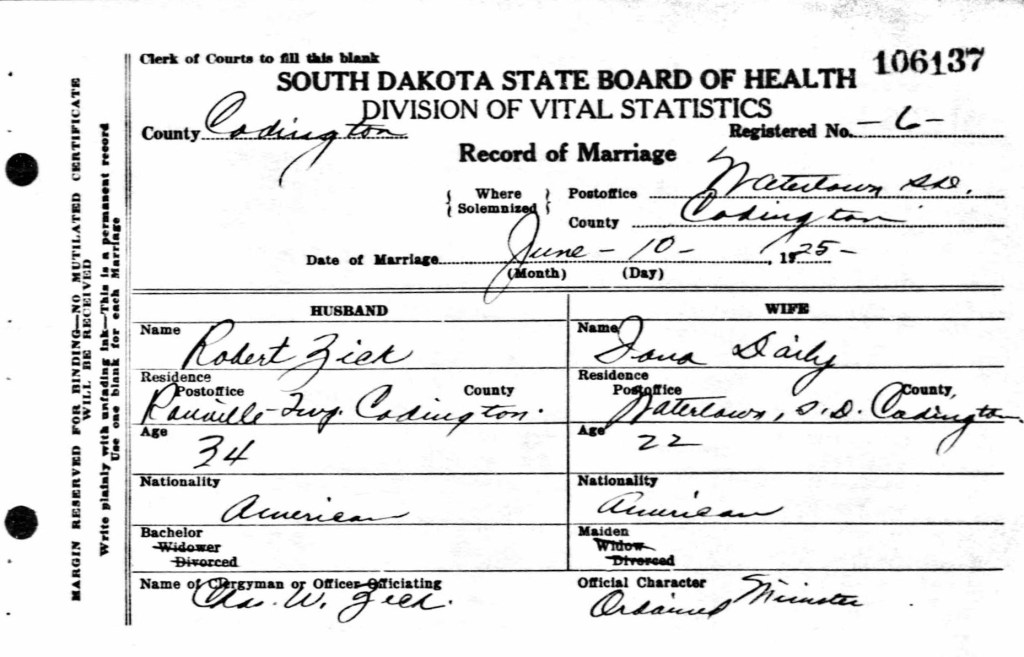
When the 1925 South Dakota Census was conducted, the only child that was living with Charles and Maggie in Rauville was 22 year-old Iona.  She would get married soon afterward, marrying Robert Zick on June 10.35  The officiating minister was Charles W. Zech [sp.?], who was likely the pastor of First Church Evangelical Association.36  Charles and Maggie’s daughter Gladys and her family were living in Rauville, but they may have been living on a different farm than Charles and Maggie.  Oranna and her husband were also still in Rauville.37  Robert had moved with his family to a farm in Germantown Township, Codington County.38


Marriage record of Robert Zick and L. Iona Daily, June 10, 192535

After living and working for 13 years on the Gunther farm, Charles and Maggie moved to another farm in the fall of 1929.  Uncle Bob explained the circumstances around their move:

Uncle Bob:  So, I went out there in the spring of ’29 on [Longstocker?] place.  An’ then Dad had a sale that fall in ’29, up on Gunther farm. 

Interviewer:  Uh huh.

Uncle Bob:  Now ‘o course, he had, he had the hay and he had his cows yet.  He kept his cows.

Interviewer: Um hmm.

Uncle Bob:  I had him come down, with me there.  That house was able – we had two different entrances.  So, so, we lived in two rooms there for ’29, and uh, oh, in the fall of ’29, that’s when Dad come down and moved in there.  Why, we had our — I had cows and he had cows.  Took ’em there.  But then I got a chance in the fall of ‘30 to buy Faragher [sp.?] out.  And, uh, ‘course, I had 1300 head o’ cattle and Faragher [sp.?] had 1700 head o’ cattle.  And uh, I moved down there.  Well, Dad figured maybe I was bitin’ off more – see, the bank was willing to loan me the money because he, Faragher [sp.?] was on there and he owed ‘em $500.  And uh, it was willing to, uh, take the loan over, oh, the mortgage over on a younger man.

Interviewer:  Um hmm.

Uncle Bob:  That’s the way I come in on it.

Interviewer:  Ahhh.  Uh huh.

Uncle Bob:  The bank loaned me all the money to buy Faragher [sp.?] out —

Interviewer:  Sure, sure.

Uncle Bob:  — and then they get their money.  They got their money, see.  …

Interviewer:  That must have been about when, when Grandpa moved to town then?  In ’30?

Uncle Bob:  Well, no.  No, he stayed there one more.  He stayed there one year and he handled the place ….  He put up the hay and fed cattle, out there.  … And so uh, when I come down here in the fall of ’30 to Longstocker’s [perhaps he meant Faragher’s instead], he stayed on one more year, and then he, uh, sold out.  And uh, moved into east Watertown, there.  That’s where he moved to then at that time.  Moved out there.39


On April 10, 1930 a census taker visited the home of Charles and Maggie in Lake Township, Codington County, also visiting the home of Robert and Ruby and their two daughters .40  Charles was 73 years-old and Maggie was 62 years-old.  Both Charles and Robert were farmers and they were actually working on the day before the census taker visited.  Oranna and her three children, aged eleven, seven and four, were living with Charles and Maggie.  Two hardships had afflicted Oranna in the 1920s: she began having epileptic seizures and her husband had deserted her.41  The census record indicates that she was divorced by 1930.

Gladys and Arthur had seven children by this time and were living on a farm very close to Elizabeth and Willis who were also living on a farm, both farms being in Kampeska Township, Codington County.42  Elizabeth had born three children, but one daughter had only lived for four months.  Living with Elizabeth and Willis were his parents Herbert and Lena Bevers.  Iona and Robert had two children prior to 1930 and would have another child a couple months after the census was taken.  They were still living on a farm in Rauville.43  So, as of the end of 1930, Charles and Maggie had 17 living grandchildren. 

In 1930, the United States government wanted to determine the extent of ownership of radio sets in the nation, so one of the questions on the 1930 census was whether the householder owned a radio set.  Between 1905 and 1920, radio broadcasting had been primarily a hobby of amateur radio operators.  During the early 1920s, broadcast stations began to be established in cities and they began providing live programs of music and information for public audiences.  At the time of the census, Charles did not own a radio set and the only ones among his children that owned a radio set were Elizabeth and Willis. 

In the next blogpost of Uncle Bob’s reminiscences, we will learn about Charles and Maggie’s years of living in Watertown, South Dakota.


1. M. R. Wilson, transcription of Robert Lee Daily Interview by R. Thiele, recording (ca. 1984): 8-9.

2. E. M. Bevers, email communication with M. R. Wilson, January 28, 2018.

3. _________, “Charles Monroe Daily Family,” in The First 100 Years in Codington County, South Dakota, 1879-1979, by Codington County History Book Committee (Watertown, South Dakota: Watertown Public Opinion Print, 1979): 150.

4. H. L. Hill (Ed.), Watertown City and Codington County Directory 1916-1917 (Watertown, South Dakota: Watertown Printing and Binding Co., 1916): 317.

5. Wilson, Robert Lee Daily Interview: 25.

6. Hill, Watertown City and Codington County Directory 1916-1917: 336.

7. H. L. Hill (Ed.), Watertown City and Codington County Directory 1919-1920 (Watertown, South Dakota: Watertown Printing and Binding Co., 1919): 323.

8. Wilson, Robert Lee Daily Interview: 14.

9. Ancestry.com, “Record of marriage of Ray Mills and Oranna Daily,” South Dakota Marriages, 1905-1949 (Provo, Utah: Ancestry.com Operations Inc., 2005).

10. Hill, Watertown City and Codington County Directory 1919-1920: 345.

11. ________, Saturday News (Watertown, South Dakota, Oct. 11, 1917), https://www.newspapers.com/image/466193821.

12. ________, Saturday News (Watertown, South Dakota, Oct. 11, 1917), https://www.newspapers.com/image/466193821.

13. ________, Saturday News (Watertown, South Dakota, Mar. 14, 1918), https://www.newspapers.com/image/465662336.

14. ________, Saturday News (Watertown, South Dakota, Jul. 11, 1918), https://www.newspapers.com/image/465664742.

15. 65th Congress, “Congressional Act H. R. 3545,” in United States of America, Public Laws of the Sixty-Fifth Congress (Washington, D. C., 1917): 76-83, http://legisworks.org/congress/65/publaw-12.pdf

16. 65th Congress, “Congressional Act H. R. 12731,” in United States of America, Public Laws of the Sixty-Fifth Congress (Washington, D. C., 1918}: 955-957, http://legisworks.org/congress/65/publaw-210.pdf.

17. “United States World War I Draft Registration Cards, 1917-1918,” database with images, FamilySearch (https://familysearch.org/ark:/61903/3:1:33S7-81WF-YWR?cc=1968530&wc=9FC7-FM9%3A928420501%2C928501301 : 9 September 2019), South Dakota > Codington County; A-Z > image 630 of 3493; citing NARA microfilm publication M1509 (Washington, D.C.: National Archives and Records Administration, n.d.).

18. “United States Census, 1930,” database with images, FamilySearch (https://familysearch.org/ark:/61903/3:1:33S7-9RCF-HX1?cc=1810731&wc=QZF7-DBF%3A648803701%2C649380801%2C648842001%2C1589282340 : 8 December 2015), South Dakota > Codington > Lake > ED 12 > image 2 of 6; citing NARA microfilm publication T626 (Washington D.C.: National Archives and Records Administration, 2002).

19. “United States Census, 1920,” database with images, FamilySearch (https://familysearch.org/ark:/61903/3:1:33SQ-GRVM-Z27?cc=1488411&wc=QZJB-QKD%3A1036874501%2C1039011801%2C1039046901%2C1589332554 : 13 September 2019), South Dakota > Codington > Watertown Ward 4 > ED 101 > image 17 of 41; citing NARA microfilm publication T625 (Washington, D.C.: National Archives and Records Administration, n.d.).

20. Ancestry.com, “Record of marriage of Arthur H. Bevers and Gladys M. Daily,” South Dakota Marriages, 1905-1949 (Provo, Utah: Ancestry.com Operations Inc, 2005).

21. “United States Census, 1920,” database with images, FamilySearch (https://familysearch.org/ark:/61903/3:1:33S7-9RVM-D6Z?cc=1488411&wc=QZJB-434%3A1036874501%2C1039011801%2C1039036701%2C1589332505 : 13 September 2019), South Dakota > Codington > Rauville > ED 94 > image 2 of 7; citing NARA microfilm publication T625 (Washington, D.C.: National Archives and Records Administration, n.d.).

22. L. A. Bevers, personal interview with M. R. Wilson, August 2, 2010.

23. Hill, Watertown City and Codington County Directory 1919-1920: 62, 242.

24. Teacher’s Contract of Richland School District No. Six with Iona Daily, August 11, 1921.

25. ________, Meridian Highway, https://web.archive.org/web/20070924192054/http://www.drivetheost.com/meridianhighway.html.

26. D. Moore, et al., The Meridian Highway in Texas (Austin, Texas: Texas Historical Commission, May 27, 2016): 1.

27. C. Ahlgren, The Meridian Highway (2011), http://plainshumanities.unl.edu/encyclopedia/doc/egp.tra.020.xml.

28. “United States Census, 1920,” database with images, FamilySearch (https://familysearch.org/ark:/61903/3:1:33SQ-GRXW-XQR?cc=1488411&wc=QZJ5-LMG%3A1036473301%2C1036471902%2C1037747101%2C1589333009 : 12 September 2019), Nebraska > Douglas > Omaha Ward 9 > ED 105 > image 11 of 30; citing NARA microfilm publication T625 (Washington, D.C.: National Archives and Records Administration, n.d.).

29. ________, City Directory of Greater Omaha 1920 (Omaha, Nebraska: R. L. Polk & Co., 1920): 1229.

30. Wilson, Robert Lee Daily Interview: 19.

31. Ancestry.com, “Record of marriage of Robert L. Daily and Ruby Violet Brumbaugh,” South Dakota Marriages, 1905-1949 (Provo, Utah: Ancestry.com Operations Inc, 2005).

32. D. L. Bevers, Herbert and Lena Bevers trip to Raymondville Texas [Transcription of Our Trip to Texas by Lena Bevers, 1919] (unpublished, n.d.): 4.

33. Ancestry.com, “Record of marriage of Willis H. Bevers and Elizabeth Daily,” South Dakota Marriages, 1905-1949 (Provo, Utah: Ancestry.com Operations Inc, 2005).

34. ________, “Willis Herbert Bevers,” in The First 100 Years in Codington County, South Dakota, 1879-1979, by Codington County History Book Committee (Watertown, South Dakota: Watertown Public Opinion Print, 1979): 116.

35. Ancestry.com, “Record of marriage of Robert Zick and Iona Daily,” South Dakota, U. S., Marriages, 1905-2017 (Lehi, Utah: Ancestry.com Operations Inc, 2005).

36. H. L. Hill (Ed.), Watertown City and Codington County Directory 1926-1927 (Watertown, South Dakota: Peck-Hill Company): 9.

37. Hill, Watertown City and Codington County Directory 1926-1927: 347.

38. “South Dakota State Census, 1925,” database with images, FamilySearch (https://familysearch.org/ark:/61903/3:1:S3HY-DCR9-M87?cc=1476077&wc=MJ7S-C68%3A1041724801 : 21 May 2014), 004245665 > image 2963 of 3379; State Historical Society, Pierre.

39. Wilson, Robert Lee Daily Interview: 25-26.

40. “United States Census, 1930,” database with images, FamilySearch (https://familysearch.org/ark:/61903/3:1:33S7-9RCF-HX1?cc=1810731&wc=QZF7-DBF%3A648803701%2C649380801%2C648842001%2C1589282340 : 8 December 2015), South Dakota > Codington > Lake > ED 12 > image 2 of 6; citing NARA microfilm publication T626 (Washington D.C.: National Archives and Records Administration, 2002).

41. Wilson, Robert Lee Daily Interview: 10.

42. “United States Census, 1930,” database with images, FamilySearch (https://familysearch.org/ark:/61903/3:1:33SQ-GRCF-HB3?cc=1810731&wc=QZF7-6VX%3A648803701%2C649380801%2C649388101%2C1589282323 : 8 December 2015), South Dakota > Codington > Kampeska > ED 10 > image 1 of 8; citing NARA microfilm publication T626 (Washington D.C.: National Archives and Records Administration, 2002).

43. “United States Census, 1930,” database with images, FamilySearch (https://familysearch.org/ark:/61903/3:1:33S7-9RCF-8C9?cc=1810731&wc=QZF7-DT9%3A648803701%2C649380801%2C649393801%2C1589282372 : 8 December 2015), South Dakota > Codington > Rauville > ED 16 > image 5 of 8; citing NARA microfilm publication T626 (Washington D.C.: National Archives and Records Administration, 2002).

The Early Life of Herbert J. Bevers

Herbert James Bevers’ life begins in the county of York, in central northern England, an area where it is likely that his ancestors had lived for hundreds of years.  Some information can be gleaned about his childhood from the Bible of his parents, Alfred Cockin Bevers and Mary Naomi Bridges.  Herbert was born on March 8, 1869 in Sheepridge, which is in Huddersfield Parish.  Three children had been born to his parents before Herbert’s birth, but one sister had died when she was 16 days old.  So, when Herbert was born, his brother George, who had been born in Hull, York County, was four years-old, and his sister Ada, who was born in Bridlington, York County, was one and a half years-old.  Two months after his birth, Herbert was baptized on May 16, 1869.1

List of “Children’s Names” in the Family Bible of Alfred C. and Mary N. Bevers

Date — Child’s Name —    Parents’ Names    — Mother’s Parents’ Names      — Profession

Baptismal record of Herbert James Bevers, dated May 16, 1869

From the lists of births and deaths in the Bevers’ Bible we can follow where Herbert’s family was living during his childhood.  While living in Sheepridge, a sister and a set of twin boys were born, but none of them survived their first year of life.  The baby girl and one of the twins died while the family was in Sheepridge, but the second twin died in Barnsley.  It appears that the Bevers family had lived in Sheepridge for about four years.  The 1871 Census of England was taken while Herbert’s family was living in Sheepridge.  At that time, Herbert’s father was a “Collector and Canvasser for Prudential Insurance Company.”2

After moving to Barnsley, a town about 20 miles southeast of Sheepridge, another sister, Gertrude, was born when Herbert was three and a half years old.  Then about two and a half years later they would be in Sheepridge again for the birth of another sister, Agnes (but called by her middle name Maud).  At that time (April 1875) Herbert’s brother George was nearly 10 years-old, his sister Ada was 7 ½ years-old, Herbert was six years-old and Gertrude was about 2 ½ years-old.

The family made a longer move sometime before May 1877, for another son was born in Liverpool, on the west coast of England.  This son lived for about 14 months, dying in Bootle, a town three miles north of Liverpool.  In 1881, when the Census of England was taken, the Bevers family was located in Kirkdale, a ward of Liverpool.3  Herbert’s father was a “tailors cutter” and his brother George at the age of fifteen was a “pupil teacher.”  Herbert and his sisters were “scholars.”  At the end of 1881, another brother was born and the family was living in Bootle.  They were still living there nine months later when the baby died.  At that point (August 1882), George was 17 years-old, Ada nearly 15 years-old, Herbert was 13 ½ years-old, Gertrude 10 years-old and Maud was seven and a half years-old.

During the next several years, all the members of Herbert’s family would immigrate to the United States.  Resources give varying years for their arrivals in the USA, but I will report the years as they were recorded in the U. S. censuses.  Herbert’s father immigrated to the United States first, in 1883,4 leaving his family presumably in Bootle (Alfred’s daughter Maud wrote a letter to her father dated September 29, 1883 which identified her address as 13 Orlando Street.  An Internet search for this address locates it in Bootle, not Kirkdale nor Liverpool).  Then in 1884 Herbert’s mother and sisters immigrated5, joining Alfred in South Dakota.  Herbert would have been 15 years-old at that time.  It is not known why he stayed in England.  According to the 1940 U. S. Census, the highest grade that Herbert had completed was 6th grade,6 so he probably was no longer attending school.  His brother George immigrated in 1885,7  but Herbert didn’t immigrate until about 1888.8

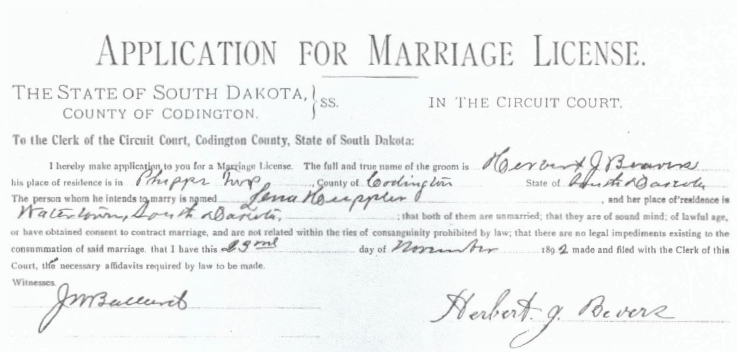
When George Bevers immigrated to the USA, he settled in Philadelphia.  The first time there is an entry for him in the Philadelphia City directory is in 1886.9  He lived there nearly all of the rest of his life.  One of Herbert’s grandsons believes that Herbert spent some time in Philadelphia,10 but Herbert’s name cannot be found in the city directory.  Another source states that Herbert went to Virginia for a time.11  I have found no documentation to corroborate this either.  After Herbert traveled to the USA, the first thing that is known for certain is that Herbert was a resident of Phipps Township in Codington County, South Dakota when he married Lena Huppler in 1892.12  It is a likely guess that Herbert had been living with his parents on their homestead in Phipps Township. The story of Herbert and Lena’s life together will have to wait for another time.

  1. “West Yorkshire, Non-Conformist Records, 1646-1985” (Provo, UT, USA: Ancestry.com Operations, Inc., 2011), http://www.Ancestry.com.
  2. “1871 England Census” [Class: RG10; Piece: 4372; Folio: 86; Page: 19; GSU roll: 848087]. In the repository of Ancestry.com (Provo, Utah, USA: Ancestry.com Operations Inc., 2004): https://www.ancestry.com/interactive/7619/WRYRG10_4369_4372-0637/25690148?backurl=https://www.ancestry.com/family-tree/person/tree/18041304/person/620842544/facts/citation/145258692549/edit/record.
  3. “1881 England Census” [Class: RG11; Piece: 3684; Folio: 133; Page: 23; GSU roll: 1341882]. In the repository of Ancestry.com (Provo, Utah, USA: Ancestry.com Operations Inc., 2004): https://www.ancestry.com/interactive/7572/LANRG11_3682_3686-0678/9137172?backurl=https://www.ancestry.com/family-tree/person/tree/18041304/person/620842544/facts/citation/140137474899/edit/record#?imageId=LANRG11_3682_3686-0679.
  4. “United States Census, 1910,” database with images, FamilySearch (https://familysearch.org/ark:/61903/3:1:33S7-9RGL-SS6B?cc=1727033&wc=QZZH-HGB%3A133638201%2C135920101%2C135948601%2C1589092018 : 24 June 2017), South Dakota > Kingsbury > De Smet Ward 2 > ED 257 > image 6 of 8; citing NARA microfilm publication T624 (Washington, D.C.: National Archives and Records Administration, n.d.).
  5. “United States Census, 1910,” database with images, FamilySearch, South Dakota > Kingsbury > De Smet Ward 2.
  6. “United States Census, 1940,” database with images, FamilySearch (https://familysearch.org/ark:/61903/3:1:3QSQ-G9M1-58J8?cc=2000219&wc=QZFM-WH1%3A791611401%2C793270701%2C793367301%2C951353501 : accessed 14 May 2020), South Dakota > Codington > Watertown City, Watertown, Ward 3 > 15-24A Watertown City Ward 3 bounded by (N) Kemp Av; (E) Maple; (S) 4th Av S; (W) ward line; also Barton Hospital, Codington County Jail, Watertown City Jail > image 17 of 42; citing Sixteenth Census of the United States, 1940, NARA digital publication T627. Records of the Bureau of the Census, 1790 – 2007, RG 29. Washington, D.C.: National Archives and Records Administration, 2012.


  7. “United States Census, 1900,” database with images, FamilySearch (https://familysearch.org/ark:/61903/3:1:S3HY-DZV6-7M?cc=1325221&wc=9B7K-NQX%3A1030550501%2C1036056801%2C1036357801 : 5 August 2014), Pennsylvania > Philadelphia > ED 976 Philadelphia city Ward 38 > image 28 of 33; citing NARA microfilm publication T623 (Washington, D.C.: National Archives and Records Administration, n.d.).
  8. “United States Census, 1900,” database with images, FamilySearch (https://familysearch.org/ark:/61903/3:1:S3HT-68DY-PH?cc=1325221&wc=9B7H-9LQ%3A1031648401%2C1033119401%2C1033119402 : 5 August 2014), South Dakota > Roberts > ED 282 Agency, One Road & Spring Grove Townships > image 4 of 11; citing NARA microfilm publication T623 (Washington, D.C.: National Archives and Records Administration, n.d.).
  9. James Gopsill’s Sons, Publishers, Gopsill’s Philadelphia Directory (Philadelphia: James Gopsill’s Sons, Publishers, 1886): 182.
  10. M. E. Bevers, Willis Bevers Family History Slideshow (Unpublished, n. d.): 6.
  11. “Herbert James Bevers Family,” In The First 100 Years in Codington County, South Dakota, 1879-1979, by Codington County History Book Committee (Watertown, South Dakota: Watertown Public Opinion Print, 1979): 116.
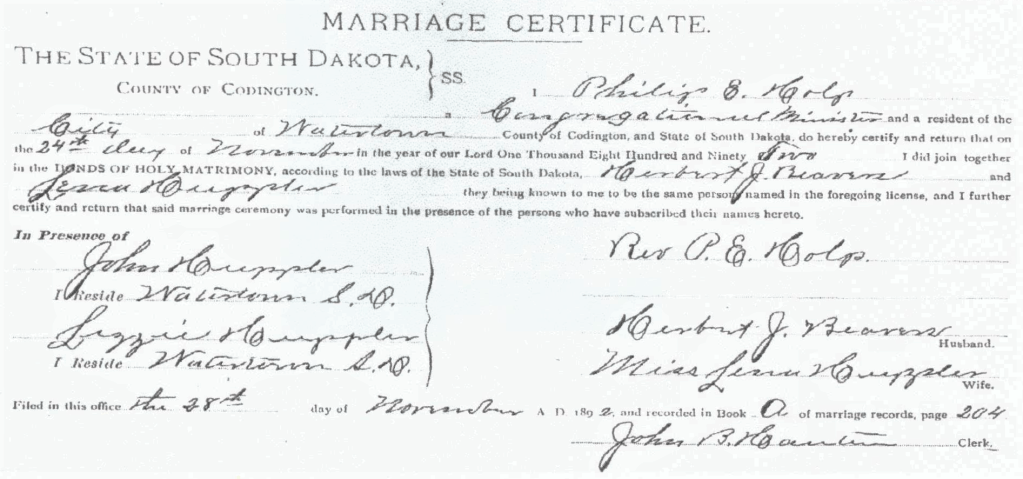
  12. “Application for Marriage License of Herbert J. Beavers” (Circuit Court, Codington County, South Dakota, November 23, 1982).
What Became of the Huppler Orphans?

Immigrants John and Anna Huppeler1, with their six children, arrived at the Port of New York in April 1874.2  Two months later, at the Circuit Court of Monroe County, Wisconsin, a declaration of intention to become a citizen of the United States was signed by John Huppler.3  Then nearly a year later, the name John Huppler appears on the Wisconsin state census.  As of June 1, 1875, he and his household were residing in Burns Township, La Crosse County.4  The census record indicates that there were four males and four females in the household, presumably these are John and his sons Christian, John and Friedrich and his wife Anna and daughters Rosetta, Anna Elizabeth5 and Lena.  This census of Burns Township also includes the household of John’s brother Jacob Hueppler, which had two males and three females.6  There is also a David Hueppler, which is probably another brother of John, having two males and two females in the household.7

Tragically, both John and Anna Huppler lose their lives within several months of being recorded on the 1875 Wisconsin census.  A century after their deaths, in a tribute to their daughter Anna Elizabeth’s 105th birthday, a statement is made: “When she was 6 her mother died and 6 mo. later, her father died. The 6 kids were placed with different families.”8  (According to other documentation of her age, Anna Elizabeth was actually eight years old when her parents died.)  The ages of the other children were: Christian, about 12; Rosetta, age 10; John, age 6 or 7; Friedrich, age 5 and Lena, age 3.

So, what became of these six children?  There is some family lore and a few documents that lead us to some possibilities of where the children were placed.  One family historian, a descendant of Lena, obtained from a descendant of Christian a copy of a document dated March 4, 1876, signed by two Supervisors of the town of Burns in La Crosse County, Wisconsin.  The document bound Christian as an indentured servant to William Sawyer of Burns until Christian reached the age of 21 years-old.  A portion of the document reads as follows:

“… Whereas Christian Huppler now 13 years of age, a minor son of John Huppler and his wife Anna, late of said Burns, both deceased, is a resident of said town of Burns and destitute of means of support and has become a charge whom said town for support ….  The Supervisors of the town of Burns have and by these presents do put and bind this said Christian Huppler unto the said William Sawyer as a servant for and until he shall have attained the full age of 21 years which will be on 22 Aug 1884 during which time the said servant shall serve his master faithfully, honestly and industriously….  The said William Sawyer hereby covenants, promises and agrees to and with said Board of Supervisors that he will furnish and provide said Christian Huppler with suitable and sufficient clothing, board and food and proper care, medical attendance in case of sickness and cause him within the said term to be instructed to read and write and in the general rules of mathematics and use him with proper care and extend to him suitable treatment and at the end of said terms he will give to said Christian Huppler the sum of $100.  And for the time performance of all and singular this covenants and agreements aforesaid, the said parties bind themselves each unto the other firmly by these presents.  In witness whereof the parties have set their hands and seals 4 Mar 1876.”9

William Sawyer was a farmer who had been living in La Crosse County since at least 1860 (his name is on the 1860 U. S. Census of the town of Bangor).10  According to the 1870 U. S. Census for Burns, William Sawyer’s household included his wife and three children, as well as another child, two farm laborers and a domestic servant.11  Christian himself can be found on the 1880 U. S. Census as part of the William Sawyer household, which was still residing in Burns.12  This census record identifies 16 year-old Christian’s relationship to the head of the household as “servant” and his occupation as “farm hand.”  Christian also attended school within the census year and he could read and write.  The birth place listed for Christian and his parents is “Switland” (this is assumed to be Switzerland).

1880 U. S. Census record of the William Sawyer household, which includes “Criss Huppler.”

According to the widow of one of Christian Huppler’s sons, the Huppler girls were raised by families with the name of McIntyre, Campbell and Christians, and she said that young John Huppler was raised by his uncle Jacob Huppler.13   She also said that “one boy died young of malaria after moving south.”  As yet I have not been able to locate the placements of Rosetta nor Friedrich Huppler, but I have collected some information about Anna Elizabeth, John and Lena.

Sorting out who Anna Elizabeth was raised by and when she left Wisconsin has been difficult to determine.  According to the above-mentioned article written when Anna Elizabeth turned 105-years-old, as an orphaned child “she lived and worked with the Alex McIntyre family” and the article also states that “two of her … brothers came to South Dakota and when she was 16 she joined them.”14  Alternatively, the text of the funeral folder of Anna Elizabeth seems to contradict the article, stating, “In 1880 she came to South Dakota with the William MacIntyre family.”15  William McIntyre was an early settler and businessman in Codington County, South Dakota (one source states that his arrival in Dakota Territory was in 1877, not 1880).16

“William and Adelaide [his wife] came to the tree claim he had staked two miles west of what is now Watertown.  They were accompanied by a large contingent of settlers including two of his brothers.  …They were very active in the early years of the city.  He served as mayor and was appointed to the group authorized to organize Codington County.”17

Anna Elizabeth might not have actually moved to South Dakota at the same time as William McIntyre.  In the 1880 U. S. Census of Sparta, Wisconsin, there is a record of a 13 year-old girl by the name of Annie in the household of Ester McIntyre who was married (not widowed), but her husband wasn’t in the household at the time the census was taken.18  The relationship of Annie to the head of the household (Ester) is recorded as “adopted.”  According to a posting about Esther McIntyre on the Find-a-Grave website, Esther’s husband was Alexander McIntyre and they had adopted Annie.19  Perhaps this is Anna Elizabeth Huppler.  Another posting on this website indicates that Alexander McIntyre moved to Watertown, South Dakota in 1886.20  If Anna Elizabeth did go to South Dakota when she was sixteen (which was 1883), then she may have left from the Alex McIntyre home, three years before he moved to South Dakota.

1880 U. S. Census record of the Ester McIntyre household, which includes adopted 13-year-old “Annie.”

Possible confirmation of the statement that young John Huppler was raised by his uncle Jacob comes from a census record that actually leaves us with some uncertainty due to spelling inconsistencies.  There is an 1880 U. S. Census record of a man named Jacob Hipler, living in Burns, Wisconsin21, the same town where Jacob Huppler was living when the Wisconsin state census was taken in 1875.  The Jacob of this 1880 census record is from Switzerland, as well as the two children in the household.  One of the children is named John, but the other is listed as Laura.  Yet both of the children are in the age range of John and Lena Huppler.  In the census record, their relationships to the head of the household are: son and daughter.

1880 U. S. Census record of Jacob Hipler household, which includes John and Laura.
(I propose that this is actually Jacob Huppler with his nephew John and niece Lena Huppler.)

After eight and a half years, the indenture of Christian Huppler was completed on August 23, 1884 when he turned 21 years-old.  Two years later he made his way to Codington County, South Dakota and began farming.22  Apparently, Christian’s relationship with his master William Sawyer was a good one, and after settling in South Dakota, Christian wrote to William.  This fact is known due to the existence of a letter written by William’s daughter Lena Sawyer to Christian.  Lena Sawyer’s letter states that she was writing a week after William Sawyer received a letter from Christian.  In her letter dated September 15, 1889, she calls herself his friend, she tells him of her impressions of South Dakota and informs him of the doings of the members of her family.  According to the wife of a family historian who is a descendant of Lena, the text of the letter reads:

“Father received your letter last week.  We are glad to know that you keep well and like Dakota.  I think it is just the place for young men and women too if they have plenty of courage.  I have often thought that I would like to own a piece of land in Dakota but could not well take a homestead. What kind did you get and are there any claims near yours.  I want land for speculation, not for a home for I could not stand Dakota winters.  I think some of taking a trip to Huron this fall to visit the cousins there.  Susie and Johnnie have moved to Mankato, MN.  Mother went East the middle of July.  She returned last week and brought a niece with her from NY.  Frank went to CA the first of July.  He thinks of spending a year in a law school at San Francisco then will settle in Stockton.  Said he would not be back for 10 years.  Allie has been home a month.  She is going to teach in the Graded School at Long Prairie next year.  Helen is at home. She is very anxious to learn short-hand and type-writing.  Edgar has moved to LaCrosse and working at carpentry.  Your friend, Lena”23

The 1915 South Dakota state census record of Lena Bevers indicates that she had been living in South Dakota for 29 years, which would mean that she moved to South Dakota in 1886, when she was 14-years-old.24  This is the same year that Lena’s cousin Kate Huppler Dellman moved to South Dakota with her husband J. H. Dellman.25  Kate was the second daughter of Jacob Huppler.  If it is true that three-year-old orphaned Lena was taken in by Jacob Huppler, then Kate would have been sixteen-years-old at the time.  Around five years later, in December 1880, Kate married Julius Dellman.26  Then, in the same year that Christian Huppler moved to Codington County, the Dellmans moved to Watertown, South Dakota.  Perhaps young Lena Huppler had joined the Dellmans during their move to South Dakota.

According to family lore learned by one of Christian Huppler’s descendants, Christian was instrumental in bringing all of his siblings to South Dakota.27  Briefly, the following information is known about the residences of Christian and his siblings as young adults.

  • “Christian’s name is one of 22 settlers who signed a petition filed April 16, 1889 asking that the area be organized into a civil township known as Phipps Township.”28
  • It is not yet known which family took in Rosetta Huppler when her parents died, nor when and how she made her way to South Dakota.  But she was living in Phipps Township, Codington County, South Dakota when she married Gottlieb Christian in 1900.29
  • Anna Elizabeth “had her own homestead near the McIntyre home which was north of Watertown and just west of Rauville.”30  Also, she and her husband Dougal Campbell were living in Phipps Township in 1900.31
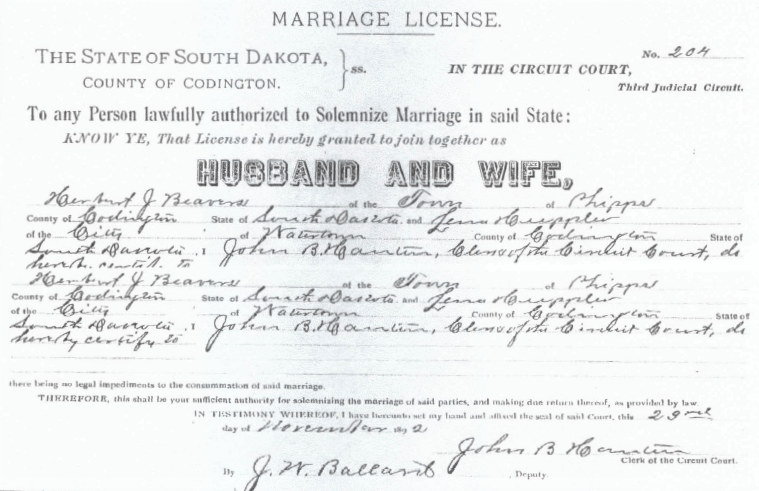
  • As a young man John Huppler must have lived in South Dakota for a short time.  He was there in 1892 when his sister Lena married Herbert Bevers.  John and his sister Anna Elizabeth were witnesses who signed Lena and Herbert’s marriage certificate.32  John must have returned to Wisconsin about 1893 because he was married there about 1894.
  • Little is known about Friedrich.  As yet, no record has been found of his living in South Dakota.  Some family historians give him a death date of about the year 1900.  Perhaps he died in the south of malaria, as one story reports about one of the Huppler boys.33
  • According to Lena’s marriage license dated November 1892, she was a resident of Watertown, Codington County, South Dakota at that time.34

Notes:

  1. The Huppler name is spelled in a variety of ways on different documents.  When a document is referenced, the name is spelled as it is written in the document.
  2. “New York Passenger Lists, 1820-1891,” database with images, FamilySearch (https://familysearch.org/ark:/61903/1:1:QK97-V815 : 11 March 2018), John Huppeler, 1874; citing Immigration, New York City, New York, United States, NARA microfilm publication M237 (Washington, D.C.: National Archives and Records Administration, n.d.), FHL microfilm 175,744.
  3. “Declaration of John Huppler,” (Circuit Court, Monroe County, Wisconsin: June 12, 1874).
  4. Wisconsin Historical Society; Madison, Wisconsin; Census Year: 1875; Roll: 3 (https://ancestry.com. Wisconsin, State Censuses, 1855-1905 [database on-line]. Provo, UT, USA: Ancestry.com Operations Inc, 2007).
  5. Both names (Anna Elizabeth) are used throughout this article because some resources refer to her as Anna and some refer to her as Elizabeth, Liz or Lizzie.
  6. Wisconsin Historical Society; Census Year: 1875.
  7. Wisconsin Historical Society; Census Year: 1875.
  8. Jenkins Methodist Home News, v. 6 no. 3, “105th Birthday” (Watertown, South Dakota: Jenkins Methodist Home, August 1972), 1.
  9. M. A. Bevers, email communication to M. Wilson, April 20, 2020.
  10. “United States Census, 1860”, database with images, FamilySearch (https://familysearch.org/ark:/61903/1:1:MW9S-VXG : 18 March 2020), William Sawyer, 1860.
  11. “United States Census, 1870”, database with images, FamilySearch (https://familysearch.org/ark:/61903/1:1:MN9L-331 : 19 March 2020), William Sawyer, 1870.
  12. “United States Census, 1880,” database with images, FamilySearch (https://familysearch.org/ark:/61903/1:1:MN4R-LFZ : 17 September 2017), William P Sowyer, Burns, La Crosse, Wisconsin, United States; citing enumeration district ED 44, sheet 335A, NARA microfilm publication T9 (Washington, D.C.: National Archives and Records Administration, n.d.), FHL microfilm 1,255,432.
  13. M. A. Bevers, notes of an interview with Geraldine Huppler, widow of Jim Huppler, July 1991 (posted to Johannes Hüpperle in “Bevers-Daily-McFerran-Nelson Families” family tree on Ancestry.com, n.d.).
  14. Jenkins Methodist Home News, “105th Birthday.”
  15. Shaw-Messer Funeral Home, “Anna E. Campbell, 1867-1972” (Watertown, South Dakota: Shaw-Messer Funeral Home, January 3, 1973).
  16. “William McIntyre Family,” In The First 100 Years in Codington County, South Dakota, 1879-1979, by Codington County History Book Committee (Watertown, South Dakota: Watertown Public Opinion Print, 1979): 264.
  17. “William McIntyre Family,” In The First 100 Years in Codington County, South Dakota, 1879-1979: 264.
  18. “United States Census, 1880,” database with images, FamilySearch (https://familysearch.org/ark:/61903/1:1:MNHW-FTG : 23 August 2017), Ester Mcintyre, Sparta, Monroe, Wisconsin, United States; citing enumeration district ED 29, sheet 93A, NARA microfilm publication T9 (Washington, D.C.: National Archives and Records Administration, n.d.), FHL microfilm 1,255,439.
  19. Find a Grave, database and images (https://www.findagrave.com : accessed 28 March 2020), memorial page for Esther E Husted McIntyre (27 May 1837–8 Jul 1912), Find a Grave Memorial no. 88550806, citing Leon Cemetery, Sparta, Monroe County, Wisconsin, USA; Maintained by Susan Hunt Williams (contributor 47664730).
  20. Find a Grave, database and images (https://www.findagrave.com : accessed 28 March 2020), memorial page for Alexander “Alex” McIntyre (18 Jun 1838–18 Nov 1907), Find a Grave Memorial no. 88523698, citing Leon Cemetery, Sparta, Monroe County, Wisconsin, USA; Maintained by Susan Hunt Williams (contributor 47664730).
  21. “United States Census, 1880,” database with images, FamilySearch (https://familysearch.org/ark:/61903/1:1:MN4R-RN5 : 17 September 2017), Jacob Kipher, Burns, La Crosse, Wisconsin, United States; citing enumeration district ED 44, sheet 341B, NARA microfilm publication T9 (Washington, D.C.: National Archives and Records Administration, n.d.), FHL microfilm 1,255,432.
  22. “Christian Huppler Family,” In The First 100 Years in Codington County, South Dakota, 1879-1979, by Codington County History Book Committee (Watertown, South Dakota: Watertown Public Opinion Print, 1979): 208.
  23. M. A. Bevers, email communication to M. Wilson, April 20, 2020.
  24. “South Dakota State Census, 1915,” database with images, FamilySearch (https://familysearch.org/ark:/61903/1:1:MMHW-WHC : 29 July 2017), Lena Bevers; citing State Historical Society, Pierre; FHL microfilm 2,283,122.
  25. “J. H. Dellman Family,” In The First 100 Years in Codington County, South Dakota, 1879-1979, by Codington County History Book Committee (Watertown, South Dakota: Watertown Public Opinion Print, 1979): 156.
  26. “J. H. Dellman Family,” In The First 100 Years in Codington County, South Dakota, 1879-1979: 156.
  27. M. L. Winzenburg, email communication with K. Bevers, Apr. 19, 2017.
  28. “Christian Huppler Family,” In The First 100 Years of Codington County, South Dakota, 1879-1979: 208.
  29. M. A. Bevers, notes of the marriage record of Rosa Huppler and Gotlip (sp?) Christian (posted to Rosetta Huppler in “Bevers-Daily-McFerran-Nelson Families” family tree on Ancestry.com, n.d.).
  30. Jenkins Methodist Home News, “105th Birthday.”
  31. “United States Census, 1900,” database with images, FamilySearch (https://familysearch.org/ark:/61903/1:1:MMRS-CZZ : accessed 15 April 2020), Anna E Campbell in household of Degald Campbell, Fuller, Richland & Phipps Townships, Codington, South Dakota, United States; citing enumeration district (ED) 102, sheet 7B, family 131, NARA microfilm publication T623 (Washington, D.C.: National Archives and Records Administration, 1972.); FHL microfilm 1,241,548.
  32. “Marriage License of Herbert J. Beavers and Lena Huppler” (Circuit Court, Codington County, South Dakota: November 23, 1892).
  33. M. A. Bevers, notes of an interview with Geraldine Huppler.
  34. “Marriage License of Herbert J. Beavers and Lena Huppler.”

The Huppelers’ Arrival in the USA

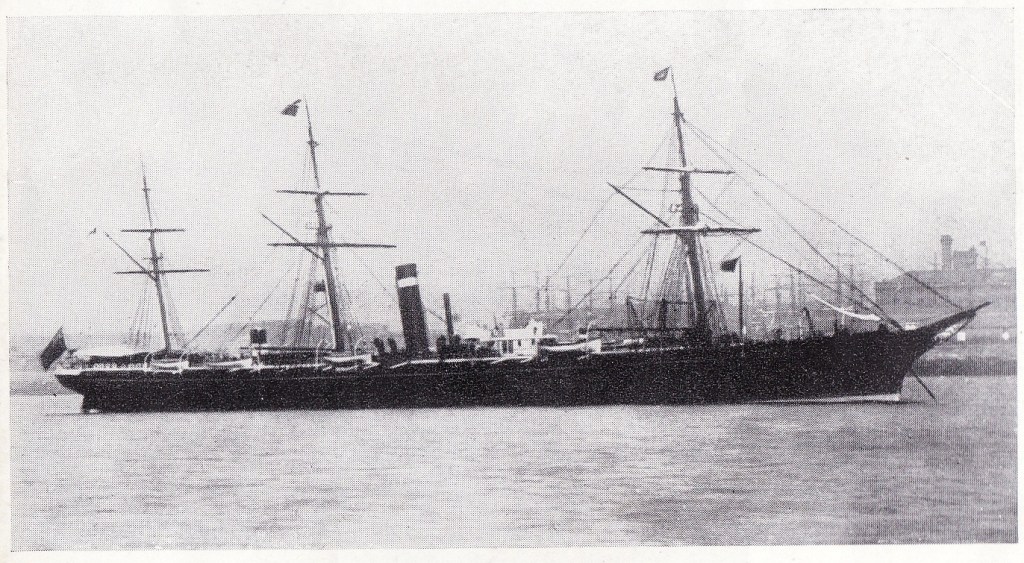
On an early spring day in 1874, the R. M. S. City of Paris arrived at the Port of New York.  This ship had been serving as a passenger liner since 18661 and its record as a fast ship along with the records of the other four or five ships in its fleet contributed to its owners being granted a contract to transport mail by the British Post Office Government.2  Thus it holds the prefix “R. M. S.” which means Royal Mail Steamship.3  It was an iron-hulled, screw-propelled steamship, but it was fitted with sails also in order to navigate in unpredictable weather.  (Initially, steamships were propelled by paddlewheel.  The first screw-propelled steamship was built in 1840.4  Screw-propellers became the standard mode of propelling steamships until they were replaced by steam turbines in the early 1900s.  The transition from wood hulls to iron hulls began about 1850.5)  “After four years of service, City of Paris was lengthened to 397 feet (121 meters) and re-engined with compounds ….  This raised her tonnage to 3100 and her capacity to 150 cabin and 400 steerage.”6

City of Paris passenger liner, 1866 (Public Domain)7

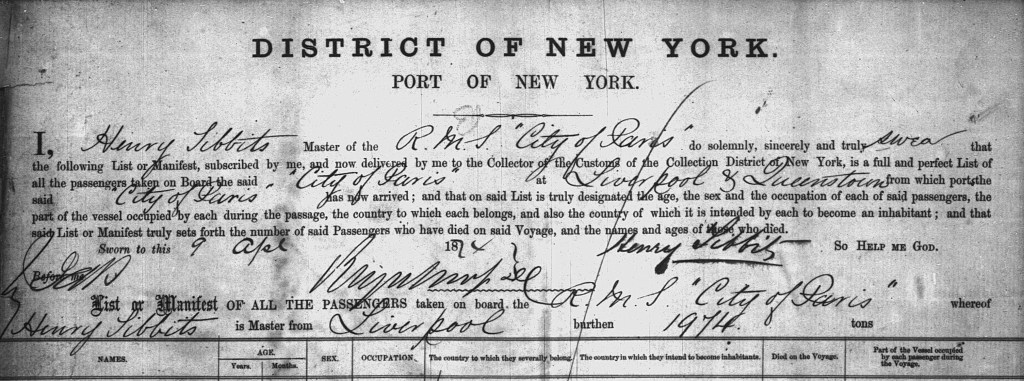
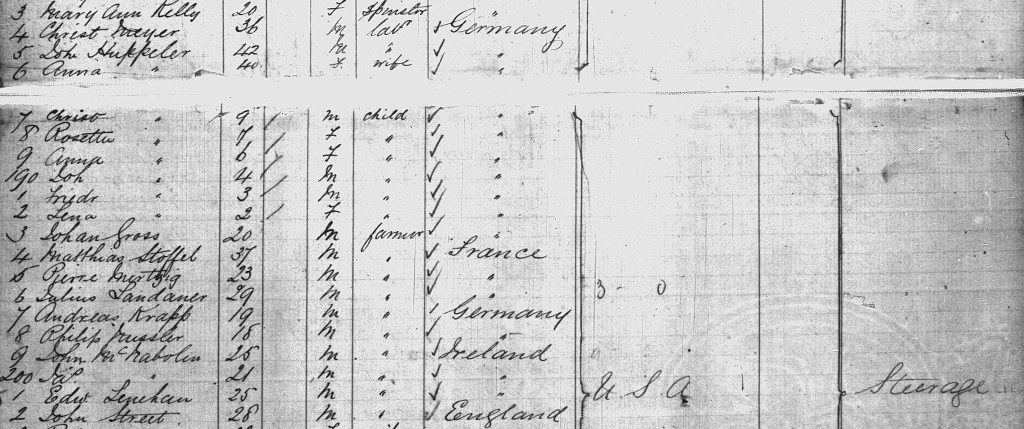
On April 9, 1874, Henry Tibbits, the Master of the R. M. S. City of Paris, submitted a ship manifest to the Collector of the Customs of the Collection District of New York.  Listed on this ship manifest as one of the families who traveled in steerage is the Huppeler family, which included:

#185      Joh Huppeler, age 42, male, laborer

#186      Anna Huppeler, age 40, female, wife

#187      Christ Huppeler, age 9, male, child

#188      Rosetta (sp) Huppeler, age 7, female, child

#189      Anna Huppeler, age 6, female, child

#190      Joh Huppeler, age 4, male, child

#191      Friedr Huppeler, age 3, male, child

#192      Lena Huppeler, age 2, female, child

A section of the manifest of the R. M. S. City of Paris, dated April 9, 18748

On this manifest, the country recorded to which the Huppelers belonged was Germany, and decades later the son John Huppler reported on his petition for naturalization that he had emigrated from Hamburg, Germany.9 Yet the naturalization documents of Christian, Anna, John and Lena Huppler indicate that they had been subjects of Switzerland.10  The R. M. S. City of Paris picked up passengers in Liverpool, England and Queenstown, Ireland.  At this point, it is not known exactly how long this specific voyage across the Atlantic Ocean was, but it is recorded that “In a famous February 1868 race, City of Paris and Russia sailed from New York within an hour of each other. The Inman liner [City of Paris] claimed 8 days, 19 hours, 23 minutes to Queenstown, while the Cunarder [Russia] required 42 minutes longer using a slightly different course.”11

The ship manifest also records that the Huppeler family intended to become inhabitants of the United States of America.  When they disembarked from the ship they would have been processed as immigrants at Castle Gardens, New York City.

“Prior to 1890, individual states (rather than the federal government) regulated immigration into the United States.  These regulation efforts were varied and inconsistent.  …

“On August 1, 1855, the [state of] New York opened the first official immigrant receiving station in New York City.  It functioned as an immigrant processing center and was the first of its kind in the United States.  Castle Gardens operated as an Emigrant Landing Depot until April 18, 1890, when the United States government assumed control of immigrant processing.  In total, the center processed approximately 8 million immigrants (mostly from northern and western Europe).

“When immigrants disembarked at Castle Garden, they had to register with their name, birth place, and destination.  A clerk at the Railway Agency would then purchase a railway ticket for the immigrant to travel to that destination.  The immigrant’s baggage would be weighed and checked to his destination.  Exchange brokers for immigrants to exchange foreign currency and a restaurant were also located at the center.  A station for [letter] writing was also available, in which an immigrant could send a letter free of charge to inform family or friends of their arrival.  The Ward’s Island and medicinal department was an important bureau at Castle Garden.  There, immigrants without the means to support themselves would be cared for until assistance came from friends or the immigrants would be disposed of as laborers.  A large blackboard with the names of ships who were or would shortly be at port was kept for friends of the immigrants to know when they arrived and locate them.  The Labor Exchange was where immigrants, and others, could apply for and generally find employment.  Immigrants could also find boarding houses to rest for one or two days before heading out to their destinations.

“Castle Gardens was a very busy and important immigrant receiving station.  To illustrate, in 1869, 2884 letters written from immigrants to their friends were forwarded, over $41,000 was sent from these friends in return.  Also in 1869, 4393 telegraph messages were forwarded and 1351 answers were received.  Also, 504 steamers and 209 sailing vessels arrived carrying passengers.”12

Five years earlier than when John Huppeler’s family arrived at New York City, another Huppeler family had immigrated to the United States – the family of John’s brother.  The ship manifest of the S. S. William Penn (“S. S.” means single-screw steamship13) lists the following members:

#259      Jacob Huppeler, age 42, male

#260      Catherine Huppeler, age 52, female

#261      Anna Lise Huppeler, age 11, female

#262      Catharine Huppeler, age 9, female

This steamship had picked up passengers in London, England and in Havre, France.  This Huppeler family had traveled in steerage, the country to which they belonged was recorded as Switzerland and they intended to become inhabitants of the United States.  Of the 613 passengers listed on the ship manifest, 158 of them were from Switzerland.

A section of the manifest of the S. S. William Penn, dated April 2, 186914

Notes:

  1. “SS City of Paris (1865)” (November 16, 2019), https://en.wikipedia.org/wiki/SS_City_of_Paris_(1865).
  2. “SS City of Paris (1865)” (November 16, 2019), https://en.wikipedia.org/wiki/SS_City_of_Paris_(1865).
  3. “Steamship” (December 17, 2019), https://en.wikipedia.org/wiki/Steamship#Name_prefix.
  4. “Steamship” (December 17, 2019), https://en.wikipedia.org/wiki/Steamship#First_ocean-going_steamships.
  5. “Inman Line” (November 18, 2019), https://en.wikipedia.org/wiki/Inman_Line#1850–66.
  6. “SS City of Paris (1865)” (November 16, 2019), https://en.wikipedia.org/wiki/SS_City_of_Paris_(1865).
  7. “File:City of Paris (1866).jpg” (September 7, 2009, https://commons.wikimedia.org/wiki/File:SS_City_of_Paris_1866.jpg.
  8. “New York Passenger Lists, 1820-1891,” database with images, FamilySearch (https://familysearch.org/ark:/61903/1:1:QK97-V815 : 11 March 2018), John Huppeler, 1874; citing Immigration, New York City, New York, United States, NARA microfilm publication M237 (Washington, D.C.: National Archives and Records Administration, n.d.), FHL microfilm 175,744.
  9. United States of America, “Petition for Naturalization: Monroe County, Wisconsin,” February 26, 1892 (NAT reel 8, p. 63).
  10. Microfilm images of naturalization papers of Christian Huppler, Anna E. Huppler, John Huppler and Lena Huppler, South Dakota State Historical Society, Pierre, South Dakota.
  11. “SS City of Paris (1865)” (November 16, 2019), https://en.wikipedia.org/wiki/SS_City_of_Paris_(1865).
  12. Becca Curtis, “US Immigration History” (August 17, 2018), https://www.familysearch.org/wiki/en/US_Immigration_History.
  13. “Steamship” (December 17, 2019), https://en.wikipedia.org/wiki/Steamship#Name_prefix.
  14. “New York Passenger Lists, 1820-1891,” database with images, FamilySearch (https://familysearch.org/ark:/61903/1:1:QV3Q-S25K : 11 March 2018), Jacob Huppelar, 1869; citing Immigration, New York City, New York, United States, NARA microfilm publication M237 (Washington, D.C.: National Archives and Records Administration, n.d.), FHL microfilm 175,664.

Why go to Texas? — Why leave Texas?

In my series of blogposts from October 13 to November 8, the focus was on how Herbert and Lena Bevers and their family traveled from Watertown, South Dakota to Raymondville, Texas.  But I didn’t address why they chose to move to a farm in Texas.  As recorded in the U. S. censuses and state censuses, from the beginning of their marriage in 1892 until 1919, Herbert and Lena farmed in four locations in South Dakota:

  1. Agency Township, Roberts County (1900)
  2. Rau Township, Codington County (1905)
  3. Oxford Township, Hamlin County (1910)
  4. Elmira Township, Codington County (1915)

The first property that I have evidence of Herbert owning was a homestead in Agency Township, Roberts County.  In the Register of Deeds Office in Sisseton, Roberts County, there is a record of Herbert paying $400.00 on October 24, 1902 for 160 acres from the United States.  A deed record in the same office shows that on the following day, Herbert and Lena sold that property for $2,300.00.  It is not known whether he purchased property following the sale of that homestead, but according to the 1910 U. S. census and the 1915 South Dakota State census, Herbert was renting farms, instead of owning them.

Somehow Herbert heard that land in southern Texas was available.  The New Handbook of Texas provides a description of land development that we can use to speculate:

“The real surge of Anglo settlement came after the building of the St. Louis, Brownsville and Mexico Railway into the lower [Rio Grande] Valley in 1904.  Close behind the tracks came the land promoters, who worked enthusiastically to convert pastures to plowed fields. … The railroad companies, more aggressive than land promoters, bought large tracts of land, subdivided them, and sold them to customers they recruited elsewhere.  Magazines, pamphlets and brochures with photographs of the happy and easy life that awaited the new settler in the area were scattered throughout the Mississippi valley.  Between 1905 and 1910, on the first and third Tuesday of the month, prospective farmers could purchase thirty-day round-trip tickets from St. Louis and Kansas for twenty dollars and from Chicago for twenty-five.  The excursions would take them to investigate the possibilities of the ‘Magic Valley.’  They bought land, settled in communities planned by ranchers or land developers, chose the most profitable cash crop that could be cultivated, and began to recruit Mexican day laborers.”1

Two men who saw the lucrative advantages of being real estate agents in southern Texas were Alva A. Lindahl and William A. Harding, who in 1910 lived in Minnesota.2,3  (On November 6, 1919, Lena stated in her travel log, “we waited for a telegram from Harding.”4  It is quite likely that she was referring to William A. Harding.)  By the mid-1910s Lindahl and Harding were purchasing and selling property in the newly established Raymondville area of Cameron County.  One example of their sales is the transfer of 6000 acres (known as Rancho Tresquilas, San Juan de Carricitos Grant) for $205,000 from Harding to Lindahl.5,6  The grant in this description refers to “the earliest Spanish land grant [which] was El Agostadero de San Juan Carricitos, made to José Narciso Cabazos on February 22, 1792.”7

A review of deed records in Cameron County deed registers reveals that Lindahl and Harding sold properties as individual agents and also in a group.  In 1916 Frederick Kammrath, who was from Minnesota and the future father-in-law of Herbert and Lena’s daughter Florence, purchased 160 acres from a group which included Alva A. Lindahl, his wife Ethel G. Lindahl, his father Ole Lindahl, his sister L. V. Harding and his brother-in-law W. A. Harding.8  Alva A. Lindahl served as the trustee for this group.  In the 1920 U. S. Census, Alva A. Lindahl’s occupation is listed as farm dealer and W. A. Harding’s occupation is real estate salesman.

In 1919 Herbert and Lena joined the stream of people traveling to Texas to begin a new farming endeavor.  One of their grandsons relates what he was told about their experience:

“Grandpa had … a farm near Raymondville but it was all cactus and mesquite trees so they had to clear the land.  The South Dakota horses were not familiar with the cactus so they didn’t know enough to walk around them.  Their legs got full of thorns and swelled up.  Grandpa had to buy some Texas horses to clear the land.”9

Mesquite trees and cactus near Raymondville, Texas (Photograph by EJJ November 9, 2019)
Cactus along U. S. Highway 181 (Photograph by MRW November 5, 2019)

Obviously, the climate and terrain of southern Texas was drastically different from South Dakota, but also the social atmosphere was very different.  In the late 1790s, Spaniards had settled in that area and in the early 1800s immigrants from Mexico began arriving.  Over time the Tejano culture developed, an intermingling of European, primarily Spanish, culture and Mexican culture.  In the 1880s and 1890s, Anglos moved into the region and gradually took control of ranches through marriage and defraud.10  An ethnic divide began to develop, with Anglos assuming superiority over Hispanics.  The division escalated following the arrival of the railway:

“The county’s new residents, however, mostly Protestant and white, were more reluctant to assimilate, and as a result ethnic divisions began to widen.  After 1910 social relations came to be increasingly dominated by ethnic separatism. … Segregated facilities – including churches, schools, and restaurants – were established for Hispanics and Anglos, and many of the former felt the sharp sting of discrimination.”11

“As more settlers came in from northern states and transformed ranches to farms, ranchers (early white settlers) sided against farmers (newcomers); the division led to the reorganization of [Willacy County in 1921]. … Relations between Anglos and Mexicans became even more antagonistic during the late 1920s, as evidenced by the Raymondville peonage cases of 1927, which showed that Mexicans were controlled by the Anglo minority ….”12

One family event is known to have occurred while the Bevers family was in Texas.  Eight and a half months after arriving in Texas, seventeen-year-old Florence married Theodore (Ted) Kamrath, the son of Frederick Kammrath, on July 20, 1920 in Brownsville, which is located about 50 miles south of Raymondville on the Mexican border.  It is believed that Herbert and Lena farmed near Raymondville for only one year.  One of their grandsons was told that they gave up and returned to Watertown, but their son Willis stayed in Texas for another year, working on a road crew before returning to Watertown.13  Florence and her new husband didn’t stay in Texas either.  They moved to Ted Kamrath’s home state, Minnesota.

Notes:

  1. A. A. Garza, “Willacy County,” The New Handbook of Texas vol. 6 (Austin, Texas: The Texas State Historical Association, 1996): 975.
  2. Year: 1910; Census Place: Center Creek, Martin, Minnesota; Roll: T624_710; Page: 2B; Enumeration District: 0110; FHL microfilm: 1374723.
  3. Year: 1910; Census Place: Winnebago, Faribault, Minnesota; Roll: T624_696; Page: 6A; Enumeration District: 0090; FHL microfilm: 1374709.
  4. L. Bevers, Our Trip to Texas (unpublished, 1919): 11.
  5. “Harding, W. A.,” General Index to Deeds – Grantors (Brownsville, Texas: Cameron County Clerk): 51.
  6. “Lindahl, Alba A. Trustee,” General Index to Deeds – Grantees (Brownsville, Texas: Cameron County Clerk): 51.
  7. A. A. Garza, “Willacy County,” The New Handbook of Texas, https://tshaonline.org/handbook/online/articles/hcw10.
  8. D. Kroeker, “Alva Andrew Lindahl,” Kroeker Family Tree, https://www.ancestry.com/family-tree/person/tree/71024103/person/36240481145/facts.
  9. D. L. Bevers, Herbert and Lena Bevers trip to Raymondville Texas [Transcription of Our Trip to Texas by Lena Bevers, 1919] (Unpublished, n.d.): 4.
  10. A. A. Garza & C. Long, “Cameron County,” The New Handbook of Texas vol. 1 (Austin, Texas: The Texas State Historical Association, 1996): 919.
  11. A. A. Garza & C. Long, “Cameron County,” The New Handbook of Texas vol. 1: 921.
  12. A. A. Garza, “Willacy County,” The New Handbook of Texas vol. 6: 975.
  13. D. L. Bevers, Herbert and Lena Bevers trip to Raymondville Texas: 4.

The Search for Herbert and Lena Bevers’ Texas Farm

On Thursday, November 7, 2019 my mother and I accomplished the main goal of our trip to Texas.  We retraced Lena Huppler Bevers’ travel log to the best of my understanding of the roads that were in existence in 1919.  Once we got to Raymondville, we had another hope to fulfill.  We wanted to see the farm where Herbert and Lena and their family lived.  On Thursday and Friday of last week, we did some research at the Willacy County Records Office and the Cameron County Archives Office.  The only information we had to start our research was the statement in Lena’s travel log saying that they had arrived in Raymondville and a record in the 1920 U. S. Census of Herbert Bevers which said that he was renting a farm in Justice Precinct #8 of Cameron County.1  I had learned that Raymondville and its surrounding area wasn’t a part of Willacy County until 1921, so I was unsure where we should look to find property records for the Raymondville area.

The first thing we wanted to determine was whether Herbert had purchased property in the Raymondville area.  Our search in the Willacy County and Cameron County offices didn’t reveal any transaction by Herbert.  So, our conclusion is that he was renting a farm for the entire time that he and his family were in Texas.  We also looked for purchases of property by Mr. McElhany, but we didn’t find any transactions by him.  In addition, because we knew that Herbert and Lena’s daughter Florence got married in Texas, we looked for a purchase by someone with her married name: Kamrath, and we did find a purchase near Raymondville by a man named Frederick Kammrath.  This was Florence’s father-in-law.  We then obtained a copy of the deed which gave us the legal description of the Kammrath property.  At the Willacy County Deeds office, we were able to take a picture of an historic plat map of the Raymondville area.  The roads were not yet named on that map, so it took some comparison of landmarks on a current map in order to identify where the Kammrath property was.

The following photograph is an edited portion of The Kleberg Town & Improvement Co. Map of Raymondville and Other Districts, Cameron Co., Texas, dated April 18, 1906.  In the upper right corner is the town of Raymondville.  Along the right side, the railroad tracks of the St. Louis, Brownsville and Mexico Railway are drawn.  In the town on each side of the railroad tracks are 6th and 7th Streets, and 1st to 5th streets can be counted to the left of 6th Street.  Presently, the main road that enters Raymondville from the west is Highway 186 (Hidalgo Avenue).

In December 1916, Frederick Kammrath purchased Lot 1-2, 7-8 Section 6, Raymondville Tract No. 1, containing 160 acres (highlighted above).2

Another thing we did to locate where the Bevers lived in 1920 was look for the property transactions of five property owners listed on the 1920 census sheets close to Herbert’s name.  We found three owners, Eddie A. Jones, Curtis S. Stockwell and E. H. Whitney.  On the plat map above, Eddie A. Jones owned Lots 11-14 in Section 63, Curtis S. Stockwell owned Lots 9-11 in Section 74 and E. H. Whitney owned Lot J in Raymondville5.  This gives us evidence of the location of the farm where the Bevers family lived.  All three of the owners were in close proximity to Frederick Kammrath’s property.  Curiously, the Kammrath name does not appear on the 1920 census of the area where the Kammrath property is located.

Based on the information we had learned, we started out Saturday morning, November 9, with a drive to the property that Frederick Kammrath purchased.  We believe there is a strong possibility that Herbert Bevers was renting the Kammrath farm.

Kammrath farm, lot 1 (Photograph by MRW November 9, 2019)
Kammrath farm, lot 8 (Photograph by MRW November 9, 2019)
Stockwell farm, lot 9 (Photograph by MRW November 9, 2019)
Jones farm, lot 11 (Photograph by MRW November 9, 2019)

Notes:

  1. “United States Census, 1920,” database with images, FamilySearch (https://familysearch.org/ark:/61903/1:1:MHYY-RT1 : accessed 20 November 2019), Herbert J Bevers, Justice Precinct 8, Cameron, Texas, United States; citing ED 38, sheet 2A, line 50, family 28, NARA microfilm publication T625 (Washington D.C.: National Archives and Records Administration, 1992), roll 1784; FHL microfilm 1,821,784.
  2. “Kammrath, Frederick,” General Index to Deeds – Grantees (Brownsville, Texas: Cameron County Clerk): 31.
  3. “Jones, Eddie A.,” General Index to Deeds – Grantees (Brownsville, Texas: Cameron County Clerk): 3.
  4. “Stockwell, Curtis S.,” General Index to Deeds – Grantees (Brownsville, Texas: Cameron County Clerk): 101.
  5. “Whitney, E. H.,” General Index to Deeds – Grantees (Brownsville, Texas: Cameron County Clerk): 18.

Day Twenty-Seven: Raymondville, Texas

November 8, 2019

Retracing Lena Huppler Bevers’ Travel Log

Sat. – Nov. 8.

Started out and got in Raymondville about 10 o’clock A. M. and went into our new home.

We crossed 4 toll bridges and was ferried across the Canadian river. – Lena Bevers

On the twenty-seventh day after leaving Watertown, South Dakota, Lena Bevers recorded that her family arrived in Raymondville, Texas about 10:00 AM. Her daughter Florence wrote in her travel log that they had driven 50 miles that morning.1 They were still traveling about 15 miles per hour.

Raymondville was only 15 years old when Herbert and Lena arrived there.  It was a small town.  By 1914 the population was only 350, but there were “four general stores, a bank, a newspaper, a hotel, a cotton gin, and a lumber company. Agriculture, primarily the raising of sorghum, cotton, citrus fruits, vegetables, and corn, drove the town’s growth in its early years.”2  Today, my mother and I didn’t find any dated historical buildings of the early 1900s.

Raymondville, Texas (Photograph by MRW November 8, 2019)
Courtyard in downtown Raymondville, Texas (Photograph by MRW November 8, 2019)
A mural in the courtyard in downtown Raymondville, Texas (Photograph by MRW November 8, 2019)
A mural in downtown Raymondville, Texas (Photograph by MRW November 8, 2019)

On January 5th, 1920 a U. S. census taker visited the Bevers family.  At that time, Raymondville was in Cameron County, then in 1921 Willacy and Cameron Counties were reorganized.  Raymondville became the county seat for Willacy County.  According to the census record, Herbert was a farmer and he and his family were living on a rented farm.3  Herbert was 50 years old and Lena was 48.  The six children that rode with them in the car are listed on the census record, as well as their son Willis who had accompanied the livestock on the train.  Today, my mother and I spent a couple hours at the Cameron County Archives Office in Brownsville, Texas.  We uncovered enough information that we believe will lead us to the area where Herbert Bevers was farming and we will go there tomorrow.

Willacy County Courthouse completed in 1923, Raymondville, Texas (Photograph by MRW November 8, 2019)

Notes:

  1. B. Winkelmann, Our Trip to Texas [Transcription of Our Trip to Texas by Florence Bevers, 1919] (unpublished, n. d.): 5.
  2. Handbook of Texas Online, Stanley Addington, “RAYMONDVILLE, TX,” http://www.tshaonline.org/handbook/online/articles/hfr02.
  3. “United States Census, 1920,” database with images, FamilySearch (https://familysearch.org/ark:/61903/3:1:33S7-9RX1-KXK?cc=1488411&wc=QZJT-MQX%3A1037034201%2C1036604401%2C1037078301%2C1589332571 : 14 September 2019), Texas > Cameron > Justice Precinct 8 > ED 38 > image 3 of 25; citing NARA microfilm publication T625 (Washington, D.C.: National Archives and Records Administration, n.d.).

Day Twenty-Six: Alice to Raymondville, Texas

November 7, 2019

Retracing Lena Huppler Bevers’ Travel Log

Fri. Nov. 7.

Left San Diego and drove for miles through timber.  Stayed all night on the praire in the car. – Lena Bevers

November 7, 1919 was a very similar day for the Bevers family as the day before.  They continued their drive south through timber.  For my mother and I, the landscape today was also similar to yesterday’s: fields and pastures with patches of woods, especially at the edges of the fields and along the highway.

A grove at a roadside park could be similar to the type of timber that the Bevers family traveled through. (Photograph by MRW November 7, 2019)

From Alice, Texas there are two routes that we could take to get to Raymondville.  U. S. Highway 281 runs south from Alice to Linn, then Highway 186 goes east to Raymondville. An alternative route would be driving to Kingsville, then take U. S. Highway 77 south to Raymondville.  On a 1924 Rand McNally map there are roads at the location of U. S. Hwy 281 and Highway 186.1  There is also a road to Kingsville, but about 15 miles south of Kingsville the road doesn’t extend to Raymondville.  Therefore, the highways we drove today were U. S. Highway 281 and Highway 186.

At Falfurrias, we decided to visit the Heritage Museum.  One picture on the display wall seems to represent what Herbert was doing in Texas.

A photograph of a real estate office in Falfurrias, Texas in 1920, hanging in the Falfurrias Heritage Museum. (Photograph by MRW November 7, 2019)

In Florence Bevers’ travel log, in the entry for November 8, 1919, she states that they had 50 miles to drive to get to Raymondville.2  Based on this statement, I propose that the Bevers and McElhanys spent the night in the vicinity of Encino or Rachal, Texas.  The place where my mother and I stopped for a picnic lunch at a roadside park is close to the point where Lena wrote that they spent the night on the prairie in their cars.

A beautiful roadside park in the center median of U. S. Highway 291, south of Falfurrias, Texas (Photograph by MRW November 7, 2019)

Instead of staying on the prairie, my mother and I continued south to Raymondville.  After 26 days of traveling, I drove into Raymondville at 1:50 PM.  Our first stop was at the Register of Deeds for Willacy County, where we searched the deed indexes to locate a transaction by Herbert purchasing property in the Raymondville area.  We were not successful in finding Herbert’s deed, nor did we find one for McElhany.  But we did find the deed of Frederick Kammrath, who in 1919 was Florence’s future father-in-law.  After our research at the Register of Deeds, we checked into our motel about 4:00 PM.

Notes:

Day Twenty-Five: Sinton to Alice, Texas

November 6, 2019

Retracing Lena Huppler Bevers’ Travel Log

Thurs. Nov. 6.

Left Skidmore and drove through Tynan, Mathis, George West, Cleggs P.O. and stayed all night in San Diego.  Drove through timber all the way. – Lena Bevers

Having had to return to Skidmore on the previous day, on November 6, 1919 Herbert Bevers and Mr. McElhany had to find a way to cross the Nueces River.  First, they head southwest toward Mathis, traveling through Tynan on the way.  Apparently, there was no way to cross there either, so they drove northwest to the town of George West, where they were able to cross the river and begin driving in a southerly direction again.

Since my mother and I stayed in Sinton for the night instead of Skidmore, we needed to return to Skidmore on U. S. Highway 181.  When we turned out of the driveway of our motel, we assumed the highway we were getting on was the highway that would take us to Skidmore.  It wasn’t until 10 miles later that we realized we were not on U. S. Highway 181, so we turned around and found the intersection where we could head in the right direction.  At Skidmore we took Route 359 to Tynan and Mathis, then followed a service road beside Interstate Highway 37, which at one point was closed, so we drove on the interstate for part of the way.

Tynan was a very small town in the midst of crop fields and windmills.  We didn’t find any historical buildings.  Mathis is also a small town and we found a few old buildings, but it didn’t appear that they were in use.  We continued on Interstate Highway 37 until we came to U. S. Highway 59, which took us to the town of George West. This town was only seven years old when the Bevers family drove through it. George West became the county seat of Live Oak County in 1919.  Although it is a small town, it was the largest one we visited today.

Tynan was surrounded by windmills (Photograph by MRW November 6, 2019)
Mathis only had a few old buildings; the date of these buildings is unknown. (Photograph by MRW November 6, 2019)
Live Oak County Courthouse, George West, Texas (Photograph by MRW November 6, 2019)
Geronimo, a favorite longhorn of its owner George West, preserved and encased in glass in 1927, Town of George West, Texas (Photograph by MRW November 6, 2019)

To get to Clegg, we took U. S. Highway 59 southwest to a farm road that the navigation program on my mother’s phone directed us to take.  Then we traveled east among shrubs and short trees.  At the point were the navigator said that we had arrived at Clegg, there were only a couple ranch houses and some farm buildings.

The landscape was not what we envisioned it would be like based on Lena Bever’s statement that they “drove through timber all the way.”  Much of the land that we drove through today had been cleared of trees for crop fields and pastures.  There were sections of trees, but the trees were not as tall or as old as we expected them to be.

An unimproved road near Clegg, Texas, is more similar to the road Herbert Bevers and Mr. McElhany drove in 1919 than most of the roads that we have driven in 2019. (Photograph by MRW November 6, 2019)
An example of the “timber” we saw in Live Oak County, Texas (Photograph by MRW November 6, 2019)

From Clegg, the navigation program directed us to U. S. Highway 281 and Highway 44 in order to get to San Diego, which is the county seat of Duval County.  The courthouse in San Diego was only three years old when the two-car caravan drove through the town.  “Duval County’s first courthouse was built shortly after county organization in the late 1870s.  It burned down on August 11, 1914. It was replaced by the current Classical Revival style red brick courthouse which was built in 1916.”1

The Bevers family stayed overnight in San Diego, Texas.  We didn’t find a motel there so we drove to Alice for the night, arriving there about 2:45 PM.

Duval County Courthouse, San Diego, Texas (Photograph by MRW November 6, 2019)
This 1909 Building is now the Duval County Public Library. (Photograph by MRW November 6, 2019)
San Diego, Texas (Photograph by MRW November 6, 2019)

Notes:

  1. Terry Jeanson, “Photographer’s note,” Duval County Courthouse, http://www.texasescapes.com/SouthTexasTowns/SanDiegoTexas/Duval-County-Courthouse-San-Diego-Texas.htm