Reminiscences of Uncle Bob, Part Seven

In the late 1930s, Charles and Maggie Daily were living in Watertown, South Dakota, in a duplex that they had bought in 1935.  Their grandsons Lee and James Bevers, sons of their deceased daughter Gladys, came to live with them in order to attend high school.1  (As of 1935, the boys’ family was living on a farm about 15 miles southwest of Watertown.) Decades later, Lee remembered his grandmother as a tall woman, probably 5’ 9,’’ and he reported that when Lee was 15 years old, Maggie had given each of the boys a watch.

 When the U. S. Census was taken in 1940, Charles was 83 years old and Maggie was 72.2 Their daughter Oranna Mills, age 43, and her 14 year-old son George, who had been living with Charles and Maggie for at least 10 years, were still living with them.  The census record indicates that both Charles and Maggie were unable to work, and Oranna was engaged in home housework.  All three noted that in 1939 they had received $50.00 or more in income that was not wages or salary.  (Their son Robert Daily stated in an interview that Charles and Maggie received $10.00 per month for renting out the opposite half of the duplex that they owned.)3 George was in school and had completed 7th grade.  In addition to the regular census questions, Charles was selected to answer supplementary questions.  In answer to a question regarding his usual occupation during the previous 10 years, Charles stated he had been a common laborer and had worked on his own account.  Oranna’s eldest son Guy, who had been living with Charles and Maggie for much of his life, was working as a “hired worker” on a farm in Oxford Township, Hamlin County, South Dakota.4

At the time of the census, Charles and Maggie’s other three children were living in townships surrounding Watertown.  Robert and Ruby Daily had four children and were living in Lake Township, west of Watertown.5 Iona and Robert Zick also had four children.  They were living in Rauville Township, north of Watertown.6 Elizabeth and Willis Bevers had seven children and were living in Pelican Township,7 southwest of Watertown, which was not far from Arthur and Elsie Bevers who were living in Kampeska Township.8 Arthur had been the husband of Charles and Maggie’s eldest daughter Gladys who had died in 1934.  (Incidentally, Arthur’s eldest son Lee was living with Elizabeth and Willis and working as a farm hand.)  Thus, along with Arthur and Gladys’ eight children, Charles and Maggie had 25 living grandchildren.

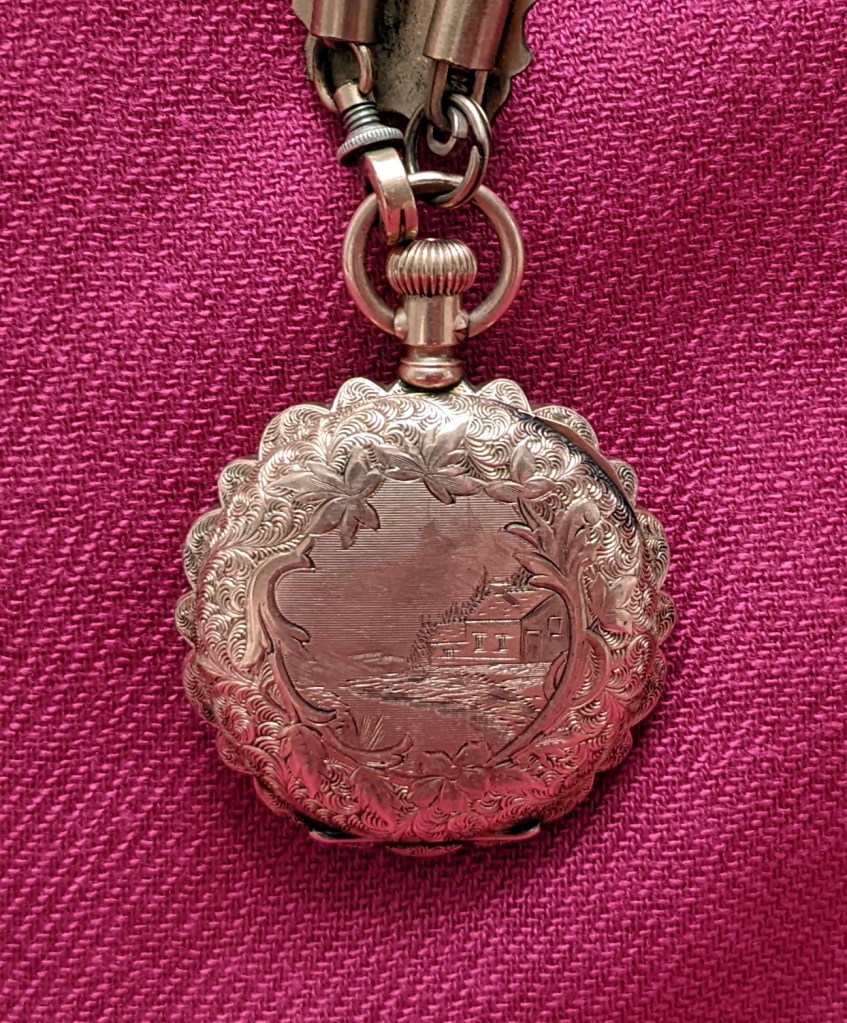
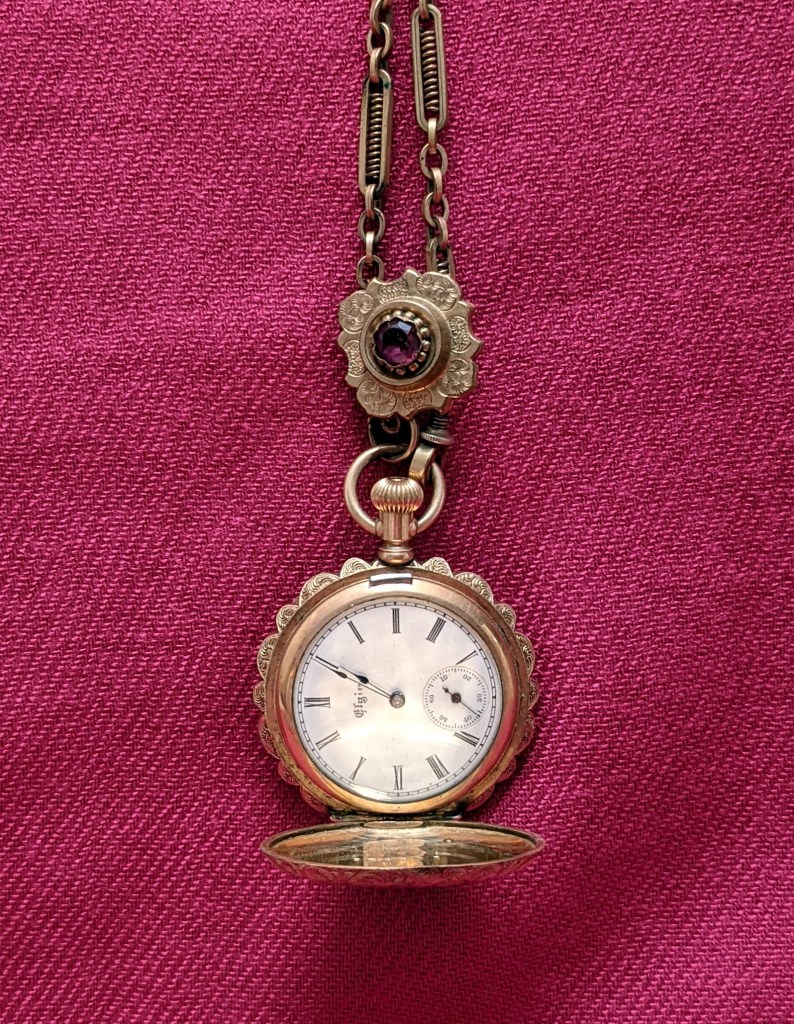
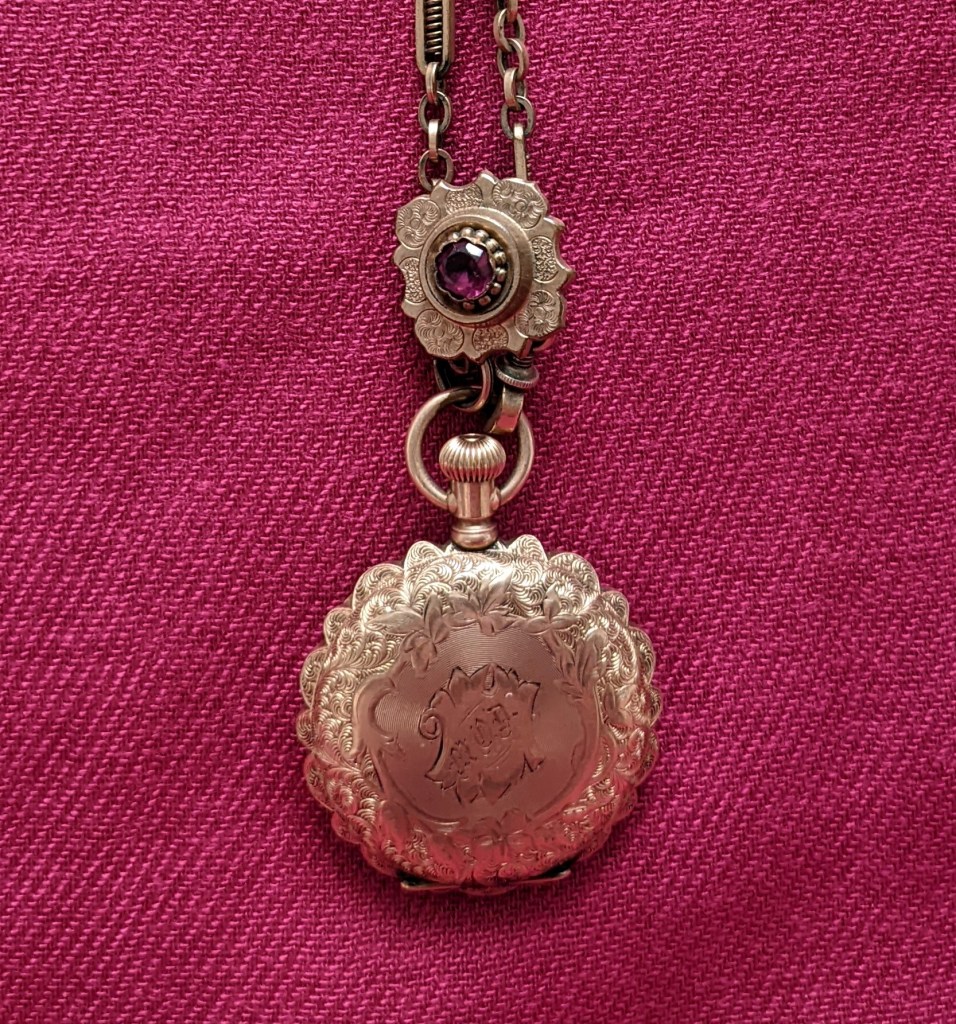
In order to attend Watertown High School, in the fall of 1939 Charles and Maggie’s granddaughter Virginia, daughter of Elizabeth and Willis, moved in with her paternal grandparents, Herbert and Lena Bevers.  They were living just a few blocks away from the Dailys.  Two years later, still living with the Bevers, Virginia became ill and developed pneumonia.  Within two weeks she succumbed to the illness, passing away on November 13.  This tragedy occurred only a few days before Charles and Maggie were to celebrate a momentous occasion in their lives, the 50th anniversary of their wedding day, November 18, 1941.  To commemorate their 50th wedding anniversary, Maggie and Charles sat for a portrait.  The pendant watch that Maggie is wearing in the photograph below is in the possession of one of Maggie’s granddaughters.
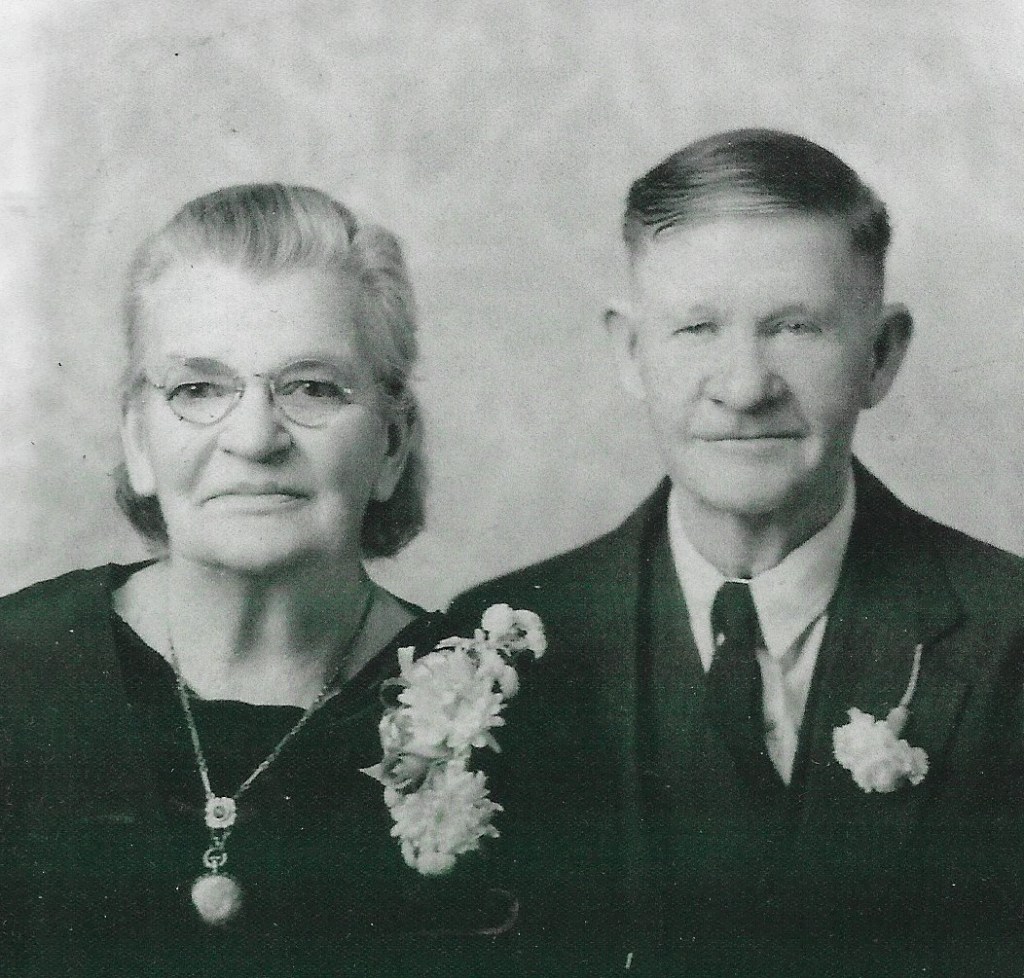
50th Wedding Anniversary Portrait (November 18, 1941)
Pendant Watch with Maggie’s Initials, M. O. D., in the center
Back of Maggie’s Pendant Watch
Open Pendant Watch

Less than three weeks later, on December 7, 1941, Pearl Harbor in Hawaii was bombed by Japanese aircraft.  The next day the United States declared war on Japan.  A week later Germany declared war on the United States.  During the next several years, six of Charles and Maggie’s grandsons would serve in the military.  Their eldest grandson Guy Mills entered the army in September 1942, listing his home address as Charles and Maggie’s home.9 He served until November 1945.  Guy’s brother, George Mills, who also gave his home address as Charles and Maggie’s home, enlisted in the Navy in July 1943.10 He trained to be an aviation radioman and gunner, and was assigned to the aircraft carrier USS Bismarck Sea in the western Pacific.11 He flew on 23 combat missions from the flight deck of the Bismarck Sea, including observation patrols over Iwo Jima on D-Day (February 19, 1945).  When the Bismarck Sea was sunk by a Japanese aerial attack in February 1945, George survived and spent leave at his home in Watertown before resuming flying duty.


Over time, the term “D-Day” has become associated with the beginning of the World War II invasion of Normandy, France by the Allied Forces, because that military event turned the war in Europe in favor of the Allies.  But during both World War I and World War II, the term “D-Day” was a military term used for a variety of operations.  The definition of “D-Day” was in question even the week following the invasion of Normandy.  A reader of Time magazine wrote, “Everybody refers to D-Day, H-Hour. Can you please tell me what they stand for or how they originated?”  The Time editor replied:

D for Day, H for Hour means the undetermined (or secret) day and hour for the start of a military operation. Their use permits the entire timetable for the operation to be scheduled in detail and its various steps prepared by subordinate commanders long before a definite day and time for the attack have been set. When the day and time are fixed, subordinates are so informed.12


The other four grandsons that served in World War II were sons of Arthur Bevers:

Lee was in the Air Force in England, flying over Germany until he was shot down and spent the last year of the war in a prison camp.  James and Dale, in the Navy, saw action under fire of the Japanese in the Pacific.  James was on a mine sweeper while Dale served on a cruiser.  Arthur, Jr. was with the Army in Hawaii until the end of the war.13

When asked about his grandparents, Lee Bevers stated that when he was in the Army Air Corp, Maggie wrote to him every week.14  Lee himself was an avid letter writer as well, as evidenced in a diary that Lee kept when he was in the military.  The first entry is dated October 29, 1943 in Grand Island, Nebraska, from which he began traveling to the base he was assigned overseas.  On his way to the base in England, there were stops in Wilmington (Delaware), Newfoundland, Ireland, Scotland and a few towns in England.  It was December 6th when he finally arrived at the base from which he would fly over northern Europe.  Lee noted in his diary when he wrote letters and when he received letters.  Sometimes the mail was delayed, and when it was finally delivered, he would get more than one letter from the same person, though the letters had been written several days apart. On November 25, 1943, Thanksgiving Day, he wrote letters to both sets of grandparents, which would be Charles and Maggie Daily and Herbert and Lena Bevers.15  His diary indicates that he wrote to “Grandma D” on December 27, 1943, January 9, 14, 28, February 5, 11, 18, 27, March 4, 16, 26 and April 7, 1944.  In the March 4th letter which he sent to Maggie, he included $40.00.  The entries in Lee’s diary abruptly end on April 12, 1944.  The following day while he was flying his 26th mission, his plane was shot down and he was taken prisoner.  For the remainder of the war, Lee was held in a prison camp near Frankfort, Germany.


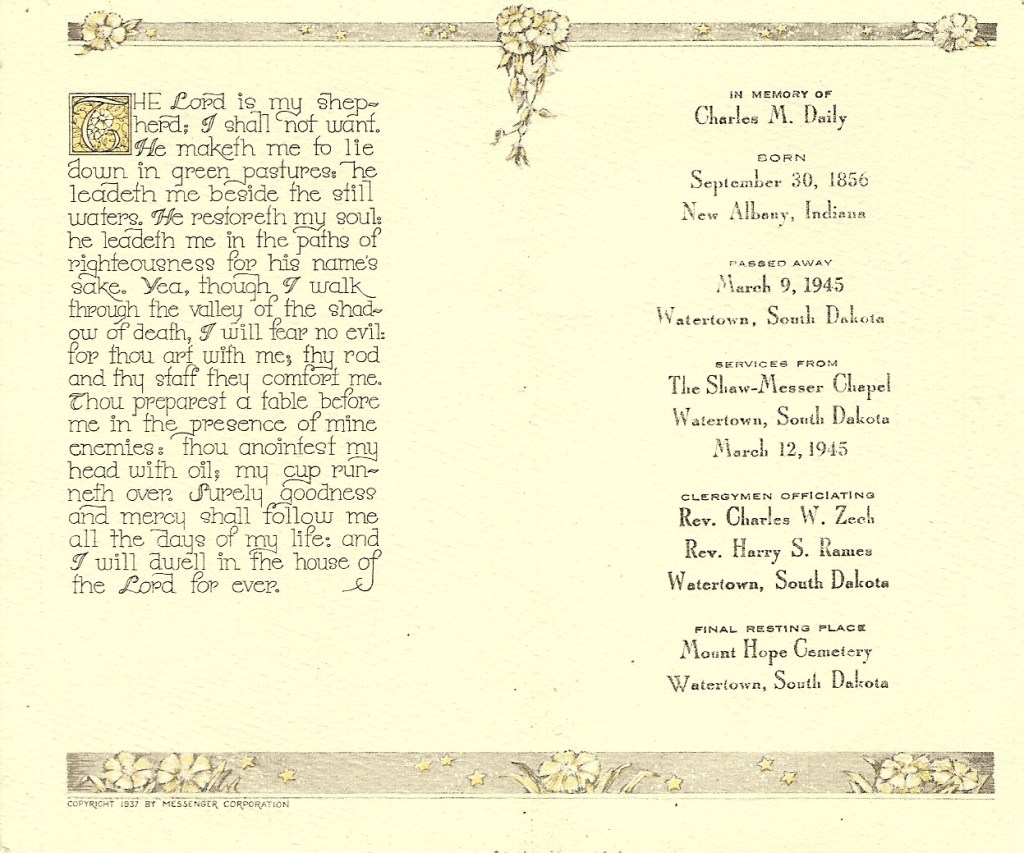
In the winter of 1945, Charles fractured his hip.  According to his granddaughter Phyllis (nee Bevers) DeBoer, he spent his last days in the living room of his home in a bed that was like a hospital bed (it was on wheels), while Maggie took care of him.16  He also developed bronchio-pneumonia which led to his death on March 9th.17  He was 88 years-old.  His funeral service was held on March 12 and he was buried in Mount Hope Cemetery in Watertown.

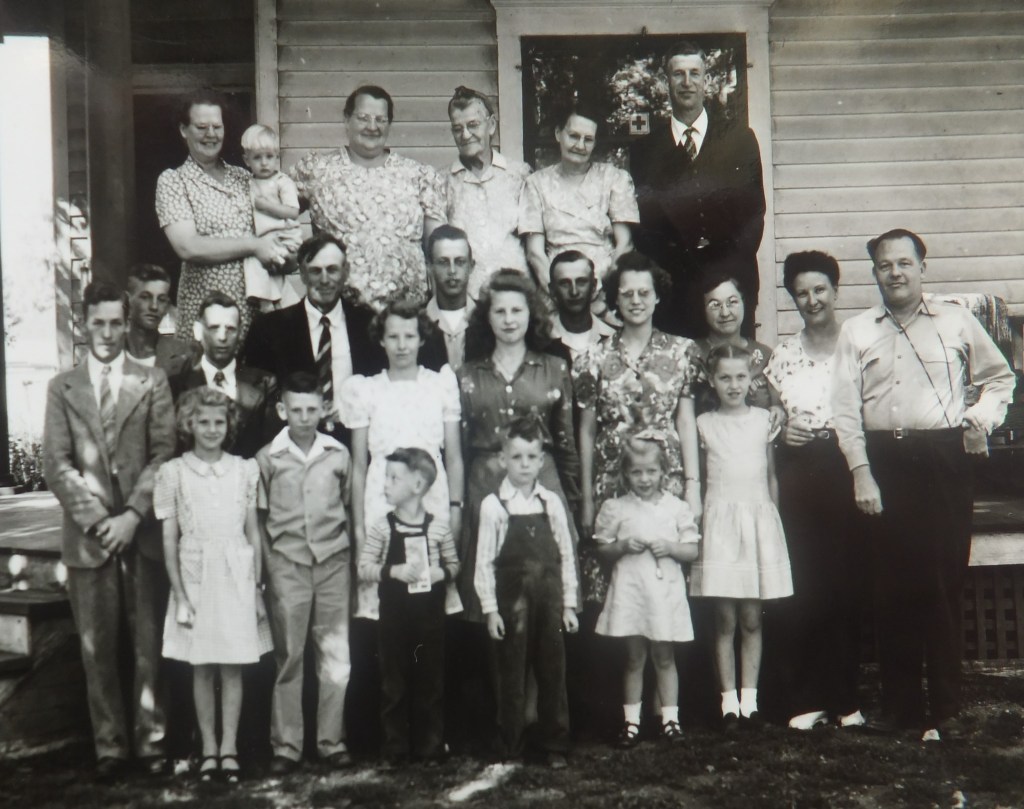
On Sundays, Elizabeth and her children would often go to dinner at her parents’ home.  One of Elizabeth’s children remembers regularly going to the Daily’s duplex after going to church.  All the children would sit on the open stairway of the front room to eat their mid-day dinner.18  During one of those Sunday visits in August 1946, Maggie enjoyed the company of her four living children and many of her grandchildren.  Everyone in attendance gathered in front of the house to take photographs.
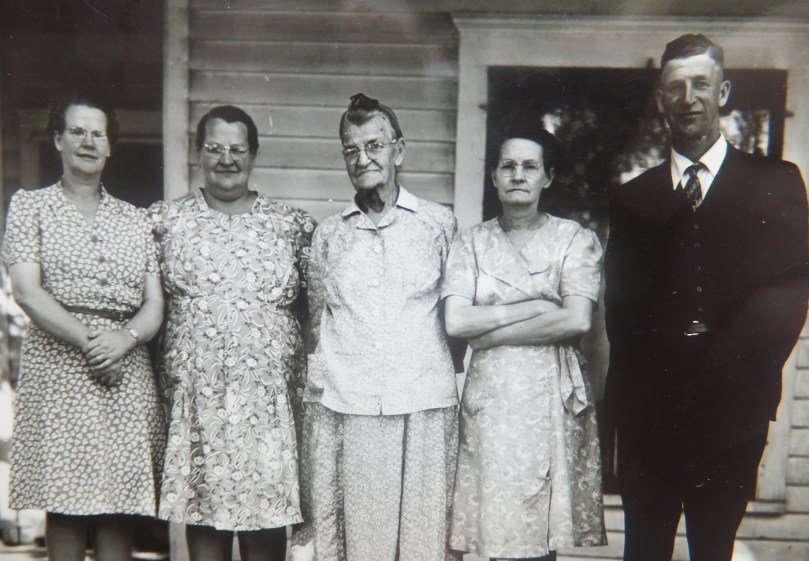
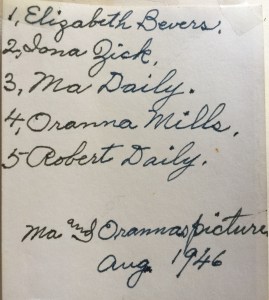
Elizabeth Bevers, Iona Zick, Maggie Daily, Oranna Mills, Robert Daily
Written on the back of the above photograph
Maggie in center of top row with many of her descendants.

Between 1940 and 1946, Iona gave birth to her last child, and Elizabeth gave birth to three more children, the last one, Maggie’s 31st grandchild, arriving in November following the family gathering in the above photograph.  In April 1942, Robert’s first granddaughter was born, giving Charles and Maggie their first great-grandchild.  Lee Bevers had married in the summer of 1943 and a son was born to them in April 1944, only eight days after Lee had become a prisoner of war.  This was Charles and Maggie’s second great-grandchild.  Their third great-grandchild arrived when Robert’s second grandchild was born in January 1945.  Then in 1946, two of Robert’s daughters each had a baby – two more great-grandchildren.

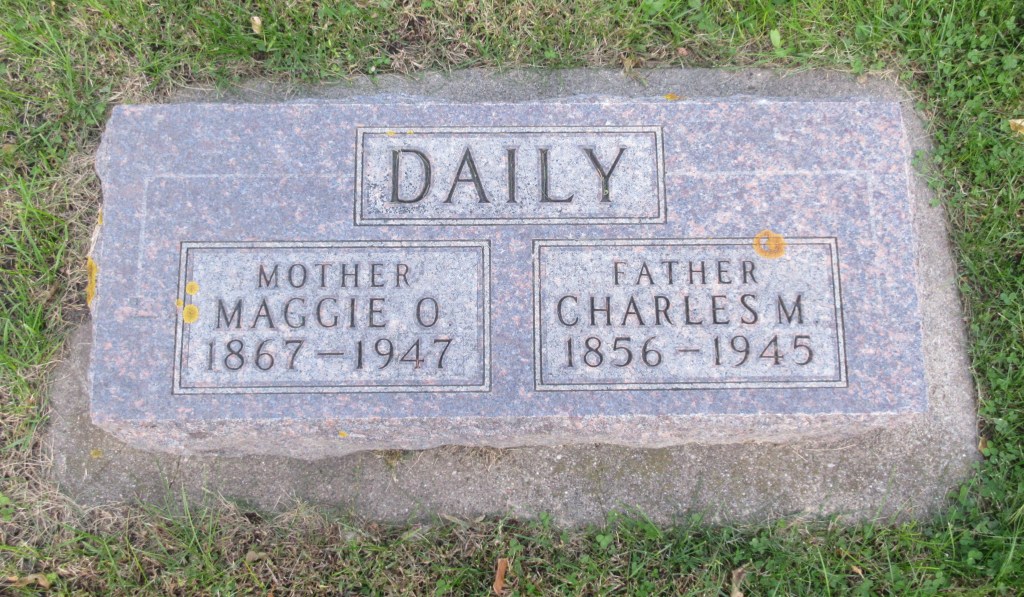
During the fall of 1946 and winter of 1947, Maggie experienced “declining health,” eventually passing away at her home on March 11, 1947.19  She was 79 years-old.  The causes of death cited on her death certificate are melano carcinoma of the skin with metastasis to liver, pernicious anemia and senility.  She was survived by her daughters Oranna, Iona and Elizabeth and her son Robert and by twenty-eight grandchildren and five great-grandchildren.  Maggie was buried beside Charles in Mount Hope Cemetery in Watertown.
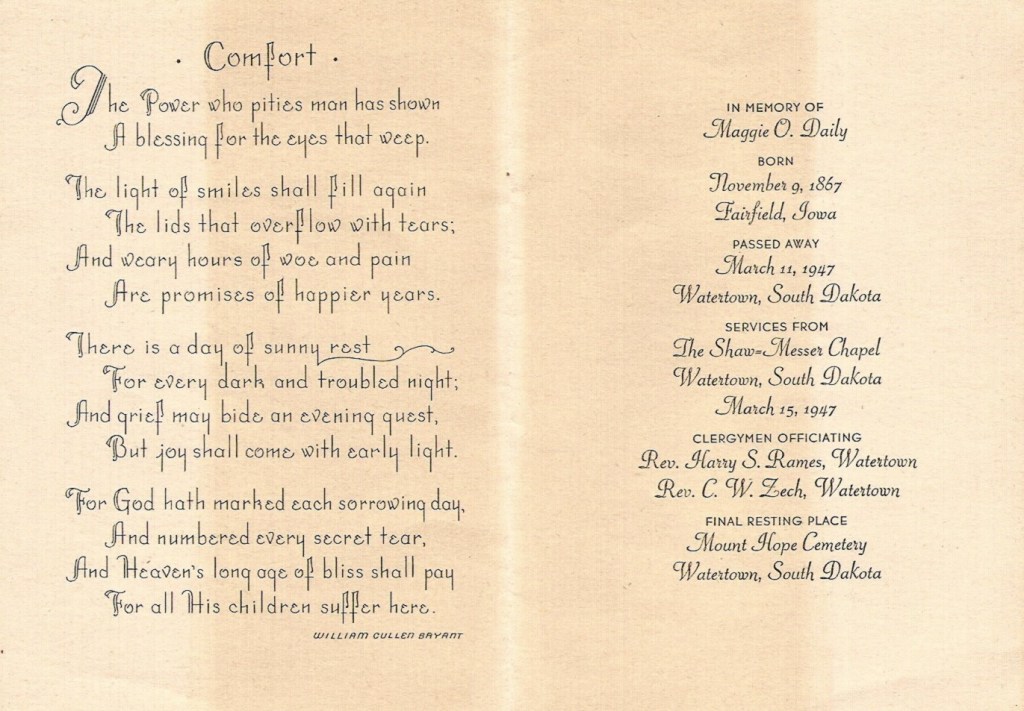
Maggie and Charles Daily are buried in Mount Hope Cemetery, Watertown, South Dakota

To conclude the series of blogposts about Charles and Maggie Daily which feature the reminiscences of their son Robert L. Daily, here is one more excerpt from the interview he gave about 1984:

Uncle Bob:  … well, Dad had made a deed out for Mother, when he bought the place.  Yeah, that’s the way he done it, handled things that way.  But he made a deed out –

Interviewer:  Um hmm.

Uncle Bob:  — for Mother to have.  So, when Mother lived alone …. Figured I’d talk to Willis and to Rob. An’ ‘course Arthur was otherwise ….

[These were Charles and Maggie’s sons-in-law who were married to Elizabeth, Iona and Gladys, respectively.]

Interviewer:  Um hm, um hm.

Uncle Bob:  … so Mother made a deed out for me.

Interviewer:  Um hm.

Uncle Bob:  An’ that helped like ev’rythin’ because when Mother passed away, instead of having a probate, or have to go through all that stuff that way, why, they had somebody to do –

Interviewer:  Yeah, then it was all taken care of.  Right.

Uncle Bob:  Yeah, … then I cleared up that debt.  An’ then I … modernized it after that.  In other words, I had to, I had the whole thing re-wired, top to bottom, because it was, when I went up in the attic an’ seen them, all bare wires up in the attic.

Interviewer:  Oh, I’m sure it was –

Uncle Bob:  Y’know in those days they didn’t, they didn’t have no plug-ins down at the bottom.

Interviewer:  No.

Uncle Bob:  Ever’thin’ come off one o’ them socket, see, an’ they put too many, too many appliances on a socket.  An’ it took the insulation off the wires up there.

Interviewer:  I remember the oil parlor furnace in the living room.

Uncle Bob:  Yeah, yeah.

Interviewer:  Yeah, that’s the only house I remember grandma being in.

Uncle Bob:  Then I had to, had to bring the water and sewer all in.

Interviewer:  Yah, we used a – there’s a cistern under there, isn’t there?

Uncle Bob:  Well, they, we had two uh, two uh, sand points.  One for each side.

Interviewer:  Okay, it was sand point, it was not cistern.

Uncle Bob:  No, no.  We had the out, the toilets outside.

Interviewer:  That’s right, that’s right. 

Uncle Bob:  Yeah, the toilets outside.  Sometime I brought that all in.  An’ I paid twenty-five hundred dollars for, for bringin’ the water in, the water – to modernize it, that way.

Interviewer:  Um hm, um hm.

Uncle Bob:  An’ paid Roger sixteen hundred dollars for, uh, to re-wire the whole thing.

Interviewer:  Oh, I’m sure that it cost quite a bit.20


  1. L. A. Bevers, interview with M. R. Wilson, August 2, 2010.
  2. “United States Census, 1940,” database with images, FamilySearch (https://familysearch.org/ark:/61903/3:1:3QSQ-G9M1-5855?cc=2000219&wc=QZFM-WRZ%3A791611401%2C793270701%2C793367301%2C793379401 : accessed 22 November 2021), South Dakota > Codington > Watertown City, Watertown, Ward 3 > 15-24B Watertown City Ward 3 bounded by (N) 4th Av S; (E) Maple, ward line; (S) city limits; (W) city limits, ward line > image 3 of 24; citing Sixteenth Census of the United States, 1940, NARA digital publication T627. Records of the Bureau of the Census, 1790 – 2007, RG 29. Washington, D.C.: National Archives and Records Administration, 2012.
  3. M. R. Wilson, transcription of Robert Lee Daily Interview by R. Thiele, recording (ca. 1984): 28.
  4. “United States Census, 1940,” database with images, FamilySearch (https://familysearch.org/ark:/61903/3:1:3QS7-L9M1-5833?cc=2000219&wc=QZFM-3CZ%3A791611401%2C795183601%2C790385801%2C795237102 : accessed 12 March 2022), South Dakota > Hamlin > Oxford Township > 29-19 Oxford Township (Township 115 Range 53 and Township 115 Range 54 (part)) > image 11 of 14; citing Sixteenth Census of the United States, 1940, NARA digital publication T627. Records of the Bureau of the Census, 1790 – 2007, RG 29. Washington, D.C.: National Archives and Records Administration, 2012.
  5. “United States Census, 1940,” database with images, FamilySearch (https://familysearch.org/ark:/61903/3:1:3QSQ-G9M1-588Q?cc=2000219&wc=QZFM-3RR%3A791611401%2C793270701%2C790542101%2C951343301 : accessed 16 December 2021), South Dakota > Codington > Lake Township > 15-12 Lake Township (Townships 117 and 118 Range 52 inside Old Sisseton and Wahpeton Indian Reservation and Township 117 Range 53 (part)) outside Watertown City > image 6 of 11; citing Sixteenth Census of the United States, 1940, NARA digital publication T627. Records of the Bureau of the Census, 1790 – 2007, RG 29. Washington, D.C.: National Archives and Records Administration, 2012.
  6. “United States Census, 1940,” database with images, FamilySearch (https://familysearch.org/ark:/61903/3:1:3QS7-89M1-588J?cc=2000219&wc=QZFM-3DS%3A791611401%2C793270701%2C793332701%2C951346101 : accessed 16 December 2021), South Dakota > Codington > Rauville Township > 15-16 Rauville Township (Township 118 Ranges 52 and 53 outside Old Sisseton and Wahpeton Indian Reservation Line and Townships 118 and 119 Range 52 (part) inside Old Sisseton and Wahpeton Indian Reservation Line) > image 8 of 11; citing Sixteenth Census of the United States, 1940, NARA digital publication T627. Records of the Bureau of the Census, 1790 – 2007, RG 29. Washington, D.C.: National Archives and Records Administration, 2012.
  7. “United States Census, 1940,” database with images, FamilySearch (https://familysearch.org/ark:/61903/3:1:3QS7-89M1-5864?cc=2000219&wc=QZFM-36G%3A791611401%2C793270701%2C793326301%2C793326302 : accessed 16 December 2021), South Dakota > Codington > Pelican Township > 15-14 Pelican Township (Township 116 Range 53 (part)) outside Watertown City > image 4 of 9; citing Sixteenth Census of the United States, 1940, NARA digital publication T627. Records of the Bureau of the Census, 1790 – 2007, RG 29. Washington, D.C.: National Archives and Records Administration, 2012.
  8. “United States Census, 1940,” database with images, FamilySearch (https://familysearch.org/ark:/61903/3:1:3QSQ-G9M1-588N?cc=2000219&wc=QZFM-QC9%3A791611401%2C793270701%2C793309301%2C793309302 : accessed 16 December 2021), South Dakota > Codington > Kampeska Township > 15-10 Kampeska Township (Township 116 Range 54) > image 4 of 13; citing Sixteenth Census of the United States, 1940, NARA digital publication T627. Records of the Bureau of the Census, 1790 – 2007, RG 29. Washington, D.C.: National Archives and Records Administration, 2012.
  9. “U. S., World War II Draft Cards Young Men, 1940-1947” (Ancestry.com Operations, Inc., Lehi, Utah, USA, 2011).
  10. “U. S., World War II Draft Cards Young Men, 1940-1947” (Ancestry.com Operations, Inc., Lehi, Utah, USA, 2011).
  11. __________, “Survives” (news article), source unknown.
  12. K. Moon, “What Does the ‘D’ in ‘D-Day’ Stand For? Experts Disagree With Eisenhower’s Answer,” Time (June 4, 2019): https://time.com/5599811/d-day-meaning/.
  13. Hamlin Historical Committee, “Bevers Family,” Hamlin County 1878-1979: 141.
  14. Bevers, interview with M. R. Wilson.
  15. L. A. Bevers, personal diary, October 29, 1943 – April 13, 1944.
  16. P. I. DeBoer, interview with M. R. Wilson, August 3, 2010.
  17. M. A. Bevers, notes about the death certificate of Charles M. Daily, accessed from “Bevers-Daily-McFerran-Nelson Families” on Ancestry.com.
  18. E. J. Jones, interview with M. R. Wilson, ca. July 2010.
  19. “Maggie Daily Dies At Home Here, Illness,” (published obituary, publication unknown).
  20. Wilson, Robert Lee Daily Interview: 29-30.
Reminiscences of Uncle Bob, Part Six

At about the age of 75, Charles M. Daily retired from farming, and with his wife Maggie, they moved into a house in east Watertown. Their son Robert Daily said in an interview, “… it was downtown.  It was about somewhere around six, seven, eight hundred block.”1 Later they rented a house in southwest Watertown at 620 2nd Street SW.  One of the things that Charles did following his retirement was to make a trip to Omaha to sell the two houses that they owned there.2

Charles and Maggie’s family continued to grow as their daughters Gladys Bevers, Iona Zick and Elizabeth Bevers and their daughter-in-law Ruby Daily gave them more grandchildren.  As of August 1934, they had 22 living grandchildren.  Tragically, the birth of Gladys’ eighth child left her weak and unable to recover.  In an interview about fifty years later, her brother Robert recounted some details of Gladys’ illness and subsequent death.

Interviewer:  Um, Aunt Gladys, um, she died in October of ‘34? [1934]

Uncle Bob:   Yeah, it’s in ’34, all right, I know.  I don’t know what the date is on there.  [He was referring to a paper they were looking at.]

Interviewer:  On this here.

Uncle Bob:  She, she was born in ’92.  She was, uh, eight and 34 made it 42, didn’t it?  Yeah. She was 42 years-old when she passed away.

Interviewer:  Um hmm.  But it was, it was more or less complications after [the baby] was born?  She never really regained her strength after [the baby] was born.

Uncle Bob:  Yeah, she, she was, when –

Interviewer:  [The baby] was born in August.

Uncle Bob:  When [the baby’s older sibling] was born in 19–, August 7.

Interviewer:  In ’29.

Uncle Bob:  Yeah, why, Dr. Hammond told them they shouldn’t have any more children because it would be either the mother or the child, see.

Interviewer:  I see, uh huh.

Uncle Bob:  And five years to the day was when [the baby] was born.  It was enlargement of the liver.  The liver had enlarged so much she couldn’t get her breath, see. 

Interviewer:  Ohhh.

Uncle Bob:  That’s the reason –

Interviewer:  So, it was what they call liver disease now?  Or?

Uncle Bob:  Well, I don’t know.  But I would have thought that — what could ha’ been the cause of it?  But Doc Hammond knew too well.  He said –

Interviewer:  Hm.

Uncle Bob:  See, she got through with, uh, [the baby’s older sibling] –

Interviewer:  Um hmm.

Uncle Bob:  — he said they shouldn’t have any more family anymore because it’d be either the mother or the child.

Interviewer:  Well, she did – [the baby] was born, it was two months later but –  

Uncle Bob:  Well, yeah.

Interviewer:  — she was jus’ too weak then.

Uncle Bob:  Yeah, she never – I know she told mother, Gladys told mother that she – I guess she kinda realized in that way.  An’ she said, “If it happens to me, I want you to take care of [the baby].”  That’s the reason [the baby], Mother took care of, from that time on until, until Elsie and Arthur took her.

Interviewer:  Um huh.

Uncle Bob:  Took her from there.   Mother … at her age, at that time ….  Oh, at that time she was in her –.  Well, ah, see, thirty, uh – 

Interviewer:  33 and 34, she was already 60.  Close to 70.

Uncle Bob:  Yeah, she didn’t want the job of raising her up and keeping her.  She, she didn’t feel able to do that.3

Maggie was nearly 67 years-old when Gladys passed away and she began caring for her infant granddaughter.  Her son-in-law Arthur Bevers, having seven children ranging in age from 14 to 4 (excluding the infant), secured the help of an 18 year-old young lady named Elsie Ludtke.  The Ludtke family had been living in Rauville Township when the Daily family moved to Rauville in 19154 and the Ludtkes lived there until after 1920,5 so it is possible that the two families knew each other.  By 1925, the Ludtkes had moved to Kampeska Township, Codington County,6 and by 1930 Arthur and his family were also living in Kampeska Township.7 Kampeska Township is approximately 13 miles southwest of Watertown.

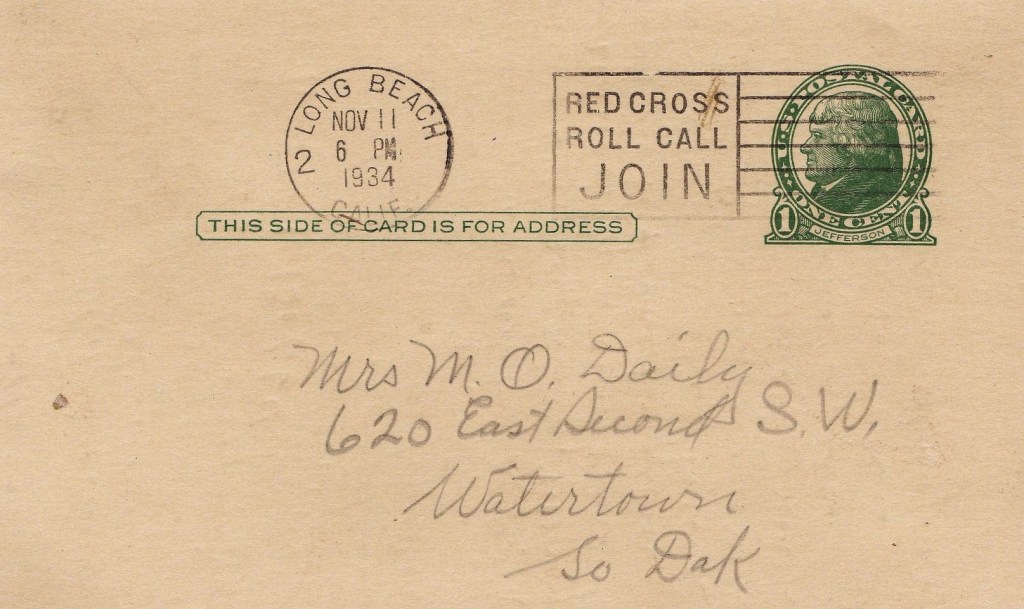
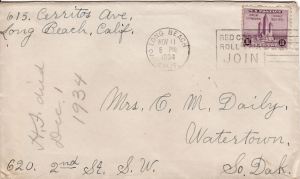
Undoubtedly, the news of Maggie taking on the care of her granddaughter reached her relations who were in California.  One of Maggie’s grandsons has stated that Maggie was an avid letter writer and that she wrote to her three siblings once a week, and occasionally, Maggie would receive a box from California that held trinkets.8 In November 1934, Maggie received a postcard and a letter from her brothers Sidney and Harman Finley Bonewitz, interestingly, both postmarked on the 11th of the month in Long Beach, California.  In Finley’s letter, he expressed his hopes that the baby was “getting along fine.”

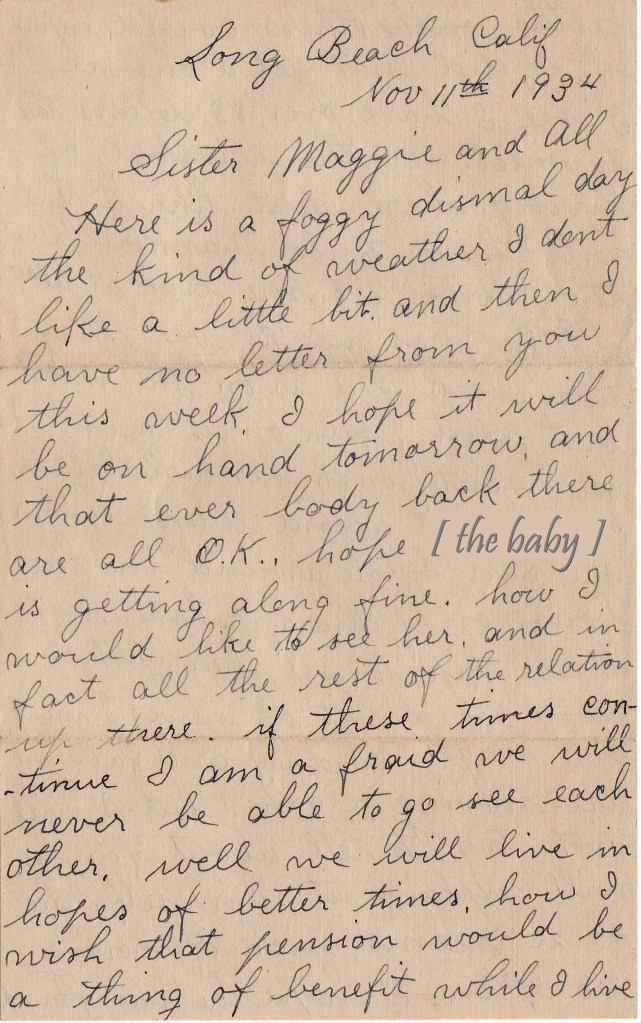
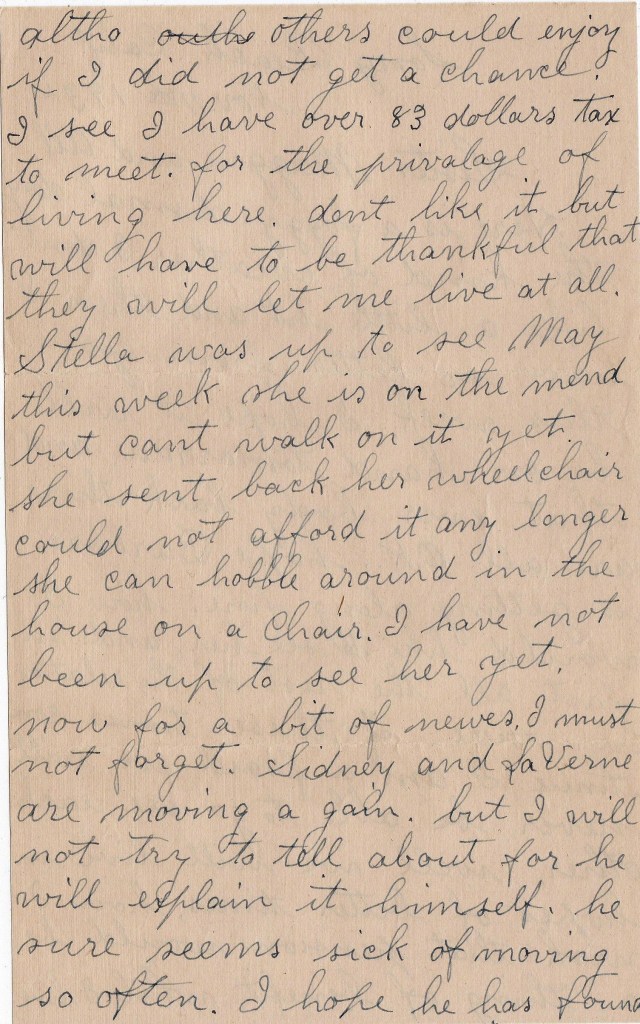
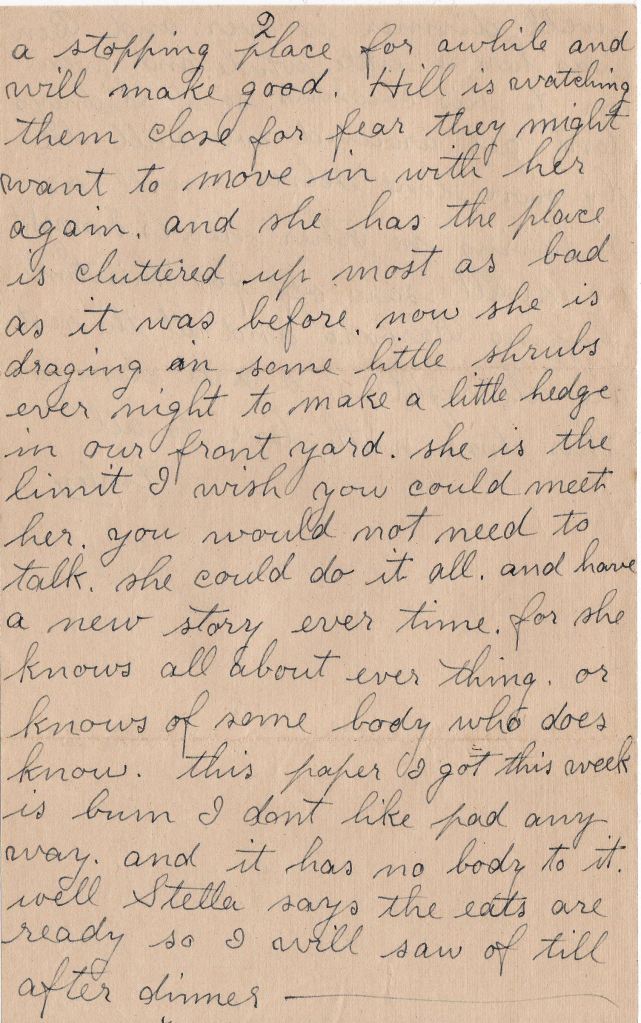
Finley had left Omaha following the death of his wife Cornelia who died in 1920, and when he married again in 1922, he was in California.  In Finley’s letter, which was posted with a three-cent stamp, he notes that he was awaiting a letter from Maggie that week and he mentions the difficult times they were in, as well as news about himself and others in California:

Sister Maggie and All

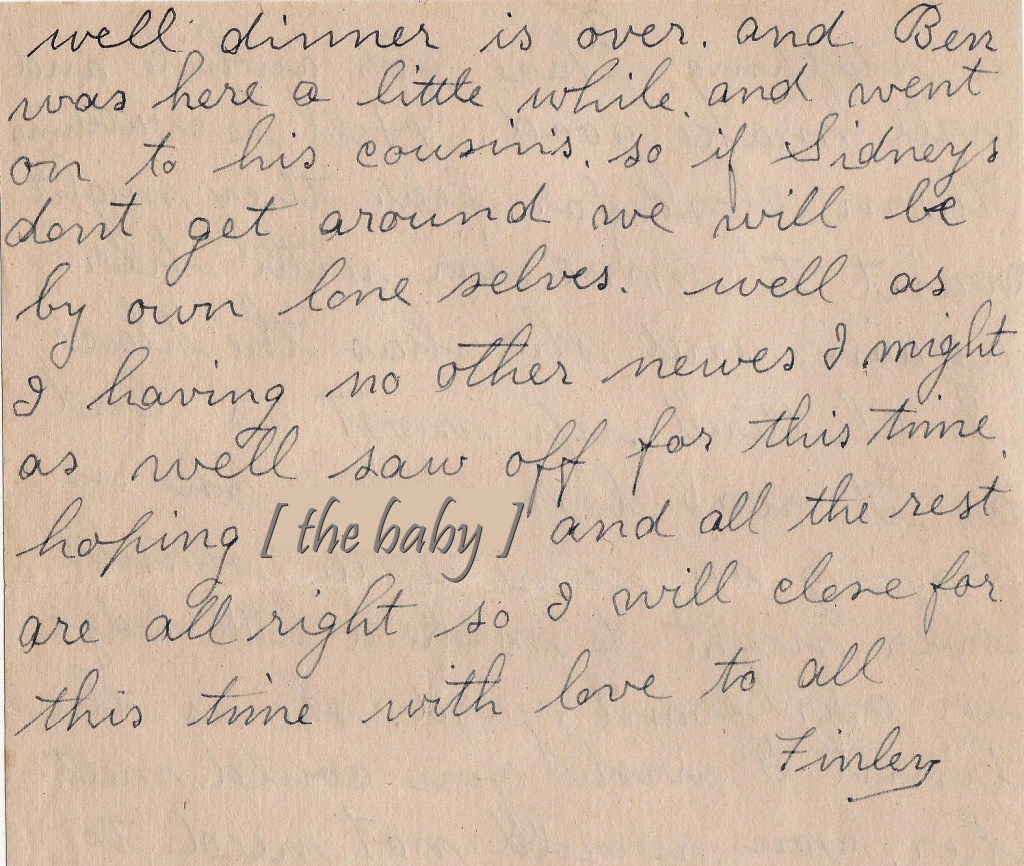
Here is a foggy dismal day  the kind of weather I don’t like a little bit.  and then I have no letter from you this week.  I hope it will be on hand tomorrow, and that ever body back there are all O.K., hope [the baby] is getting along fine.  how I would like to see her, and in fact all the rest of the relation up there.  if these times continue I am a fraid we will never be able to go see each other.  well we will live in hopes of better times.  how I wish that pension would be a thing of benefit while I live altho others could enjoy if I did not get a chance.  I see I have over 83 dollars tax to meet.  for the privalage of living here.  don’t like it but will have to be thankful that they will let me live at all.  Stella was up to see May this week  she is on the mend but cant walk on it yet.  she sent back her wheelchair  could not afford it any longer  she can hobble around in the house on a chair.  I have not been up to see her yet.  now for a bit of newes, I must not forget.  Sidney and LaVerne are moving a gain.  but I will not try to tell about for he will explain it himself.  he sure seems sick of moving so often.  I hope he has found a stopping place for awhile and will make good.  Hill is watching them close for fear they might want to move in with her again.  and she has the place is cluttered up most as bad as it was before.  now she is draging in some little shrubs ever night to make a little hedge in our front yard.  she is the limit  I wish you could meet her.  you would not need to talk.  she could do it all.  and have a new story ever time.  for she knows all about ever thing.  or knows of some body who does know.  this paper I got this week is bum  I don’t like pad any way.  and it has no body to it.  well Stella says the eats are ready so I will saw of till after dinner –

well dinner is over.  and Ben was here a little while and went on to his cousin’s, so if Sidneys dont get around we will be by own lone selves.  well as I having no other newes I might as well saw off for this time.  hoping [the baby] and all the rest are all right so I will close for this time with love to all

Finley


Envelope dated November 11, 1934, sent from Harman Finley Bonewitz

Finley shared that Stella had gone to visit May.  Stella would be his wife and May could be his sister Carrie Mae Belle White.  Carrie and her husband Charles White and their possibly widowed daughter Mabel Day were living in Tujunga, a town 40 miles north of Long Beach.

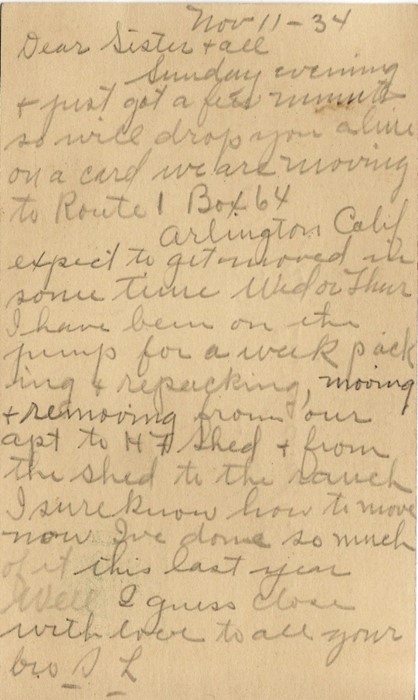
Sidney had probably moved to California about 1927.  According to the message on his one-cent postcard, he and his wife La Verne were going to be moving to a ranch in a rural area 55 miles west of Long Beach.  In addition, the message briefly told about the moves that he had made during that week and he gave Maggie his new address:

Dear Sister & all

Sunday evening & just got a few minutes so will drop you a line on a card  we are moving to Route 1 Box 64  Arlington Calif

expect to get moved in some time Wed or Thur  I have been on the jump for a week packing & repacking, moving & removing from our apt to HF shed & from the shed to the ranch  I sure know how to move now  Ive done so much of it this last year

Well I guess close with love to all your bro S L


The year 1934 was in the midst of the Great Depression.  In his letter, Finley alluded to the difficult times the nation was experiencing.  When Finley expressed, “How I wish that pension would be a thing of benefit while I live,” he may have been referring to one of several insurance programs that were being proposed by various individuals and organizations (including the United States President).  A survey of 12,076 newspaper and farm journal editors, revealed that 64% of the editors believed “… that public opinion favors a compulsory governmental system of old age pensions ….”9

Mrs. [Eleanor] Roosevelt devoted one of her widely-syndicated columns to a discussion of old age pensions. “Old age pensions,” she wrote, “have been brought very much to the fore again in the Congressional campaigns on the coast this year, and there is no doubt that some type of this form of relief will be a part of the social program proposed to the next Congress ….

There is no question in my mind but that old people who have given of their strength and youth to the bringing up of a family and have been unable to save should not in their old age have to live off their children’s bounty or on charity. Older civilizations have long conceded this right and I feel that taking this group out of industry a little earlier would be a great help to another group which is now very much menaced–these men and women between 45 and 60 who are finding it harder and harder to get jobs. Every citizen, it seems to me, should study this question and give his support to discussions of it in Congress in the hope that some really workable plan may be found and established in every state in the Union.”10

On June 8, 1934, President Franklin D. Roosevelt, in a message to the Congress, announced his intention to provide a program for Social Security.  Subsequently, the President created by Executive Order the Committee on Economic Security, which was composed of five top cabinet-level officials. The committee was instructed to study the entire problem of economic insecurity and to make recommendations that would serve as the basis for legislative consideration by the Congress.11

This Committee was established … to develop a comprehensive social insurance system covering all major personal economic hazards with a special emphasis on unemployment and old age insurance.  The Committee’s legislative recommendations were presented to the President in January 1935, and introduced to Congress for consideration shortly thereafter.  A compromise Social Security Bill was signed by the President on August 14, 1935.12


Finley made a comment to Maggie in his letter that “the times” could prevent them from seeing each other again.  His letter gave no outright indication of him being in poor health, although perhaps that could be inferred from his statement that he might not experience the benefit of the pension.  In actuality, Finley did not see his relations in South Dakota again.  Three weeks after writing the November 11th letter, at 75 years of age, Finley passed away on December 1, 1934.

When the South Dakota census was taken in the spring of 1935, Elsie Ludtke was recorded with Arthur Bevers’ family and her occupation was listed as housekeeper.13 Two census records were completed for Arthur’s 9 month-old infant in Codington County: one at the home of her father in Kampeska Township14 and the other at 620 2nd Street SW, Watertown which was Charles and Maggie’s home.15 In addition to the infant, Charles and Maggie’s daughter Oranna Mills and her three children, aged 9, 12 & 17, were also living with them.16 Later that year, a year after losing his wife, Arthur married Elsie.  In his interview, Uncle Bob reported that the infant then went to live with Arthur and Elsie.17

In the summer of 1935, the Daily family experienced a sudden loss.  Uncle Bob related that Charles and Maggie’s 12-year-old granddaughter Florence, who was living with them, “went out to Van’s” (most likely Florence’s uncle Van Mills’ farm in Germantown, Codington County)18 and “she had a severe headache.  … When she come in, she, they tried aspirin and things like that, in order to try to relieve her that way.”19 Sadly, by the end of the day, July 15, Florence had departed this life.  Uncle Bob stated that the illness was caused in some way by her brain.  He and his interviewer speculated that it could have been caused by sun stroke, cerebral hemorrhage or a tumor.


Charles and Maggie made a third move in Watertown in 1935.  They purchased a duplex at 219 5th Avenue SW.  Uncle Bob explained the purchase and also how they supported themselves during their retirement years:

Uncle Bob:  ‘Course, they got a chance to buy the duplex in ‘35.

Interviewer:  Yeah, that’s the only place I remember.

Uncle Bob:  An‘ o’course they lived there til ’47.  That’s twelve years.

Interviewer:  Um hm, um hm.  Yeah, right.

Uncle Bob:  Yep, then o’course, oh, I took it over.  Why, course Dad’d bought it for a thousand fifty dollars, the duplex in ‘35.

Interviewer:  In ’35, i’n’t that somethin’.

Uncle Bob:  Yeah.  Herman Michael wanted to sell it.  An’ he was land poor, property poor, see.  An’ he wanted to sell it.  ‘Course, taxes wasn’t bad.  But rent at that time was only $10 a month, see.

Interviewer:  It sounds unreal, isn’t it?  What –

Uncle Bob:  And they bought the duplex and that way they got $10 from the other side.

Interviewer:  Umm hmm.

Uncle Bob:  And o‘course, folks had, had old-age, got old-age assistance that way. 

Interviewer:  Uh-huh.

Uncle Bob:  An’ I, it always hurt me to think, how they, they had to know ever-, ev’rythin’, all expenditures.  Uh, an’ account for ‘em.  Dad shingled the duplex.  Aw, painted it and he had to do that on his, either on his own money or off that $10 that he got from the other side.  (chuckling)  An’ yet, when they passed on, it was against the property, see.  All the –

Interviewer:  Was it?  Ohhh.

Uncle Bob:  All the, their old-age assistance was, was all against the property, see.

Interviewer:  Hmmm.

Uncle Bob:  If, if you didn’t own anything, the old-age assistance paid your rent.

Interviewer:  But they owned –

Uncle Bob:  But now why, cuz they had a home –

Interviewer:  Huh.

Uncle Bob:  — why, why did they have to be so tight.  And it, whatever they got, all the money they got they – see, when Dad – they were getting old-age assistance, an’ Dad went down, that was in ’35 or ’34, Dad went back down to Omaha an’ sold his property.  Well, then he paid back the old-age assistance.

Interviewer:  Um hmm.

Uncle Bob:  An’ what he had got up to that time.

Interviewer:  Um hm.

Uncle Bob:  An’ they told ‘im that he could keep, uh, when they got – they were allowed to keep $250 a piece for burial expenses, see.  When they got down to close to that, then they could re–

Interviewer:  Re-apply.

Uncle Bob:  — re-apply, see.  Well then, o’course from that time on they had got, but they had to ‘count for everythin’.  The other side had to be accounted for, see.

Interviewer:  Ohhh, yeah.

Uncle Bob:  Well, they got over sixteen hundred dollars, see.  Course that was against the property.  I had to pay that off.20

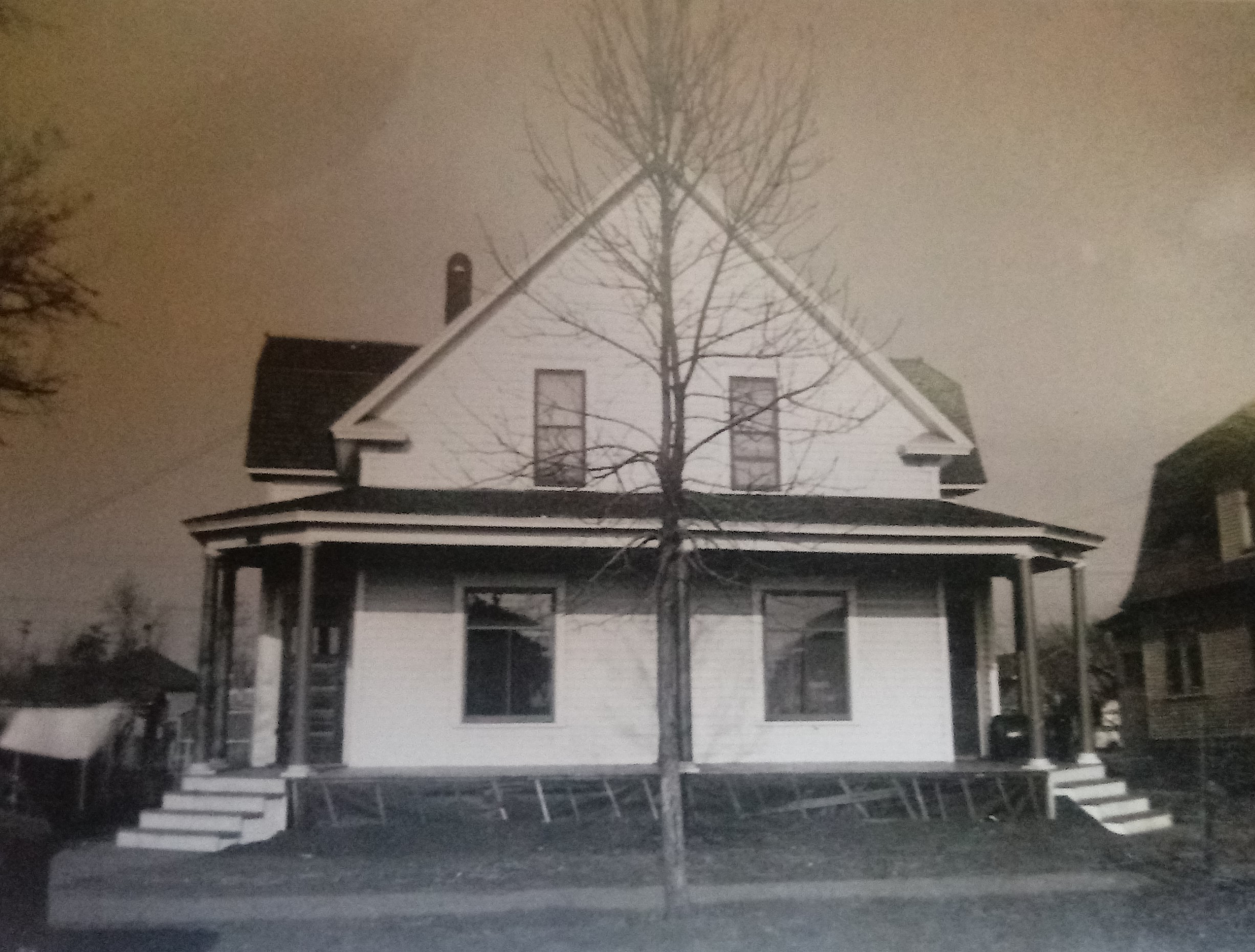
Charles and Maggie lived in the left side of this duplex and rented out the right side.

One of Charles and Maggie’s grandchildren described their house as follows:

The duplex had three rooms downstairs and two bedrooms and hallway upstairs with an open stairway.  Grandma and Grandpa’s bedroom was the front room.  The middle room was the dining room with a large table, cupboard and the oil stove.  In one corner was Grandpa’s wicker rocker where he always sat with the paper or leaned close to the small radio to hear the progress of the war.  When we had Sunday dinner there with some of the cousins, we (the cousins) filled our plates and sat on the stairs to eat.

The back room was the kitchen with stove (and kerosine stove for summer cooking), cupboard, washing machine and large single sink.  A cistern pump was over the sink for getting water for washing dishes and clothes.  There was also a small pantry and the back porch.  The basement stairway led off of the kitchen under the stairs to the upstairs.  I was never down the basement more than once or twice.  I recall it was dark and damp down there.  I was told there was a sand point well there but can’t tell more than that.

The east half of the duplex was identical but in reverse.  And oh yes, the bathroom was out the back door and down the walk to the two identical small buildings at the alley called the “outhouses.”

Grandpa always had a large beautiful garden that filled all of their half of the back yard.  The fresh peas were always so tempting but we better not let Grandpa see us pick any and pop them into our mouths. My Aunt Oranna and children, Guy and George, also lived with Grandma and Grandpa. … Aunt Oranna was epileptic and unable to live alone so spent some time living with each of her sisters and then with Grandma and Grandpa.21

Charles and Maggie lived out their final years in this duplex in Watertown. Some of the events of those years will be shared in the next blogpost.


  1. M. R. Wilson, transcription of Robert Lee Daily Interview by R. Thiele, recording (ca. 1984): 27.
  2. L. A. Bevers, personal correspondence with M. R. Wilson, November 24, 2010.
  3. Wilson, Robert Lee Daily Interview: 22-23.
  4. “South Dakota State Census, 1915,” database with images, FamilySearch (https://familysearch.org/ark:/61903/3:1:S3HT-6LCJ-1L?cc=1476041&wc=MJQK-N38%3A1041734401 : 21 May 2014), 004245360 > image 3042 of 3102; State Historical Society, Pierre, South Dakota.
  5. “United States Census, 1920,” database with images, FamilySearch (https://familysearch.org/ark:/61903/3:1:33SQ-GRVM-DZJ?cc=1488411&wc=QZJB-434%3A1036874501%2C1039011801%2C1039036701%2C1589332505 : 13 September 2019), South Dakota > Codington > Rauville > ED 94 > image 4 of 7; citing NARA microfilm publication T625 (Washington, D.C.: National Archives and Records Administration, n.d.).
  6. South Dakota State Census, 1925,” database with images, FamilySearch (https://familysearch.org/ark:/61903/3:1:S3HY-DZ2S-88Z?cc=1476077&wc=MJ7S-T38%3A1041768301 : 21 May 2014), 004246371 > image 1862 of 3407; State Historical Society, Pierre, South Dakota.
  7. “United States Census, 1930,” database with images, FamilySearch (https://familysearch.org/ark:/61903/3:1:33SQ-GRCF-HB3?cc=1810731&wc=QZF7-6VX%3A648803701%2C649380801%2C649388101%2C1589282323 : 8 December 2015), South Dakota > Codington > Kampeska > ED 10 > image 1 of 8; citing NARA microfilm publication T626 (Washington D.C.: National Archives and Records Administration, 2002).
  8. L. A. Bevers, interview with M. R. Wilson, August 2, 2010.
  9. M. B. Schnapper, “Trend of Interest in Economic Security,” https://www.ssa.gov/history/reports/ces/cesvol9trend.html.
  10. Schnapper, “Economic Security,” https://www.ssa.gov/history/reports/ces/cesvol9trend.html.
  11. Social Security Administration, Historical Background and Development of Social Security, “The Committee on Economic Security (CES),” https://www.ssa.gov/history/briefhistory3.html.
  12. Congressional Panel on Social Security Organization, Organizational History of SSA, “Committee on Economic Security (1934),” https://www.ssa.gov/history/orghist.html.
  13. “South Dakota State Census, 1935,” database with images, FamilySearch (https://familysearch.org/ark:/61903/3:1:S3G9-DVBD-6?cc=1614831&wc=MJ4G-PTL%3A1041689201 : 21 May 2014), 004447442 > image 481 of 3547; State Historical Society, Pierre, South Dakota.
  14. “South Dakota State Census, 1935,” database with images, FamilySearch (https://familysearch.org/ark:/61903/3:1:S3G3-DKPS-FM?cc=1614831&wc=MJ4R-N38%3A1041633301 : 21 May 2014), 004443899 > image 2284 of 3338; State Historical Society, Pierre, South Dakota.
  15. “South Dakota State Census, 1935,” database with images, FamilySearch (https://familysearch.org/ark:/61903/3:1:S3G3-DKPS-F9?cc=1614831&wc=MJ4R-N38%3A1041633301 : 21 May 2014), 004443899 > image 2285 of 3338; State Historical Society, Pierre, South Dakota.
  16. “South Dakota State Census, 1935,” database with images, FamilySearch (https://familysearch.org/ark:/61903/3:1:S3HT-DW5Q-MN3?cc=1614831&wc=MJ4L-DP8%3A1041680801 : 21 May 2014), 004447088 > image 653 of 3506; State Historical Society, Pierre, South Dakota.
  17. Wilson, Robert Lee Daily Interview: 22.
  18. “South Dakota State Census, 1935,” database with images, FamilySearch (https://familysearch.org/ark:/61903/3:1:S3HT-DW53-YLN?cc=1614831&wc=MJ4L-DP8%3A1041680801 : 21 May 2014), 004447088 > image 693 of 3506; State Historical Society, Pierre, South Dakota.
  19. Wilson, Robert Lee Daily Interview: 10.
  20. Wilson, Robert Lee Daily Interview: 29.
  21. ___ Zick, “Daily,” (n. d.).

Reminiscences of Uncle Bob, Part Five

On the 10th of April, 1915, Charles and Maggie Daily left Omaha and headed with their family to South Dakota because Maggie “wanted to get back to the farm” (according to their son Robert1), and possibly wanting to get away from the tornadoes (according to one of their grandsons2). They moved to a farm in Rauville Township in Codington County.3  Rauville was “a station on the [Great Northern Railway], 6 miles N of Watertown,” and primarily the site of two grain companies.4 

The Daily family had been in South Dakota for two months when the state census was taken.  At that time, Charles was 58 years-old, Maggie was 47, Gladys was 22, Oranna, 19, Robert, 15, Iona, 12 and Elizabeth, 10.  The census forms of Charles and Maggie reveal that they had received a common education and the forms of Gladys and Oranna indicate that they had attended high school.  Also, the forms of Maggie, Gladys, Oranna and Robert note that their church affiliation was Methodist.


At about the age of 84, during an interview, Robert explained a little about settling in Rauville Township:

Interviewer:  When you came up here then [South Dakota], you prob’ly had a quarter to start with.

Uncle Bob:  Yeah, a quarter up here.  Across from Rauville Hall.

Interviewer:  Okay.

Uncle Bob:  Rauville Hall out there, eight miles north [of Watertown].

Interviewer:  And then you moved a mile south.

Uncle Bob:  Yeah, a mile south.  ‘Course, then we had the three quarters.

Interviewer:  And then didn’t you live further, uh, to the northwest of there?

Uncle Bob:  Ahh, not northwest.  But we come on down in ’29.  See Dad was on that place from 1917.  When we lived on the [Brent? or Brandt?] farm two years –

Interviewer:  Okay.

Uncle Bob:  ’15 and ’16.  Come down to Gunther’s in the fall of ’16.

Interviewer:  Um hmm.

Uncle Bob:  And o’ course, an’ then we lived there.  We lived there for 13 years, up to ’29.

Interviewer:  Oh!  You lived there quite a while.5


Charles’ name was in the Farmers’ List of the 1916 Watertown City and Codington County Directory, which indicated that he was a farm tenant of a 160-acre farm in section SW 17 of Rauville Township.6 In the 1919 edition of the directory, the entry for Charles noted that he was renting in section NE 30 of Rauville.7

Another thing Uncle Bob related was that in 1917 Charles’ brother William visited them while they were living at the Gunther farm and that was the last time that they saw William.  (He passed away in 1925 in or near Lovelock, Nevada.) Uncle Bob expounded, “I know he, when he went back through Chicago, why he, uh, bought a watch, a Waltham watch, for Dad. Sent it to him.  An’ Dad wore it, oh, clear up ‘til he was gone.  An’ I had it an’ I give it to [my son] for — to take care of, see.  Well, it’s in’resting, it’s right here in Watertown, it’s in [my son’s] lockbox right here in Watertown.”8  This would have been about 65 years after the purchase of the watch.

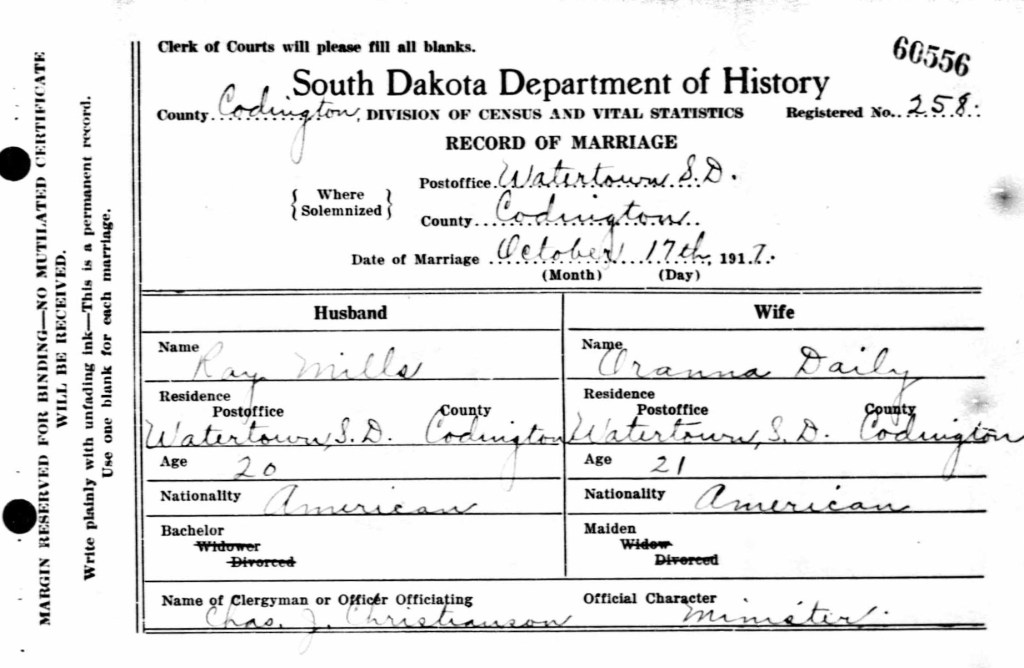
During the next several years, one by one Charles and Maggie’s children began moving out of their home, either by marrying or by finding work in a different location or by moving to Watertown to go to high school.  On October 17, 1917, 21 year-old Oranna married 20 year-old G. Ray Mills.  They were married by Charles J. Christianson, the pastor of First Congregational Church, which was located in Watertown.9  The following year, Oranna gave birth to Charles and Maggie’s first grandchild.  By 1919, Ray had begun farming near Rauville.10

Marriage record of G. Ray Mills and Oranna J. Daily, October 17, 19179

Newspaper items in the Watertown Public Opinion reveal that the Daily family became friends with the Herbert J. Bevers family.  On October 11, 1917, the newspaper reported: “Mr. and Mrs. Herbert Bevers, family and Miss Strombotne were dinner guests at the C. M. Daley [sp.] residence, near Rauville, Sunday.”11  The same issue also stated, “The Bever [sp.] and Daley [sp.] families autoed to Hazel and Grover Thursday on a combined business and pleasure trip.”12  On March 14, 1918, it was reported that “The Herbert Bevers family had as their guests, Sunday, Mr. and Mrs. Raymond Mills, Robert Dailey [sp.] and the Misses Iona and Elizabeth Dailey [sp.], of Rauville, and Miss Verna Edwards of Hazel.”13  Later that year, on July 11, a short article recounted that “Mr. and Mrs. H. J. Bevers of Elmira township, accompanied by Messrs Dailey [sp.] of Rauville and Wells of [Watertown], returned last week from a trip through portions of Minnesota and North Dakota. … [In the] valley of the Red River…, north of Big Stone City, S. D. … ‘it impressed [them] as having crops enough to feed the world, judging by the looks of the fields of grain.’”14


The First World War had broken out in Europe in 1914 and the United States entered the war in April 1917.  In June of that year the U. S. Congress authorized President Woodrow Wilson to institute a military draft of men from the age of 21 to 30.15  The purpose of this Selective Service Act was to increase the size of the army to 500,000 men.  A year later the army still was not large enough, so in August 1918, the Selective Service Act was amended to include all men between 18 and 45.16  Uncle Bob who turned 18 years old in May 1918 registered for the draft in September of that year.17  Mercifully, the war came to an end in November 1918 and Uncle Bob never served in the military.18 By 1920 Uncle Bob was boarding in Watertown at the home of Harold and Lula Nordaker, and working for a transfer company as a drayman (a driver of a cart or vehicle without fixed sides).19

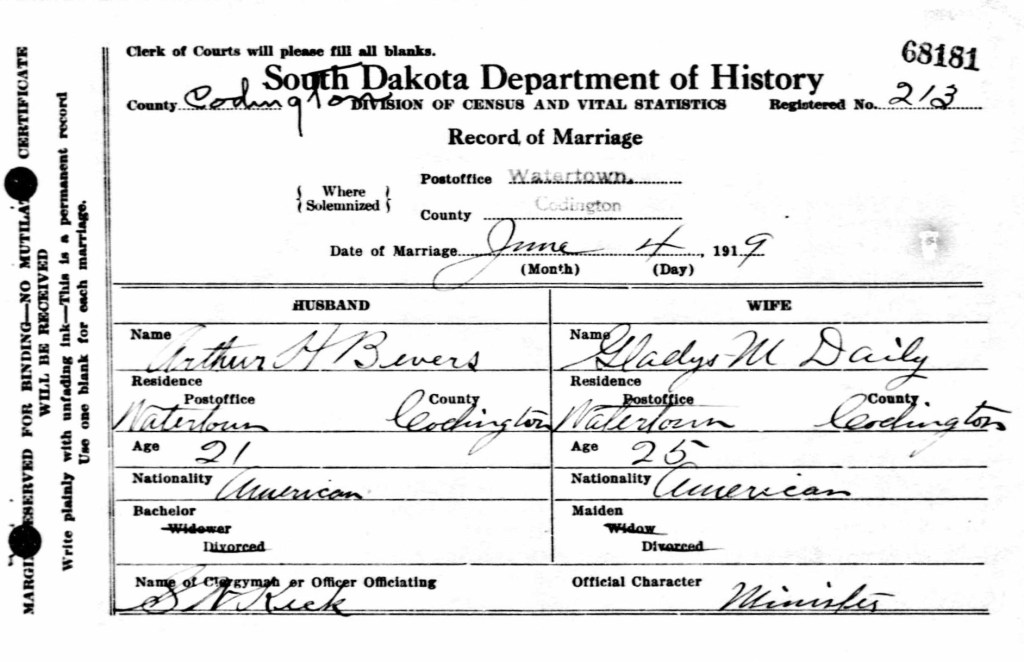
The Daily family and the Bevers family became linked in 1919 when 25 year-old Gladys married 21 year-old Arthur on June 4th.  The marriage was officiated by S. W. Keck, the pastor of First Congregational Church.20  On February 18, 1920, when the U. S. census was taken, Arthur and Gladys were living with Charles and Maggie on the farm in Rauville.21  Two months later, Arthur and Gladys’ first son was born on that farm,22 giving Charles and Maggie a second grandchild.  Iona and Elizabeth were also recorded on the 1920 census sheet.

Marriage record of Arthur H. Bevers and Gladys M. Daily, June 4, 191920

In the 1919 Watertown directory, Iona was identified as a student and she was boarding at 215 4th Street SW, which was the address of George and Hattie Baxter.23  At the age of 17, she was attending Watertown High School.  Iona graduated in May 1921 and three months later, after obtaining a South Dakota Second Grade Teacher’s Certificate, she entered into a two-year contract with Richland School District No. Six and began teaching on September 5th.24 Elizabeth would also attend Watertown High School, graduating in 1923 at the age of 18.


The 1920 U. S. census indicated that the farm that the Dailys were renting was on Meridian Road, also known as Meridian Highway.  In 1911, a road development association, the International Meridian Road Association, had organized for the purpose of building a transcontinental road, on which “a full wagon-box load or a car at high gear can pass, except in wet weather.”25  The name of the highway was “derived from the Sixth Principal Meridian, which extends north-south through the Great Plains region.”26 The route that was designated as the Meridian Road had a starting point in Winnipeg, Manitoba, Canada and ending points in Galveston, Texas and Mexico City.  Traveling along the eastern border of North Dakota, this highway entered South Dakota, veered west a short ways, then headed south and passed through Rauville and Watertown.  Presently, from the northern border of North Dakota to Watertown, Interstate Highway 29 and U. S. Highway 81 roughly follow the route that was once called the Meridian Highway.

The Meridian Highway evolved primarily as a farm-to-market road, important to the rural areas, small towns, and cities through which it passed.  The original route followed section line roads, running perpendicular to historic east–west transportation corridors.  Reflecting its creation from existing farm-to-market rural roads, the original highway passed through each county seat along its route.  In 1911 the Meridian Road Association was formed to mark, map, and promote the highway; in 1919 it became the Meridian Highway Association.  Similar to contemporaneous good roads organizations, the Meridian Highway Association consisted of representatives from the states, counties, and cities along the route.  The Meridian Highway promoters, however, perhaps in recognition of its divergence from more established routes, emphasized the absence of mountain passes and proclaimed that motorists could travel from Canada to Mexico without shifting gears.  The association sold memberships and instituted widely publicized tours.  When the association was a year old, in 1912, an automobile caravan was organized to travel the route south to Mexico, an event that was irregularly repeated in subsequent years.27


According to the U. S. census of Omaha, in 1920 Maggie’s mother Josephine (nee Smith) Bonewitz was living with Maggie’s niece Maggie (nee Thompson) Stier.28  Maggie Stier and her husband Fred were renting one of the two homes that the Dailys still owned in Omaha.29  In his interview, Uncle Bob mentioned a trip that Maggie Daily made to visit her 83 year-old mother in Omaha:

Uncle Bob: October 7, 1920. Yeah, that’s right there. I can remember that, oh, [like] it was yesterday. Mother was — Mother went down to, uh. ‘Course, I had a date with Ruby and Mother was away, at the time, see.

Interviewer:  Um hmm.

Uncle Bob:  An’ ‘course, Grandma passed away.  I don’t know what this date was, far as it was in 1920.  An’ she come home on the train an’ I was suppose t’ meet her.  An’ I didn’t. 

Interviewer:  And you didn’t.  [squealing laughter]

Uncle Bob:  I didn’t [pass] that too well.

Interviewer:  And you were in trouble!

Uncle Bob:  Yeah.  Didn’t think much of me.  [chuckling]30


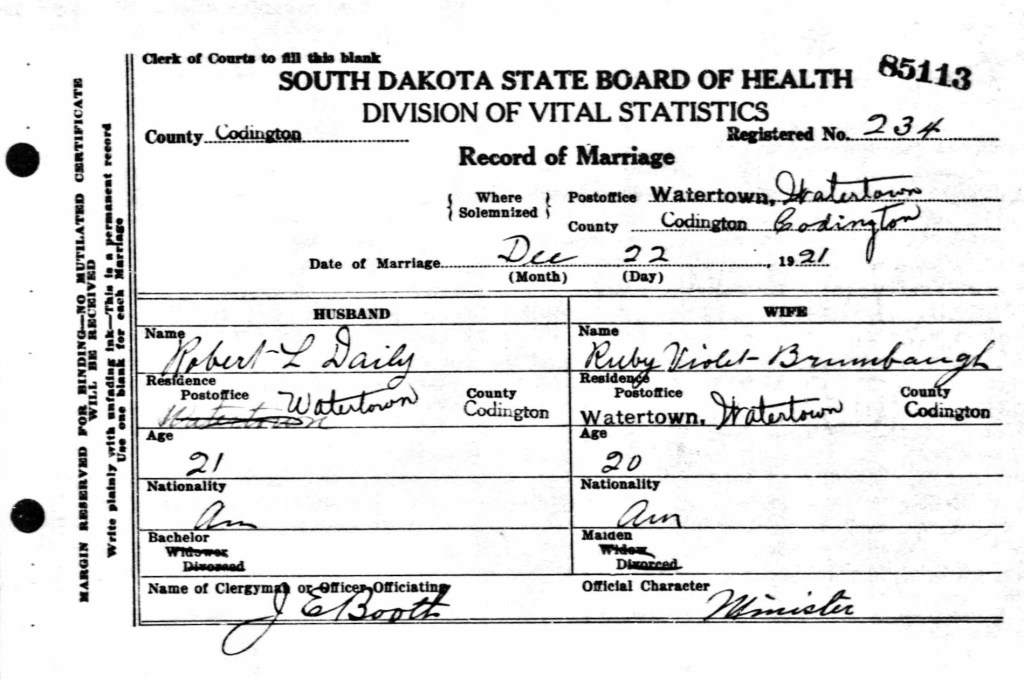
Just over a year later, Robert married Ruby Brumbaugh on December 22, 1921.31  The following December, Ruby gave birth to Charles and Maggie’s fourth grandchild.  Gladys had had her second child in August 1921 (the third grandchild) and Oranna would have her second child eight days after Ruby (the fifth grandchild).

Marriage record of Robert L. Daily and Ruby V. Brumbaugh, December 22, 192131

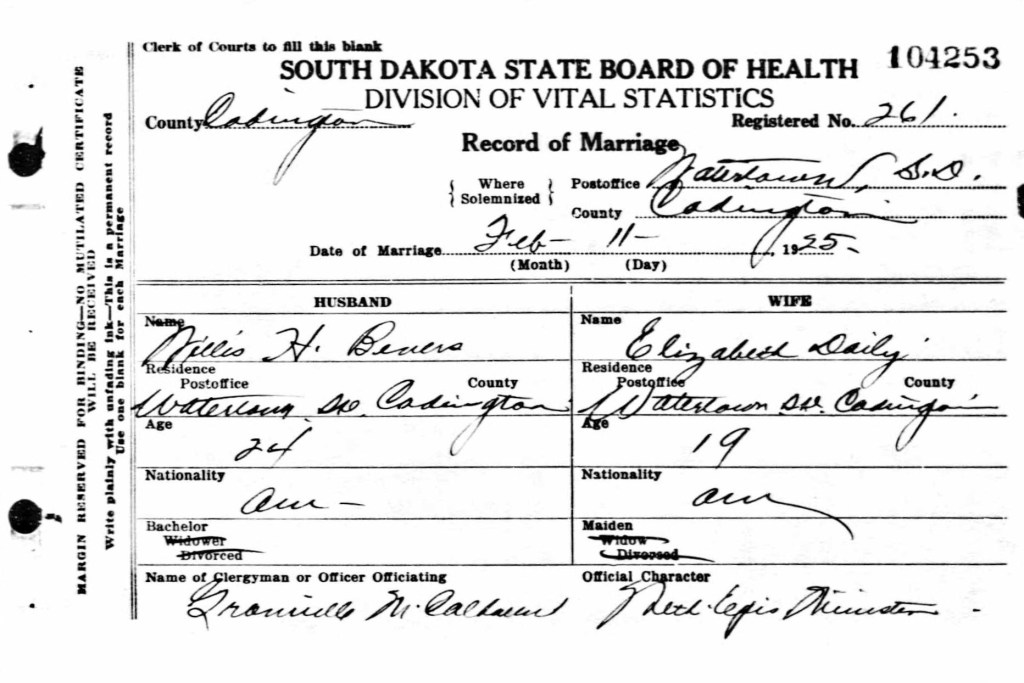
When Gladys’ in-laws, Herbert and Lena Bevers, moved their family to Raymondville, Texas in the fall of 1919, Elizabeth and Iona kept in touch with their son Willis.  The Bevers family returned to South Dakota a year later, but Willis stayed and worked on a road crew for another year.32  About three years after Willis returned to South Dakota, Elizabeth and Willis would marry.  The letters that they had exchanged during those two years are in the possession of one of their sons.  They were married on February 11, 1925, by Granville M. Calhoun, the minister of the Methodist Episcopal Church in Watertown.33 They set up their household in Watertown for a few months and later moved to a farm southwest of Grover.34 Their first child was born in December 1925 and was the tenth grandchild of Charles and Maggie.  Gladys had born two more children, and Oranna and Ruby had each born one more by this time.

Marriage record of Willis H. Bevers and Elizabeth J. B. V. Daily, February 11, 192533

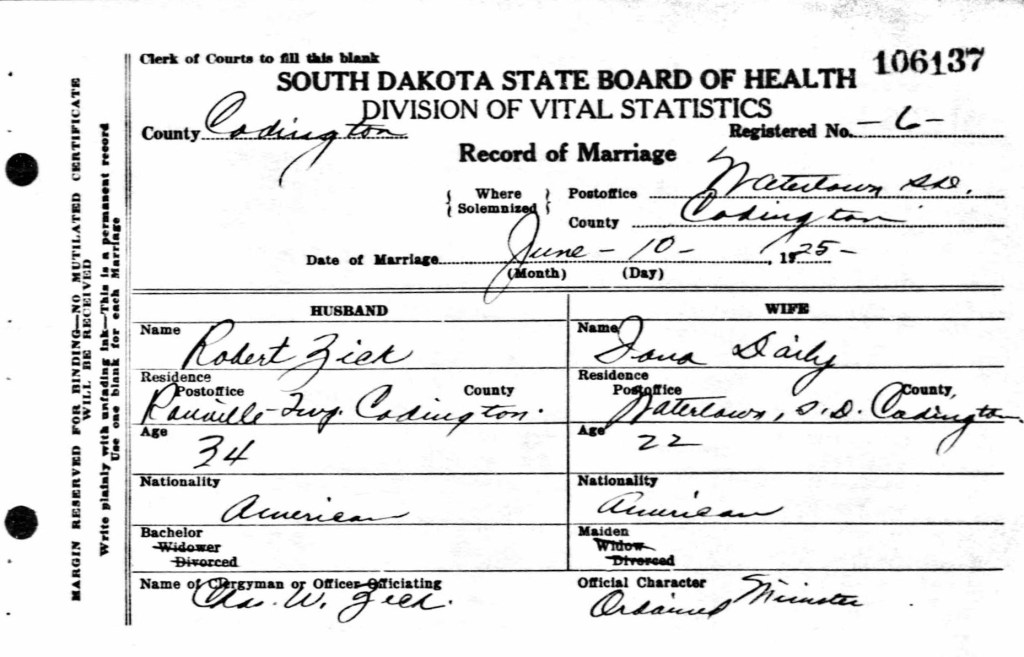
When the 1925 South Dakota Census was conducted, the only child that was living with Charles and Maggie in Rauville was 22 year-old Iona.  She would get married soon afterward, marrying Robert Zick on June 10.35  The officiating minister was Charles W. Zech [sp.?], who was likely the pastor of First Church Evangelical Association.36  Charles and Maggie’s daughter Gladys and her family were living in Rauville, but they may have been living on a different farm than Charles and Maggie.  Oranna and her husband were also still in Rauville.37  Robert had moved with his family to a farm in Germantown Township, Codington County.38


Marriage record of Robert Zick and L. Iona Daily, June 10, 192535

After living and working for 13 years on the Gunther farm, Charles and Maggie moved to another farm in the fall of 1929.  Uncle Bob explained the circumstances around their move:

Uncle Bob:  So, I went out there in the spring of ’29 on [Longstocker?] place.  An’ then Dad had a sale that fall in ’29, up on Gunther farm. 

Interviewer:  Uh huh.

Uncle Bob:  Now ‘o course, he had, he had the hay and he had his cows yet.  He kept his cows.

Interviewer: Um hmm.

Uncle Bob:  I had him come down, with me there.  That house was able – we had two different entrances.  So, so, we lived in two rooms there for ’29, and uh, oh, in the fall of ’29, that’s when Dad come down and moved in there.  Why, we had our — I had cows and he had cows.  Took ’em there.  But then I got a chance in the fall of ‘30 to buy Faragher [sp.?] out.  And, uh, ‘course, I had 1300 head o’ cattle and Faragher [sp.?] had 1700 head o’ cattle.  And uh, I moved down there.  Well, Dad figured maybe I was bitin’ off more – see, the bank was willing to loan me the money because he, Faragher [sp.?] was on there and he owed ‘em $500.  And uh, it was willing to, uh, take the loan over, oh, the mortgage over on a younger man.

Interviewer:  Um hmm.

Uncle Bob:  That’s the way I come in on it.

Interviewer:  Ahhh.  Uh huh.

Uncle Bob:  The bank loaned me all the money to buy Faragher [sp.?] out —

Interviewer:  Sure, sure.

Uncle Bob:  — and then they get their money.  They got their money, see.  …

Interviewer:  That must have been about when, when Grandpa moved to town then?  In ’30?

Uncle Bob:  Well, no.  No, he stayed there one more.  He stayed there one year and he handled the place ….  He put up the hay and fed cattle, out there.  … And so uh, when I come down here in the fall of ’30 to Longstocker’s [perhaps he meant Faragher’s instead], he stayed on one more year, and then he, uh, sold out.  And uh, moved into east Watertown, there.  That’s where he moved to then at that time.  Moved out there.39


On April 10, 1930 a census taker visited the home of Charles and Maggie in Lake Township, Codington County, also visiting the home of Robert and Ruby and their two daughters .40  Charles was 73 years-old and Maggie was 62 years-old.  Both Charles and Robert were farmers and they were actually working on the day before the census taker visited.  Oranna and her three children, aged eleven, seven and four, were living with Charles and Maggie.  Two hardships had afflicted Oranna in the 1920s: she began having epileptic seizures and her husband had deserted her.41  The census record indicates that she was divorced by 1930.

Gladys and Arthur had seven children by this time and were living on a farm very close to Elizabeth and Willis who were also living on a farm, both farms being in Kampeska Township, Codington County.42  Elizabeth had born three children, but one daughter had only lived for four months.  Living with Elizabeth and Willis were his parents Herbert and Lena Bevers.  Iona and Robert had two children prior to 1930 and would have another child a couple months after the census was taken.  They were still living on a farm in Rauville.43  So, as of the end of 1930, Charles and Maggie had 17 living grandchildren. 

In 1930, the United States government wanted to determine the extent of ownership of radio sets in the nation, so one of the questions on the 1930 census was whether the householder owned a radio set.  Between 1905 and 1920, radio broadcasting had been primarily a hobby of amateur radio operators.  During the early 1920s, broadcast stations began to be established in cities and they began providing live programs of music and information for public audiences.  At the time of the census, Charles did not own a radio set and the only ones among his children that owned a radio set were Elizabeth and Willis. 

In the next blogpost of Uncle Bob’s reminiscences, we will learn about Charles and Maggie’s years of living in Watertown, South Dakota.


1. M. R. Wilson, transcription of Robert Lee Daily Interview by R. Thiele, recording (ca. 1984): 8-9.

2. E. M. Bevers, email communication with M. R. Wilson, January 28, 2018.

3. _________, “Charles Monroe Daily Family,” in The First 100 Years in Codington County, South Dakota, 1879-1979, by Codington County History Book Committee (Watertown, South Dakota: Watertown Public Opinion Print, 1979): 150.

4. H. L. Hill (Ed.), Watertown City and Codington County Directory 1916-1917 (Watertown, South Dakota: Watertown Printing and Binding Co., 1916): 317.

5. Wilson, Robert Lee Daily Interview: 25.

6. Hill, Watertown City and Codington County Directory 1916-1917: 336.

7. H. L. Hill (Ed.), Watertown City and Codington County Directory 1919-1920 (Watertown, South Dakota: Watertown Printing and Binding Co., 1919): 323.

8. Wilson, Robert Lee Daily Interview: 14.

9. Ancestry.com, “Record of marriage of Ray Mills and Oranna Daily,” South Dakota Marriages, 1905-1949 (Provo, Utah: Ancestry.com Operations Inc., 2005).

10. Hill, Watertown City and Codington County Directory 1919-1920: 345.

11. ________, Saturday News (Watertown, South Dakota, Oct. 11, 1917), https://www.newspapers.com/image/466193821.

12. ________, Saturday News (Watertown, South Dakota, Oct. 11, 1917), https://www.newspapers.com/image/466193821.

13. ________, Saturday News (Watertown, South Dakota, Mar. 14, 1918), https://www.newspapers.com/image/465662336.

14. ________, Saturday News (Watertown, South Dakota, Jul. 11, 1918), https://www.newspapers.com/image/465664742.

15. 65th Congress, “Congressional Act H. R. 3545,” in United States of America, Public Laws of the Sixty-Fifth Congress (Washington, D. C., 1917): 76-83, http://legisworks.org/congress/65/publaw-12.pdf

16. 65th Congress, “Congressional Act H. R. 12731,” in United States of America, Public Laws of the Sixty-Fifth Congress (Washington, D. C., 1918}: 955-957, http://legisworks.org/congress/65/publaw-210.pdf.

17. “United States World War I Draft Registration Cards, 1917-1918,” database with images, FamilySearch (https://familysearch.org/ark:/61903/3:1:33S7-81WF-YWR?cc=1968530&wc=9FC7-FM9%3A928420501%2C928501301 : 9 September 2019), South Dakota > Codington County; A-Z > image 630 of 3493; citing NARA microfilm publication M1509 (Washington, D.C.: National Archives and Records Administration, n.d.).

18. “United States Census, 1930,” database with images, FamilySearch (https://familysearch.org/ark:/61903/3:1:33S7-9RCF-HX1?cc=1810731&wc=QZF7-DBF%3A648803701%2C649380801%2C648842001%2C1589282340 : 8 December 2015), South Dakota > Codington > Lake > ED 12 > image 2 of 6; citing NARA microfilm publication T626 (Washington D.C.: National Archives and Records Administration, 2002).

19. “United States Census, 1920,” database with images, FamilySearch (https://familysearch.org/ark:/61903/3:1:33SQ-GRVM-Z27?cc=1488411&wc=QZJB-QKD%3A1036874501%2C1039011801%2C1039046901%2C1589332554 : 13 September 2019), South Dakota > Codington > Watertown Ward 4 > ED 101 > image 17 of 41; citing NARA microfilm publication T625 (Washington, D.C.: National Archives and Records Administration, n.d.).

20. Ancestry.com, “Record of marriage of Arthur H. Bevers and Gladys M. Daily,” South Dakota Marriages, 1905-1949 (Provo, Utah: Ancestry.com Operations Inc, 2005).

21. “United States Census, 1920,” database with images, FamilySearch (https://familysearch.org/ark:/61903/3:1:33S7-9RVM-D6Z?cc=1488411&wc=QZJB-434%3A1036874501%2C1039011801%2C1039036701%2C1589332505 : 13 September 2019), South Dakota > Codington > Rauville > ED 94 > image 2 of 7; citing NARA microfilm publication T625 (Washington, D.C.: National Archives and Records Administration, n.d.).

22. L. A. Bevers, personal interview with M. R. Wilson, August 2, 2010.

23. Hill, Watertown City and Codington County Directory 1919-1920: 62, 242.

24. Teacher’s Contract of Richland School District No. Six with Iona Daily, August 11, 1921.

25. ________, Meridian Highway, https://web.archive.org/web/20070924192054/http://www.drivetheost.com/meridianhighway.html.

26. D. Moore, et al., The Meridian Highway in Texas (Austin, Texas: Texas Historical Commission, May 27, 2016): 1.

27. C. Ahlgren, The Meridian Highway (2011), http://plainshumanities.unl.edu/encyclopedia/doc/egp.tra.020.xml.

28. “United States Census, 1920,” database with images, FamilySearch (https://familysearch.org/ark:/61903/3:1:33SQ-GRXW-XQR?cc=1488411&wc=QZJ5-LMG%3A1036473301%2C1036471902%2C1037747101%2C1589333009 : 12 September 2019), Nebraska > Douglas > Omaha Ward 9 > ED 105 > image 11 of 30; citing NARA microfilm publication T625 (Washington, D.C.: National Archives and Records Administration, n.d.).

29. ________, City Directory of Greater Omaha 1920 (Omaha, Nebraska: R. L. Polk & Co., 1920): 1229.

30. Wilson, Robert Lee Daily Interview: 19.

31. Ancestry.com, “Record of marriage of Robert L. Daily and Ruby Violet Brumbaugh,” South Dakota Marriages, 1905-1949 (Provo, Utah: Ancestry.com Operations Inc, 2005).

32. D. L. Bevers, Herbert and Lena Bevers trip to Raymondville Texas [Transcription of Our Trip to Texas by Lena Bevers, 1919] (unpublished, n.d.): 4.

33. Ancestry.com, “Record of marriage of Willis H. Bevers and Elizabeth Daily,” South Dakota Marriages, 1905-1949 (Provo, Utah: Ancestry.com Operations Inc, 2005).

34. ________, “Willis Herbert Bevers,” in The First 100 Years in Codington County, South Dakota, 1879-1979, by Codington County History Book Committee (Watertown, South Dakota: Watertown Public Opinion Print, 1979): 116.

35. Ancestry.com, “Record of marriage of Robert Zick and Iona Daily,” South Dakota, U. S., Marriages, 1905-2017 (Lehi, Utah: Ancestry.com Operations Inc, 2005).

36. H. L. Hill (Ed.), Watertown City and Codington County Directory 1926-1927 (Watertown, South Dakota: Peck-Hill Company): 9.

37. Hill, Watertown City and Codington County Directory 1926-1927: 347.

38. “South Dakota State Census, 1925,” database with images, FamilySearch (https://familysearch.org/ark:/61903/3:1:S3HY-DCR9-M87?cc=1476077&wc=MJ7S-C68%3A1041724801 : 21 May 2014), 004245665 > image 2963 of 3379; State Historical Society, Pierre.

39. Wilson, Robert Lee Daily Interview: 25-26.

40. “United States Census, 1930,” database with images, FamilySearch (https://familysearch.org/ark:/61903/3:1:33S7-9RCF-HX1?cc=1810731&wc=QZF7-DBF%3A648803701%2C649380801%2C648842001%2C1589282340 : 8 December 2015), South Dakota > Codington > Lake > ED 12 > image 2 of 6; citing NARA microfilm publication T626 (Washington D.C.: National Archives and Records Administration, 2002).

41. Wilson, Robert Lee Daily Interview: 10.

42. “United States Census, 1930,” database with images, FamilySearch (https://familysearch.org/ark:/61903/3:1:33SQ-GRCF-HB3?cc=1810731&wc=QZF7-6VX%3A648803701%2C649380801%2C649388101%2C1589282323 : 8 December 2015), South Dakota > Codington > Kampeska > ED 10 > image 1 of 8; citing NARA microfilm publication T626 (Washington D.C.: National Archives and Records Administration, 2002).

43. “United States Census, 1930,” database with images, FamilySearch (https://familysearch.org/ark:/61903/3:1:33S7-9RCF-8C9?cc=1810731&wc=QZF7-DT9%3A648803701%2C649380801%2C649393801%2C1589282372 : 8 December 2015), South Dakota > Codington > Rauville > ED 16 > image 5 of 8; citing NARA microfilm publication T626 (Washington D.C.: National Archives and Records Administration, 2002).