The Bible that our family calls “The Breitenstein Bible” came into the possession of my husband in the year 2000 after the passing of his mother. It is a volume of substantial size, measuring nearly 13 inches in height by 11 inches in width and five inches deep. Having a weight of 15 pounds, it is truly a hardback book. Its front and back covers, when tapped with the knuckles, sound as though they are made of wood. Within the covers there are approximately 2,025 pages of content, with additional pages of illustrations, maps and record pages for births, marriages and deaths. There are 1,009 pages devoted to the Old Testament, 315 pages for the New Testament, and it includes the Apocrypha, 104 pages. In addition, there are many supplemental resources for studying the Bible and for understanding the historical setting and the people of the Bible.

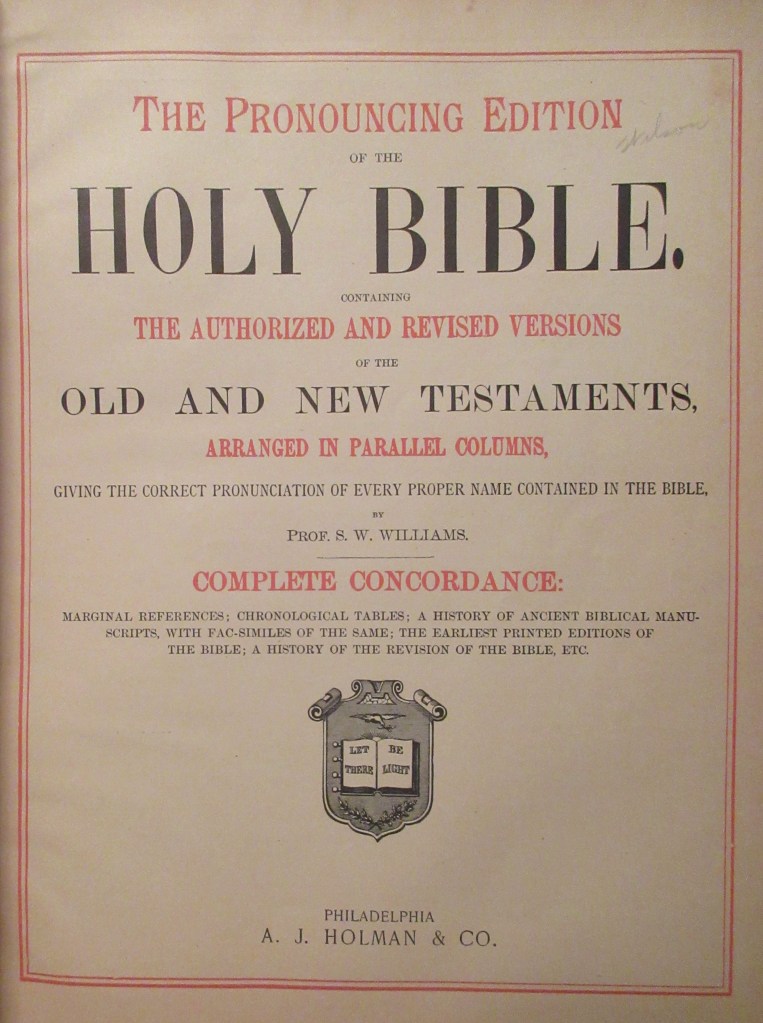
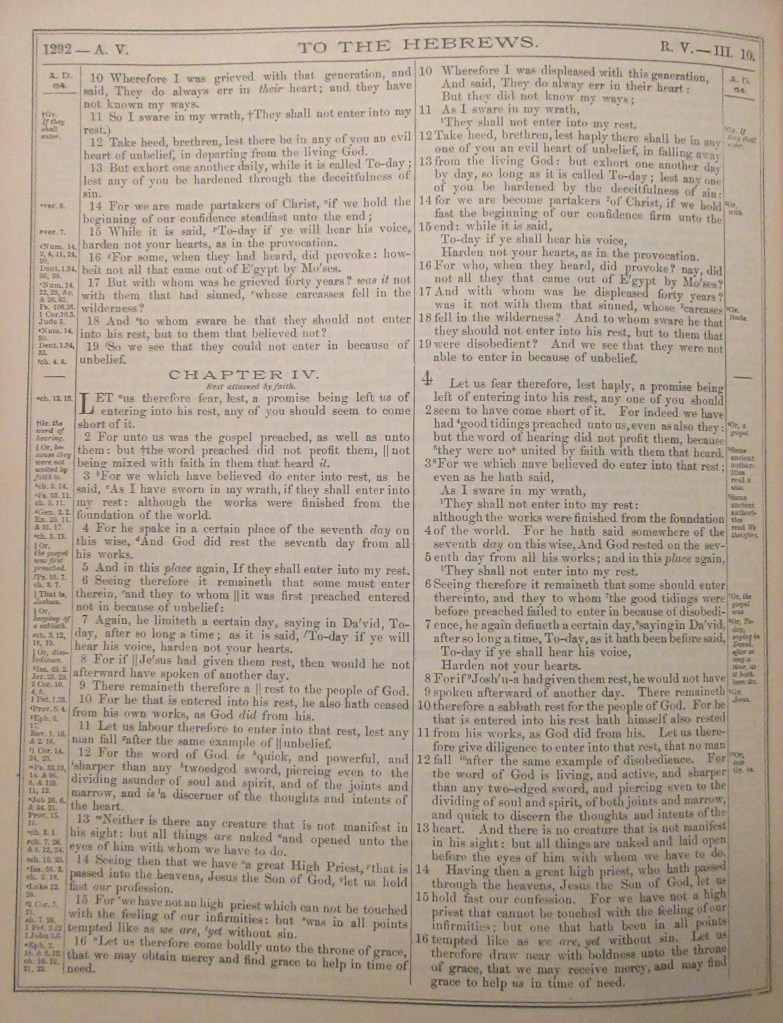
The title of this publication is THE PRONOUNCING EDITION OF THE HOLY BIBLE. Printed in Philadelphia, Pennsylvania, the editor was Professor S. W. Williams and it was published by A. J. Holman and Company. Its most distinctive characteristic is that it contains a translation of the scriptures into English, dated 1611 and “commonly known by the name of the Authorised Version,”1 which is printed alongside a Revised Version of the scriptures dated 1881. The title page explains the contents as follows:
CONTAINING
THE AUTHORIZED AND REVISED VERSIONS
OF THE
OLD AND NEW TESTAMENTS,
ARRANGED IN PARALLEL COLUMNS,
GIVING THE CORRECT PRONUNCIATION OF EVERY PROPER NAME CONTAINED IN THE BIBLE,
BY
PROF. S. W. WILLIAMS.
The Authorised2 Version is so named because in 1604, “King James commissioned a new translation. … What set the King James Version apart from the rest of the translations that went before was its use of a highly-skilled committee of fifty-four translators from England’s finest institutions.”3 Beginning their work in 1607, these scholars revised previous translations that depended highly on the translations by William Tyndale of the New Testament and portions of the Old Testament, which had been translated in the 1520s and 1530s.
“William Tyndale (1494-1536), who had become an expert of the ancient languages of Greek and Hebrew, sought to make an English translation of the Bible that was based on the Greek and Hebrew texts. Like [Martin] Luther before him, Tyndale contended that the people should have access to the scriptures in their own vernacular.“4
At the time that Tyndale was translating the scriptures, doing so was in opposition to the Catholic Church and the King of England. He did his translation work in Europe and the published works were smuggled into England. His work of translating the Old Testament was interrupted because King Henry VIII called for Tyndale’s arrest, resulting in betrayal and imprisonment in 1535 and execution for heresy in 1536 in Belgium.5 Other scholars took up the work of translating the Bible into English, but some did not use the original Hebrew and Greek texts as Tyndale had. Some translators used Tyndale’s work as the basis of their translations.6
Two hundred seventy years after the Authorised Version of the Bible was published, a new effort was commenced to revise it. In February 1870, the Convocation of the Province of Canterbury, an assembly of provincial clergy and bishops of the Church of England, adopted Resolutions in the two houses which make up the Convocation, the House of Bishops and the House of Clergy. These Resolutions led to the formation of two companies which were tasked with the revision.7
“One of the [revisers] stated his understanding of the object sought in these words: ‘The new Bible is to read like the old, and the sacred associations connected with it are not to be disturbed; but within these limits all necessary and desirable corrections and improvements on which the best scholars are agreed will be introduced: a good version will be made better; a clear and accurate version clearer and more accurate; the oldest and purest text is to be followed; errors, obscurities and inconsistencies are to be removed; uniformity in rendering Hebrew and Greek words and proper names to be sought. In one word, the revision is to give, in idiomatic English, the nearest possible equivalent for the original Word of God as it came from the inspired organs of the Holy Spirit. It aims to be the best version possible in the nineteenth century, as King James’ version was the best which could be made in the seventeenth century.'”8
Prior to beginning the work of revision, the Convocation established five Resolutions to guide the work. (See Appendix 1) Two of these resolutions stipulated that they would not “contemplate any new translation of the Bible, or any alteration of the language, except where in the judgment of the most competent scholars such change [was] necessary,” and “in such necessary changes, the style of the language employed in the existing Version be closely followed.”9 In addition to the Resolutions, a special Committee of Convocation established eight Principles and Rules as guidelines for the work of revision. (See Appendix 2) The revisers kept in mind “that it was their duty not to make a new translation, but to revise one already existing, which for more than two centuries and a half had held the position of an English classic. They … therefore departed from it only in cases where they disagreed with the Translators of 1611 ….”10 The earnestness of their undertaking is reflected in the fourth principle: “That the text to be adopted be that for which the evidence is decidedly preponderating [exceeding in importance]; and that when the Text so adopted differs from that from which the Authorised Version was made, the alteration be indicated in the margin.”11 On June 22, 1870, the work was begun by the two companies, one working on the Old Testament and the other working on the New Testament. By the time the Revised Version was completed, the text had been reviewed three times, as explained below:
“It may be of some interest to describe the method observed by the Company in their work, if only to shew that every question raised was carefully and deliberately considered. In the first Revision it was the practice for the Secretary to read over each verse, first in the original and then in the Authorised Version: the proposals for change were then taken; first those communicated in writing by absent members, and next those made by the members present. Each proposal was moved, and if seconded was discussed and voted upon; the decision in the first Revision being by a majority only. If a proposal met with no seconder, it was not discussed but allowed to drop. In the second Revision, the Secretary read out in order the changes which had been made at the first Revision; if these were unchallenged they were allowed to remain, otherwise they were put to the vote and affirmed or rejected according as they were or were not supported by the requisite majority of two-thirds. In the second Revision new propositions could only be made by special permission of the Company, and discussion was limited, as far as possible, to exceptional cases. In the final review, which was in reality the completion of the second Revision, the Company employed themselves in making a general survey of what they had done, deciding finally upon reserved points, harmonizing inconsistencies, smoothing down roughnesses, removing unnecessary changes, and generally giving finish and completeness to their work. Everything in this final survey was decided by the vote of a majority of two-thirds.”12
An additional resolution was passed by both houses of Convocation which invited American scholars to join the effort. Eventually, two American Committees were formed which supplied scholarly support to the two English Companies. The members of these American Committees included divinity school and theological seminary professors, for example, Yale College and Harvard University. “In every instance the suggestions from America were treated with the same consideration as those proceeding from members of the English Company, and were adopted or rejected on their merits.”13 The English Company of the New Testament described their communication with the American Committee as follows:
“We transmitted to them from time to time each several portion of our First Revision, and received from them in return their criticisms and suggestions. These we considered with much care and attention during the time we were engaged on our Second Revision. We then sent over to them the various portions of the Second Revision as they were completed, and received further suggestions, which like the former, were closely and carefully considered. Last of all, we forwarded to them the Revised Version in its final form; and a list of those passages in which they desire to place on record their preference of other readings and renderings will be found at the end of the volume.”14
It took 10½ years to complete the revision of the New Testament,15 which was published in May 1881.16 “The First Revision occupied about six years; the Second, about two years and a half. The remaining time [was] spent in the consideration of the suggestions from America on the Second Revision, and of many details ….”17 The work of the New Testament Company was conducted during “a session of four days … held every month (with the exception of August and September) in each year from the commencement of the work in June 1870.”18 One of the New Testament revisers noted, “This, however, represents only a small part of the labor, since each member of the Committee gave closest study outside of the meetings to every point of the translation.”19
In contrast, the majority of the 85 sessions held by the Old Testament Company “were for ten days each, and each day the Company generally sat for six hours.”20 The Old Testament Company’s labor occupied 792 days over the course of 14 years, ending on June 20, 1884.21 During all of this time, the revisers were not compensated for their efforts. “The necessary expenses for traveling, printing, etc., of the British Committee, [were] paid by the University Presses; those of the American Committee, by voluntary contributions of liberal friends, under the direction of an efficient Committee of Finance ….”22
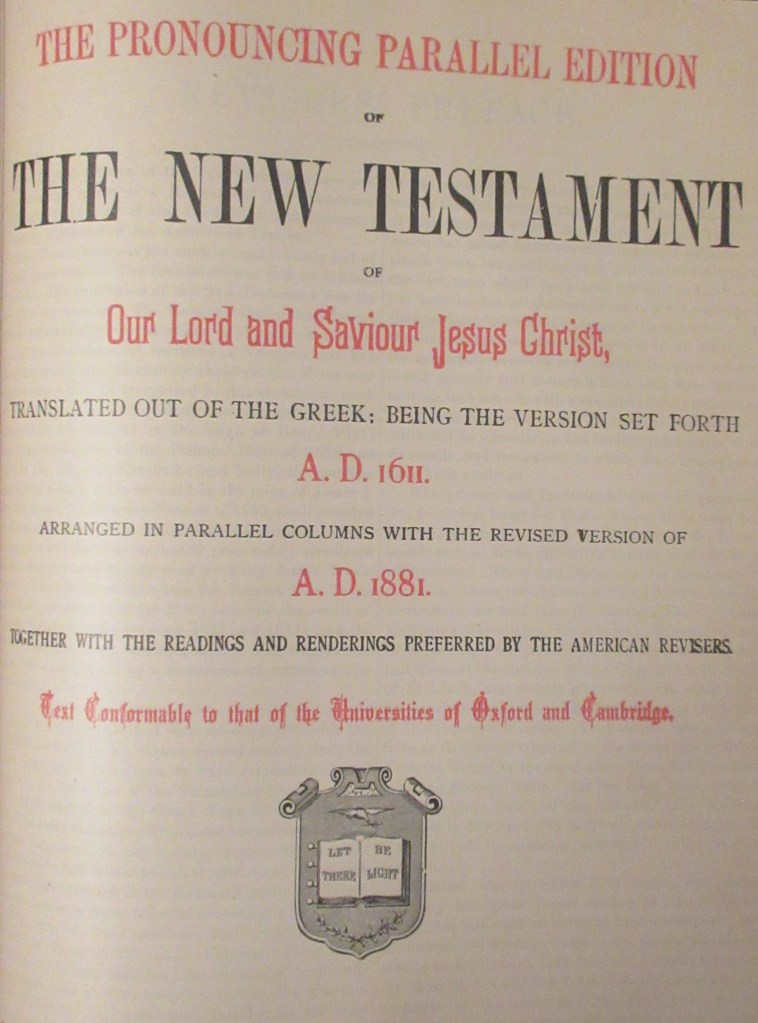
The Pronouncing Edition of the Holy Bible
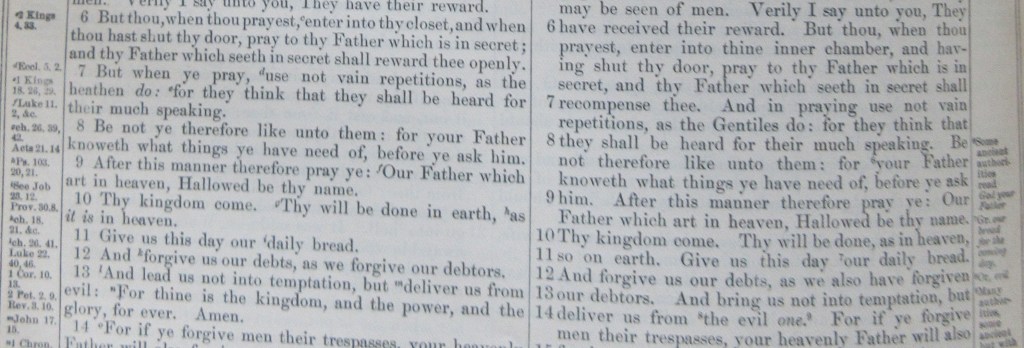
An examination of Matthew 6:6-13 provides some examples of revisions that the New Testament Company determined were necessary. This is one of the passages in which Jesus teaches about prayer, and it includes the text of The Lord’s Prayer.
- Verse 6 in the Authorised Version reads: “But thou, when thou prayest, enter into thy closet, and when thou hast shut thy door, pray to thy Father which is in secret; and thy Father which seeth in secret shall reward thee openly.” In the Revised Version it was determined that a phrase that better represents the original Greek language is: “…enter into thine inner chamber, and having shut thy door….”23
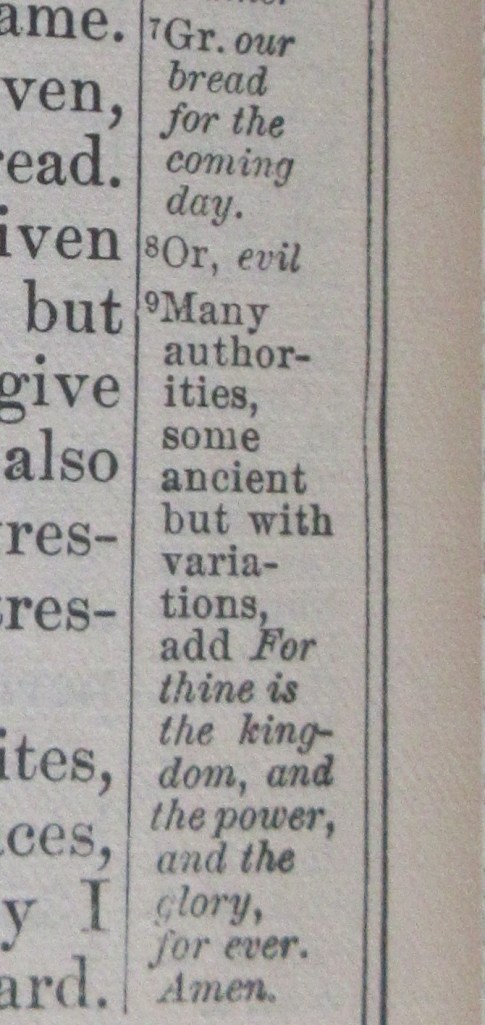
- For verse 11, the American Committee preferred a different translation of the Greek for the phrase “our daily bread.” The Committee made their preference known by requesting that a note be included in the margin stating that there was an alternate reading of the original Greek. The alternate reading being “our bread for the coming day.”24
- Verse 13 of the Revised Version omits a sentence that is in the Authorized Version: “For thine is the kingdom, and the power, and the glory, for ever. Amen.” The margin notes that this sentence is included in some ancient manuscripts (but apparently not in the manuscripts that the revisers used to qualify their revision.)
A list of the contents of the entire “Breitenstein Bible” can be found in Appendix 3. Among the study resources are: a 96-page self-pronouncing dictionary of the important words of the Bible; a 72-page illustrated cyclopedia explaining topics relevant to Biblical times, such as manners and customs, idolatry and Jewish worship, nations and Palestine; a 64-page article about the cities of the Holy Lands with pictorial representations; and a 48-page concordance.
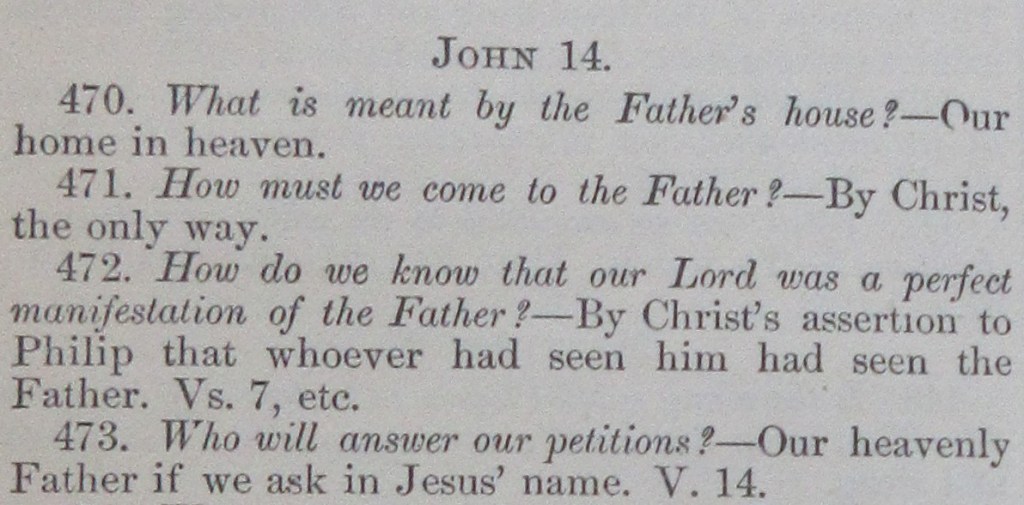
One of the supplementary resources is named: “Four Thousand Questions and Answers on the Old and New Testaments. Intended to Open Up the Scriptures For the Use of Students and Sunday-School Teachers.” It fills 56 pages with questions and answers. There are 664 questions that apply to the New Testament books of Matthew, Mark, Luke, John and Acts. An example of some of the questions for chapter 14 of the book of John follows:

Dispersed throughout the volume are illustrations as black and white line drawings or, less frequently, in color.
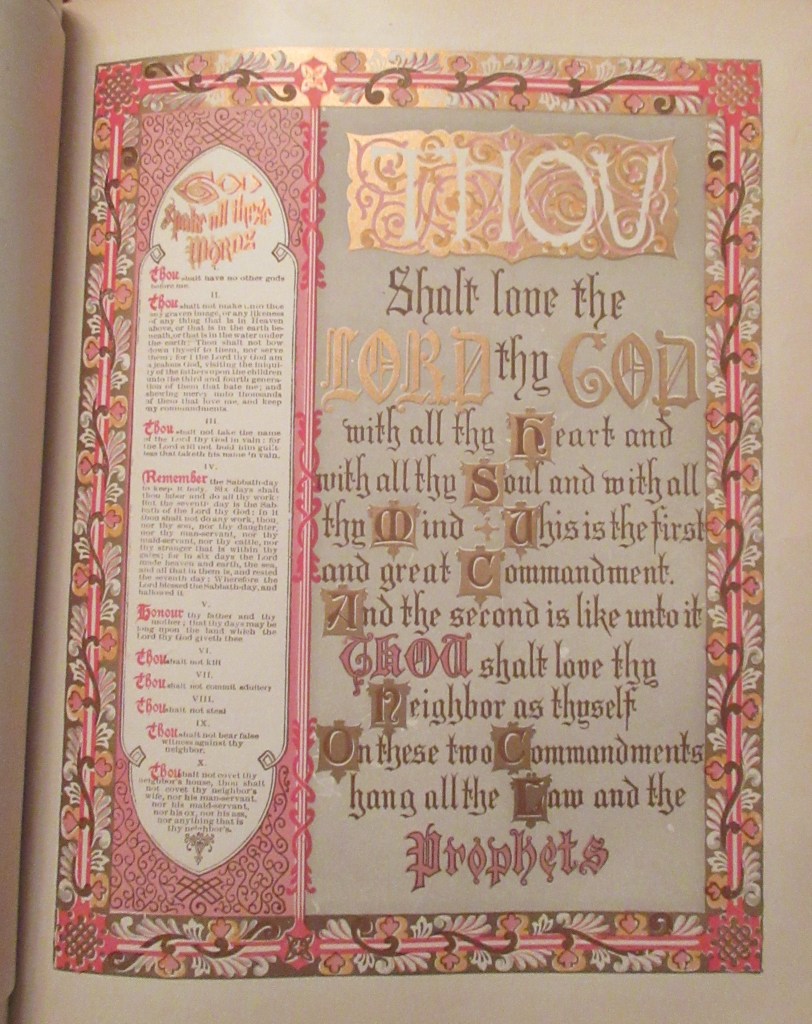
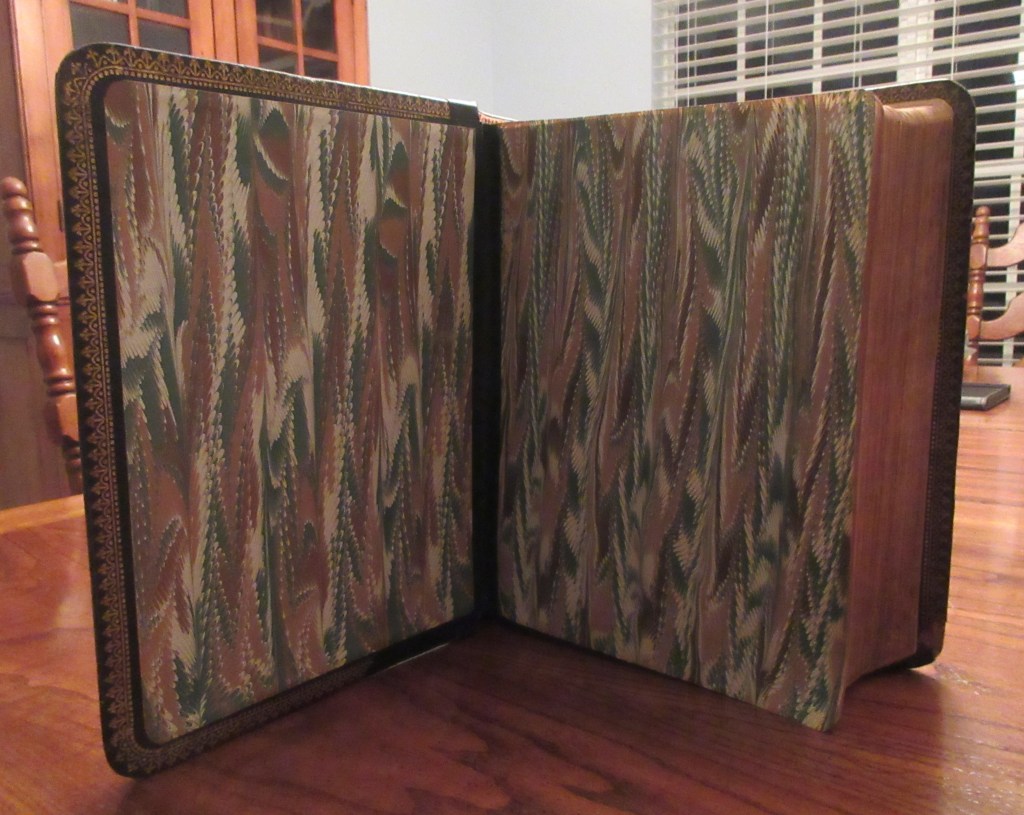
At some point, repairs were made to the “The Breitenstein Bible.” It appears that the front and back covers have been externally re-hinged, meaning that on the outside new leather was applied at the hinge in order to attach the covers to the spine. On the inside of the front and back covers, the original endpapers have been replaced with endpapers with a striking design.
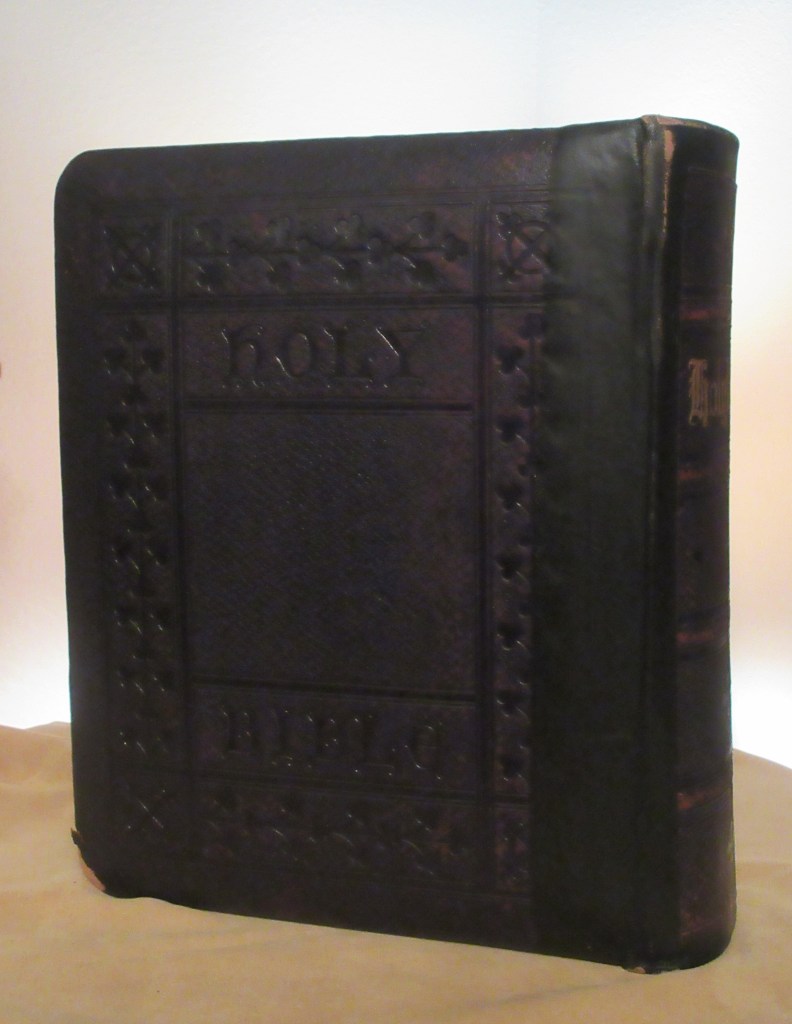
The original owner of “The Breitenstein Bible” is unknown. None of the family register pages are filled in. Although we call it “The Breitenstein Bible,” its first owner could have been a Goodhart. There were handwritten notes tucked within the pages of this Bible, one of which noted the date of Amos K. Goodhart’s death with a scripture reference to a verse of the book of Job. The handwritten notes were possibly written by Amos’ daughter Sarah (Sallie) Goodhart who married Jacob Breitenstein. More about the items found in the “Breitenstein Bible” is presented in the blogpost, The Oldest Mementos of “The Breitenstein Bible.”
Appendix 1
Resolutions of the Convocation of the Province of Canterbury, 1870, regarding the revision of the Authorised Version of the Bible:
- That it is desirable that a revision of the Authorised Version of the Holy Scriptures be undertaken.
- That the revision be so conducted as to comprise both marginal renderings and such emendations as it may be found necessary to insert in the text of the Authorised Version.
- That in the above resolutions we do not contemplate any new translation of the Bible, or any alteration of the language, except where in the judgment of the most competent scholars such change is necessary.
- That in such necessary changes, the style of the language employed in the existing Version be closely followed.
- That it is desirable that Convocation should nominate a body of its own members to undertake the work of revision, who shall be at liberty to invite the co-operation of any eminent for scholarship, to whatever nation or religious body they may belong.25
Appendix 2
Principles and Rules established by the special Committee of Convocation, May 1870, regarding the revision of the Authorised Version of the Bible:
- To introduce as few alterations as possible into the Text of the Authorised Version consistently with faithfulness.
- To limit, as far as possible, the expression of such alterations to the language of the Authorised and earlier English Versions.
- Each Company to go twice over the portion to be revised, once provisionally, the second time finally, and on principles of voting as hereinafter is provided.
- That the text to be adopted be that for which the evidence is decidedly preponderating [exceeding in importance]; and that when the Text so adopted differs from that from which the Authorised Version was made, the alteration be indicated in the margin.
- To make or retain no change in the Text on the second final revision by each Company, except two thirds of those present approve of the same, but on the first revision to decide by simple majorities.
- In every case of proposed alteration that may have given rise to discussion, to defer the voting thereupon till the next Meeting, whensoever the same shall be required by one third of those present at the Meeting, such intended vote to be announced in the notice for the next Meeting.
- To revise the headings of chapters and pages, paragraphs, italics, and punctuation.
- To refer, on the part of each Company, when considered desirable, to Divines, Scholars, and Literary Men, whether at home or abroad, for their opinions.26
Appendix 3
Contents of The Pronouncing Edition of the Holy Bible, edited by Professor S. W. Williams:
- Title page, copyright page and other introductory pages
- “Reviser’s Preface” [One of two prefaces written by the revisers; the second precedes the New Testament]
- “General Officers of the American Committee”
- “History of the English Translations of the Bible”
- “The Names and Order of all the Books of the Old Testament”
- “Contents of the Books of the Old and New Testaments”
- Two maps
- “Animated Nature as Found in Bible Times and Lands” by James P. Boyd, A. M.
- “Patriarchs, Priests, Prophets, and Kings; or, Striking Characters, Scenes, and Events of Old-Testament History” by James P. Boyd, A. M.
- “Biographical Sketches of the Translators and Reformers and Other Eminent Biblical Scholars Describing the Fate of These Learned Men Who Rendered the Bible into the English Language” by Rev. William F. B. Jackson
- “Religious Denominations, Their History and Creeds” By Rev. Wm. H. Munroe
- “Science and Revelation or, The Triumph of the Bible Over Criticism”
- “Views From Photographs of Recent Surveys in the Holy Lands”
- “Trees, Plants, Flowers, and Fruits; Such as are Prominently Mentioned in the Holy Scriptures, and as Appear to Have Been Among the Most Important, Useful, and Well Known in the Early Centuries”
- “Analysis of the Bible in Which Its Important Teachings are Plainly Grouped in Regard to God; Man; Jesus Christ; The Holy Spirit; The Holy Scriptures; Providence of God; The Christian Life; The Sabbath; The Church and Its Ministry; Family Life; and Time and Eternity,” copyright, 1898, by A. J. Holman & Co.
- “Illustrated Cyclopedia of the Bible Bringing Within a Convenient Compass All the Most Particular and Highly Essential Information in Relation to Eastern Manners and Customs; Wanderings of the Israelites; Idols and Idolatry of the Ancients; Jewish Worship—Its Types Explained; Countries and Nations of the Bible; Palestine, or the Holy Land; City and Environs of Jerusalem; St. Paul’s Missionary Journeys; The Prophecies of the Bible, Etc.” by M. Laird Simons, copyright, 1898, by A. J. Holman & Co.
- “Historical Illustrations of Bible Text, Derived from Ancient Coins and Gems of the Period of Time from Alexander the Great to the Destruction of Jerusalem, 336 B. C. to 138 A. D., ….” by A. L. Rawson, LL.D., copyright 1881
- “Valuable Chronological and Miscellaneous Tables”
- “Cities of the Bible, with Descriptive Scenes and Events, and Pictorial Representations of Palestine, Including Mountains, Valleys, Rivers, and Egyptian and Jewish Antiquities in the Holy Lands” by Rev. Wm. F. B. Jackson, copyright 1873
- “A New Self-Pronouncing Dictionary of the Bible, Containing Every Important Scriptural Word,” compiled from the latest editions of William Smith, LL.D. copyright, 1898, by A. J. Holman & Co.
- “A Self-Pronouncing Dictionary of Scripture Proper Names and Foreign Words Contained in the Bible” by Prof. S. W. Williams copyright, 1891, by A. J. Holman & Co.
- The Old Testament in parallel columns, containing the Authorized and Revised Versions
- “Appendix”
- “Apocrypha”
- Record pages for Marriages, Births, Deaths and Memorandum
- Family Temperance Pledge
- Title page for the New Testament
- “Revisers’ Preface” [Written at the time the New Testament was published, three years prior to the completion of the revision of the Old Testament]
- “History of Herod, King of the Jews” by Rev G. F. Maclear, D. D.
- “Synagogues and Forms of Worship”
- “The Names and Order of All the Books of the New Testament”
- The New Testament in parallel columns, containing the Authorized and Revised Versions
- “List of Readings and Rendering Preferred by the American Committee”
- “A Chronological Index to the Holy Bible”
- “Four Thousand Questions and Answers on the Old and New Testaments. Intended to Open Up the Scriptures For the Use of Students and Sunday-School Teachers”
- “Evangelists and Deacons”
- “Betrayal and Crucifixion of Our Saviour”
- “A New Practical Concordance to the Old and New Testaments; or, An Alphabetical Index to the Bible (Based on Cruden’s, Young’s, and Oxford Concordances)”
- One map
- “The Psalms of David in Metre”
1. __________, “Revisers’ Preface” [of the New Testament] in The Pronouncing Edition of the Holy Bible, ed. S. W. Williams (Philadelphia: A. J. Holman & Co., n. d. [estimated 1901]), 1029.
2. Throughout this article the word “authorised” uses the British spelling instead of the American spelling.
3. Society of Biblical Literature, “The History of the English Bible” [timeline] in Bible Odyssey, https://www.bibleodyssey.org/timeline-gallery/the-history-of-the-english-bible/.
4. Bible Odyssey: https://www.bibleodyssey.org/timeline-gallery/the-history-of-the-english-bible/.
5. Joshua J. Mark, “William Tyndale” in World History Encyclopedia (April 2, 2022), https://www.worldhistory.org/William_Tyndale/.
6. __________, “Revisers’ Preface” [of the New Testament], 1029.
7. __________, “Revisers’ Preface” [of the New Testament], 1030.
8. __________, “The Present Revision Movement” in The Revised New Testament and History of Revision, ed. Isaac H. Hall (Philadelphia: Hubbard Brothers; Atlanta: C. R. Blackall & Co.; New York: A. L. Bancroft & Co., 1881), https://www.bible-researcher.com/ervhistory.html.
9. __________, “Revisers’ Preface” [of the New Testament], 1031.
10. __________, “Revisers’ Preface” [of the Old Testament] in The Pronouncing Edition of the Holy Bible, ed. S. W. Williams (Philadelphia: A. J. Holman & Co., n. d. [estimated 1901]), 3.
11. __________, “Revisers’ Preface” [of the New Testament], 1031.
12. __________, “Revisers’ Preface” [of the Old Testament], 6.
13. __________, “Revisers’ Preface” [of the Old Testament], 6-7.
14. __________, “Revisers’ Preface” [of the New Testament], 1031.
15. __________, “Revisers’ Preface” [of the New Testament], 1031.
16. __________, “Revisers’ Preface” [of the Old Testament], 3.
17. __________, “Revisers’ Preface” [of the New Testament], 1031.
18. __________, “Revisers’ Preface” [of the New Testament], 1031.
19. __________, “The Present Revision Movement,” https://www.bible-researcher.com/ervhistory.html.
20. __________, “Revisers’ Preface” [of the Old Testament], 7.
21. __________, “Revisers’ Preface” [of the Old Testament], 7.
22. __________, “The Present Revision Movement,” https://www.bible-researcher.com/ervhistory.html.
23. __________, “The Pronouncing Parallel Edition of The New Testament” in The Pronouncing Edition of the Holy Bible, ed. S. W. Williams (Philadelphia: A. J. Holman & Co., n. d. [estimated 1901]), 1042.
24. __________, “List of Readings and Renderings Preferred by the American Committee” in The Pronouncing Edition of the Holy Bible, ed. S. W. Williams (Philadelphia: A. J. Holman & Co., n. d. [estimated 1901]), 1339.
25. __________, “Revisers’ Preface” [of the New Testament], 1031.
26. __________, “Revisers’ Preface” [of the New Testament], 1031.
 Sojourners, Settlers & Other Legacy Conveyors