Maude Bevers, Career Woman

In September 1883, 8-year-old Maude Bevers, living near Liverpool, England, wrote a letter to her father Alfred C. Bevers, who had traveled to Dakota Territory in America.  One of the things she reported to her father was: “Mama say’s that I am getting on very well at school.”  (See the full letter in Ada, Gertie and Maude) About fifteen months later, Maude emigrated to Dakota Territory with her mother and two older sisters, joining her father.  Because Maude’s father was a supply pastor for the Methodist Episcopal Conference in Dakota Territory and in South Dakota when it became a state, Maude continued her education in several small towns.  Eventually, she would be the first among her siblings to attend and complete high school.  According to the reports her siblings gave for the 1940 United States census, the highest grades they had attended were 6th, 7th or 8th grade.

Not only did Maude complete high school, in her early twenties, Maude attended college. An agricultural college had been established by the Dakota Territorial Legislature in 1881, and in Brookings the first building was built in 1884.1  A college catalog explained the history and purpose of the college, including the following statements:

Upon the division of the territory of Dakota into the states of North and South Dakota when admitted into the Union in 1889, the agricultural and mechanical college of Dakota became known as the South Dakota Agricultural College [SDAC].

… The college is devoted to advancing the interests of practical education and its purpose is to give men and women such training as will best fit them for the active duties of life, whether it be in the fields, the shops, the house, or in the class or counting rooms.2

Even though the college was initially established as an agricultural and mechanical college, by 1896 it had broadened its curriculum to include 24 departments.  Maude’s name is listed in the SDAC catalog dated 1897-98, which indicated she was studying Commercial Science and her address was Willow Lakes.3  Her father had been assigned to the Willow Lakes Methodist Episcopal charge in 1896.4  With a population of approximately 220, in 1897-98, Willow Lakes sent 10 young men and women to the agricultural college, five of whom studied Commercial Science.  Other subjects studied by these students were Domestic Science, Mechanical Engineering and Agriculture.
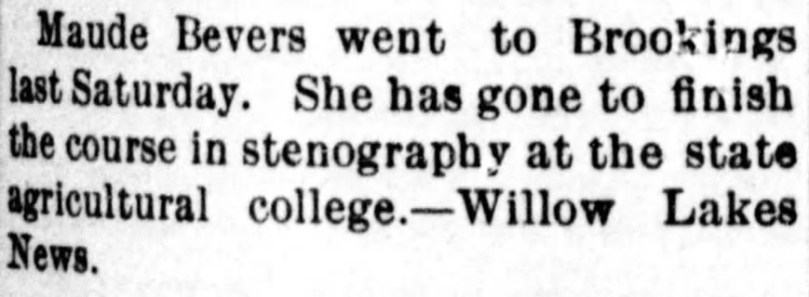
News item of The Brookings Register
May 8, 18975

During the 1897-98 school year, there were about 550 students attending SDAC.  Two-thirds of them were men and one-third women.  The college catalog explained the affordability for students to attend the state-established college:

No young person should be deterred from obtaining a liberal education when such advantages as this college offers can be had at a nominal price.  The aggregate of all the regular fees is only four dollars per quarter and is payable at the time of registration.  Books and stationery are furnished by the student.  A laboratory fee of one dollar is charged for the use of each laboratory in which a student takes work.6

Due to the expansion of the educational departments during the first decade and a half, the dormitories had been converted into classrooms and teaching labs.  By 1896, there was only one cottage available for lodging on the campus.  It held about 20 young women.  The rest of the student population boarded in Brookings—a town with a population of nearly 2000—in private homes or hotels, starting at about 50 cents per week.7  It is not known whether Maude lodged on or off campus. The expenses of the average student who attended three quarters of the school year were: $6.00 for tuition, $90.00 for board and room, $45.00 for clothes, $15.00 for laundry, $25.00 for books and stationery, and $10.00 for traveling expenses.8

About fifteen percent of the SDAC students of the 1897-98 school year were majoring in Commercial Science.  The college catalog described the aim of the department:

Appreciating the fact that business men are governed largely by certain specific and established rules, it becomes necessary that this department keep in touch with these usages and impart the same to the student in such definite and concise terms as shall prepare him for successful entrance to the business world.

The rooms for the department are exceptionally well suited and adapted to the work of the business student.  The amanuensis room is supplied with fifteen typewriting machines and ample table and black board surface.  The offices such as the Bank, Post Office and Mercantile are well fitted for giving the student actual practice in business methods.  The college library affords good opportunity for references and collateral reading. …9

Note: The 1886 edition of Webster’s Dictionary defines amanuensis as “A person whose employment is to write what another dictates, or to copy what another has written; a copyist.”10
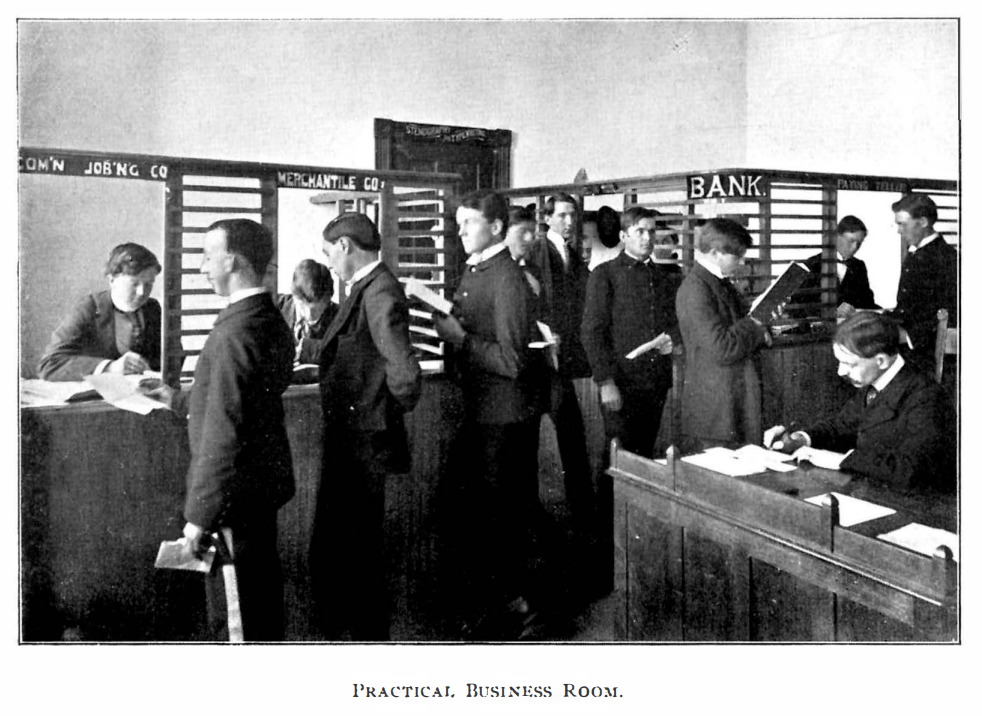
A simulated business center at SDAC11

Based on the dates that news items reported about when Maude was at the college or left the college, it appears that Maude attended for two years.  Therefore, she would not have earned a bachelor’s degree, but she may have completed the coursework to earn a certificate of graduation in Commercial Science. To earn this certificate, a student had to complete the courses of shorthand, penmanship, advanced dictation, commercial law, bookkeeping, business practice, correspondence, typewriting, commercial arithmetic and English words.  The description of the course in English Words was: “A study of Anglo-Saxon, Latin, French and Greek derivatives and synonyms.  This course is designed to form an intermediate step between grammar and rhetoric, and aims to make the student familiar with the elements entering into the growth and present use of the English language.”12
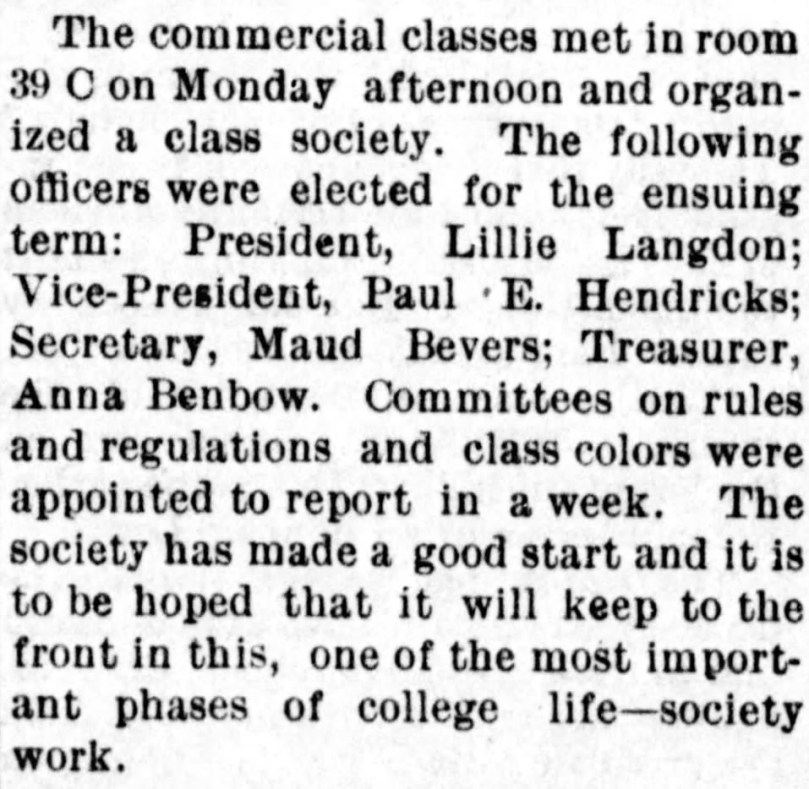
News item of The Brookings Register
October 2, 189713

In June 1897, The Brookings Register reported “Rev. Bevers, of Willow Lakes, led chapel devotionals Thursday noon.”14  This was Maude’s father.  The SDAC students were not required to attend the chapel exercises, instead the college catalog stated:

The Young Men’s and Young Women’s Christian Associations are important elements in retaining a strong christian fellowship among the student body.  Their relations to the State and Inter-National organizations assist in keeping the college in touch with other educational institutions.  … [T]hese student organizations are allowed to take the religious lead by holding prayer and devotional meetings nearly every day to which all are invited.15

Another item in The Brookings Register reported that Maude left the college in March 1898, stating that she had “accepted a position which she [was] fully capable of filling.“16 According to a family historian, she was hired by Alfred Newman Waters, an attorney and realtor, doing business in De Smet, South Dakota.17  A. N. Waters was one of the pioneer settlers of Kingsbury County, arriving in August 1880.18  He had been a prominent citizen of De Smet since its founding.  Besides being a businessman, a few of the capacities in which he served the community were as a notary public, a director on the boards of financial businesses, and a county court judge. When Maude became an office worker in De Smet, she joined the nearly eighteen percent of gainfully employed workers in the United States who were women.19  Also, among the gainfully employed women, she joined the nine percent of women engaged in nonagricultural pursuits who were working in the clerical field.20
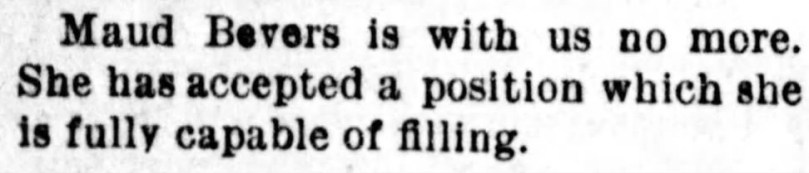
News item of The Brookings Register
March 29, 1898

Traditionally, rather than pursue an occupation in the community, most women have worked within the home.  The percentage of women that were gainfully employed in 1870 was less than 10 percent.21  The three occupations most often held by women between 1870 and 1900 were domestic service worker, teacher, and nurse.  As the industrial revolution advanced, more women entered the workforce.  By 1900, the percentage of women that were gainfully occupied was over 14 percent22 and the percentage of single women that were gainfully occupied was nearly 41 percent.23 One of the reasons for this growth was an increase in the demand for professional and semi-professional workers, including clerical workers, due to “the need by business and industry for accurate record-keeping, with the development of large-scale business practices, and with modern methods used in distributing the output of a vastly expanded economy.”24  A report of the United States Department of Labor provides additional information on this point:

The invention of the typewriter and other office machines, in response to the growing needs of business, made it possible to carry out record keeping, communication, and related activities on a tremendous scale.  The result was the creation of entirely new occupations many of which women perform.25

The greatest rate of increase for women “office workers” in any decade occurred from 1880 to 1890.  Women in these selected office occupations [referring to stenographers, typists, and secretaries; shipping and receiving clerks; clerical and kindred workers; and office machine operators] multiplied nearly 20 times – a testament to the growing acceptance of the typewriter and of the trained woman typist.26

In 1900, the percentage of office workers that were women was about 29%.27 “In taking on the functions of clerical workers, women did not replace men.  Rather they found entirely new opportunities.”28


By the fall of 1898, Maude’s parents and sister Gertrude had moved to De Smet as well.  In 1900, Maude and her family lived on First Street.29  The Methodist Episcopal church was only a few blocks away.  Records of the church state that all of them became members on November 26, 1898.30  Maude was the church choir leader for many years.31  In addition, the minutes of the women’s group noted that in December 1902 she was the organist at the Epworth League meeting (an organization for young adults), and she was the secretary pro tem at the women’s meeting on April 16, 1903.

Maude had a poetic and artistic side to her.  On February 14, 1900, she created a tribute to Lieutenant Sidney Ellsworth Morrison.  It is not known what the relationship was between Maude and Lieutenant Morrison, but it is noteworthy that the tribute was dated on Valentine’s Day.  An item in The Christian Advocate, dated April 27, 1899, reads: “Lieutenant Sidney Morrison, who was killed in the recent charge of the South Dakota Regiment at Mariloa, was a brother of the Rev. J. G. Morrison, Pastor of Franklin Avenue Church, Minneapolis, Minn.”

Sidney Morrison was a member of Company E of First South Dakota Infantry and his rank was 2nd Lieutenant.  He died in the Philippines on March 27, 1899,32 but it wasn’t until January 25, 1900, that his remains were transported on the ship “City of Peking” to his father James Morrison, whose residence was De Smet, South Dakota.33

Maude’s tribute, entitled Translated, is typewritten.  As far as is known, this is the earliest piece of family memorabilia that was written using a typewriter.  The keys $, #, % and @ were used to create the decorative border.
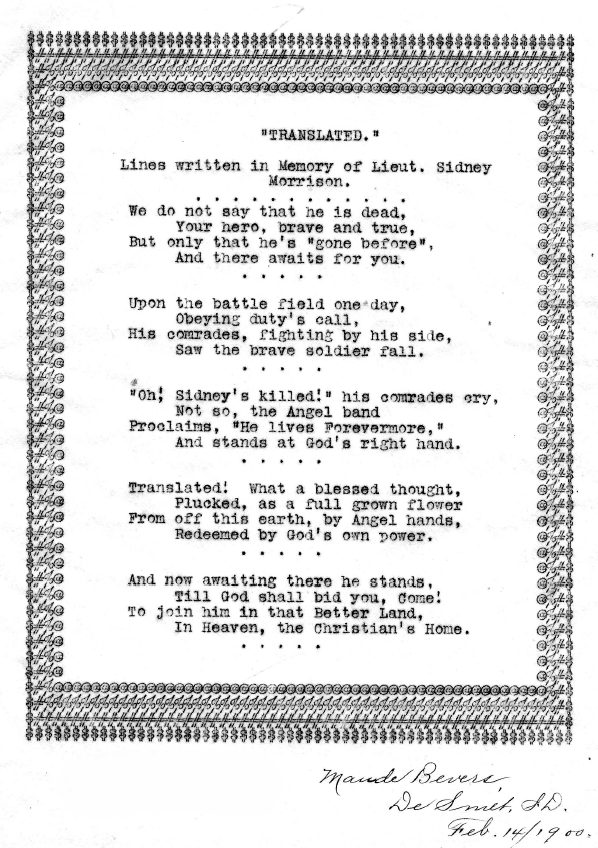
More about Maude’s life will be continued in another blogpost.


1 South Dakota Agricultural College [SDAC], “The South Dakota Agricultural College Catalog 1897-1898 with Announcements for 1898-1899” (1898). Campus Course Catalogs and Bulletins. Paper 15, https://openprairie.sdstate.edu/cgi/viewcontent.cgi?article=1011&context=archives_catalogs, page 31.

2 SDAC, “SDAC Catalog 1897-1898,” page 31.

3 SDAC, “SDAC Catalog 1897-1898,” page 14.

4 United Methodist Church, Dakotas Conference, Commission on Archives and History, personal communication with M. R. Wilson, June 20, 1995.

5 “Items of Local Interest,” The Brookings Register (Brookings, South Dakota), May 8, 1897, page 3, Newspapers.com.

6 SDAC, “SDAC Catalog 1897-1898,” page 56.

7 SDAC, “SDAC Catalog 1897-1898,” page 57.

8 SDAC, “SDAC Catalog 1897-1898,” page 57.

9 SDAC, “SDAC Catalog 1897-1898,” page 83.

10 Noah Webster, Webster’s complete dictionary of the English language (London: George Bell & Sons, 1886): 42, https://archive.org/details/websterscomplete00webs/page/42/mode/2up.

11 SDAC, “SDAC Catalog 1897-1898,” following page 82.

12 SDAC, “SDAC Catalog 1897-1898,” page 89.

13 “College News,” The Brookings Register (Brookings, South Dakota), October 2, 1897, page 4, Newspapers.com.

14 “College Chestnuts,” The Brookings Register (Brookings, South Dakota), June 16, 1897, page 4, Newspapers.com.

15 SDAC, “SDAC Catalog 1897-1898,” page 43.

16 “College News,” The Brookings Register (Brookings, South Dakota), March 29, 1898, page 2, Newspapers.com.

17 K. and M. Bevers, notes attached to Agnes Maude Bevers in Ancestral Quest program file dated June 29, 2022.

18 The De Smet News, “A. N. Waters, Pioneer, Laid to Rest Here Sunday” (De Smet, South Dakota), September 2, 1927, in Waters, http://www.pioneergirl.com/waters_cemetery.pdf.

19 Joseph A. Hill, Women in Gainful Occupations 1870 to 1920 (Washington, D. C., USA: United States Government Printing Office, 1929): 52, https://babel.hathitrust.org/cgi/pt?id=hvd.hba9kx&seq=1.

20 Joseph A. Hill, Women in Gainful Occupations 1870 to 1920: 40.

21 Janet M. Hooks, Women’s Occupations Through Seven Decades (Washington, D. C., USA: United States Government Printing Office, 1947): 34, https://babel.hathitrust.org/cgi/pt?id=uiug.30112104139180&seq=1.

22 Janet M. Hooks, Women’s Occupations Through Seven Decades: 34.

23 Janet M. Hooks, Women’s Occupations Through Seven Decades: 39. 

24 Janet M. Hooks, Women’s Occupations Through Seven Decades: 72.

25 Janet M. Hooks, Women’s Occupations Through Seven Decades: 72.

26 Janet M. Hooks, Women’s Occupations Through Seven Decades: 74.

27 Janet M. Hooks, Women’s Occupations Through Seven Decades: 76.

28 Janet M. Hooks, Women’s Occupations Through Seven Decades: 75.

29 “United States Census, 1900”, , FamilySearch (https://www.familysearch.org/ark:/61903/1:1:MMRW-TKS : Sat Aug 17 18:09:29 UTC 2024), Entry for Alfred C Peevers and Mary N Peevers, 1900.

30 First Methodist Church of De Smet, “Record of Members.”

31 First Methodist Church, “A History of the Church,” Consecration Service of the Remodeled First Methodist Church (De Smet, South Dakota: First Methodist Church, September 26, 1965).

32 “LT Sidney Ellsworth Morrison,” Find a Grave, https://www.findagrave.com/memorial/154931201/sidney-ellsworth-morrison.

33 Ancestry.com, U.S., National Cemetery Interment Control Forms, 1928-1962 [database on-line] (Lehi, UT, USA: Ancestry.com Operations, Inc., 2012): http://www.Ancestry.com.
Ada and William Mankey

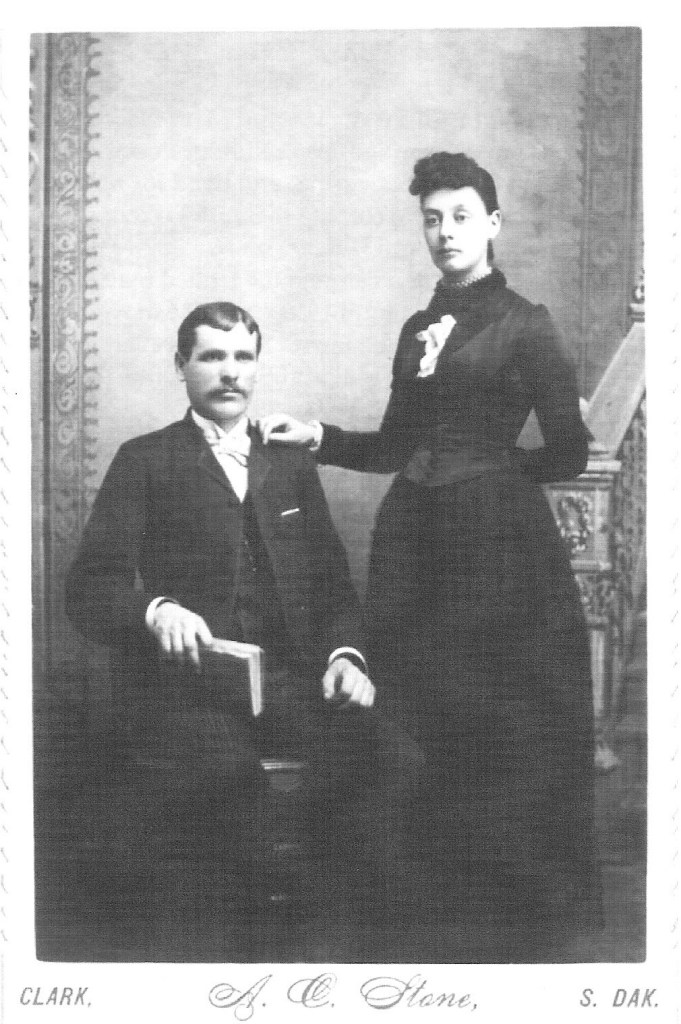
It was probably in the fall of 1885 that 18 year-old Ada Bevers met William Mankey.  Ada had immigrated from England only about 10 months prior.  William, having immigrated from England in 18751 and having worked (as of 1880) in a mine in Deer Park Township, La Salle County, Illinois,2 by 1882 had obtained a tract of land in Clark County, Dakota Territory.3  In October 1885 Ada’s father, Alfred C. Bevers, was assigned to be the supply pastor of the Henry Methodist Episcopal (M. E.) Church in southwestern Codington County, Dakota Territory.4  The charge may have included a congregation located in Garden City as well, which was about 12 miles to the northwest of Henry, over the county line in Clark County.  It is known that in 1888, William and his mother were members of the Garden City congregation and William was also a steward of the Henry Charge.5  

Ada’s family lived in Henry for two years, then her father was assigned to Wolsey M. E. Church and the following year he was assigned to Bradley M. E. Church.  Around this time period, Alfred submitted a claim for a homestead in Phipps Township, in western Codington County, about 10 miles northeast of Garden City.  When Alfred and his wife Mary celebrated their 25th wedding anniversary in September 1889 at their small home on the homestead, it is believed that William attended the gathering.  (See a photograph of the group attending the celebration in Ada, Gertie and Maude). 

Ada and William would eventually marry on October 28, 1891.6  During the next decade, they lived on their farm in Clark County and they would have three children born to them.  Their first child, Florence Gertrude, was born on October 16, 1892.7  Her namesakes were Ada’s sisters, Florence who had died as an infant and Gertrude who was still living with Ada’s parents.  On April 13, 1894, Ada gave birth to William Arthur,8 named after his father of course and one of Ada’s deceased brothers Arthur.  On June 7, 1897, George Floyd was born, named after Ada’s eldest brother George, who was living in Philadelphia.9 By 1898, Ada’s parents and sisters Gertrude and Maude had moved to De Smet, the county seat of Kingsbury County, about 50 miles to the south of William and Ada’s farm.

William and Ada Mankey

When the 1900 United States census was taken, 32-year-old Ada and 42-year-old William had been married for eight years.10  They were living on the farm that they owned in Eden Township, Clark County.  William was a farmer and a naturalized citizen, having lived in the United States for 25 years.  The census recorded that Ada had immigrated in 1884 and had been in the United States for 16 years.  She was not a naturalized citizen (although she had submitted her intention to become a citizen in 1889.)11  Seven year-old Florence had attended five months of school that year.  W. Arthur was six years-old and G. Floyd was two years old.  On the section to the east of William and Ada’s farm, William’s mother Mary lived with his brother Tobias, his sister Margaret Minor and Margaret’s three children.12  William’s father Thomas had passed away in 1899 and is buried in Garden City Cemetery.13

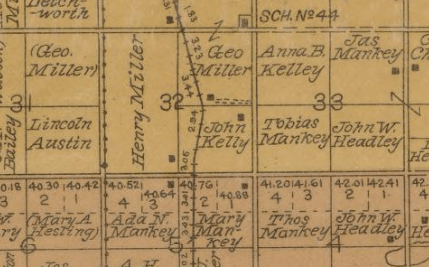
The quarter section in Eden Township that William and Ada owned can be found on a 1900 map of Clark County; the farm is about a mile north of Garden City and labeled with Ada’s name.14  Adjacent to Ada and William’s farm, the map shows the quarter section owned by Mary Mankey, and to the east of her farm, William’s brother Thomas Mankey held a quarter section.  Not far away in Maydell Township to the north were the farms of William’s brothers Tobias and James Mankey.

Cropped from a map of Clark County, South Dakota, dated ca. 1900.

William and Ada added another daughter to their family, Hazel Maude, on September 14, 1904.15  She was named after Ada’s youngest sister Maude.  When the South Dakota census was taken in 1905, the Mankey family was still living at the same location in Eden Township.  Four years later, William’s mother passed away in 1909 and was buried with his father in Garden City Cemetery.16

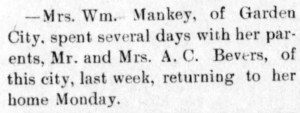
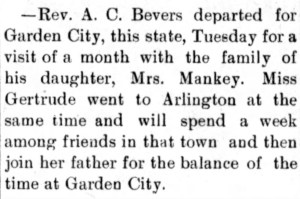
In late winter 1909, Ada made a trip to De Smet to visit her parents for several days.  Possibly she traveled by train.  The Chicago, Milwaukee and Saint Paul Railway had an extension which had stations at Garden City and Lake Preston, a town ten miles to the east of De Smet.  A year and a half after this visit, Ada’s mother, who had been afflicted with diabetes for nearly four years, passed away in July 1910.17  Shortly afterwards, Ada’s father spent a month at Ada’s home and her sister Gertrude joined them after visiting some friends.

Reported in Kingsbury County Independent, March 5, 1909
Reported in Kingsbury County Independent, August 26, 1910

When the 1910 United States census was taken, Ada and William were still living on a farm in Eden Township.18  Florence (age 17), W. Arthur (age 16) and G. Floyd (age 12) had all attended school that year.  Hazel at five years-old had not attended school.  While in high school, W. Arthur made a glider from plans published in the magazine Popular Mechanics.19

Both the 1900 and the 1910 censuses asked women how many children they had and how many of them were alive.  Ada had given birth to four children and all of them were alive.  This was unlike her mother, who had born 11 children, six of which passed away in their first or second year of life.  In England early childhood mortality (deaths of children between the age one and five) had begun to decline about 1870, but infant mortality (deaths of children before the age of one) didn’t decline until around the turn of the twentieth century.20  Ada’s mother was living in England and bearing children when infant mortality was high.  Ada’s children were born during a period of steady decline in child mortality in the United States.21

In 1915 when the South Dakota state census was taken, Florence and Hazel were at home with Ada and William.22  W. Arthur was attending his second year of college at Dakota Wesleyan University (DWU) in Mitchell, South Dakota.23  He was studying Engineering and Math.24  The census records identify the family’s religion as “M. E.” (Methodist Episcopal).  It is not known where G. Floyd was at the time of this census, but according to the 1930 United States census he was a veteran of “the World War,”25 which would be World War 1.  He was a seaman in the United States Navy from May to December 1918.26 

The first of William and Ada’s children to marry was W. Arthur.  He married Birdella A. Carhart in April 1916 in Mitchell,27 where they had met while he was attending DWU.  The officiating clergyman was Birdella’s father, A. E. Carhart, who was a minister in the M. E. Church.  A year and a half after their marriage, W. Arthur and Birdella had their first child, born in December 1917, giving William and Ada their first grandchild.  By then, W. Arthur and Birdella were living in Washington, D. C.28  They would give Ada and William their second and third grandchildren in July 1921 and January 1924. 

By the time the United States census was taken in January 1920, William and Ada had purchased and lived on a dairy farm outside of Remington, Fauquier County, Virginia, about 60 miles southwest of Washington, D. C.29  William was 61 years-old, a naturalized citizen and a dairy farmer.  Ada was 52 years-old and she was also naturalized.  Their 27 year-old daughter Florence and 15 year-old daughter Hazel were living with them, and Hazel was attending school.  W. Arthur, Birdella and their child were in a rented place in Washington, D. C.30  W. Arthur was a draftsman, working for the Navy Department.  G. Floyd was possibly lodging in Washington, D. C. and working as an automobile salesman.31  A year after the census was taken, back in DeSmet, South Dakota, Ada’s father passed away in September 1921.32 

In the early 1920s, W. Arthur would move to southern California and embark on a career in aviation engineering.  During the next several decades he would play a role in the advancement of the aviation field and in its regulation.  One of his first accomplishments was modifying an airplane wing which with one further modification became the wing of Colonel Charles Lindbergh’s plane, the Spirit of Saint Louis.33  In 1927, the Spirit of Saint Louis was the first plane to be successfully flown across the Atlantic Ocean.

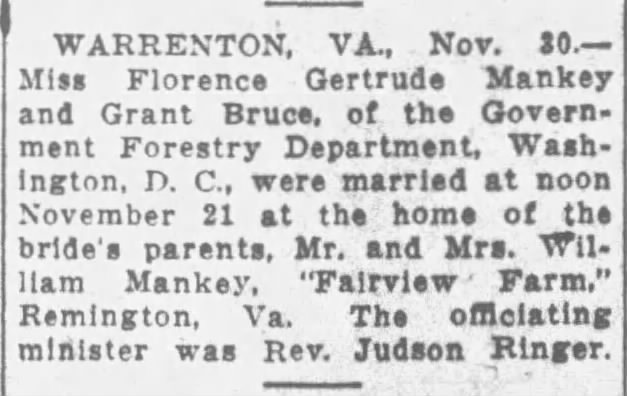
At noon on November 21, 1923, a wedding was performed at Ada and William’s “Fairview Farm.”34  Florence married Grant B. Bruce, a widower employed by the Government Forestry Department in Washington, D. C.  The city directory provides additional information:  He was a statistician for the Department of Agriculture.35  Upon settling in Grant’s home in northwest Washington, D. C., Florence would host lodgers in their home for the next couple of decades.  Many of the lodgers worked for the United States government. 

Reported in Richmond Times-Dispatch, December 1, 1923

Two more weddings occurred in the 1920s.  Hazel married James H. Weeks in October 1924,36 and G. Floyd, who had moved to San Francisco in the mid-1920s, married Lucia Neira, an Italian immigrant, in May 1927.37

In December 1927, Ada’s sister Gertrude mailed a Christmas greeting card from the town of Remington, Virginia.  The card was addressed to one of her brother Herbert’s sons and his wife, Willis and Elizabeth Bevers, in Hazel, South Dakota.  Presumably Gertrude was visiting Ada and her family.

According to the 1930 United States census, 61 year-old Ada and 71 year-old William were living on a dairy farm that they owned, still in Fauquier County.  William was a farmer and he had worked on the day before the census taker visited their home.38  He was not a veteran.  They did not own a radio set.  Florence and Grant were living at the same location in Washington, D. C.39  W. Arthur and his family had left California and were living in Detroit, Michigan.  W. Arthur was an aeronautical engineer, working in the auto products industry.40   George and Lucille were in San Francisco and George was working as an automobile salesman.41  They owned a radio set.  Hazel and James were living with her in-laws on her father-in-law’s dairy farm which was not far from Ada and William.42  They had two children by this time, giving Ada and William a total of five grandchildren.  Three years later, Florence would give them their sixth grandchild.

In 1935, Ada and William still lived on a farm outside of Remington.43  Florence and Grant with their child were living at the same address as previously in Washington, D. C.44  W. Arthur and his family had moved to Santa Monica, California.45  Hazel and James were on a farm in Lee, Virginia.46  George and Lucille still lived in San Francisco,47 but by 1937, they would move to southern California where Lucille gave birth to Ada and William’s seventh grandchild.48

Tragedy struck Ada and Florence within a single day of each other.  Florence’s husband died on April 30, 1938.  Grant had worked for the federal government for about 37 years and had been “in charge of all map records of the United States Forest Service” for 25 years before his retirement in May 1937.49  The day after Grant died, William at nearly 80 years-old passed away on May 1, 1938.  His death certificate states that he worked as a dairy farmer “to time of death.”50  William is buried in Remington Cemetery, Remington, Virginia.

The 1940 United States census record indicates that 72 year-old Ada was a lodger in Washington, D. C. and in the previous year she had received more than $50.00 that was not money wages or salary.51  Florence, at 46 years-old was continuing to live at the same residence which she owned in Washington, D. C.; also at the residence was her seven year-old child and three lodgers.52  W. Arthur had returned to the east coast, he and his family were living in Baltimore County, Maryland.53  He was an aeronautical engineer at an airplane factory.  George and Lucille had moved to Montebello, Los Angeles County and he was working as a house roofer.54  Hazel and her family were still living on a farm in Lee, Virginia.55  Her father-in-law lived with them and they had two children.  There was also a lodger and a servant living with them.

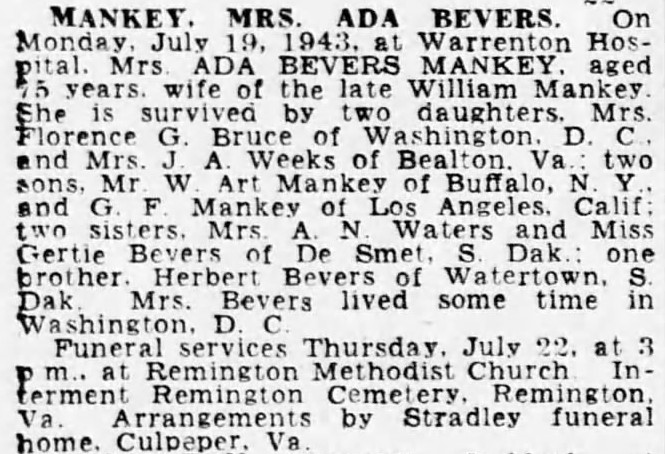
During the last years of Ada’s life, her eighth and ninth grandchildren were born, the children of Hazel and James, born in 194056 and 1943.57  At the age of 75, Ada’s last days were spent in Warrenton Hospital, Fauquier County and she died there on Monday, July 19, 1943.  She is buried in Remington Cemetery with her husband.

Reported in Washington, D. C.’s Evening Star, July 21, 1943

1 Ancestry.com, New York, Passenger Lists, 1820-1957 (Provo, Utah, USA: Ancestry.com Operations Inc, 2010): http://www.Ancestry.com.

2 “United States Census, 1880”, database with images, FamilySearch (https://www.familysearch.org/ark:/61903/1:1:MXV4-9J7 : Mon Sep 18 07:00:43 UTC 2023), Entry for Thomas Mankey and Mary Mankey, 1880.

3 “United States Bureau of Land Management Tract Books, 1800-c. 1955,” database with images, FamilySearch (https://familysearch.org/ark:/61903/3:1:3QS7-89WS-ZB44?cc=2074276&wc=M7WS-8ZC%3A356164401%2C356186301 : 14 October 2022), Dakota Territory > Vol 32 > image 54 of 254; Records Improvement, Bureau of Land Management, Washington D.C.”

4 United Methodist Church, Dakotas Conference, Commission on Archives and History, personal communication with M. R. Wilson (June 20, 1995).

5 J. G. Palmer, Palmer’s Directory of the Methodist Episcopal Church for Dakota Conference, “Henry” (1888): 128.

6 K. & M. Bevers, marriage note attached to William Mankey in Ancestral Quest program file dated June 29, 2022.

7 South Dakota Department of Health, “South Dakota Birth Records With Birth Dates Over 100 Years,” [Birth Information for Florence Mankey, State File Number: 599515]: https://apps.sd.gov/PH14Over100BirthRec/resultDetail.aspx?args=B7173D5000910C4994EA3F8456480222D6E12B84CB216B4C0933C9B568E36E1D0E715C23B1B77D480BE3E15CB8FC342C.

8 K. and M. Bevers, record of William Arthur Mankey, Ancestral Quest program file dated June 29, 2022.

9 South Dakota Department of Health, “South Dakota Birth Records With Birth Dates Over 100 Years,” [Birth Information for George Mankey, State File Number: 571260]: https://apps.sd.gov/PH14Over100BirthRec/resultDetail.aspx?args=B7173D5000910C4994EA3F8456480222567A6332A151C9247E16A4E0455BC1DD47D4462802BD74BF1CB49DF6E38B4573.

10 “United States Census, 1900,” database with images, FamilySearch (https://familysearch.org/ark:/61903/3:1:S3HY-6PQ9-455?cc=1325221&wc=9BW8-7MH%3A1031648401%2C1030694601%2C1032143801 : 5 August 2014), South Dakota > Clark > ED 89 Eden, Elrod & Maydell Townships > image 5 of 16; citing NARA microfilm publication T623 (Washington, D.C.: National Archives and Records Administration, n.d.).

11 United States of America, “First Naturalization Paper of Ada N. Bevers,” (Codington County, Dakota Territory: USA, May 22, 1889).

12 “United States Census, 1900,” database with images, FamilySearch (https://familysearch.org/ark:/61903/3:1:S3HY-6PQ9-QHQ?cc=1325221&wc=9BW8-7MH%3A1031648401%2C1030694601%2C1032143801 : 5 August 2014), South Dakota > Clark > ED 89 Eden, Elrod & Maydell Townships > image 6 of 16; citing NARA microfilm publication T623 (Washington, D.C.: National Archives and Records Administration, n.d.).

13 South Dakota State Historical Society, online cemetery search, “Thomas Mankey,“ https://apps.sd.gov/dt58cemetery/.

14 Peterson, E. F., and S. Wangersheim. Map of Clark County, South Dakota: compiled and drawn from a special survey and official records (Vermillion, S.D.: E. Frank Peterson, 1900): https://www.loc.gov/item/2012593005/.

15 South Dakota Department of Health, “South Dakota Birth Records With Birth Dates Over 100 Years,” [Birth Information for Hazel Mankey, State File Number: 599514]: https://apps.sd.gov/PH14Over100BirthRec/resultDetail.aspx?args=B7173D5000910C4994EA3F845648022241EB9E32217A5B880C0B80F399C73EA3C6FFD3355FD484F8AC6A0AC2E2AEC648.

16 South Dakota State Historical Society, online cemetery search, “Mary Mankey,“ https://apps.sd.gov/dt58cemetery/.

17 Kingsbury County Independent, “Mrs. Alfred C. Bevers,” (DeSmet, South Dakota: July 22, 1910): 4.

18 “United States Census, 1910,” database with images, FamilySearch (https://familysearch.org/ark:/61903/3:1:33S7-9TD2-CVC?cc=1727033&wc=QZZH-XC3%3A133638201%2C133675901%2C133835401%2C1589089262 : 24 June 2017), South Dakota > Clark > Eden > ED 108 > image 3 of 8; citing NARA microfilm publication T624 (Washington, D.C.: National Archives and Records Administration, n.d.).

19 K. & M. Bevers, biographical note attached to W. A. Mankey.

20 University of Cambridge, Populations Past – Atlas of Victorian and Edwardian Population, https://www.populationspast.org/about/.

21 Statista, Child mortality rate (under five years old) in the United States, from 1800 to 2020, https://www.statista.com/statistics/1041693/united-states-all-time-child-mortality-rate/.

22 “South Dakota State Census, 1915,” database with images, FamilySearch (https://familysearch.org/ark:/61903/3:1:S3HY-6917-3R9?cc=1476041&wc=MJQL-MNL%3A1041735101 : 21 May 2014), 004245361 > image 1948, 1970, 1972 & 1997 of 3079; State Historical Society, Pierre.

23 “South Dakota State Census, 1915,” database with images, FamilySearch (https://familysearch.org/ark:/61903/3:1:S3HY-691Q-K1F?cc=1476041&wc=MJQL-MNL%3A1041735101 : 21 May 2014), 004245361 > image 1953 of 3079; State Historical Society, Pierre.

24 K. & M. Bevers, biographical note attached to W. A. Mankey.

25 “United States Census, 1930,” database with images, FamilySearch (https://familysearch.org/ark:/61903/3:1:33SQ-GR4N-9Y7?cc=1810731&wc=QZFS-M82%3A648807101%2C651480501%2C651480502%2C1589283887 : 8 December 2015), California > San Francisco > San Francisco (Districts 1-250) > ED 134 > image 40 of 43; citing NARA microfilm publication T626 (Washington D.C.: National Archives and Records Administration, 2002).

26 “United States Headstone Applications for U.S. Military Veterans, 1925-1949,” database with images, FamilySearch (https://familysearch.org/ark:/61903/3:1:3QS7-994Q-YRD4?cc=1916249&wc=MDBG-K68%3A205942901%2C213448601 : 26 April 2021), 1941-1949 > Mangum, Tully-Marks, Edward > image 136 of 2371; citing NARA microfilm publication M1916 (Washington, D.C.: National Archives and Records Administration, n.d.).

27 Ancestry.com, South Dakota, U. S., Marriages, 1905-2018 (Ancestry.com Operations, Inc.: Lehi, Utah, USA, 2005).

28 The Mitchell Capital (Mitchell, South Dakota, December 13, 1917): 3.

29 “United States Census, 1920,” database with images, FamilySearch (https://familysearch.org/ark:/61903/3:1:33SQ-GRFW-4QZ?cc=1488411&wc=QZJT-FXV%3A1038215501%2C1038273601%2C1036505301%2C1589332367 : 14 September 2019), Virginia > Fauquier > Lee > ED 47 > image 19 of 42; citing NARA microfilm publication T625 (Washington, D.C.: National Archives and Records Administration, n.d.).

30 “United States Census, 1920,” database with images, FamilySearch (https://familysearch.org/ark:/61903/3:1:33S7-9R69-46Q?cc=1488411&wc=QZJG-FM7%3A1036474401%2C1036474402%2C1036476301%2C1589335824 : 10 September 2019), District of Columbia > Washington > Washington > ED 317 > image 18 of 28; citing NARA microfilm publication T625 (Washington, D.C.: National Archives and Records Administration, n.d.).

31 “United States Census, 1920”, , FamilySearch (https://www.familysearch.org/ark:/61903/1:1:MNLV-Z7N : Thu Oct 05 15:18:14 UTC 2023), Entry for George F Mauky, 1920.

32 The Tabor Independent (Tabor, South Dakota, October 6, 1921): 6.

33 The Los Angeles Times (Los Angeles, California, April 20, 1985): 61.

34 Richmond Times-Dispatch (Richmond, Virginia, December 1, 1923): 4.

35 Ancestry.com, Boyd’s Directory of the District of Columbia 1923, U.S., City Directories, 1822-1995 [database on-line] (Lehi, UT, USA: Ancestry.com Operations, Inc., 2011).

36 K. & M. Bevers, biographical note attached to Hazel Maude Mankey, Ancestral Quest program file dated June 29, 2022.

37 Ancestry.com, “California, U.S., Federal Naturalization Records, 1843-1999” [Naturalization record of Lucille Mankey, Naturalization Records/i. National Archives at Riverside, Peris, California] (Lehi, UT, USA: Ancestry.com Operations, Inc., 2014).

38 “United States Census, 1930,” database with images, FamilySearch (https://familysearch.org/ark:/61903/3:1:33SQ-GRZF-38K?cc=1810731&wc=QZFW-811%3A648805201%2C650224701%2C648825601%2C1589282415 : 8 December 2015), Virginia > Fauquier > Lee > ED 7 > image 30 of 38; citing NARA microfilm publication T626 (Washington D.C.: National Archives and Records Administration, 2002).

39 “United States Census, 1930,” database with images, FamilySearch (https://familysearch.org/ark:/61903/3:1:33SQ-GR4D-K8R?cc=1810731&wc=QZF9-L2Q%3A648806901%2C648806902%2C648806903%2C1589285158 : 8 December 2015), District of Columbia > Washington > Washington > ED 229 > image 29 of 34; citing NARA microfilm publication T626 (Washington D.C.: National Archives and Records Administration, 2002).

40 “United States Census, 1930,” database with images, FamilySearch (https://familysearch.org/ark:/61903/3:1:33SQ-GRHZ-Z3X?cc=1810731&wc=QZF3-G74%3A648805801%2C649542601%2C651567401%2C1589285374 : 8 December 2015), Michigan > Wayne > Detroit (Districts 0251-0500) > ED 304 > image 55 of 84; citing NARA microfilm publication T626 (Washington D.C.: National Archives and Records Administration, 2002).

41 “United States Census, 1930,” database with images, FamilySearch (8 December 2015), California > San Francisco > San Francisco (Districts 1-250) > ED 134 > image 40 of 43.

42 “United States Census, 1930,” database with images, FamilySearch (https://familysearch.org/ark:/61903/3:1:33SQ-GRZF-3ND?cc=1810731&wc=QZFW-DPK%3A648805201%2C650224701%2C648825601%2C1589282427 : 8 December 2015), Virginia > Fauquier > Lee > ED 8 > image 15 of 24; citing NARA microfilm publication T626 (Washington D.C.: National Archives and Records Administration, 2002).

43 “United States Census, 1940”, database with images, FamilySearch (ark:/61903/1:1:K73M-H7C : Fri Jun 09 01:27:49 UTC 2023), Entry for Ada N Mankey, 1940.

44 “United States Census, 1940,” database with images, FamilySearch (https://familysearch.org/ark:/61903/3:1:3QS7-L9M1-53H5?cc=2000219&wc=QZFM-7NZ%3A790105901%2C790105902%2C792841801%2C792851601 : accessed 11 November 2023), District of Columbia > District of Columbia > Police Precinct 13, District of Columbia, Tract 33 > 1-508 Police Precinct 13 (Tract 33 – part), District of Columbia > image 8 of 41; citing Sixteenth Census of the United States, 1940, NARA digital publication T627. Records of the Bureau of the Census, 1790 – 2007, RG 29. Washington, D.C.: National Archives and Records Administration, 2012.

45 “United States Census, 1940,” database with images, FamilySearch (https://familysearch.org/ark:/61903/3:1:3QS7-L9M1-HL5H?cc=2000219&wc=QZXB-4M5%3A790103401%2C790855101%2C790360501%2C951056401 : accessed 11 November 2023), Maryland > Baltimore > Election District 9 > 3-58 Election District 9 S of Joppa Rd, W of Forest Av, W and N of Stevenson Av, and E of York Rd and Dulaneys Valley Rd; Aigburth Manor, Towson (part) including Baltimore County Jail and Presbyterian Home of Maryland for Aged Women > image 55 of 67; citing Sixteenth Census of the United States, 1940, NARA digital publication T627. Records of the Bureau of the Census, 1790 – 2007, RG 29. Washington, D.C.: National Archives and Records Administration, 2012.

46 “United States Census, 1940,” database with images, FamilySearch (https://familysearch.org/ark:/61903/3:1:3QSQ-G9MR-37NM?cc=2000219&wc=QZXG-CKG%3A794217401%2C796669201%2C794293801%2C796711401 : accessed 12 November 2023), Virginia > Fauquier > Lee Magisterial District > 31-11 Lee Magisterial District outside Remington Town S of Southern Railway and W of State Road 17, Morrisville (part) > image 21 of 29; citing Sixteenth Census of the United States, 1940, NARA digital publication T627. Records of the Bureau of the Census, 1790 – 2007, RG 29. Washington, D.C.: National Archives and Records Administration, 2012.

47 “United States Census, 1940”, , FamilySearch (https://www.familysearch.org/ark:/61903/1:1:K9W9-D85 : Tue Nov 28 18:48:53 UTC 2023), Entry for George F Mankey and Lucille A Mankey, 1940.

48 Ancestry.com, “California, U.S., Federal Naturalization Records, 1843-1999.”

49 Evening Star (Washington, District of Columbia, May 1, 1938): 14.

50 Commonwealth of Virginia, Department of Health, Bureau of Vital Statistics, certificate of death of William Mankey.

51 “United States Census, 1940”, FamilySearch, Entry for Ada N Mankey.

52 “United States Census, 1940,” FamilySearch (https://familysearch.org/ark:/61903/3:1:3QS7-L9M1-53H5?cc=2000219&wc=QZFM-7NZ%3A790105901%2C790105902%2C792841801%2C792851601).

53 “United States Census, 1940,” FamilySearch (https://familysearch.org/ark:/61903/3:1:3QS7-L9M1-HL5H?cc=2000219&wc=QZXB-4M5%3A790103401%2C790855101%2C790360501%2C951056401).

54 “United States Census, 1940”, FamilySearch (https://www.familysearch.org/ark:/61903/1:1:K9W9-D85), Entry for G F Mankey and L A Mankey.

55 “United States Census, 1940,” database with images, FamilySearch (https://familysearch.org/ark:/61903/3:1:3QSQ-G9MR-37NM?cc=2000219&wc=QZXG-CKG%3A794217401%2C796669201%2C794293801%2C796711401}.

56 “Virginia, Marriage Certificates, 1936-1988,” database with images, FamilySearch (https://familysearch.org/ark:/61903/3:1:3Q9M-C9TN-K9CD?cc=2370234 : 10 January 2019), > image 1 of 1; from “Virginia, Marriage Records, 1700-1850,” database and images, Ancestry (http://www.ancestry.com : 2012); citing Virginia Department of Health, Richmond.

57 “Virginia, Marriage Certificates, 1936-1988,” database with images, FamilySearch (https://familysearch.org/ark:/61903/3:1:3Q9M-C9TF-G7KK-9?cc=2370234 : 10 January 2019), > image 1 of 1; from “Virginia, Marriage Records, 1700-1850,” database and images, Ancestry (http://www.ancestry.com : 2012); citing Virginia Department of Health, Richmond.