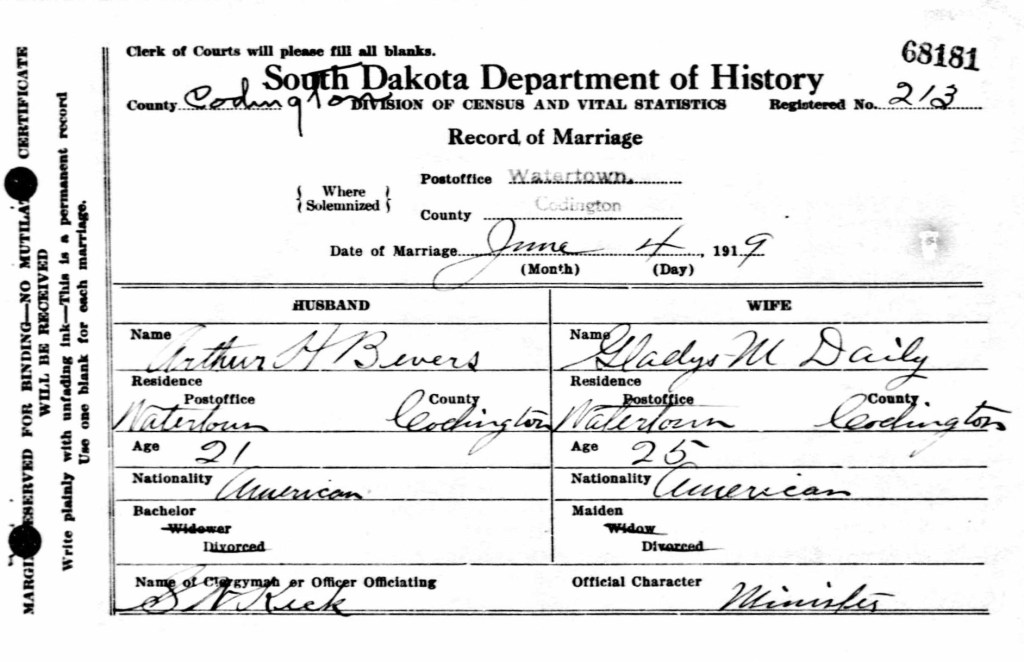
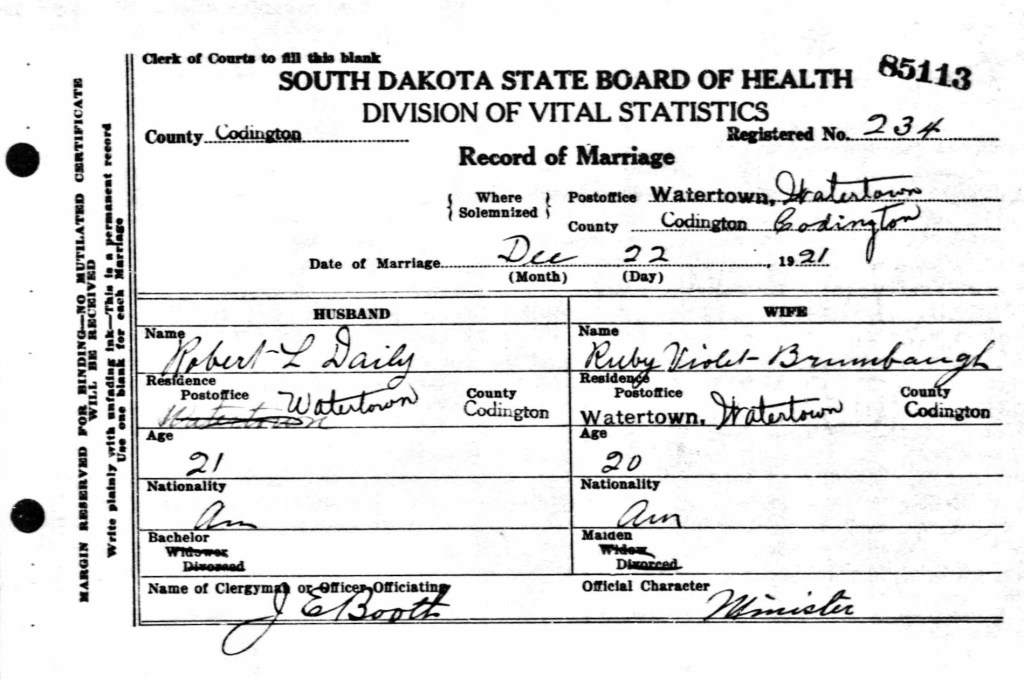
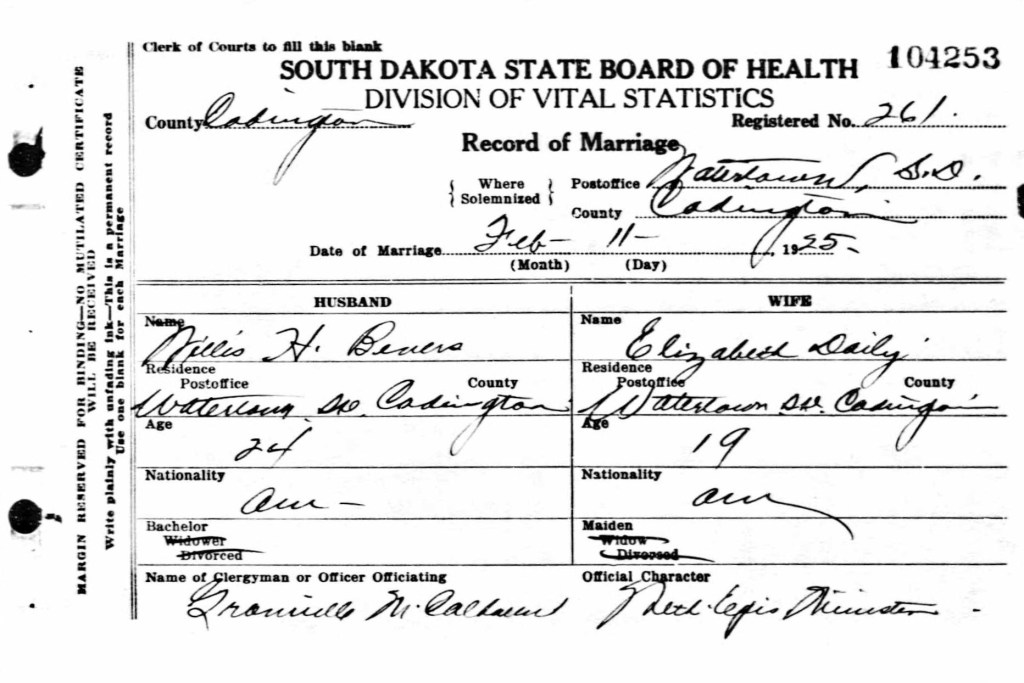
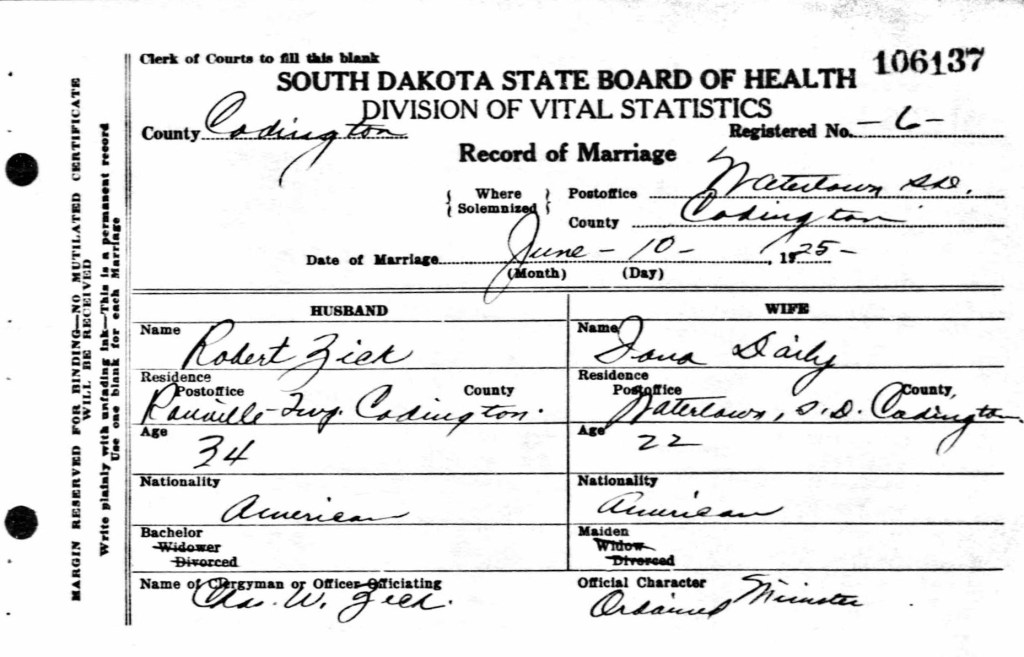
Maude and Alfred Waters, Part Two

The May 1904 news article announcing the marriage of Maude Bevers and Alfred N. Waters described the two of them as “prominent people” of the small town of De Smet, South Dakota.  (You can see the news article in Part One.) Each of them was involved in a variety of social groups and community pursuits.  For example, Maude was active in the Methodist Episcopal Church, the Red Cross and a philanthropic educational society.  Waters held civic roles and promoted improvements in their county (Kingsbury) and in their town, which as of 1906 had “a population a little in excess of 1,000 souls.”1

After her wedding, even though her husband was not a member of the church, Maude continued her activities in the Methodist church, having become a member in November 1898.  The records of the women’s group of the church noted that Maude served as secretary and 4th Vice in 1904 and 1905, respectively.  Another role in which she served was the leader of the choir, this she did for years before and after her marriage.2  In addition, “… for many years [she] was a member of a mixed quartet that sang for funerals in various churches of the town and area.”3

On a Friday night in March 1907, there was a Demorest medal contest held at the church, six young ladies competing for a Silver medal.4  Throughout the evening, musical selections were performed as well as the orations by the contestants.  One of the selections, which was entitled “David and Goliath,” was performed by a ladies’ quartette in which Maude sang a part. 


The Demorest Medal program was an educational program through which young people and community members learned about the tenets of the prohibition movement.  In 1886, W. Jennings Demorest inaugurated oratory contests, utilizing subject matter promoting the prohibition of liquor traffic.  The work began in New York City, then was introduced in California and within three years had spread throughout the United States and into several foreign nations.

Six to eight contestants competed at the local level and the winner would be awarded a Silver medal.  At the next level, six Silver medalists would compete for a Gold medal, then six Gold medalists would compete for a Grand Gold medal.  At the highest level six Grand Gold medalists competed for a Diamond medal.

In 1895, the Woman’s Christian Temperance Union (W. C. T. U.) adopted the Demorest Medal program and in the following years expanded the topics of the oratory books.  “Recitation books, embracing orations on Prohibition, Total Abstinence, Scientific Temperance, Anti-Narcotics, Franchise, Social Purity, etc., were published; medals were designed with mottoes and emblems of the W. C. T. U., and circulars setting forth the plans of this new system sent out to all the States in the Union.”5  As of January 1907, the contest publications had been disseminated into Australia, South Africa, India, Canada, Mexico and the Philippine Islands as well.
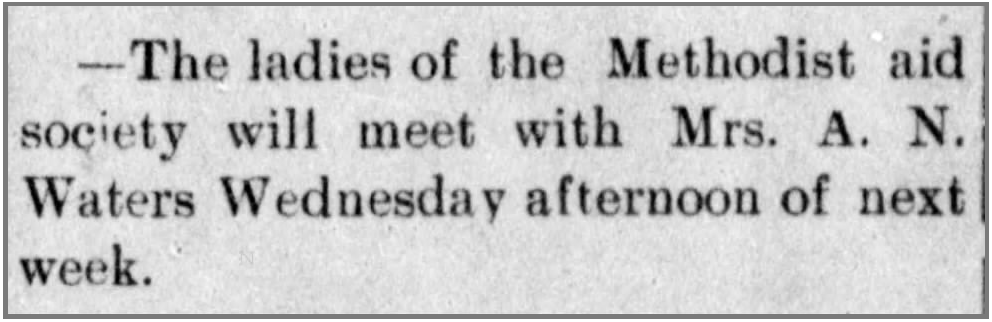

News clipping from the January 29, 1909 issue of Kingsbury County Independent

The Ladies Aid Society of the Methodist church rotated its meetings among its members.  In the first week of February 1909 the society met at Maude’s home.6  For a fundraising project that year, they produced a cookbook, entitled Kitchen Echoes.  “The venture was a very profitable one,”7 as it included advertisements for local businesses in addition to its recipe entries.  Waters Land and Loan Company, the real estate company of Maude’s husband, was one of the business sponsors, advertising that the company had the “Best Bargains in Grain, Dairy and Stock Farms.”  Maude and her sister Gertrude both submitted recipes.  Gertrude’s recipes were for Potato Salad and Sugar Cookies.  (See Gertrude’s recipes in Aunt Gertie.)  Maude’s entries were for Angel Custard and Mrs. Power’s Ginger Snaps.  The recipe for Ginger Snaps honored Elizabeth Power, a former resident and pioneer settler of De Smet, arriving in June 1880 along with her husband and four children.  Shortly before the recipe was published in Kitchen Echoes, Mrs. Power had passed away on February 11, 1909.  Her obituary stated: “Mrs. Power was one of those motherly women who everybody likes, always ready to answer sick calls, and never so happy as when doing some kind deed.  She was a life long and consistent member of the Roman Catholic church, and her remains lie in the Catholic cemetery at Bellingham [Washington].”8  Two years later, in January 1911, the Methodist aid society met again at Maude’s house.9  An entry in the treasurer’s book of the church’s women’s group indicates that Maude hosted a supper in that same month which brought in $6.60.  In 2025, an equivalent amount of money is approximately $225.00.


Angel Custard.—Separate the yolks and whites of two eggs, beat the whites to a stiff froth, adding a few drops of flavoring.  Beat the yolks, add two teaspoons corn starch wet with a little cold milk, and stir into a pint of boiling milk which has been sweetened to taste (about two-thirds cup of sugar), adding a pinch of salt the last thing.  When thickened and boiling pour the custard over the beaten whites of eggs and stir rapidly a few moments.  Delicious either hot or cold.—Maude Waters.

Mrs. Powers’ Ginger Snaps.—One-half cup butter (scant), one-half cup lard (scant), one cup white sugar, one cup molasses, one teaspoon soda dissolved in one tablespoon water, one egg, one tablespoon ginger, a pinch of salt.  Flour to mix quite stiff.—Maude Waters.
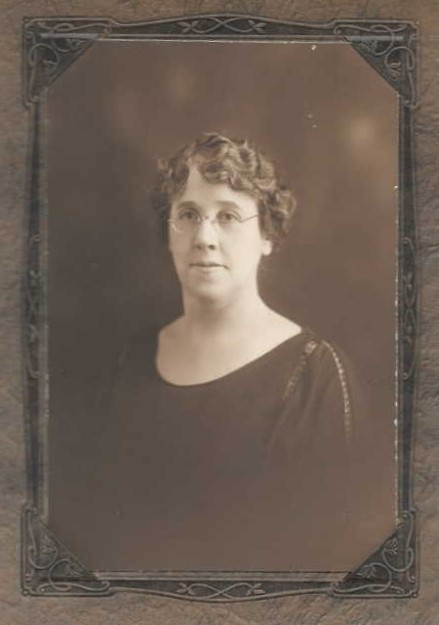
Maude (nee Bevers) Waters, estimated date 1910

From the time that A. N. Waters settled in De Smet, he served in numerous civic capacities and promoted improvements in the town, county and state.  A few of his responsibilities during the year 1905 give us a glimpse of his involvements in the local community at that time, as well as in the broader region.

  • April 1905 – At a meeting of the stockholders, Waters was elected to be a director on the board of the Athletic Association.10  Two years later, he was elected to be the president of the association, which was reported to have a large membership.11
  • August 1905 – While serving as mayor of De Smet, Waters was appointed by the South Dakota governor to be a delegate to the Trans-Mississippi Commercial Congress which met at Portland, Oregon from August 16 to 19.12  This congress was organized to promote the commercial interests of the states and territories west of the Mississippi River.  The following year, Waters was appointed again to the congress which met November 20 to 23 in Kansas City, Missouri.13
  • September 1905 – The county commissioners made Waters the chairman of a committee for the purpose of creating an agricultural exhibit to represent Kingsbury County at the state fair held in Huron, South Dakota.14  He consented to procure the materials for the exhibit and was authorized to appoint members to the committee from different parts of the county.  Waters and the committee members did not receive a salary, but the county commissioners authorized payment for the cost of transporting the materials for the exhibit to Huron.  
  • November 1905 – A real estate dealers association was formed to which Waters was elected secretary of the board.  The purpose of the association was “promoting and advancing the interests of [South Dakota] by devising ways and means to advertise its resources and encourage immigration, etc.”15  Four months later, at the March 1906 meeting of the association, which had about 250 member firms by that time, Waters gave a speech during the evening banquet which was entitled, “Had We Better Hang Together or Hang Seperate.“ [sp.]16  Moving ahead with their aims, in March 1907, Waters and about 25 members of the association met with the governor of South Dakota and the Immigration Commissioner “to consider co-operative advertisement of the state. … The association indorsed a proposition made by the Minneapolis and St. Louis railway to furnish a car and superintend and bear the expense of making a traveling exhibit of products of South Dakota farms on its line, provided the exhibit be furnished by the real estate men.”17

Waters had begun his career in real estate investment in 1880 when he arrived in De Smet, the same year that the town was founded. Thirty years later, he was continuing his career in that profession. A few of Waters’ transactions are noteworthy:

  • On April 16, 1909, Waters Land and Loan Company made a ten-year lease with the United States for the use of “the first floor of the one story … brick premises, known as ‘Waters Building’ situated on the North side of Second Street between Calumet and Joliet avenues.”18 (The consideration was $325.00 per annum in quarter yearly payments.) The Waters Building had been built in 1888-89 by the Kingsbury Abstract Company and Waters Land and Loan Company had purchased it in 1906. (More about this transfer is in Part One.) The De Smet post office had occupied a space in the building since at least 1893.19 In 1909, an extension was built onto the Waters building and the post office moved into it. The lease described above commenced the occupation of the post office in the extension. “The new post office was of fireproof construction, 25×45 feet and fitted with the latest style of furnishings. The building was heated by steam and supplied with gas and water….”20
  • About 1910, Waters owned a house at the corner of Lyle Avenue and Front Street NE.  It was the former home of Fred Dow but had been relocated from its original site.  Fred Dow had sold his farmstead and grove of trees to Waters in the early 1900s.  Waters had moved the house from the Dow farm to the corner lot across the road on Front Street NE.21 Fred Dow’s farmstead was the location of the “surveyors house” in which the Charles Ingalls’ family lived when Ingalls was hired by Dakota Central Railway in 1879. The surveyors’ house was moved in 188422 to its current site in the town of De Smet. Therefore, it had not been sitting on the property when Waters purchased the Dow farm. The surveyors’ house was purchased by the Laura Ingalls Wilder Memorial Society in 1967 and placed on the National Register of Historic Places in 1974.23
  • On September 28, 1915, Alfred purchased lot #32 of De Smet from Caroline A. Swanzey (formerly Caroline A. Ingalls) for $62.50.24  This was author Laura Ingalls Wilder’s sister, known as Carrie in Wilder’s Little House books.  In Standard Atlas of Kingsbury County, South Dakota, published in 1909, the owner of lot #32 of De Smet is noted as C. P. Ingalls, Caroline’s father who had passed away in 1902.
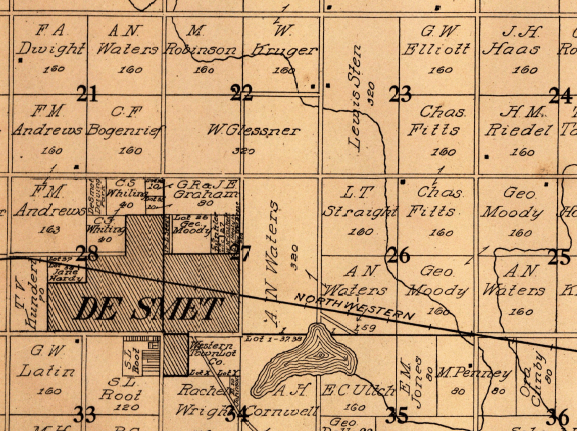
The above clipping is from a map in the 1909 edition of Standard Atlas of Kingsbury County, South Dakota.  It shows that Waters owned 320 acres directly east of De Smet.  The lower half of this property had been a tree claim filed by Fred N. Dow, and to the east of F. N. Dow’s claim, his father, James C. Dow, had filed a claim on a quarter section, which in 1909 Waters also owned.25  Through a cursory examination of the 1909 atlas, 14 properties in the county were found with Waters’ name on them (in the townships of Le Seur, Spirit, Manchester, De Smet, Esmond and Mathews).  One of the properties that Waters owned had been the homestead of Almanzo Wilder (Laura Ingalls Wilder’s husband); Wilder had sold the property to Dakota Loan and Investment in 1891, a company in which Waters was a partner.26  It is not known at this time when Waters became the sole owner.  That property can be seen on the above clipping in the upper left corner.  In addition to her husband’s properties, the atlas also indicated that Maude owned two adjoining quarters in Manchester Township.


The United States census taken in April 1910 recorded Alfred as 54 years old and working on his own account in his own real estate office.27  Maude was 35 years old and did not have an occupation.  In the record, besides Maude and Alfred, there was a housekeeper living in their home, named Izora Youmans [sp.], who was 37 years old, single and had been born in New York.

For six years, Maude’s mother, who lived a half block to the east of the Waters home with Maude’s father and sister Gertrude, had been impaired following an operation from which she did not completely heal.  Two years after the operation, her mother developed diabetes.  “All during her illness, and especially during the last months when almost helpless and suffering great pain everything that could be done to relieve and give pleasure was done for her by loving hands of her own family and friends.”28  No doubt Maude had been involved in her mother’s care until her passing on July 14, 1910.29


On the last Saturday of May 1910, Waters was invited to dine at the home of Mr. and Mrs. Charles H. Tinkham. Along with Waters and Tinkham, the other five guests were men of De Smet who had lived through the “hard winter” of 1880-81. They all had arrived in Kingsbury County in the winter and spring of 1880, except Waters who hadn’t arrived until August. When early snow storms commenced in the fall, the men stayed in the newly built buildings of the fledgling town, which had about 14 businesses.30 Recurring blizzards would cover the railroad tracks that winter, eventually closing the track altogether from January to May. About 50 families (including single men) wintered in the town. Thirty years later at the gathering held in the Tinkham home:
The varied experiences of that hard winter were all recounted. Of one thing our readers can be certain, however, and that is the dinner served on this occasion was not on the half-ration plan of some of the dinners eaten by the gentleman [sp.]during that never to be forgotten winter of [1880-81]when supplies ran low and wheat had to be ground in coffee mills, and when sugar for coffee was kept in a jewel case.31

During that trying winter, Waters boarded in the home of Arthur and Jennie Sherwood. A. S. Sherwood “is mentioned in the Laura Ingalls Wilder book The Long Winter as one of the few families wintered in for that historic experience. He and his wife … were among the few married couples in the town that winter. Some of the bachelors roomed and boarded there including A. N. Waters, in a house so small that blankets separated the beds in a sleeping room.”32 Waters himself was not mentioned in Wilder’s The Long Winter but he was mentioned in her autobiographical manuscript, Pioneer Girl, which relates the following story:
There was in town a lawyer named Waters who had expected to go east early in the winter to be married but had got caught by the storms.

Now the wedding day was drawing near and no way to get transportation out. He decided to walk and … he started before daylight one morning as the blizzard wind was dying down and the sky cleared.

It was a scant day’s calm this time and we were afraid he was caught in the next storm, but he walked the miles to Brookins [sic] safely and after resting walked on to Tracy.

The next spring we learned that he arrived safely in time for his wedding, but both feet were so badly frozen that he was unable to walk on that day. However his feet recovered and he came back in the spring, bringing his wife with him.33

The above story, of course, refers to Waters’ first wife, Josephine E. Humphrey, whereas Maude was his second wife. Waters obituary adds details to this account of the winter of 1881:
… he boarded with the Arthur Sherwood family, “Sixteen of them in a house sixteen feet square,” [Waters] called it. He lived here through the Hard Winter and in the spring of 1881 made his famed hike along the railroad track in company with a brother of Mrs. Arthur Sherwood. The whole country had been snow-bound for months and the two young men struck out for the East, hauling a sled, and in four days reached Tracy, secured a team and floundered thru to Sleepy Eye, where they were again disappointed in train service and Mr. Waters continued on alone to New Ulm.34

Another perspective on this event was recounted by the editor of De Smet News in 1921:
… The big snows of the winter of 1880-1881 caused such a blockade thruout the country that after the first of January there was no train from De Smet east until the following May. Along in March Mr. Waters became anxious to get out of the country and keep a date in the east, so he started on foot over the snow banks, carrying a hundred letters from De Smet people to their relatives and friends back home. He walked as far as Tracy, covering the distance in four days. There a team of mules hitched to a sleigh was secured and several men made use of the outfit to get as far as Sleepy Eye. At that point a train was boarded and they were scheduled to leave next morning; but a storm prevented and they were there a whole week. Mr. Waters became uneasy at the delay and started out alone, hoofing it to New Ulm. There the road was open and he was soon on his way east.35

Charles H. Tinkham, the host of the 1910 gathering of De Smet pioneers, had arrived in De Smet in the spring of 1880.  Soon after his arrival Tinkham opened a furniture and houseware store, and he also engaged in undertaking.36   During the “hard winter,” “Tinkham was a member of the ‘bachelor’s club’ who lived with William Crook, sleeping on boards laid across the ceiling joists.”37 

Among the guests attending the dinner was Charles L. Dawley, who settled in De Smet in May 1880.  As an agent for a lumber company, he began “selling loads of lumber to the new settlers. He set up an office tent and sold lumber from railroad cars until an office and shed could be built. During the Hard Winter, he boarded with Mrs. Garland, and began courting her daughter Florence.”38  Florence was Laura Ingalls Wilder’s teacher during that winter.  Within a few years, Dawley left the lumber business to go into real estate with Waters, a partnership which lasted 15 years.  Waters, Dawley and Alfred Thomas were associates who established the Dakota Loan and Investment Company, “which continued the loan business previously run by Alfred Waters, doing a general real estate and chattel loan business.”39 Waters and Dawley took full control of the business in 1887.

The other guests were Charles E. Ely, Edward H. Couse, Daniel H. Loftus and John H. Carroll.  About April 1880, Ely was a lumber agent also, selling lumber in De Smet from a rail car.  Subsequently, he established the town’s first lumber yard.40  He was married, but had not yet moved his family to De Smet when the winter storms came later that year.  Couse, who was also married when he came to De Smet and a Civil War veteran, was the owner of a hardware store.41  Loftus was a partner in a general merchandise store in 1880, and in February 1881 in the midst of the “hard winter”, a local newspaper reported, “the first grist of wheat was ground in De Smet on the 5th, by Dan Loftus. Dan makes a fine miller.”42

John H. Carroll was the first clerk of courts in Kingsbury County (April 1880) and he was the first postmaster, later he would become the first mayor of De Smet.43 His homestead adjoined the town of De Smet. On that property, Carroll would plat 10 blocks as residence blocks which became an addition to the original town. Waters would eventually purchase lots in Carroll’s addition, and on those lots, in 1905, build the home in which he and Maude would live. Another property that Carroll at one point owned was the northeast corner lot at Calumet Avenue and Second Street. Waters and his partners of the Kingsbury Abstract Company purchased it from Carroll and then constructed the building that many years later, through a series of transactions, would be owned by Waters Land and Loan in 1906. (See more about the Waters residence and the business building in Part One.)

Part Three will continue the community activities of Maude and Alfred Waters.


1 “The Growth of De Smet,” Sioux Falls (South Dakota) Argus-Leader, March 23, 1906.

2 Caryl Lynn Meyer Poppen, ed., “A History of the Methodist Church,” De Smet Yesterday and Today (De Smet, South Dakota: De Smet News, printer, 1976): 144.

3 “Mrs. A. N. Waters, Native of England, Resident 60 Years,” De Smet (South Dakota) News (July 10, 1958) in Nancy S. Cleaveland and Gina Terrana, Waters (2015): http://www.pioneergirl.com/waters_cemetery.pdf.

4 “Items from De Smet,” Sioux Falls (South Dakota) Argus-Leader, March 22, 1907, 3, Newspapers.com.

5 Cornelia T. Jewett, “History of Contest Work,” The National Advocate (New York, January 1907): 1-2, https://books.google.com/books?id=HwFQAAAAYAAJ&pg=RA1#v=onepage&q&f=false.

6 Kingsbury County Independent (De Smet, South Dakota), January 29, 1909, 5, Newspapers.com.

7 Poppen, “A History of the Methodist Church,” 144.

8 Gina Terrana, “Biography of Thomas P. Power,” http://www.pioneergirl.com/blog/archives/7859.

9 Kingsbury County Independent (De Smet, South Dakota), December 30, 1910, 8, Newspapers.com.

10 Kingsbury County Independent (De Smet, South Dakota), April 21, 1905, 5, Newspapers.com.

11 Citizen-Republican (Scotland, South Dakota), April 4, 1907, 2, Newspapers.com.

12 Kingsbury County Independent (De Smet, South Dakota), August 11, 1905, 5, Newspapers.com.

13 Hot Springs (South Dakota) Weekly Star, November 9, 1906, 2, Newspapers.com.

14 Kingsbury County Independent (De Smet, South Dakota), September 15, 1905, 4, Newspapers.com.

15 “Real Estate Dealers,” Sioux Falls (South Dakota) Argus-Leader, January 5, 1906, 3, Newspapers.com.

16 “Real Estate Men Meet,” Sioux Falls (South Dakota) Argus-Leader, March 15, 1906, 3, Newspapers.com.

17 “To Exhibit Car Load of South Dakota Products,” Citizen-Republican (Scotland, South Dakota), April 4, 1907, 2, Newspapers.com.

18 The Heritage House, LLC, “Abstract of Title,” Transfer Number 31.

19 Nancy S. Cleaveland, “post office/post-office,” Laura Ingalls Wilder A-Z, http://www.pioneergirl.com/blog/archives/13454.

20 Cleaveland, “post office/post-office.”

21 “Life’s End Comes at 103 for Mrs. Fred Dow, Oldest Resident County,” De Smet (South Dakota) News (April 26, 1973) in Nancy Cleaveland and Gina Terrana, Dow/Glover (2015): http://www.pioneergirl.com/dow_f_cemetery.pdf.

22 De Smet Leader (March 22, 1884) in Nancy S. Cleaveland, “surveyors’ house,” Laura Ingalls Wilder A-Z, http://www.pioneergirl.com/blog/archives/13817.

23 Cleaveland, “surveyors’ house.”

24 State of South Dakota, Kingsbury County, Deed Record No. 50, 77.

25 Nancy S. Cleaveland, “surveyors’ house.”

26 Nancy S. Cleaveland, “claim,” Laura Ingalls Wilder A-Z, http://www.pioneergirl.com/blog/archives/10912.

27 “United States, Census, 1910”, FamilySearch (https://www.familysearch.org/ark:/61903/1:1:MPXB-BGS : Wed Oct 15 05:57:53 UTC 2025), Entry for Alfred N Waters and Maud Waters, 1910.

28 Kingsbury County Independent (De Smet, South Dakota), July 22, 1910, 4, Newspapers.com.  

29 Ancestry.com. South Dakota, U.S., Death Index, 1879-1955 [database on-line]. Provo, UT, USA: Ancestry.com Operations, Inc., 2004.

30 Nancy S. Cleaveland, “The Long Winter – historical perspective,” Laura Ingalls Wilder A-Z, http://www.pioneergirl.com/blog/archives/5096.
31 Kingsbury County Independent (De Smet, South Dakota), June 3, 1910, 5, Newspapers.com.
32 Aubrey Sherwood, “The Sherwoods of De Smet” in De Smet Yesterday and Today by Caryl Lynn Meyer Poppen, ed. (De Smet, South Dakota: De Smet Bicentennial Committee, 1976): 116.
33 Laura Ingalls Wilder, “Hard Winter,” Pioneer Girl (unpublished manuscript) in Nancy S. Cleaveland and Gina Terrana, Waters (2015): http://www.pioneergirl.com/waters_cemetery.pdf.
34 “A. N. Waters, Pioneer, Laid to Rest Here Sunday,” De Smet (South Dakota) News (September 2, 1927) in Nancy S. Cleaveland and Gina Terrana, Waters (2015): http://www.pioneergirl.com/waters_cemetery.pdf.
35 Carter Sherwood, ed., De Smet (South Dakota) News (November 4, 1921) in Nancy S. Cleaveland and Gina Terrana, Waters (2015): http://www.pioneergirl.com/waters_cemetery.pdf.

36 “Charles H. Tinkham,” Memorial and Biographical Record (Chicago: George A. Ogle and Co., publisher, 1898): 435.

37 Nancy S. Cleaveland and Gina Terrana, Tinkham (2015): http://www.pioneergirl.com/tinkham_cemetery.pdf.

38 Nancy S. Cleaveland and Gina Terrana, Dawley (2015): http://www.pioneergirl.com/dawley_cemetery.pdf.

39 Nancy S. Cleaveland, “bank,” Laura Ingalls Wilder A-Z, http://www.pioneergirl.com/blog/archives/15076.

40 De Smet (South Dakota) News (August 25, 1916) in Nancy S. Cleaveland and Gina Terrana, Ely (2015): http://www.pioneergirl.com/ely_cemetery.pdf.

41 George W. Kingsbury, “Edward H. Couse,” History of Dakota Territory, vol. 4 (Chicago: S. J. Clarke Publishing Co., 1915): 1048.

42 Kingsbury County (South Dakota) News (February 24, 1881) in Nancy S. Cleaveland and Gina Terrana, Loftus / Fritzel (2015): http://www.pioneergirl.com/loftus_cemetery.pdf.

43 Nancy S. Cleaveland and Gina Terrana, Carroll/Imus (2015): http://pioneergirl.com/carroll_cemetery.pdf.
Maude and Alfred Waters, Part One

On May 11, 1904, the Syndicate Hotel–which had been enlarged two years earlier, making it one of the largest hotels in South Dakota1–hosted the wedding of two distinguished citizens of De Smet. The groom was the town’s widowed mayor, Alfred Newman Waters, who had lived in De Smet since 1880, the year it was founded. The bride was Maude Bevers, his secretary, according to Bevers family historians.2 She had been hired six years earlier by A. N. Waters to work in his office, following a course in Commercial Science at South Dakota Agricultural College. (For more about Maude’s professional training, see Maude Bevers, Career Woman.) Maude’s sister Gertrude was the bridesmaid at the wedding and C. E. Swanson, who was the county superintendent of schools, was the groomsman. The officiating minister, Rev. Henry Preston, was the minister of De Smet Episcopal Methodist Church.

The local newspaper reported on the event:

Wednesday evening at 7:30 occurred the marriage of two of De Smet’s prominent people, Mr. A. N. Waters and Miss Maude Bevers, at Syndicate Hotel parlors, Rev. Henry Preston officiating. The ceremony was performed in presence of only a few invited guests, together with the bride’s relatives. Miss Gertie Bevers acted as bridesmaid and Mr. C. E. Swanson as groomsman. The bride was becomingly attired in white silk. After the ceremony the wedding party was ushered into the dining room where covers were laid, for thirty and an elaborate banquet of eight courses was served, the party leaving the banquet hall only in time to accompany the happy couple to the train to see them started upon a trip to the eastern cities, which is to occupy about two weeks’ time. Little need be said by us concerning the contracting parties. The groom has been prominent in De Smet circles for many years. He has held many positions of trust and is now serving as mayor of our city for the second term. He has been a leading spirit in all affairs and undertakings, looking toward the upbuilding of our city. Time and money have been freely given by him for this purpose. No one man has done more to advance the interests of De Smet and Kingsbury County than has Mr. A. N. Waters. The bride has been a resident of this city for some seven years past. She has been prominent in social and church circles and is held in high esteem by all acquaintances because of the many fine qualities of character which constitute the true woman. She never failed to command the respect of all, even upon slight acquaintance. The people of De Smet unite in extending to Mr. and Mrs. Waters their best wishes for a long and happy married life.3

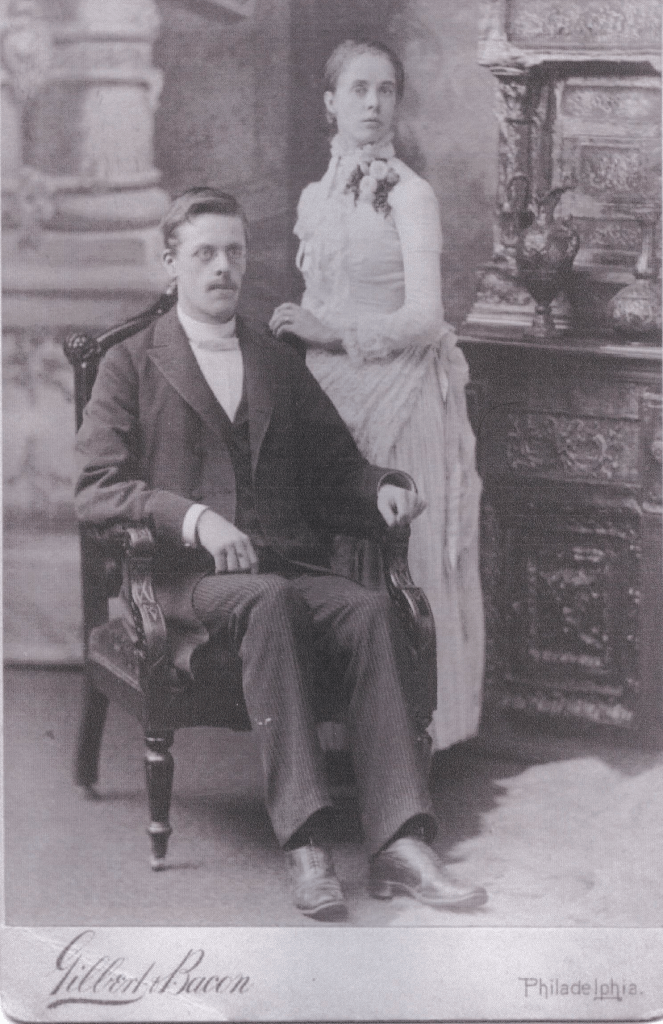
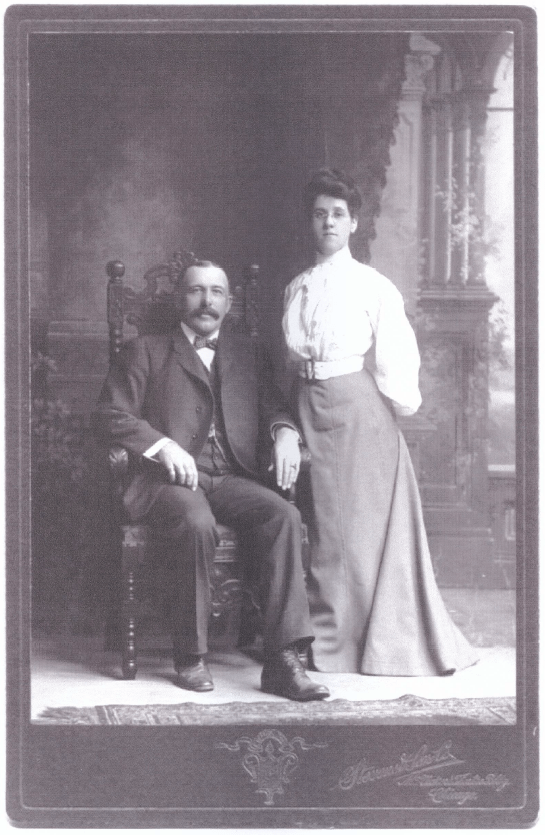
Alfred and Maude Waters
(The photographer appears to be located in Chicago)

Only a few days after their wedding, a meeting was held at De Smet City Hall at which Waters was appointed to a committee that was charged with organizing the Old Settler’s Celebration that would be held on June 10, 1904.4  Waters himself was one of the old settlers of the county, having “arrived in De Smet at the age of twenty-four during the summer of 1880, fresh out of law school.”5  On the day of the Old Settler’s Celebration, horse racing was one of the events held.  It was reported that “the free-for-all trotting race on the 10th was won by A. N. Waters’ horse.”6

In the month following the Old Settler’s Celebration, the newlyweds were visited by Waters’ aunts and cousins from Wisconsin and New York: Mrs. Alfred W. Newman, Mrs. Emory E. Newman and Mr. & Mrs. Isaac U. Tripp.  Mrs. A. W. Newman (Celia), who was the widow of Waters’ mother’s brother, came from Madison, Wisconsin, where her husband had been a judge on the state supreme court from 1894 until his death in 1898.  Mrs. E. E. Newman (Cordelia), arriving from Durham, New York, was the widow of another brother of Waters’ mother.  Because Waters’ mother had died when he was only a few weeks old, Waters grew up in his maternal grandparents’ home.7  Waters’ uncle Emory was 19 at the time of Waters’ mother’s death in 1855.  Following the passing of his grandfather, Waters was included in his uncle Emory’s household.8  Mrs. Isaac U. Tripp (Addie) was the daughter of one of Waters’ mother’s sisters, Lucilia (nee Newman) Winchell.

When the South Dakota census was taken in 1905, Maude was 30 years-old and her occupation was housewife.9  The census record for her husband has an incorrect first name, it is written as “Albert” instead of “Alfred.”  Waters was 49 years-old and his occupation was land agent.10  Later that year, Waters’ birthday (November 14, 1855) was noted by the local newspaper:

A. N. Waters celebrated his 50th birthday anniversary Tuesday. Twenty-five years and four months of that time have been spent in the city of De Smet. He has labored all these years for the upbuilding of this city and vicinity and has accomplished much for the community and built up a large business for himself. Here’s hoping that he spends the next fifty years right here in De Smet.11


Since his arrival in De Smet, Waters was very active as a real estate broker, and he partnered with other businessmen in land development businesses.  “During the early days, lawyers tended to involve themselves as much in the business of land as in the law, and Waters reaped a small fortune from shrewd land investments, eventually becoming one of the largest landholders in [Kingsbury County].”12  One of the businesses with which Waters was associated was Kingsbury Abstract Company, whose members in addition to Waters were J. C. Gibson, A. W. Miller, C. L. Dawley and Al Thomas.13  The abstract company built a two-story building in 1888-89 on the northeast corner of the intersection of Calumet Avenue (the main street) and Second Street. The construction costs were seven to ten thousand dollars.14 “This building had the historical importance of being a place where the pioneers would come to stake their claims.”15  About four years prior to the construction of the abstract company’s building, Charles P. Ingalls, the father of Laura Ingalls Wilder who wrote Little Town on the Prairie, a novel set in De Smet, owned the property on the southeast corner of the same intersection.16

... [The two-story building] was solid brick with white stone trimmings. The front office was 22×33 feet, connected to an office in the rear 15×16 feet, with another room not connected to the front part of the building, it being 19×22 feet. Upstairs was a lodge hall and meeting room, accessed via exterior stairs at the rear of the building. The front office downstairs housed the Dakota Loan and Investment Company; the middle part housed the Abstract Company. The separate room to the east – with an entrance on Second Street – became the De Smet Post Office.17

From 1904 to 1906, several business dealings were made by Waters, which resulted in the transfer of the Calumet building to Waters Land and Loan Company.  These dealings included:

  • April 1904 – A couple of weeks before Maude and Alfred married, for $2,500 Alfred purchased from one of the members of the Kingsbury Abstract Company (C. L. Dawley) and his wife: “An Undivided one half interest in Lot Numbered 8, Block Numbered 2.”18 This was the lot on which the abstract company had built the two-story building.
  • November 1905 – Waters and two associates incorporated the Waters Land and Loan Company. The purpose of the corporation was to transact a general real estate, brokerage and loan business. “The amount of the capital stock of this Corporation shall be and is Fifty Thousand ($50,000) Dollars divided into Five Hundred (500) shares of the par value of One Hundred (100.) dollars each.”19
  • December 1905 – Waters was given title to the entire lot (Lot Numbered 8, Block Numbered 2) for consideration of “$1.00 and other val.” from Kingsbury County Abstract Company.20
  • February 1906 – The city lot with the two-story building was sold by Waters and his wife Maude to Waters Land and Loan for $10,000.21
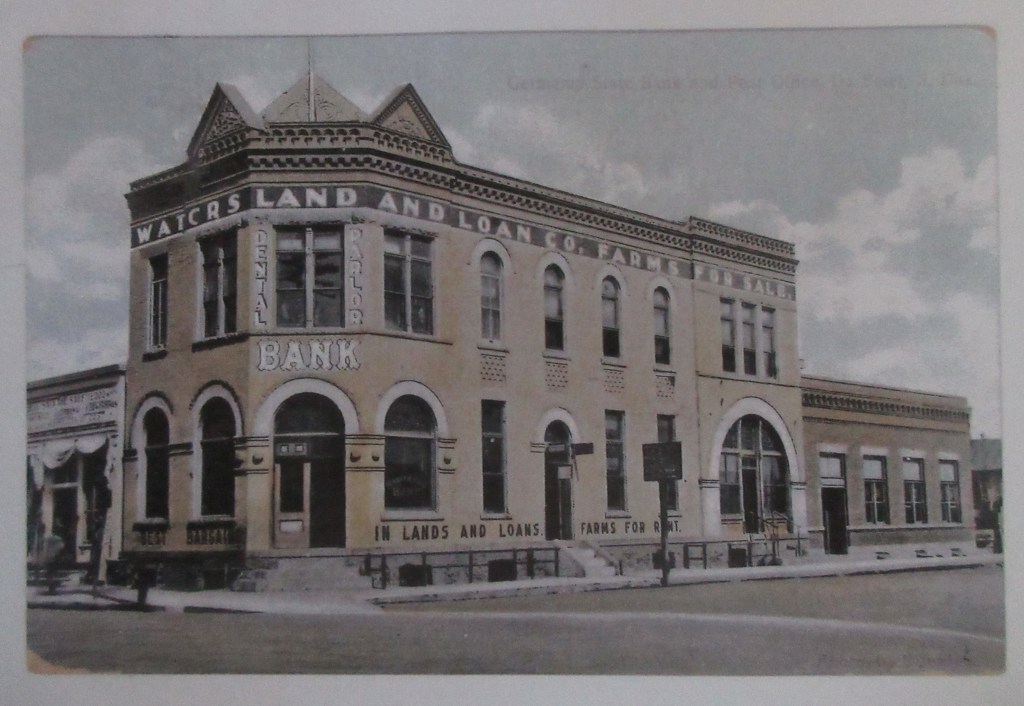
Postcard photograph of the building of Waters Land and Loan Company

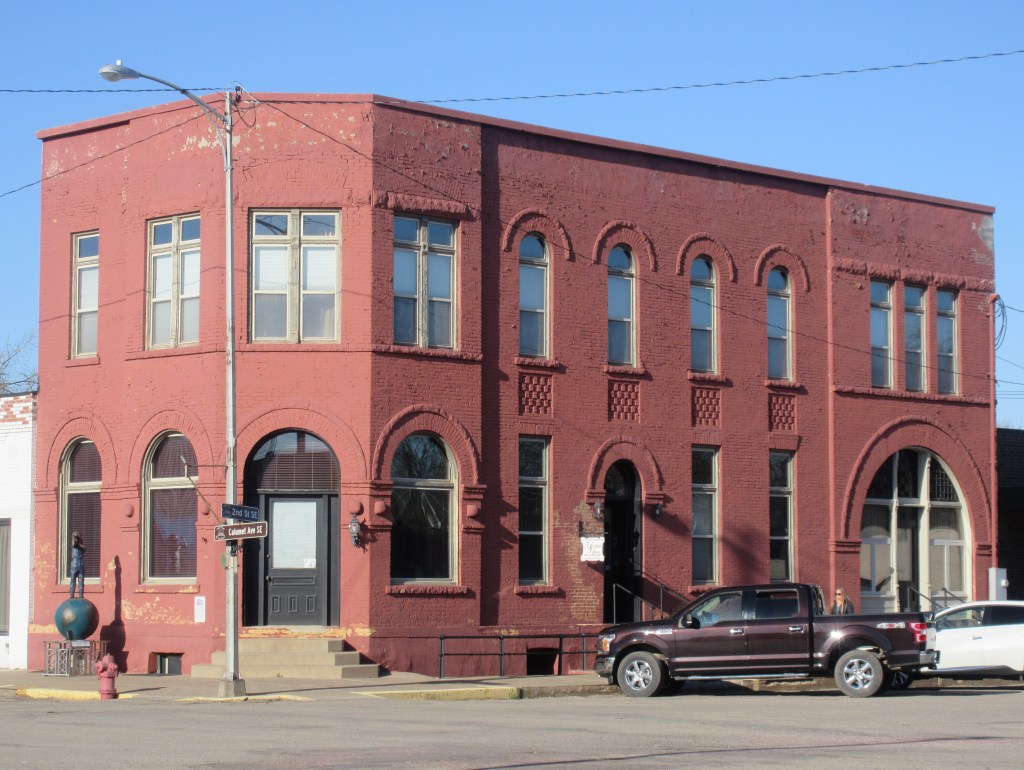
Through the years the building has housed many offices, including the Germania State Bank, Peoples State Bank, a doctors office and dental office.  The building exchanged hands again in 1997, and after three years of extensive restoration, was opened as The Heritage House Bed and Breakfast.22

Heritage Bed and Breakfast, photographed by the author, April 2025

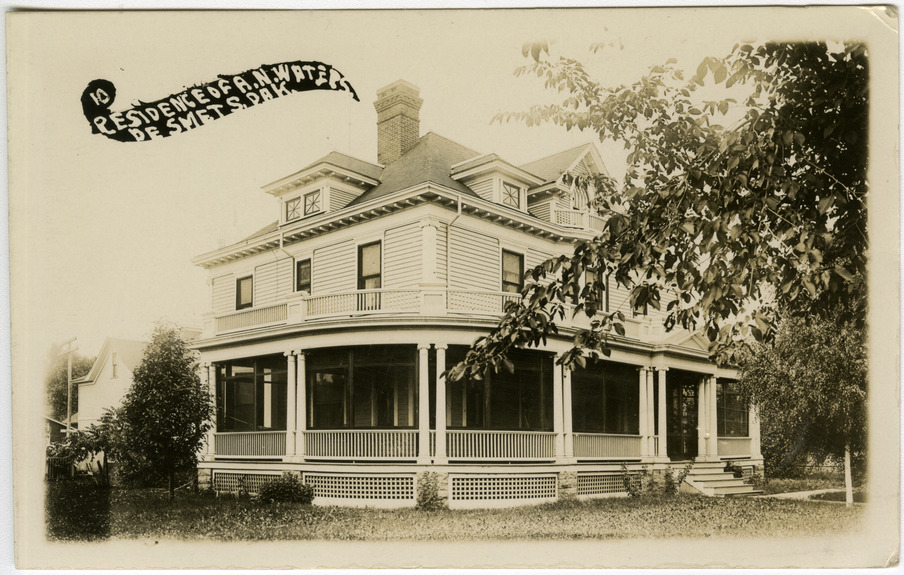
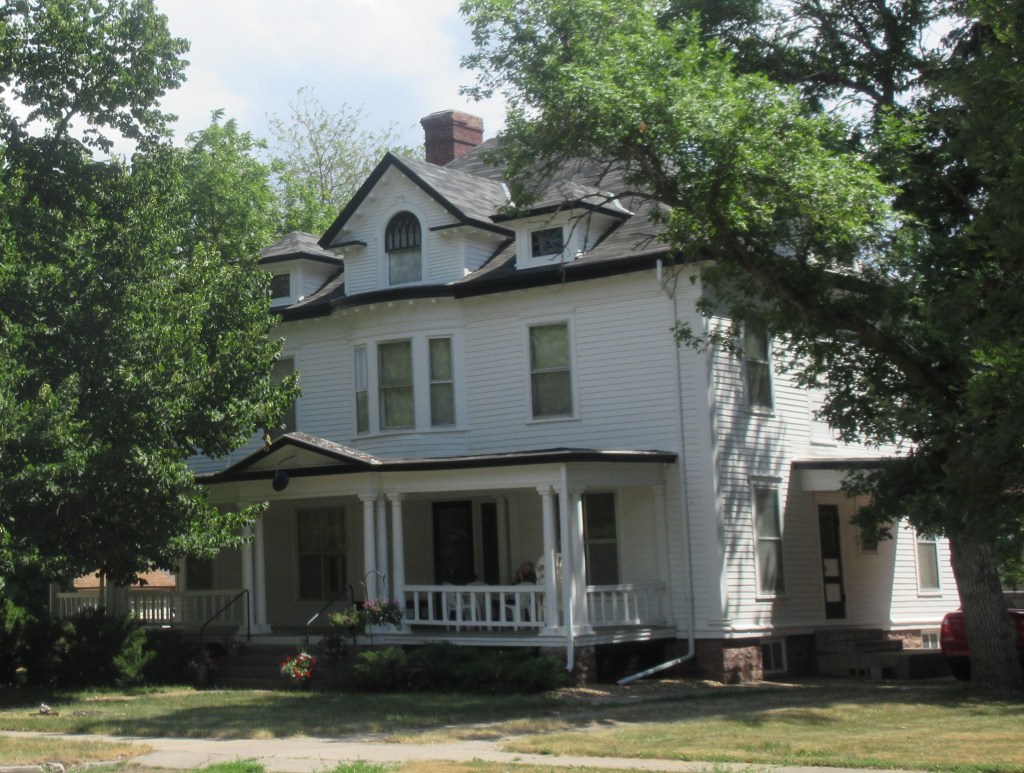
It appears that simultaneously to his business dealings involving the Calumet property above, Waters was involved in another project, which was the construction of his and Maude’s personal residence.  In 1905, a large home was built on Second Street,23 two and a half blocks west of Waters’ building at Calumet.  The house has been described as “the most elegant in town.”24

[It] was a gathering place for many of the town’s social elite.  The Waters hosted many dinners, parties and get-togethers in the large house.  It featured a full basement and an attic with enough headroom, it could be converted to another level.  There were plenty of rooms on the first and second floor which had all the modern amenities for its time.25

Postcard photograph of Waters’ residence, 1912

More than a century after the Waters’ home was built, a descendant of Maude’s brother Herbert and his wife were in De Smet and stopped at the house. Upon striking up a conversation with the owner at that time, they were given permission to take a look inside.  Subsequently, the wife described their brief tour:

As you walk in there is a visiting room with a big brick fireplace to the left.  To the right are a couple small bedrooms.  At the end is the kitchen.  Behind the fireplace was a hall way with 2 or three small rooms.  They were where the vet had his office and other items.  Long stairway going upstairs ….26

Maude and Alfred’s home in De Smet, South Dakota, photographed by the author, June 2021

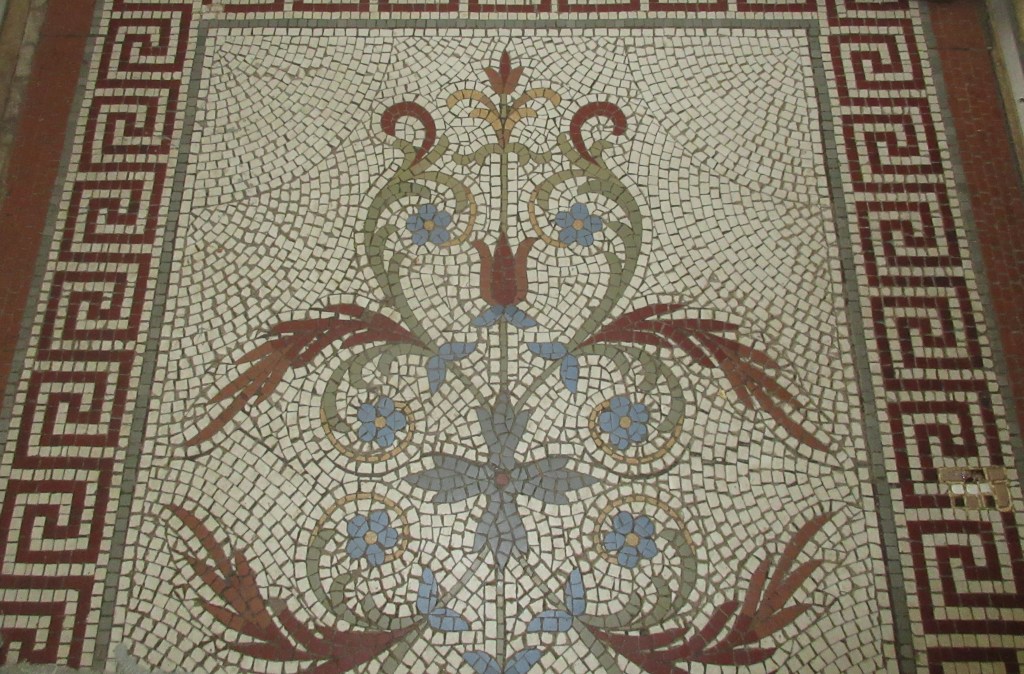
Another of Herbert’s descendants visited De Smet in June 2021.  Seeing the large wrap-around front porch, she recalled playing on that porch as a young child.  She and the group with her were also invited to enter the home to look around.  Below is a picture of the tiled front entry.

Front entry of Waters’ home (this partial view is from the side of the entryway, not the front), photographed by the author, June 2021

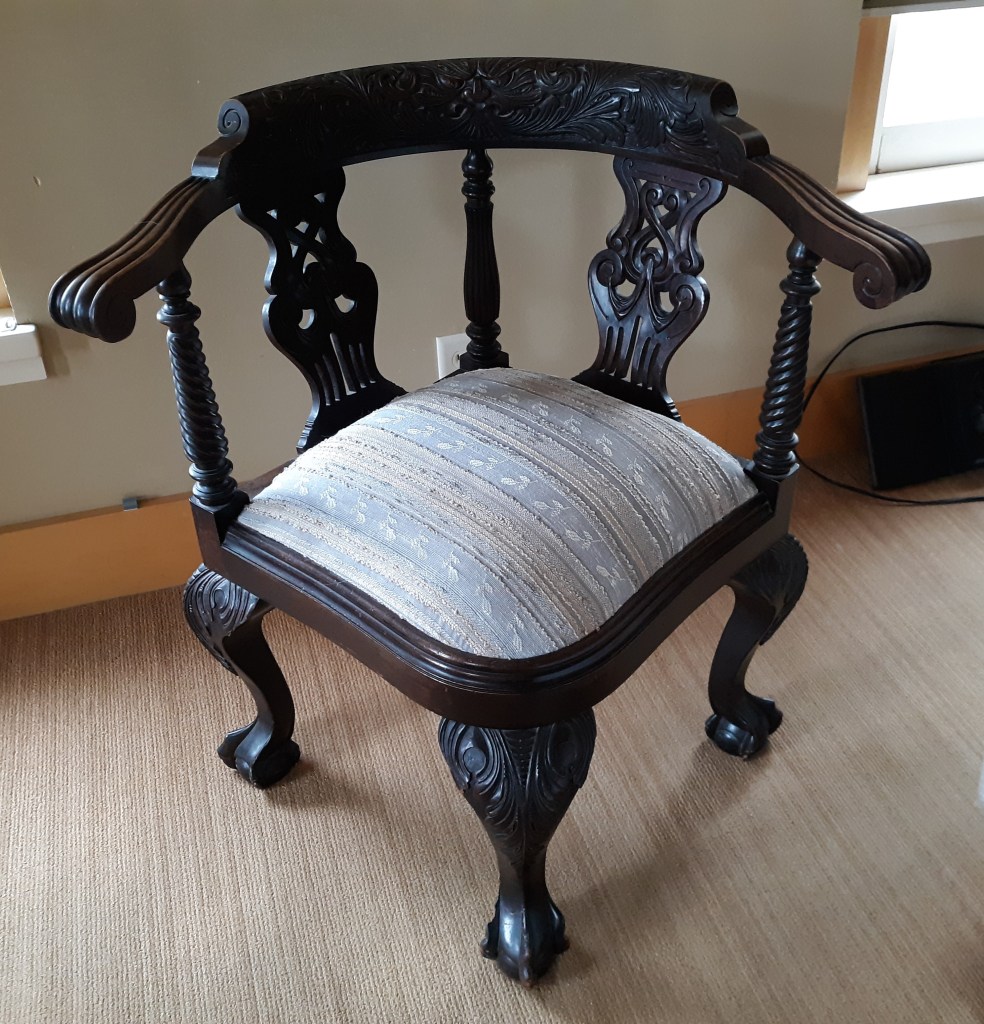
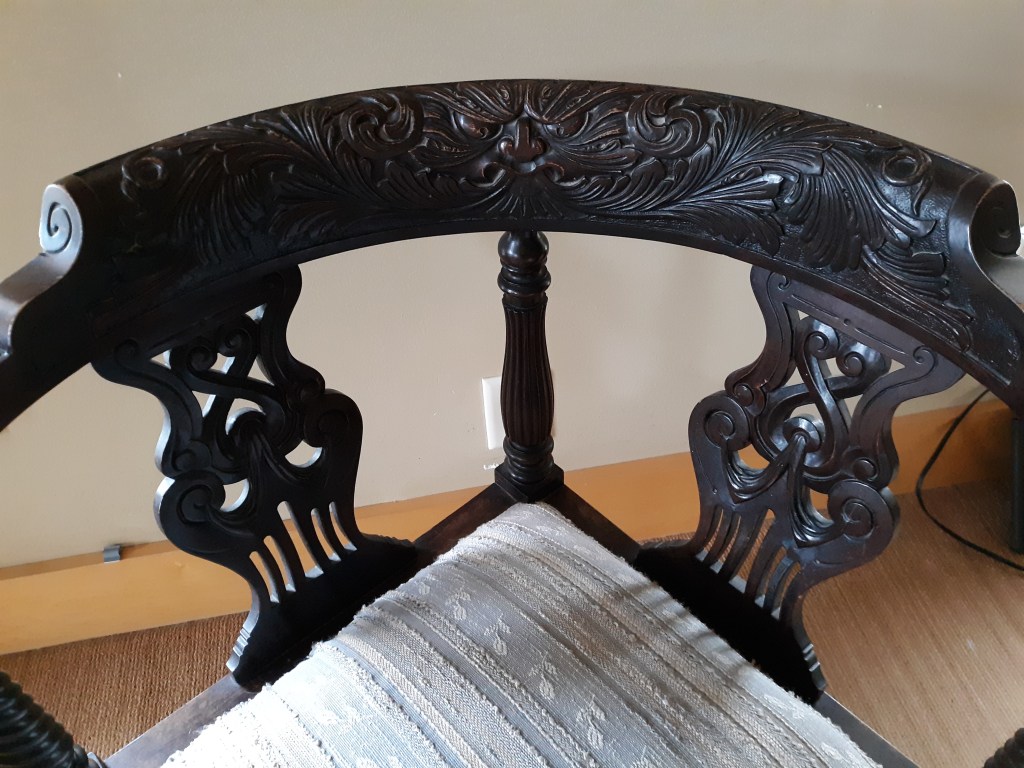
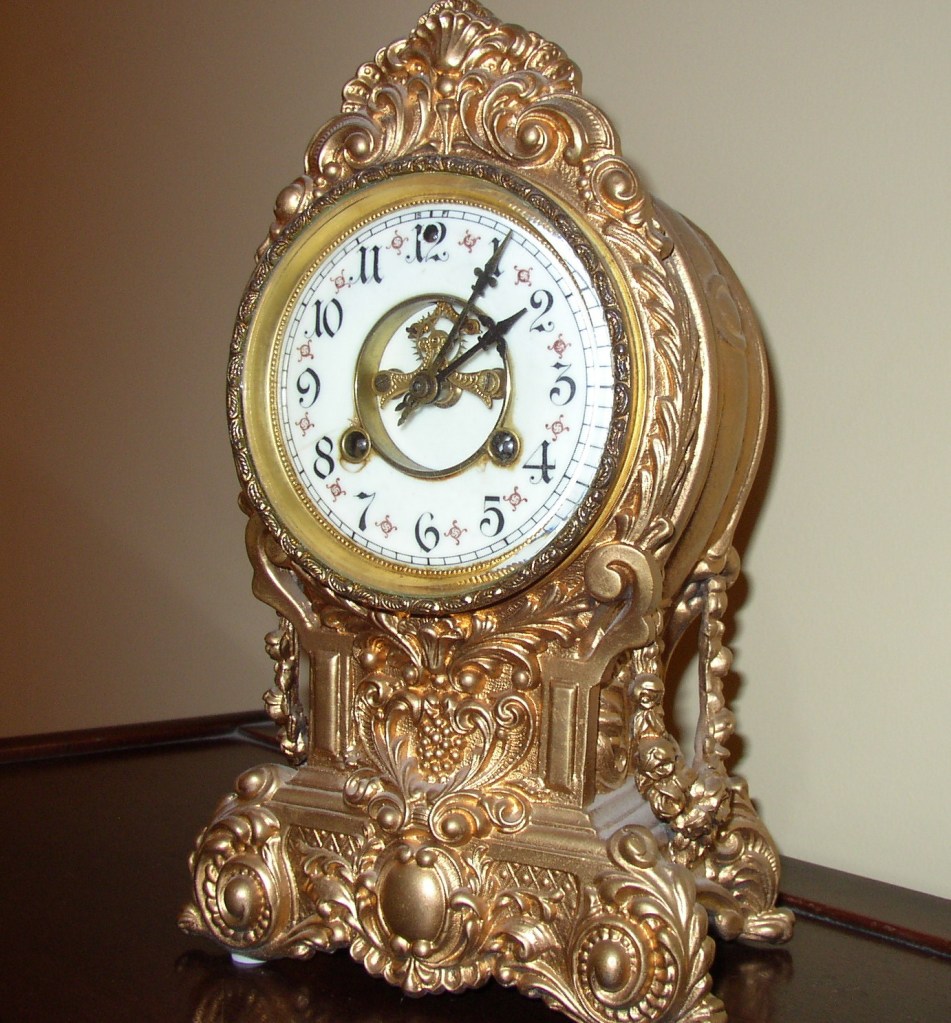
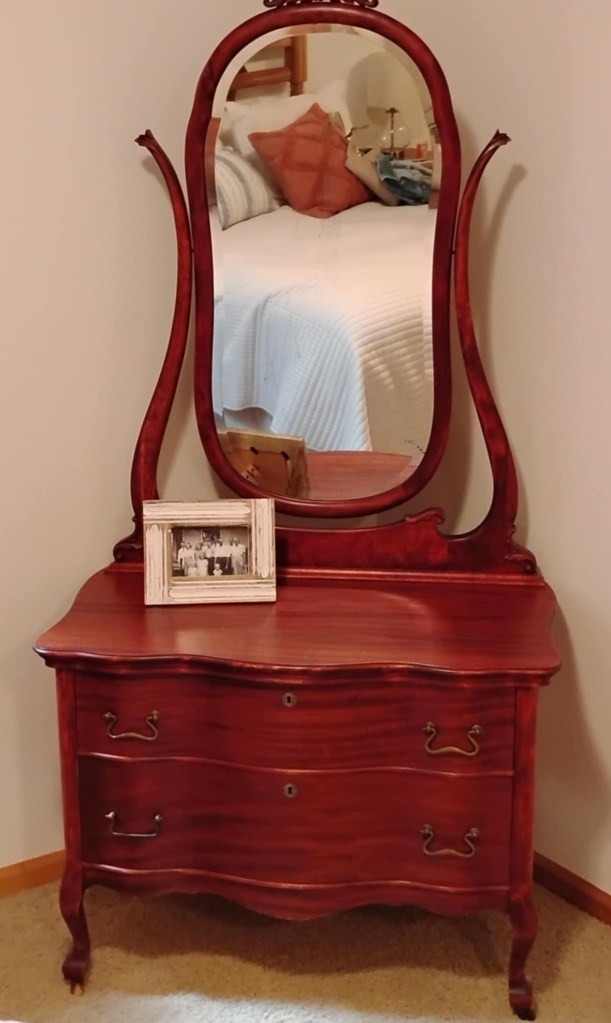
Some of the furnishings of the Waters’ home are still in the possession of Herbert’s descendants.

An antique chair, dated 1825
Close-up of the engraving
A “Verona” model clock manufactured by Waterbury Clock Company; approximate date, 1910
This dresser with beveled mirror had a darker finish when it was owned by Maude’s nephew Arthur Bevers and his wife Elsie. One of their sons had it re-finished to this natural red oak finish. The photograph sitting on the dresser is of the Arthur Bevers, Sr. family taken about 1943.

Several news items in the Kingsbury County Independent highlight the hospitality and generosity of Maude and Alfred Waters. On August 17, 1906, the newspaper reported, “Mrs. A. N. Waters entertained a number of young ladies in honor of her guest, Miss Eggleson Friday last.”27 The same edition of the newspaper reported that on the following day, a former resident of De Smet, Mrs. James T. Cooley, had arrived from New York City and was a guest at the Waters’ residence. In June 1909, the wedding of Dr. John H. Hall and Tillie Nelson was held at the Waters’ home. Hall was a dentist whose office was in the building owned by Waters Land and Loan Company. (On the postcard above, one of Hall’s office windows is demarked with the words “Dental Parlor.”) Hall was a member of the Methodist Episcopal Church, singing in the choir for many years as tenor.28 His bride had been living with the Waters. The write-up about the wedding follows:

At the home of Mr. and Mrs. A. N. Waters in this city Monday evening, June 14th, occured the marriage of Miss Tillie Nelson to Dr. J. H. Hall, both of this city, Rev. J. E. Booth officiating.  The ceremony was performed in the presence of a few relatives of the bride and a small number of mutual friends of the contracting parties.  After the ceremony an elaborate wedding dinner was served by Mrs. Waters.  The happy couple took the evening train east for points in Wisconsin where they will visit for two weeks.

The bride is a young lady who has made her home with the Waters family for some time and is well known and highly esteemed by our people.  The groom is so well known that no words of introduction are needed.  He has been engaged in the practice of dentistry in this city for about fourteen years and is regarded as one of our leading citizens.  Everyone has a good word for John Hall.  The happy couple have a host of friends in and about De Smet who unite in wishing them a happy married life.29

Before movies and cinema theaters became popular, “Parties and informal gatherings in people’s homes constituted most of the social swirl for high-school students in De Smet.”30  One such example was reported in the local news: a gathering held at the Waters’ home on Friday night, March 1, 1912, starting at 8:00 pm.  The guests included all the members of the senior class of the high school and their instructors, and their purpose was to celebrate the birthday of Edith Mitchell; the news report concluded: “A most delightful evening was spent and the occasion will long be remembered by all.  An elaborate lunch was served at midnight.”31  Two of the members of the senior class, Edith Mitchell and Evelyn Keating, were noted to have been attendees of the Epworth League, a young people’s group which met at the Methodist Episcopal Church on Sunday evenings.32

De Smet High School Class of 1912
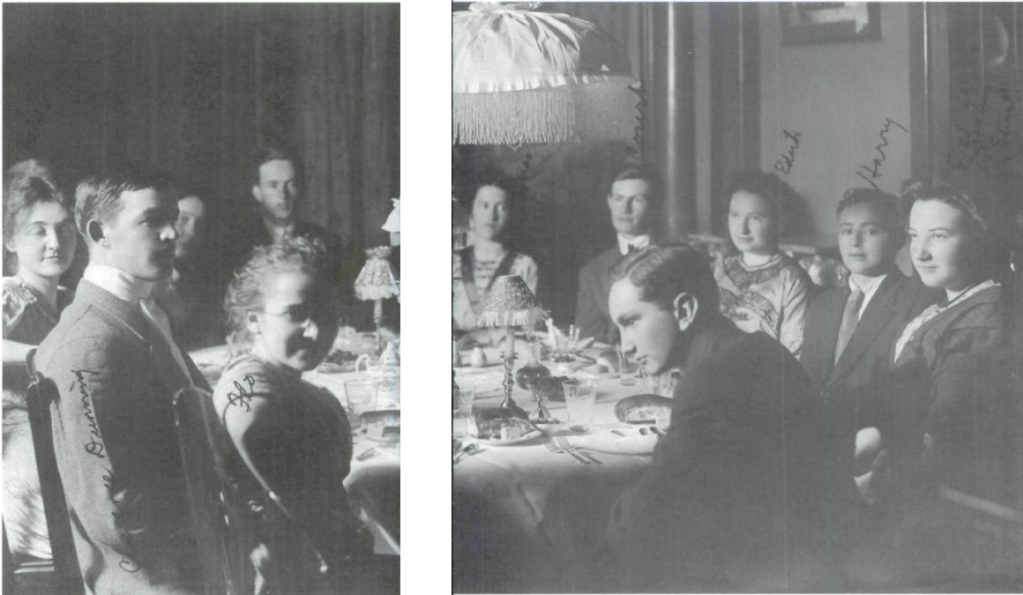
Celebrating Edith Mitchell’s birthday at the Waters’ home, March 191233

Edith Mitchell’s “family, who lived in a house north of the railroad tracks, had gone through some difficult times, and the Waterses had taken her in to live with them.”34  In addition, they would make it possible for Edith to attend college, the only girl in her class to do so.  She started out at South Dakota State College in Brookings, which is the college that Maude had attended, and later she transferred to the University of Minnesota.35 In the summer of 1912, prior to going off to college, Edith “accompanied her benefactors, the Waterses, on a three-month automobile tour back to Alfred Waters’s boyhood home in Durham, New York.  Driving over roads that much of the way consisted of nothing more than dirt paths and stopping at nearly every town to obtain directions to the next one made the excursion quite an adventure.”36 

The Brookings Register announced the marriage of Edith in June 1917: “Another former State College student has joined the ranks of the ‘Newly Weds.’  Miss Edith Mitchell was united in marriage at De Smet, last Wednesday, to Randle Toland, by the Rev. Paul Roberts.  The ceremony occured at the home of Judge and Mrs. A. N. Waters and a large company was assembled, with many out of town guests present.  After a trip east the couple will reside in De Smet, where Mr. Toland is in the real estate business.”37

Highlights of Maude and Alfred Waters’ social and civic lives will continue in the next blogpost.


1 Nancy S. Cleaveland, “Syndicate Hotel,” Laura Ingalls Wilder A-Z, http://www.pioneergirl.com/blog/archives/9165.

2 K. and M. Bevers, notes attached to Agnes Maude Bevers in Ancestral Quest program file dated June 29, 2022.

3 “Waters-Bevers Nuptials,” Kingsbury County (South Dakota) Independent (May 13, 1904), in Nancy S. Cleaveland and Gina Terrana, Waters (2015): http://www.pioneergirl.com/waters_cemetery.pdf.
4 _____, “June 10th Celebration,” Kingsbury County Independent (De Smet, South Dakota), May 20, 1904, 6, Newspapers.com.

5 John E. Miller, “End of an Era: De Smet High School Class of 1912,” South Dakota History Volume 20 Number 3 (South Dakota Historical Society Press, September 26, 1990): 190, https://www.sdhspress.com/journal/south-dakota-history-20-3/end-of-an-era-de-smet-high-school-class-of-1912/vol-20-no-3-end-of-an-era.pdf.

6 _____, Kingsbury County Independent (De Smet, South Dakota), June 17, 1904, 1, Newspapers.com.  

7 _____, “A. N. Waters, Pioneer, Laid to Rest Here Sunday,” De Smet (South Dakota) News (September 2, 1927) in Nancy S. Cleaveland and Gina Terrana, Waters (2015): http://www.pioneergirl.com/waters_cemetery.pdf.
8 “New York, United States records,” images, FamilySearch (https://www.familysearch.org/ark:/61903/3:1:33SQ-GYBK-KDN?view=explore : Jul 26, 2025), image 447 of 706; United States. National Archives and Records Administration.  Image Group Number: 005161473

9 “South Dakota, State Census, 1905”, FamilySearch (https://www.familysearch.org/ark:/61903/1:1:MMH3-NNS : Sat Mar 09 19:18:13 UTC 2024), Entry for Maud Waters.

10 “South Dakota, State Census, 1905”, FamilySearch (https://www.familysearch.org/ark:/61903/1:1:MMH3-NXC : Sun Jul 20 06:06:04 UTC 2025), Entry for Alfred N.

11 _____, Kingsbury County (South Dakota) Independent, (November 17, 1905), in Nancy S. Cleaveland and Gina Terrana, Waters, (2015): http://www.pioneergirl.com/waters_cemetery.pdf.
12 Miller, “End of an Era:” 190-91.

13 _____, Historical sign posted on the outside wall of Heritage House Bed and Breakfast, De Smet, South Dakota.

14 Nancy S. Cleaveland, “post office/post-office,” Laura Ingalls Wilder A-Z, http://www.pioneergirl.com/blog/archives/13454.

15 _______, Heritage House Bed and Breakfast, https://heritagehousesd.com.

16 Laura Ingalls Wilder Memorial Society, Inc., Heritage Plat of De Smet (De Smet, South Dakota, 1994).

17 Cleaveland, “post office/post-office.”

18 The Heritage House, LLC, “Abstract of Title,” Transfer Number 26.

19 State of South Dakota, Articles of Incorporation of the Waters Land and Loan Company, November 15, 1905.

20 The Heritage House, LLC, “Abstract of Title,” Transfer Number 27.

21 The Heritage House, LLC, “Abstract of Title,” Transfer Number 28.

22 Historical sign posted on the outside wall of Heritage House Bed and Breakfast, De Smet, South Dakota.

23 “A. N. Waters, Pioneer, Laid to Rest Here Sunday,” in Cleaveland and Terrana, Waters: http://www.pioneergirl.com/waters_cemetery.pdf.
24 Miller, “End of an Era:” 185.

25 Mike Siefker, “Hof’s stately home has history as a hospital,” Kingsbury Journal (May 4, 2022): 13.

26 S. Bevers, Facebook post of Bevers Family and Reunions private group, July 8, 2023.

27 _____, “Local News,” Kingsbury County (South Dakota) Independent (August 17, 1906): 5, Newspapers.com.

28 Caryl Lynn Meyer Poppen, ed., “A History of the Methodist Church,” De Smet Yesterday and Today (De Smet, South Dakota: De Smet News, printer, 1976): 144.

29 _____, “Nelson—Hall,” Kingsbury County (South Dakota) Independent (June 18, 1909): 4, Newspapers.com.

30 Miller, “End of an Era”: 185.

31 _____, De Smet (South Dakota) News (March 8, 1912), in MIller, “End of an Era”: 185.

32 First Methodist Church, “A History of the Church,” Consecration Service of the Remodeled First Methodist Church (De Smet, South Dakota: First Methodist Church, September 26, 1965).

33 From Evelyn Keating’s class book, School-Girl Days: A Memory Book in Miller, “End of an Era:” 186-87.

34 Miller, “End of an Era:” 190.

35 Miller, “End of an Era:”: 202.

36 Miller, “End of an Era:” 202.

37 J. F. Brooke, ed., “Local and Personal,” Brookings (South Dakota) Register (June 28, 1917): 7, Newspapers.com.

Maude Bevers, Career Woman

In September 1883, 8-year-old Maude Bevers, living near Liverpool, England, wrote a letter to her father Alfred C. Bevers, who had traveled to Dakota Territory in America.  One of the things she reported to her father was: “Mama say’s that I am getting on very well at school.”  (See the full letter in Ada, Gertie and Maude) About fifteen months later, Maude emigrated to Dakota Territory with her mother and two older sisters, joining her father.  Because Maude’s father was a supply pastor for the Methodist Episcopal Conference in Dakota Territory and in South Dakota when it became a state, Maude continued her education in several small towns.  Eventually, she would be the first among her siblings to attend and complete high school.  According to the reports her siblings gave for the 1940 United States census, the highest grades they had attended were 6th, 7th or 8th grade.

Not only did Maude complete high school, in her early twenties, Maude attended college. An agricultural college had been established by the Dakota Territorial Legislature in 1881, and in Brookings the first building was built in 1884.1  A college catalog explained the history and purpose of the college, including the following statements:

Upon the division of the territory of Dakota into the states of North and South Dakota when admitted into the Union in 1889, the agricultural and mechanical college of Dakota became known as the South Dakota Agricultural College [SDAC].

… The college is devoted to advancing the interests of practical education and its purpose is to give men and women such training as will best fit them for the active duties of life, whether it be in the fields, the shops, the house, or in the class or counting rooms.2

Even though the college was initially established as an agricultural and mechanical college, by 1896 it had broadened its curriculum to include 24 departments.  Maude’s name is listed in the SDAC catalog dated 1897-98, which indicated she was studying Commercial Science and her address was Willow Lakes.3  Her father had been assigned to the Willow Lakes Methodist Episcopal charge in 1896.4  With a population of approximately 220, in 1897-98, Willow Lakes sent 10 young men and women to the agricultural college, five of whom studied Commercial Science.  Other subjects studied by these students were Domestic Science, Mechanical Engineering and Agriculture.

News item of The Brookings Register
May 8, 18975

During the 1897-98 school year, there were about 550 students attending SDAC.  Two-thirds of them were men and one-third women.  The college catalog explained the affordability for students to attend the state-established college:

No young person should be deterred from obtaining a liberal education when such advantages as this college offers can be had at a nominal price.  The aggregate of all the regular fees is only four dollars per quarter and is payable at the time of registration.  Books and stationery are furnished by the student.  A laboratory fee of one dollar is charged for the use of each laboratory in which a student takes work.6

Due to the expansion of the educational departments during the first decade and a half, the dormitories had been converted into classrooms and teaching labs.  By 1896, there was only one cottage available for lodging on the campus.  It held about 20 young women.  The rest of the student population boarded in Brookings—a town with a population of nearly 2000—in private homes or hotels, starting at about 50 cents per week.7  It is not known whether Maude lodged on or off campus. The expenses of the average student who attended three quarters of the school year were: $6.00 for tuition, $90.00 for board and room, $45.00 for clothes, $15.00 for laundry, $25.00 for books and stationery, and $10.00 for traveling expenses.8

About fifteen percent of the SDAC students of the 1897-98 school year were majoring in Commercial Science.  The college catalog described the aim of the department:

Appreciating the fact that business men are governed largely by certain specific and established rules, it becomes necessary that this department keep in touch with these usages and impart the same to the student in such definite and concise terms as shall prepare him for successful entrance to the business world.

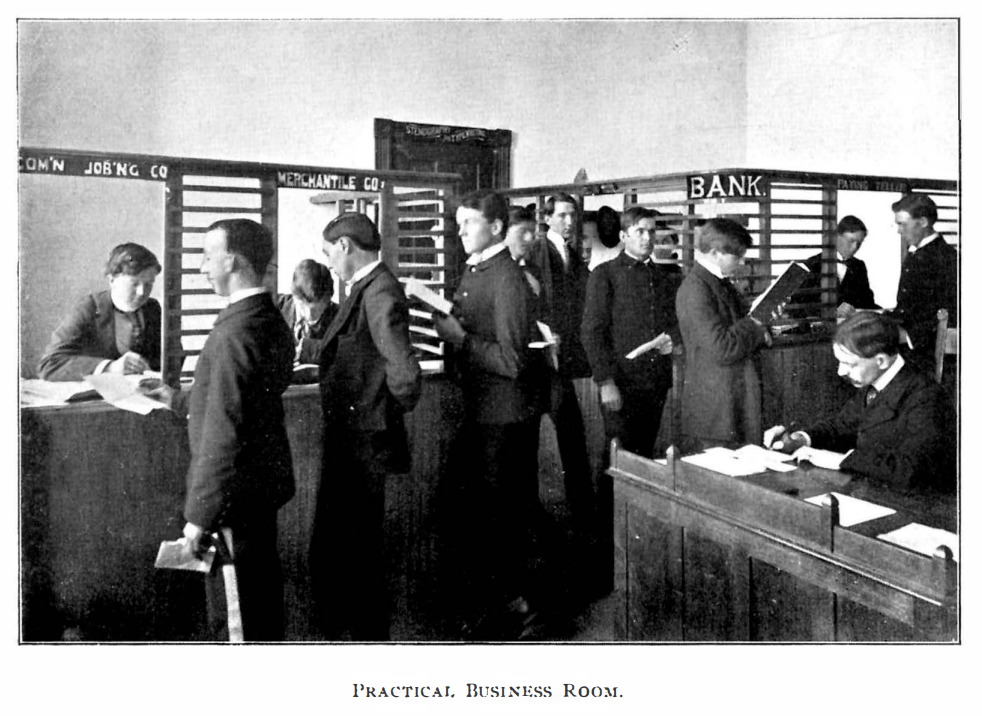
The rooms for the department are exceptionally well suited and adapted to the work of the business student.  The amanuensis room is supplied with fifteen typewriting machines and ample table and black board surface.  The offices such as the Bank, Post Office and Mercantile are well fitted for giving the student actual practice in business methods.  The college library affords good opportunity for references and collateral reading. …9

Note: The 1886 edition of Webster’s Dictionary defines amanuensis as “A person whose employment is to write what another dictates, or to copy what another has written; a copyist.”10

A simulated business center at SDAC11

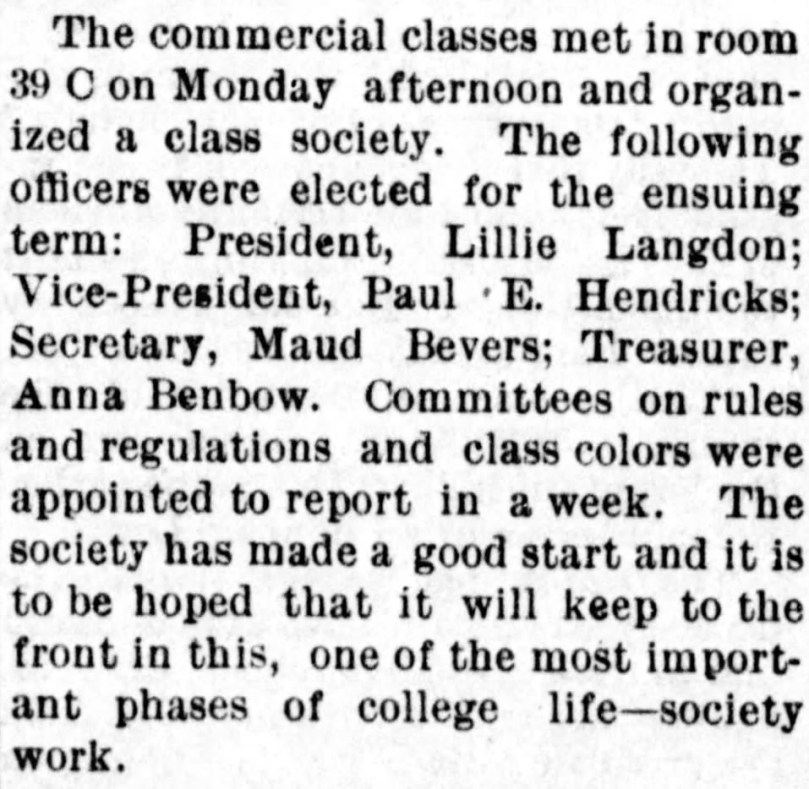
Based on the dates that news items reported about when Maude was at the college or left the college, it appears that Maude attended for two years.  Therefore, she would not have earned a bachelor’s degree, but she may have completed the coursework to earn a certificate of graduation in Commercial Science. To earn this certificate, a student had to complete the courses of shorthand, penmanship, advanced dictation, commercial law, bookkeeping, business practice, correspondence, typewriting, commercial arithmetic and English words.  The description of the course in English Words was: “A study of Anglo-Saxon, Latin, French and Greek derivatives and synonyms.  This course is designed to form an intermediate step between grammar and rhetoric, and aims to make the student familiar with the elements entering into the growth and present use of the English language.”12

News item of The Brookings Register
October 2, 189713

In June 1897, The Brookings Register reported “Rev. Bevers, of Willow Lakes, led chapel devotionals Thursday noon.”14  This was Maude’s father.  The SDAC students were not required to attend the chapel exercises, instead the college catalog stated:

The Young Men’s and Young Women’s Christian Associations are important elements in retaining a strong christian fellowship among the student body.  Their relations to the State and Inter-National organizations assist in keeping the college in touch with other educational institutions.  … [T]hese student organizations are allowed to take the religious lead by holding prayer and devotional meetings nearly every day to which all are invited.15

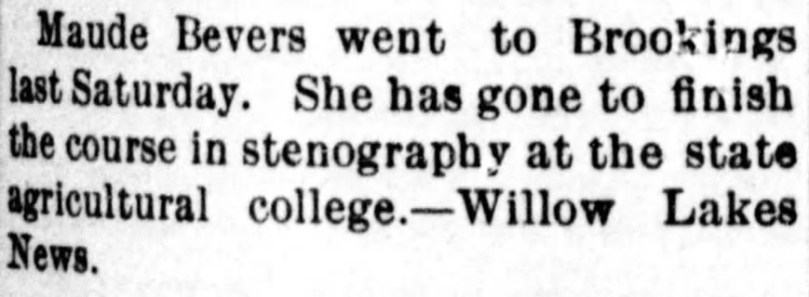
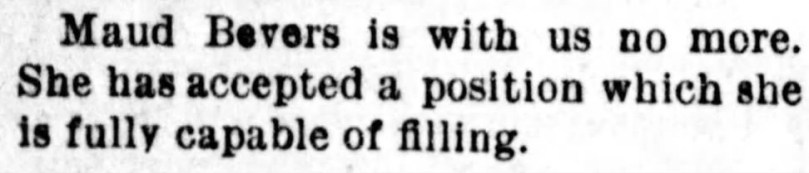
Another item in The Brookings Register reported that Maude left the college in March 1898, stating that she had “accepted a position which she [was] fully capable of filling.“16 According to a family historian, she was hired by Alfred Newman Waters, an attorney and realtor, doing business in De Smet, South Dakota.17  A. N. Waters was one of the pioneer settlers of Kingsbury County, arriving in August 1880.18  He had been a prominent citizen of De Smet since its founding.  Besides being a businessman, a few of the capacities in which he served the community were as a notary public, a director on the boards of financial businesses, and a county court judge. When Maude became an office worker in De Smet, she joined the nearly eighteen percent of gainfully employed workers in the United States who were women.19  Also, among the gainfully employed women, she joined the nine percent of women engaged in nonagricultural pursuits who were working in the clerical field.20

News item of The Brookings Register
March 29, 1898

Traditionally, rather than pursue an occupation in the community, most women have worked within the home.  The percentage of women that were gainfully employed in 1870 was less than 10 percent.21  The three occupations most often held by women between 1870 and 1900 were domestic service worker, teacher, and nurse.  As the industrial revolution advanced, more women entered the workforce.  By 1900, the percentage of women that were gainfully occupied was over 14 percent22 and the percentage of single women that were gainfully occupied was nearly 41 percent.23 One of the reasons for this growth was an increase in the demand for professional and semi-professional workers, including clerical workers, due to “the need by business and industry for accurate record-keeping, with the development of large-scale business practices, and with modern methods used in distributing the output of a vastly expanded economy.”24  A report of the United States Department of Labor provides additional information on this point:

The invention of the typewriter and other office machines, in response to the growing needs of business, made it possible to carry out record keeping, communication, and related activities on a tremendous scale.  The result was the creation of entirely new occupations many of which women perform.25

The greatest rate of increase for women “office workers” in any decade occurred from 1880 to 1890.  Women in these selected office occupations [referring to stenographers, typists, and secretaries; shipping and receiving clerks; clerical and kindred workers; and office machine operators] multiplied nearly 20 times – a testament to the growing acceptance of the typewriter and of the trained woman typist.26

In 1900, the percentage of office workers that were women was about 29%.27 “In taking on the functions of clerical workers, women did not replace men.  Rather they found entirely new opportunities.”28


By the fall of 1898, Maude’s parents and sister Gertrude had moved to De Smet as well.  In 1900, Maude and her family lived on First Street.29  The Methodist Episcopal church was only a few blocks away.  Records of the church state that all of them became members on November 26, 1898.30  Maude was the church choir leader for many years.31  In addition, the minutes of the women’s group noted that in December 1902 she was the organist at the Epworth League meeting (an organization for young adults), and she was the secretary pro tem at the women’s meeting on April 16, 1903.

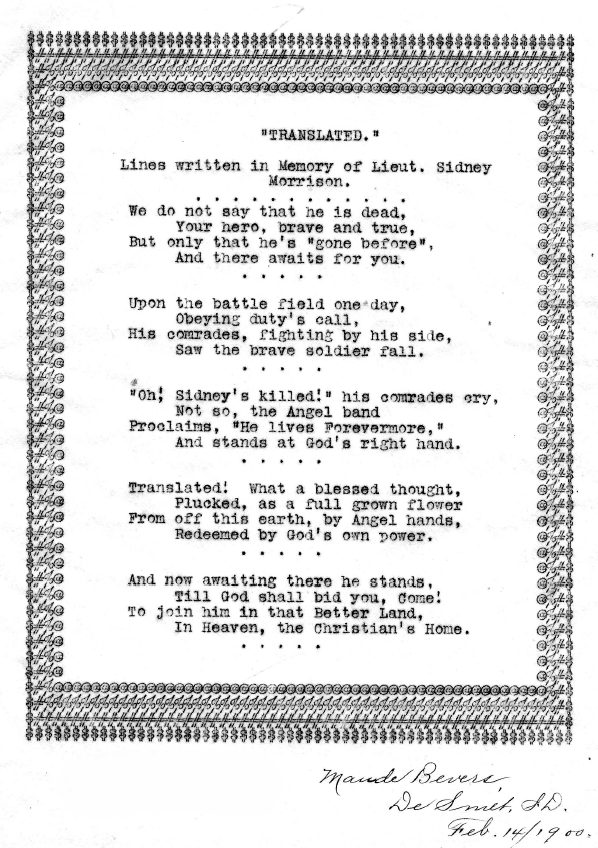
Maude had a poetic and artistic side to her.  On February 14, 1900, she created a tribute to Lieutenant Sidney Ellsworth Morrison.  It is not known what the relationship was between Maude and Lieutenant Morrison, but it is noteworthy that the tribute was dated on Valentine’s Day.  An item in The Christian Advocate, dated April 27, 1899, reads: “Lieutenant Sidney Morrison, who was killed in the recent charge of the South Dakota Regiment at Mariloa, was a brother of the Rev. J. G. Morrison, Pastor of Franklin Avenue Church, Minneapolis, Minn.”

Sidney Morrison was a member of Company E of First South Dakota Infantry and his rank was 2nd Lieutenant.  He died in the Philippines on March 27, 1899,32 but it wasn’t until January 25, 1900, that his remains were transported on the ship “City of Peking” to his father James Morrison, whose residence was De Smet, South Dakota.33

Maude’s tribute, entitled Translated, is typewritten.  As far as is known, this is the earliest piece of family memorabilia that was written using a typewriter.  The keys $, #, % and @ were used to create the decorative border.

More about Maude’s life will be continued in another blogpost.


1 South Dakota Agricultural College [SDAC], “The South Dakota Agricultural College Catalog 1897-1898 with Announcements for 1898-1899” (1898). Campus Course Catalogs and Bulletins. Paper 15, https://openprairie.sdstate.edu/cgi/viewcontent.cgi?article=1011&context=archives_catalogs, page 31.

2 SDAC, “SDAC Catalog 1897-1898,” page 31.

3 SDAC, “SDAC Catalog 1897-1898,” page 14.

4 United Methodist Church, Dakotas Conference, Commission on Archives and History, personal communication with M. R. Wilson, June 20, 1995.

5 “Items of Local Interest,” The Brookings Register (Brookings, South Dakota), May 8, 1897, page 3, Newspapers.com.

6 SDAC, “SDAC Catalog 1897-1898,” page 56.

7 SDAC, “SDAC Catalog 1897-1898,” page 57.

8 SDAC, “SDAC Catalog 1897-1898,” page 57.

9 SDAC, “SDAC Catalog 1897-1898,” page 83.

10 Noah Webster, Webster’s complete dictionary of the English language (London: George Bell & Sons, 1886): 42, https://archive.org/details/websterscomplete00webs/page/42/mode/2up.

11 SDAC, “SDAC Catalog 1897-1898,” following page 82.

12 SDAC, “SDAC Catalog 1897-1898,” page 89.

13 “College News,” The Brookings Register (Brookings, South Dakota), October 2, 1897, page 4, Newspapers.com.

14 “College Chestnuts,” The Brookings Register (Brookings, South Dakota), June 16, 1897, page 4, Newspapers.com.

15 SDAC, “SDAC Catalog 1897-1898,” page 43.

16 “College News,” The Brookings Register (Brookings, South Dakota), March 29, 1898, page 2, Newspapers.com.

17 K. and M. Bevers, notes attached to Agnes Maude Bevers in Ancestral Quest program file dated June 29, 2022.

18 The De Smet News, “A. N. Waters, Pioneer, Laid to Rest Here Sunday” (De Smet, South Dakota), September 2, 1927, in Waters, http://www.pioneergirl.com/waters_cemetery.pdf.

19 Joseph A. Hill, Women in Gainful Occupations 1870 to 1920 (Washington, D. C., USA: United States Government Printing Office, 1929): 52, https://babel.hathitrust.org/cgi/pt?id=hvd.hba9kx&seq=1.

20 Joseph A. Hill, Women in Gainful Occupations 1870 to 1920: 40.

21 Janet M. Hooks, Women’s Occupations Through Seven Decades (Washington, D. C., USA: United States Government Printing Office, 1947): 34, https://babel.hathitrust.org/cgi/pt?id=uiug.30112104139180&seq=1.

22 Janet M. Hooks, Women’s Occupations Through Seven Decades: 34.

23 Janet M. Hooks, Women’s Occupations Through Seven Decades: 39. 

24 Janet M. Hooks, Women’s Occupations Through Seven Decades: 72.

25 Janet M. Hooks, Women’s Occupations Through Seven Decades: 72.

26 Janet M. Hooks, Women’s Occupations Through Seven Decades: 74.

27 Janet M. Hooks, Women’s Occupations Through Seven Decades: 76.

28 Janet M. Hooks, Women’s Occupations Through Seven Decades: 75.

29 “United States Census, 1900”, , FamilySearch (https://www.familysearch.org/ark:/61903/1:1:MMRW-TKS : Sat Aug 17 18:09:29 UTC 2024), Entry for Alfred C Peevers and Mary N Peevers, 1900.

30 First Methodist Church of De Smet, “Record of Members.”

31 First Methodist Church, “A History of the Church,” Consecration Service of the Remodeled First Methodist Church (De Smet, South Dakota: First Methodist Church, September 26, 1965).

32 “LT Sidney Ellsworth Morrison,” Find a Grave, https://www.findagrave.com/memorial/154931201/sidney-ellsworth-morrison.

33 Ancestry.com, U.S., National Cemetery Interment Control Forms, 1928-1962 [database on-line] (Lehi, UT, USA: Ancestry.com Operations, Inc., 2012): http://www.Ancestry.com.

Aunt Gertie, An Active Methodist

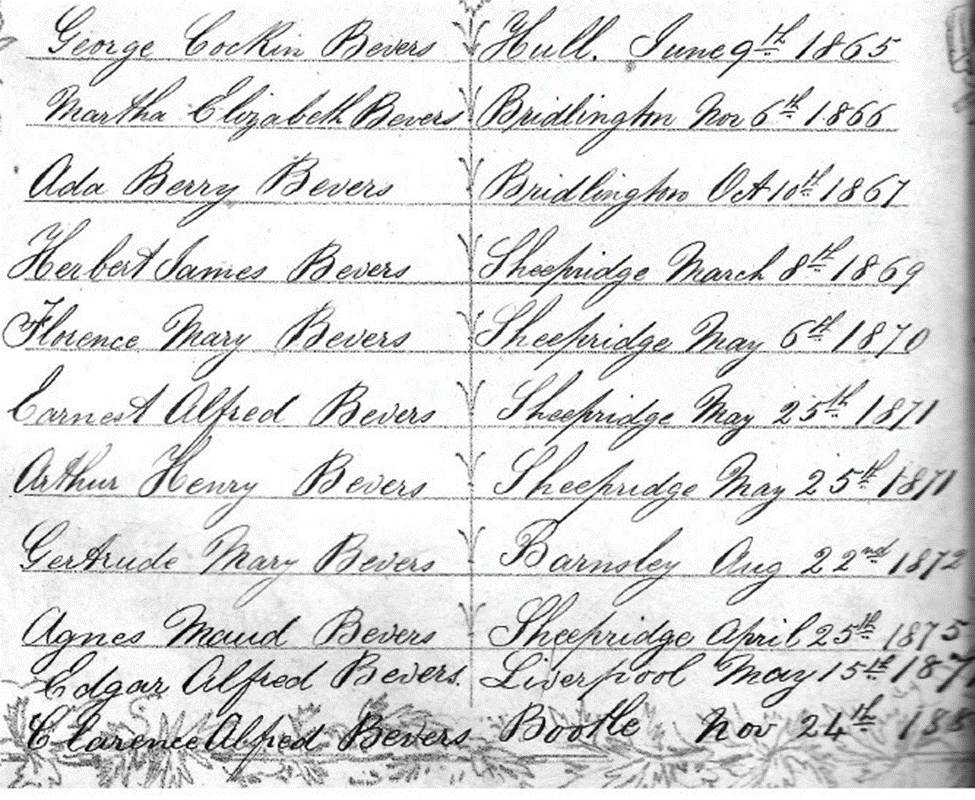
Born in August 1872, Gertrude Mary Bevers was the eighth child of Alfred C. and Mary N. (nee Bridges) Bevers, although at the time of her birth only three of her siblings had lived past the age of one.  She was born in a small town in England and during her childhood her family moved every few years, including emigrating to the United States when she was 12 years old.  (A summary of the young lives of Gertrude and her sisters can be found in Ada, Gertie and Maude Bevers, and an article about her brother George is found in George C. Bevers, Bookkeeper.)

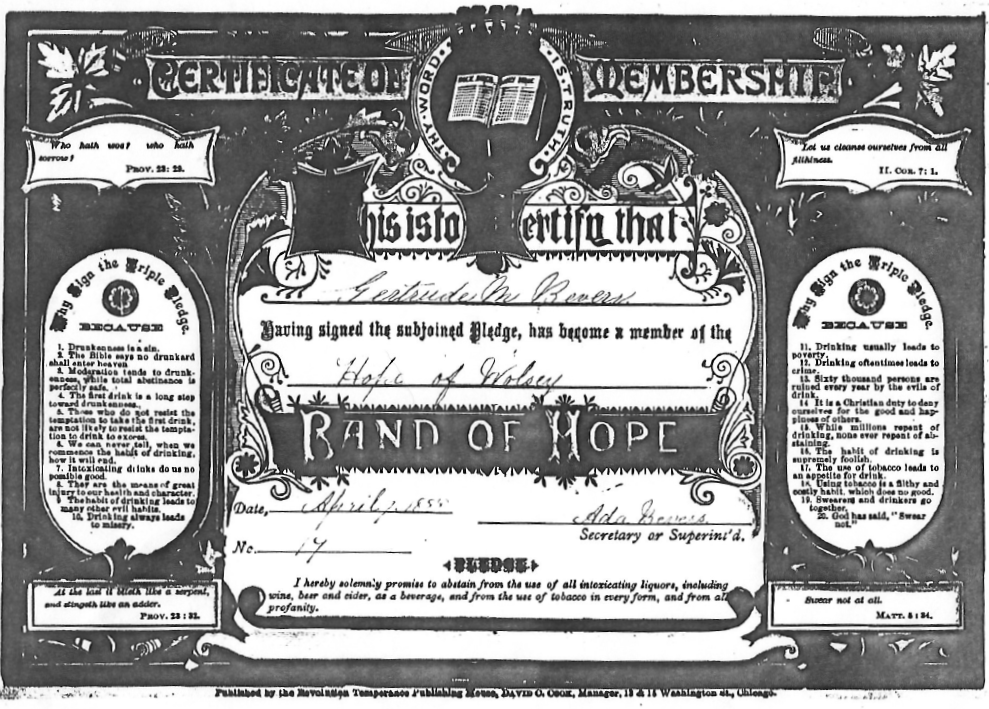
There is evidence that at a young age Gertrude began following in the footsteps of her parents.  One example is that at the age of 15, Gertrude along with her 20 year-old sister Ada embraced a tenet of her father and her father’s father, William Bevers, who “had been a total abstainer over 60 years … [and] was an ardent temperance advocate.”1  Gertrude’s father participated in the temperance movement in England by giving lectures, one of which proposed that alcohol gave no assistance to the health of one’s body.2  When Gertrude’s family was living in Wolsey, South Dakota, she and Ada were involved in the Hope of Wolsey, an offshoot of a temperance organization that had risen up in England called the Band of Hope.  (More about the Band of Hope’s history and mission can be found in Ada, Gertie and Maude Bevers.)  In April 1888, Gertrude was issued a certificate of membership in the Hope of Wolsey, which was signed by Ada.  It certified that she had made a pledge of temperance, which was printed on the certificate: “I hereby solemnly promise to abstain from the use of all intoxicating liquors, including wine, beer and cider, as a beverage, and from the use of tobacco in every form, and from all profanity.”  Appendix 1 below provides the text of the certificate.

Gertrude’s certificate of membership in the temperance organization Hope of Wolsey

In the year that Gertrude turned 26 years-old, she moved with her parents and younger sister Maude to De Smet, South Dakota, where she would reside for the rest of her life, about 55 years.  Their residence in 1900 was on First Street.3  The town of De Smet had been established when the Dakota Central Railway Company laid tracks through Kingsbury County.  (Soon afterward, in 1881, the railroad was bought by Chicago Northwestern Railroad Company).4

“The first family of De Smet was that of Charles P. Ingalls.  He was the timekeeper for the railway construction crew at his camp on the shore of Silver Lake, a mile east of where De Smet was to be built.  As construction work ceased in the fall of 1879, he and his wife, along with four daughters remained in the timekeeper’s building through the winter and spring and built what was to become Ingalls’ store.

“By 1883, De Smet was a typical early prairie town.  De Smet had about 60 buildings including grocery and provision stores, wagon shops, lumber yards, banks, a drug store, newspaper companies, a flour mill, a church, a school, an elevator, two attorneys, a harness shop, one hotel and two real estate dealers.”5

One of the early real estate dealers was Alfred N. Waters, who would be a prominent land developer and citizen of the town.  Two decades after establishing himself in De Smet, he would marry Gertrude’s sister Maude.

On November 26, 1898, Gertude with her parents and sister were received, by letter from the Willow Lake congregation, into membership of First Methodist Episcopal Church of De Smet.6  The De Smet congregation was small, having dropped in size from 100 members in 1891 to 60 members in 1900.7  The history of the church traces its beginning to the founding of the town.

“In 1880, all of the Protestant people of this area met for their worship services in the Chicago & Northwestern Railway depot, part of the time in the town’s public school house.  Many families of the community cooperated to build a church edifice in 1882 under the chartered name of First Congregational Church and this was used by both Methodist and Baptist organizations for services, by alternating Sundays and hours.

“The Methodist organization, including the Ladies’ Aid Society, was formed in 1881 under the leadership of V. P. Neary.  A separate building was not erected until 1885.  It was then The Methodist Episcopal Church. …”8

Never marrying, Gertrude’s role would be housekeeper while living in her parent’s home, as well as while living in her sister’s home after her parents passed away.9,10  In the community, Gertrude was active in several organizations.  Some of what is known about her life has been extracted from minutes of meetings of women’s groups.  Known as Gertie in the records of the Ladies Aid Society, she is found on its membership roll as of May 19, 1899, along with her mother.  Sometimes Gertie served as the secretary or secretary pro tem of the aid society.  She also served as its treasurer in 1902.  Her name and her parents’ names were often mentioned in the minutes, as seen in these summarized examples:

July 11, 1899.    “The Ladies Aid of the First M. E. Church met with Mrs. Crane.”

The scripture reading was Psalm 115.  Mrs. Bevers gave the opening prayer.  It was moved “that the Ladies serve a gallon of ice-cream each day at the church, during Institute.”  Gertie seconded the motion and she signed the minutes of the meeting as the “sec pro tem.”  There were 21 in attendance, not including children.  Lastly, ice cream and cake were served.

August 23, 1899.    “The Ladies Aid met with Mrs. O. E. Sterns.”

Gertrude signed the minutes of the meeting as secretary.  The scripture reading, John 15:18, and opening prayer were given by Rev. Bevers.  It was moved and carried that the society give Brother Akers, their minister, $5.00 for his salary.  Rev. Bevers on behalf of the society presented Sister Akers, the minister’s wife, with a monetary gift ($5.00) for her birthday, and he sang a birthday song at the end of his presentation of the gift.  This was followed by music and a social time.  There were 10 members, seven visitors and eight children present.

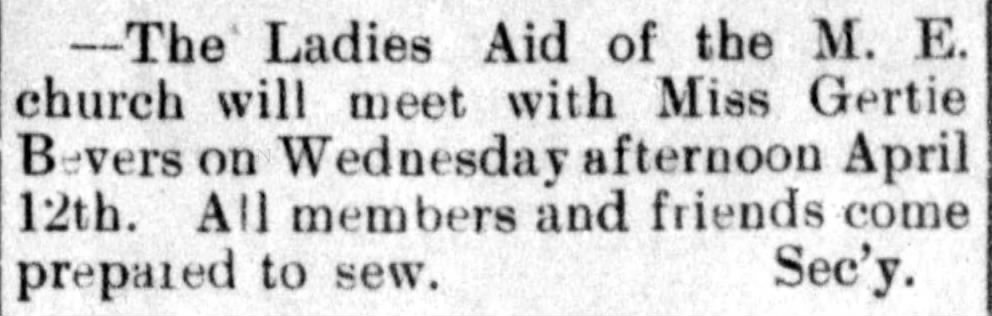
News item in Kingsbury County Independent
May 20, 1904

One of the aims of the Ladies Aid Society was to raise money for the church.  According to the 1965 history of the Methodist Church of De Smet: “The money paid in for the minister’s salary was never enough, so the Ladies’ Aid Society always put on big public chicken suppers.  The group published a cook book, Kitchen Echoes, in 1909 with tried recipes from the women of the town.  This brought in quite a bit of money for the church.”  Both Gertie and Maude contributed recipes which were printed in Kitchen Echoes, which sold for 50 cents per copy.

“Potato Salad.—Two teacups cold sliced potato, two hard boiled eggs, one good sized onion. Dressing for same: one egg, two tablespoons sugar, one-half cup vinegar, one tablespoon of butter, one teaspoon of mustard dissolved in a little milk, a pinch of salt. Heat until it thickens, but do not let it boil.—Gertie Bevers.”

“Sugar Cookies.—Two cups sugar, one cup butter, one cup sour cream, two eggs, one teaspoon soda, one teaspoon essence of lemon, flour to mix just stiff enough to roll easily.—Gertie Bevers”

News item in Kingsbury County Independent
April 7, 1911

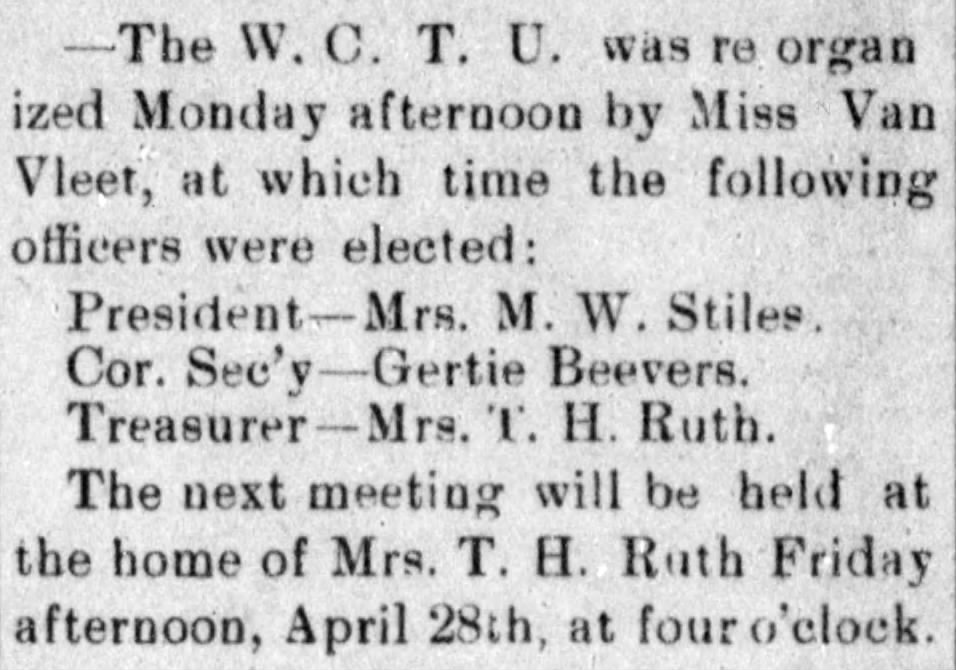
Another organization in which Gertie held an office was the Woman’s Christian Temperance Union (W. C. T. U.).  Although this organization was originally established to advocate for temperance, it later adopted the stance that local branches could advocate for other social causes, such as women’s suffrage.  In April 1905, the Kingsbury County Independent announced the re-organization of the chapter in De Smet by Miss Grace Van Vleet, who was the state secretary of Y. W. C. T. U. (the young women’s branch) and a temperance lecturer.  Gertie was elected to be the Correspondence Secretary of the local chapter.11  In March of the following year, the district convention of W. C. T. U. was held in De Smet.12  Most of the meetings on the 27th and 28th were held at the Methodist Episcopal Church.

News item in Kingsbury County Independent
April 21, 1905

A third organization in which Gertie participated was the Epworth League, which had been founded in 1889 as a merger of several young people’s organizations of Methodist Episcopal churches.13  Epworth League was made up of primarily young adults.  There were six departments of social service: Spiritual Life, Social Work, Literary Work, Correspondence, Mercy and Help, and Finance.  At the Methodist Episcopal church in De Smet, there were two Epworth League meetings held on Sundays, one was called the junior league and the other was the senior league.14  Gertie at the age of 39 was a delegate to an Epworth League convention in Brookings, South Dakota in September 1911.15

Additionally, Gertie was a dues-paying member of the Methodist women’s group.  She served on a committee in 1902 and was assistant to the 1st Vice in 1905.  She held a supper at her house in December 1910 to raise funds, $4.60 was collected.  On December 26, 1911, the minutes recorded: “Resolved Miss Bevers assist Evelyn in social work.”  She held another supper in April 1912, which raised $3.85.


On May 11, 1904, Gertie was a bridesmaid at her sister’s wedding.  Maude married her employer Alfred N. Waters, whose first wife had passed away in 1900.16  One of the earliest businessmen of De Smet, Waters was the president of Waters Land and Loan, as well as being the mayor of De Smet.  He had hired Maude to be his stenographer in 1898.17  The groomsman at the wedding was Professor C. E. Swanson, who was the superintendent of the De Smet schools, and the officiating minister was Rev. Henry Preston of the Methodist church.  The wedding was held at Syndicate Hotel which had opened in De Smet in 1887.  After an addition to the hotel was constructed in 1902, it was one of the largest hotels in South Dakota.18

As of the date of this blogpost, digitized versions of the issues of Kingsbury County Independent are only available for the years 1904 to 1929, which is when the Independent merged with the De Smet News.19  The succeeding issues are not available online.  From the issues that are digitized some of Gertie’s personal life can be envisioned because the local newspapers often reported on the events and travels of the Bevers family. 

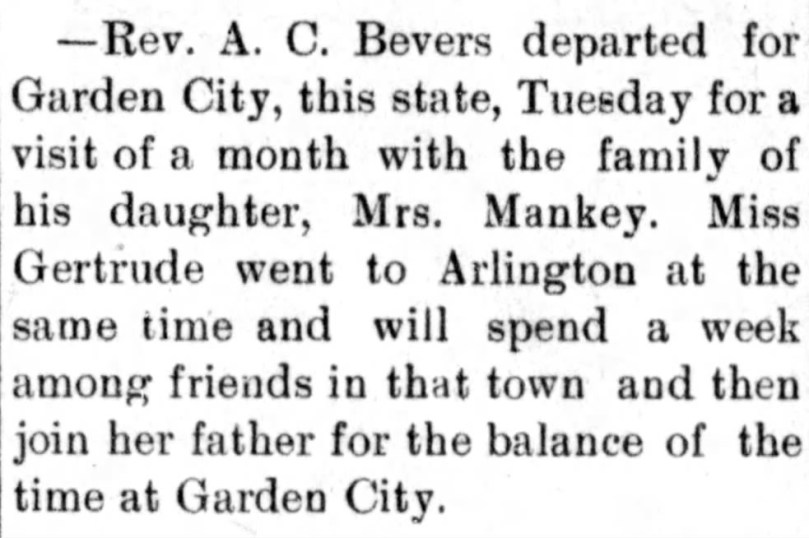
Sometimes Gertie’s sister Ada or her children made a trip to visit the Bevers family, but during the latter half of June 1906, Gertie spent two weeks with Ada, who lived with her husband William Mankey on a farm near Garden City, South Dakota.20  When the 1910 United States census was taken, Gertie was 37 years-old and still living with her parents who were 72 and 69.21  That year, Gertie’s mother passed away on July 14, and a lengthy obituary was published.22 It explained that Mary had had an operation six years earlier, from which she never fully recovered.  A couple of years later, she developed diabetes, and during this illness, Gertie and her family lovingly cared for Mary until her death.  Soon after the funeral, Gertie accompanied her father to Arlington, South Dakota to visit friends.23  And a month later, Mrs. James Bridges (the wife of Gertie’s mother’s nephew) came from Minneapolis to spend five days as a guest at the Bevers’ home.24 Shortly after that, both Gertie and her father took trips, in part separately and partly together. Gertie went to Arlington for two weeks, then joined her father at Ada’s home.25

News item in Kingsbury County Independent
Aug. 26, 1910

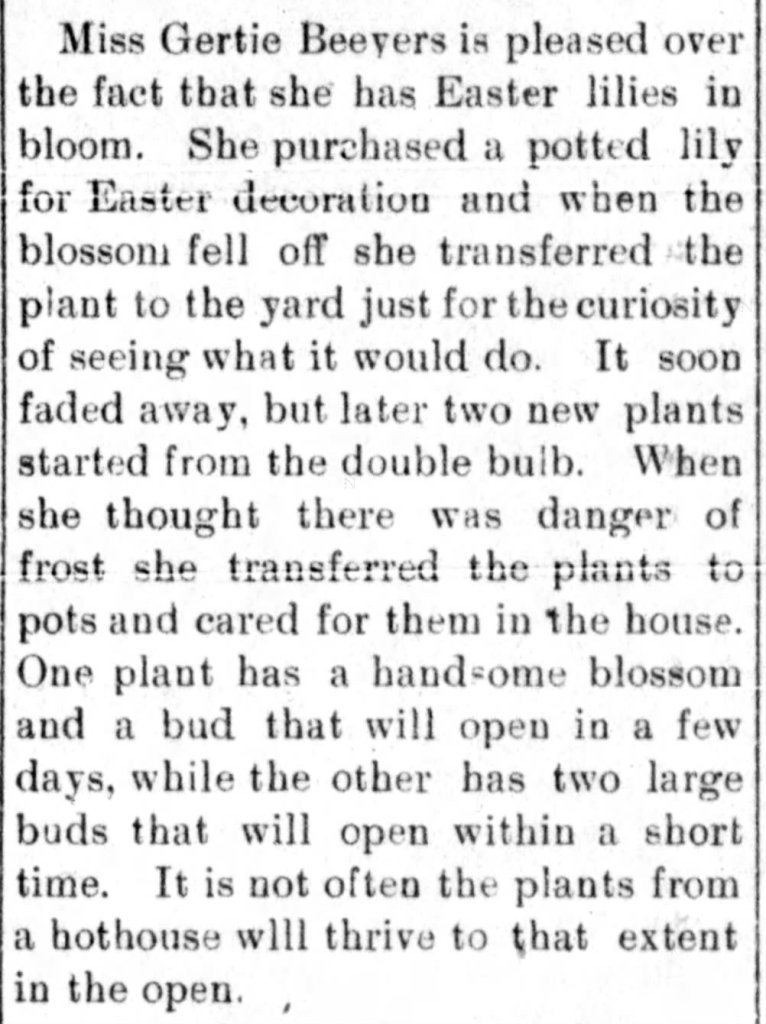
In March 1911, Gertie went again to Arlington to visit friends,26 and in August 1911, Mrs. John Glendenning came from Arlington to visit Gertie.27  Mrs. Glendenning was the daughter of Mrs. James Bridges and the granddaughter of Mathias Bridges, who was Gertie’s mother’s brother. A month later, the newspaper reported about an experiment that Gertie conducted with an Easter lily she had purchased.28

News item in Kingsbury County Independent, September 15, 1911

Gertie and Maude made a trip to Mitchell, South Dakota, in May 1916 to attend the wedding of their nephew W. Arthur Mankey, who was their sister Ada’s son.29  The wedding was held in the home of the bride, Birdella Carhart, and the officiating minister was the bride’s father, Rev. A. E. Carhart.  Also, in attendance were Arthur’s brother G. Floyd Mankey and his cousin Lester Mankey.


When Gertie was in her thirties and forties, suffrage for women was a fiercely contended political issue on both the state and federal levels.  In 1918, the men of South Dakota were asked to consider the question of amending the South Dakota state constitution, granting women the right to vote.  That November the amendment passed by approximately 63% of the vote.30  Six months later, the congress of the United States passed a suffrage amendment.  During subsequent months, the individual states either ratified or rejected the amendment.  South Dakota ratified it “without a dissenting vote in either house on Dec. 4, 1919, being the 21st state to act.”31  Ratification by the final state that was needed to adopt the 19th Amendment to the Constitution of the United States occurred on August 18, 1920.  The next day, a newspaper in Sioux Falls, South Dakota, declared, “Thus the political freedom for which women have contended since the founding of the republic has been attained and 27,000,000 women, half the population of the United States, accorded the right to vote under the constitution.”32


In January 1920 when the United States census was taken, 47-year-old Gertie and her 82-year-old father were living on Second Street in De Smet.33  Gertie’s father lived nearly two more years.  A news article dated September 23, 1921 included the following:

“For a number of years, the elderly gentleman had been in poor health, first being confined to a wheel chair, but later to his bed. His continued illness made it advisable for him to be moved from the Bevers home to A.N. Waters’ home, where his two daughters, Mrs. Waters and Gertrude Bevers, have cared for him.”34


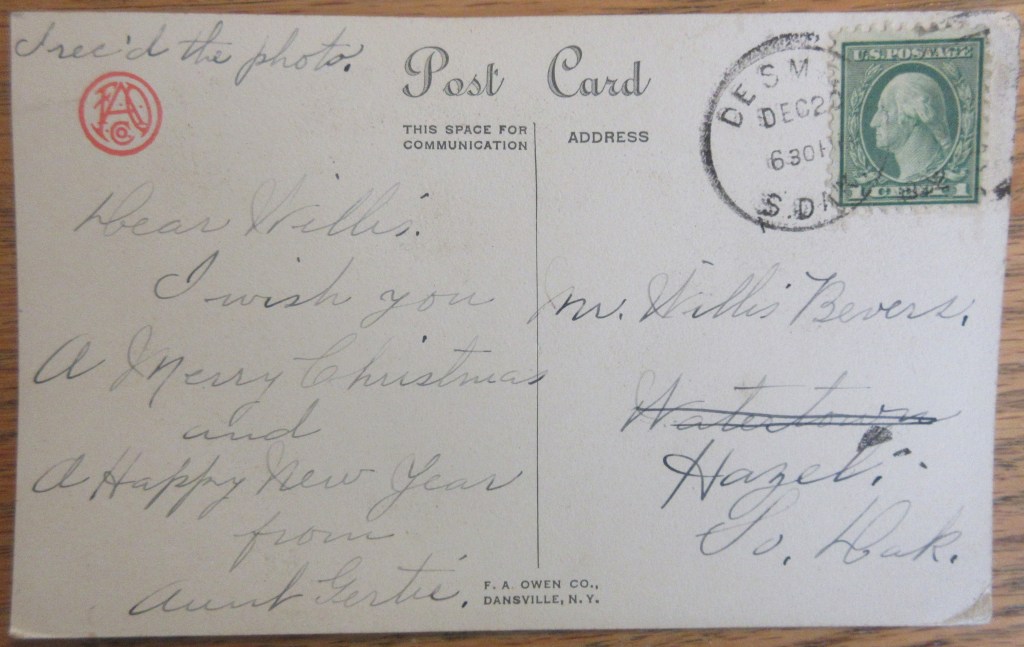
A couple of Gertie’s correspondences have survived for about 100 years.  In December 1922, she mailed a postcard to her nephew Willis Bevers, son of her brother Herbert.  Willis and his parents and six of his siblings had gone to southern Texas in the fall of 1919. The travel log of Willis’ mother has also survived.  After finding that they didn’t like farming in Texas, his parents with most of his siblings returned to South Dakota in 1920.  Willis stayed in Texas for another year but also returned to South Dakota about 1921.

Front of a Christmas postcard mailed by Gertie in December 1922
Back of a Christmas postcard mailed by Gertie in December 1922

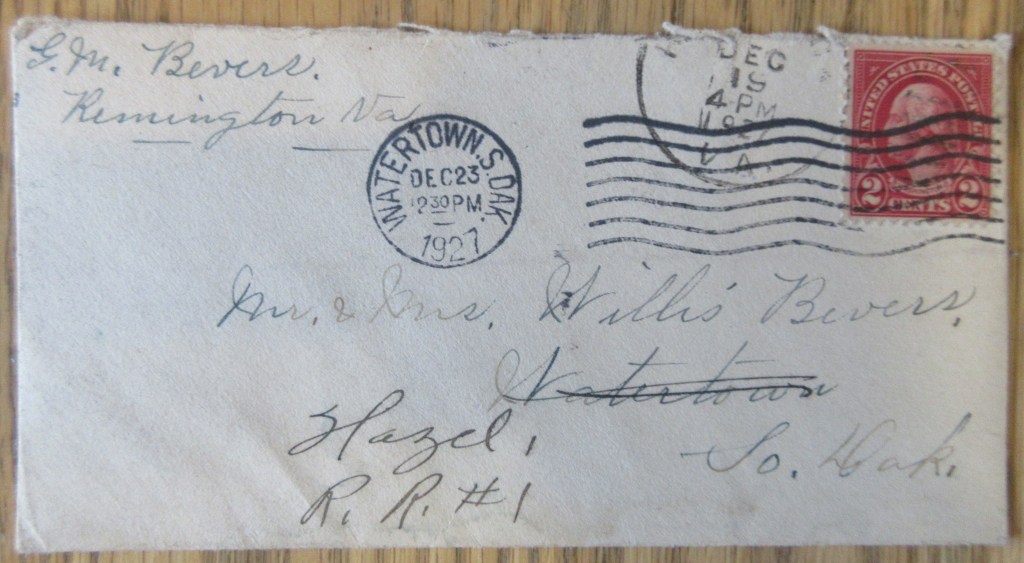
In 1927, apparently, Gertie made a cross-country trip to visit her sister Ada.  Ada with her husband and two daughters had moved to Virginia, near Remington, between 1915 and 1920.  Gertie’s trip is known because she mailed a Christmas greeting from Remington to Mr. and Mrs. Willis Bevers who were living in Hazel, South Dakota.  Postage for the letter was two cents and it took five days to travel from Virginia to Watertown, South Dakota.

Small envelope addressed by Gertie in December 1927
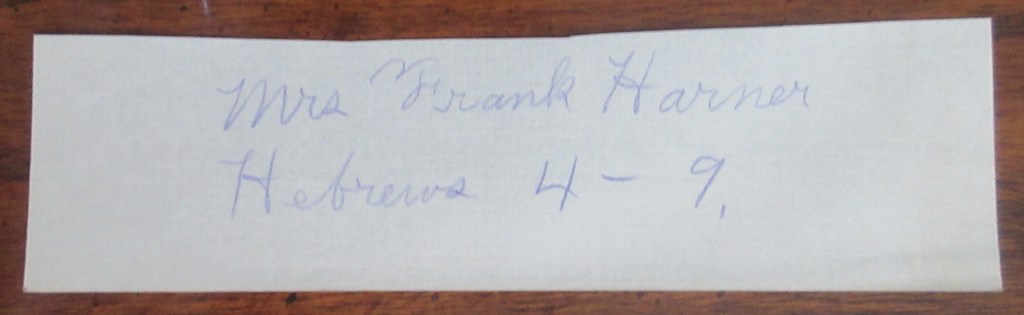
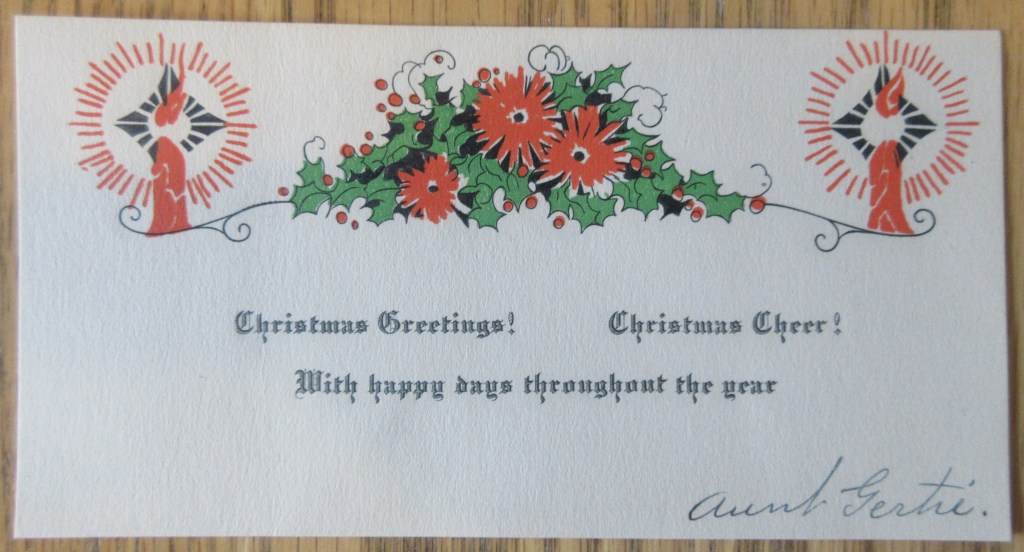
Small greeting card enclosed in the envelope mailed in December 1927

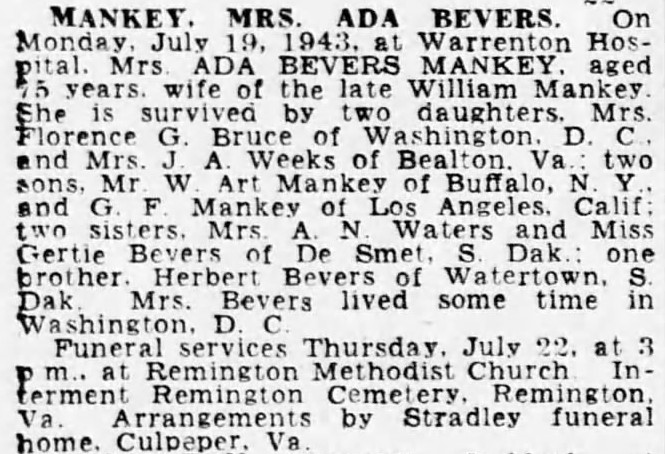
Little is known about Gertie’s personal life during the remaining years of her life.  In 1930, 1940 and 1950, when the United States censuses were taken, she was living with her widowed sister Maude, whose house was on 3rd Street in De Smet.  In 1930, Gertie was 57 years-old, Maude was 54 years-old and both of them were naturalized citizens.35  In 1940, both of them were engaged in home housework and they both received “income of $50 or more from sources other than money wages or salary.”36  Gertie’s brother George passed away in June 1943 in Los Angeles, California, and a month later Ada passed away in Washington, D. C.  About a year and a half later, her brother Herbert died in November 1944 in Watertown, South Dakota.

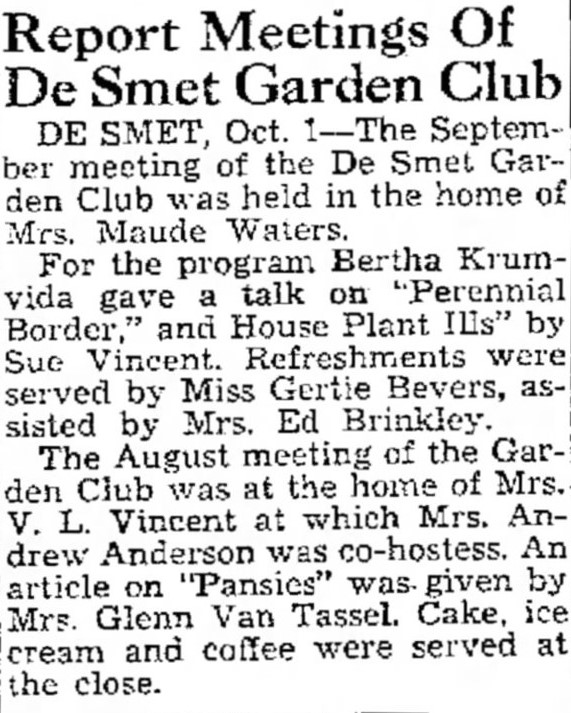
One miscellaneous item known about Gertie is that she continued to be active in the community in her sixties and seventies. She and Maude were members of the Friendly Garden Club in De Smet. In May 1939, they each participated in the program of the garden club by reading papers to the group. Gertrude read “Garden Verse” and Maude read “Gardening in all Countries and All Ages.”37 Nearly 10 years later, the sisters hosted a garden club meeting at Maude’s house.38

News item in The Daily Plainsman
October 1, 1948

In April 1950 the record of the United States census designates Gertie and Maude’s residence as Block 2 of “Original Town” of De Smet City.39  They were 77 and 74 years-old, respectively.  To the question, “What was this person doing most of last week – working, keeping house, or something else?” the answer for both of them was keeping house.  Gertie was selected to answer additional questions.  Her responses included that she was living in the same house a year earlier.  Her education level was recorded as “S7” (seventh grade), and she didn’t finish that grade.  She had not worked any weeks outside of her home in the previous year.  She didn’t receive money by working as an employee, or by working in her own business.  And to the question, “How much money did he receive from interest, dividends, veteran’s allowances, pensions, rents or other income (aside from earnings)?” she answered “none.”

Aunt Gertie passed away in De Smet on October 3, 1953, at the age of 81, after a “lingering illness” of stomach cancer.40  Her remains are buried in De Smet Cemetery beside her parents. Nearby, her sister Maude and her brother-in-law Alfred N. Waters are also buried.


APPENDIX 1

Text of the certificate of membership of the Band of Wolsey:

Thy Word is Truth

This is to certify that

Gertrude M. Bevers

Having signed the subjoined Pledge, has become a member of the

Hope of Wolsey

BAND OF HOPE

PLEDGE

I hereby solemnly promise to abstain from the use of all intoxicating liquors, including wine, beer and cider, as a beverage, and from the use of tobacco in every form, and from all profanity.

Thy Sign the Triple Pledge

BECAUSE

  1. Drunkenness is a sin.
  2. The Bible says no drunkard shall enter heaven
  3. Moderation tends to drunkenness, while total abstinence is perfectly safe.
  4. The first drink is a long step toward drunkenness.
  5. Those who do not resist the temptation to take the first drink, are not likely to resist the temptation to drink to excess.
  6. We can never tell, when we commence the habit of drinking, how it will end.
  7. Intoxicating drinks do us no possible good.
  8. They are the means of great injury to our health and character.
  9. The habit of drinking leads to many other evil habits.
  10. Drinking always leads to misery.
  11. Drinking usually leads to poverty.
  12. Drinking oftentimes leads to crime.
  13. Sixty thousand persons are ruined every year by the evils of drink.
  14. It is a Christian duty to deny ourselves for the good and happiness of others.
  15. While millions repent of drinking, none ever repent of abstaining.
  16. The habit of drinking is supremely foolish.
  17. The use of tobacco leads to an appetite for drink.
  18. Using tobacco is a filthy and costly habit, which does no good.
  19. Swearers and drinkers go together.
  20. God has said, “Swear not.”

Published by the Revolution Temperance Publishing House, David C. Cook, Manager, 13 & 15 Washington st., Chicago.           

Bible verses printed in each corner of the certificate:

Proverbs 23:29   Who hath woe?  Who hath sorrow?

II Corinthians 7:1  Let us cleanse ourselves from all filthiness.

Proverbs 23:32  At the last it biteth like a serpent, and stingeth like an adder.

Matthew 5:34  Swear not at all.


1 “RIPON. Death of an Old Temperance Advocate,” The Yorkshire Herald and the York Herald (York, North Yorkshire, England), February 17, 1894, page 11, Newspapers.com.

2 “Longwood Temperance Society,” Weekly Examiner (Huddersfield, West Yorkshire, England), April 24, 1869, page 6, Newspapers.com.

3 “United States Census, 1900”, , FamilySearch (https://www.familysearch.org/ark:/61903/1:1:MMRW-TKS : Sat Aug 17 18:09:29 UTC 2024), Entry for Alfred C Peevers and Mary N Peevers, 1900.

4 City of De Smet, South Dakota, “Depot Museum / Harvey Dunn School,” https://cityofdesmet.com/depot-museum.

5 Caryl Lynn Meyer Poppen, ed., excerpt from De Smet Yesterday and Today “Little Town on the Prairie” in “History,” De Smet, South Dakota, https://desmetsd.com/history.

6 First Methodist Church of DeSmet, “Record of Members.”

7 First Methodist Church, “A History of the Church,” Consecration Service of the Remodeled First Methodist Church (De Smet, South Dakota: First Methodist Church, September 26, 1965).

8 First Methodist Church, “A History of the Church.”

9 “South Dakota State Census, 1905”, , FamilySearch (https://www.familysearch.org/ark:/61903/1:1:MM42-JWN : Sun Mar 10 20:39:28 UTC 2024), Entry for Gertrude M Bevers.

10 “United States Census, 1940”, , FamilySearch (https://www.familysearch.org/ark:/61903/1:1:V19L-5LM : Fri Mar 08 09:56:34 UTC 2024), Entry for Maude Waters and Gertrude Bevers, 1940.

11“Local News,” Kingsbury County Independent (De Smet, South Dakota), April 21, 1905, page 5, Newspapers.com.

12 Kingsbury County Independent (De Smet, South Dakota), March 23, 1906, page 4, Newspapers.com.

13 Case Western Reserve University, “Epworth League,” Encyclopedia of Cleveland History, https://case.edu/ech/articles/e/epworth-league.

14 “Church Services,” Kingsbury County Independent (De Smet, South Dakota), September 15, 1911, page 5, Newspapers.com.

15 “Local News,” Kingsbury County Independent (De Smet, South Dakota), September 15, 1911, page 5, Newspapers.com.

16 Nancy S. Cleaveland, “Alfred N. Waters,” Laura Ingalls Wilder A-Z, http://www.pioneergirl.com/blog/archives/7204.

17 “College News,” The Brookings Register (Brookings, South Dakota), March 29, 1898, page 2, Newspapers.com.

18 Nancy S. Cleaveland, “Syndicate Hotel,” Laura Ingalls Wilder A-Z, http://www.pioneergirl.com/blog/archives/9165.

19 Library of Congress, Kingsbury County Independent (Desmet, Kingsbury County, S.D.) 1894-1929, https://www.loc.gov/item/sn00065130/.

20 “Local News,” Kingsbury County Independent (De Smet, South Dakota), June 15, 1906, page 5, Newspapers.com.

21 “United States Census, 1910”, , FamilySearch (https://www.familysearch.org/ark:/61903/1:1:MPX1-9J6 : Sun Mar 10 11:44:32 UTC 2024), Entry for Alfred C Bevers and Mary N Bevers, 1910.

22 Kingsbury County Independent (De Smet, South Dakota), July 22, 1910, page 4, Newspapers.com.

23 “Local News,” Kingsbury County Independent (De Smet, South Dakota), July 22, 1910, page 5, Newspapers.com.

24 “Local News,” Kingsbury County Independent (De Smet, South Dakota), August 19, 1910, page 5, Newspapers.com.

25 “Local News,” Kingsbury County Independent (De Smet, South Dakota), August 26, 1910, page 5, Newspapers.com.

26 “Local News,” Kingsbury County Independent (De Smet, South Dakota), March 24, 1911, page 5, Newspapers.com.

27 Kingsbury County Independent (De Smet, South Dakota), August 11, 1911, page 4, Newspapers.com.

28 “Local News,” Kingsbury County Independent (De Smet, South Dakota), September 15, 1911, page 5, Newspapers.com.

29 “Society,” Mitchell Capital (Mitchell, South Dakota), May 4, 1916, page 5, Newspapers.com.

30 Forest City Press (Forest City, South Dakota), December 5, 1918, page 2, Newspapers.com.

31 Argus-Leader (Sioux Falls, South Dakota), August 19, 1920, page 4, Newspapers.com.

32 Argus-Leader, August 19, 1920.

33 “United States Census, 1920”, , FamilySearch (https://www.familysearch.org/ark:/61903/1:1:M6JQ-J85 : Thu Mar 07 04:17:06 UTC 2024), Entry for Alfred C Bevers and Gertrude Bevers, 1920.

34 Nancy Cleaveland and Gina Terrana, Waters (2015), http://www.pioneergirl.com/waters_cemetery.pdf.
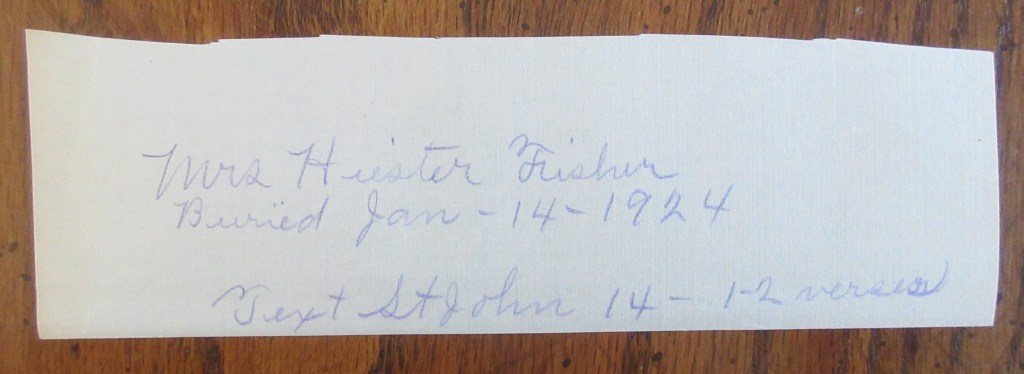
35 “United States Census, 1930”, , FamilySearch (https://www.familysearch.org/ark:/61903/1:1:XQVH-29Z : Thu Jul 11 05:02:51 UTC 2024), Entry for Maude A Waters and Gertrude V Bevers, 1930.

36 “United States Census, 1940”, Entry for Maude Waters and Gertrude Bevers, 1940.

37 The Daily Plainsman, (Huron, South Dakota), May 12, 1939, page 5, Newspapers.com.

38 The Daily Plainsman, (Huron, South Dakota), October 1, 1948, page 5, Newspapers.com.

39 “United States Census, 1950”, , FamilySearch (https://www.familysearch.org/ark:/61903/1:1:6F9N-CQQP : Wed Oct 04 18:17:08 UTC 2023), Entry for Agnes Maude Katers and Gertrude M Bevers, 10 April 1950.

40 K. and M. Bevers, notes attached to Gertrude Mary Bevers in Ancestral Quest program file dated June 29, 2022.

The Oldest Mementos of “The Breitenstein Bible”

“The Breitenstein Bible” came into possession of our family when my mother-in-law passed away.  For a dozen years, it remained packed away, undisturbed.  Finally, when down-sizing our belongings and upon deciding to pass the Bible on to our son, I took the time to look through the Bible.  Turning the leaves, I found news clippings, obituaries and funeral folders dispersed between its more than 2000 pages.  Another dozen years would pass before I had the opportunity to peruse those pages and mementos again.  In December 2023, I examined the Bible and photographed the mementos it has safe-guarded for decades, a few items for more than a century.  This blogpost is devoted to the oldest items in “The Breitenstein Bible” and the people with whom they are connected.  A description of the Bible itself, which was published about 1900, can be found on the Legacy Page entitled “The Breitenstein Bible.”

The Bible had been passed down to my mother-in-law through her father, who was a Breitenstein, but the oldest mementos would suggest that the Bible came to him from his mother’s line not his father’s. The oldest identifiable item is a handwritten note about Amos Goodhart. My mother-in-law’s ancestry can be traced to Amos K. Goodhart, so perhaps the Bible should be called “The Goodhart Bible.”

The original owner of the Bible is unknown.  None of the family register pages are filled in.  Besides the note about Amos Goodhart, there are two other handwritten notes which appear to be written in the same handwriting.  Since Amos’ wife had already passed away when he died, I propose that it was his daughter Sarah (Sallie) that wrote the notes.  Sallie married Jacob B. Breitenstein; they were my mother-in-law’s grandparents.

The oldest handwritten note found in “The Breitenstein Bible”

Amos’ ancestors had been living in Berks County, Pennsylvania, since at least 1754, when it was still a province.  His 2nd great-grandfather Fredrick Goodhart was recorded as residing in the district (or township) of Alsace when a tax list was created for the first assessment of taxes of the newly organized Berks County (which had been carved out of Philadelphia County).1  Fredrick Goodhart’s son, Frederick, acquired a homestead in Exeter Township.2  At the time of Amos’ death, the Goodharts had been residing in Exeter Township for roughly 130-140 years. Amos K. Goodhart, born February 23, 1852, was the son of John Newkirk Goodhart (1821-1898) and Sophia Kline (1827-1902).  As a child his family lived in Exeter Township3 and upon marrying Ellen Levan, they began raising their family on a farm in the township,4 remaining in Exeter Township their whole lives.

This handwritten note documents the dates of Amos’ death and burial, and very likely the text that was used at his funeral.  He was buried in the Schwarzwald Cemetery on January 5, 1923, having died on December 31, 1922 of “complications” according to the death register of Schwarzwald Reformed Church.5  In addition to his death, the church records also have an entry about his baptism and confirmation, which didn’t occur until he was 43 years old.6  Having been catechized, Amos was baptized on October 12, 1895 and then confirmed on the following day. Amos’ son Victor and his daughter Sarah were confirmed on that very same day. 

Job 5:26 as printed in “The Breitenstein Bible,” which is the text recorded along with Amos Goodhart’s death and burial dates.

Of the two other handwritten notes in “The Breitenstein Bible,” one note gives the burial date of Mrs. Hiester Fisher and the reference to a scripture text.  The other note simply states the name Mrs. Frank Harner and a scripture reference.  Over the years, as I’ve compiled a genealogy of my husband’s family, I have never seen the name Fisher nor Harner.  So, I proceeded to try to identify who Mrs. Hiester Fisher and Mrs. Frank Harner were.

In my search for someone named Hiester Fisher, I came up with no likely candidates.  But a search using the spelling Heister (e before i) led me to someone that could be the husband of the woman commemorated in “The Breitenstein Bible.”  In 1920, Sallie Breitenstein (Amos’ daughter) and her husband were living in Amity Township in Berks County.7  There was also living in this township a Heister Fisher with his wife Ellen.8  A few years later Ellen and subsequently Heister were buried in Saint Paul’s Church Cemetery in Amity Township.  The date of death engraved on Ellen’s gravestone is January 10, 1924,9 which would correspond to the burial date listed on the handwritten note, January 14.  A search in family trees on Ancestry.com leads to the conclusion that her maiden name was most likely Ellen Wise or Weise or Weiss.  She would have been in the generation of Sallie’s mother. Incidentally, Saint Paul’s Church Cemetery is where Sallie and her husband would later be buried. 

Presumably, the second-oldest handwritten note in “The Breitenstein Bible”
John 14:1-2 as printed in “The Breitenstein Bible,” which is the text recorded along with Mrs. Hiester Fisher’s burial date

Since the handwritten note about Mrs. Frank Harner doesn’t have a death or burial date, it is difficult to determine with any certainty who she was.  My guess is that she was Catherine (Kate) S. Rhoads who is buried in Saint Paul’s Church Cemetery with her husband, Franklin, but the last name on the gravestone is Herner, instead of Harner.  Kate Rhoads was also of the generation of Sallie’s mother.  Her death date was April 8, 1925.10  Kate’s sister, Rosa Ellen Rhoads, had married a man named Wellington Wise,11 who was possibly a relation of Ellen Wise (Mrs. Heister Fisher above.)

Presumably, the third-oldest handwritten note in “The Breitenstein Bible”
Hebrews 4:9 as printed in “The Breitenstein Bible,” which is the text noted with Mrs. Frank Harner’s name

There is an item in “The Breitenstein Bible” that is older than the three handwritten notes.  It is a lock of hair wrapped in a scrap of newsprint dated June 21, 1918.  Perhaps this could be the hair of Ellen S. Goodhart, saved as a memento by her husband Amos or her daughter Sallie.  Born March 29, 1849, Ellen was the daughter of Peter S. Levan (1822-1894) and Sarah E. Snyder (1825-1898).  One historian of Berks County made this statement in 1886: “The Levan family have occupied a prominent position in [Exeter] township for one hundred and fifty years, having, during this time, owned a large area of farming land where the members of that family are now located.  They gave much encouragement to the Schwartzwald Church by liberal contributions.”12  The Levan family can be traced back to three brothers whose father Daniel Levan was a French Huguenot.  “The Huguenots were French Protestants most of whom eventually came to follow the teachings of John Calvin, and who, due to religious persecution, were forced to flee France to other countries in the sixteenth and seventeenth centuries.”13  Daniel Levan fled from France to Amsterdam, Holland, which is where Isaac Levan was born, Ellen Levan’s 4th great-grandfather.14  Isaac and his brothers emigrated from Amsterdam to America and Isaac eventually settled in Exeter Township about 1730.

A lock of hair, which was wrapped in a scrap of newsprint, found in “The Breitenstein Bible”
The scrap of newsprint dated June 21, 1918

Ellen Goodhart died on October 19, 1918 and was buried in Schwarzwald Cemetery.15  Like her husband, her death was recorded in the death register of Schwarzwald Reformed Church.  During that time period, the usual number of burials per month in that cemetery was one or two, or sometimes three.  But in October 1918, the death register lists seven people dying between October 14 and October 27.  Although the causes of death were recorded as heart disease, pneumonia, tuberculosis, and influenza, consideration should be given to an historic event that was taking place in Pennsylvania during the fall of 1918.  An epidemic of influenza had begun in Philadelphia in late September and travelled from the city west through the state, reaching Berks County.

In The Great Influenza, author John M. Barry thoroughly relates the events and timelines of many of the outbreaks of influenza in the United States, and a few places abroad, from 1917 to 1919.  He devotes a portion of his book to the rise of the epidemic in Philadelphia.16  The details and quotes below are from Barry’s book.  In 1918 influenza spread to Pennsylvania when on “September 7, three hundred sailors arrived from Boston at the Philadelphia Navy Yard.”  Four days later, “nineteen sailors reported ill with symptoms of influenza.”  Knowing that influenza was wreaking havoc in Boston:

Lieutenant Commander R. W. Plummer, a physician and chief health officer for the Philadelphia naval district … ordered the immediate quarantine of the men’s barracks and the meticulous disinfecting of everything the men had touched. …

… The next day eighty-seven sailors reported ill.  By September 15, … the virus had made six hundred sailors and marines sick enough to require hospitalization, and more men were reporting ill every few minutes”.

On September 18, “…the Evening Bulletin assured its readers that influenza posed no danger, was as old as history ….”  The first two sailors dying of influenza in Philadelphia occurred the next day.  “…Plummer declared, ‘The disease has about reached its crest.  We believe the situation is well in hand.  From now on the disease will decrease.’”  The city’s director of public health, Dr. Wilmer Krusen insisted that “the dead were not victims of an epidemic; he said that they had died of influenza but insisted it was only ‘old-fashioned influenza or grip.’”  The next day fourteen sailors died and the first civilian died.  The following day there were more than twenty deaths.

On September 21, the city’s Board of Health “assured the city that it was ‘fully convinced that the statement issued by Director Krusen that no epidemic of influenza prevails in the civil population at the present time is absolutely correct.’”

Seven days later, on September 28, a great Liberty Loan parade, designed to sell millions of dollars of war bonds, was scheduled.  Weeks of organizing had gone into the event, and it was to be the greatest parade in Philadelphia history, with thousands marching in it and hundreds of thousands expected to watch it.

Influenza continued spreading through the city, “… the day before the parade, hospitals admitted two hundred more people – 123 of them civilians ….”  Even though several doctors urged Krusen to cancel the parade, “Krusen declared that the Liberty Loan parade and associated rallies would proceed.”

On September 28, marchers in the greatest parade in the city’s history proudly stepped forward.  The paraders stretched at least two miles, two miles of bands, flags, Boy Scouts, women’s auxiliaries, marines, sailors, crushing against each other to get a better look, the ranks behind shouting encouragement over shoulders and past faces to the brave young men.  It was a grand sight indeed.

Two days after the parade, Krusen issued a somber statement: ‘The epidemic is now present in the civilian population and is assuming the type found in naval stations and cantonments.’

… Within seventy-two hours after the parade, every single bed in each of the city’s thirty-one hospitals was filled.  And people began dying.

… On October 1, the third day after the parade, the epidemic killed more than one hundred people – 117 – in a single day.

From Philadelphia the epidemic spread west into Pennsylvania.  Three weeks after the parade, people in Berks County were dying of influenza.  The Schwarzwald Reformed Church death register documents that two of its members succumbed to influenza.  A question lingers over the other five deaths recorded that month – was the influenza virus a contributing factor in their deaths; for example, in Ellen Goodhart’s death which was recorded as heart disease?


In October 2018 Surgeon General Rupert Blue of the U. S. Public Health Service issued the following information about the epidemic:

The disease now occurring in this country and called ‘Spanish Influenza’ resembles a very contagious kind of ‘cold’ accompanied by fever, pains in the head, eyes, ears, back or other parts of the body and a feeling of severe sickness.  In most of the cases the symptoms disappear after three or four days, the patient then rapidly recovering.  Some of the patients, however, develop pneumonia, or inflammation of the ear, or meningitis, and many of these complicated cases die. …

There is as yet no certain way in which a single case of ‘Spanish influenza’ can be recognized.  On the other hand, recognition is easy where there is a group of cases.  In contrast to the outbreaks of ordinary coughs and colds, which usually occur in the cold months, epidemics of influenza may occur at any season of the year.  Thus the present epidemic raged most intensely in Europe in May, June and July.  Moreover, in the case of ordinary colds, the general symptoms (fever, pain, depression) are by no means as severe or as sudden in their onset as they are in influenza.  Finally, ordinary colds do not spread through the community so rapidly or so extensively as does influenza. …

No matter what particular kind of germ causes the epidemic, it is now believed that influenza is always spread from person to person, the germs being carried with the air along with the very small droplets of mucus, expelled by coughing or sneezing, forceful talking, and the like by one who already has the germs of the disease.  They may also be carried about in the air in the form of dust coming from dried mucus, from coughing and sneezing, or from careless people who spit on the floor and on the sidewalk.  As in most other catching diseases, a person who has only a mild attack of the disease himself may give a very severe attack to others. …

It is very important that every person who becomes sick with influenza should go home at once and go to bed.  This will help keep away dangerous complications and will, at the same time, keep the patient from scattering the disease far and wide.  It is highly desirable that no one be allowed to sleep in the same room with the patient.  In fact, no one but the nurse should be allowed in the room. …

… Only such medicine should be given as is prescribed by the doctor.  It is foolish to ask the druggist to prescribe and may be dangerous to take the so-called ‘safe, sure and harmless’ remedies advertised by patent medicine manufacturers.

If the patient is so situated that he can be attended only by some one who must also look after others in the family, it is advisable that such attendant wear a wrapper, apron or gown over the ordinary house clothes while in the sick room and slip this off when leaving to look after the others.

Nurses and attendants will do well to guard against breathing in dangerous disease germs by wearing a simple fold of gauze or mask while near the patient. …

When crowding is unavoidable, as in street cars, care should be taken to keep the face so turned as not to inhale directly the air breathed out by another person.

“It is especially important to beware of the person who coughs or sneezes without covering his mouth and nose.  It also follows that one should keep out of crowds and stuffy places as much as possible, keep homes, offices and workshops well aired, spend some time out of doors each day, walk to work if at all practicable – in short, make every possible effort to breathe as much pure air as possible.

In all health matters follow the advice of your doctor and obey the regulations of your local and state health officers.

Cover up each cough and sneeze,

 if you don’t you’ll spread disease.17


1. __________, “Erection of County” in Historical and Biographical Annals of Berks County Pennsylvania, vol. 1, ed. Morton L. Montgomery (Chicago: J. H. Beers & Co., 1909), 8.

2. __________, “Daniel B. Keehn” in Historical and Biographical Annals of Berks County Pennsylvania, vol. 2, ed. Morton L. Montgomery (Chicago: J. H. Beers & Co., 1909), 999.

3. “United States Census, 1860”, , FamilySearch (https://www.familysearch.org/ark:/61903/1:1:MXPZ-BTN : Thu Mar 07 06:01:10 UTC 2024), Entry for John Newkirk Goodhart and Sufiah Goodhart, 1860.

4. “United States Census, 1880”, , FamilySearch (https://www.familysearch.org/ark:/61903/1:1:MW6B-F7D : Sun Mar 10 10:50:22 UTC 2024), Entry for Amos Goodhart and Ellen Goodhart, 1880.

5. Schwarzwald Reformed Church, Protocol of the German Reformed Church at Schwartzwald commencing with the ministry of Rev. Aaron S. Leinbach in Pennsylvania and New Jersey, Church and Town Records, 1708-1985 [microfilm collection of Historical Society of Pennsylvania] (Provo, UT, USA: Ancestry.com Operations, Inc., 2011), image 115, http://www.Ancestry.com.

6. Schwarzwald Reformed Church, German Reformed Church at Schwartzwald, image 75.

7. “United States Census, 1920”, , FamilySearch (https://www.familysearch.org/ark:/61903/1:1:M6BG-RV5 : Fri Mar 08 15:45:19 UTC 2024), Entry for Jacob Breitinstine and Sallie Breitinstine, 1920.

8. “United States Census, 1920”, , FamilySearch (https://www.familysearch.org/ark:/61903/1:1:M6BP-24K : Sat Mar 09 08:45:24 UTC 2024), Entry for Heister Fisher and Ellen Fisher, 1920.

9. Find a Grave, “Ellen G. Weiss Fisher,” https://www.findagrave.com/memorial/59396049/ellen-g-fisher.

10. Find a Grave, “Catherine S. “Kate” Rhoads Herner,” https://www.findagrave.com/memorial/59239221/catherine_s-herner.

11. __________, “Wellington L. Wise” in Historical and Biographical Annals of Berks County Pennsylvania, vol. 2, ed. Morton L. Montgomery (Chicago: J. H. Beers & Co., 1909), 1101.

12. M. L. M., “Townships of Berks County,” History of Berks County, Pennsylvania (location unknown: Everts, Peck & Richards, 1886), 973.

13. National Huguenot Society, Who Were the Huguenots? (2024), https://nationalhuguenotsociety.org/who-were-the-huguenots/.

14. __________, “Henry B. Levan” in Historical and Biographical Annals of Berks County Pennsylvania, vol. 1, ed. Morton L. Montgomery (Chicago: J. H. Beers & Co., 1909), 494.

15. Schwarzwald Reformed Church, German Reformed Church at Schwartzwald

16. John M. Barry, The Great Influenza (New York: Viking Press, 2004): 197-220.

17. “Uncle Sam’s Advice on Flu,” Saturday News (Watertown, South Dakota), October 10, 1918, 5, Newspapers.com.

Ada and William Mankey

It was probably in the fall of 1885 that 18 year-old Ada Bevers met William Mankey.  Ada had immigrated from England only about 10 months prior.  William, having immigrated from England in 18751 and having worked (as of 1880) in a mine in Deer Park Township, La Salle County, Illinois,2 by 1882 had obtained a tract of land in Clark County, Dakota Territory.3  In October 1885 Ada’s father, Alfred C. Bevers, was assigned to be the supply pastor of the Henry Methodist Episcopal (M. E.) Church in southwestern Codington County, Dakota Territory.4  The charge may have included a congregation located in Garden City as well, which was about 12 miles to the northwest of Henry, over the county line in Clark County.  It is known that in 1888, William and his mother were members of the Garden City congregation and William was also a steward of the Henry Charge.5  

Ada’s family lived in Henry for two years, then her father was assigned to Wolsey M. E. Church and the following year he was assigned to Bradley M. E. Church.  Around this time period, Alfred submitted a claim for a homestead in Phipps Township, in western Codington County, about 10 miles northeast of Garden City.  When Alfred and his wife Mary celebrated their 25th wedding anniversary in September 1889 at their small home on the homestead, it is believed that William attended the gathering.  (See a photograph of the group attending the celebration in Ada, Gertie and Maude). 

Ada and William would eventually marry on October 28, 1891.6  During the next decade, they lived on their farm in Clark County and they would have three children born to them.  Their first child, Florence Gertrude, was born on October 16, 1892.7  Her namesakes were Ada’s sisters, Florence who had died as an infant and Gertrude who was still living with Ada’s parents.  On April 13, 1894, Ada gave birth to William Arthur,8 named after his father of course and one of Ada’s deceased brothers Arthur.  On June 7, 1897, George Floyd was born, named after Ada’s eldest brother George, who was living in Philadelphia.9 By 1898, Ada’s parents and sisters Gertrude and Maude had moved to De Smet, the county seat of Kingsbury County, about 50 miles to the south of William and Ada’s farm.

William and Ada Mankey

When the 1900 United States census was taken, 32-year-old Ada and 42-year-old William had been married for eight years.10  They were living on the farm that they owned in Eden Township, Clark County.  William was a farmer and a naturalized citizen, having lived in the United States for 25 years.  The census recorded that Ada had immigrated in 1884 and had been in the United States for 16 years.  She was not a naturalized citizen (although she had submitted her intention to become a citizen in 1889.)11  Seven year-old Florence had attended five months of school that year.  W. Arthur was six years-old and G. Floyd was two years old.  On the section to the east of William and Ada’s farm, William’s mother Mary lived with his brother Tobias, his sister Margaret Minor and Margaret’s three children.12  William’s father Thomas had passed away in 1899 and is buried in Garden City Cemetery.13

The quarter section in Eden Township that William and Ada owned can be found on a 1900 map of Clark County; the farm is about a mile north of Garden City and labeled with Ada’s name.14  Adjacent to Ada and William’s farm, the map shows the quarter section owned by Mary Mankey, and to the east of her farm, William’s brother Thomas Mankey held a quarter section.  Not far away in Maydell Township to the north were the farms of William’s brothers Tobias and James Mankey.

Cropped from a map of Clark County, South Dakota, dated ca. 1900.

William and Ada added another daughter to their family, Hazel Maude, on September 14, 1904.15  She was named after Ada’s youngest sister Maude.  When the South Dakota census was taken in 1905, the Mankey family was still living at the same location in Eden Township.  Four years later, William’s mother passed away in 1909 and was buried with his father in Garden City Cemetery.16

In late winter 1909, Ada made a trip to De Smet to visit her parents for several days.  Possibly she traveled by train.  The Chicago, Milwaukee and Saint Paul Railway had an extension which had stations at Garden City and Lake Preston, a town ten miles to the east of De Smet.  A year and a half after this visit, Ada’s mother, who had been afflicted with diabetes for nearly four years, passed away in July 1910.17  Shortly afterwards, Ada’s father spent a month at Ada’s home and her sister Gertrude joined them after visiting some friends.

Reported in Kingsbury County Independent, March 5, 1909
Reported in Kingsbury County Independent, August 26, 1910

When the 1910 United States census was taken, Ada and William were still living on a farm in Eden Township.18  Florence (age 17), W. Arthur (age 16) and G. Floyd (age 12) had all attended school that year.  Hazel at five years-old had not attended school.  While in high school, W. Arthur made a glider from plans published in the magazine Popular Mechanics.19

Both the 1900 and the 1910 censuses asked women how many children they had and how many of them were alive.  Ada had given birth to four children and all of them were alive.  This was unlike her mother, who had born 11 children, six of which passed away in their first or second year of life.  In England early childhood mortality (deaths of children between the age one and five) had begun to decline about 1870, but infant mortality (deaths of children before the age of one) didn’t decline until around the turn of the twentieth century.20  Ada’s mother was living in England and bearing children when infant mortality was high.  Ada’s children were born during a period of steady decline in child mortality in the United States.21

In 1915 when the South Dakota state census was taken, Florence and Hazel were at home with Ada and William.22  W. Arthur was attending his second year of college at Dakota Wesleyan University (DWU) in Mitchell, South Dakota.23  He was studying Engineering and Math.24  The census records identify the family’s religion as “M. E.” (Methodist Episcopal).  It is not known where G. Floyd was at the time of this census, but according to the 1930 United States census he was a veteran of “the World War,”25 which would be World War 1.  He was a seaman in the United States Navy from May to December 1918.26 

The first of William and Ada’s children to marry was W. Arthur.  He married Birdella A. Carhart in April 1916 in Mitchell,27 where they had met while he was attending DWU.  The officiating clergyman was Birdella’s father, A. E. Carhart, who was a minister in the M. E. Church.  A year and a half after their marriage, W. Arthur and Birdella had their first child, born in December 1917, giving William and Ada their first grandchild.  By then, W. Arthur and Birdella were living in Washington, D. C.28  They would give Ada and William their second and third grandchildren in July 1921 and January 1924. 

By the time the United States census was taken in January 1920, William and Ada had purchased and lived on a dairy farm outside of Remington, Fauquier County, Virginia, about 60 miles southwest of Washington, D. C.29  William was 61 years-old, a naturalized citizen and a dairy farmer.  Ada was 52 years-old and she was also naturalized.  Their 27 year-old daughter Florence and 15 year-old daughter Hazel were living with them, and Hazel was attending school.  W. Arthur, Birdella and their child were in a rented place in Washington, D. C.30  W. Arthur was a draftsman, working for the Navy Department.  G. Floyd was possibly lodging in Washington, D. C. and working as an automobile salesman.31  A year after the census was taken, back in DeSmet, South Dakota, Ada’s father passed away in September 1921.32 

In the early 1920s, W. Arthur would move to southern California and embark on a career in aviation engineering.  During the next several decades he would play a role in the advancement of the aviation field and in its regulation.  One of his first accomplishments was modifying an airplane wing which with one further modification became the wing of Colonel Charles Lindbergh’s plane, the Spirit of Saint Louis.33  In 1927, the Spirit of Saint Louis was the first plane to be successfully flown across the Atlantic Ocean.

At noon on November 21, 1923, a wedding was performed at Ada and William’s “Fairview Farm.”34  Florence married Grant B. Bruce, a widower employed by the Government Forestry Department in Washington, D. C.  The city directory provides additional information:  He was a statistician for the Department of Agriculture.35  Upon settling in Grant’s home in northwest Washington, D. C., Florence would host lodgers in their home for the next couple of decades.  Many of the lodgers worked for the United States government. 

Reported in Richmond Times-Dispatch, December 1, 1923

Two more weddings occurred in the 1920s.  Hazel married James H. Weeks in October 1924,36 and G. Floyd, who had moved to San Francisco in the mid-1920s, married Lucia Neira, an Italian immigrant, in May 1927.37

In December 1927, Ada’s sister Gertrude mailed a Christmas greeting card from the town of Remington, Virginia.  The card was addressed to one of her brother Herbert’s sons and his wife, Willis and Elizabeth Bevers, in Hazel, South Dakota.  Presumably Gertrude was visiting Ada and her family.

According to the 1930 United States census, 61 year-old Ada and 71 year-old William were living on a dairy farm that they owned, still in Fauquier County.  William was a farmer and he had worked on the day before the census taker visited their home.38  He was not a veteran.  They did not own a radio set.  Florence and Grant were living at the same location in Washington, D. C.39  W. Arthur and his family had left California and were living in Detroit, Michigan.  W. Arthur was an aeronautical engineer, working in the auto products industry.40   George and Lucille were in San Francisco and George was working as an automobile salesman.41  They owned a radio set.  Hazel and James were living with her in-laws on her father-in-law’s dairy farm which was not far from Ada and William.42  They had two children by this time, giving Ada and William a total of five grandchildren.  Three years later, Florence would give them their sixth grandchild.

In 1935, Ada and William still lived on a farm outside of Remington.43  Florence and Grant with their child were living at the same address as previously in Washington, D. C.44  W. Arthur and his family had moved to Santa Monica, California.45  Hazel and James were on a farm in Lee, Virginia.46  George and Lucille still lived in San Francisco,47 but by 1937, they would move to southern California where Lucille gave birth to Ada and William’s seventh grandchild.48

Tragedy struck Ada and Florence within a single day of each other.  Florence’s husband died on April 30, 1938.  Grant had worked for the federal government for about 37 years and had been “in charge of all map records of the United States Forest Service” for 25 years before his retirement in May 1937.49  The day after Grant died, William at nearly 80 years-old passed away on May 1, 1938.  His death certificate states that he worked as a dairy farmer “to time of death.”50  William is buried in Remington Cemetery, Remington, Virginia.

The 1940 United States census record indicates that 72 year-old Ada was a lodger in Washington, D. C. and in the previous year she had received more than $50.00 that was not money wages or salary.51  Florence, at 46 years-old was continuing to live at the same residence which she owned in Washington, D. C.; also at the residence was her seven year-old child and three lodgers.52  W. Arthur had returned to the east coast, he and his family were living in Baltimore County, Maryland.53  He was an aeronautical engineer at an airplane factory.  George and Lucille had moved to Montebello, Los Angeles County and he was working as a house roofer.54  Hazel and her family were still living on a farm in Lee, Virginia.55  Her father-in-law lived with them and they had two children.  There was also a lodger and a servant living with them.

During the last years of Ada’s life, her eighth and ninth grandchildren were born, the children of Hazel and James, born in 194056 and 1943.57  At the age of 75, Ada’s last days were spent in Warrenton Hospital, Fauquier County and she died there on Monday, July 19, 1943.  She is buried in Remington Cemetery with her husband.

Reported in Washington, D. C.’s Evening Star, July 21, 1943

1 Ancestry.com, New York, Passenger Lists, 1820-1957 (Provo, Utah, USA: Ancestry.com Operations Inc, 2010): http://www.Ancestry.com.

2 “United States Census, 1880”, database with images, FamilySearch (https://www.familysearch.org/ark:/61903/1:1:MXV4-9J7 : Mon Sep 18 07:00:43 UTC 2023), Entry for Thomas Mankey and Mary Mankey, 1880.

3 “United States Bureau of Land Management Tract Books, 1800-c. 1955,” database with images, FamilySearch (https://familysearch.org/ark:/61903/3:1:3QS7-89WS-ZB44?cc=2074276&wc=M7WS-8ZC%3A356164401%2C356186301 : 14 October 2022), Dakota Territory > Vol 32 > image 54 of 254; Records Improvement, Bureau of Land Management, Washington D.C.”

4 United Methodist Church, Dakotas Conference, Commission on Archives and History, personal communication with M. R. Wilson (June 20, 1995).

5 J. G. Palmer, Palmer’s Directory of the Methodist Episcopal Church for Dakota Conference, “Henry” (1888): 128.

6 K. & M. Bevers, marriage note attached to William Mankey in Ancestral Quest program file dated June 29, 2022.

7 South Dakota Department of Health, “South Dakota Birth Records With Birth Dates Over 100 Years,” [Birth Information for Florence Mankey, State File Number: 599515]: https://apps.sd.gov/PH14Over100BirthRec/resultDetail.aspx?args=B7173D5000910C4994EA3F8456480222D6E12B84CB216B4C0933C9B568E36E1D0E715C23B1B77D480BE3E15CB8FC342C.

8 K. and M. Bevers, record of William Arthur Mankey, Ancestral Quest program file dated June 29, 2022.

9 South Dakota Department of Health, “South Dakota Birth Records With Birth Dates Over 100 Years,” [Birth Information for George Mankey, State File Number: 571260]: https://apps.sd.gov/PH14Over100BirthRec/resultDetail.aspx?args=B7173D5000910C4994EA3F8456480222567A6332A151C9247E16A4E0455BC1DD47D4462802BD74BF1CB49DF6E38B4573.

10 “United States Census, 1900,” database with images, FamilySearch (https://familysearch.org/ark:/61903/3:1:S3HY-6PQ9-455?cc=1325221&wc=9BW8-7MH%3A1031648401%2C1030694601%2C1032143801 : 5 August 2014), South Dakota > Clark > ED 89 Eden, Elrod & Maydell Townships > image 5 of 16; citing NARA microfilm publication T623 (Washington, D.C.: National Archives and Records Administration, n.d.).

11 United States of America, “First Naturalization Paper of Ada N. Bevers,” (Codington County, Dakota Territory: USA, May 22, 1889).

12 “United States Census, 1900,” database with images, FamilySearch (https://familysearch.org/ark:/61903/3:1:S3HY-6PQ9-QHQ?cc=1325221&wc=9BW8-7MH%3A1031648401%2C1030694601%2C1032143801 : 5 August 2014), South Dakota > Clark > ED 89 Eden, Elrod & Maydell Townships > image 6 of 16; citing NARA microfilm publication T623 (Washington, D.C.: National Archives and Records Administration, n.d.).

13 South Dakota State Historical Society, online cemetery search, “Thomas Mankey,“ https://apps.sd.gov/dt58cemetery/.

14 Peterson, E. F., and S. Wangersheim. Map of Clark County, South Dakota: compiled and drawn from a special survey and official records (Vermillion, S.D.: E. Frank Peterson, 1900): https://www.loc.gov/item/2012593005/.

15 South Dakota Department of Health, “South Dakota Birth Records With Birth Dates Over 100 Years,” [Birth Information for Hazel Mankey, State File Number: 599514]: https://apps.sd.gov/PH14Over100BirthRec/resultDetail.aspx?args=B7173D5000910C4994EA3F845648022241EB9E32217A5B880C0B80F399C73EA3C6FFD3355FD484F8AC6A0AC2E2AEC648.

16 South Dakota State Historical Society, online cemetery search, “Mary Mankey,“ https://apps.sd.gov/dt58cemetery/.

17 Kingsbury County Independent, “Mrs. Alfred C. Bevers,” (DeSmet, South Dakota: July 22, 1910): 4.

18 “United States Census, 1910,” database with images, FamilySearch (https://familysearch.org/ark:/61903/3:1:33S7-9TD2-CVC?cc=1727033&wc=QZZH-XC3%3A133638201%2C133675901%2C133835401%2C1589089262 : 24 June 2017), South Dakota > Clark > Eden > ED 108 > image 3 of 8; citing NARA microfilm publication T624 (Washington, D.C.: National Archives and Records Administration, n.d.).

19 K. & M. Bevers, biographical note attached to W. A. Mankey.

20 University of Cambridge, Populations Past – Atlas of Victorian and Edwardian Population, https://www.populationspast.org/about/.

21 Statista, Child mortality rate (under five years old) in the United States, from 1800 to 2020, https://www.statista.com/statistics/1041693/united-states-all-time-child-mortality-rate/.

22 “South Dakota State Census, 1915,” database with images, FamilySearch (https://familysearch.org/ark:/61903/3:1:S3HY-6917-3R9?cc=1476041&wc=MJQL-MNL%3A1041735101 : 21 May 2014), 004245361 > image 1948, 1970, 1972 & 1997 of 3079; State Historical Society, Pierre.

23 “South Dakota State Census, 1915,” database with images, FamilySearch (https://familysearch.org/ark:/61903/3:1:S3HY-691Q-K1F?cc=1476041&wc=MJQL-MNL%3A1041735101 : 21 May 2014), 004245361 > image 1953 of 3079; State Historical Society, Pierre.

24 K. & M. Bevers, biographical note attached to W. A. Mankey.

25 “United States Census, 1930,” database with images, FamilySearch (https://familysearch.org/ark:/61903/3:1:33SQ-GR4N-9Y7?cc=1810731&wc=QZFS-M82%3A648807101%2C651480501%2C651480502%2C1589283887 : 8 December 2015), California > San Francisco > San Francisco (Districts 1-250) > ED 134 > image 40 of 43; citing NARA microfilm publication T626 (Washington D.C.: National Archives and Records Administration, 2002).

26 “United States Headstone Applications for U.S. Military Veterans, 1925-1949,” database with images, FamilySearch (https://familysearch.org/ark:/61903/3:1:3QS7-994Q-YRD4?cc=1916249&wc=MDBG-K68%3A205942901%2C213448601 : 26 April 2021), 1941-1949 > Mangum, Tully-Marks, Edward > image 136 of 2371; citing NARA microfilm publication M1916 (Washington, D.C.: National Archives and Records Administration, n.d.).

27 Ancestry.com, South Dakota, U. S., Marriages, 1905-2018 (Ancestry.com Operations, Inc.: Lehi, Utah, USA, 2005).

28 The Mitchell Capital (Mitchell, South Dakota, December 13, 1917): 3.

29 “United States Census, 1920,” database with images, FamilySearch (https://familysearch.org/ark:/61903/3:1:33SQ-GRFW-4QZ?cc=1488411&wc=QZJT-FXV%3A1038215501%2C1038273601%2C1036505301%2C1589332367 : 14 September 2019), Virginia > Fauquier > Lee > ED 47 > image 19 of 42; citing NARA microfilm publication T625 (Washington, D.C.: National Archives and Records Administration, n.d.).

30 “United States Census, 1920,” database with images, FamilySearch (https://familysearch.org/ark:/61903/3:1:33S7-9R69-46Q?cc=1488411&wc=QZJG-FM7%3A1036474401%2C1036474402%2C1036476301%2C1589335824 : 10 September 2019), District of Columbia > Washington > Washington > ED 317 > image 18 of 28; citing NARA microfilm publication T625 (Washington, D.C.: National Archives and Records Administration, n.d.).

31 “United States Census, 1920”, , FamilySearch (https://www.familysearch.org/ark:/61903/1:1:MNLV-Z7N : Thu Oct 05 15:18:14 UTC 2023), Entry for George F Mauky, 1920.

32 The Tabor Independent (Tabor, South Dakota, October 6, 1921): 6.

33 The Los Angeles Times (Los Angeles, California, April 20, 1985): 61.

34 Richmond Times-Dispatch (Richmond, Virginia, December 1, 1923): 4.

35 Ancestry.com, Boyd’s Directory of the District of Columbia 1923, U.S., City Directories, 1822-1995 [database on-line] (Lehi, UT, USA: Ancestry.com Operations, Inc., 2011).

36 K. & M. Bevers, biographical note attached to Hazel Maude Mankey, Ancestral Quest program file dated June 29, 2022.

37 Ancestry.com, “California, U.S., Federal Naturalization Records, 1843-1999” [Naturalization record of Lucille Mankey, Naturalization Records/i. National Archives at Riverside, Peris, California] (Lehi, UT, USA: Ancestry.com Operations, Inc., 2014).

38 “United States Census, 1930,” database with images, FamilySearch (https://familysearch.org/ark:/61903/3:1:33SQ-GRZF-38K?cc=1810731&wc=QZFW-811%3A648805201%2C650224701%2C648825601%2C1589282415 : 8 December 2015), Virginia > Fauquier > Lee > ED 7 > image 30 of 38; citing NARA microfilm publication T626 (Washington D.C.: National Archives and Records Administration, 2002).

39 “United States Census, 1930,” database with images, FamilySearch (https://familysearch.org/ark:/61903/3:1:33SQ-GR4D-K8R?cc=1810731&wc=QZF9-L2Q%3A648806901%2C648806902%2C648806903%2C1589285158 : 8 December 2015), District of Columbia > Washington > Washington > ED 229 > image 29 of 34; citing NARA microfilm publication T626 (Washington D.C.: National Archives and Records Administration, 2002).

40 “United States Census, 1930,” database with images, FamilySearch (https://familysearch.org/ark:/61903/3:1:33SQ-GRHZ-Z3X?cc=1810731&wc=QZF3-G74%3A648805801%2C649542601%2C651567401%2C1589285374 : 8 December 2015), Michigan > Wayne > Detroit (Districts 0251-0500) > ED 304 > image 55 of 84; citing NARA microfilm publication T626 (Washington D.C.: National Archives and Records Administration, 2002).

41 “United States Census, 1930,” database with images, FamilySearch (8 December 2015), California > San Francisco > San Francisco (Districts 1-250) > ED 134 > image 40 of 43.

42 “United States Census, 1930,” database with images, FamilySearch (https://familysearch.org/ark:/61903/3:1:33SQ-GRZF-3ND?cc=1810731&wc=QZFW-DPK%3A648805201%2C650224701%2C648825601%2C1589282427 : 8 December 2015), Virginia > Fauquier > Lee > ED 8 > image 15 of 24; citing NARA microfilm publication T626 (Washington D.C.: National Archives and Records Administration, 2002).

43 “United States Census, 1940”, database with images, FamilySearch (ark:/61903/1:1:K73M-H7C : Fri Jun 09 01:27:49 UTC 2023), Entry for Ada N Mankey, 1940.

44 “United States Census, 1940,” database with images, FamilySearch (https://familysearch.org/ark:/61903/3:1:3QS7-L9M1-53H5?cc=2000219&wc=QZFM-7NZ%3A790105901%2C790105902%2C792841801%2C792851601 : accessed 11 November 2023), District of Columbia > District of Columbia > Police Precinct 13, District of Columbia, Tract 33 > 1-508 Police Precinct 13 (Tract 33 – part), District of Columbia > image 8 of 41; citing Sixteenth Census of the United States, 1940, NARA digital publication T627. Records of the Bureau of the Census, 1790 – 2007, RG 29. Washington, D.C.: National Archives and Records Administration, 2012.

45 “United States Census, 1940,” database with images, FamilySearch (https://familysearch.org/ark:/61903/3:1:3QS7-L9M1-HL5H?cc=2000219&wc=QZXB-4M5%3A790103401%2C790855101%2C790360501%2C951056401 : accessed 11 November 2023), Maryland > Baltimore > Election District 9 > 3-58 Election District 9 S of Joppa Rd, W of Forest Av, W and N of Stevenson Av, and E of York Rd and Dulaneys Valley Rd; Aigburth Manor, Towson (part) including Baltimore County Jail and Presbyterian Home of Maryland for Aged Women > image 55 of 67; citing Sixteenth Census of the United States, 1940, NARA digital publication T627. Records of the Bureau of the Census, 1790 – 2007, RG 29. Washington, D.C.: National Archives and Records Administration, 2012.

46 “United States Census, 1940,” database with images, FamilySearch (https://familysearch.org/ark:/61903/3:1:3QSQ-G9MR-37NM?cc=2000219&wc=QZXG-CKG%3A794217401%2C796669201%2C794293801%2C796711401 : accessed 12 November 2023), Virginia > Fauquier > Lee Magisterial District > 31-11 Lee Magisterial District outside Remington Town S of Southern Railway and W of State Road 17, Morrisville (part) > image 21 of 29; citing Sixteenth Census of the United States, 1940, NARA digital publication T627. Records of the Bureau of the Census, 1790 – 2007, RG 29. Washington, D.C.: National Archives and Records Administration, 2012.

47 “United States Census, 1940”, , FamilySearch (https://www.familysearch.org/ark:/61903/1:1:K9W9-D85 : Tue Nov 28 18:48:53 UTC 2023), Entry for George F Mankey and Lucille A Mankey, 1940.

48 Ancestry.com, “California, U.S., Federal Naturalization Records, 1843-1999.”

49 Evening Star (Washington, District of Columbia, May 1, 1938): 14.

50 Commonwealth of Virginia, Department of Health, Bureau of Vital Statistics, certificate of death of William Mankey.

51 “United States Census, 1940”, FamilySearch, Entry for Ada N Mankey.

52 “United States Census, 1940,” FamilySearch (https://familysearch.org/ark:/61903/3:1:3QS7-L9M1-53H5?cc=2000219&wc=QZFM-7NZ%3A790105901%2C790105902%2C792841801%2C792851601).

53 “United States Census, 1940,” FamilySearch (https://familysearch.org/ark:/61903/3:1:3QS7-L9M1-HL5H?cc=2000219&wc=QZXB-4M5%3A790103401%2C790855101%2C790360501%2C951056401).

54 “United States Census, 1940”, FamilySearch (https://www.familysearch.org/ark:/61903/1:1:K9W9-D85), Entry for G F Mankey and L A Mankey.

55 “United States Census, 1940,” database with images, FamilySearch (https://familysearch.org/ark:/61903/3:1:3QSQ-G9MR-37NM?cc=2000219&wc=QZXG-CKG%3A794217401%2C796669201%2C794293801%2C796711401}.

56 “Virginia, Marriage Certificates, 1936-1988,” database with images, FamilySearch (https://familysearch.org/ark:/61903/3:1:3Q9M-C9TN-K9CD?cc=2370234 : 10 January 2019), > image 1 of 1; from “Virginia, Marriage Records, 1700-1850,” database and images, Ancestry (http://www.ancestry.com : 2012); citing Virginia Department of Health, Richmond.

57 “Virginia, Marriage Certificates, 1936-1988,” database with images, FamilySearch (https://familysearch.org/ark:/61903/3:1:3Q9M-C9TF-G7KK-9?cc=2370234 : 10 January 2019), > image 1 of 1; from “Virginia, Marriage Records, 1700-1850,” database and images, Ancestry (http://www.ancestry.com : 2012); citing Virginia Department of Health, Richmond.

George C. Bevers, Bookkeeper

George Cockin Bevers was the first child born to Alfred Cockin Bevers and Mary Naomi Bridges.  They recorded his birth in their Family Bible as June 9, 1865 in Hull.  His birth is also recorded in the civil registration records of Hull, Yorkshire East Riding.1  The full name of this town is Kingston-Upon-Hull, the name it was given after King Edward I had purchased the town and gave it a royal charter.2  The name is a derivative of King’s Town upon Hull (referring to the river Hull.)3  A hundred years before George was born, Hull was the birthplace of William Wilberforce, the champion of the abolition of the slave trade and slavery in the British Empire.4

Kingston-Upon-Hull is a port city on the northeastern coast of England, situated at the mouth of the Hull River entering the Humber River.  At the time of George’s birth, the city had grown from 12,000 houses to over 20,000 houses during the previous 35 years, the growth being primarily outside the medieval old town.5  The expansion of the town was due to industrial advancement in the region and the resulting increase in importation. 

During George’s childhood Alfred and Mary Bevers moved their residence several times.  The locations are recorded in their Family Bible with every child’s birth, and sadly, with the deaths of some of George’s siblings.  By the time he was 17 years old, George had 10 siblings.  Six of his siblings died in their first year of life or shortly after.

List of “Children’s Names” with their birthplace and birthdate
in the Family Bible of Alfred C. and Mary N. Bevers

When George’s first and second sisters were born his family lived in Bridlington, Yorkshire.  The first one only lived 16 days; the second sister Ada would live to be 75 years-old.   At the next location, Sheepridge, Yorkshire, which is the town where George’s father had been born, four of George’s siblings were born: a brother, a sister and a set of twin boys.  The only one of these four who would survive was his brother Herbert and he would live to be 75 years-old.  When the 1871 census was recorded in Sheepridge, at the age of five George was a scholar and his father was a collector and canvasser for Prudential Insurance Company.6  Their next residence was south of Sheepridge in Barnsley, which is where his sister Gertrude was born.  Then the family returned to Sheepridge where George’s last sister Maude was born.  Gertrude would live to be 81 years-old and Maude would live to be 83.

On December 18, 1875, the Weekly Examiner, a newspaper published in Huddersfield, printed a lengthy article describing a concert performed by the school children of the Hillhouse School Board.  One of the students named in the article is a Master George Bevers.  Since Sheepridge, the town where the Bevers are known to have lived when Maude was baptized, is only about 1¼ mile from Hillhouse, it is possible that this article is referring to the subject of this blogpost.

CONCERT BY THE HILLHOUSE BOARD SCHOOL CHILDREN. – On Thursday night, the eighth annual concert by the children attending this school was given in the schoolroom, and the profit arising from it will be handed over to the Huddersfield Infirmary.  The room was very tastefully decorated for the occasion with mottoes and texts appropriate to the coming festival, and also with evergreens studded with artificial flowers, and a few pretty bannerets judiciously and effectively placed.  The concert was given by about seventy children, only those being chosen who could sing a little piece of music, chosen by Mr. Gaunt, their instructor, at sight, and one piece on the programme; and in making choice of the children to sing, neither their age nor the standard they were in was taken into account, but only their efficiency in the tonic sol fa method of singing.  The result was that, with the assistance of a few adults, a concert was given which, both for the quality of the music and the manner in which it was performed, would have done credit to much older scholars. …  The dialogues were well given, the accurate pronunciation of the words, and the absence of a “singing” style being very marked.  The first one was taken part in by the Misses Beatrice Waite, Clara Louisa Hirst, Clara Jane Brier, and Ellen Fisher, and Masters George Bevers, F. W. Thornton, Albert Victor Shaw ….  A very interesting part of the entertainment was the sight singing test, and before it took place, Mr. W. H. Bedford said some people had been under the misapprehension that it was to be a singing contest, but that was not the case; it was a test for the whole of the children together, to show that Mr. Gaunt’s teaching was real, and not that he had merely taught them to sing those pieces of music by ear.  He (Mr. Bedford), taking into account the ages of the children, had not gone in for anything very difficult or elaborate.  He had therefore written a long metre hymn tune.  The children would sol-fa it three times first, the treble part only, and then the other voices would join in.  Nobody present but himself had seen the music before that night.  Copies of the test piece were then given to each scholar, and they had to hold them with the print downwards till all had got a copy; then Mr. Gaunt gave the signal to start, and the tune (which is called Clara Street), was sol-faed three times by the children very accurately.  Next the other singers joined them, and it was sung through the use of the “la” only, and afterwards “Praise God from whom all blessings flow” was sung to the music, which, thus rendered, showed a simple grandeur of construction very commendable to the composer. … The room was crowded with the parents and friends of the children, and others who take an interest in the school, all of whom seemed to thoroughly appreciate and enjoy the concert, and they must have felt highly gratified with the successful manner in which Mr. Gaunt had trained the children, not in music merely, but musical knowledge.7

Sometime after Maude’s birth, the Bevers family made a long move west, across the country, to Liverpool where another brother was born.  Finally, Alfred and Mary would have their last child in Bootle, a town three miles north of Liverpool.  Both of these brothers passed away as infants.

In 1881, when the census of England was taken, the Bevers family resided at 97 Derby Road, Kirkdale, a ward of Liverpool.8  George, having completed his education through the 8th grade,9 at the age of 15, was a “pupil teacher” at a Church of England school and his father was a tailor’s cutter.10  When George was about 17 years-old, his father emigrated to America, and a year or two later, his mother and sisters followed George’s father.  Following the departure of their family, it is not known where George and his brother Herbert stayed.

Both brothers would also emigrate to the United States, and it is possible that they made the trip together in the fall of 1885.  Some of the details of an entry in a passenger list of the steamship, Lord Clive, correspond with information about George and Herbert, but some does not correspond.  This passenger list includes the names George Bevers and Herbert Bevers.11  The spelling is the correct spelling, but Ireland is recorded as their place of birth.  The Lord Clive departed from Liverpool, which would very likely be the port where the brothers would have departed.  This steamship arrived at the port of Philadelphia on December 1, 1885.  This date corresponds with information in the 1900 U. S. census which states that George C. Bevers immigrated in 1885.12 But the 1900 U. S. census record for Herbert J. Bevers indicates that he didn’t immigrate until 1888.13  The passenger list of the Lord Clive provides additional information about the men: they were both laborers, they had never been to the United States and they were not tourists.  Something that is missing on the ship manifest is the age of George and Herbert Bevers.  If that information had been recorded, there would have been additional information to confirm whether the record is about our families’ ancestors.

Passenger List of the Steamship “Lord Clive”

Upon immigrating to the USA, George settled in Philadelphia.  The first time there is an entry for him in the city directory of Philadelphia is in 1886 and he was the only Bevers listed in the directory that year.  He was a clerk and living at 1532 Herbine.14  This was the same residence as Arthur Wright, a tailor, who would the following year become George’s father-in-law.  Possibly, the Wright family and Bevers family were acquainted with each other in England.  Both families lived in wards of Liverpool in 1881 and both Alfred C. Bevers and Arthur Wright were tailors.

George and Evelina Bevers

In 1887 and for a few years afterwards, the Philadelphia city directory would list George and Arthur at the same address: 47 Apsley in Germantown, which was a suburb northwest of Philadelphia.15  In that home on Friday September 2, 1887, George married Arthur’s daughter Evelina.16  The marriage record can be found in the marriage register of the Church of Saint John the Baptist, an Episcopal church.  One of the witnesses was Evelina’s brother Ernest Wright.  Two years later, the baptism register of this same church has a record of George and Evelina’s daughter Evelina.  The record documents her birth as September 8, 1889 and her baptism on Thursday, December 26, 1889.17  Two of the sponsors of the infant Evelina were her uncle Francis Wright and her aunt Louisa Wright, her mother’s brother and sister.  In July 1888, George had declared his intention to become a citizen of the United States.18


Above and below:
Marriage record of George C. Bevers and Evelina Wright,
Marriage register of the Church of Saint John the Baptist, Germantown, Pennsylvania


Above and below:
Baptismal record of Evelina Maude Bevers,
Baptism register of the Church of Saint John the Baptist, Germantown, Pennsylvania

The Philadelphia city directories of the 1890s give a few details of George’s life.

  • In 1891 and in following years, George’s occupation was listed as bookkeeper instead of clerk.19
  • In 1893, the address for George and Arthur was Old York Road, Milestown, a few miles northeast of Germantown.20  But the following year they returned to Germantown at “Pulaski a, N Apsley”21 and that year Evelina gave birth to a son, Arthur William Bevers on September 2, 1894.22
  • In 1895 and 1896, George and Arthur’s address would be 4460 Pulaski Avenue, Germantown.23 
  • Then in 1897, although George’s name was not listed in the directory, at the same address as in ’95 and ’96, Arthur’s name was listed along with Arthur’s newly widowed daughter-in-law Catherine Wright and his son Ernest G. Wright.24 
  • In 1899 George and Arthur were both living at 3308 N. Broad, Philadelphia.25 
  • In 1900 they would both change their residence again to 2211 Venango, Philadelphia,26 but the following year they would return to Germantown at 223 Apsley.27

From that point forward Arthur’s name would no longer be listed in the city directory.


“Originally a township independent of Philadelphia …. The establishment of Germantown as a permanent German settlement in America in 1683 put into place William Penn’s bold ideas of religious toleration of different faiths in one colony, bringing Quakers to Pennsylvania together with Mennonites, Dunkards, and other groups that had been unwelcome in England and Continental Europe.  In 1688 four Germantown settlers drafted a protest against slavery within the Dutch-German Quaker community that is considered to be the earliest antislavery document made public by whites in North America. …”28


The 1900 U. S. census tells us some information about George’s in-laws.  Arthur Wright was 63 years-old, born in England in August 1836.29  His occupation was “taylor-cutter.”  His wife was 69 year-old Eliza Wright, who was born in England in September 1830.  Arthur, Eliza and daughter Evelina had immigrated from England in 1883.  Arthur was renting a home and 35 year-old George with 38 year-old Evelina were living there, as well as their two children, 10 year-old Evelina and five year-old Arthur.  Also living in the household was another of Arthur Wright’s daughters.  She was 27 years-old and unmarried. A few years later, George’s in-laws would pass away. Eliza Ann Ventom Wright died on October 27, 190230 and Arthur died on March 18, 1904.31

From 1906 to 1911, the city directories of Philadelphia listed George’s address as 5607 Baynton, Germantown and the entries for 1909 and 1910 included his place of employment: “Mitchell & Bevers.”32  Apparently, George was in business with a man named Harry T. Mitchell.  In 1911, George’s occupation was listed simply as accountant, without the notation of his business.  This would be the last time that George’s name was printed in the Philadelphia city directory.

In July 1908, the Philadelphia Inquirer printed a news item about a meeting of the Artisans Order of Mutual Protection:

Germantown Assembly, No. 36, … on the 3d of July, held a unique entertainment for the enjoyment of the members.  Twenty-three questions in American history were propounded, and to the member answering the greatest number correctly was given a pair of beautiful American flags.  Strange to say, an Englishman, Bro. Geo. C. Bevers, won the prize with sixteen correct answers. …33

The Artisans Order of Mutual Protection was organized May 1, 1873, the result of gentlemen who desired “to devise a form of beneficial society, embracing improvement upon the old organizations as to death benefits, and a fraternal organization to give it strength and permanency.”34  The society is still in existence as of this writing, being “the second oldest fraternal insurance organization in the country.”  Its website explains its position in American society: “The role of fraternalism, along with the efforts of our schools and churches, is to form a powerful alliance with government to give us a more orderly, and economically successful society.”

As of the date of the above-mentioned Artisans fraternal meeting, July 3, 1908, the United States flag had 45 stars.  But beginning July 4, 1908, the flag had 46 stars because Oklahoma had been admitted to the union in November 1907.35  Most likely, George had been given two 46-star flags at the Artisans meeting.  The 46-star flag was flown until July 3, 1912, then it was replaced with a 48-star flag because New Mexico and Arizona had become states in the winter of 1912.  (See the flag of 1908 at https://en.m.wikipedia.org/wiki/File:Flag_of_the_United_States_(1908%E2%80%931912).svg)

The 1910 U. S. Census records that the Bevers family was living in a rented home at 5607 Baynton Street in Philadelphia,36 although the city directory indicates that this is in Germantown.   George was an accountant in private business working on his own account.  He was 44 years-old and Evelina was 48. They had been married for 23 years.  Their unmarried daughter Evelina was 19; she was not attending school and did not have an occupation.  Their son Arthur was 15 and attending school.

Two family events were held in Christ Church, an Episcopal church, in Germantown.  George and Evelina’s son was baptized on February 13, 1910.37 Then on December 2, 1911 their daughter was married to William P. Woodroffe.38  The Woodroffes would move to Brooklyn, New York where George and Evelina’s grandson Francis was born in 1914 and their granddaughter Mildred was born in 1919.39


Baptismal record of Arthur W. Bevers,
Baptism Register of Christ Church, Germantown, Pennsylvania

In 1917 the United States entered the great war which had been raging in Europe since 1914.  Arthur Bevers joined the Army and served in the Engineer Reserve Corps from September 1917 to December 1918.40   Upon entering the Army, he declared his residence as 39 Woodlawn Avenue, Aldan, Pennsylvania, which is the town where his parents were living when the 1920 U. S. census was taken.  Only a few months after Arthur’s entrance into the Army, George and Evelina made a trip to Camden, New Jersey to attend his marriage to Martha T. Severns on December 22, 1917.41  George and Evelina gained three more grandchildren when Dorothy was born in 1919, George was born in 1922 and William was born in 1923.

From this point forward the record trail for George and Evelina dwindles.  According to the 1920 U. S. census, they were living at 201 East Providence Road in Aldan, Pennsylvania, a small town west of Philadelphia.  George owned their house, he had a mortgage and he was a cashier at a mill.42  The census record also indicates that George had become a naturalized citizen of the United States in 1908 and that Evelina was naturalized as well, but no date is supplied in the record.

Only a couple of family events are known about George and Evelina’s life in the 1920s.  First, Evelina’s sister Louise Wright Millar died in 1924, and George submitted the information for her death certificate.43 Second, their daughter Evelina and her husband moved back to Philadelphia sometime after 1920 and in 1927 their third child Mary was born, George and Evelina’s sixth grandchild.44

When the U. S. census was taken in 1930, it appears that George and Evelina were still living in the same home in which they had lived 10 years earlier.  The home was valued at $10,000 and they owned a radio set.45  George at 64 years-old was a credit manager at a woolen goods establishment.  Evelina was 68 years-old.  A couple of family historians state that Evelina died on August 12, 1933 and one states that she was buried in Aldan on August 15, 1933, but documentation of Evelina’s death has not been located.  In the 1940 U. S. census, 74 year-old George was recorded as a widower, unable to work and he was living with his son Arthur in Inglewood, California at 520 W. Hillcrest Blvd.46  Arthur’s family included his wife Martha and their children Dorothy, George and William.  According to the census, five years earlier George had been living in Philadelphia.

Three years later Arthur supplied the information for George’s death certificate.  George had lived with Arthur for five years prior to his death and for the last five months of his life he stayed at Gray’s Sanitarium in Los Angeles, California.47  On June 21, 1943, twelve days after his 78th birthday, George succumbed to cardiac failure, having suffered from cardiac disease for a couple of years.  George’s body was cremated by Inglewood Park Cemetery, Inglewood, California.


1 FreeBMD, “Births registered in April, May, June 1865,” [vol. 9D, page 234] England & Wales, FreeBMD Birth Index, 1837-1915 (Provo, UT, USA: Ancestry.com Operations Inc, publisher, 2006): http://www.Ancestry.com.

2 V. Bettney, “Hull: A History,” The York Historian (August 8, 2017): https://theyorkhistorian.com/2017/08/08/hull-a-history/.

3 “Kingston upon Hull” (Wikipedia): https://en.wikipedia.org/wiki/Kingston_upon_Hull.

4 Encyclopaedia Britannica, editors, “William Wilberforce, British Politician,” Britannica (January 13, 2023): https://www.britannica.com/biography/William-Wilberforce.

5 V. Bettney, “Hull: A History”: https://theyorkhistorian.com/2017/08/08/hull-a-history/.

6 Ancestry.com, 1871 England Census [Class: RG10; Piece: 4372; Folio: 86; Page: 19; GSU roll: 848087], (Provo, Utah, USA: Ancestry.com Operations Inc., publisher, 2004): http://www.Ancestry.com.

7 Weekly Examiner (Huddersfield, West Yorkshire, England, December 18, 1875): 3.

8 Ancestry.com, 1881 England Census [Class: RG11; Piece: 3684; Folio: 133; Page: 23; GSU roll: 1341882] (Provo, Utah, USA: Ancestry.com Operations Inc., publisher, 2004): http://www.Ancestry.com.

9 “United States Census, 1940”, database with images, FamilySearch (ark:/61903/1:1:K975-B84 : Thu Mar 16 16:18:54 UTC 2023), Entry for Dorothy Bevers and George S Bevers, 1940.

10 Ancestry.com, 1881 England Census.

11 “Pennsylvania, Philadelphia Passenger Lists, 1883-1945,” database with images, FamilySearch (https://familysearch.org/ark:/61903/3:1:33SQ-GPBF-QKS?cc=1921481&wc=M616-JTP%3A214200701 : 21 May 2014), 006 – v. G, Jul 5, 1885-Dec 28, 1885 > image 393 of 448; citing NARA microfilm publication T840 (Washington, D.C.: National Archives and Records Administration, n.d.).

12 “United States Census, 1900,” database with images, FamilySearch (https://familysearch.org/ark:/61903/3:1:S3HY-DZV6-7M?cc=1325221&wc=9B7K-NQX%3A1030550501%2C1036056801%2C1036357801 : 5 August 2014), Pennsylvania > Philadelphia > ED 976 Philadelphia city Ward 38 > image 28 of 33; citing NARA microfilm publication T623 (Washington, D.C.: National Archives and Records Administration, n.d.).

13 “United States Census, 1900,” database with images, FamilySearch (https://familysearch.org/ark:/61903/3:1:S3HT-68DY-PH?cc=1325221&wc=9B7H-9LQ%3A1031648401%2C1033119401%2C1033119402 : 5 August 2014), South Dakota > Roberts > ED 282 Agency, One Road & Spring Grove Townships > image 4 of 11; citing NARA microfilm publication T623 (Washington, D.C.: National Archives and Records Administration, n.d.).

14 James Gopsill’s Sons, Publishers, Gopsill’s Street Index and City Guide of the City of Philadelphia (Philadelphia: James Gopsill’s Sons, Publishers, 1886): 182.

15 Gopsill’s Sons, Publishers, Gopsill’s Philadelphia City Directory (Philadelphia: Gopsill’s Sons, Publishers, 1887): 180 & 1843.

16 Historical Society of Pennsylvania, “St. John the Baptist Church, Germantown, 1876 to March 1891” in Pennsylvania and New Jersey, U.S., Church and Town Records, 1669-2013 [database on-line] (Lehi, UT, USA: Ancestry.com Operations, Inc., 2011): 200-01.

17 Historical Society of Pennsylvania, “St. John the Baptist Church, Germantown, 1876 to March 1891” in Pennsylvania and New Jersey, U.S., Church and Town Records, 1669-2013 [database on-line] (Lehi, UT, USA: Ancestry.com Operations, Inc., 2011): 100-01.

18 Ancestry.com, [Naturalization Petition of George C. Bevers], Pennsylvania, Federal Naturalization Records, 1795-1931 (Provo, UT, USA: Ancestry.com Operations, Inc., 2011).

19 James Gopsill’s Sons, Publishers, Gopsill’s Philadelphia City Directory (Philadelphia: James Gopsill’s Sons, 1891): 165.

20 James Gopsill’s Sons, Gopsill’s Philadelphia City Directory (Philadelphia: James Gopsill’s Sons, 1893): 169 & 2124.

21 James Gopsill’s Sons, Gopsill’s Philadelphia City Directory (Philadelphia: James Gopsill’s Sons, 1894): 173 & 2167.

22 Historical Society of Pennsylvania, “Christ Church and St Michaels Episcopal, Germantown, Philadelphia PA, 1899 to 1938” in Pennsylvania and New Jersey, U.S., Church and Town Records, 1669-2013 (Lehi, UT, USA: Ancestry.com Operations, Inc., 2011): 34-35.

23 James Gopsill’s Sons, Gopsill’s Philadelphia City Directory (Philadelphia: James Gopsill’s Sons, 1895): 164 & 2050.

24 James Gopsill’s Sons, Gopsill’s Philadelphia City Directory (Philadelphia: James Gopsill’s Sons, 1897): 2180.

25 James Gopsill’s Sons, Gopsill’s Philadelphia City Directory (Philadelphia: James Gopsill’s Sons, 1899): 197 & 2471.

26 James Gopsill’s Sons, Gopsill’s Philadelphia City Directory (Philadelphia: James Gopsill’s Sons, 1900): 197 & 2498.

27 James Gopsill’s Sons, Gopsill’s Philadelphia City Directory (Philadelphia: James Gopsill’s Sons, 1901): 215 & 2631.

28 D. W. Young, “Historic Germantown: New Knowledge in a Very Old Neighborhood,” The Encyclopedia of Greater Philadelphia: https://philadelphiaencyclopedia.org/essays/historic-germantown-new-knowledge-in-a-very-old-neighborhood-2/.

29 “United States Census, 1900”, database with images, FamilySearch (https://www.familysearch.org/ark:/61903/1:1:M3WT-MLY : 27 January 2023), Authur Wright, 1900.

30 Historical Society of Pennsylvania, “Kirk & Nice, Undertakers” [record books], in Pennsylvania and New Jersey, Church and Town Records, 1708-1985 (Provo, UT, USA: Ancestry.com Operations, Inc., 2011).

31 Historical Society of Pennsylvania, “Kirk & Nice, Undertakers” [record books].

32 C. E. Howe Co., Philadelphia City Register (Philadelphia: C. E. Howe Company, 1910): 213.

33 “Artisans Order of Mutual Protection,” Philadelphia Inquirer (Philadelphia, Pennsylvania, July 12, 1908): 3, Newspapers.com.

34 Artisans Order of Mutual Protection, “History”: http://www.artisansaomp.org/history.html.

35 Armed Forces History Collections, “Facts about the United States Flag,” Smithsonian Institution (Public Inquiry Services, September 2001): https://www.si.edu/spotlight/flag-day/flag-facts.

36 “United States Census, 1910,” database with images, FamilySearch (https://familysearch.org/ark:/61903/3:1:33S7-9RKV-WRB?cc=1727033&wc=QZZH-W5T%3A133638001%2C143194401%2C143376101%2C1589124991 : 24 June 2017), Pennsylvania > Philadelphia > Philadelphia Ward 22 > ED 407 > image 15 of 24; citing NARA microfilm publication T624 (Washington, D.C.: National Archives and Records Administration, n.d.).

37 Historical Society of Pennsylvania, “Christ Church and St Michaels Episcopal, Germantown, Philadelphia PA, 1899 to 1938”: 34-35.

38 Historical Society of Pennsylvania, “Christ Church and St Michaels Episcopal, Germantown, Philadelphia PA, 1899 to 1938”: 388-389.

39 The National Archives at Philadelphia, Philadelphia, Pennsylvania, “Petition of Naturalization” [of Evelina M. Woodroffe] in Pennsylvania, U.S., Federal Naturalization, 1795-1931 (Lehi, UT, USA: Ancestry.com Operations, Inc., 2011).

40 Ancestry.com, Pennsylvania, U.S., World War I Veterans Service and Compensation Files, 1917-1919, 1934-1948 (Lehi, UT, USA: Ancestry.com Operations, Inc., 2015).

41 Ancestry.com, “St. John’s Church, Camden, N. J. 2d Appendix to Volume 3, Marriages,” New Jersey, U. S., Episcopal Diocese of New Jersey, Church Records, 1700-1970 (Lehi, UT, USA: Ancestry.com Operations, Inc., 2021): 118.

42 “United States Census, 1920”, database with images, FamilySearch (https://www.familysearch.org/ark:/61903/1:1:M61K-TBX : 3 February 2021), George C Bever, 1920.

43 Ancestry.com, Pennsylvania, U.S., Death Certificates, 1906-1968 (Lehi, UT, USA: Ancestry.com Operations, Inc., 2014).

44 The National Archives at Philadelphia, Philadelphia, Pennsylvania, “Petition of Naturalization” [of Evelina M. Woodroffe].

45 “United States Census, 1930,” database with images, FamilySearch (https://familysearch.org/ark:/61903/3:1:33SQ-GRZH-HT?cc=1810731&wc=QZF7-YD9%3A649490601%2C649796601%2C649796602%2C1589282332 : 8 December 2015), Pennsylvania > Delaware > Aldan > ED 1 > image 14 of 22; citing NARA microfilm publication T626 (Washington D.C.: National Archives and Records Administration, 2002).

46 “United States Census, 1940”, database with images, FamilySearch (ark:/61903/1:1:K975-B84 : Thu Mar 16 16:18:54 UTC 2023), Entry for Dorothy Bevers and George S Bevers, 1940.

47 “California, County Birth and Death Records, 1800-1994,” database with images, FamilySearch (https://familysearch.org/ark:/61903/3:1:3QS7-89SV-Y9CV-J?cc=2001287&wc=FP4T-DP8%3A285176601%2C285575401 : 27 September 2019), Los Angeles, Los Angeles > Death certificates 1943 no 7540-9600 > image 2603 of 2794; California State Archives, Sacramento.

Reminiscences of Uncle Bob, Part Six

At about the age of 75, Charles M. Daily retired from farming, and with his wife Maggie, they moved into a house in east Watertown. Their son Robert Daily said in an interview, “… it was downtown.  It was about somewhere around six, seven, eight hundred block.”1 Later they rented a house in southwest Watertown at 620 2nd Street SW.  One of the things that Charles did following his retirement was to make a trip to Omaha to sell the two houses that they owned there.2

Charles and Maggie’s family continued to grow as their daughters Gladys Bevers, Iona Zick and Elizabeth Bevers and their daughter-in-law Ruby Daily gave them more grandchildren.  As of August 1934, they had 22 living grandchildren.  Tragically, the birth of Gladys’ eighth child left her weak and unable to recover.  In an interview about fifty years later, her brother Robert recounted some details of Gladys’ illness and subsequent death.

Interviewer:  Um, Aunt Gladys, um, she died in October of ‘34? [1934]

Uncle Bob:   Yeah, it’s in ’34, all right, I know.  I don’t know what the date is on there.  [He was referring to a paper they were looking at.]

Interviewer:  On this here.

Uncle Bob:  She, she was born in ’92.  She was, uh, eight and 34 made it 42, didn’t it?  Yeah. She was 42 years-old when she passed away.

Interviewer:  Um hmm.  But it was, it was more or less complications after [the baby] was born?  She never really regained her strength after [the baby] was born.

Uncle Bob:  Yeah, she, she was, when –

Interviewer:  [The baby] was born in August.

Uncle Bob:  When [the baby’s older sibling] was born in 19–, August 7.

Interviewer:  In ’29.

Uncle Bob:  Yeah, why, Dr. Hammond told them they shouldn’t have any more children because it would be either the mother or the child, see.

Interviewer:  I see, uh huh.

Uncle Bob:  And five years to the day was when [the baby] was born.  It was enlargement of the liver.  The liver had enlarged so much she couldn’t get her breath, see. 

Interviewer:  Ohhh.

Uncle Bob:  That’s the reason –

Interviewer:  So, it was what they call liver disease now?  Or?

Uncle Bob:  Well, I don’t know.  But I would have thought that — what could ha’ been the cause of it?  But Doc Hammond knew too well.  He said –

Interviewer:  Hm.

Uncle Bob:  See, she got through with, uh, [the baby’s older sibling] –

Interviewer:  Um hmm.

Uncle Bob:  — he said they shouldn’t have any more family anymore because it’d be either the mother or the child.

Interviewer:  Well, she did – [the baby] was born, it was two months later but –  

Uncle Bob:  Well, yeah.

Interviewer:  — she was jus’ too weak then.

Uncle Bob:  Yeah, she never – I know she told mother, Gladys told mother that she – I guess she kinda realized in that way.  An’ she said, “If it happens to me, I want you to take care of [the baby].”  That’s the reason [the baby], Mother took care of, from that time on until, until Elsie and Arthur took her.

Interviewer:  Um huh.

Uncle Bob:  Took her from there.   Mother … at her age, at that time ….  Oh, at that time she was in her –.  Well, ah, see, thirty, uh – 

Interviewer:  33 and 34, she was already 60.  Close to 70.

Uncle Bob:  Yeah, she didn’t want the job of raising her up and keeping her.  She, she didn’t feel able to do that.3

Maggie was nearly 67 years-old when Gladys passed away and she began caring for her infant granddaughter.  Her son-in-law Arthur Bevers, having seven children ranging in age from 14 to 4 (excluding the infant), secured the help of an 18 year-old young lady named Elsie Ludtke.  The Ludtke family had been living in Rauville Township when the Daily family moved to Rauville in 19154 and the Ludtkes lived there until after 1920,5 so it is possible that the two families knew each other.  By 1925, the Ludtkes had moved to Kampeska Township, Codington County,6 and by 1930 Arthur and his family were also living in Kampeska Township.7 Kampeska Township is approximately 13 miles southwest of Watertown.

Undoubtedly, the news of Maggie taking on the care of her granddaughter reached her relations who were in California.  One of Maggie’s grandsons has stated that Maggie was an avid letter writer and that she wrote to her three siblings once a week, and occasionally, Maggie would receive a box from California that held trinkets.8 In November 1934, Maggie received a postcard and a letter from her brothers Sidney and Harman Finley Bonewitz, interestingly, both postmarked on the 11th of the month in Long Beach, California.  In Finley’s letter, he expressed his hopes that the baby was “getting along fine.”

Finley had left Omaha following the death of his wife Cornelia who died in 1920, and when he married again in 1922, he was in California.  In Finley’s letter, which was posted with a three-cent stamp, he notes that he was awaiting a letter from Maggie that week and he mentions the difficult times they were in, as well as news about himself and others in California:

Sister Maggie and All

Here is a foggy dismal day  the kind of weather I don’t like a little bit.  and then I have no letter from you this week.  I hope it will be on hand tomorrow, and that ever body back there are all O.K., hope [the baby] is getting along fine.  how I would like to see her, and in fact all the rest of the relation up there.  if these times continue I am a fraid we will never be able to go see each other.  well we will live in hopes of better times.  how I wish that pension would be a thing of benefit while I live altho others could enjoy if I did not get a chance.  I see I have over 83 dollars tax to meet.  for the privalage of living here.  don’t like it but will have to be thankful that they will let me live at all.  Stella was up to see May this week  she is on the mend but cant walk on it yet.  she sent back her wheelchair  could not afford it any longer  she can hobble around in the house on a chair.  I have not been up to see her yet.  now for a bit of newes, I must not forget.  Sidney and LaVerne are moving a gain.  but I will not try to tell about for he will explain it himself.  he sure seems sick of moving so often.  I hope he has found a stopping place for awhile and will make good.  Hill is watching them close for fear they might want to move in with her again.  and she has the place is cluttered up most as bad as it was before.  now she is draging in some little shrubs ever night to make a little hedge in our front yard.  she is the limit  I wish you could meet her.  you would not need to talk.  she could do it all.  and have a new story ever time.  for she knows all about ever thing.  or knows of some body who does know.  this paper I got this week is bum  I don’t like pad any way.  and it has no body to it.  well Stella says the eats are ready so I will saw of till after dinner –

well dinner is over.  and Ben was here a little while and went on to his cousin’s, so if Sidneys dont get around we will be by own lone selves.  well as I having no other newes I might as well saw off for this time.  hoping [the baby] and all the rest are all right so I will close for this time with love to all

Finley


Envelope dated November 11, 1934, sent from Harman Finley Bonewitz

Finley shared that Stella had gone to visit May.  Stella would be his wife and May could be his sister Carrie Mae Belle White.  Carrie and her husband Charles White and their possibly widowed daughter Mabel Day were living in Tujunga, a town 40 miles north of Long Beach.

Sidney had probably moved to California about 1927.  According to the message on his one-cent postcard, he and his wife La Verne were going to be moving to a ranch in a rural area 55 miles west of Long Beach.  In addition, the message briefly told about the moves that he had made during that week and he gave Maggie his new address:

Dear Sister & all

Sunday evening & just got a few minutes so will drop you a line on a card  we are moving to Route 1 Box 64  Arlington Calif

expect to get moved in some time Wed or Thur  I have been on the jump for a week packing & repacking, moving & removing from our apt to HF shed & from the shed to the ranch  I sure know how to move now  Ive done so much of it this last year

Well I guess close with love to all your bro S L


The year 1934 was in the midst of the Great Depression.  In his letter, Finley alluded to the difficult times the nation was experiencing.  When Finley expressed, “How I wish that pension would be a thing of benefit while I live,” he may have been referring to one of several insurance programs that were being proposed by various individuals and organizations (including the United States President).  A survey of 12,076 newspaper and farm journal editors, revealed that 64% of the editors believed “… that public opinion favors a compulsory governmental system of old age pensions ….”9

Mrs. [Eleanor] Roosevelt devoted one of her widely-syndicated columns to a discussion of old age pensions. “Old age pensions,” she wrote, “have been brought very much to the fore again in the Congressional campaigns on the coast this year, and there is no doubt that some type of this form of relief will be a part of the social program proposed to the next Congress ….

There is no question in my mind but that old people who have given of their strength and youth to the bringing up of a family and have been unable to save should not in their old age have to live off their children’s bounty or on charity. Older civilizations have long conceded this right and I feel that taking this group out of industry a little earlier would be a great help to another group which is now very much menaced–these men and women between 45 and 60 who are finding it harder and harder to get jobs. Every citizen, it seems to me, should study this question and give his support to discussions of it in Congress in the hope that some really workable plan may be found and established in every state in the Union.”10

On June 8, 1934, President Franklin D. Roosevelt, in a message to the Congress, announced his intention to provide a program for Social Security.  Subsequently, the President created by Executive Order the Committee on Economic Security, which was composed of five top cabinet-level officials. The committee was instructed to study the entire problem of economic insecurity and to make recommendations that would serve as the basis for legislative consideration by the Congress.11

This Committee was established … to develop a comprehensive social insurance system covering all major personal economic hazards with a special emphasis on unemployment and old age insurance.  The Committee’s legislative recommendations were presented to the President in January 1935, and introduced to Congress for consideration shortly thereafter.  A compromise Social Security Bill was signed by the President on August 14, 1935.12


Finley made a comment to Maggie in his letter that “the times” could prevent them from seeing each other again.  His letter gave no outright indication of him being in poor health, although perhaps that could be inferred from his statement that he might not experience the benefit of the pension.  In actuality, Finley did not see his relations in South Dakota again.  Three weeks after writing the November 11th letter, at 75 years of age, Finley passed away on December 1, 1934.

When the South Dakota census was taken in the spring of 1935, Elsie Ludtke was recorded with Arthur Bevers’ family and her occupation was listed as housekeeper.13 Two census records were completed for Arthur’s 9 month-old infant in Codington County: one at the home of her father in Kampeska Township14 and the other at 620 2nd Street SW, Watertown which was Charles and Maggie’s home.15 In addition to the infant, Charles and Maggie’s daughter Oranna Mills and her three children, aged 9, 12 & 17, were also living with them.16 Later that year, a year after losing his wife, Arthur married Elsie.  In his interview, Uncle Bob reported that the infant then went to live with Arthur and Elsie.17

In the summer of 1935, the Daily family experienced a sudden loss.  Uncle Bob related that Charles and Maggie’s 12-year-old granddaughter Florence, who was living with them, “went out to Van’s” (most likely Florence’s uncle Van Mills’ farm in Germantown, Codington County)18 and “she had a severe headache.  … When she come in, she, they tried aspirin and things like that, in order to try to relieve her that way.”19 Sadly, by the end of the day, July 15, Florence had departed this life.  Uncle Bob stated that the illness was caused in some way by her brain.  He and his interviewer speculated that it could have been caused by sun stroke, cerebral hemorrhage or a tumor.


Charles and Maggie made a third move in Watertown in 1935.  They purchased a duplex at 219 5th Avenue SW.  Uncle Bob explained the purchase and also how they supported themselves during their retirement years:

Uncle Bob:  ‘Course, they got a chance to buy the duplex in ‘35.

Interviewer:  Yeah, that’s the only place I remember.

Uncle Bob:  An‘ o’course they lived there til ’47.  That’s twelve years.

Interviewer:  Um hm, um hm.  Yeah, right.

Uncle Bob:  Yep, then o’course, oh, I took it over.  Why, course Dad’d bought it for a thousand fifty dollars, the duplex in ‘35.

Interviewer:  In ’35, i’n’t that somethin’.

Uncle Bob:  Yeah.  Herman Michael wanted to sell it.  An’ he was land poor, property poor, see.  An’ he wanted to sell it.  ‘Course, taxes wasn’t bad.  But rent at that time was only $10 a month, see.

Interviewer:  It sounds unreal, isn’t it?  What –

Uncle Bob:  And they bought the duplex and that way they got $10 from the other side.

Interviewer:  Umm hmm.

Uncle Bob:  And o‘course, folks had, had old-age, got old-age assistance that way. 

Interviewer:  Uh-huh.

Uncle Bob:  An’ I, it always hurt me to think, how they, they had to know ever-, ev’rythin’, all expenditures.  Uh, an’ account for ‘em.  Dad shingled the duplex.  Aw, painted it and he had to do that on his, either on his own money or off that $10 that he got from the other side.  (chuckling)  An’ yet, when they passed on, it was against the property, see.  All the –

Interviewer:  Was it?  Ohhh.

Uncle Bob:  All the, their old-age assistance was, was all against the property, see.

Interviewer:  Hmmm.

Uncle Bob:  If, if you didn’t own anything, the old-age assistance paid your rent.

Interviewer:  But they owned –

Uncle Bob:  But now why, cuz they had a home –

Interviewer:  Huh.

Uncle Bob:  — why, why did they have to be so tight.  And it, whatever they got, all the money they got they – see, when Dad – they were getting old-age assistance, an’ Dad went down, that was in ’35 or ’34, Dad went back down to Omaha an’ sold his property.  Well, then he paid back the old-age assistance.

Interviewer:  Um hmm.

Uncle Bob:  An’ what he had got up to that time.

Interviewer:  Um hm.

Uncle Bob:  An’ they told ‘im that he could keep, uh, when they got – they were allowed to keep $250 a piece for burial expenses, see.  When they got down to close to that, then they could re–

Interviewer:  Re-apply.

Uncle Bob:  — re-apply, see.  Well then, o’course from that time on they had got, but they had to ‘count for everythin’.  The other side had to be accounted for, see.

Interviewer:  Ohhh, yeah.

Uncle Bob:  Well, they got over sixteen hundred dollars, see.  Course that was against the property.  I had to pay that off.20

Charles and Maggie lived in the left side of this duplex and rented out the right side.

One of Charles and Maggie’s grandchildren described their house as follows:

The duplex had three rooms downstairs and two bedrooms and hallway upstairs with an open stairway.  Grandma and Grandpa’s bedroom was the front room.  The middle room was the dining room with a large table, cupboard and the oil stove.  In one corner was Grandpa’s wicker rocker where he always sat with the paper or leaned close to the small radio to hear the progress of the war.  When we had Sunday dinner there with some of the cousins, we (the cousins) filled our plates and sat on the stairs to eat.

The back room was the kitchen with stove (and kerosine stove for summer cooking), cupboard, washing machine and large single sink.  A cistern pump was over the sink for getting water for washing dishes and clothes.  There was also a small pantry and the back porch.  The basement stairway led off of the kitchen under the stairs to the upstairs.  I was never down the basement more than once or twice.  I recall it was dark and damp down there.  I was told there was a sand point well there but can’t tell more than that.

The east half of the duplex was identical but in reverse.  And oh yes, the bathroom was out the back door and down the walk to the two identical small buildings at the alley called the “outhouses.”

Grandpa always had a large beautiful garden that filled all of their half of the back yard.  The fresh peas were always so tempting but we better not let Grandpa see us pick any and pop them into our mouths. My Aunt Oranna and children, Guy and George, also lived with Grandma and Grandpa. … Aunt Oranna was epileptic and unable to live alone so spent some time living with each of her sisters and then with Grandma and Grandpa.21

Charles and Maggie lived out their final years in this duplex in Watertown. Some of the events of those years will be shared in the next blogpost.


  1. M. R. Wilson, transcription of Robert Lee Daily Interview by R. Thiele, recording (ca. 1984): 27.
  2. L. A. Bevers, personal correspondence with M. R. Wilson, November 24, 2010.
  3. Wilson, Robert Lee Daily Interview: 22-23.
  4. “South Dakota State Census, 1915,” database with images, FamilySearch (https://familysearch.org/ark:/61903/3:1:S3HT-6LCJ-1L?cc=1476041&wc=MJQK-N38%3A1041734401 : 21 May 2014), 004245360 > image 3042 of 3102; State Historical Society, Pierre, South Dakota.
  5. “United States Census, 1920,” database with images, FamilySearch (https://familysearch.org/ark:/61903/3:1:33SQ-GRVM-DZJ?cc=1488411&wc=QZJB-434%3A1036874501%2C1039011801%2C1039036701%2C1589332505 : 13 September 2019), South Dakota > Codington > Rauville > ED 94 > image 4 of 7; citing NARA microfilm publication T625 (Washington, D.C.: National Archives and Records Administration, n.d.).
  6. South Dakota State Census, 1925,” database with images, FamilySearch (https://familysearch.org/ark:/61903/3:1:S3HY-DZ2S-88Z?cc=1476077&wc=MJ7S-T38%3A1041768301 : 21 May 2014), 004246371 > image 1862 of 3407; State Historical Society, Pierre, South Dakota.
  7. “United States Census, 1930,” database with images, FamilySearch (https://familysearch.org/ark:/61903/3:1:33SQ-GRCF-HB3?cc=1810731&wc=QZF7-6VX%3A648803701%2C649380801%2C649388101%2C1589282323 : 8 December 2015), South Dakota > Codington > Kampeska > ED 10 > image 1 of 8; citing NARA microfilm publication T626 (Washington D.C.: National Archives and Records Administration, 2002).
  8. L. A. Bevers, interview with M. R. Wilson, August 2, 2010.
  9. M. B. Schnapper, “Trend of Interest in Economic Security,” https://www.ssa.gov/history/reports/ces/cesvol9trend.html.
  10. Schnapper, “Economic Security,” https://www.ssa.gov/history/reports/ces/cesvol9trend.html.
  11. Social Security Administration, Historical Background and Development of Social Security, “The Committee on Economic Security (CES),” https://www.ssa.gov/history/briefhistory3.html.
  12. Congressional Panel on Social Security Organization, Organizational History of SSA, “Committee on Economic Security (1934),” https://www.ssa.gov/history/orghist.html.
  13. “South Dakota State Census, 1935,” database with images, FamilySearch (https://familysearch.org/ark:/61903/3:1:S3G9-DVBD-6?cc=1614831&wc=MJ4G-PTL%3A1041689201 : 21 May 2014), 004447442 > image 481 of 3547; State Historical Society, Pierre, South Dakota.
  14. “South Dakota State Census, 1935,” database with images, FamilySearch (https://familysearch.org/ark:/61903/3:1:S3G3-DKPS-FM?cc=1614831&wc=MJ4R-N38%3A1041633301 : 21 May 2014), 004443899 > image 2284 of 3338; State Historical Society, Pierre, South Dakota.
  15. “South Dakota State Census, 1935,” database with images, FamilySearch (https://familysearch.org/ark:/61903/3:1:S3G3-DKPS-F9?cc=1614831&wc=MJ4R-N38%3A1041633301 : 21 May 2014), 004443899 > image 2285 of 3338; State Historical Society, Pierre, South Dakota.
  16. “South Dakota State Census, 1935,” database with images, FamilySearch (https://familysearch.org/ark:/61903/3:1:S3HT-DW5Q-MN3?cc=1614831&wc=MJ4L-DP8%3A1041680801 : 21 May 2014), 004447088 > image 653 of 3506; State Historical Society, Pierre, South Dakota.
  17. Wilson, Robert Lee Daily Interview: 22.
  18. “South Dakota State Census, 1935,” database with images, FamilySearch (https://familysearch.org/ark:/61903/3:1:S3HT-DW53-YLN?cc=1614831&wc=MJ4L-DP8%3A1041680801 : 21 May 2014), 004447088 > image 693 of 3506; State Historical Society, Pierre, South Dakota.
  19. Wilson, Robert Lee Daily Interview: 10.
  20. Wilson, Robert Lee Daily Interview: 29.
  21. ___ Zick, “Daily,” (n. d.).

Reminiscences of Uncle Bob, Part Five

On the 10th of April, 1915, Charles and Maggie Daily left Omaha and headed with their family to South Dakota because Maggie “wanted to get back to the farm” (according to their son Robert1), and possibly wanting to get away from the tornadoes (according to one of their grandsons2). They moved to a farm in Rauville Township in Codington County.3  Rauville was “a station on the [Great Northern Railway], 6 miles N of Watertown,” and primarily the site of two grain companies.4 

The Daily family had been in South Dakota for two months when the state census was taken.  At that time, Charles was 58 years-old, Maggie was 47, Gladys was 22, Oranna, 19, Robert, 15, Iona, 12 and Elizabeth, 10.  The census forms of Charles and Maggie reveal that they had received a common education and the forms of Gladys and Oranna indicate that they had attended high school.  Also, the forms of Maggie, Gladys, Oranna and Robert note that their church affiliation was Methodist.


At about the age of 84, during an interview, Robert explained a little about settling in Rauville Township:

Interviewer:  When you came up here then [South Dakota], you prob’ly had a quarter to start with.

Uncle Bob:  Yeah, a quarter up here.  Across from Rauville Hall.

Interviewer:  Okay.

Uncle Bob:  Rauville Hall out there, eight miles north [of Watertown].

Interviewer:  And then you moved a mile south.

Uncle Bob:  Yeah, a mile south.  ‘Course, then we had the three quarters.

Interviewer:  And then didn’t you live further, uh, to the northwest of there?

Uncle Bob:  Ahh, not northwest.  But we come on down in ’29.  See Dad was on that place from 1917.  When we lived on the [Brent? or Brandt?] farm two years –

Interviewer:  Okay.

Uncle Bob:  ’15 and ’16.  Come down to Gunther’s in the fall of ’16.

Interviewer:  Um hmm.

Uncle Bob:  And o’ course, an’ then we lived there.  We lived there for 13 years, up to ’29.

Interviewer:  Oh!  You lived there quite a while.5


Charles’ name was in the Farmers’ List of the 1916 Watertown City and Codington County Directory, which indicated that he was a farm tenant of a 160-acre farm in section SW 17 of Rauville Township.6 In the 1919 edition of the directory, the entry for Charles noted that he was renting in section NE 30 of Rauville.7

Another thing Uncle Bob related was that in 1917 Charles’ brother William visited them while they were living at the Gunther farm and that was the last time that they saw William.  (He passed away in 1925 in or near Lovelock, Nevada.) Uncle Bob expounded, “I know he, when he went back through Chicago, why he, uh, bought a watch, a Waltham watch, for Dad. Sent it to him.  An’ Dad wore it, oh, clear up ‘til he was gone.  An’ I had it an’ I give it to [my son] for — to take care of, see.  Well, it’s in’resting, it’s right here in Watertown, it’s in [my son’s] lockbox right here in Watertown.”8  This would have been about 65 years after the purchase of the watch.

During the next several years, one by one Charles and Maggie’s children began moving out of their home, either by marrying or by finding work in a different location or by moving to Watertown to go to high school.  On October 17, 1917, 21 year-old Oranna married 20 year-old G. Ray Mills.  They were married by Charles J. Christianson, the pastor of First Congregational Church, which was located in Watertown.9  The following year, Oranna gave birth to Charles and Maggie’s first grandchild.  By 1919, Ray had begun farming near Rauville.10

Marriage record of G. Ray Mills and Oranna J. Daily, October 17, 19179

Newspaper items in the Watertown Public Opinion reveal that the Daily family became friends with the Herbert J. Bevers family.  On October 11, 1917, the newspaper reported: “Mr. and Mrs. Herbert Bevers, family and Miss Strombotne were dinner guests at the C. M. Daley [sp.] residence, near Rauville, Sunday.”11  The same issue also stated, “The Bever [sp.] and Daley [sp.] families autoed to Hazel and Grover Thursday on a combined business and pleasure trip.”12  On March 14, 1918, it was reported that “The Herbert Bevers family had as their guests, Sunday, Mr. and Mrs. Raymond Mills, Robert Dailey [sp.] and the Misses Iona and Elizabeth Dailey [sp.], of Rauville, and Miss Verna Edwards of Hazel.”13  Later that year, on July 11, a short article recounted that “Mr. and Mrs. H. J. Bevers of Elmira township, accompanied by Messrs Dailey [sp.] of Rauville and Wells of [Watertown], returned last week from a trip through portions of Minnesota and North Dakota. … [In the] valley of the Red River…, north of Big Stone City, S. D. … ‘it impressed [them] as having crops enough to feed the world, judging by the looks of the fields of grain.’”14


The First World War had broken out in Europe in 1914 and the United States entered the war in April 1917.  In June of that year the U. S. Congress authorized President Woodrow Wilson to institute a military draft of men from the age of 21 to 30.15  The purpose of this Selective Service Act was to increase the size of the army to 500,000 men.  A year later the army still was not large enough, so in August 1918, the Selective Service Act was amended to include all men between 18 and 45.16  Uncle Bob who turned 18 years old in May 1918 registered for the draft in September of that year.17  Mercifully, the war came to an end in November 1918 and Uncle Bob never served in the military.18 By 1920 Uncle Bob was boarding in Watertown at the home of Harold and Lula Nordaker, and working for a transfer company as a drayman (a driver of a cart or vehicle without fixed sides).19

The Daily family and the Bevers family became linked in 1919 when 25 year-old Gladys married 21 year-old Arthur on June 4th.  The marriage was officiated by S. W. Keck, the pastor of First Congregational Church.20  On February 18, 1920, when the U. S. census was taken, Arthur and Gladys were living with Charles and Maggie on the farm in Rauville.21  Two months later, Arthur and Gladys’ first son was born on that farm,22 giving Charles and Maggie a second grandchild.  Iona and Elizabeth were also recorded on the 1920 census sheet.

Marriage record of Arthur H. Bevers and Gladys M. Daily, June 4, 191920

In the 1919 Watertown directory, Iona was identified as a student and she was boarding at 215 4th Street SW, which was the address of George and Hattie Baxter.23  At the age of 17, she was attending Watertown High School.  Iona graduated in May 1921 and three months later, after obtaining a South Dakota Second Grade Teacher’s Certificate, she entered into a two-year contract with Richland School District No. Six and began teaching on September 5th.24 Elizabeth would also attend Watertown High School, graduating in 1923 at the age of 18.


The 1920 U. S. census indicated that the farm that the Dailys were renting was on Meridian Road, also known as Meridian Highway.  In 1911, a road development association, the International Meridian Road Association, had organized for the purpose of building a transcontinental road, on which “a full wagon-box load or a car at high gear can pass, except in wet weather.”25  The name of the highway was “derived from the Sixth Principal Meridian, which extends north-south through the Great Plains region.”26 The route that was designated as the Meridian Road had a starting point in Winnipeg, Manitoba, Canada and ending points in Galveston, Texas and Mexico City.  Traveling along the eastern border of North Dakota, this highway entered South Dakota, veered west a short ways, then headed south and passed through Rauville and Watertown.  Presently, from the northern border of North Dakota to Watertown, Interstate Highway 29 and U. S. Highway 81 roughly follow the route that was once called the Meridian Highway.

The Meridian Highway evolved primarily as a farm-to-market road, important to the rural areas, small towns, and cities through which it passed.  The original route followed section line roads, running perpendicular to historic east–west transportation corridors.  Reflecting its creation from existing farm-to-market rural roads, the original highway passed through each county seat along its route.  In 1911 the Meridian Road Association was formed to mark, map, and promote the highway; in 1919 it became the Meridian Highway Association.  Similar to contemporaneous good roads organizations, the Meridian Highway Association consisted of representatives from the states, counties, and cities along the route.  The Meridian Highway promoters, however, perhaps in recognition of its divergence from more established routes, emphasized the absence of mountain passes and proclaimed that motorists could travel from Canada to Mexico without shifting gears.  The association sold memberships and instituted widely publicized tours.  When the association was a year old, in 1912, an automobile caravan was organized to travel the route south to Mexico, an event that was irregularly repeated in subsequent years.27


According to the U. S. census of Omaha, in 1920 Maggie’s mother Josephine (nee Smith) Bonewitz was living with Maggie’s niece Maggie (nee Thompson) Stier.28  Maggie Stier and her husband Fred were renting one of the two homes that the Dailys still owned in Omaha.29  In his interview, Uncle Bob mentioned a trip that Maggie Daily made to visit her 83 year-old mother in Omaha:

Uncle Bob: October 7, 1920. Yeah, that’s right there. I can remember that, oh, [like] it was yesterday. Mother was — Mother went down to, uh. ‘Course, I had a date with Ruby and Mother was away, at the time, see.

Interviewer:  Um hmm.

Uncle Bob:  An’ ‘course, Grandma passed away.  I don’t know what this date was, far as it was in 1920.  An’ she come home on the train an’ I was suppose t’ meet her.  An’ I didn’t. 

Interviewer:  And you didn’t.  [squealing laughter]

Uncle Bob:  I didn’t [pass] that too well.

Interviewer:  And you were in trouble!

Uncle Bob:  Yeah.  Didn’t think much of me.  [chuckling]30


Just over a year later, Robert married Ruby Brumbaugh on December 22, 1921.31  The following December, Ruby gave birth to Charles and Maggie’s fourth grandchild.  Gladys had had her second child in August 1921 (the third grandchild) and Oranna would have her second child eight days after Ruby (the fifth grandchild).

Marriage record of Robert L. Daily and Ruby V. Brumbaugh, December 22, 192131

When Gladys’ in-laws, Herbert and Lena Bevers, moved their family to Raymondville, Texas in the fall of 1919, Elizabeth and Iona kept in touch with their son Willis.  The Bevers family returned to South Dakota a year later, but Willis stayed and worked on a road crew for another year.32  About three years after Willis returned to South Dakota, Elizabeth and Willis would marry.  The letters that they had exchanged during those two years are in the possession of one of their sons.  They were married on February 11, 1925, by Granville M. Calhoun, the minister of the Methodist Episcopal Church in Watertown.33 They set up their household in Watertown for a few months and later moved to a farm southwest of Grover.34 Their first child was born in December 1925 and was the tenth grandchild of Charles and Maggie.  Gladys had born two more children, and Oranna and Ruby had each born one more by this time.

Marriage record of Willis H. Bevers and Elizabeth J. B. V. Daily, February 11, 192533

When the 1925 South Dakota Census was conducted, the only child that was living with Charles and Maggie in Rauville was 22 year-old Iona.  She would get married soon afterward, marrying Robert Zick on June 10.35  The officiating minister was Charles W. Zech [sp.?], who was likely the pastor of First Church Evangelical Association.36  Charles and Maggie’s daughter Gladys and her family were living in Rauville, but they may have been living on a different farm than Charles and Maggie.  Oranna and her husband were also still in Rauville.37  Robert had moved with his family to a farm in Germantown Township, Codington County.38


Marriage record of Robert Zick and L. Iona Daily, June 10, 192535

After living and working for 13 years on the Gunther farm, Charles and Maggie moved to another farm in the fall of 1929.  Uncle Bob explained the circumstances around their move:

Uncle Bob:  So, I went out there in the spring of ’29 on [Longstocker?] place.  An’ then Dad had a sale that fall in ’29, up on Gunther farm. 

Interviewer:  Uh huh.

Uncle Bob:  Now ‘o course, he had, he had the hay and he had his cows yet.  He kept his cows.

Interviewer: Um hmm.

Uncle Bob:  I had him come down, with me there.  That house was able – we had two different entrances.  So, so, we lived in two rooms there for ’29, and uh, oh, in the fall of ’29, that’s when Dad come down and moved in there.  Why, we had our — I had cows and he had cows.  Took ’em there.  But then I got a chance in the fall of ‘30 to buy Faragher [sp.?] out.  And, uh, ‘course, I had 1300 head o’ cattle and Faragher [sp.?] had 1700 head o’ cattle.  And uh, I moved down there.  Well, Dad figured maybe I was bitin’ off more – see, the bank was willing to loan me the money because he, Faragher [sp.?] was on there and he owed ‘em $500.  And uh, it was willing to, uh, take the loan over, oh, the mortgage over on a younger man.

Interviewer:  Um hmm.

Uncle Bob:  That’s the way I come in on it.

Interviewer:  Ahhh.  Uh huh.

Uncle Bob:  The bank loaned me all the money to buy Faragher [sp.?] out —

Interviewer:  Sure, sure.

Uncle Bob:  — and then they get their money.  They got their money, see.  …

Interviewer:  That must have been about when, when Grandpa moved to town then?  In ’30?

Uncle Bob:  Well, no.  No, he stayed there one more.  He stayed there one year and he handled the place ….  He put up the hay and fed cattle, out there.  … And so uh, when I come down here in the fall of ’30 to Longstocker’s [perhaps he meant Faragher’s instead], he stayed on one more year, and then he, uh, sold out.  And uh, moved into east Watertown, there.  That’s where he moved to then at that time.  Moved out there.39


On April 10, 1930 a census taker visited the home of Charles and Maggie in Lake Township, Codington County, also visiting the home of Robert and Ruby and their two daughters .40  Charles was 73 years-old and Maggie was 62 years-old.  Both Charles and Robert were farmers and they were actually working on the day before the census taker visited.  Oranna and her three children, aged eleven, seven and four, were living with Charles and Maggie.  Two hardships had afflicted Oranna in the 1920s: she began having epileptic seizures and her husband had deserted her.41  The census record indicates that she was divorced by 1930.

Gladys and Arthur had seven children by this time and were living on a farm very close to Elizabeth and Willis who were also living on a farm, both farms being in Kampeska Township, Codington County.42  Elizabeth had born three children, but one daughter had only lived for four months.  Living with Elizabeth and Willis were his parents Herbert and Lena Bevers.  Iona and Robert had two children prior to 1930 and would have another child a couple months after the census was taken.  They were still living on a farm in Rauville.43  So, as of the end of 1930, Charles and Maggie had 17 living grandchildren. 

In 1930, the United States government wanted to determine the extent of ownership of radio sets in the nation, so one of the questions on the 1930 census was whether the householder owned a radio set.  Between 1905 and 1920, radio broadcasting had been primarily a hobby of amateur radio operators.  During the early 1920s, broadcast stations began to be established in cities and they began providing live programs of music and information for public audiences.  At the time of the census, Charles did not own a radio set and the only ones among his children that owned a radio set were Elizabeth and Willis. 

In the next blogpost of Uncle Bob’s reminiscences, we will learn about Charles and Maggie’s years of living in Watertown, South Dakota.


1. M. R. Wilson, transcription of Robert Lee Daily Interview by R. Thiele, recording (ca. 1984): 8-9.

2. E. M. Bevers, email communication with M. R. Wilson, January 28, 2018.

3. _________, “Charles Monroe Daily Family,” in The First 100 Years in Codington County, South Dakota, 1879-1979, by Codington County History Book Committee (Watertown, South Dakota: Watertown Public Opinion Print, 1979): 150.

4. H. L. Hill (Ed.), Watertown City and Codington County Directory 1916-1917 (Watertown, South Dakota: Watertown Printing and Binding Co., 1916): 317.

5. Wilson, Robert Lee Daily Interview: 25.

6. Hill, Watertown City and Codington County Directory 1916-1917: 336.

7. H. L. Hill (Ed.), Watertown City and Codington County Directory 1919-1920 (Watertown, South Dakota: Watertown Printing and Binding Co., 1919): 323.

8. Wilson, Robert Lee Daily Interview: 14.

9. Ancestry.com, “Record of marriage of Ray Mills and Oranna Daily,” South Dakota Marriages, 1905-1949 (Provo, Utah: Ancestry.com Operations Inc., 2005).

10. Hill, Watertown City and Codington County Directory 1919-1920: 345.

11. ________, Saturday News (Watertown, South Dakota, Oct. 11, 1917), https://www.newspapers.com/image/466193821.

12. ________, Saturday News (Watertown, South Dakota, Oct. 11, 1917), https://www.newspapers.com/image/466193821.

13. ________, Saturday News (Watertown, South Dakota, Mar. 14, 1918), https://www.newspapers.com/image/465662336.

14. ________, Saturday News (Watertown, South Dakota, Jul. 11, 1918), https://www.newspapers.com/image/465664742.

15. 65th Congress, “Congressional Act H. R. 3545,” in United States of America, Public Laws of the Sixty-Fifth Congress (Washington, D. C., 1917): 76-83, http://legisworks.org/congress/65/publaw-12.pdf

16. 65th Congress, “Congressional Act H. R. 12731,” in United States of America, Public Laws of the Sixty-Fifth Congress (Washington, D. C., 1918}: 955-957, http://legisworks.org/congress/65/publaw-210.pdf.
17. “United States World War I Draft Registration Cards, 1917-1918,” database with images, FamilySearch (https://familysearch.org/ark:/61903/3:1:33S7-81WF-YWR?cc=1968530&wc=9FC7-FM9%3A928420501%2C928501301 : 9 September 2019), South Dakota > Codington County; A-Z > image 630 of 3493; citing NARA microfilm publication M1509 (Washington, D.C.: National Archives and Records Administration, n.d.).
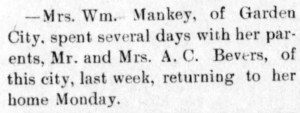
18. “United States Census, 1930,” database with images, FamilySearch (https://familysearch.org/ark:/61903/3:1:33S7-9RCF-HX1?cc=1810731&wc=QZF7-DBF%3A648803701%2C649380801%2C648842001%2C1589282340 : 8 December 2015), South Dakota > Codington > Lake > ED 12 > image 2 of 6; citing NARA microfilm publication T626 (Washington D.C.: National Archives and Records Administration, 2002).

19. “United States Census, 1920,” database with images, FamilySearch (https://familysearch.org/ark:/61903/3:1:33SQ-GRVM-Z27?cc=1488411&wc=QZJB-QKD%3A1036874501%2C1039011801%2C1039046901%2C1589332554 : 13 September 2019), South Dakota > Codington > Watertown Ward 4 > ED 101 > image 17 of 41; citing NARA microfilm publication T625 (Washington, D.C.: National Archives and Records Administration, n.d.).

20. Ancestry.com, “Record of marriage of Arthur H. Bevers and Gladys M. Daily,” South Dakota Marriages, 1905-1949 (Provo, Utah: Ancestry.com Operations Inc, 2005).

21. “United States Census, 1920,” database with images, FamilySearch (https://familysearch.org/ark:/61903/3:1:33S7-9RVM-D6Z?cc=1488411&wc=QZJB-434%3A1036874501%2C1039011801%2C1039036701%2C1589332505 : 13 September 2019), South Dakota > Codington > Rauville > ED 94 > image 2 of 7; citing NARA microfilm publication T625 (Washington, D.C.: National Archives and Records Administration, n.d.).

22. L. A. Bevers, personal interview with M. R. Wilson, August 2, 2010.

23. Hill, Watertown City and Codington County Directory 1919-1920: 62, 242.

24. Teacher’s Contract of Richland School District No. Six with Iona Daily, August 11, 1921.

25. ________, Meridian Highway, https://web.archive.org/web/20070924192054/http://www.drivetheost.com/meridianhighway.html.

26. D. Moore, et al., The Meridian Highway in Texas (Austin, Texas: Texas Historical Commission, May 27, 2016): 1.

27. C. Ahlgren, The Meridian Highway (2011), http://plainshumanities.unl.edu/encyclopedia/doc/egp.tra.020.xml.

28. “United States Census, 1920,” database with images, FamilySearch (https://familysearch.org/ark:/61903/3:1:33SQ-GRXW-XQR?cc=1488411&wc=QZJ5-LMG%3A1036473301%2C1036471902%2C1037747101%2C1589333009 : 12 September 2019), Nebraska > Douglas > Omaha Ward 9 > ED 105 > image 11 of 30; citing NARA microfilm publication T625 (Washington, D.C.: National Archives and Records Administration, n.d.).

29. ________, City Directory of Greater Omaha 1920 (Omaha, Nebraska: R. L. Polk & Co., 1920): 1229.

30. Wilson, Robert Lee Daily Interview: 19.

31. Ancestry.com, “Record of marriage of Robert L. Daily and Ruby Violet Brumbaugh,” South Dakota Marriages, 1905-1949 (Provo, Utah: Ancestry.com Operations Inc, 2005).

32. D. L. Bevers, Herbert and Lena Bevers trip to Raymondville Texas [Transcription of Our Trip to Texas by Lena Bevers, 1919] (unpublished, n.d.): 4.

33. Ancestry.com, “Record of marriage of Willis H. Bevers and Elizabeth Daily,” South Dakota Marriages, 1905-1949 (Provo, Utah: Ancestry.com Operations Inc, 2005).

34. ________, “Willis Herbert Bevers,” in The First 100 Years in Codington County, South Dakota, 1879-1979, by Codington County History Book Committee (Watertown, South Dakota: Watertown Public Opinion Print, 1979): 116.

35. Ancestry.com, “Record of marriage of Robert Zick and Iona Daily,” South Dakota, U. S., Marriages, 1905-2017 (Lehi, Utah: Ancestry.com Operations Inc, 2005).

36. H. L. Hill (Ed.), Watertown City and Codington County Directory 1926-1927 (Watertown, South Dakota: Peck-Hill Company): 9.

37. Hill, Watertown City and Codington County Directory 1926-1927: 347.

38. “South Dakota State Census, 1925,” database with images, FamilySearch (https://familysearch.org/ark:/61903/3:1:S3HY-DCR9-M87?cc=1476077&wc=MJ7S-C68%3A1041724801 : 21 May 2014), 004245665 > image 2963 of 3379; State Historical Society, Pierre.

39. Wilson, Robert Lee Daily Interview: 25-26.

40. “United States Census, 1930,” database with images, FamilySearch (https://familysearch.org/ark:/61903/3:1:33S7-9RCF-HX1?cc=1810731&wc=QZF7-DBF%3A648803701%2C649380801%2C648842001%2C1589282340 : 8 December 2015), South Dakota > Codington > Lake > ED 12 > image 2 of 6; citing NARA microfilm publication T626 (Washington D.C.: National Archives and Records Administration, 2002).

41. Wilson, Robert Lee Daily Interview: 10.

42. “United States Census, 1930,” database with images, FamilySearch (https://familysearch.org/ark:/61903/3:1:33SQ-GRCF-HB3?cc=1810731&wc=QZF7-6VX%3A648803701%2C649380801%2C649388101%2C1589282323 : 8 December 2015), South Dakota > Codington > Kampeska > ED 10 > image 1 of 8; citing NARA microfilm publication T626 (Washington D.C.: National Archives and Records Administration, 2002).

43. “United States Census, 1930,” database with images, FamilySearch (https://familysearch.org/ark:/61903/3:1:33S7-9RCF-8C9?cc=1810731&wc=QZF7-DT9%3A648803701%2C649380801%2C649393801%2C1589282372 : 8 December 2015), South Dakota > Codington > Rauville > ED 16 > image 5 of 8; citing NARA microfilm publication T626 (Washington D.C.: National Archives and Records Administration, 2002).

Reminiscences of Uncle Bob, Part Four

In March 1913, Charles and Maggie Daily moved their family from a farm near Topeka, Kansas (see Reminiscences of Uncle Bob, Part 3) back to Omaha, Nebraska.  Charles probably took employment at a company he had worked for previously, in the 1890s.  Whether he started working there immediately or later in the year, by the time the 1914 Omaha city directory was issued, he was a foreman at West Omaha Coal and Ice Company.1 When the Dailys arrived in Omaha, they intended to move into the home that they owned in the neighborhood called West Side.  Renters were still living in their house so they had to wait until the first of April to move into it.  During the interim, tragedy struck the city.  At about age 84, their son Robert recounted the event:

Interviewer:  … Let’s see, the tornado in Omaha —

Uncle Bob:  That was on the 23rd of March.

Interviewer:  And I believe your house was damaged?

Uncle Bob:  Yeah, it was. Our home was completely gone except one side wall of our own home.  We were, we moved up there just, see, 10 days before the, uh, tornado and we had to wait till the first of the month.  Easter Sunday, see, uh, the tornado was on Easter Sunday, and we had to wait till the first of the month to be able to get in our own home.  So, we stored all our household goods in Grandma’s basement.  She had a 13-room house, a full basement apartment underneath.  An’ o’ course, when the storm hit, why, it took a lot.  But when it finally did move, why it just crushed the foundation down and we just lost all our household goods, see.

Interviewer:  Ohhh!

Uncle Bob:  It set that big house down.  An’ our own home was two blocks north of there and all that was left was just one side wall.  The house went completely away from there.  We never found it, see.2


The following photographs of damaged homes are from the interviewer’s collection.  They are not labeled, so it is not known whose homes these are.


On the evening of Easter Sunday, six tornadoes struck eastern Nebraska and southwestern Iowa. The most destructive of these raced through Omaha, striking 2000 homes and demolishing 750 of them, thus displacing over 2000 residents and killing 94 people.3  The tornado entered the city from the southwest, immediately striking the workers’ cottage area of West Side where the Daily home was located as well as the homes of relations of the Dailys:

As the whirlwind raced over West Lawn and the Bohemian cemeteries toppling tombstones, it struck the worker cottage area from 53rd and Francis to 51st and Center and on to Leavenworth Street.  It splintered a long strip of houses, killing eight people in the 48th and Pacific neighborhood.  A score of fires broke out due to ruptured gas lines.  The amount of debris in the streets, at times concealing fire hydrants, prevented firefighters from responding effectively.  Fortuitously, evening rains squelched the fires throughout the city.4


Within the path of the twister were the homes of:

Charles and Maggie Daily at 1022 S. 46th.5

Maggie’s brother Harman Bonewitz at 1048 S. 48th with his wife Cornelia and son Roscoe.6

Maggie’s mother Josephine (nee Smith) Bonewitz at 4817 Pacific (where Maggie’s brother Sidney Bonewitz was also living).7

Maggie’s aunt Joanna Gantz at 4909 Hickory with her husband John and daughter Adda.8

Joanna Gantz’ son, J. Harmon Gantz at 4850 Hickory, with his wife Helen and two daughters, Dorothy and Bernice.9

Thankfully, none of these families lost lives to the whirlwind. But unfortunately, West Omaha Coal and Ice, Charles’ employer, which was located at 4801 Leavenworth10 would also have been in the path of the tornado.

A map of the tornado’s path through the city,
published by The Omaha Daily Bee11

Soon after the tornado passed through the city, Omaha’s Mayor James C. Dahlman issued a proclamation:

To the People of Omaha: A great calamity has struck our city.  Many lives and homes have been destroyed.  The authorities, with the assistance of Major C. F. Hartman of Fort Omaha, with 200 troops, are doing all that can be done tonight in guarding property and rescuing the dead and injured.

Tomorrow it will be necessary to properly patrol this district, which extends over several miles of territory, and until matters can be adjusted, so that property may be protected and men have an opportunity to clear the wreckage.  No one will be allowed inside the lines unless properly authorized, so I call on the public generally to be patient.

Thousands of volunteers are doing all they can tonight.  I appeal to the people in this hour of distress to house and feed all that need help until other arrangements can be made.12

Throughout the night, reporters were busy gathering information and by the time the printing presses started at about 4:00 A. M., the front page of the Morning World-Herald was full of descriptions of the destruction caused by the tornado, as well as preliminary lists of the deceased and the injured, stating where the injured were recovering.  Portions of the front-page article follows:

Cyclonic conditions, unknown to all, prevailed over the Missouri valley during the day, and a gigantic twister suddenly appeared, at 5:45 o’clock, as a manifestation of this disturbance.

The wind demon came careening over the prairies from the southwest and drove a diagonal course through the residence district to the north east ….

The huge, fashionable residences of the denizens of West Farnam hill suffered alike with the simple cottages of West Side and the substantial homes of Bemis Park and northern Omaha. …

Omaha has long been regarded as tornado-proof, on account of its barricade of surrounding hills, but this imaginary protection was swiftly proven a flimsy fabric indeed.  The twister, reaping a harvest over half a mile wide, swept over the hilltops and down the valleys with the neat and deadly precision of some omnipotent mowing machine. …

… Streets and boulevards are so enmeshed in wreckage that travel, even on foot, is practically impossible, while street car and telephone service is almost nil.  Automobiles and other vehicles are likewise nearly helpless ….13

Relief efforts began immediately, including the organization of a Citizens Relief Committee, which had the responsibility of disbursing funds and supplies, such as food, clothing, fuel and other necessities.  “A sub-committee investigated aid requests using vehicles donated by wealthy Omahans; upon verification, requisitions sped to the destination in trucks loaned by businesses and in horse-drawn wagons lent by the Army.”14 During the following months, over $350,000 in aid was dispensed.

The city established neighborhood relief stations to distribute donated food and clothing; teachers opened additional stations in schools for relief and to act as shelters and congregants did so in their churches.  The state contributed $100,000, some of which went for low-interest reconstruction loans.  The Omaha World-Herald resurrected its “Tow Line” appeal and collected approximately $50,000 towards the relief effort.  Several hotels offered free lodging to the poor, and the Real Estate Exchange worked to prevent gouging on rents.15

A relief station at 48th and Leavenworth,16 near the Daily property

Everyone in the city was involved in cleaning up after the tornado because of “a fine, brownish dust that entered homes through the smallest of openings and settled on furniture and carpets.”17 Organized clean-up efforts began the first weekend of April in order to remove the wreckage in the streets and lots:

Over 10,000 volunteers met at 27 locations in the affected areas to pitch debris into trucks that removed it to designated dumping areas.  Groups volunteered in units of college students, school children and factory workers.  The newspapers praised the heroic effort that cleared the ruble, made the streets passable and precipitated a rapid rebuilding effort.18

A Restoration Committee handled the reconstruction effort:

This body secured large amounts of money from local financiers and likewise made trips to Chicago, where they secured additional funds from the railroads running into Omaha.  For the purposes of restoration they loaned money without interest for a term of years and in some instances practically gave it away.19


Robert explained how his family rebuilt their homes:

Uncle Bob:  So, Uncle Finley, that’s mother’s brother, older brother, he was a carpenter. [Harman was his first name, Finley was his middle name.]  Always had carpentry.  In the first place was, we had to build up Grandma’s home, see.

Interviewer:  Um hmm.

Uncle Bob:  Build up a cottage, we built up a cottage for Grandma.  An’ that’s where I worked all the time that summer, ten cents an hour, cleaning bricks and cleaning – [chuckling]

Interviewer:  You’d’ve been 13?

Uncle Bob:  Yeah, I was coming on 13, not til May, see. …  Built Grandma’s house.  And uh, then built, well, first we built a, uh, called it a barn, but when it come right down, it was just about the size of a one stall garage, see.

Interviewer:  Mmm.  Um hmm.

Uncle Bob:  We lived in it.  There was a loft in it ….  An’ that’s where we lived while uncle was building Grandma’s house, and then built our house. … We had a nine-room house.  Took that out, see.

Interviewer:  So, you left a new house in Omaha when you moved up here?

Uncle Bob:  Well, it [wasn’t] that new.  From 1913 to 1915.  Yeah.

Interviewer:  Two years.

Uncle Bob:  … An’ we built another house in 1914 there.  Uncle had a, had a house in lot, just in the second lot, uh, can’t tell you the direction, got different direction down there.  But then there was a house in between our home and his, one that he rented.  Of course, it [the tornado] damaged that one there, so he sold it to dad an’ then he tore that down to build a cottage up there, jus’ small four-room cottage.20

The newly built home of Charles and Maggie Daily one year after the tornado. (March 1914)

Besides helping to re-build homes, Robert continued attending public school.  Robert related the difficulties he encountered during his schooling because the curriculums of various schools were not comparable.

Interviewer:  Now, would you, you would have been through school, or you would have been through 8th grade?

Uncle Bob:  No, I’d been through so much, I’d had so much free schooling, see.  I didn’t, I didn’t graduate until 1915 from the seventh grade. …

Interviewer:  I see.  Okay.

Uncle Bob:  ‘Cause I’d had free schooling.  From moving in from the farm, coming into town, they sent me back. [The Dailys moved from a farm west of Omaha into the city in 1908 when Robert was 7 years old.]

Interviewer:  Um hmm.

Uncle Bob:  Well, I was only in there 15 months, and then we moved to Kansas.  When we moved to Kansas, Kansas had a different set up, see.  So, I had to pick up that.  Well, I was [down there] four years, an’ then come back to Omaha, and they sent me back again, because I didn’t have the education ….  I had lots of free schooling, though.

Interviewer:  Did you, did you ever finish eighth grade?

Uncle Bob:  No.

Interviewer:  You didn’t.

Uncle Bob:  Just 7th grade.  … after I graduated from the 7th grade, I did put in from September until 1st of March, that’s how much, in 8th grade.

Uncle Bob:  And Oranna, she started in – at that time we had a two-year high school and a four-year high school.  One was more of a business [school] and Oranna wasn’t cut out for that kind of work.  After she went there, well, she wasn’t interested in educating, she was always interested in more, want’n t’raise a family and –

Interviewer:  Housework.

Uncle Bob:  That was her turf.21

A high school Robert’s older sister Oranna may have attended was the High School of Commerce.

At this time, many students’ school careers ended with eighth grade graduation. Students who went on to high school were preparing to enter a profession that required college and generally came from more well-to-do families. The High School of Commerce offered classes in typing, stenography, telegraphy, bookkeeping, commerce law, etc., that prepared students for opportunities for better paying jobs in the business field. The program originated in the basement of Omaha’s Central High School in 1911, but the response was so great that within a year, classes were moved to the old Leavenworth Elementary School building at 17th and Leavenworth Streets. The school quickly became overcrowded and was replaced in 1922 by Technical High School.22

High School of Commerce, Omaha, Nebraska, 191222

After the Dailys had lived in Omaha for two years, at Maggie’s urging Charles found another farm for them and on April 10, 1915, the family headed to northeast South Dakota.23  Robert’s reminiscences will continue.


  1. __________, Omaha City Directory Including South Omaha 1914 (Omaha, Nebraska: Omaha Directory Co., 1914): 250.
  2. M. R. Wilson, transcription of Robert Lee Uncle Bob Interview by R. Thiele, recording (ca. 1984): 7-8.
  3. D. Mihelich (Ed.), Ribbon of Destruction (Omaha, Nebraska: Douglas County Historical Society, n. d.): 3.
  4. Mihelich, Ribbon of Destruction: 8.
  5. Omaha City Directory 1914: 250.
  6. __________, Omaha City Directory Including South Omaha 1913 (Omaha, Nebraska: Omaha Directory Co., 1913): 133.
  7. Omaha City Directory 1913: 133-134.
  8. Omaha City Directory 1913: 333.
  9. Omaha City Directory 1913: 333.
  10. Omaha City Directory 1913: 954.
  11. “Map Showing Devastated District, with Principal Points Marked,” The Omaha Daily Bee, March 26, 1913, morning edition, https://nebnewspapers.unl.edu/lccn/sn99021999/1913-03-26/ed-1/seq-2/.
  12. J. C. Dahlman, “Mayor’s proclamation,” Morning World-Herald, March 24, 1913.
  13. __________, “Tornado kills 60, injures 152, in Omaha,” Morning World-Herald, March 24, 1913.
  14. Mihelich, Ribbon of Destruction: 46.
  15. Mihelich, Ribbon of Destruction: 42.
  16. S. Jones, “Back in the day, March 23, 1913: Monster tornado rips a scar across Omaha on Easter,” Omaha World-Herald, Mar. 23, 2021, https://omaha.com/news/local/history/back-in-the-day-march-23-1913-monster-tornado-rips-a-scar-across-omaha-on/article_53e17c40-74b1-11eb-a848-4b45501f7435.html.
  17. Mihelich, Ribbon of Destruction: 46.
  18. Mihelich, Ribbon of Destruction: 46.
  19. Mihelich, Ribbon of Destruction: 47.
  20. Wilson, Robert Lee Daily Interview: 8.
  21. Wilson, Robert Lee Daily Interview: 9-10.
  22. Nebraska Memories, “Omaha High School of Commerce,” http://memories.nebraska.gov/cdm/singleitem/collection/ops/id/2/rec/13.
  23. Wilson, Robert Lee Daily Interview: 9.