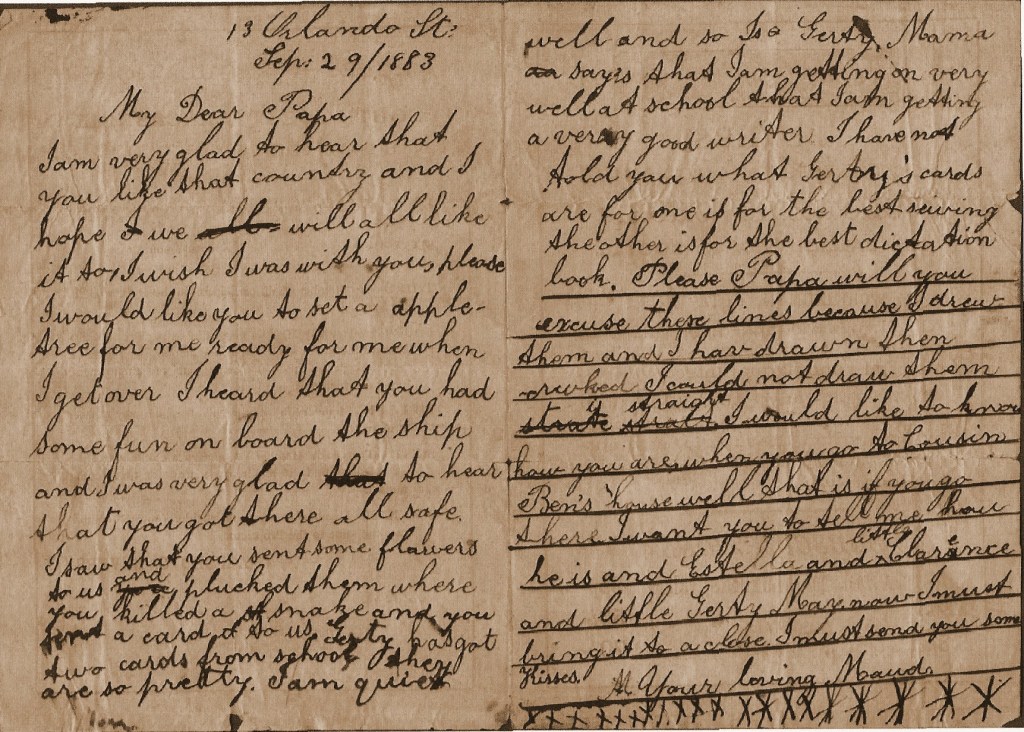
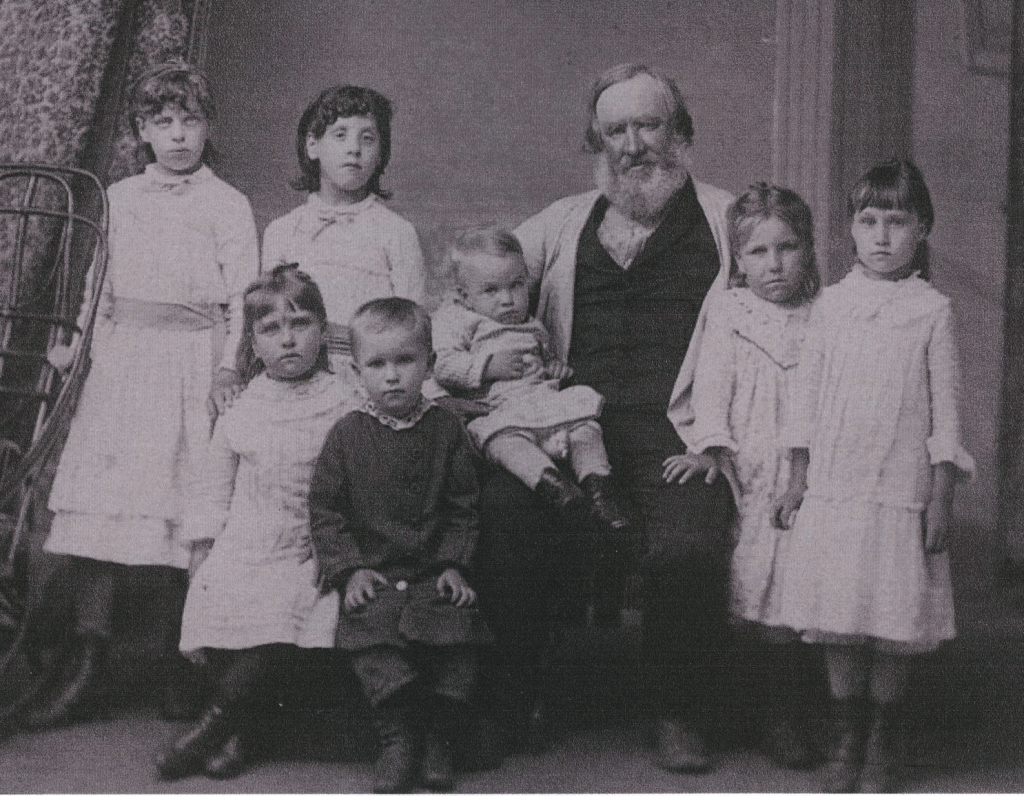
In September 1883, 8-year-old Maude Bevers, living near Liverpool, England, wrote a letter to her father Alfred C. Bevers, who had traveled to Dakota Territory in America. One of the things she reported to her father was: “Mama say’s that I am getting on very well at school.” (See the full letter in Ada, Gertie and Maude) About fifteen months later, Maude emigrated to Dakota Territory with her mother and two older sisters, joining her father. Because Maude’s father was a supply pastor for the Methodist Episcopal Conference in Dakota Territory and in South Dakota when it became a state, Maude continued her education in several small towns. Eventually, she would be the first among her siblings to attend and complete high school. According to the reports her siblings gave for the 1940 United States census, the highest grades they had attended were 6th, 7th or 8th grade.
Not only did Maude complete high school, in her early twenties, Maude attended college. An agricultural college had been established by the Dakota Territorial Legislature in 1881, and in Brookings the first building was built in 1884.1 A college catalog explained the history and purpose of the college, including the following statements:
Upon the division of the territory of Dakota into the states of North and South Dakota when admitted into the Union in 1889, the agricultural and mechanical college of Dakota became known as the South Dakota Agricultural College [SDAC].
… The college is devoted to advancing the interests of practical education and its purpose is to give men and women such training as will best fit them for the active duties of life, whether it be in the fields, the shops, the house, or in the class or counting rooms.2
Even though the college was initially established as an agricultural and mechanical college, by 1896 it had broadened its curriculum to include 24 departments. Maude’s name is listed in the SDAC catalog dated 1897-98, which indicated she was studying Commercial Science and her address was Willow Lakes.3 Her father had been assigned to the Willow Lakes Methodist Episcopal charge in 1896.4 With a population of approximately 220, in 1897-98, Willow Lakes sent 10 young men and women to the agricultural college, five of whom studied Commercial Science. Other subjects studied by these students were Domestic Science, Mechanical Engineering and Agriculture.
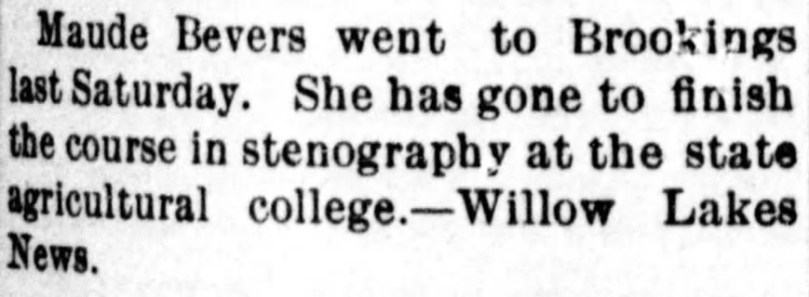
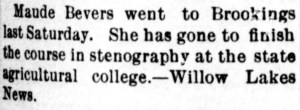
May 8, 18975
During the 1897-98 school year, there were about 550 students attending SDAC. Two-thirds of them were men and one-third women. The college catalog explained the affordability for students to attend the state-established college:
No young person should be deterred from obtaining a liberal education when such advantages as this college offers can be had at a nominal price. The aggregate of all the regular fees is only four dollars per quarter and is payable at the time of registration. Books and stationery are furnished by the student. A laboratory fee of one dollar is charged for the use of each laboratory in which a student takes work.6
Due to the expansion of the educational departments during the first decade and a half, the dormitories had been converted into classrooms and teaching labs. By 1896, there was only one cottage available for lodging on the campus. It held about 20 young women. The rest of the student population boarded in Brookings—a town with a population of nearly 2000—in private homes or hotels, starting at about 50 cents per week.7 It is not known whether Maude lodged on or off campus. The expenses of the average student who attended three quarters of the school year were: $6.00 for tuition, $90.00 for board and room, $45.00 for clothes, $15.00 for laundry, $25.00 for books and stationery, and $10.00 for traveling expenses.8
About fifteen percent of the SDAC students of the 1897-98 school year were majoring in Commercial Science. The college catalog described the aim of the department:
Appreciating the fact that business men are governed largely by certain specific and established rules, it becomes necessary that this department keep in touch with these usages and impart the same to the student in such definite and concise terms as shall prepare him for successful entrance to the business world.
The rooms for the department are exceptionally well suited and adapted to the work of the business student. The amanuensis room is supplied with fifteen typewriting machines and ample table and black board surface. The offices such as the Bank, Post Office and Mercantile are well fitted for giving the student actual practice in business methods. The college library affords good opportunity for references and collateral reading. …9
Note: The 1886 edition of Webster’s Dictionary defines amanuensis as “A person whose employment is to write what another dictates, or to copy what another has written; a copyist.”10
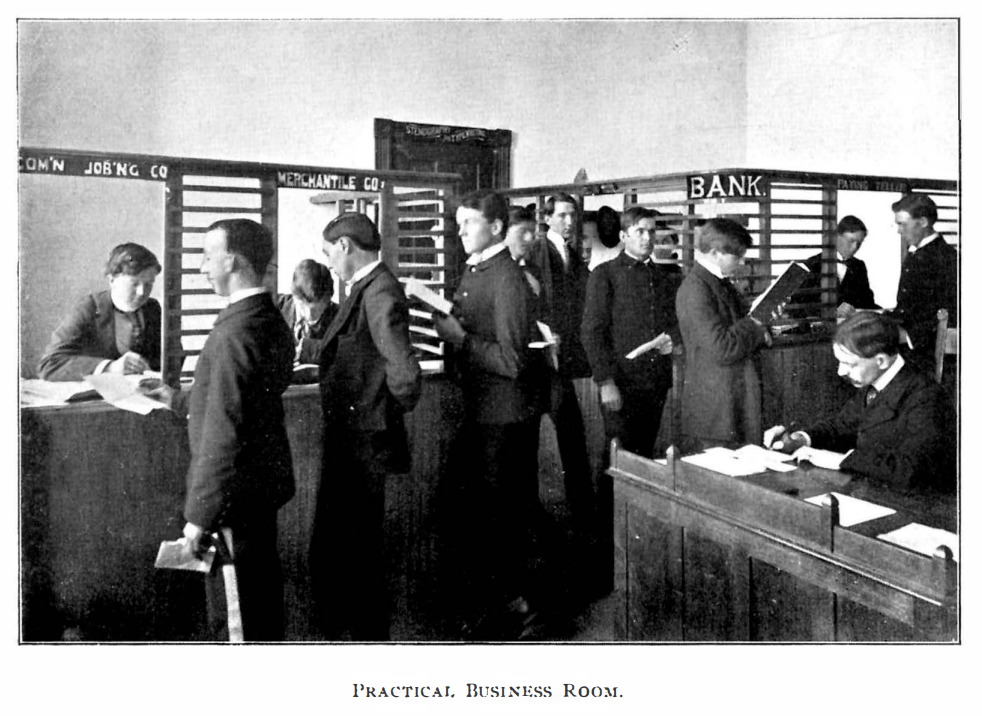
Based on the dates that news items reported about when Maude was at the college or left the college, it appears that Maude attended for two years. Therefore, she would not have earned a bachelor’s degree, but she may have completed the coursework to earn a certificate of graduation in Commercial Science. To earn this certificate, a student had to complete the courses of shorthand, penmanship, advanced dictation, commercial law, bookkeeping, business practice, correspondence, typewriting, commercial arithmetic and English words. The description of the course in English Words was: “A study of Anglo-Saxon, Latin, French and Greek derivatives and synonyms. This course is designed to form an intermediate step between grammar and rhetoric, and aims to make the student familiar with the elements entering into the growth and present use of the English language.”12
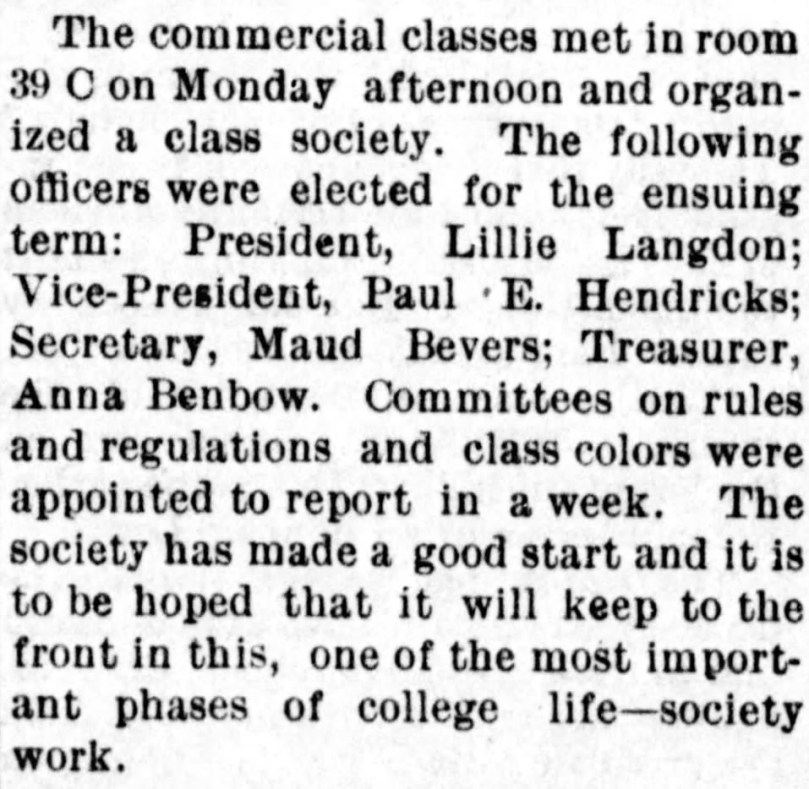
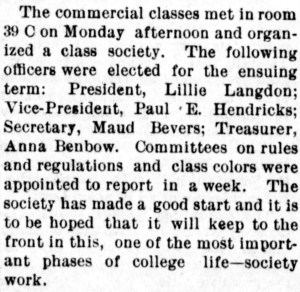
October 2, 189713
In June 1897, The Brookings Register reported “Rev. Bevers, of Willow Lakes, led chapel devotionals Thursday noon.”14 This was Maude’s father. The SDAC students were not required to attend the chapel exercises, instead the college catalog stated:
The Young Men’s and Young Women’s Christian Associations are important elements in retaining a strong christian fellowship among the student body. Their relations to the State and Inter-National organizations assist in keeping the college in touch with other educational institutions. … [T]hese student organizations are allowed to take the religious lead by holding prayer and devotional meetings nearly every day to which all are invited.15
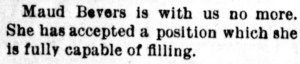
Another item in The Brookings Register reported that Maude left the college in March 1898, stating that she had “accepted a position which she [was] fully capable of filling.“16 According to a family historian, she was hired by Alfred Newman Waters, an attorney and realtor, doing business in De Smet, South Dakota.17 A. N. Waters was one of the pioneer settlers of Kingsbury County, arriving in August 1880.18 He had been a prominent citizen of De Smet since its founding. Besides being a businessman, a few of the capacities in which he served the community were as a notary public, a director on the boards of financial businesses, and a county court judge. When Maude became an office worker in De Smet, she joined the nearly eighteen percent of gainfully employed workers in the United States who were women.19 Also, among the gainfully employed women, she joined the nine percent of women engaged in nonagricultural pursuits who were working in the clerical field.20
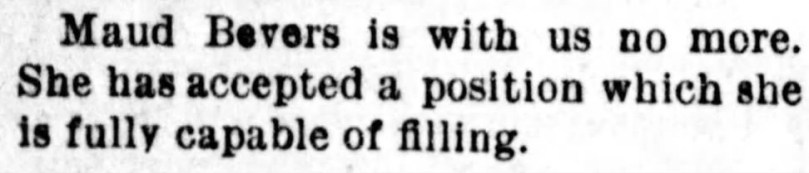
March 29, 1898
Traditionally, rather than pursue an occupation in the community, most women have worked within the home. The percentage of women that were gainfully employed in 1870 was less than 10 percent.21 The three occupations most often held by women between 1870 and 1900 were domestic service worker, teacher, and nurse. As the industrial revolution advanced, more women entered the workforce. By 1900, the percentage of women that were gainfully occupied was over 14 percent22 and the percentage of single women that were gainfully occupied was nearly 41 percent.23 One of the reasons for this growth was an increase in the demand for professional and semi-professional workers, including clerical workers, due to “the need by business and industry for accurate record-keeping, with the development of large-scale business practices, and with modern methods used in distributing the output of a vastly expanded economy.”24 A report of the United States Department of Labor provides additional information on this point:
… The invention of the typewriter and other office machines, in response to the growing needs of business, made it possible to carry out record keeping, communication, and related activities on a tremendous scale. The result was the creation of entirely new occupations many of which women perform.25 …
The greatest rate of increase for women “office workers” in any decade occurred from 1880 to 1890. Women in these selected office occupations [referring to stenographers, typists, and secretaries; shipping and receiving clerks; clerical and kindred workers; and office machine operators] multiplied nearly 20 times – a testament to the growing acceptance of the typewriter and of the trained woman typist.26 …
In 1900, the percentage of office workers that were women was about 29%.27 “In taking on the functions of clerical workers, women did not replace men. Rather they found entirely new opportunities.”28
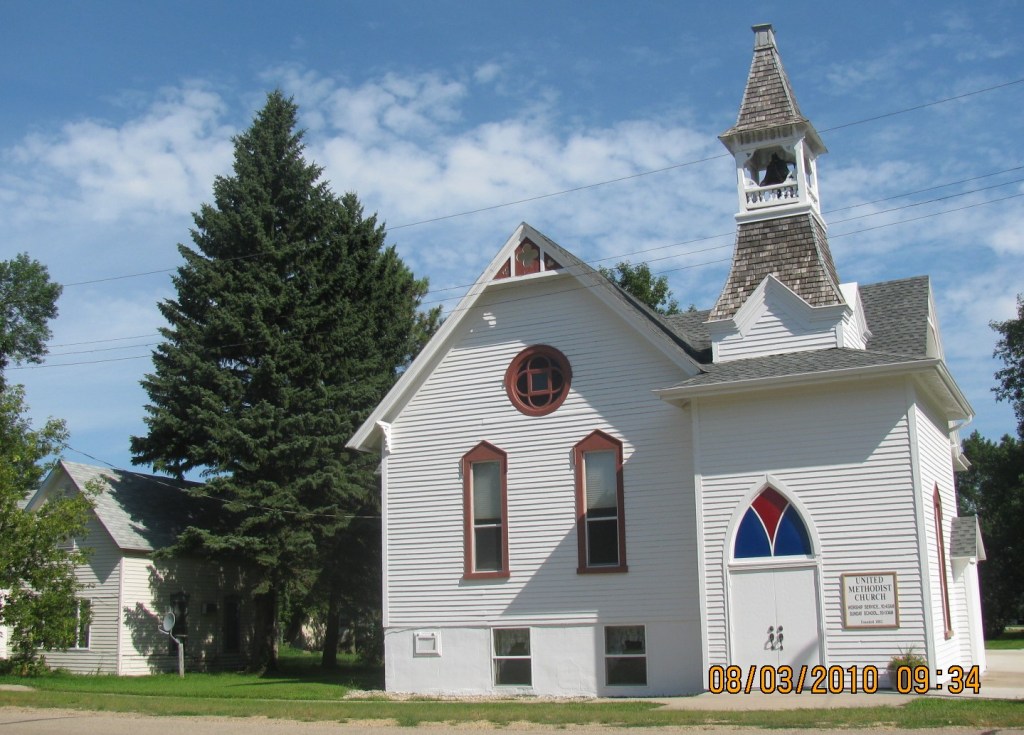
By the fall of 1898, Maude’s parents and sister Gertrude had moved to De Smet as well. In 1900, Maude and her family lived on First Street.29 The Methodist Episcopal church was only a few blocks away. Records of the church state that all of them became members on November 26, 1898.30 Maude was the church choir leader for many years.31 In addition, the minutes of the women’s group noted that in December 1902 she was the organist at the Epworth League meeting (an organization for young adults), and she was the secretary pro tem at the women’s meeting on April 16, 1903.
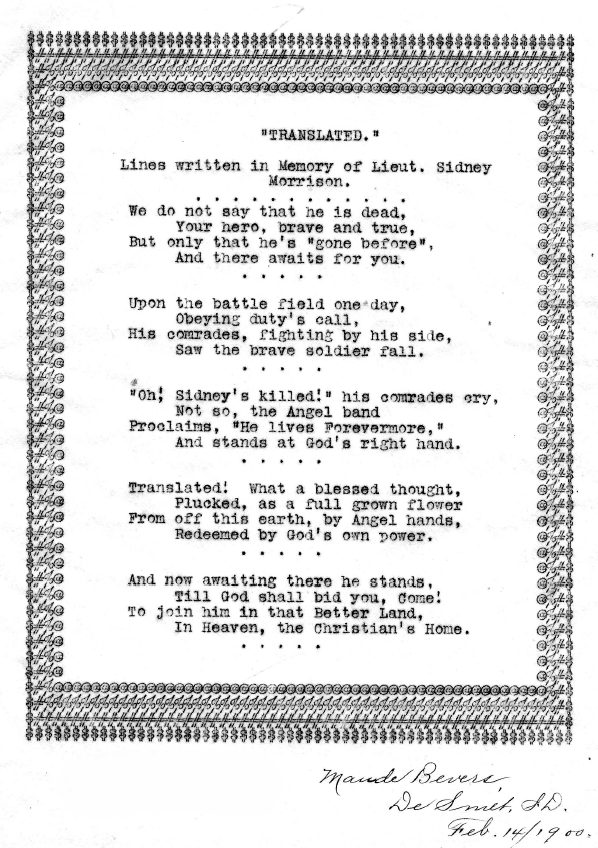
Maude had a poetic and artistic side to her. On February 14, 1900, she created a tribute to Lieutenant Sidney Ellsworth Morrison. It is not known what the relationship was between Maude and Lieutenant Morrison, but it is noteworthy that the tribute was dated on Valentine’s Day. An item in The Christian Advocate, dated April 27, 1899, reads: “Lieutenant Sidney Morrison, who was killed in the recent charge of the South Dakota Regiment at Mariloa, was a brother of the Rev. J. G. Morrison, Pastor of Franklin Avenue Church, Minneapolis, Minn.”
Sidney Morrison was a member of Company E of First South Dakota Infantry and his rank was 2nd Lieutenant. He died in the Philippines on March 27, 1899,32 but it wasn’t until January 25, 1900, that his remains were transported on the ship “City of Peking” to his father James Morrison, whose residence was De Smet, South Dakota.33
Maude’s tribute, entitled Translated, is typewritten. As far as is known, this is the earliest piece of family memorabilia that was written using a typewriter. The keys $, #, % and @ were used to create the decorative border.
More about Maude’s life will be continued in another blogpost.
1 South Dakota Agricultural College [SDAC], “The South Dakota Agricultural College Catalog 1897-1898 with Announcements for 1898-1899” (1898). Campus Course Catalogs and Bulletins. Paper 15, https://openprairie.sdstate.edu/cgi/viewcontent.cgi?article=1011&context=archives_catalogs, page 31.
2 SDAC, “SDAC Catalog 1897-1898,” page 31.
3 SDAC, “SDAC Catalog 1897-1898,” page 14.
4 United Methodist Church, Dakotas Conference, Commission on Archives and History, personal communication with M. R. Wilson, June 20, 1995.
5 “Items of Local Interest,” The Brookings Register (Brookings, South Dakota), May 8, 1897, page 3, Newspapers.com.
6 SDAC, “SDAC Catalog 1897-1898,” page 56.
7 SDAC, “SDAC Catalog 1897-1898,” page 57.
8 SDAC, “SDAC Catalog 1897-1898,” page 57.
9 SDAC, “SDAC Catalog 1897-1898,” page 83.
10 Noah Webster, Webster’s complete dictionary of the English language (London: George Bell & Sons, 1886): 42, https://archive.org/details/websterscomplete00webs/page/42/mode/2up.
11 SDAC, “SDAC Catalog 1897-1898,” following page 82.
12 SDAC, “SDAC Catalog 1897-1898,” page 89.
13 “College News,” The Brookings Register (Brookings, South Dakota), October 2, 1897, page 4, Newspapers.com.
14 “College Chestnuts,” The Brookings Register (Brookings, South Dakota), June 16, 1897, page 4, Newspapers.com.
15 SDAC, “SDAC Catalog 1897-1898,” page 43.
16 “College News,” The Brookings Register (Brookings, South Dakota), March 29, 1898, page 2, Newspapers.com.
17 K. and M. Bevers, notes attached to Agnes Maude Bevers in Ancestral Quest program file dated June 29, 2022.
18 The De Smet News, “A. N. Waters, Pioneer, Laid to Rest Here Sunday” (De Smet, South Dakota), September 2, 1927, in Waters, http://www.pioneergirl.com/waters_cemetery.pdf.
19 Joseph A. Hill, Women in Gainful Occupations 1870 to 1920 (Washington, D. C., USA: United States Government Printing Office, 1929): 52, https://babel.hathitrust.org/cgi/pt?id=hvd.hba9kx&seq=1.
20 Joseph A. Hill, Women in Gainful Occupations 1870 to 1920: 40.
21 Janet M. Hooks, Women’s Occupations Through Seven Decades (Washington, D. C., USA: United States Government Printing Office, 1947): 34, https://babel.hathitrust.org/cgi/pt?id=uiug.30112104139180&seq=1.
22 Janet M. Hooks, Women’s Occupations Through Seven Decades: 34.
23 Janet M. Hooks, Women’s Occupations Through Seven Decades: 39.
24 Janet M. Hooks, Women’s Occupations Through Seven Decades: 72.
25 Janet M. Hooks, Women’s Occupations Through Seven Decades: 72.
26 Janet M. Hooks, Women’s Occupations Through Seven Decades: 74.
27 Janet M. Hooks, Women’s Occupations Through Seven Decades: 76.
28 Janet M. Hooks, Women’s Occupations Through Seven Decades: 75.
29 “United States Census, 1900”, , FamilySearch (https://www.familysearch.org/ark:/61903/1:1:MMRW-TKS : Sat Aug 17 18:09:29 UTC 2024), Entry for Alfred C Peevers and Mary N Peevers, 1900.
30 First Methodist Church of De Smet, “Record of Members.”
31 First Methodist Church, “A History of the Church,” Consecration Service of the Remodeled First Methodist Church (De Smet, South Dakota: First Methodist Church, September 26, 1965).
32 “LT Sidney Ellsworth Morrison,” Find a Grave, https://www.findagrave.com/memorial/154931201/sidney-ellsworth-morrison.
33 Ancestry.com, U.S., National Cemetery Interment Control Forms, 1928-1962 [database on-line] (Lehi, UT, USA: Ancestry.com Operations, Inc., 2012): http://www.Ancestry.com.











 ward line; also Barton Hospital, Codington County Jail, Watertown City Jail > image 17 of 42; citing Sixteenth Census of the United States, 1940, NARA digital publication T627. Records of the Bureau of the Census, 1790 – 2007, RG 29. Washington, D.C.: National Archives and Records Administration, 2012.
 Sojourners, Settlers & Other Legacy Conveyors
.svg)