Reminiscences of Uncle Bob, Part Three

After his family spent 15 months in Omaha, Nebraska (see Reminiscences of Uncle Bob, Part Two), Robert L. Daily reported in an interview when he was about 84 years-old that his family moved to Kansas because “Mother wanted to get back to the farm again, so Dad went lookin’ around again,” and Robert gives a date: “We moved down to Kansas in 1909.  So, that was, see, when I was comin’ nine years old.  We landed down in March, and ‘course, I was nine years old in May, see.”1  Robert also said that in that year his father’s brother William brought his oldest daughter Inez to live with Robert’s family when they were living in Kansas, and Robert said that Inez looked like her father.2

In the trunk that holds many Daily memorabilia, the portrait below can be found.  The photograph is labeled “Wm. J. Daily and C. M. Daily” and in the lower right corner of the image the words “Topeka, Kansas” are embossed below the photographer’s name.  It is most likely that this portrait was taken when William brought his daughter to Kansas.  William would have been about 47 years-old and Charles, 53 years-old.
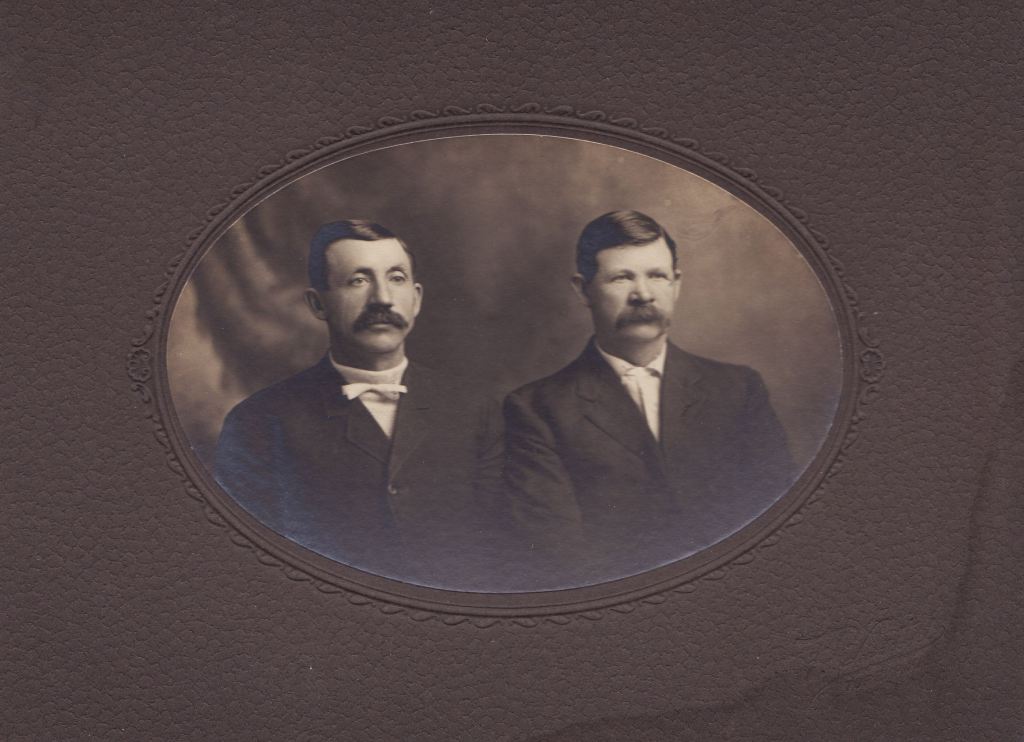
Wm. J. Daily and C. M. Daily

One of Charles’ grandsons recalled what his mother Gladys and grandmother Maggie said about the farm: “I can remember my mother talking about a farm in Kansas which had lots of walnuts on it” and they cracked a lot of walnuts.3  Robert identified the location of the farm in his interview:

Uncle Bob:  … Kilmer, Kansas was where it was at. It was just a flag station.

Interviewer:  It wasn’t Topeka?

Uncle Bob:  Topeka was, was 8 miles from us.

Interviewer:  Oh, I see.

Uncle Bob:  It was our —

Interviewer:  Mom always said Topeka.

Uncle Bob:  No, that’s our post office.

Interviewer: Uh huh.

Uncle Bob: We were, we were 8 miles out from Topeka at Kilmer, just a flag station.  And uh, we generally went to Meriden, that went the other direction, four miles to Meriden.  For, up to, uh —

Interviewer:  For shopping?

Uncle Bob:  Yeah.  ‘Course, we’d go to Topeka for circus or for, and the capitol, see.  I can remember going through the capitol in Topeka, Kansas, y’see.  Yeah, yeah.4
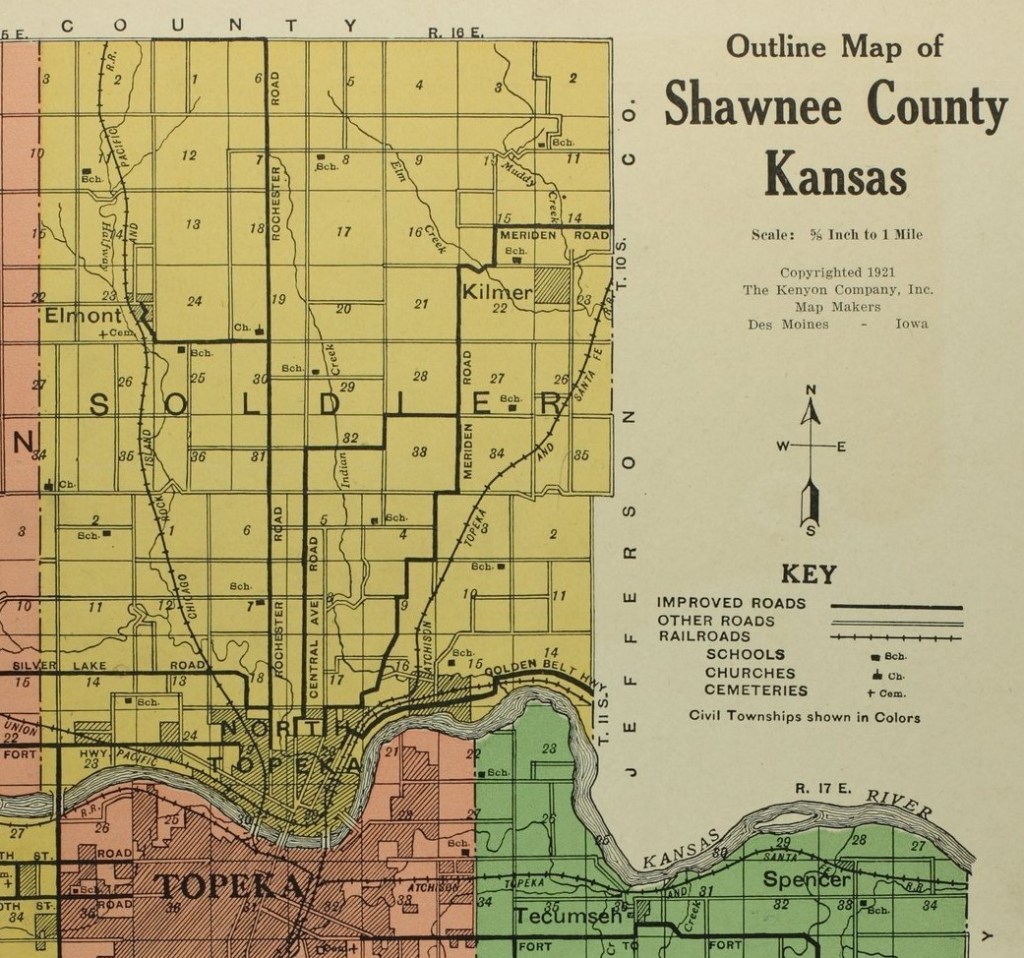

A section of a Shawnee County, Kansas, map showing Soldier Township5

A flag station is “a railroad station where trains stop only when a flag or other signal is displayed or when passengers are to be discharged.”6  Northeast of Topeka, Kilmer was a small station on the Atchison, Topeka and Santa Fe Railroad which crossed the southeast corner of Soldier Township in Shawnee County.7  The Daily family may have ridden a train into Topeka to see a circus performance.  One of the circuses that was scheduled to perform in Topeka was the Barnum and Bailey Circus.  It came to Topeka on September 7, 1909, but the city newspaper reported that the circus couldn’t be set up because of the weather.8  Record-breaking rain (over eight inches) fell that day, flooding the site where the circus was to be set up.9 The following year, the Ringling Brothers Circus arrived on September 5.  In the Monday evening issue of the Topeka State Journal, which sold for 2 cents, the following article described the spectacle that the circus provided.
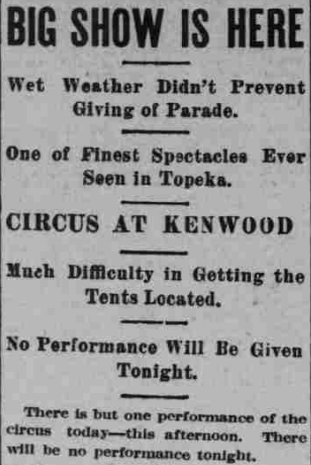
Cropped image from The Topeka State Journal, September 5, 1910

Ringlings’ “Big Top” today is the attraction in Topeka.  Sunday the interest was hardly less.  Thousands of persons watched the parade which came on time nothwithstanding the rain, with hardly less interest than did an almost equal number see the unloading and transfer of the circus from the Rock Island yards to the Kenwood tract near Fourth and Buchanan streets.

As the pageant was a chain of novel surprises likewise was the trail of wagons and the animals following the arrival.  The parade was nearly three miles long and the aforementioned surprises extended from the twenty-four horse band chariot in the lead to the tail end.  The rain fell all right and continued during the forenoon, making it difficult for the wagons to leave the grounds.

The show arrived here Sunday morning after some delay, in coming from St. Joseph.  About 9 o’clock the first wagon reached Kenwood.  Immediately the work of putting up the huge cook tent was started.  Stands began to spring up on adjacent property to the main entrance to the grounds between Buchanan and Lincoln streets on Fourth street.

Most of the paraphernalia was transferred in wagons, the majority of them being pulled by six horses each.  These were driven out Sixth avenue after having left the Rock Island yards.  Arriving at Buchanan street they again turned north to the Kenwood tract.  As soon as the wagons left the Buchanan street pavement going onto Fourth street difficulty was experienced.  The recent rains had made the unpaved street soft and the wagons mired to the hubs.  It was necessary to unload some of them before they could be moved.  Others were moved with 22, 24 and even 32 horses.

No sooner than the work of pitching the cook tent was started, crowds began to arrive from all directions.  From noon on there was a steady stream of humanity down Buchanan street from Sixth avenue to Kenwod.  A baby carriage brigade seemed to have been formed.  For two or three hours the day seemed to have been set apart for their display alone.  There was grandpa and papa and mamma and uncle and even forty-seventh cousin of each of them.  All had a baby.  In fact every woman who had a baby to loan was in great demand.  That condition seemed not to abate.

Crowd Gets a Ducking.

Pedestrians were not alone in their evidenced curiosity.  Car after car reached the tract, all of them packed.  Extras were put on and these, too, were filled to capacity.  Twenty or thirty spectators got wet when the circus employes stopped at Fifth and Buchanan streets to cool and water the elephants and the polar bears.  A hose was attached to the water plug and the operation started.  No sooner had the bears been given a bath than the hippopotamus arrived.  He had to have a bath, too.

Then was when the fun started.  An “accident” occurred.  Mr. Keeper intentionally or not allowed the water hose to get away from him.  He struggled with the rubber tube which under the pressure of water lunged and pulled and drenched a number of nearby onlookers.  Still he struggled manfully.  The hose got him down.  More persons were drenched.  Finally when the crowd had retired to a safe distance he gained control of it again.

Noticeable about the circus aggregation was that of all the employees none of them was given to loud talking or profanity in the time required to get the paraphernalia in its place.  Another noticeable thing was that the usual number of hardened men were conspicuously absent.  Most of the following was represented in young men appearing to be college students and others of that character.

Features of the Parade.

In the parade some of the remarkable features were teams of elephants, camels, zebras and llamas hitched to ornate tableau floats and driven like horses.  It has been supposed that the zebra could not be driven.  The Ringlings have proved otherwise.  In all nearly 700 horses were exhibited, the most of them Norman Percherons.  Many of them were white.

More than 1,200 men, women and children from Australian bushwackers to those advertised as the royalty of Asia and Europe took part.  Music was provided by six brass bands, a cathedral organ, a calliope, barbarian orchestras, fife and drum corps, church chimes, trumpeters and Oriental string and reed musicians.10


Besides the circus, Robert mentioned that he had visited the capitol of Kansas in Topeka.

This sepia colored photograph [below] shows the capitol in Topeka, Kansas. Located on twenty acres of land once owned by Cyrus K. Holliday, work began on October 17, 1855 when the cornerstone was laid for the east wing. Thirty-seven years later the statehouse, an example of French Renaissance architecture and Corinthian details, was completed at a total cost of $3,200,588.92.”11
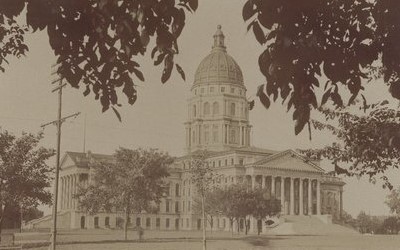
Kansas State Capitol, Topeka, Kansas

On April 26, 1910 a census taker visited the Daily family at the farm they were renting in Soldier Township, Shawnee County, Kansas.  Charles is mistakenly recorded as being 56 years-old (he was 53), Maggie was 42 years-old.  Their five children were living with them:  Gladys, age 17; Oranna, 14; Robert, 9; Iona, 7 and Elizabeth, 5.12  In addition, there were also in the household Inez Daily, age 16 and Alpha Bailey, age 20.  Inez was the daughter of William Daily, noted above.  Alpha was Charles’ nephew, the son of his sister Cynthia, who had come to live with the Dailys in 1908.  All of the children, including Gladys and Inez, attended school for a period of time between September 1, 1909 and the end of April 1910.  Robert said that Inez went to school for a couple of years and then got married in Kansas.13  Charles and Maggie kept ownership of their house in Omaha and according to the 1910 U. S. census of Omaha, the house was being rented by a bartender named Samuel J. Barth.  In the Barth household were his wife Sophia and daughter Edith.14

The same census taker that visited the Daily family also visited a farmer named Lawson Bonnewitz, who owned a farm in Soldier Township.15  Maggie and Lawson were cousins.  Jacob Bonewitz (b. 1761) was their great-grandfather.  Two of Jacob’s sons were Joseph Bonewitz (b. 1790), who was Lawson’s grandfather, and John Adam Bonewitz (b. 1792), who was Maggie’s grandfather.  


One event in Kansas that Robert related was the baptism of two of his sisters:

Uncle Bob:  … When we lived in Kansas we was able to go to church more than any place else.  ‘Course, we, we had, uh, afternoon services, see.

Interviewer:  Oh, uh, circuit rider type.

Uncle Bob:  Yeah, and o’ course, a minister came out from, I don’t know where.  Meriden or Topeka, one o’ the two.  An’ I guess he was a Baptist minister, see, ‘cuz Gladys and Oranna were both, uhh, immersed in the river.

Interviewer:  Oh!  Uh huh.

Uncle Bob:  At that time, … ‘course, they were old enough to be baptized.  An’ I think Baptists, when you get right down to it

Interviewer:  I suppose that they —

Uncle Bob:  … that they don’t believe, didn’t believe in baptizing before 12 years old, see.

Interviewer:  Um hmm, um hmm.

Uncle Bob:  An’ Oranna an’ Gladys were still o’ that age.  I didn’t get in on it.  See, it was still before I was 12 years-old.  Either ten or eleven is what I was.  I can remember it so well.  We, uh, like the, like the song goes, “Shall we gather at the river,” see.

Interviewer:  Um hmm, um hmm.

Uncle Bob:  An’ that’s when we gathered at the river an’ the minister walked in. This’s out in the pasture, down in the pasture of our neighbors.

Interviewer:  Um hmm.

Uncle Bob:  That’s where we had our meeting there, went through there.  An’ that’s where Gladys and Oranna —

Interviewer:  Was it Omaha then?  This would be the Missouri River? 

Uncle Bob:  No, no, this was just a creek [pronounced crick].

Interviewer:  Oh, okay.

Uncle Bob:  Creek that went through the pasture, down in Kansas.16


Robert may have been referring to a hymn written by Robert Lowry in 1864, entitled, “Shall We Gather at the River?”

  1. Shall we gather at the river,
    Where bright angel feet have trod,
    With its crystal tide forever
    Flowing by the throne of God?
  2. On the margin of the river,
    Washing up its silver spray,
    We will talk and worship ever,
    All the happy golden day.
  3. Ere we reach the shining river,
    Lay we every burden down;
    Grace our spirits will deliver,
    And provide a robe and crown.
  4. At the smiling of the river,
    Mirror of the Savior’s face,
    Saints, whom death will never sever,
    Lift their songs of saving grace.
  5. Soon we’ll reach the silver river,
    Soon our pilgrimage will cease;
    Soon our happy hearts will quiver
    With the melody of peace.

Refrain:
Yes, we’ll gather at the river,
The beautiful, the beautiful river;
Gather with the saints at the river
That flows by the throne of God.
17


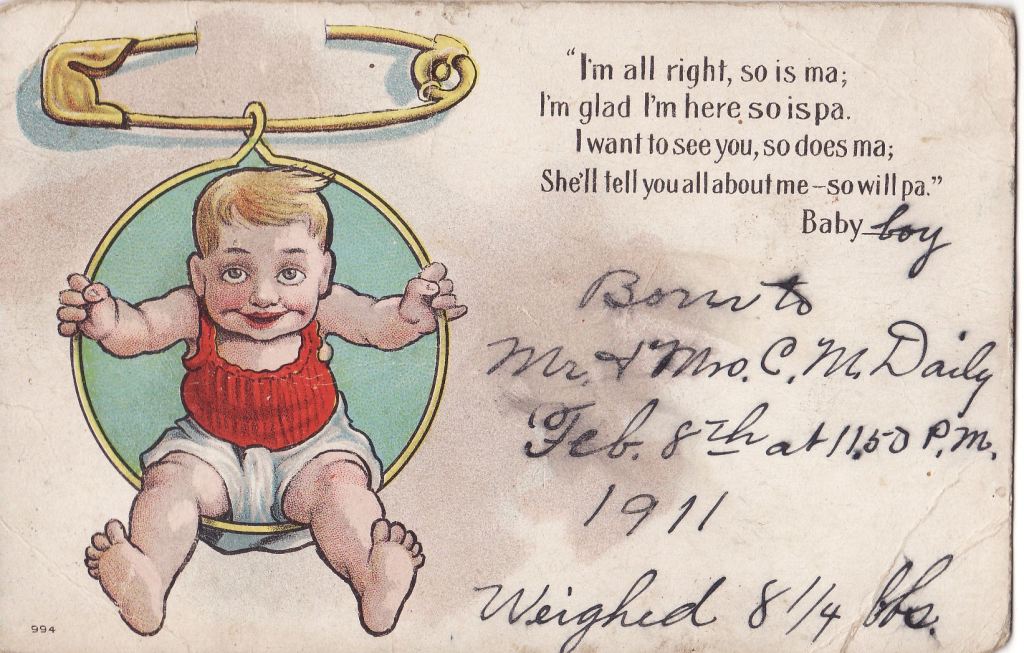
Joseph Esli Daily’s birth announcement which is stored in the trunk that holds Daily memorabilia

On February 8, 1911, Maggie gave birth to another son, Joseph Esli.  Sadly, the boy didn’t live to his first birthday.  Charles and Maggie buried Joseph in Evergreen Memorial Park in Omaha, where they had buried their first son, who had died in 1899.  Robert gives a few details about Joseph’s short life.

Interviewer:  But, the baby boy —

Uncle Bob:  Oh, Joseph?

Interviewer:  Joseph — was born and died in Topeka.

Uncle Bob:  Yeah, yeah.  … Mother always came up to see Grandma, once a year, around Christmas time, see.  And ‘course, other years Iona an’ Elizabeth, … would come up, too.  But when Joseph was born, a baby, she wanted the baby to, Grandma to see the baby, see.  Joseph.  And o‘ course, ah, that year was the time that I, Joseph and I came up with her.

Interviewer:  You mean up to Omaha.

Uncle Bob:  Yeah, up to Omaha.  See, he was born in 1911.  Passed away in January 1912.

Interviewer:  Oh, okay.

Uncle Bob:  That was Joseph, he was just ‘leven months old.  … but we’d been up to Omaha, and got back, and then he got the croup.  And ah, he was a little weak anyway in the spine.  He never had set up, really.  He was happy.  He’d lay on the lounge and watch us kids play on the floors and that.  But when it come to this here getting the croup.  So, why, that’s when —

Interviewer:  Went into pneumonia, I suppose.

Uncle Bob:  Yeah, suppose.  In those days, that’s what they’d call it.  Lungs filled up some, I guess.18


For years the details were somewhat of a mystery regarding when and how Charles and Maggie’s youngest daughter’s name came to be Elizabeth J. Best Viola Daily.  Since no one has been able to locate a birth record for Elizabeth, it is unclear whether she had that name at her birth or if she acquired the name later.  One of Elizabeth’s children thought that she had been given money to carry on the name of a woman named Elizabeth J. Best, another thought the woman’s name was J. Best and that property was involved.

Early in 2019 one of Elizabeth’s children was searching through old items that are kept in the trunk which has been previously mentioned and “… he came across some interesting info.  Mom stayed with someone in Indiana and went to school.  He came up with the name Stults and money being passed back and forth.  I suggested this may be the money Mom received for being named after Elizabeth J Best.  This morning I typed Elizabeth J Best in the internet search line and came up with Elizabeth J Stults Best.”19  The source of this name was the Find-a-Grave memorial page of Elizabeth J. Best (nee Stults) of Huntington County, Indiana.20  The webpage identifies the cemetery where she was buried, it is the same cemetery where one of Maggie’s brothers is buried,21 as well as her maternal grandparents Harman and Barbara Smith22,23 and her great-grandfather Jacob Flora (Barbara’s father).24

In August 2019, I found a document accessible on Ancestry.com that revealed some intriguing details.  It is the will of Elizabeth J. Best, dated October 26, 1910.  In the will, Elizabeth J. Best Daily of Omaha, Nebraska, is named as an heir.  Additionally, in March 2020, when listening to Robert’s interview, additional details came to light:

Uncle Bob:  … Elizabeth was heir to some money back East.

Interviewer:  I heard about that.

Uncle Bob:  See, she uh, Elizabeth Best was her name. And, Grandma’s name was Josephine Smith, as they went to school together.

Interviewer:  Ohhh.

Uncle Bob:  But they didn’t have no, no middle names, see.  So, Grandma took the name of — Elizabeth’s initial, E.  She was Josephine E. Bonewitz, that’s her married [name].  And Best took, took, uhh —

Interviewer:  Josephine, took the J.

Uncle Bob:  Yeah, took the J.  And she was, that’s the reason, she got the name Elizabeth J. Best, see.

Interviewer:  Okaaay.

Uncle Bob:  So, that’s the way she picked that up, see.

Interviewer:  And this was a school friend of Josephine Smith?  Okay.

Uncle Bob:  Yes, that’s right, and she was very wealthy.  O’ course, as I mentioned, ever’thin’ ended up, why, she [Robert’s sister Elizabeth] lived with the woman at that time in 1912.  Elizabeth was born in 1905, 7 years old.

Interviewer:  Um hmm.

Uncle Bob:  And, o’ course, uh then, ahh, all the time she was goin’ to school afterwards – the Elizabeth Best, or Elizabeth J. Best, ahh, had a friend, I can’t say what his name was, the lawyer, the lawyer, a friend lawyer.  And he was bound and determined that her word was law, see, ever’thin’ she said.  And Elizabeth’s other relatives tried to, tried to break the, uh —

Interviewer:  The will.

Uncle Bob:  — the will.  But he stuck in there and o’ course all the while she was goin’ to school, up ‘til she was 18, why, anythin’ needed for school, that’d come off the, off of her inheritance.

Interviewer:  Well, she had quite an inheritance, then!

Uncle Bob:  I don’t know what it was, I never knew what it was.  I know, I just know that she uh, afterwards when she come home, why, ‘course that’s what really put Willis on his feet there, because he, ahh, when she inherited that money, why ‘o course, uh, they bought out, uh — I can’t say what his name was down there —

Interviewer:  He bought down in that Grover area.

Uncle Bob:  Down in Grover area, see.  An’ o’ course, she gave each of us fifty dollars.  ‘Course, I think somewhere roun’ twenty-five hundred dollars is what she got.  ‘Course, at that time, was pretty good money.25

Elizabeth Stults was born in Stark County, Ohio,26 the same county in which Josephine Smith was born.  Both of their families moved to Huntington County, Indiana.27,28  Robert explains that they were school mates.  When Elizabeth Stults got married, she added a middle initial “J” to her name, becoming Elizabeth J. Best.  And when Josephine Smith got married, she added the middle initial “E” to her name, becoming Josephine E. Bonewitz.

Best’s husband Joseph C. Best had passed away seven years before she wrote her will and their only two children had died in infancy.29  So, at the time of the writing of her will, Best had no direct heirs.  Her will names 11 people as heirs, including Josephine’s granddaughter, Elizabeth J. Best Daily.

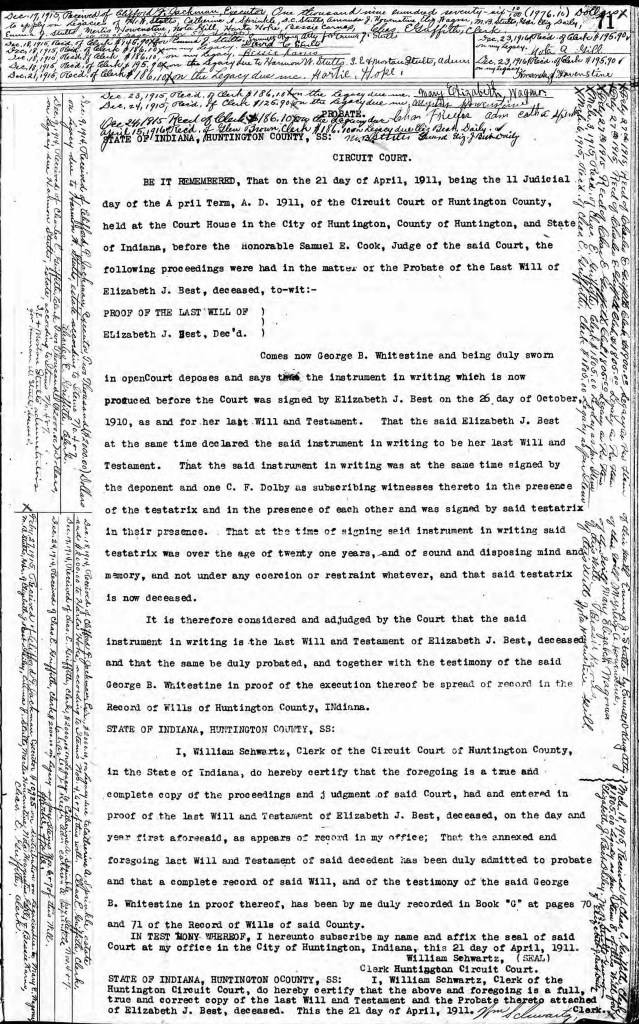
The date that the will was probated was April 21, 1911.  Along the edges of the will there is an accounting of when funds were distributed to the heirs.  The first distribution was October 24, 1914 and the last was December 23, 1916.  Each time a distribution is noted for Elizabeth J. Best Daily, it is received by a person named M. B. Stults.  It appears that this was the guardian for young Elizabeth.  Perhaps this is the friend or lawyer to which Robert referred in the interview.  Robert’s explanation clears up some questions, including the name of the woman, and confirmation that there was money given, and he also provides information as to why property was attached to the mystery.
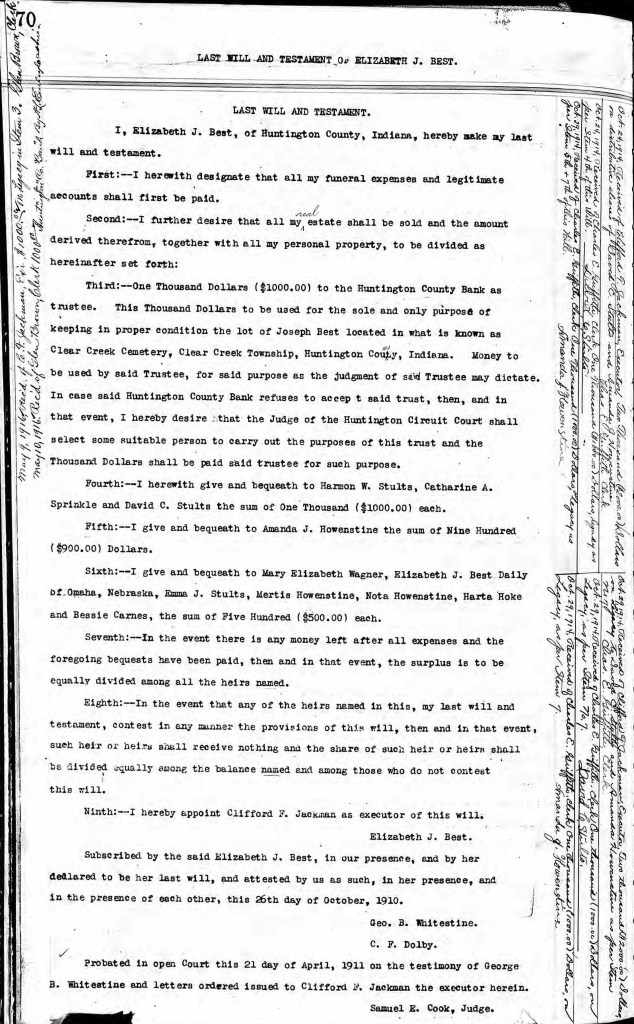
Last will and testament of Elizabeth J. Best,
a friend of Elizabeth Daily’s grandmother Josephine Bonewitz
On May 1, 1912, Charles and Maggie’s third daughter Iona was honored by the Shawnee County School Superintendent.  She was in the third grade and had earned seven monthly Certificates of Perfect Attendance.  This achievement entitled her to receive a Certificate of Award for Punctual and Regular Attendance.
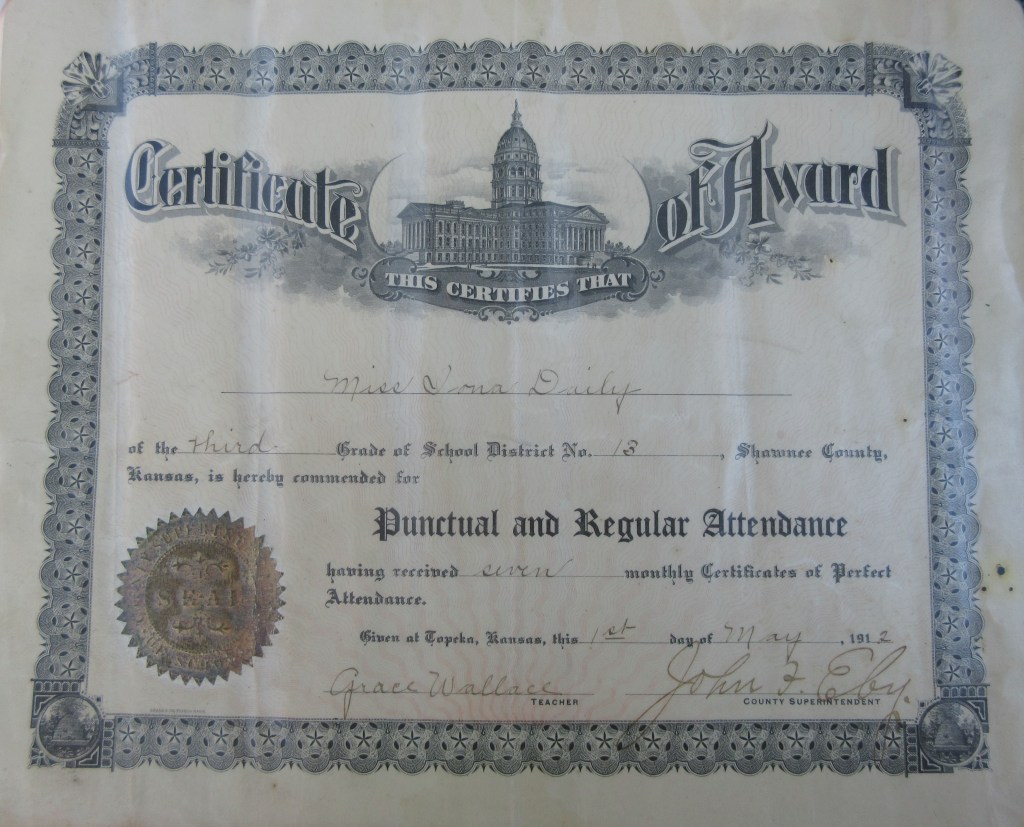
Certificate for Punctual and Regular Attendance awarded to third grade student, Iona Daily

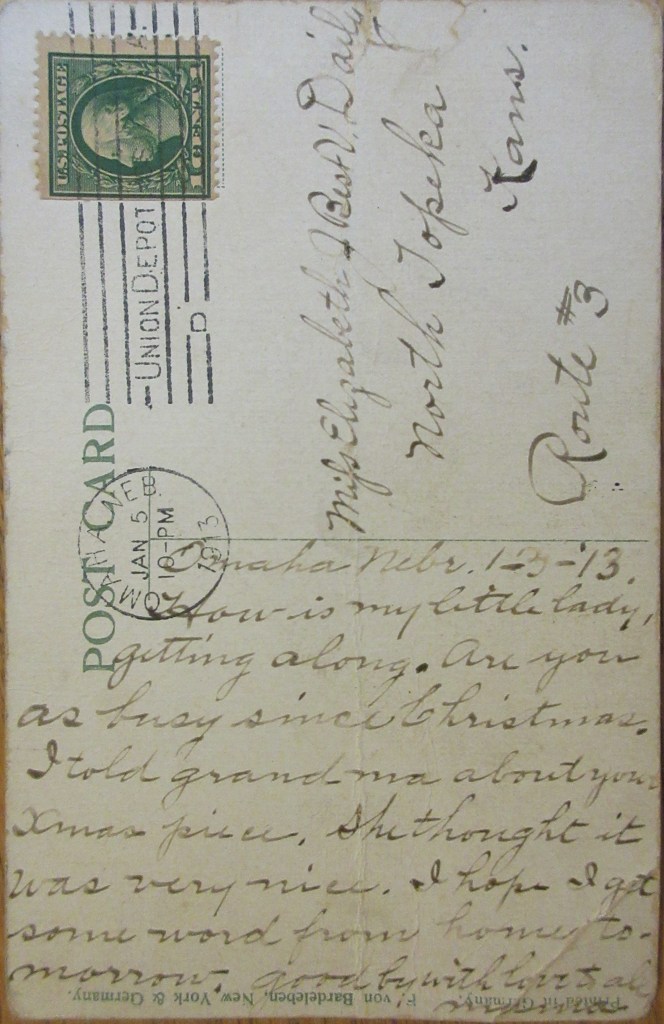
On January 5, 1913, Maggie mailed a postcard to her daughter Elizabeth at their home north of Topeka. The text of the postcard indicates that Maggie had been in Omaha during the Christmas holidays. Maggie wrote: “How is my little lady getting along. Are you as busy since Christmas. I told grandma about your Xmas piece. She thought it was very nice. I hope I get some word from home tomorrow. good by with love to all. mama”
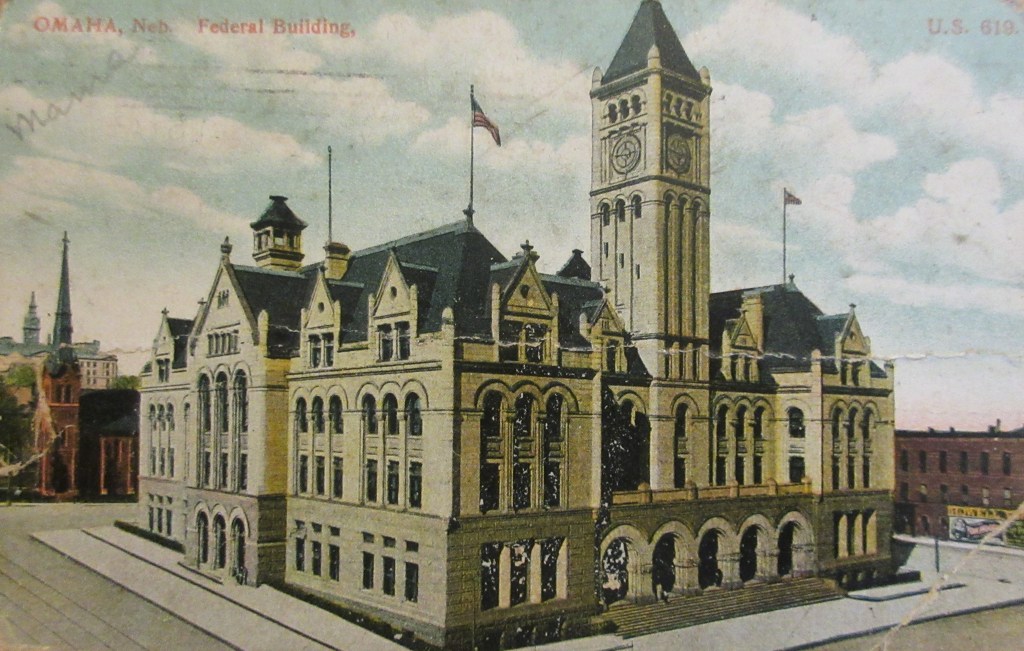
Front of Maggie’s postcard postmarked January 5, 1913
Back of Maggie’s postcard postmarked January 5, 1913

Apparently, Maggie was in Omaha because her father was seriously ill. On January 12, 1913, Maggie’s father, John Esli Bonewitz, passed away.  About thirteen years earlier, when Charles and Maggie’s baby died two days after its birth, Charles had bought a lot in Evergreen Memorial Park (Section A, Block 26, Lot 3).  Their son Joseph Esli was buried in that lot on January 5, 1912, and Maggie’s father was buried there on January 14, 1913 alongside the two sons.
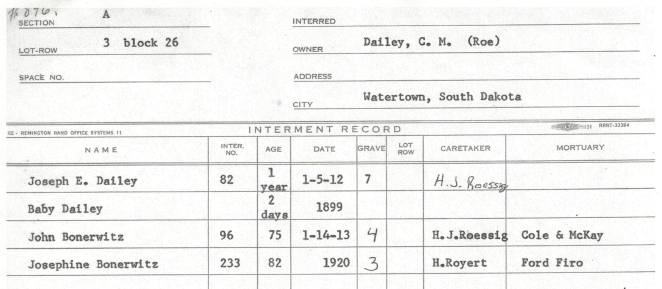
Interment record of the cemetery lot owned by C. M. Dailey
in Evergreen Memorial Park, Omaha, Nebraska

Presently, in the cemetery lot, there are no grave markers for the un-named baby nor for Joseph Esli.  The interment record states that Joseph Esli was buried in grave #7 and John Esli was buried in grave #4.  It doesn’t indicate the location of the un-named baby, but a very helpful employee of the cemetery diagramed the lot, and there is a high probability that the baby was buried in grave #8. 
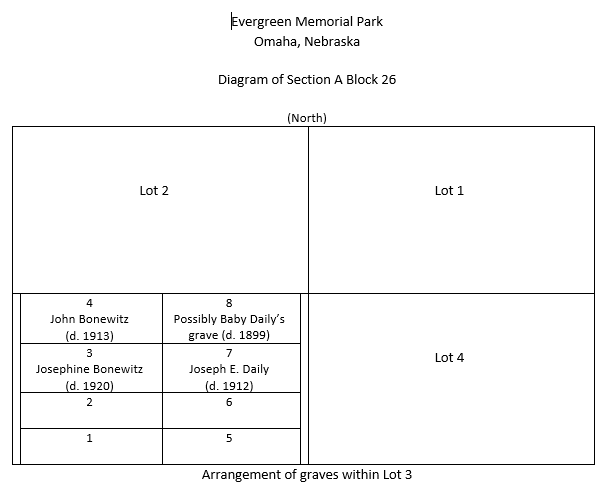
Two months after Maggie’s father passed away, the Daily family moved back to Omaha again.  In the next blogpost, Uncle Bob will continue his reminiscences of the next two years while they resumed living there.


1 M. R. Wilson, transcription of Robert Lee Daily Interview by R. Thiele, recording (ca. 1984): 6.

2 Wilson, Robert Lee Daily Interview: 13 & 16.

3 L. A. Bevers, personal communication with M. R. Wilson, August 10, 2010 and November 24, 2010.

4 Wilson, Robert Lee Daily Interview: 22-23.

5 The Kenyon Company, Inc., Atlas and Plat Book of Shawnee County Kansas (Topeka, Kansas: Kansas Farmer and Mail & Breeze, 1921): 5, https://www.kansasmemory.org/item/224002/page/7.

6 “Flag station,” Dictionary.com, https://www.dictionary.com/browse/flag-station.

7 James L. King, ed., History of Shawnee County, Kansas and Representative Citizens (Chicago: Richmond & Arnold, 1905): 55, https://ia902604.us.archive.org/7/items/historyofshawnee00king/historyofshawnee00king.pdf.

8 “Big Show Goes By,” The Topeka State Journal, September 7, 1909, https://chroniclingamerica.loc.gov/lccn/sn82016014/1909-09-07/ed-1/seq-1/.

9 “Eight-Inch Rain,” The Topeka State Journal, September 7, 1909, https://chroniclingamerica.loc.gov/lccn/sn82016014/1909-09-07/ed-1/seq-1/.

10 “Big Show Is Here,” The Topeka State Journal, September 5, 1910, https://chroniclingamerica.loc.gov/lccn/sn82016014/1910-09-05/ed-1/seq-5/.

11 Capitol, Topeka, Kansas, postcard, ca. 1910, https://www.kansasmemory.org/item/215285.

12 “United States Census, 1910,” database with images, FamilySearch (https://familysearch.org/ark:/61903/3:1:33SQ-GRJZ-GJ1?cc=1727033&wc=QZZQ-PF3%3A133640801%2C140502701%2C134349501%2C1589089094 : 24 June 2017), Kansas > Shawnee > Soldier > ED 140 > image 8 of 22; citing NARA microfilm publication T624 (Washington, D.C.: National Archives and Records Administration, n.d.).

13 Wilson, Robert Lee Daily Interview: 14-15.

14 “United States Census, 1910,” database with images, FamilySearch (https://familysearch.org/ark:/61903/3:1:33S7-9RVD-94BH?cc=1727033&wc=QZZW-D1C%3A133641701%2C133718401%2C136867001%2C1589089011 : 24 June 2017), Nebraska > Douglas > Omaha Ward 11 > ED 81 > image 15 of 30; citing NARA microfilm publication T624 (Washington, D.C.: National Archives and Records Administration, n.d.).

15 “United States Census, 1910,” database with images, FamilySearch (https://familysearch.org/ark:/61903/3:1:33S7-9RJZ-GRH?cc=1727033&wc=QZZQ-PF3%3A133640801%2C140502701%2C134349501%2C1589089094 : 24 June 2017), Kansas > Shawnee > Soldier > ED 140 > image 20 of 22; citing NARA microfilm publication T624 (Washington, D.C.: National Archives and Records Administration, n.d.).

16 Wilson, Robert Lee Daily Interview: 21-22.

17 Robert Lowry, “Shall We Gather at the River?,” 1864, Timeless Truths, https://library.timelesstruths.org/music/Shall_We_Gather_at_the_River/.

18 Wilson, Robert Lee Daily Interview: 6.

19 E. J. Jones, email communication with M. R. Wilson, February 2, 2019.

20 “Elizabeth J Stults Best,” https://www.findagrave.com/memorial/63599577/elizabeth-j-best.

21 “Rosco Neff Bonewitz,” https://www.findagrave.com/memorial/62071397/rosco-neff-bonewitz.

22 “Harman Smith,” https://www.findagrave.com/memorial/62815250/harman-smith.

23 “Barbara Marguet Flora Smith,” https://www.findagrave.com/memorial/62071353/barbara-marguet-smith.

24 “Jacob Flora,” https://www.findagrave.com/memorial/62852349/jacob-flora.

25 Wilson, Robert Lee Daily Interview: 7-8.

26 “Joseph C. Best,” Biographical Memoirs of Huntington County, Ind. (Chicago: B. F. Bowen, 1901): 587.

27 “United States Census, 1850,” database with images, FamilySearch (https://familysearch.org/ark:/61903/3:1:S3HY-6QMQ-QDH?cc=1401638&wc=95RX-2JQ%3A1031336301%2C1031975601%2C1031975602 : 9 April 2016), Indiana > Huntington > Huntington county > image 49 of 194; citing NARA microfilm publication M432 (Washington, D.C.: National Archives and Records Administration, n.d.).

28 “United States Census, 1860,” database with images, FamilySearch (https://familysearch.org/ark:/61903/3:1:33S7-9YBY-65K?cc=1473181&wc=7QK5-RD2%3A1589426070%2C1589426540%2C1589423705 : 24 March 2017), Indiana > Huntington > Huntington > image 41 of 41; from “1860 U.S. Federal Census – Population,” database, Fold3.com (http://www.fold3.com : n.d.); citing NARA microfilm publication M653 (Washington, D.C.: National Archives and Records Administration, n.d.).

29 “Joseph C Best,” https://www.findagrave.com/memorial/61993911/joseph-c-best.
Charles and Maggie in the 1890s

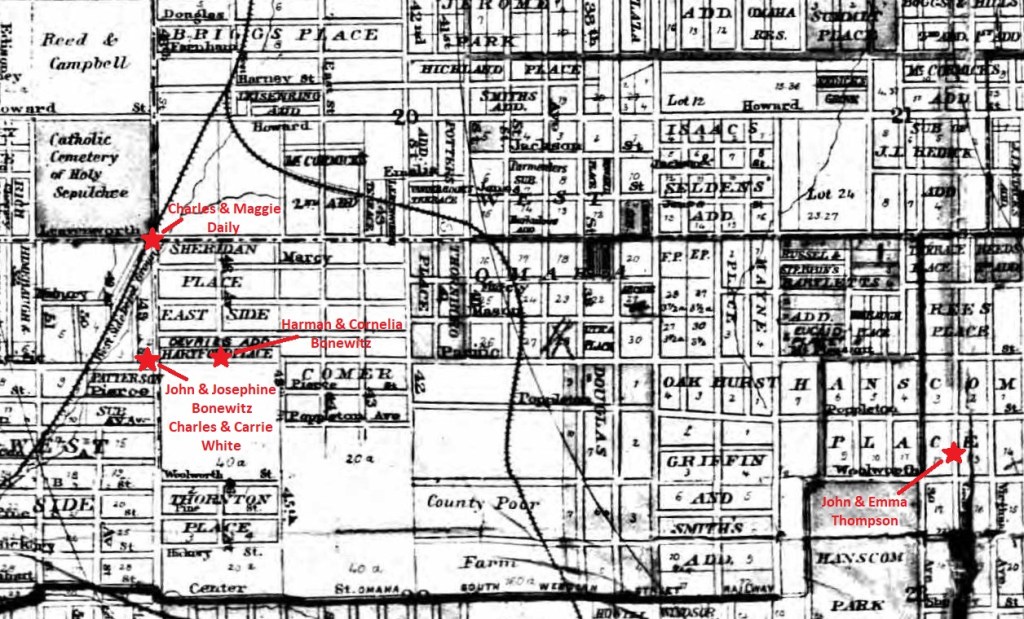
Following the marriage of Charles M. Daily and Maggie O. Bonewitz on November 18, 1891, they set up their household at 4801 Leavenworth in the developing area of West Side in Omaha, Nebraska.1  Their residence was about four blocks from Maggie’s parents, brothers and one of her sisters.  Maggie’s parents and brother Sidney lived at 4817 Pacific.2  Her brother Harman lived at 47th and Pacific with his wife Cornelia and his son.3  Her sister Carrie lived at 4824 Pacific with her husband Charles White and their two children.4  About two miles away, Maggie’s sister Emma was living at 1213 South 29th Street with her husband John Thompson and their three daughters.5


A section of an 1892 map of Omaha, Nebraska identifying the locations of the residences of the Daily, Bonewitz, White and Thompson families.6

Charles and Maggie were living in a city that had begun as a small frontier village in 1854.  In less than forty years, it would be called “the metropolis of Nebraska” and described as follows:

“Upon entering Omaha we find ourselves treading finely paved streets and surrounded by a busy throng of active, energetic people, substantial and elegant buildings on every side, stores filled with goods from every clime, and all the appliances of modern civilization, and can scarcely realize the fact that some are living here who remember when the buffalo, the deer and the wolf were hunted by the Indian over the hills, the bluffs and the prairies where this great city, occupying an area of 24 2/3 square miles …, now stands.  The streets are broad, cleanly, well lighted and many of them excellently paved with granite, Colorado sandstone, asphaltum, or cedar or cypress blocks, making fine drives and roadways.”7

Before their first wedding anniversary, Charles and Maggie became the parents of Gladys Melvina, who was born October 10, 1892.  Gladys was a seven month baby.8  By 1896, which was the year their second daughter Oranna Josephine was born, Charles and Maggie were living in a house that Charles had built.9  It was located at the corner of Pacific Avenue and South 46th Street, only 1 ½ blocks from Maggie’s parents’ home, and on the same street and very near to her brother Harman’s house.  The 1897 Omaha city directory explains that the houses in much of Omaha had been re-numbered that year,10 so from that point forward the Dailys’ house had the address:  1022 South 46th Street.  Maggie gave birth to a son on March 7, 1899, but the baby only lived two days and was buried in Evergreen Memorial Park.  Then a year later, Robert Lee was born on May 10, 1900.


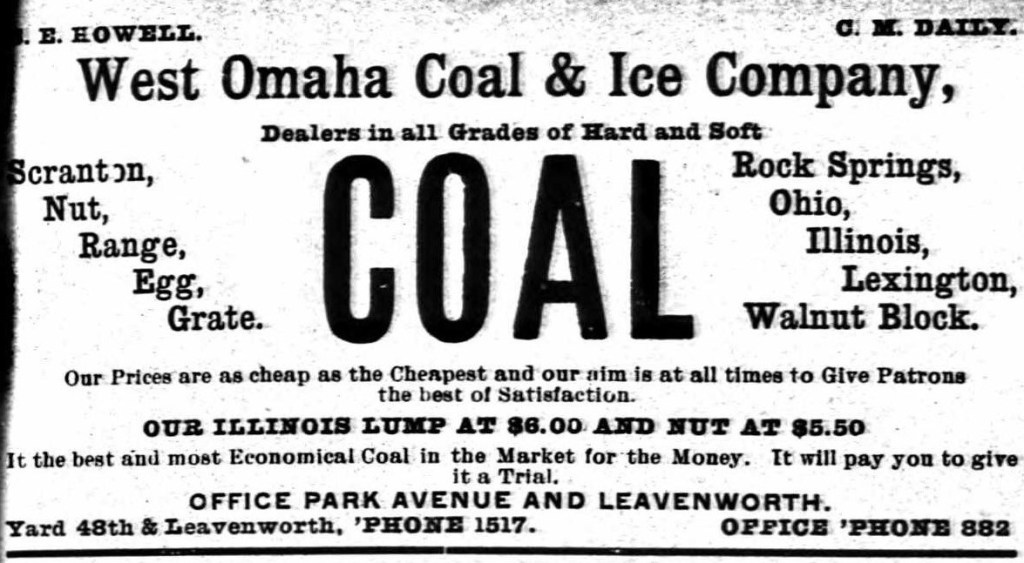
Prior to his marriage, for a few years Charles Daily had been working for Maggie’s brother-in-law, Charles White, who had been running a coal and feed business.  Around 1891 White began working at a bakery,11 so Daily changed employers and in 1892 can be found working with West Omaha Coal & Ice Co.12  Although it is not known whether Daily had ownership in this company, he did have a significant role as evidenced by Daily’s name being printed in the company’s advertisement in the 1894 Omaha City Directory.  (See the ad below.)  According to Maggie’s son Robert, Maggie worked as a bookkeeper for this same business.13 Then in 1897, Daily was employed by Omaha Coal, Coke and Lime Company as a teamster.  At that time, a teamster was a “‘person who drives a team of horses’ (especially in hauling freight).”14

Advertisement in Omaha City Directory for 189415

There are a couple interesting things to note in the advertisement of West Omaha Coal and Ice Company.  One thing is: the location of the “Yard” is close to the location of Charles and Maggie’s first address (4801 Leavenworth would be one of the corners of 48th and Leavenworth).  Another interesting thing is that this business has telephone numbers.  The introduction of the telephone in Omaha and its dissemination within the city was quiet and slow.  It had begun about 15 years earlier, shortly before Maggie’s family moved to Omaha.

“… Louis H. Korty, an Omaha railroad executive, had seen Bell’s exhibit at Philadelphia and became interested in its possibilities.  In the summer of 1877 he sent to Boston for a pair of the instruments.  He induced a fellow railroad man, J. J. Dickey, to cooperate with him and in November connected the telephones across the Missouri River to establish connection from his office at Omaha to the Union Pacific Transfer at Council Bluffs.

“Messrs. Korty and Dickey then formed a partnership, acquiring license rights from the Bell Company at Boston for a portion of Iowa and all of Nebraska, Wyoming, Montana and Idaho.  For a year they were content to lease their telephones in pairs to provide private lines without interconnection to customers in western Iowa and eastern Nebraska.  In the spring of 1879 they admitted S. H. H. Clark, then president of the Union Pacific, into partnership and organized the Omaha telephone exchange.  This was brought into service in July 1879 ….”16

During the year before the telephone exchange was organized (1878), Korty and Dickey, running their business as Omaha Electric Company, had enlisted 150 telephone subscribers.17  These were two-party lines which did not connect to other subscribers.  When the telephone exchange was formed, which was named Nebraska Telephone Company, it had two operators, and the first telephone directory was issued.17  Soon afterward the telephone company “reported it had 323 subscribers that were interconnected by 160 miles of telephone wires.”19

The first mention of telephones in an Omaha city directory was made in the 1883 edition: “Omaha is connected with all the principal cities in Nebraska by telephone, and with Council Bluffs, Iowa, by that marvelous invention, the telephone ….”20  This issue of the city directory has the first listing of Nebraska Telephone Company.  By 1887, there were 4,500 subscribers and a press release announced that it provided service to 70 fire and 40 police department “boxes.”21

Very little mention of the telephone service is given in the city directory until the 1892 edition, in which it was reported that the Nebraska Telephone Company was about to erect a three-story fireproof building that would be “adapted exclusively for telephone purposes, … fitted throughout with all the latest and most improved apparatus and appliances pertaining to the telephone business.”22  The 1894 edition announced the following:

“The Nebraska Telephone Co., has completed and now occupies its fine new fire-proof exchange building, at the corner of South Eighteenth and Douglas streets, and is operating its system mostly through underground wires, thus relieving the city from much that was dangerous as well as inconvenient and unsightly.

“The adoption of the underground system caused the laying of 1,500 miles of copper wire in 40,000 feet of 100 pair cables.  The improvements cost about $180,000 and bring the company’s operations up to the highest state of efficiency, by the adoption of the latest improvements and inventions.”23


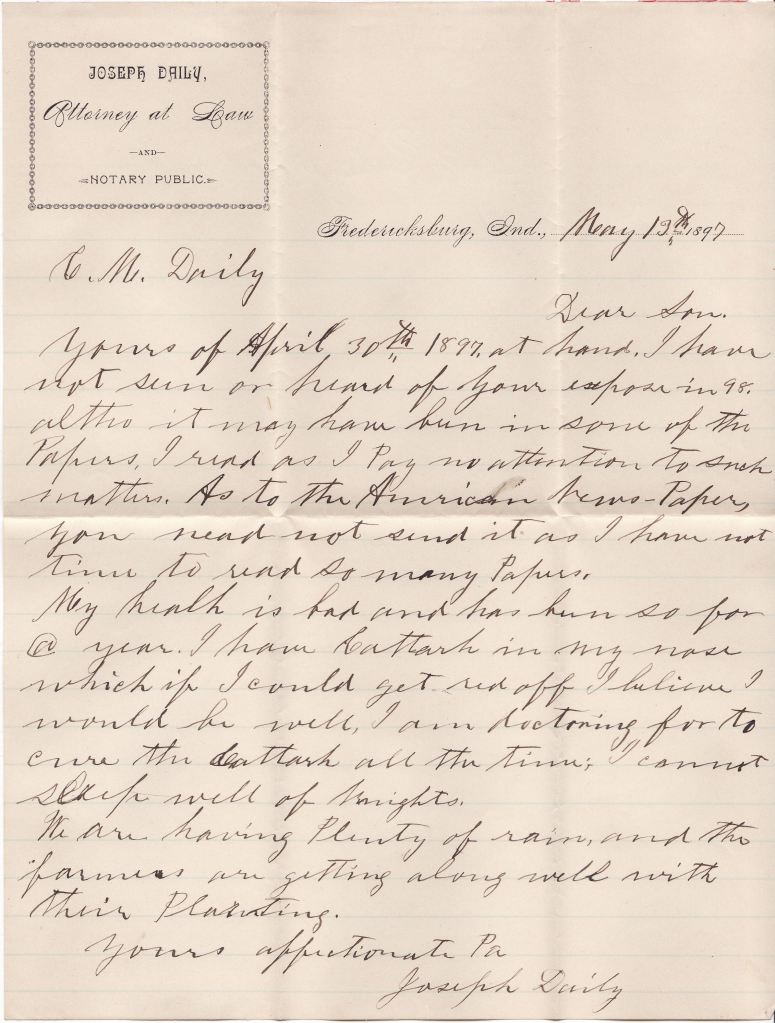
On April 30, 1897, Charles wrote a letter to his father, Joseph S. Daily, who lived in Fredericksburg, Indiana.  This is known because Joseph makes note of this fact in a letter dated May 13, 1897 which he sent to his son Charles.  It is unlikely that Charles’ letter still exists, but Joseph’s letter is in possession of one of his great-grandsons.  At the time that Joseph wrote the letter, he was afflicted with catarrh.  Currently, the word catarrh isn’t used much in the United States, but the condition is as common as ever (catarrh is the build-up of mucus in the nasal passages and in the throat.)24

Charles may have sent his father a copy of The American, which was a weekly newspaper edited by John C. Thompson, the husband of Maggie’s sister, Emma.  John was a printer, and having opened his own shop about six years earlier,25 he started printing a newspaper as an organ of a secret society called the American Protective Association.26  Joseph declined Charles’ offer of having the newspaper sent to him, saying he didn’t have time to read it.  The text of Joseph’s letter follows:

“C. M. Daily

“Dear Son.

“Yours of April 30th 1897, at hand.  I have not seen or heard of your expose in 98.  altho it may have been in some of the Papers I read as I pay no attention to such matters.  As to the Amrican News-Paper, you nead not send it as I have not time to read so many Papers.

“My healh is bad and has been so for a year.  I have Cattarh in my nose which if I could get rid off I believe I would be well.  I am doctoring for to cure the Cattarh all the time, I cannot sleep well of Nights.

“We are having Plenty of rain, and the farmers are getting along well with their Planting.

“Your affectionate Pa

“Joseph Daily”

Letter written by Joseph Daily to his son Charles Daily, dated May 13, 1897

Joseph mentioned that he had not heard of “your expose in 98.”  He was referring to the Trans-Mississippi Exposition that would be held the next year in Omaha from June 1 until October 31, 1898.  The purpose of the exposition was “to showcase the economic, cultural and artistic achievements of the individuals who lived in this region.  All of the buildings, which housed over 5000 exhibits, were built as temporary structures.  A monument to the exposition is in Omaha’s Kountze Park, the former site of the exposition.”27  This exposition is the largest event Omaha has ever hosted.28

“William Jennings Bryan brought the idea of a multistate agricultural fair to Omaha leaders after he attended the Chicago World’s Fair in 1893.  From this, plans were developed for Omaha to be the site of the Trans-Mississippi Exposition five years later.

“… The cornerstone for the Trans-Mississippi and International Exposition and Indian Congress was laid in April [1897] and the project got underway a week later.  Thomas Kimball, chief architect for the Trans-Miss Exposition, supervised the design of classical buildings around a central lagoon, which became the “Grand Court” and centerpiece for hundreds of activities.  The Trans-Miss was located on 184 acres of land in North Omaha donated by the Kountze family.”29

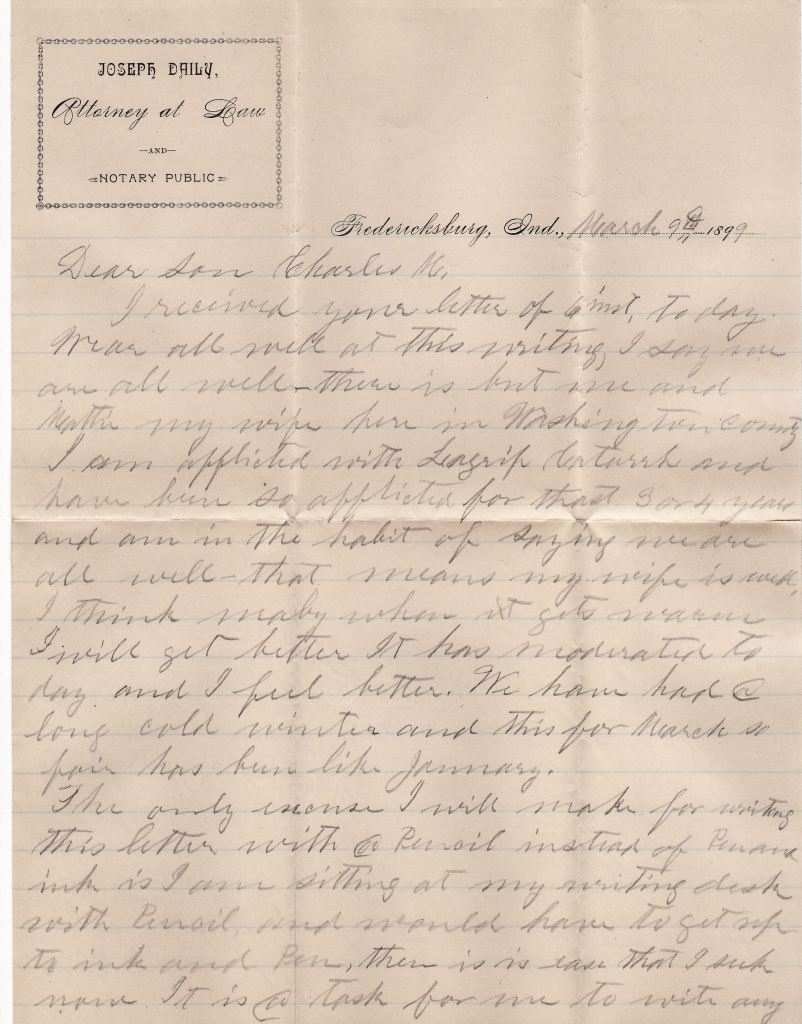
Joseph, still suffering from catarrh, wrote another letter to Charles, dated March 9, 1899.  He noted that Charles had written a letter to him, dated on the sixth.  At the end of the letter, Joseph mentions that he previously wrote a family history and sent it to Charles.  It is not known at this time if that original document still exists, but it may be the basis of the History of the Daily’s, which is the research work of Charles’ daughter, Iona Daily Zick, and has been distributed among Joseph and Charles’ descendants.  The text of Joseph’s letter reads:

“Dear Son Charles M.

“I received your letter of 6 inst. today.  We are all well at this writing, I say we are all well – there is but me and Mattie my wife here in Washington county.  I am afflicted with Lingrip Catarrh and have been so afflicted for [the last] 3 or 4 years and am in the habit of saying we are all well that means my wife is well.  I think maby when it gets warm I will get better  It has moderated to day and I feel better.  We have had a long cold winter and this for March so far has been like January.

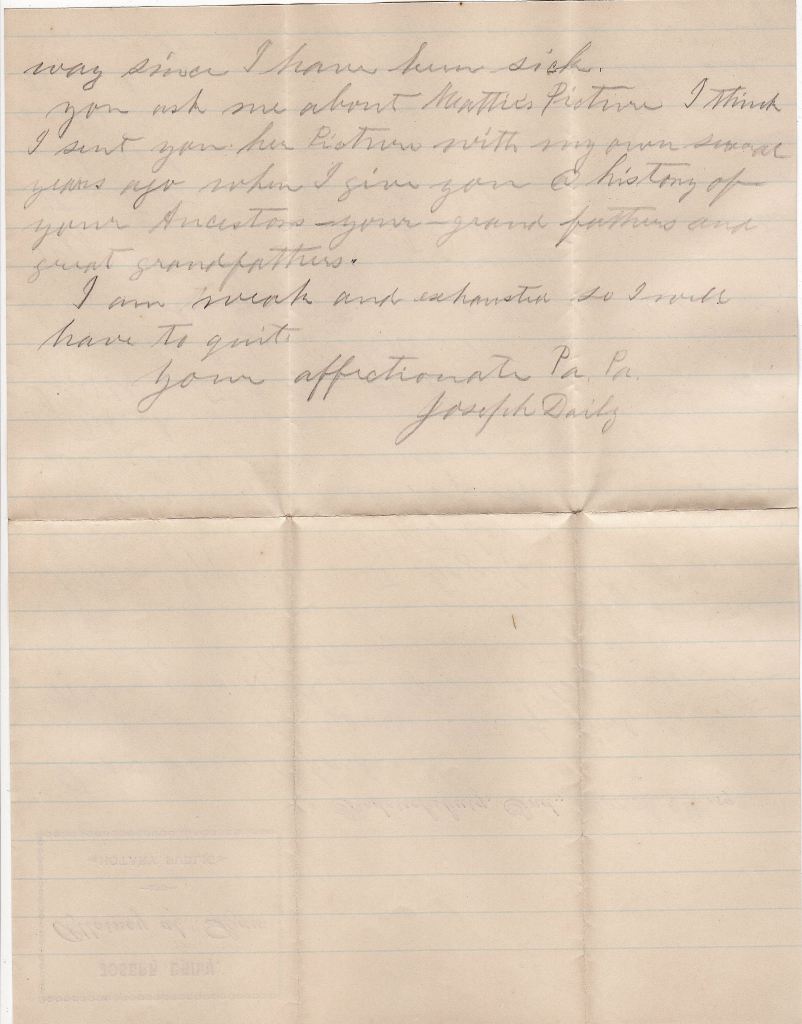
“The only excuse I will make for writing this letter with a pencil instead of pen and ink is I am sitting at my writing desk with pencil, and would have to get up to ink and pen ….  It is a task for me to write any way since I have been sick.

“you ask me about Mattie’s Picture  I think I sent you her Picture with my own several years ago when I give you a history of your Ancestors – your grandfathers and great grandfathers.

“I am weak and exhausted so I will have to quit.

“Your affectionate Pa Pa

“Joseph Daily”

Letter written by Joseph Daily to his son Charles Daily, dated March 9, 1899

Notes:

  1. Omaha City Directory Including South Omaha for 1893 (Omaha, Nebraska: J. M. Wolfe & Co., Publishers, 1893): 247.
  2. Omaha City Directory Including South Omaha for 1893: 152.
  3. Omaha City and South Omaha City Directory for 1891 (Omaha, Nebraska: J. M. Wolfe & Co., Publishers, 1891): 103.
  4. Omaha City and South Omaha City Directory for 1892 (Omaha, Nebraska: J. M. Wolfe & Co., Publishers, 1892): 686.
  5. Omaha City and South Omaha City Directory for 1892: 644.
  6. Omaha City and South Omaha City Directory for 1892: front.
  7. Omaha City and South Omaha City Directory for 1890 (Omaha, Nebraska: J. M. Wolfe & Co., Publishers, 1890): 10.
  8. M. R. Wilson, transcription of Robert Lee Daily Interview by R. Thiele, recording (ca. 1984): 19.
  9. M. R. Wilson, transcription of Robert Lee Daily Interview: 4.
  10. McAvoy’s Omaha City Directory for 1897 (Omaha, Nebraska: Omaha Directory Company, 1897): 11.
  11. This statement is based on the fact that the 1892 Omaha city directory has an entry for C. P. White which indicates his workplace is a bakery; Omaha City and South Omaha City Directory for 1892: 686.
  12. Omaha City Directory Including South Omaha for 1892: 169.
  13. M. R. Wilson, transcription of Robert Lee Daily Interview: 4, 19.
  14. Online Etymology Dictionary, “Teamster,” https://www.etymonline.com/word/teamster.
  15. Omaha City Directory for 1894 (Omaha, Nebraska: The J. M. Wolfe Directory Co., Publishers, 1894): 813.
  16. The Lincoln Telephone and Telegraph Company, The History of L T & T (The Lincoln Telephone and Telegraph Company: Lincoln, Nebraska, 1955): 3, http://bellsystempractices.org/Miscellaneous/the_history_of_lincoln_telephone_and_telegraph_-_1955-small.pdf.
  17. Jim McKee, “The telephone comes to Omaha” (Lincoln, Nebraska: Lincoln Journal Star, Jan 24, 2015): https://journalstar.com/news/local/jim-mckee-the-telephone-comes-to-omaha/article_5b1f1678-bada-5b27-8220-f08fc40e99a2.html.
  18. Jim McKee, “The telephone comes to Omaha.”
  19. Jim McKee, “The telephone comes to Omaha.”
  20. J. M. Wolfe, Wolfe’s Omaha City Directory 1883-84 (Omaha, Nebraska: Herald Printing, Binding and Electrotyping Establishment, 1883): 19.
  21. Jim McKee, “The telephone comes to Omaha.”
  22. Omaha City and South Omaha City Directory for 1892: 9-10.
  23. Omaha City Directory for 1894: 10.
  24. Jill Seladi-Schulman, Going with the Flow: Recognizing and Treating Catarrh (Postnasal Drip) (Healthline Media, September 28, 2020): https://www.healthline.com/health/allergies/catarrh#definition.
  25. Omaha City and South Omaha City Directory for 1892: 644.
  26. University of Nebraska-Lincoln, The American, http://nebnewspapers.unl.edu/lccn/2017270212/.
  27. Trans-Mississippi Exposition, Omaha, Nebraska, 1898, http://www.historicomaha.com/transmis.htm#:~:text=The%20Trans-Mississippi%20Exposition%2C%20held%20in%20Omaha%2C%20Nebraska%2C%20from,housed%20over%205000%20exhibits%2C%20were%20built%20as%20temporary.
  28. Liz Rea, History at a glance (Omaha, Nebraska: Douglas County Historical Society, 2007): 56, http://www.douglascohistory.org/wp-content/uploads/2018/08/History-at-a-Glance-9-2007.pdf.
  29. Liz Rea, History at a glance: 51, 54-55.

The First Few Decades of Charles M. Daily’s Life

One hundred years before I was born, my great-grandfather Charles Monroe Daily, whose heritage was Yankee Irish,1 was born to Joseph and Amanda (Black) Daily.  Born on September 30, 1856 near New Albany, Indiana,2 he was the fourth child born to them, the third son.  The 1860 U. S. census recorded his family living on a farm in Franklin Township, Floyd County, Indiana.  The household included (with their ages): Joseph (30), Amanda (27), Thomas (10), Patrick (8), Syntha [Cynthia] (6), Charles (3), Martha (1), Andrew Black (22) and Huldy Dailey (40).  Andrew Black was probably Amanda’s brother and was working as a farm laborer.  Huldy Dailey was probably Joseph’s sister who was a “Criple.”3

Charles’ mother gave birth to three more sons (William, Robert and Joseph Albert).  A few days after the birth of Joseph Albert, Amanda died on February 19, 1866.4  The baby Joseph only lived for three months, dying in May 1866.5  When the 1870 U. S. census was taken, the Daily family was still living on a farm in Franklin Township, Floyd County, Indiana.  At that time the household included (with their ages): Joseph (41), Thomas (19), Patrick (17), Cynthia (15), Charles (13), Martha (11), William (8), Robbert (6) and a farm laborer named Henry Black (60).6   Charles and all of his siblings except Cynthia had attended school during that year.7  As an adult Charles would report that the highest grade he completed was 6th grade.8

It is not known where Charles was located when the 1880 U. S. census was taken.  Charles was not living with his father, nor were any of Charles’ siblings living with their father.  Joseph Daily, who had remarried in 1874, was living with his new wife Mattie (Lafollette) Daily and her brother and sister in Fredericksburg, Indiana.9  Neither was Charles living with his elder brothers and sister, each of whom were married and living on farms in Franklin Township, Indiana.10,11  It is also unsure where Charles’ younger sister and brothers were at that time.

According to Charles’ son Robert, Charles and his younger brother William “kinda left home real early on account that they had a step-mother,” the two youngsters “worked out for friends, neighbors, always a farm around” and Charles “looked after Bill his brother.”12  A Daily family historian has written that Charles “when still quite a young man started to work west through Illinois, Iowa to Omaha, Nebraska where he settled.”13  A statement printed in Standard Atlas of Codington County South Dakota asserts that Charles “was one of the pioneer settlers of Nebraska.”14  It is unclear where Charles was located in Nebraska until he was about 32 years old.  Beginning with the 1889 issue, his name can be found in many Omaha city directories.  At that time the city of Omaha was described as follows:

“… Within its limits nothing is wanting that will in any way conduce to human happiness.  Trade in all departments is being rapidly developed.  Buildings to meet its wants have either been erected already or are being rapidly pushed to completion.  A few years ago a six-story building was a structure worthy of comment, not only in the west, but almost anywhere; to-day in this city eleven story edifices are stretching upward to the skies.  Brick and stone have long since taken the place of the pioneer wooden structure, and the stone even sometimes taken from the shores laved by the Atlantic.  The banks are nearly all in buildings of their own, that at once attract the attention by their massive, substantial proportions as well as their beauty of architecture.  Their stability never was questioned, and the returns of the clearing house demonstrate the volume, as well as the rapidly increasing percentage of business, as well as the faith of the public.  The railways from the city point everywhere and gather up the treasures of the earth for the city’s general distribution.  Cable and electric cars have to a large extent displaced the former horse cars and landmarks of an earlier date are rapidly passing away.  The electric light has outshown the feebler rays of gas, and ere long will wholly monopolize the domain of illumination.  The drainage of the city is perfect, natural facilities largely aiding those who have that portion of the public works in hand.  The police of the city are well organized and the malicious, found in all large cities, are kept under proper restraint.  The administration of the law is in able hands and the courts of justice are models of purity and excellence.  The schools and churches are of the highest standing.  Each ward in the city is provided with an excellent school building and able teachers, and the youth of both sexes are well trained for business, the professions or social requirements.  The high school is equal in its training to many of the colleges of the land, and taken as a whole, the intellectual advantages of the city are unsurpassed.  The churches are numerous, their pulpits ably filled and their congregations large.  The water works system is of the finest description;  the fire department efficient and well equipped, and in no detail of the city’s service is there anything whatever not fully equal to the best anywhere to be found.”15

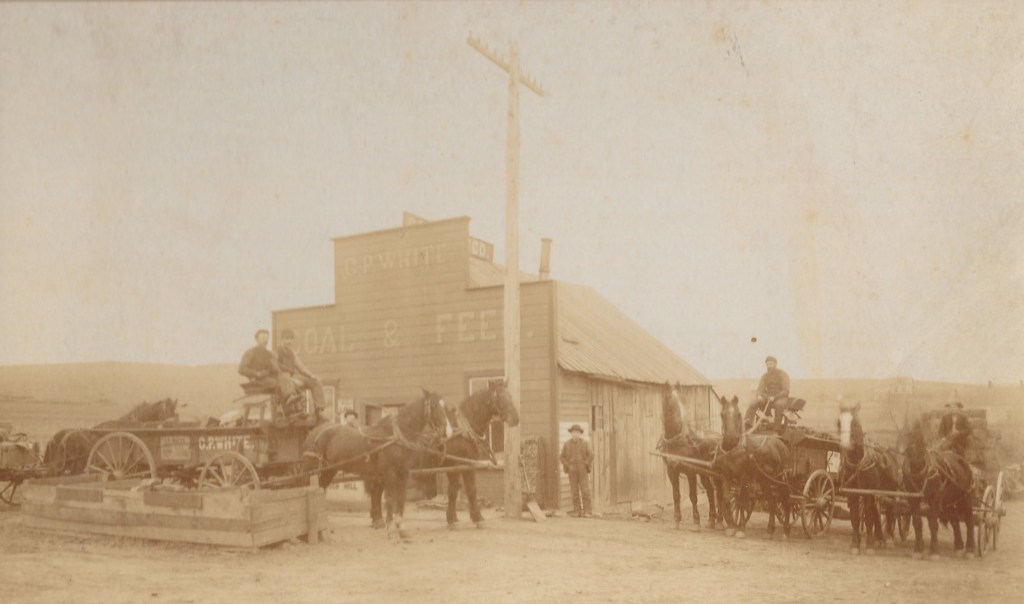
The 1889 entry about Charles in the Omaha city directory reads: “Dailey Charles M, clk Chas P White, res West Side.”16  Charles was working as a clerk at a business run by Charles P. White.  White’s business handled “coal and feed” and was located at the corner of Leavenworth and Missouri Pacific Railway in West Side.17  West Side was a newly developing area on the outskirts of Omaha.  It would later be described as an area of workers’ cottages.18  A year later, the 1890 city directory indicates that Charles Daily was working and living at the same places.  Then in the 1891 directory, he was boarding at 1023 S. 48th Ave and he was still working for C. P. White.19  Interestingly, C. P. White’s residence was also 1023 S. 48th Ave.20  That year White’s business was selling ice as well as coal and feed.  It is also noteworthy that C. P. White was married to Carrie Bonewitz, whose sister was Maggie Bonewitz, Charles Daily’s future wife.

C. P. White Coal & Feed, Omaha, Nebraska
Entries for this business can be found in the Omaha city directory from 1887 to 1891.

Notes:

  1. E. J. B. V. Bevers, personal communication with M. R. Wilson, ca. 1976.
  2. Shaw-Messer Chapel, “In Memory of Charles M. Daily” (Watertown, South Dakota: Shaw-Messer Chapel, March 12, 1945).
  3. “United States Census, 1860,” database with images, FamilySearch (https://familysearch.org/ark:/61903/3:1:33SQ-GYBY-3RS?cc=1473181&wc=7QK5-R7B%3A1589426070%2C1589423360%2C1589422457 : 24 March 2017), Indiana > Floyd > Franklin Township > image 4 of 20; from “1860 U.S. Federal Census – Population,” database, Fold3.com (http://www.fold3.com : n.d.); citing NARA microfilm publication M653 (Washington, D.C.: National Archives and Records Administration, n.d.).
  4. L. I. Zick, History of the Daily’s (unpublished, n. d.): 1.
  5. Find a Grave, database and images (https://www.findagrave.com : accessed 10 August 2020), memorial page for Joseph Albert Daily (14 Feb 1866–9 May 1866), Find a Grave Memorial no. 134995828, citing Silas Daily Cemetery, New Albany, Floyd County, Indiana, USA ; Maintained by John Ozzy Williams (contributor 47315704) .
  6. “United States Census, 1870,” database with images, FamilySearch (https://familysearch.org/ark:/61903/3:1:S3HY-69R9-3QM?cc=1438024&wc=92KT-2JM%3A518664801%2C519250701%2C518720802 : 8 June 2019), Indiana > Floyd > Franklin > image 15 of 20; citing NARA microfilm publication M593 (Washington, D.C.: National Archives and Records Administration, n.d.).
  7. “United States Census, 1870,” Indiana > Floyd > Franklin > image 15 of 20.
  8. “United States Census, 1940,” database with images, FamilySearch (https://familysearch.org/ark:/61903/3:1:3QSQ-G9M1-5855?cc=2000219&wc=QZFM-WRZ%3A791611401%2C793270701%2C793367301%2C793379401 : accessed 5 July 2020), South Dakota > Codington > Watertown City, Watertown, Ward 3 > 15-24B Watertown City Ward 3 bounded by (N) 4th Av S; (E) Maple, ward line; (S) city limits; (W) city limits, ward line > image 3 of 24; citing Sixteenth Census of the United States, 1940, NARA digital publication T627. Records of the Bureau of the Census, 1790 – 2007, RG 29. Washington, D.C.: National Archives and Records Administration, 2012.
  9. “United States Census, 1880,” database with images, FamilySearch (https://familysearch.org/ark:/61903/3:1:33SQ-GYBZ-LJ5?cc=1417683&wc=XCT5-W38%3A1589401272%2C1589395180%2C1589403077%2C1589396220 : 24 December 2015), Indiana > Washington > Fredericksburg > ED 183 > image 3 of 6; citing NARA microfilm publication T9, (National Archives and Records Administration, Washington, D.C., n.d.)
  10. “United States Census, 1880,” database with images, FamilySearch (https://familysearch.org/ark:/61903/3:1:33S7-LBF7-97K?cc=1417683&wc=XC5C-VZ9%3A1589401272%2C1589399936%2C1589395978%2C1589395374 : 24 December 2015), Indiana > Floyd > Franklin > ED 65 > image 12 of 17; citing NARA microfilm publication T9, (National Archives and Records Administration, Washington, D.C., n.d.)
  11. “United States Census, 1880,” database with images, FamilySearch (https://familysearch.org/ark:/61903/3:1:33SQ-GBF7-9GX?cc=1417683&wc=XC5C-VZ9%3A1589401272%2C1589399936%2C1589395978%2C1589395374 : 24 December 2015), Indiana > Floyd > Franklin > ED 65 > image 11 of 17; citing NARA microfilm publication T9, (National Archives and Records Administration, Washington, D.C., n.d.)
  12. M.R. Wilson, transcription of Robert Lee Daily Interview by R. Thiele, recording (ca. 1984): 2-3.
  13. L. I. Zick, History of the Daily’s (unpublished, n. d.): 1.
  14. Standard Atlas of Codington County South Dakota (Chicago: Brock and Co. Publishers and Engravers, 1929).
  15. Omaha City and South Omaha City Directory for 1889 (Omaha, Nebraska: J. M. Wolfe & Co., Publishers, 1889): 3.
  16. Omaha City Directory for 1889: 194.
  17. Omaha City Directory for 1889: 846.
  18. Dennis Mihelich, ed., Ribbon of Destruction (Omaha, Nebraska: Douglas County Historical Society, n. d.): 8.
  19. Omaha City and South Omaha City Directory for 1891 (Omaha, Nebraska: J. M. Wolfe & Co., Publishers, 1891): 214.
  20. Omaha City Directory for 1891: 928.

An Introduction to Charles Monroe Daily

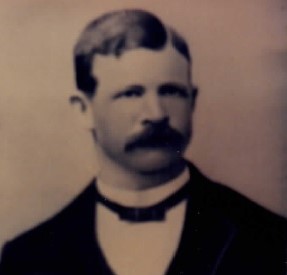
Charles Monroe Daily on his wedding day November 18, 1891

Miss Maggie’s Early Life

When I was a child, occasionally I would ask my mother where our ancestors were from.  She would tell me that her father’s father was from England, her father’s mother was from Switzerland, her mother’s father was Irish and her mother’s mother was Pennsylvania Dutch.  It was not until I was well into adulthood that I learned that my mother’s grandmother Maggie was not actually born in Pennsylvania, nor were Maggie’s parents born there.  It was Maggie’s grandparents who were born in Pennsylvania.  Her paternal grandparents (John Adam Bonewitz and Mary Margaret Rider, also called Peggy) were already married when they moved from Pennsylvania to Ohio about 1820, but Maggie’s maternal grandparents (Harman Smith and Barbara Flora) were still children when they moved with their parents to Ohio about 1822 and 1815, respectively.

Subsequently, all of Maggie’s grandparents moved to Indiana.  When Harman and Barbara Smith moved from Ohio to Huntington County, Indiana (about 1843), their children were still young, which included Josephine Smith.  Late in life (about 1853), John Adam and Peggy Bonewitz moved to neighboring Wabash County, Indiana and their son John Esli Bonewitz moved with them.  Somehow, John Esli met Josephine and they married in 1856.  They lived in Indiana for a few years, then in the early 1860s, they moved to Fairfield, Iowa, which is where Maggie was born on November 9, 1867.1

When the 1870 U. S. census was taken in Fairfield, Iowa, Maggie, at nearly 3 years-old, was the youngest in a household of three adults and seven children.2  Maggie’s father was 35 years-old and her mother was 32 years-old.  She had two older brothers and two older sisters:  Orlando, age 13; Harman, age 11; Carrie, age 9 and Emma, age 5.  Maggie’s mother’s sister Malissa Griffith and Malissa’s two children William and Viola, age 8 and 7 respectively, were also living in the Bonewitz household.

Little is known of Maggie’s life as a child, but from what is recorded in the 1940 U. S. census it is known that she attended school through the fifth grade.3  Also, from the 1880 U. S. Census, we learn that two more brothers (Claudius and J. F.) were born after Maggie,4 one when she was eight or nine years-old and the other when she was twelve.  When Maggie was about ten years-old, her father and eldest brothers traveled 230 miles due west of Fairfield to Omaha, Nebraska and a few years later the entire family moved there. 

The annual Omaha city directories reveal information about the occupations and residences of the family.  Beginning with the 1878-79 city directory, entries can be found for John, Orlando and Harman Bonewitz.  When the 1880 U. S. census was taken, the Bonewitz family was listed in Fairfield, even though the 1880 Omaha city directory has an entry for John.

When Maggie’s family arrived in Omaha, she was 13 years-old.  Maggie’s teenage years were filled with many family events, including deaths, marriages and changing residences.  Sadly, two weeks after the census was taken in Fairfield, Maggie’s nearly six-month-old brother J. F. passed away.  His grave is in Omaha, not Fairfield.5  Less than 10 months later, Maggie’s other younger brother Claudius died at nearly five-years-old.6

Omaha, which “derived its name from a tribe of Indians that were formerly the owners of the soil,”7 was a booming city.  It was established in 1854 and immediately experienced rapid development.8  After a brief slowdown due to a financial crisis in the late 1850s, the city resumed its expansion as Omaha became the outfitting center for immigrants to Colorado, Utah, Idaho, Montana and Wyoming.9  An article in the 1870 Omaha city directory identified several factors which attributed to Omaha’s development:

“The mines of the west, the termination of the [Civil] war, and the initiation of the U. P. R. R. [Union Pacific Rail Road] brought back vitality.  Capitalists made homes here; railroads one after another came from the east, making Omaha their objective point; a fleet of steamers gave connection with the south; the Government established here headquarters for the army of the West; manufactures sprung into existence; the U. P. R. R. constructed workshops, employing hundreds of hands, and executing every description of work, and prosperity which has known no interruption, returned.”10

The population when John and his sons arrived in Omaha was about 26,215.11  When the Bonewitz family moved to Omaha in 1880, the census report gave it a population of 30,652.12  The population in 1884 was estimated at 55,23013 and in 1887 it was estimated at 96,717.14

According to the city directories the family moved several times.  Upon moving to Omaha, the first address of the family was 1314 Jackson.15  The first time that Maggie’s name is listed in the city directory is in 1884.  Her residence was at 1623 Dodge, which is the same address listed for her sister Carrie and her father.16  Her father’s entry notes that his occupation was “boarding.”  Maggie’s parents ran a boarding house and it is likely that Maggie assisted her parents in this endeavor.  In 1885, Maggie’s residence was at 1209 Georgia Avenue17 and in 1886 she lived at 1113 Georgia,18 both of these addresses were listed for her father and brother Harman also.

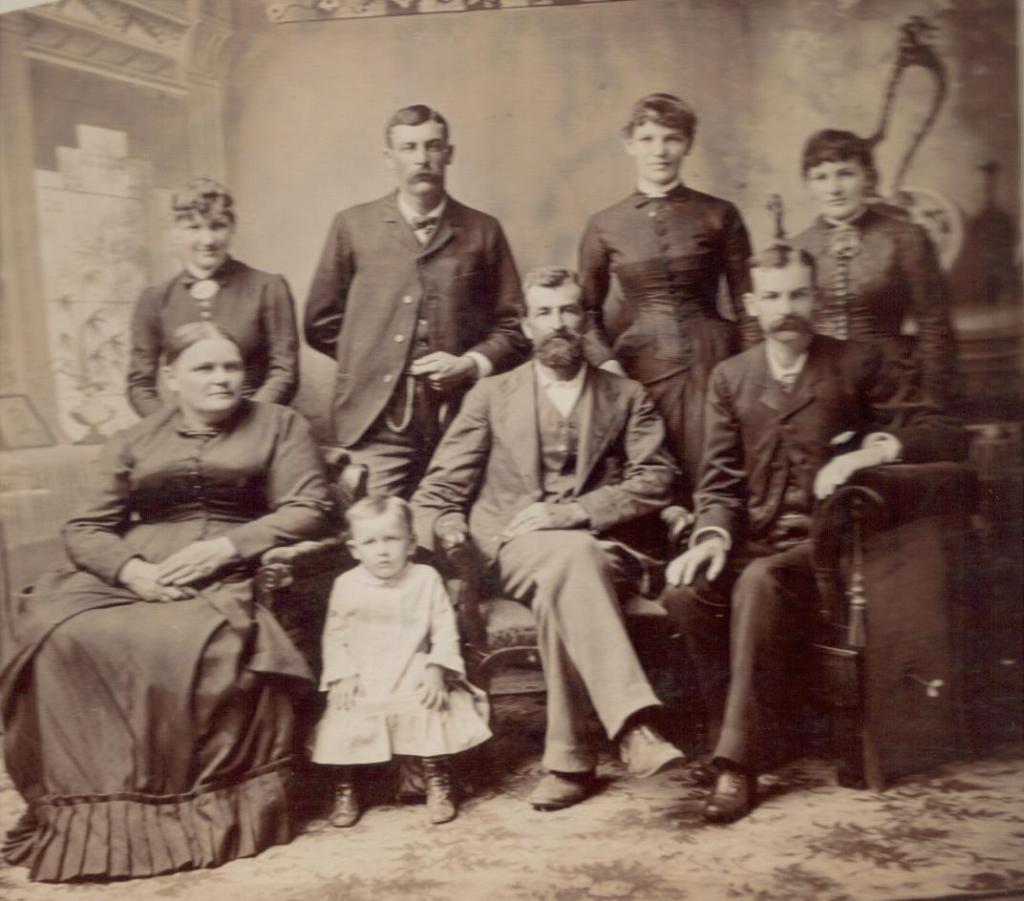
Other family events that occurred in the first half of the 1880s included the birth of another brother (Sidney) in January 1882.19  Maggie’s sister Emma married John C. Thompson in May 188320 and her sister Carrie married Charles P. White in 1884.21  The next year, tragically, Maggie’s eldest brother Orlando passed away.  In the Omaha city directory, he is in the list of “the most prominent persons who have died within the city of Omaha during the year 1885,” and is given the date of death of August 27.22  (This may actually have been the date of his burial.)  Not long before Orlando’s death the Bonewitz family posed for a family portrait.23  Based on how old Sidney appears to be, the photograph may have been taken in late 1884 or early 1885.  Maggie, standing on the left, would have been about 17 years-old.

The Bonewitz family (with their approximate ages):
Back Row: Maggie (17), Orlando (27), probably Emma (20), probably Carrie (23) (Emma and Carrie could be the opposite)
Front Row: Josephine (46), Sidney (3), John (49), Harman (25)

When the 1885 census of Nebraska was taken, Maggie along with her father, mother and three brothers lived on 28th street.24  Maggie’s sister Emma and brother-in-law also lived in the household and they had a daughter, Josephine, who was one year old.  In addition, there were five boarders in the household.  Another marriage took place in December 1886.  Maggie’s brother Harman married Cornelia Higley.25

In the newspaper Omaha Daily Bee, an announcement was placed describing Maggie’s 20th birthday:

“Wednesday evening a large number of young friends assembled at the residence of Mr. John E. Bonewitz, in West Side, and passed a very pleasant evening, the gathering being in honor of the twentieth birthday of his daughter, Miss Maggie.  Quite a number of invitations had been sent out and as a result the house was filled with merry, fun-loving young people.  Some very nice and costly presents were bestowed upon the young lady, who made an admirable hostess on this occasion.  At 11 o’clock a very fine lunch was served, after which the assembled friends were entertained with music and games.  Those in attendance were G. L. McIlvane and Miss Robertson, J. E. Hardy and Miss Emma Lyman, A. S. Gantz and Miss Anna Higley, Charles Roberts and Miss Hannah Roberts, George Ritchie and wife, T. W. Smith and wife, C. P. White and wife, H. N. Stump, Ernest Gantz, Mr. Christ, of Sac City, Ia.; John Collins, Rockport, Mo.; John C. Thompson and wife and the parents of the young lady.”26

Besides Maggie and her parents there were 20 people in attendance at her birthday party.  Some of the guests were:

  • A. S. Gantz (Argola) who was Maggie’s 18 year-old cousin, the son of her mother’s sister Joannah.  The Gantz family had been living in Fairfield, Iowa at the same time that the Bonewitz’ family lived there in 1880.27 
  • Ernest Gantz is possibly a relation of Argola.  There was another Gantz family that lived in Fairfield in 1880 which included a young person named Ernest.28
  • Argola accompanied Anna Higley who was probably the 17 year-old sister of Maggie’s sister-in-law Cornelia.  The Higley family was also living in Fairfield in 1880.29
  • C. P. White and wife were Maggie’s brother-in-law Charles and her sister Carrie.
  • John C. Thompson and wife were Maggie’s brother-in-law and her sister Emma.
  • H. N. Stump was a carpenter living in West Side.30  (Maggie’s father was a carpenter at the time.)31

The newspaper article notes that the Bonewitz family lived in West Side.  This was a newly developing area about three miles west from the post office and was near the West Side train depot grounds.  It would later be described as an area of workers’ cottages.32 This is the area that members of Maggie’s family would reside for the next 30 years.

Notes:

  1. Shaw-Messer Chapel, “In Memory of Maggie O. Daily” (Watertown, South Dakota: Shaw-Messer Chapel, March 15, 1947).
  2. “United States Census, 1870,” database with images, FamilySearch (https://familysearch.org/ark:/61903/1:1:MDVC-DFR : 17 October 2014), Maggie O Bonewits in household of John E Bonewits, Iowa, United States; citing p. 5, family 37, NARA microfilm publication M593 (Washington D.C.: National Archives and Records Administration, n.d.); FHL microfilm 545,898.
  3. “United States Census, 1940,” database with images, FamilySearch (https://familysearch.org/ark:/61903/3:1:3QSQ-G9M1-5855?cc=2000219&wc=QZFM-WRZ%3A791611401%2C793270701%2C793367301%2C793379401 : accessed 5 July 2020), South Dakota > Codington > Watertown City, Watertown, Ward 3 > 15-24B Watertown City Ward 3 bounded by (N) 4th Av S; (E) Maple, ward line; (S) city limits; (W) city limits, ward line > image 3 of 24; citing Sixteenth Census of the United States, 1940, NARA digital publication T627. Records of the Bureau of the Census, 1790 – 2007, RG 29. Washington, D.C.: National Archives and Records Administration, 2012.
  4. “United States Census, 1880,” database with images, FamilySearch (https://familysearch.org/ark:/61903/1:1:MD2G-RHC : 13 July 2016), Maggie Bonewitz in household of J E Bonewitz, Fairfield, Jefferson, Iowa, United States; citing enumeration district ED 81, sheet 409D, NARA microfilm publication T9 (Washington D.C.: National Archives and Records Administration, n.d.), roll 0347; FHL microfilm 1,254,347.
  5. Find a Grave, database and images (https://www.findagrave.com : accessed 19 July 2020), memorial page for Freddy Bonewitz (Jan 1880–Jul 1880), Find a Grave Memorial no. 170992635, citing Prospect Hill Cemetery, Omaha, Douglas County, Nebraska, USA ; Maintained by SRGF (contributor 47487065) .
  6. Find a Grave, database and images (https://www.findagrave.com : accessed 19 July 2020), memorial page for Claudius Coan Bonewitz (7 May 1876–23 Apr 1881), Find a Grave Memorial no. 170992581, citing Prospect Hill Cemetery, Omaha, Douglas County, Nebraska, USA ; Maintained by SRGF (contributor 47487065) .
  7. Collins’ Omaha Directory (Omaha, Nebraska: Charles Collins, Publisher, June 1866): 19.
  8. Collins’ Omaha Directory: 21.
  9. Collins’ Omaha Directory: 24.
  10. Omaha Directory for 1870 (Omaha, Nebraska: J. M. Wolfe, Publisher, 1870): 17.
  11. J. M. Wolfe, publisher, Wolfe’s Omaha City Directory 1878-1879 (Omaha, Nebraska: Herald Publishing House and Book Bindery, 1878): 27.
  12. J. M. Wolfe, publisher, Wolfe’s Omaha City Directory 1881-1882 (Omaha, Nebraska: Herald Printing, Binding and Electrotyping House, 1881): 11.
  13. J. M. Wolfe, publisher, Omaha City Directory 1884 (Omaha, Nebraska: Herald Printing, Binding and Electrotyping Establishment, 1884): 9.
  14. Omaha City and Douglas County Directory 1887 (Omaha, Nebraska: J. M. Wolfe & Co., Publishers, 1887): 2.
  15. J. M. Wolfe, Wolfe’s Omaha City Directory 1881-1882: 116.
  16. J. M. Wolfe, Omaha City Directory 1884: 100.
  17. J. M. Wolfe, publisher, Omaha City and Douglas County Directory 1885 (Omaha, Nebraska: Herald Printing, Binding and Electrotyping House, 1885): 102.
  18. Omaha City and Douglas County Directory 1886 (Omaha, Nebraska: J. M. Wolfe & Co., Publishers, 1886): 113.
  19. State of California, California Death Index, 1940-1997 (Sacramento: State of California Department of Health Services, Center for Health Statistics): http://search.ancestry.com/cgi-bin/sse.dll?db=cadeath1940&h=709689&ti=0&indiv=try&gss=pt .
  20. Marriage license of John C. Thompson and Emma V. Bonewitz (State of Nebraska, Douglas County, May 6, 1883).
  21. Marriage license of Charles P. White and Carrie Bonewitz (State of Nebraska, Douglas County, June 12, 1884).
  22. Omaha City and Douglas County Directory 1886: 15.
  23. A descendant of Josephine Smith Bonewitz’ brother Obediah Smith contacted the author through Ancestry.com and subsequently supplied this photograph which her grandmother had labeled John and Josephine Bonewitz.
  24. “Nebraska State Census Collection, 1860-1885,” (Online publication – Provo, UT: Ancestry.com Operations, Inc., 2009): http://search.ancestry.com/cgi-bin/sse.dll?db=nestatecensus&h=1420813&ti=0&indiv=try&gss=pt .
  25. Marriage license of Harman F. Bonewitz and Cornelia B. Higley (State of Nebraska, Douglas County, December 29, 1886).
  26. Omaha Daily Bee (Omaha, Nebraska, November 20, 1887): 11, https://www.newspapers.com/image/149885912.
  27. “United States Census, 1880,” database with images, FamilySearch (https://familysearch.org/ark:/61903/3:1:33S7-9YYV-9P9W?cc=1417683&wc=XHBX-4WL%3A1589394762%2C1589396075%2C1589395491%2C1589396321 : 24 December 2015), Iowa > Jefferson > Fairfield > ED 80 > image 17 of 23; citing NARA microfilm publication T9, (National Archives and Records Administration, Washington, D.C., n.d.)
  28. “United States Census, 1880,” database with images, FamilySearch (https://familysearch.org/ark:/61903/3:1:33SQ-GYYV-9R3L?cc=1417683&wc=XHBX-C68%3A1589394762%2C1589396075%2C1589395491%2C1589396695 : 24 December 2015), Iowa > Jefferson > Fairfield > ED 81 > image 60 of 64; citing NARA microfilm publication T9, (National Archives and Records Administration, Washington, D.C., n.d.)
  29. “United States Census, 1880,” database with images, FamilySearch (https://familysearch.org/ark:/61903/3:1:33SQ-GYYV-9RN5?cc=1417683&wc=XHBX-C68%3A1589394762%2C1589396075%2C1589395491%2C1589396695 : 24 December 2015), Iowa > Jefferson > Fairfield > ED 81 > image 19 of 64; citing NARA microfilm publication T9, (National Archives and Records Administration, Washington, D.C., n.d.)
  30. Omaha City and Douglas County Directory 1887: 660.
  31. Omaha City and Douglas County Directory 1887: 75.
  32. Dennis Mihelich, ed., Ribbon of Destruction (Omaha, Nebraska: Douglas County Historical Society, n. d.): 8.