Maude and Alfred Waters, Part One

On May 11, 1904, the Syndicate Hotel–which had been enlarged two years earlier, making it one of the largest hotels in South Dakota1–hosted the wedding of two distinguished citizens of De Smet. The groom was the town’s widowed mayor, Alfred Newman Waters, who had lived in De Smet since 1880, the year it was founded. The bride was Maude Bevers, his secretary, according to Bevers family historians.2 She had been hired six years earlier by A. N. Waters to work in his office, following a course in Commercial Science at South Dakota Agricultural College. (For more about Maude’s professional training, see Maude Bevers, Career Woman.) Maude’s sister Gertrude was the bridesmaid at the wedding and C. E. Swanson, who was the county superintendent of schools, was the groomsman. The officiating minister, Rev. Henry Preston, was the minister of De Smet Episcopal Methodist Church.

The local newspaper reported on the event:

Wednesday evening at 7:30 occurred the marriage of two of De Smet’s prominent people, Mr. A. N. Waters and Miss Maude Bevers, at Syndicate Hotel parlors, Rev. Henry Preston officiating. The ceremony was performed in presence of only a few invited guests, together with the bride’s relatives. Miss Gertie Bevers acted as bridesmaid and Mr. C. E. Swanson as groomsman. The bride was becomingly attired in white silk. After the ceremony the wedding party was ushered into the dining room where covers were laid, for thirty and an elaborate banquet of eight courses was served, the party leaving the banquet hall only in time to accompany the happy couple to the train to see them started upon a trip to the eastern cities, which is to occupy about two weeks’ time. Little need be said by us concerning the contracting parties. The groom has been prominent in De Smet circles for many years. He has held many positions of trust and is now serving as mayor of our city for the second term. He has been a leading spirit in all affairs and undertakings, looking toward the upbuilding of our city. Time and money have been freely given by him for this purpose. No one man has done more to advance the interests of De Smet and Kingsbury County than has Mr. A. N. Waters. The bride has been a resident of this city for some seven years past. She has been prominent in social and church circles and is held in high esteem by all acquaintances because of the many fine qualities of character which constitute the true woman. She never failed to command the respect of all, even upon slight acquaintance. The people of De Smet unite in extending to Mr. and Mrs. Waters their best wishes for a long and happy married life.3
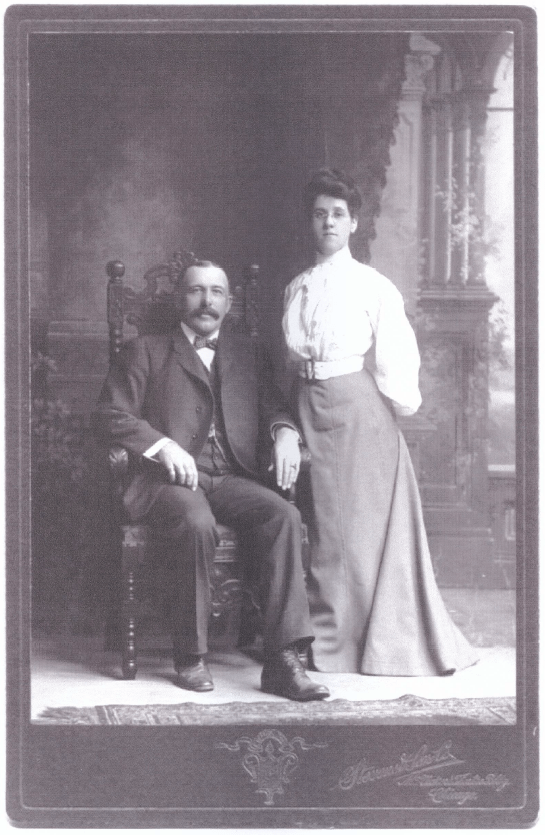
Alfred and Maude Waters
(The photographer appears to be located in Chicago)

Only a few days after their wedding, a meeting was held at De Smet City Hall at which Waters was appointed to a committee that was charged with organizing the Old Settler’s Celebration that would be held on June 10, 1904.4  Waters himself was one of the old settlers of the county, having “arrived in De Smet at the age of twenty-four during the summer of 1880, fresh out of law school.”5  On the day of the Old Settler’s Celebration, horse racing was one of the events held.  It was reported that “the free-for-all trotting race on the 10th was won by A. N. Waters’ horse.”6

In the month following the Old Settler’s Celebration, the newlyweds were visited by Waters’ aunts and cousins from Wisconsin and New York: Mrs. Alfred W. Newman, Mrs. Emory E. Newman and Mr. & Mrs. Isaac U. Tripp.  Mrs. A. W. Newman (Celia), who was the widow of Waters’ mother’s brother, came from Madison, Wisconsin, where her husband had been a judge on the state supreme court from 1894 until his death in 1898.  Mrs. E. E. Newman (Cordelia), arriving from Durham, New York, was the widow of another brother of Waters’ mother.  Because Waters’ mother had died when he was only a few weeks old, Waters grew up in his maternal grandparents’ home.7  Waters’ uncle Emory was 19 at the time of Waters’ mother’s death in 1855.  Following the passing of his grandfather, Waters was included in his uncle Emory’s household.8  Mrs. Isaac U. Tripp (Addie) was the daughter of one of Waters’ mother’s sisters, Lucilia (nee Newman) Winchell.

When the South Dakota census was taken in 1905, Maude was 30 years-old and her occupation was housewife.9  The census record for her husband has an incorrect first name, it is written as “Albert” instead of “Alfred.”  Waters was 49 years-old and his occupation was land agent.10  Later that year, Waters’ birthday (November 14, 1855) was noted by the local newspaper:

A. N. Waters celebrated his 50th birthday anniversary Tuesday. Twenty-five years and four months of that time have been spent in the city of De Smet. He has labored all these years for the upbuilding of this city and vicinity and has accomplished much for the community and built up a large business for himself. Here’s hoping that he spends the next fifty years right here in De Smet.11


Since his arrival in De Smet, Waters was very active as a real estate broker, and he partnered with other businessmen in land development businesses.  “During the early days, lawyers tended to involve themselves as much in the business of land as in the law, and Waters reaped a small fortune from shrewd land investments, eventually becoming one of the largest landholders in [Kingsbury County].”12  One of the businesses with which Waters was associated was Kingsbury Abstract Company, whose members in addition to Waters were J. C. Gibson, A. W. Miller, C. L. Dawley and Al Thomas.13  The abstract company built a two-story building in 1888-89 on the northeast corner of the intersection of Calumet Avenue (the main street) and Second Street. The construction costs were seven to ten thousand dollars.14 “This building had the historical importance of being a place where the pioneers would come to stake their claims.”15  About four years prior to the construction of the abstract company’s building, Charles P. Ingalls, the father of Laura Ingalls Wilder who wrote Little Town on the Prairie, a novel set in De Smet, owned the property on the southeast corner of the same intersection.16

... [The two-story building] was solid brick with white stone trimmings. The front office was 22×33 feet, connected to an office in the rear 15×16 feet, with another room not connected to the front part of the building, it being 19×22 feet. Upstairs was a lodge hall and meeting room, accessed via exterior stairs at the rear of the building. The front office downstairs housed the Dakota Loan and Investment Company; the middle part housed the Abstract Company. The separate room to the east – with an entrance on Second Street – became the De Smet Post Office.17

From 1904 to 1906, several business dealings were made by Waters, which resulted in the transfer of the Calumet building to Waters Land and Loan Company.  These dealings included:

  • April 1904 – A couple of weeks before Maude and Alfred married, for $2,500 Alfred purchased from one of the members of the Kingsbury Abstract Company (C. L. Dawley) and his wife: “An Undivided one half interest in Lot Numbered 8, Block Numbered 2.”18 This was the lot on which the abstract company had built the two-story building.
  • November 1905 – Waters and two associates incorporated the Waters Land and Loan Company. The purpose of the corporation was to transact a general real estate, brokerage and loan business. “The amount of the capital stock of this Corporation shall be and is Fifty Thousand ($50,000) Dollars divided into Five Hundred (500) shares of the par value of One Hundred (100.) dollars each.”19
  • December 1905 – Waters was given title to the entire lot (Lot Numbered 8, Block Numbered 2) for consideration of “$1.00 and other val.” from Kingsbury County Abstract Company.20
  • February 1906 – The city lot with the two-story building was sold by Waters and his wife Maude to Waters Land and Loan for $10,000.21
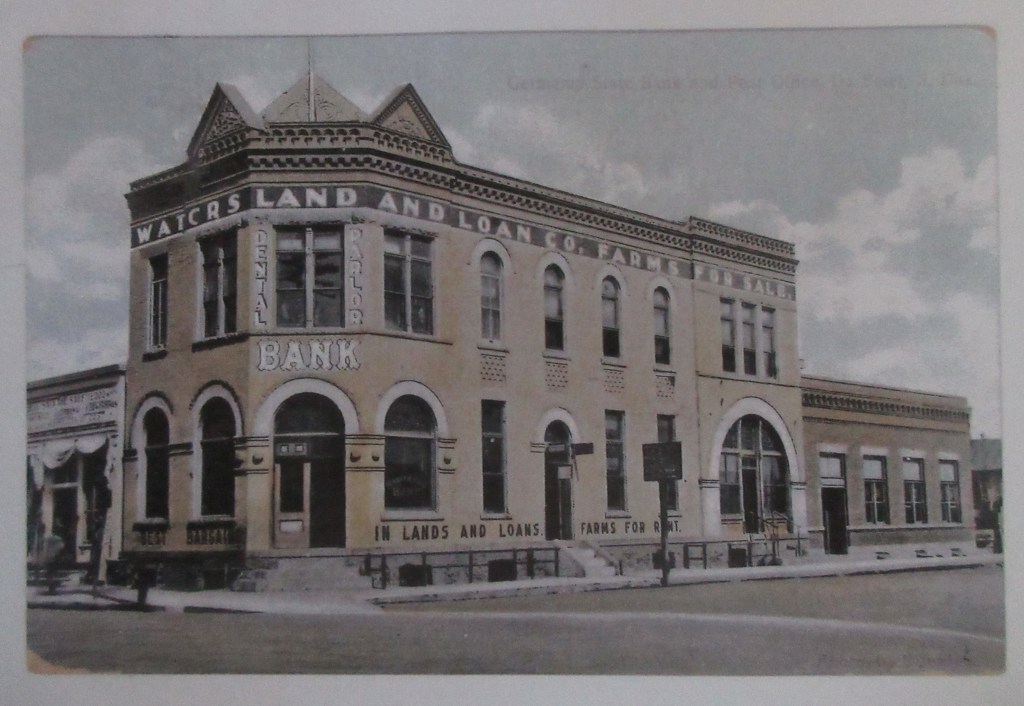
Postcard photograph of the building of Waters Land and Loan Company

Through the years the building has housed many offices, including the Germania State Bank, Peoples State Bank, a doctors office and dental office.  The building exchanged hands again in 1997, and after three years of extensive restoration, was opened as The Heritage House Bed and Breakfast.22
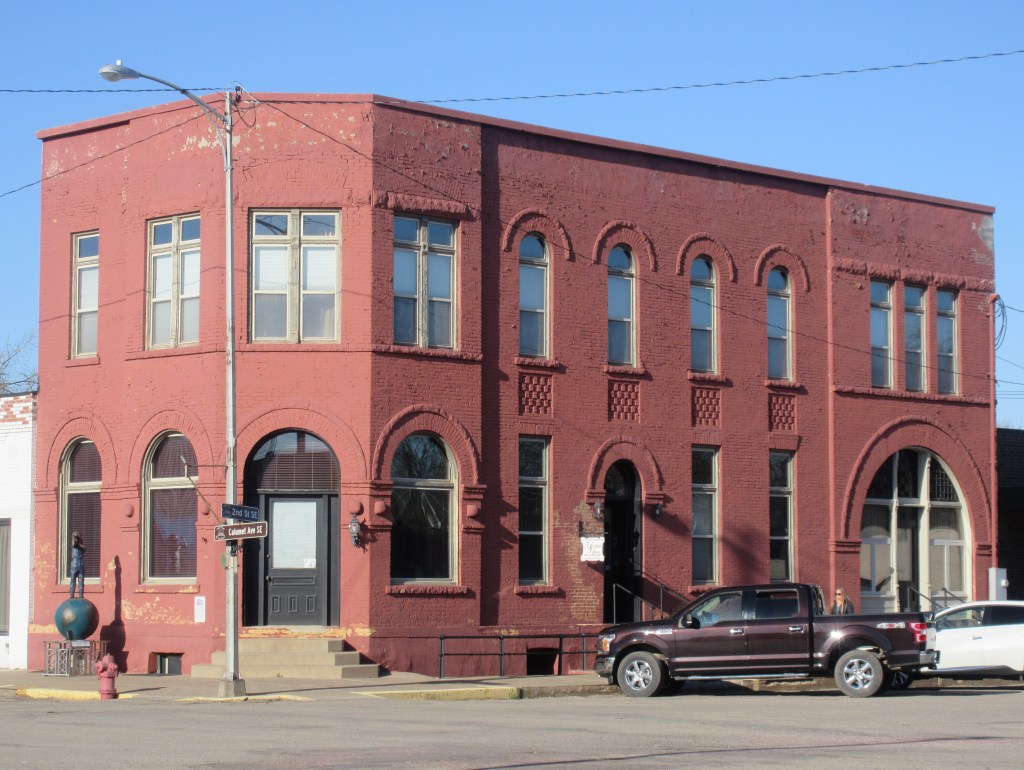
Heritage Bed and Breakfast, photographed by the author, April 2025

It appears that simultaneously to his business dealings involving the Calumet property above, Waters was involved in another project, which was the construction of his and Maude’s personal residence.  In 1905, a large home was built on Second Street,23 two and a half blocks west of Waters’ building at Calumet.  The house has been described as “the most elegant in town.”24

[It] was a gathering place for many of the town’s social elite.  The Waters hosted many dinners, parties and get-togethers in the large house.  It featured a full basement and an attic with enough headroom, it could be converted to another level.  There were plenty of rooms on the first and second floor which had all the modern amenities for its time.25
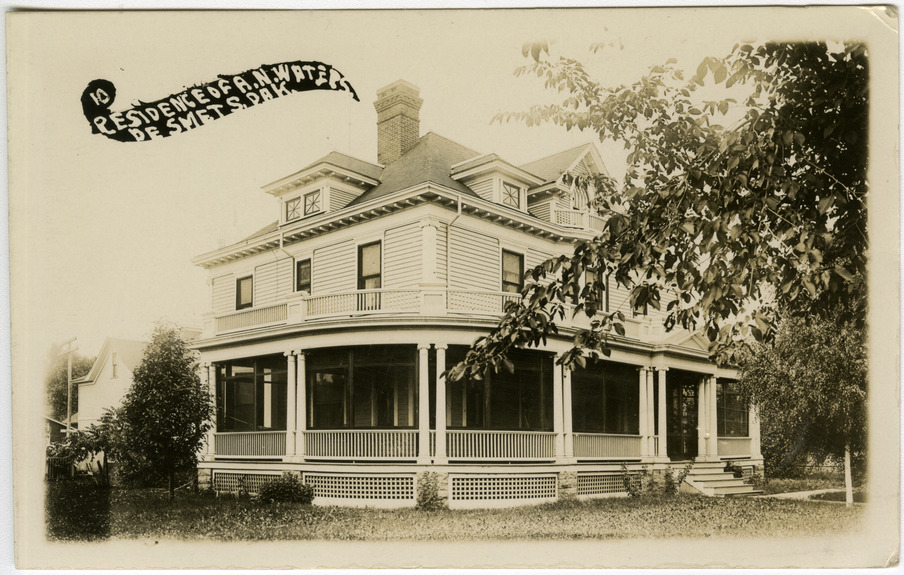
Postcard photograph of Waters’ residence, 1912

More than a century after the Waters’ home was built, a descendant of Maude’s brother Herbert and his wife were in De Smet and stopped at the house. Upon striking up a conversation with the owner at that time, they were given permission to take a look inside.  Subsequently, the wife described their brief tour:

As you walk in there is a visiting room with a big brick fireplace to the left.  To the right are a couple small bedrooms.  At the end is the kitchen.  Behind the fireplace was a hall way with 2 or three small rooms.  They were where the vet had his office and other items.  Long stairway going upstairs ….26
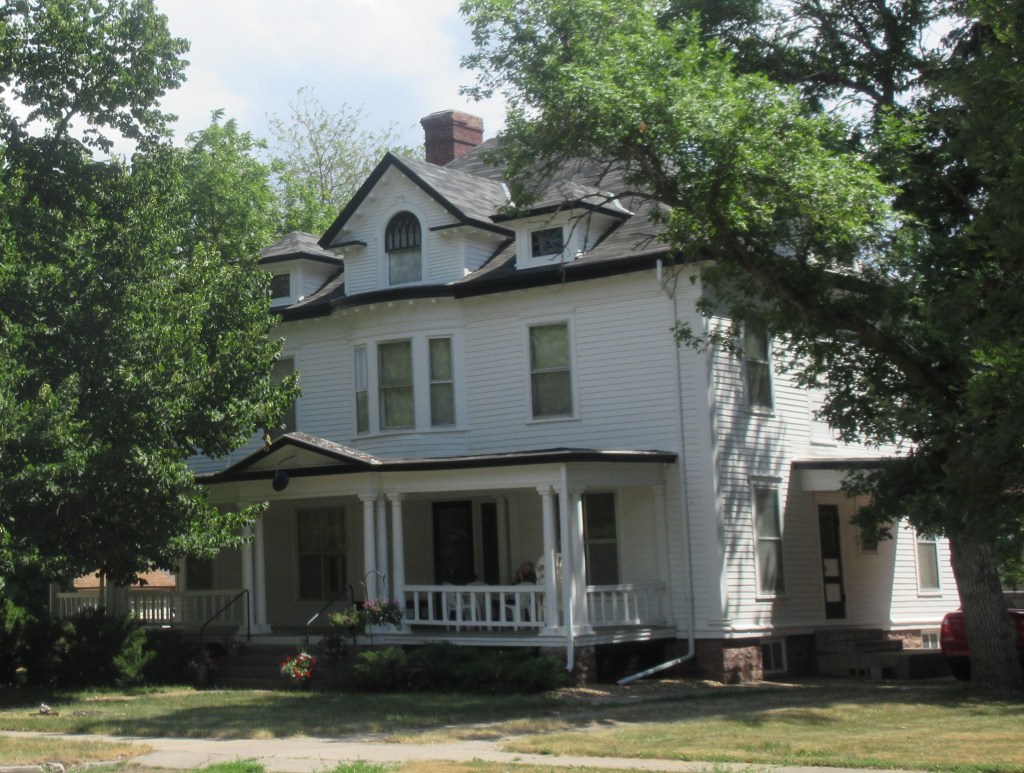
Maude and Alfred’s home in De Smet, South Dakota, photographed by the author, June 2021

Another of Herbert’s descendants visited De Smet in June 2021.  Seeing the large wrap-around front porch, she recalled playing on that porch as a young child.  She and the group with her were also invited to enter the home to look around.  Below is a picture of the tiled front entry.
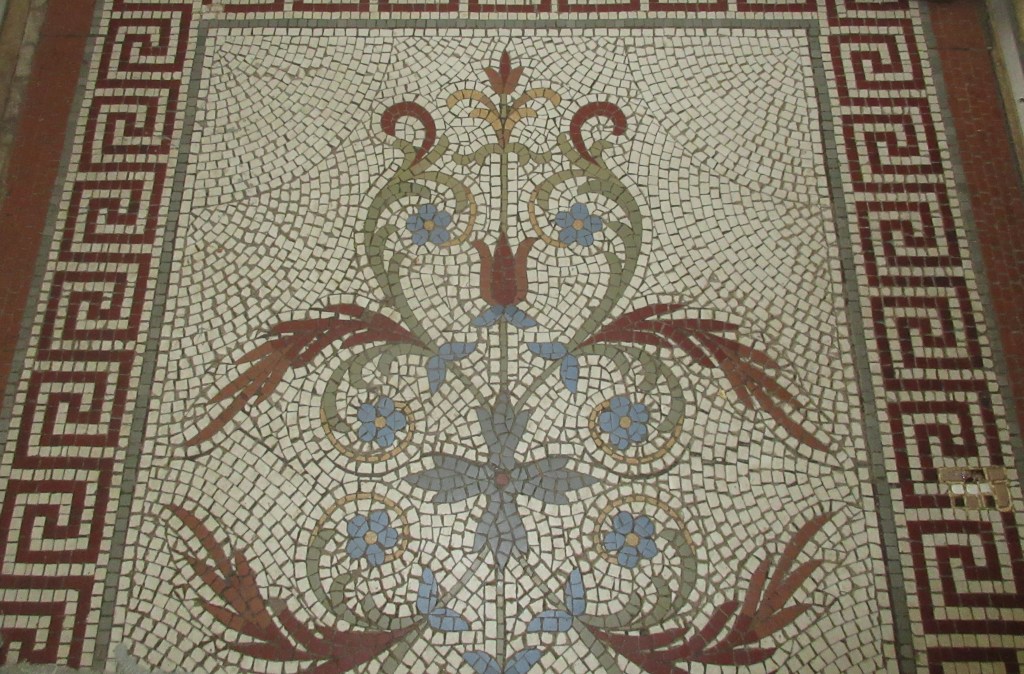
Front entry of Waters’ home (this partial view is from the side of the entryway, not the front), photographed by the author, June 2021

Some of the furnishings of the Waters’ home are still in the possession of Herbert’s descendants.
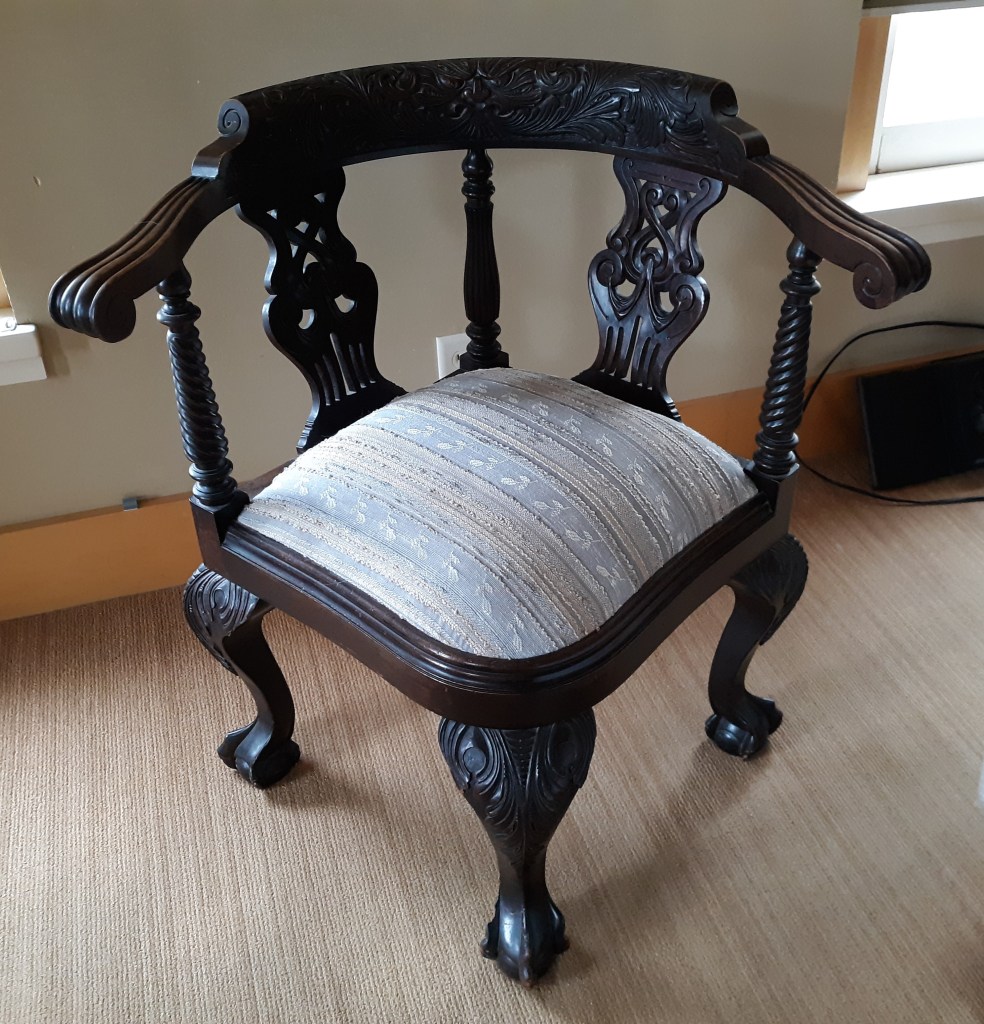
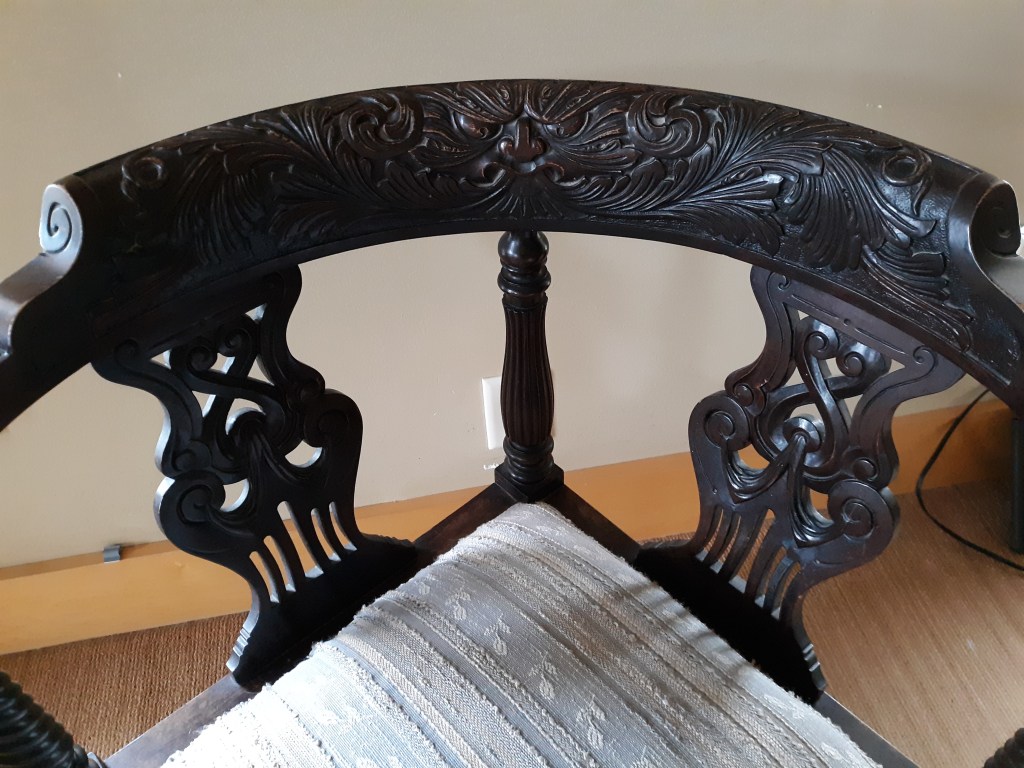
An antique chair, dated 1825
Close-up of the engraving
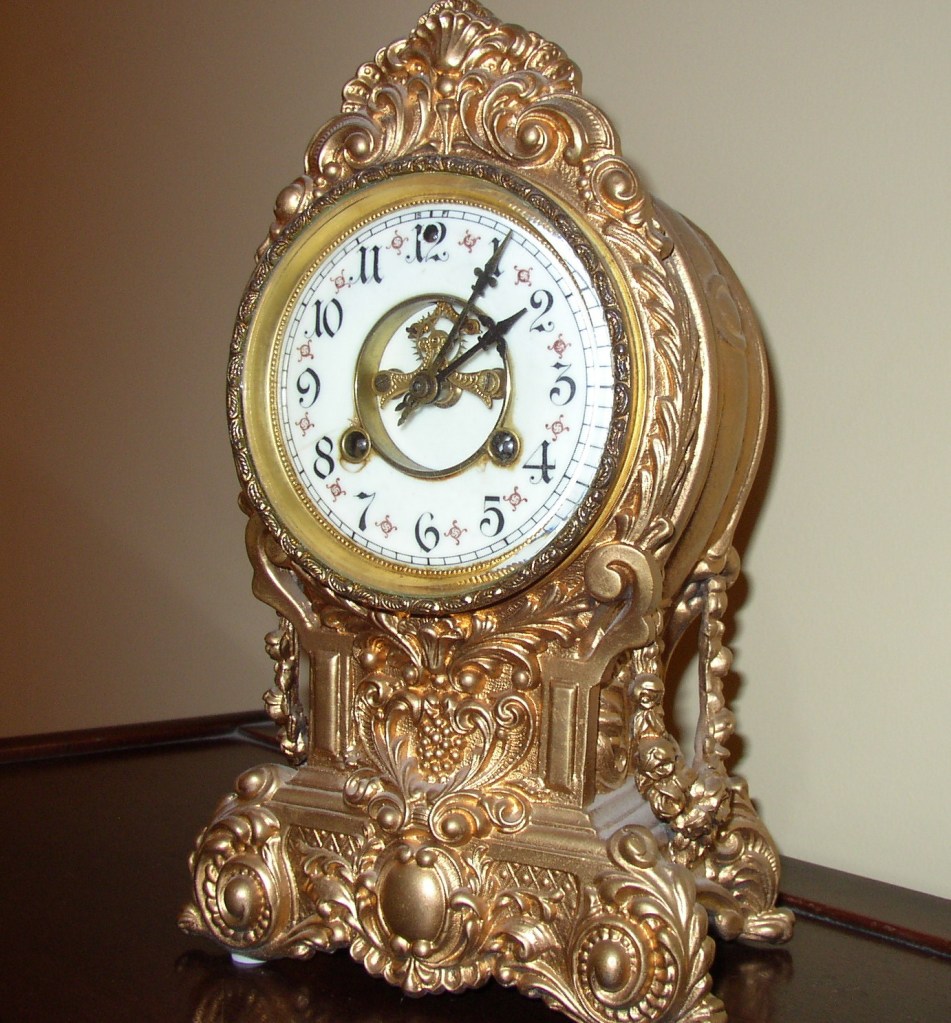
A “Verona” model clock manufactured by Waterbury Clock Company; approximate date, 1910
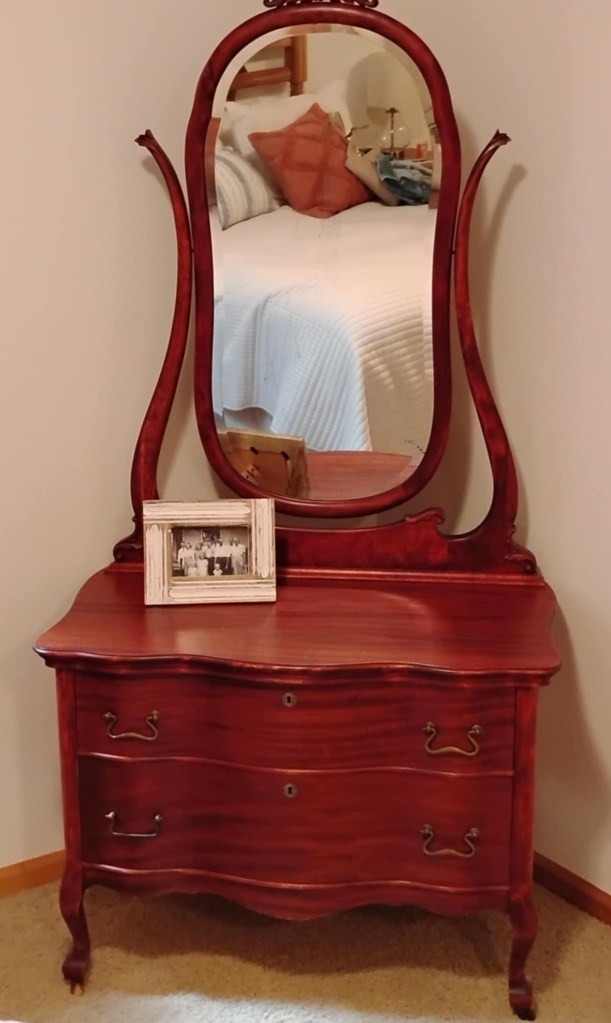
This dresser with beveled mirror had a darker finish when it was owned by Maude’s nephew Arthur Bevers and his wife Elsie. One of their sons had it re-finished to this natural red oak finish. The photograph sitting on the dresser is of the Arthur Bevers, Sr. family taken about 1943.

Several news items in the Kingsbury County Independent highlight the hospitality and generosity of Maude and Alfred Waters. On August 17, 1906, the newspaper reported, “Mrs. A. N. Waters entertained a number of young ladies in honor of her guest, Miss Eggleson Friday last.”27 The same edition of the newspaper reported that on the following day, a former resident of De Smet, Mrs. James T. Cooley, had arrived from New York City and was a guest at the Waters’ residence. In June 1909, the wedding of Dr. John H. Hall and Tillie Nelson was held at the Waters’ home. Hall was a dentist whose office was in the building owned by Waters Land and Loan Company. (On the postcard above, one of Hall’s office windows is demarked with the words “Dental Parlor.”) Hall was a member of the Methodist Episcopal Church, singing in the choir for many years as tenor.28 His bride had been living with the Waters. The write-up about the wedding follows:

At the home of Mr. and Mrs. A. N. Waters in this city Monday evening, June 14th, occured the marriage of Miss Tillie Nelson to Dr. J. H. Hall, both of this city, Rev. J. E. Booth officiating.  The ceremony was performed in the presence of a few relatives of the bride and a small number of mutual friends of the contracting parties.  After the ceremony an elaborate wedding dinner was served by Mrs. Waters.  The happy couple took the evening train east for points in Wisconsin where they will visit for two weeks.

The bride is a young lady who has made her home with the Waters family for some time and is well known and highly esteemed by our people.  The groom is so well known that no words of introduction are needed.  He has been engaged in the practice of dentistry in this city for about fourteen years and is regarded as one of our leading citizens.  Everyone has a good word for John Hall.  The happy couple have a host of friends in and about De Smet who unite in wishing them a happy married life.29

Before movies and cinema theaters became popular, “Parties and informal gatherings in people’s homes constituted most of the social swirl for high-school students in De Smet.”30  One such example was reported in the local news: a gathering held at the Waters’ home on Friday night, March 1, 1912, starting at 8:00 pm.  The guests included all the members of the senior class of the high school and their instructors, and their purpose was to celebrate the birthday of Edith Mitchell; the news report concluded: “A most delightful evening was spent and the occasion will long be remembered by all.  An elaborate lunch was served at midnight.”31  Two of the members of the senior class, Edith Mitchell and Evelyn Keating, were noted to have been attendees of the Epworth League, a young people’s group which met at the Methodist Episcopal Church on Sunday evenings.32
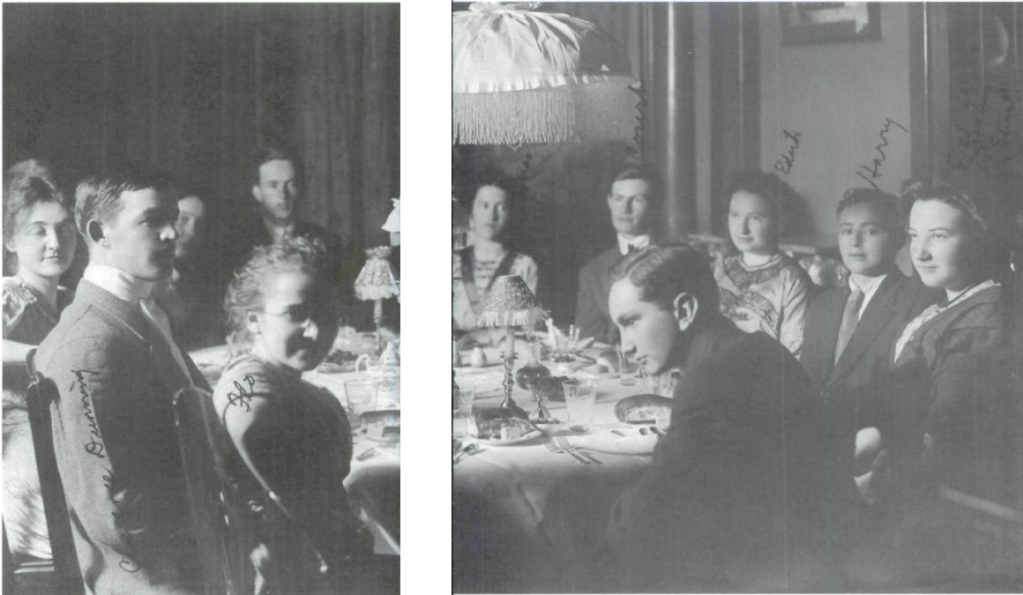
De Smet High School Class of 1912
Celebrating Edith Mitchell’s birthday at the Waters’ home, March 191233

Edith Mitchell’s “family, who lived in a house north of the railroad tracks, had gone through some difficult times, and the Waterses had taken her in to live with them.”34  In addition, they would make it possible for Edith to attend college, the only girl in her class to do so.  She started out at South Dakota State College in Brookings, which is the college that Maude had attended, and later she transferred to the University of Minnesota.35 In the summer of 1912, prior to going off to college, Edith “accompanied her benefactors, the Waterses, on a three-month automobile tour back to Alfred Waters’s boyhood home in Durham, New York.  Driving over roads that much of the way consisted of nothing more than dirt paths and stopping at nearly every town to obtain directions to the next one made the excursion quite an adventure.”36 

The Brookings Register announced the marriage of Edith in June 1917: “Another former State College student has joined the ranks of the ‘Newly Weds.’  Miss Edith Mitchell was united in marriage at De Smet, last Wednesday, to Randle Toland, by the Rev. Paul Roberts.  The ceremony occured at the home of Judge and Mrs. A. N. Waters and a large company was assembled, with many out of town guests present.  After a trip east the couple will reside in De Smet, where Mr. Toland is in the real estate business.”37

Highlights of Maude and Alfred Waters’ social and civic lives will continue in the next blogpost.


1 Nancy S. Cleaveland, “Syndicate Hotel,” Laura Ingalls Wilder A-Z, http://www.pioneergirl.com/blog/archives/9165.

2 K. and M. Bevers, notes attached to Agnes Maude Bevers in Ancestral Quest program file dated June 29, 2022.

3 “Waters-Bevers Nuptials,” Kingsbury County (South Dakota) Independent (May 13, 1904), in Nancy S. Cleaveland and Gina Terrana, Waters (2015): http://www.pioneergirl.com/waters_cemetery.pdf.

4 _____, “June 10th Celebration,” Kingsbury County Independent (De Smet, South Dakota), May 20, 1904, 6, Newspapers.com.

5 John E. Miller, “End of an Era: De Smet High School Class of 1912,” South Dakota History Volume 20 Number 3 (South Dakota Historical Society Press, September 26, 1990): 190, https://www.sdhspress.com/journal/south-dakota-history-20-3/end-of-an-era-de-smet-high-school-class-of-1912/vol-20-no-3-end-of-an-era.pdf.

6 _____, Kingsbury County Independent (De Smet, South Dakota), June 17, 1904, 1, Newspapers.com.  

7 _____, “A. N. Waters, Pioneer, Laid to Rest Here Sunday,” De Smet (South Dakota) News (September 2, 1927) in Nancy S. Cleaveland and Gina Terrana, Waters (2015): http://www.pioneergirl.com/waters_cemetery.pdf.

8 “New York, United States records,” images, FamilySearch (https://www.familysearch.org/ark:/61903/3:1:33SQ-GYBK-KDN?view=explore : Jul 26, 2025), image 447 of 706; United States. National Archives and Records Administration.  Image Group Number: 005161473

9 “South Dakota, State Census, 1905”, FamilySearch (https://www.familysearch.org/ark:/61903/1:1:MMH3-NNS : Sat Mar 09 19:18:13 UTC 2024), Entry for Maud Waters.

10 “South Dakota, State Census, 1905”, FamilySearch (https://www.familysearch.org/ark:/61903/1:1:MMH3-NXC : Sun Jul 20 06:06:04 UTC 2025), Entry for Alfred N.

11 _____, Kingsbury County (South Dakota) Independent, (November 17, 1905), in Nancy S. Cleaveland and Gina Terrana, Waters, (2015): http://www.pioneergirl.com/waters_cemetery.pdf.

12 Miller, “End of an Era:” 190-91.

13 _____, Historical sign posted on the outside wall of Heritage House Bed and Breakfast, De Smet, South Dakota.

14 Nancy S. Cleaveland, “post office/post-office,” Laura Ingalls Wilder A-Z, http://www.pioneergirl.com/blog/archives/13454.

15 _______, Heritage House Bed and Breakfast, https://heritagehousesd.com.

16 Laura Ingalls Wilder Memorial Society, Inc., Heritage Plat of De Smet (De Smet, South Dakota, 1994).

17 Cleaveland, “post office/post-office.”

18 The Heritage House, LLC, “Abstract of Title,” Transfer Number 26.

19 State of South Dakota, Articles of Incorporation of the Waters Land and Loan Company, November 15, 1905.

20 The Heritage House, LLC, “Abstract of Title,” Transfer Number 27.

21 The Heritage House, LLC, “Abstract of Title,” Transfer Number 28.

22 Historical sign posted on the outside wall of Heritage House Bed and Breakfast, De Smet, South Dakota.

23 “A. N. Waters, Pioneer, Laid to Rest Here Sunday,” in Cleaveland and Terrana, Waters: http://www.pioneergirl.com/waters_cemetery.pdf.

24 Miller, “End of an Era:” 185.

25 Mike Siefker, “Hof’s stately home has history as a hospital,” Kingsbury Journal (May 4, 2022): 13.

26 S. Bevers, Facebook post of Bevers Family and Reunions private group, July 8, 2023.

27 _____, “Local News,” Kingsbury County (South Dakota) Independent (August 17, 1906): 5, Newspapers.com.

28 Caryl Lynn Meyer Poppen, ed., “A History of the Methodist Church,” De Smet Yesterday and Today (De Smet, South Dakota: De Smet News, printer, 1976): 144.

29 _____, “Nelson—Hall,” Kingsbury County (South Dakota) Independent (June 18, 1909): 4, Newspapers.com.

30 Miller, “End of an Era”: 185.

31 _____, De Smet (South Dakota) News (March 8, 1912), in MIller, “End of an Era”: 185.

32 First Methodist Church, “A History of the Church,” Consecration Service of the Remodeled First Methodist Church (De Smet, South Dakota: First Methodist Church, September 26, 1965).

33 From Evelyn Keating’s class book, School-Girl Days: A Memory Book in Miller, “End of an Era:” 186-87.

34 Miller, “End of an Era:” 190.

35 Miller, “End of an Era:”: 202.

36 Miller, “End of an Era:” 202.

37 J. F. Brooke, ed., “Local and Personal,” Brookings (South Dakota) Register (June 28, 1917): 7, Newspapers.com.
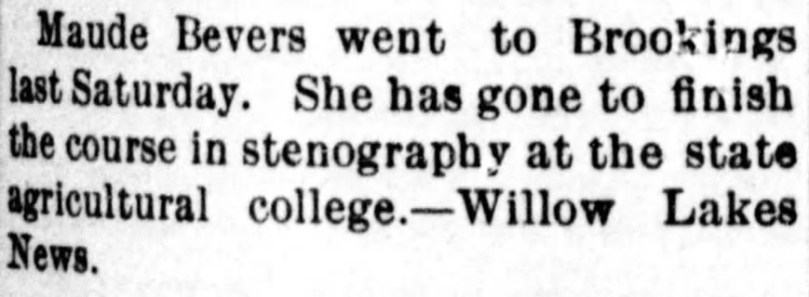
Maude Bevers, Career Woman

In September 1883, 8-year-old Maude Bevers, living near Liverpool, England, wrote a letter to her father Alfred C. Bevers, who had traveled to Dakota Territory in America.  One of the things she reported to her father was: “Mama say’s that I am getting on very well at school.”  (See the full letter in Ada, Gertie and Maude) About fifteen months later, Maude emigrated to Dakota Territory with her mother and two older sisters, joining her father.  Because Maude’s father was a supply pastor for the Methodist Episcopal Conference in Dakota Territory and in South Dakota when it became a state, Maude continued her education in several small towns.  Eventually, she would be the first among her siblings to attend and complete high school.  According to the reports her siblings gave for the 1940 United States census, the highest grades they had attended were 6th, 7th or 8th grade.

Not only did Maude complete high school, in her early twenties, Maude attended college. An agricultural college had been established by the Dakota Territorial Legislature in 1881, and in Brookings the first building was built in 1884.1  A college catalog explained the history and purpose of the college, including the following statements:

Upon the division of the territory of Dakota into the states of North and South Dakota when admitted into the Union in 1889, the agricultural and mechanical college of Dakota became known as the South Dakota Agricultural College [SDAC].

… The college is devoted to advancing the interests of practical education and its purpose is to give men and women such training as will best fit them for the active duties of life, whether it be in the fields, the shops, the house, or in the class or counting rooms.2

Even though the college was initially established as an agricultural and mechanical college, by 1896 it had broadened its curriculum to include 24 departments.  Maude’s name is listed in the SDAC catalog dated 1897-98, which indicated she was studying Commercial Science and her address was Willow Lakes.3  Her father had been assigned to the Willow Lakes Methodist Episcopal charge in 1896.4  With a population of approximately 220, in 1897-98, Willow Lakes sent 10 young men and women to the agricultural college, five of whom studied Commercial Science.  Other subjects studied by these students were Domestic Science, Mechanical Engineering and Agriculture.

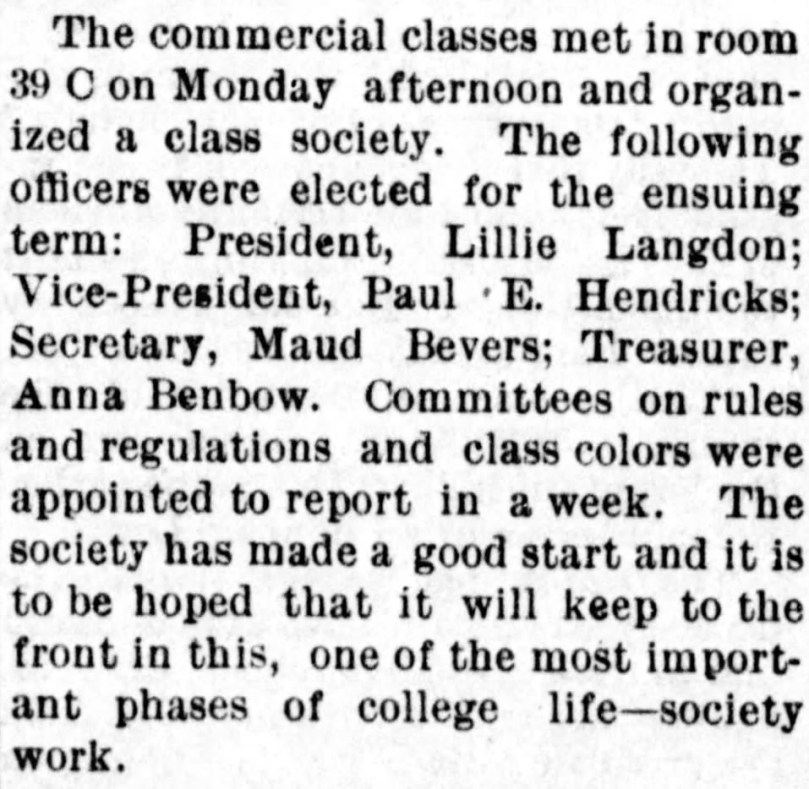
News item of The Brookings Register
May 8, 18975

During the 1897-98 school year, there were about 550 students attending SDAC.  Two-thirds of them were men and one-third women.  The college catalog explained the affordability for students to attend the state-established college:

No young person should be deterred from obtaining a liberal education when such advantages as this college offers can be had at a nominal price.  The aggregate of all the regular fees is only four dollars per quarter and is payable at the time of registration.  Books and stationery are furnished by the student.  A laboratory fee of one dollar is charged for the use of each laboratory in which a student takes work.6

Due to the expansion of the educational departments during the first decade and a half, the dormitories had been converted into classrooms and teaching labs.  By 1896, there was only one cottage available for lodging on the campus.  It held about 20 young women.  The rest of the student population boarded in Brookings—a town with a population of nearly 2000—in private homes or hotels, starting at about 50 cents per week.7  It is not known whether Maude lodged on or off campus. The expenses of the average student who attended three quarters of the school year were: $6.00 for tuition, $90.00 for board and room, $45.00 for clothes, $15.00 for laundry, $25.00 for books and stationery, and $10.00 for traveling expenses.8

About fifteen percent of the SDAC students of the 1897-98 school year were majoring in Commercial Science.  The college catalog described the aim of the department:

Appreciating the fact that business men are governed largely by certain specific and established rules, it becomes necessary that this department keep in touch with these usages and impart the same to the student in such definite and concise terms as shall prepare him for successful entrance to the business world.

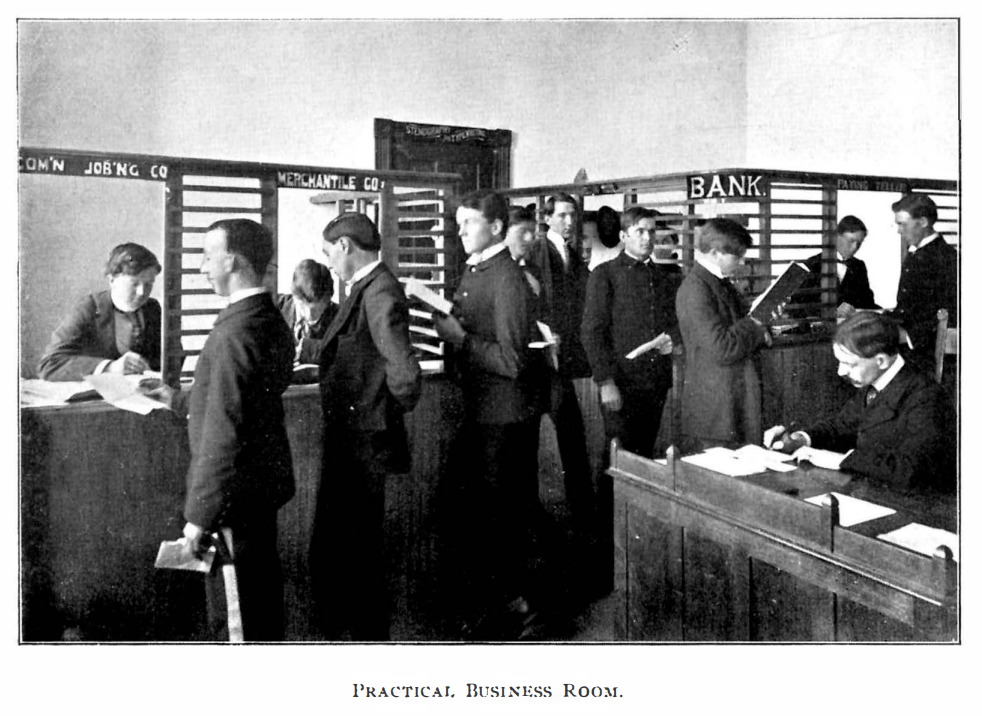
The rooms for the department are exceptionally well suited and adapted to the work of the business student.  The amanuensis room is supplied with fifteen typewriting machines and ample table and black board surface.  The offices such as the Bank, Post Office and Mercantile are well fitted for giving the student actual practice in business methods.  The college library affords good opportunity for references and collateral reading. …9

Note: The 1886 edition of Webster’s Dictionary defines amanuensis as “A person whose employment is to write what another dictates, or to copy what another has written; a copyist.”10

A simulated business center at SDAC11

Based on the dates that news items reported about when Maude was at the college or left the college, it appears that Maude attended for two years.  Therefore, she would not have earned a bachelor’s degree, but she may have completed the coursework to earn a certificate of graduation in Commercial Science. To earn this certificate, a student had to complete the courses of shorthand, penmanship, advanced dictation, commercial law, bookkeeping, business practice, correspondence, typewriting, commercial arithmetic and English words.  The description of the course in English Words was: “A study of Anglo-Saxon, Latin, French and Greek derivatives and synonyms.  This course is designed to form an intermediate step between grammar and rhetoric, and aims to make the student familiar with the elements entering into the growth and present use of the English language.”12

News item of The Brookings Register
October 2, 189713

In June 1897, The Brookings Register reported “Rev. Bevers, of Willow Lakes, led chapel devotionals Thursday noon.”14  This was Maude’s father.  The SDAC students were not required to attend the chapel exercises, instead the college catalog stated:

The Young Men’s and Young Women’s Christian Associations are important elements in retaining a strong christian fellowship among the student body.  Their relations to the State and Inter-National organizations assist in keeping the college in touch with other educational institutions.  … [T]hese student organizations are allowed to take the religious lead by holding prayer and devotional meetings nearly every day to which all are invited.15

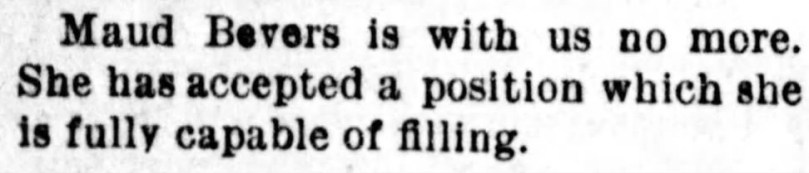
Another item in The Brookings Register reported that Maude left the college in March 1898, stating that she had “accepted a position which she [was] fully capable of filling.“16 According to a family historian, she was hired by Alfred Newman Waters, an attorney and realtor, doing business in De Smet, South Dakota.17  A. N. Waters was one of the pioneer settlers of Kingsbury County, arriving in August 1880.18  He had been a prominent citizen of De Smet since its founding.  Besides being a businessman, a few of the capacities in which he served the community were as a notary public, a director on the boards of financial businesses, and a county court judge. When Maude became an office worker in De Smet, she joined the nearly eighteen percent of gainfully employed workers in the United States who were women.19  Also, among the gainfully employed women, she joined the nine percent of women engaged in nonagricultural pursuits who were working in the clerical field.20

News item of The Brookings Register
March 29, 1898

Traditionally, rather than pursue an occupation in the community, most women have worked within the home.  The percentage of women that were gainfully employed in 1870 was less than 10 percent.21  The three occupations most often held by women between 1870 and 1900 were domestic service worker, teacher, and nurse.  As the industrial revolution advanced, more women entered the workforce.  By 1900, the percentage of women that were gainfully occupied was over 14 percent22 and the percentage of single women that were gainfully occupied was nearly 41 percent.23 One of the reasons for this growth was an increase in the demand for professional and semi-professional workers, including clerical workers, due to “the need by business and industry for accurate record-keeping, with the development of large-scale business practices, and with modern methods used in distributing the output of a vastly expanded economy.”24  A report of the United States Department of Labor provides additional information on this point:

The invention of the typewriter and other office machines, in response to the growing needs of business, made it possible to carry out record keeping, communication, and related activities on a tremendous scale.  The result was the creation of entirely new occupations many of which women perform.25

The greatest rate of increase for women “office workers” in any decade occurred from 1880 to 1890.  Women in these selected office occupations [referring to stenographers, typists, and secretaries; shipping and receiving clerks; clerical and kindred workers; and office machine operators] multiplied nearly 20 times – a testament to the growing acceptance of the typewriter and of the trained woman typist.26

In 1900, the percentage of office workers that were women was about 29%.27 “In taking on the functions of clerical workers, women did not replace men.  Rather they found entirely new opportunities.”28


By the fall of 1898, Maude’s parents and sister Gertrude had moved to De Smet as well.  In 1900, Maude and her family lived on First Street.29  The Methodist Episcopal church was only a few blocks away.  Records of the church state that all of them became members on November 26, 1898.30  Maude was the church choir leader for many years.31  In addition, the minutes of the women’s group noted that in December 1902 she was the organist at the Epworth League meeting (an organization for young adults), and she was the secretary pro tem at the women’s meeting on April 16, 1903.

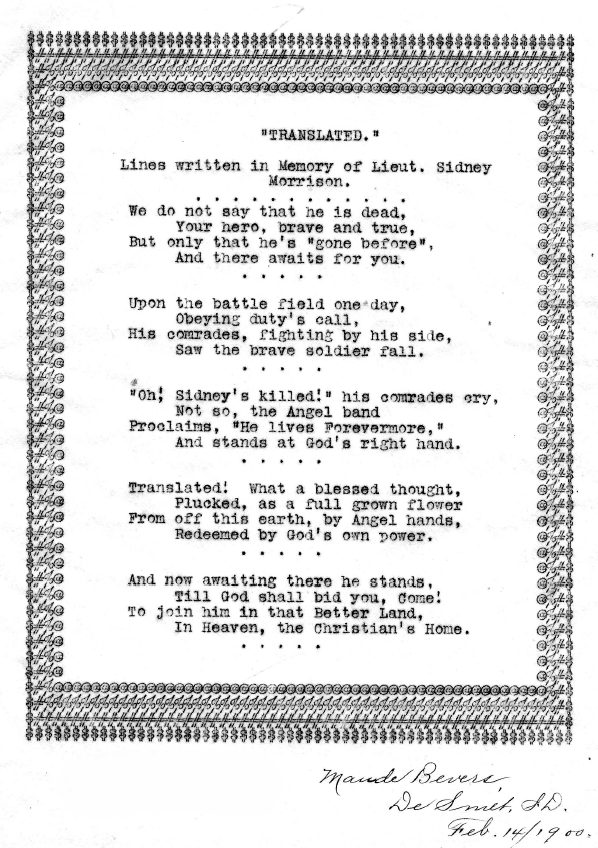
Maude had a poetic and artistic side to her.  On February 14, 1900, she created a tribute to Lieutenant Sidney Ellsworth Morrison.  It is not known what the relationship was between Maude and Lieutenant Morrison, but it is noteworthy that the tribute was dated on Valentine’s Day.  An item in The Christian Advocate, dated April 27, 1899, reads: “Lieutenant Sidney Morrison, who was killed in the recent charge of the South Dakota Regiment at Mariloa, was a brother of the Rev. J. G. Morrison, Pastor of Franklin Avenue Church, Minneapolis, Minn.”

Sidney Morrison was a member of Company E of First South Dakota Infantry and his rank was 2nd Lieutenant.  He died in the Philippines on March 27, 1899,32 but it wasn’t until January 25, 1900, that his remains were transported on the ship “City of Peking” to his father James Morrison, whose residence was De Smet, South Dakota.33

Maude’s tribute, entitled Translated, is typewritten.  As far as is known, this is the earliest piece of family memorabilia that was written using a typewriter.  The keys $, #, % and @ were used to create the decorative border.

More about Maude’s life will be continued in another blogpost.


1 South Dakota Agricultural College [SDAC], “The South Dakota Agricultural College Catalog 1897-1898 with Announcements for 1898-1899” (1898). Campus Course Catalogs and Bulletins. Paper 15, https://openprairie.sdstate.edu/cgi/viewcontent.cgi?article=1011&context=archives_catalogs, page 31.

2 SDAC, “SDAC Catalog 1897-1898,” page 31.

3 SDAC, “SDAC Catalog 1897-1898,” page 14.

4 United Methodist Church, Dakotas Conference, Commission on Archives and History, personal communication with M. R. Wilson, June 20, 1995.

5 “Items of Local Interest,” The Brookings Register (Brookings, South Dakota), May 8, 1897, page 3, Newspapers.com.

6 SDAC, “SDAC Catalog 1897-1898,” page 56.

7 SDAC, “SDAC Catalog 1897-1898,” page 57.

8 SDAC, “SDAC Catalog 1897-1898,” page 57.

9 SDAC, “SDAC Catalog 1897-1898,” page 83.

10 Noah Webster, Webster’s complete dictionary of the English language (London: George Bell & Sons, 1886): 42, https://archive.org/details/websterscomplete00webs/page/42/mode/2up.

11 SDAC, “SDAC Catalog 1897-1898,” following page 82.

12 SDAC, “SDAC Catalog 1897-1898,” page 89.

13 “College News,” The Brookings Register (Brookings, South Dakota), October 2, 1897, page 4, Newspapers.com.

14 “College Chestnuts,” The Brookings Register (Brookings, South Dakota), June 16, 1897, page 4, Newspapers.com.

15 SDAC, “SDAC Catalog 1897-1898,” page 43.

16 “College News,” The Brookings Register (Brookings, South Dakota), March 29, 1898, page 2, Newspapers.com.

17 K. and M. Bevers, notes attached to Agnes Maude Bevers in Ancestral Quest program file dated June 29, 2022.

18 The De Smet News, “A. N. Waters, Pioneer, Laid to Rest Here Sunday” (De Smet, South Dakota), September 2, 1927, in Waters, http://www.pioneergirl.com/waters_cemetery.pdf.

19 Joseph A. Hill, Women in Gainful Occupations 1870 to 1920 (Washington, D. C., USA: United States Government Printing Office, 1929): 52, https://babel.hathitrust.org/cgi/pt?id=hvd.hba9kx&seq=1.

20 Joseph A. Hill, Women in Gainful Occupations 1870 to 1920: 40.

21 Janet M. Hooks, Women’s Occupations Through Seven Decades (Washington, D. C., USA: United States Government Printing Office, 1947): 34, https://babel.hathitrust.org/cgi/pt?id=uiug.30112104139180&seq=1.

22 Janet M. Hooks, Women’s Occupations Through Seven Decades: 34.

23 Janet M. Hooks, Women’s Occupations Through Seven Decades: 39. 

24 Janet M. Hooks, Women’s Occupations Through Seven Decades: 72.

25 Janet M. Hooks, Women’s Occupations Through Seven Decades: 72.

26 Janet M. Hooks, Women’s Occupations Through Seven Decades: 74.

27 Janet M. Hooks, Women’s Occupations Through Seven Decades: 76.

28 Janet M. Hooks, Women’s Occupations Through Seven Decades: 75.

29 “United States Census, 1900”, , FamilySearch (https://www.familysearch.org/ark:/61903/1:1:MMRW-TKS : Sat Aug 17 18:09:29 UTC 2024), Entry for Alfred C Peevers and Mary N Peevers, 1900.

30 First Methodist Church of De Smet, “Record of Members.”

31 First Methodist Church, “A History of the Church,” Consecration Service of the Remodeled First Methodist Church (De Smet, South Dakota: First Methodist Church, September 26, 1965).

32 “LT Sidney Ellsworth Morrison,” Find a Grave, https://www.findagrave.com/memorial/154931201/sidney-ellsworth-morrison.

33 Ancestry.com, U.S., National Cemetery Interment Control Forms, 1928-1962 [database on-line] (Lehi, UT, USA: Ancestry.com Operations, Inc., 2012): http://www.Ancestry.com.

The Oldest Mementos of “The Breitenstein Bible”

“The Breitenstein Bible” came into possession of our family when my mother-in-law passed away.  For a dozen years, it remained packed away, undisturbed.  Finally, when down-sizing our belongings and upon deciding to pass the Bible on to our son, I took the time to look through the Bible.  Turning the leaves, I found news clippings, obituaries and funeral folders dispersed between its more than 2000 pages.  Another dozen years would pass before I had the opportunity to peruse those pages and mementos again.  In December 2023, I examined the Bible and photographed the mementos it has safe-guarded for decades, a few items for more than a century.  This blogpost is devoted to the oldest items in “The Breitenstein Bible” and the people with whom they are connected.  A description of the Bible itself, which was published about 1900, can be found on the Legacy Page entitled “The Breitenstein Bible.”

The Bible had been passed down to my mother-in-law through her father, who was a Breitenstein, but the oldest mementos would suggest that the Bible came to him from his mother’s line not his father’s. The oldest identifiable item is a handwritten note about Amos Goodhart. My mother-in-law’s ancestry can be traced to Amos K. Goodhart, so perhaps the Bible should be called “The Goodhart Bible.”

The original owner of the Bible is unknown.  None of the family register pages are filled in.  Besides the note about Amos Goodhart, there are two other handwritten notes which appear to be written in the same handwriting.  Since Amos’ wife had already passed away when he died, I propose that it was his daughter Sarah (Sallie) that wrote the notes.  Sallie married Jacob B. Breitenstein; they were my mother-in-law’s grandparents.

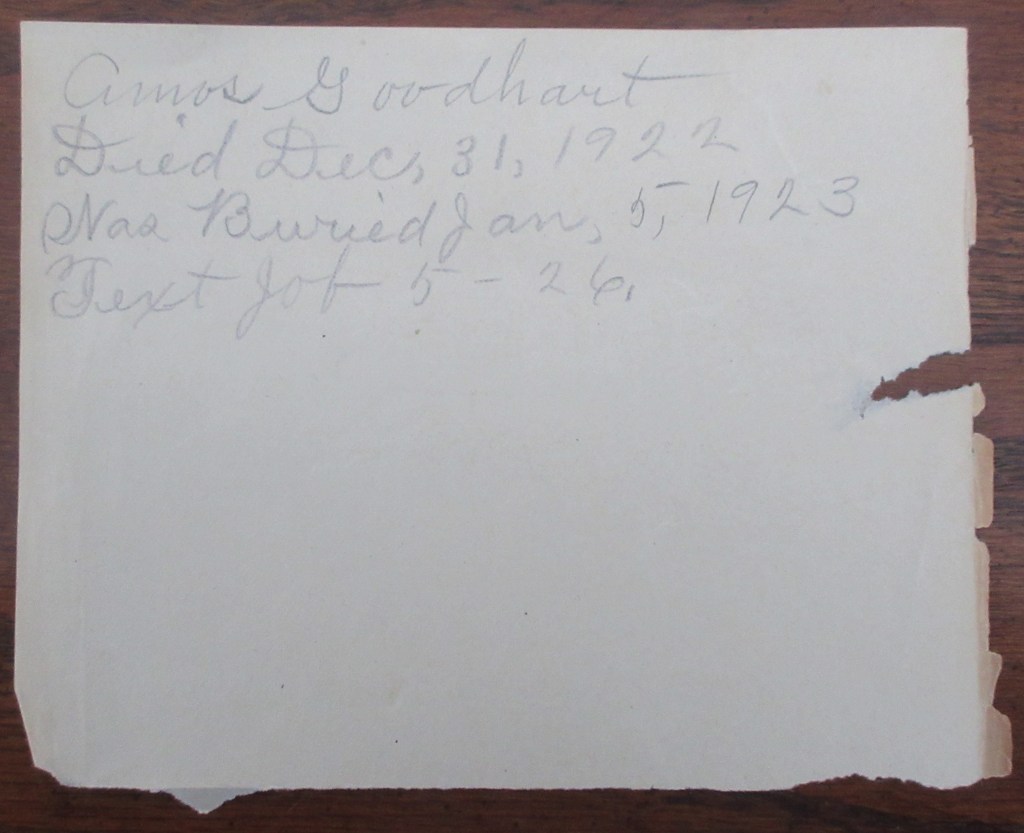
The oldest handwritten note found in “The Breitenstein Bible”

Amos’ ancestors had been living in Berks County, Pennsylvania, since at least 1754, when it was still a province.  His 2nd great-grandfather Fredrick Goodhart was recorded as residing in the district (or township) of Alsace when a tax list was created for the first assessment of taxes of the newly organized Berks County (which had been carved out of Philadelphia County).1  Fredrick Goodhart’s son, Frederick, acquired a homestead in Exeter Township.2  At the time of Amos’ death, the Goodharts had been residing in Exeter Township for roughly 130-140 years. Amos K. Goodhart, born February 23, 1852, was the son of John Newkirk Goodhart (1821-1898) and Sophia Kline (1827-1902).  As a child his family lived in Exeter Township3 and upon marrying Ellen Levan, they began raising their family on a farm in the township,4 remaining in Exeter Township their whole lives.

This handwritten note documents the dates of Amos’ death and burial, and very likely the text that was used at his funeral.  He was buried in the Schwarzwald Cemetery on January 5, 1923, having died on December 31, 1922 of “complications” according to the death register of Schwarzwald Reformed Church.5  In addition to his death, the church records also have an entry about his baptism and confirmation, which didn’t occur until he was 43 years old.6  Having been catechized, Amos was baptized on October 12, 1895 and then confirmed on the following day. Amos’ son Victor and his daughter Sarah were confirmed on that very same day. 

Job 5:26 as printed in “The Breitenstein Bible,” which is the text recorded along with Amos Goodhart’s death and burial dates.

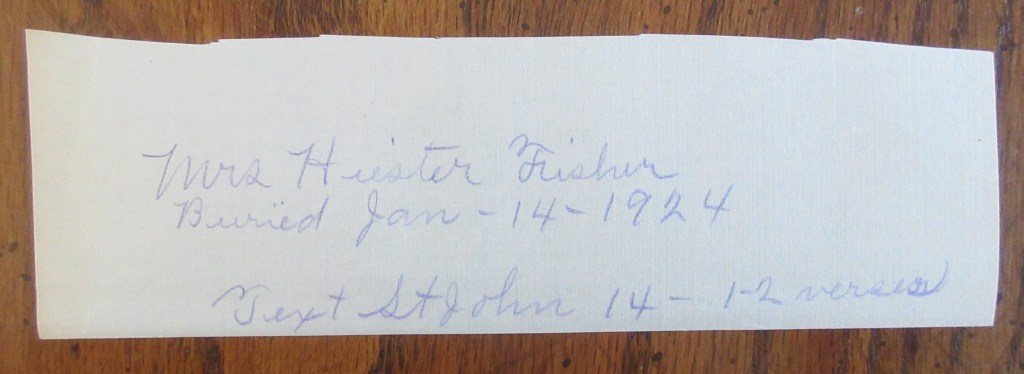
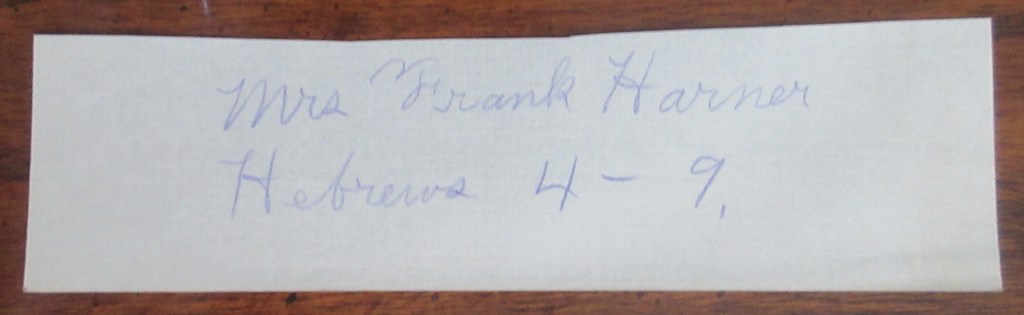
Of the two other handwritten notes in “The Breitenstein Bible,” one note gives the burial date of Mrs. Hiester Fisher and the reference to a scripture text.  The other note simply states the name Mrs. Frank Harner and a scripture reference.  Over the years, as I’ve compiled a genealogy of my husband’s family, I have never seen the name Fisher nor Harner.  So, I proceeded to try to identify who Mrs. Hiester Fisher and Mrs. Frank Harner were.

In my search for someone named Hiester Fisher, I came up with no likely candidates.  But a search using the spelling Heister (e before i) led me to someone that could be the husband of the woman commemorated in “The Breitenstein Bible.”  In 1920, Sallie Breitenstein (Amos’ daughter) and her husband were living in Amity Township in Berks County.7  There was also living in this township a Heister Fisher with his wife Ellen.8  A few years later Ellen and subsequently Heister were buried in Saint Paul’s Church Cemetery in Amity Township.  The date of death engraved on Ellen’s gravestone is January 10, 1924,9 which would correspond to the burial date listed on the handwritten note, January 14.  A search in family trees on Ancestry.com leads to the conclusion that her maiden name was most likely Ellen Wise or Weise or Weiss.  She would have been in the generation of Sallie’s mother. Incidentally, Saint Paul’s Church Cemetery is where Sallie and her husband would later be buried. 

Presumably, the second-oldest handwritten note in “The Breitenstein Bible”
John 14:1-2 as printed in “The Breitenstein Bible,” which is the text recorded along with Mrs. Hiester Fisher’s burial date

Since the handwritten note about Mrs. Frank Harner doesn’t have a death or burial date, it is difficult to determine with any certainty who she was.  My guess is that she was Catherine (Kate) S. Rhoads who is buried in Saint Paul’s Church Cemetery with her husband, Franklin, but the last name on the gravestone is Herner, instead of Harner.  Kate Rhoads was also of the generation of Sallie’s mother.  Her death date was April 8, 1925.10  Kate’s sister, Rosa Ellen Rhoads, had married a man named Wellington Wise,11 who was possibly a relation of Ellen Wise (Mrs. Heister Fisher above.)

Presumably, the third-oldest handwritten note in “The Breitenstein Bible”
Hebrews 4:9 as printed in “The Breitenstein Bible,” which is the text noted with Mrs. Frank Harner’s name

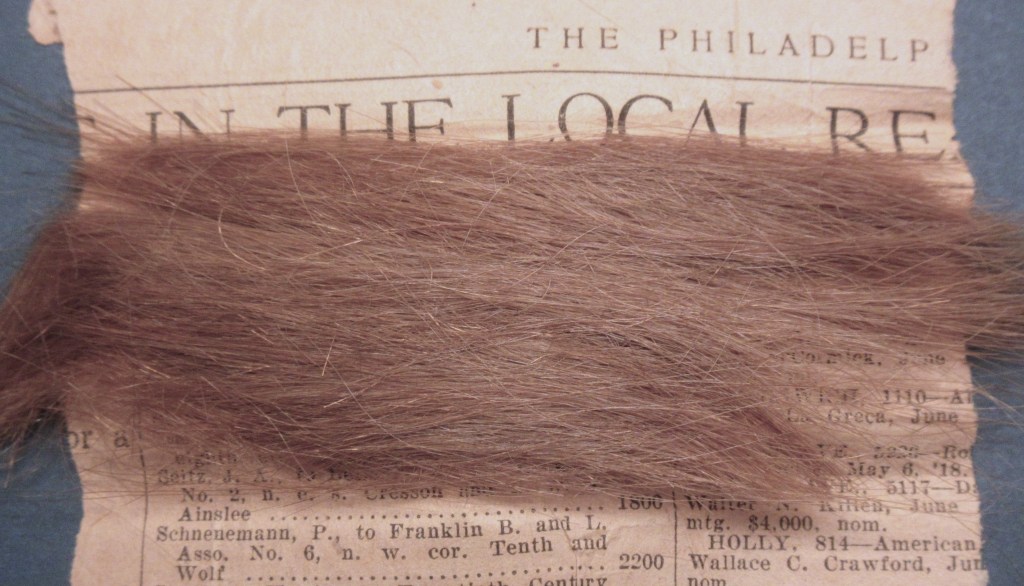
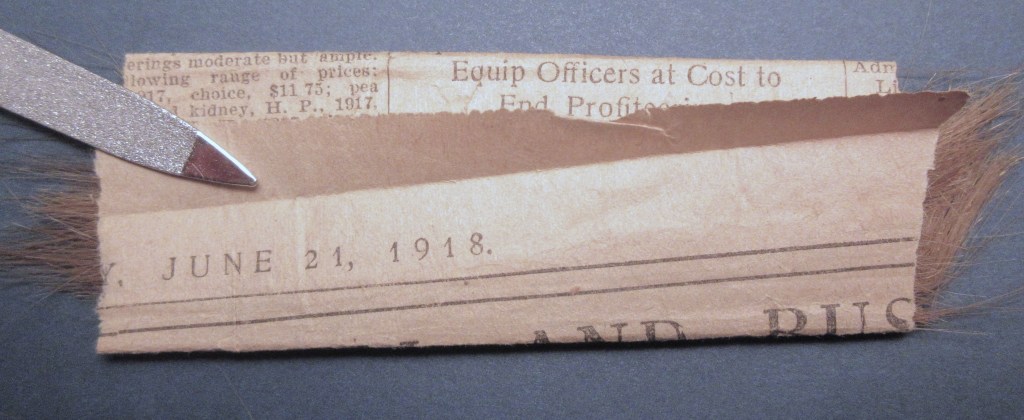
There is an item in “The Breitenstein Bible” that is older than the three handwritten notes.  It is a lock of hair wrapped in a scrap of newsprint dated June 21, 1918.  Perhaps this could be the hair of Ellen S. Goodhart, saved as a memento by her husband Amos or her daughter Sallie.  Born March 29, 1849, Ellen was the daughter of Peter S. Levan (1822-1894) and Sarah E. Snyder (1825-1898).  One historian of Berks County made this statement in 1886: “The Levan family have occupied a prominent position in [Exeter] township for one hundred and fifty years, having, during this time, owned a large area of farming land where the members of that family are now located.  They gave much encouragement to the Schwartzwald Church by liberal contributions.”12  The Levan family can be traced back to three brothers whose father Daniel Levan was a French Huguenot.  “The Huguenots were French Protestants most of whom eventually came to follow the teachings of John Calvin, and who, due to religious persecution, were forced to flee France to other countries in the sixteenth and seventeenth centuries.”13  Daniel Levan fled from France to Amsterdam, Holland, which is where Isaac Levan was born, Ellen Levan’s 4th great-grandfather.14  Isaac and his brothers emigrated from Amsterdam to America and Isaac eventually settled in Exeter Township about 1730.

A lock of hair, which was wrapped in a scrap of newsprint, found in “The Breitenstein Bible”
The scrap of newsprint dated June 21, 1918

Ellen Goodhart died on October 19, 1918 and was buried in Schwarzwald Cemetery.15  Like her husband, her death was recorded in the death register of Schwarzwald Reformed Church.  During that time period, the usual number of burials per month in that cemetery was one or two, or sometimes three.  But in October 1918, the death register lists seven people dying between October 14 and October 27.  Although the causes of death were recorded as heart disease, pneumonia, tuberculosis, and influenza, consideration should be given to an historic event that was taking place in Pennsylvania during the fall of 1918.  An epidemic of influenza had begun in Philadelphia in late September and travelled from the city west through the state, reaching Berks County.

In The Great Influenza, author John M. Barry thoroughly relates the events and timelines of many of the outbreaks of influenza in the United States, and a few places abroad, from 1917 to 1919.  He devotes a portion of his book to the rise of the epidemic in Philadelphia.16  The details and quotes below are from Barry’s book.  In 1918 influenza spread to Pennsylvania when on “September 7, three hundred sailors arrived from Boston at the Philadelphia Navy Yard.”  Four days later, “nineteen sailors reported ill with symptoms of influenza.”  Knowing that influenza was wreaking havoc in Boston:

Lieutenant Commander R. W. Plummer, a physician and chief health officer for the Philadelphia naval district … ordered the immediate quarantine of the men’s barracks and the meticulous disinfecting of everything the men had touched. …

… The next day eighty-seven sailors reported ill.  By September 15, … the virus had made six hundred sailors and marines sick enough to require hospitalization, and more men were reporting ill every few minutes”.

On September 18, “…the Evening Bulletin assured its readers that influenza posed no danger, was as old as history ….”  The first two sailors dying of influenza in Philadelphia occurred the next day.  “…Plummer declared, ‘The disease has about reached its crest.  We believe the situation is well in hand.  From now on the disease will decrease.’”  The city’s director of public health, Dr. Wilmer Krusen insisted that “the dead were not victims of an epidemic; he said that they had died of influenza but insisted it was only ‘old-fashioned influenza or grip.’”  The next day fourteen sailors died and the first civilian died.  The following day there were more than twenty deaths.

On September 21, the city’s Board of Health “assured the city that it was ‘fully convinced that the statement issued by Director Krusen that no epidemic of influenza prevails in the civil population at the present time is absolutely correct.’”

Seven days later, on September 28, a great Liberty Loan parade, designed to sell millions of dollars of war bonds, was scheduled.  Weeks of organizing had gone into the event, and it was to be the greatest parade in Philadelphia history, with thousands marching in it and hundreds of thousands expected to watch it.

Influenza continued spreading through the city, “… the day before the parade, hospitals admitted two hundred more people – 123 of them civilians ….”  Even though several doctors urged Krusen to cancel the parade, “Krusen declared that the Liberty Loan parade and associated rallies would proceed.”

On September 28, marchers in the greatest parade in the city’s history proudly stepped forward.  The paraders stretched at least two miles, two miles of bands, flags, Boy Scouts, women’s auxiliaries, marines, sailors, crushing against each other to get a better look, the ranks behind shouting encouragement over shoulders and past faces to the brave young men.  It was a grand sight indeed.

Two days after the parade, Krusen issued a somber statement: ‘The epidemic is now present in the civilian population and is assuming the type found in naval stations and cantonments.’

… Within seventy-two hours after the parade, every single bed in each of the city’s thirty-one hospitals was filled.  And people began dying.

… On October 1, the third day after the parade, the epidemic killed more than one hundred people – 117 – in a single day.

From Philadelphia the epidemic spread west into Pennsylvania.  Three weeks after the parade, people in Berks County were dying of influenza.  The Schwarzwald Reformed Church death register documents that two of its members succumbed to influenza.  A question lingers over the other five deaths recorded that month – was the influenza virus a contributing factor in their deaths; for example, in Ellen Goodhart’s death which was recorded as heart disease?


In October 2018 Surgeon General Rupert Blue of the U. S. Public Health Service issued the following information about the epidemic:

The disease now occurring in this country and called ‘Spanish Influenza’ resembles a very contagious kind of ‘cold’ accompanied by fever, pains in the head, eyes, ears, back or other parts of the body and a feeling of severe sickness.  In most of the cases the symptoms disappear after three or four days, the patient then rapidly recovering.  Some of the patients, however, develop pneumonia, or inflammation of the ear, or meningitis, and many of these complicated cases die. …

There is as yet no certain way in which a single case of ‘Spanish influenza’ can be recognized.  On the other hand, recognition is easy where there is a group of cases.  In contrast to the outbreaks of ordinary coughs and colds, which usually occur in the cold months, epidemics of influenza may occur at any season of the year.  Thus the present epidemic raged most intensely in Europe in May, June and July.  Moreover, in the case of ordinary colds, the general symptoms (fever, pain, depression) are by no means as severe or as sudden in their onset as they are in influenza.  Finally, ordinary colds do not spread through the community so rapidly or so extensively as does influenza. …

No matter what particular kind of germ causes the epidemic, it is now believed that influenza is always spread from person to person, the germs being carried with the air along with the very small droplets of mucus, expelled by coughing or sneezing, forceful talking, and the like by one who already has the germs of the disease.  They may also be carried about in the air in the form of dust coming from dried mucus, from coughing and sneezing, or from careless people who spit on the floor and on the sidewalk.  As in most other catching diseases, a person who has only a mild attack of the disease himself may give a very severe attack to others. …

It is very important that every person who becomes sick with influenza should go home at once and go to bed.  This will help keep away dangerous complications and will, at the same time, keep the patient from scattering the disease far and wide.  It is highly desirable that no one be allowed to sleep in the same room with the patient.  In fact, no one but the nurse should be allowed in the room. …

… Only such medicine should be given as is prescribed by the doctor.  It is foolish to ask the druggist to prescribe and may be dangerous to take the so-called ‘safe, sure and harmless’ remedies advertised by patent medicine manufacturers.

If the patient is so situated that he can be attended only by some one who must also look after others in the family, it is advisable that such attendant wear a wrapper, apron or gown over the ordinary house clothes while in the sick room and slip this off when leaving to look after the others.

Nurses and attendants will do well to guard against breathing in dangerous disease germs by wearing a simple fold of gauze or mask while near the patient. …

When crowding is unavoidable, as in street cars, care should be taken to keep the face so turned as not to inhale directly the air breathed out by another person.

“It is especially important to beware of the person who coughs or sneezes without covering his mouth and nose.  It also follows that one should keep out of crowds and stuffy places as much as possible, keep homes, offices and workshops well aired, spend some time out of doors each day, walk to work if at all practicable – in short, make every possible effort to breathe as much pure air as possible.

In all health matters follow the advice of your doctor and obey the regulations of your local and state health officers.

Cover up each cough and sneeze,

 if you don’t you’ll spread disease.17


1. __________, “Erection of County” in Historical and Biographical Annals of Berks County Pennsylvania, vol. 1, ed. Morton L. Montgomery (Chicago: J. H. Beers & Co., 1909), 8.

2. __________, “Daniel B. Keehn” in Historical and Biographical Annals of Berks County Pennsylvania, vol. 2, ed. Morton L. Montgomery (Chicago: J. H. Beers & Co., 1909), 999.

3. “United States Census, 1860”, , FamilySearch (https://www.familysearch.org/ark:/61903/1:1:MXPZ-BTN : Thu Mar 07 06:01:10 UTC 2024), Entry for John Newkirk Goodhart and Sufiah Goodhart, 1860.

4. “United States Census, 1880”, , FamilySearch (https://www.familysearch.org/ark:/61903/1:1:MW6B-F7D : Sun Mar 10 10:50:22 UTC 2024), Entry for Amos Goodhart and Ellen Goodhart, 1880.

5. Schwarzwald Reformed Church, Protocol of the German Reformed Church at Schwartzwald commencing with the ministry of Rev. Aaron S. Leinbach in Pennsylvania and New Jersey, Church and Town Records, 1708-1985 [microfilm collection of Historical Society of Pennsylvania] (Provo, UT, USA: Ancestry.com Operations, Inc., 2011), image 115, http://www.Ancestry.com.

6. Schwarzwald Reformed Church, German Reformed Church at Schwartzwald, image 75.

7. “United States Census, 1920”, , FamilySearch (https://www.familysearch.org/ark:/61903/1:1:M6BG-RV5 : Fri Mar 08 15:45:19 UTC 2024), Entry for Jacob Breitinstine and Sallie Breitinstine, 1920.

8. “United States Census, 1920”, , FamilySearch (https://www.familysearch.org/ark:/61903/1:1:M6BP-24K : Sat Mar 09 08:45:24 UTC 2024), Entry for Heister Fisher and Ellen Fisher, 1920.

9. Find a Grave, “Ellen G. Weiss Fisher,” https://www.findagrave.com/memorial/59396049/ellen-g-fisher.

10. Find a Grave, “Catherine S. “Kate” Rhoads Herner,” https://www.findagrave.com/memorial/59239221/catherine_s-herner.

11. __________, “Wellington L. Wise” in Historical and Biographical Annals of Berks County Pennsylvania, vol. 2, ed. Morton L. Montgomery (Chicago: J. H. Beers & Co., 1909), 1101.

12. M. L. M., “Townships of Berks County,” History of Berks County, Pennsylvania (location unknown: Everts, Peck & Richards, 1886), 973.

13. National Huguenot Society, Who Were the Huguenots? (2024), https://nationalhuguenotsociety.org/who-were-the-huguenots/.

14. __________, “Henry B. Levan” in Historical and Biographical Annals of Berks County Pennsylvania, vol. 1, ed. Morton L. Montgomery (Chicago: J. H. Beers & Co., 1909), 494.

15. Schwarzwald Reformed Church, German Reformed Church at Schwartzwald

16. John M. Barry, The Great Influenza (New York: Viking Press, 2004): 197-220.

17. “Uncle Sam’s Advice on Flu,” Saturday News (Watertown, South Dakota), October 10, 1918, 5, Newspapers.com.

Alfred and Mary Bevers’ Family Bible

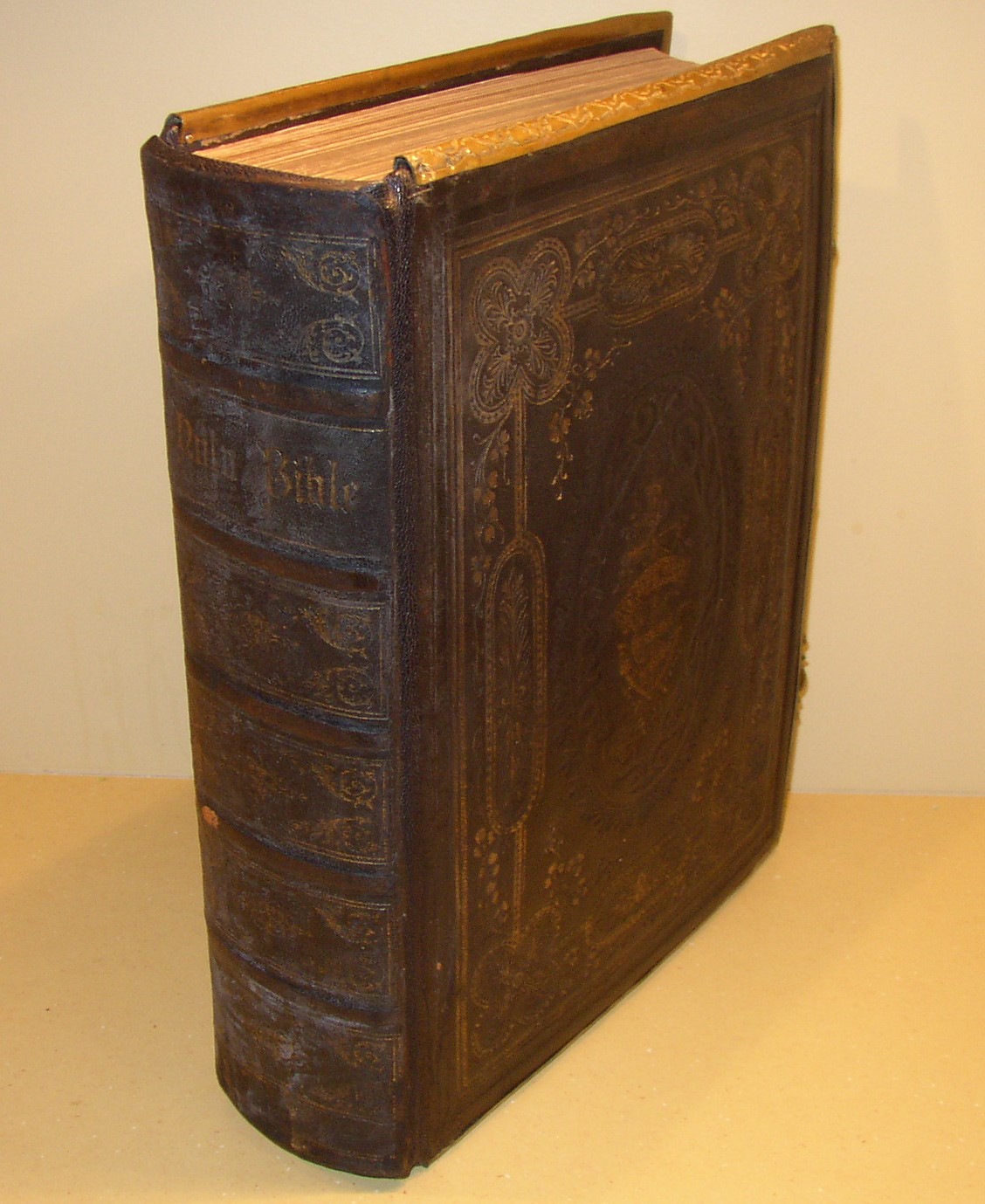
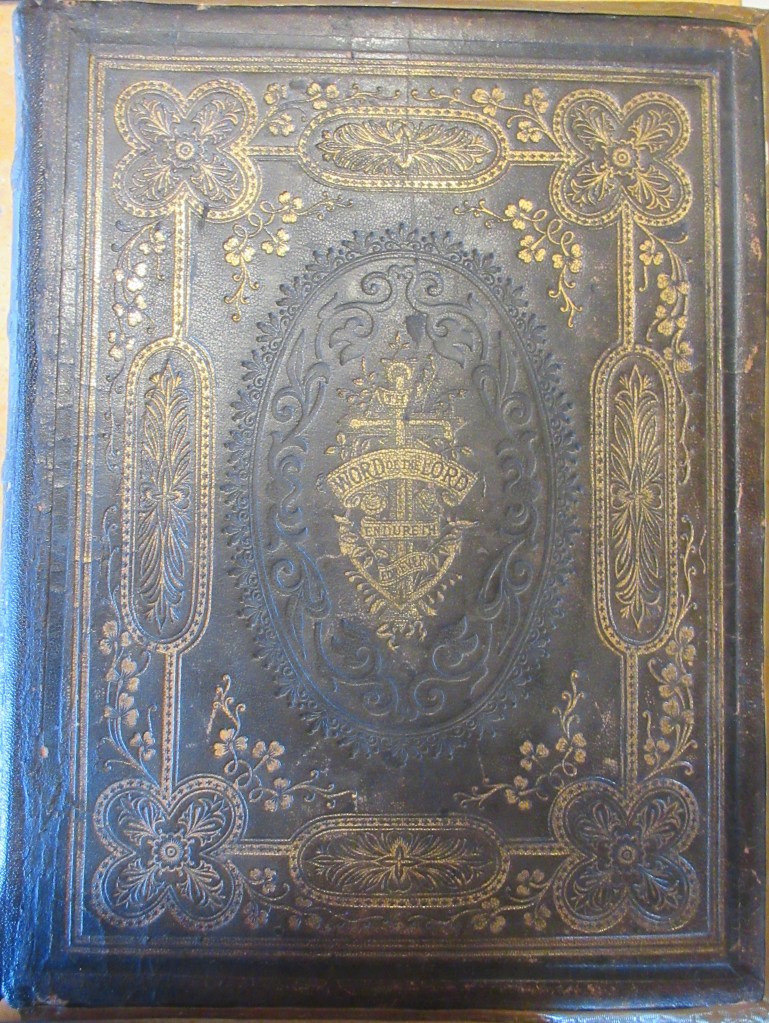
One of the sources that documents the marriage and offspring of Alfred C. and Mary N. (nee Bridges) Bevers is the Family Register on which, it is assumed, either Alfred or Mary wrote in distinguished script the details of their marriage as well as the births and deaths of their children.  (To see these records, go to this Legacy page: https://sojourners.family.blog/legacies/bevers-family-bible/.)  This Family Register can be found in a Bible that has been in the possession of one of Alfred and Mary’s great-great-grandsons, Kyle N. Bevers.  He relates: “It was in terrible shape when my parents rescued it from the sale items after Maude Bevers Waters died in 1958.  There were many loose pages and both the leather covers were completely separated from the binding.  It was passed on to me by my father ….”1 Maude Waters was Alfred and Mary’s youngest daughter (b. 1875) and she was a grandaunt of Kyle’s father.

There is no publication date in the Bevers’ Family Bible, but based on some comparisons with similar Bibles sold on the Internet, at the time Kyle’s parents obtained the Bible, it was probably around eighty or ninety years old.  Another fifty years would pass by before the Bible would be restored and rebound.  Kyle’s wife decided to take it to a bookbinder, and in 2007 the Bible’s original august appearance was renewed.  Kyle explains: “the binder … is a native of England and was trained by monks there who did book binding.  He has some great old equipment and was of course thrilled to work on the book that size and of such antiquity.”2

The bookbinder’s goal of restoration was “to retain the original appearance” of the Bible and he declared that, if the book was cared for, the restoration would enable it to exist for another one or two hundred years.3  The restoration included:

  • Mending the pages with an archival quality repair tape, especially the pages around the family history section
  • Making new cloth-jointed endpapers using authentic Victorian Bible papers imported from England
  • Attaching new linings of linen and kraft paper on the spine
  • Attaching a new silk page marker ribbon
  • Attaching endbands at the head and tail of the spine
  • Re-backing the spine of the book with new goatskin leather (archivally tanned in England) which was placed underneath the original leather
  • Re-mounting the original spine onto the newly bound spine
  • Dyeing and polishing the faded original leather
  • Re-attaching the brass clasps with brass pins4

Alfred and Mary’s Bible is an edition of The Self-Interpreting Family Bible edited by Rev. John Brown of Haddington, Scotland.  Their edition was printed in Glasgow, Scotland, although the publisher was located in Bolton-Le-Moors, England.  The title of the Bible is followed by explanations of its contents:

CONTAINING THE

OLD AND NEW TESTAMENTS

TO WHICH ARE ANNEXED

AN EXTENSIVE INTRODUCTION; MARGINAL REFERENCES AND ILLUSTRATIONS;

AN EXACT SUMMARY OF THE SEVERAL BOOKS;

A PARAPHRASE ON THE MOST OBSCURE OR IMPORTANT PARTS;

EXPLANATORY NOTES, EVANGELICAL REFLECTIONS, &c., &c. …

WITH MANY ADDITIONAL REFERENCES AND A LIFE OF THE AUTHOR.

WITH NUMEROUS COLOURED ILLUSTRATIONS IN OIL.5

Rev. John Brown who lived from 1722 to 1787 published his original edition of The Self-Interpreting Family Bible in 1778.6 For about 140 years, there were numerous versions printed in Scotland and America.7 The Dunham Bible Museum provides a description of the uniqueness of Brown’s edition over other Bibles of the time:

Brown’s Bible included explanatory notes placed at the bottom of the page with the scriptural text above.  These notes, focusing primarily on translation issues, grammar or historical background, were primarily to make the text more understandable.  The notes for each section were followed by “reflections,” which applied the Scripture to the heart.  Throughout his work Brown emphasized that the goal of Scripture was to promote holiness and virtue and to glorify God.  Dates and Scripture cross-references were placed in the margin.8

Rev. Brown himself remarked about his work on this Bible: “I can truly say, that my labor, in collecting the parallel texts in this work, has afforded me much more Pleasant Insight into the oracles of God than all the numerous commentaries which I ever perused.”9 (A digitized version of The Self-Interpreting Bible can be found on the Reformed Standards website.)

Although Alfred and Mary’s edition of Brown’s Family Bible does not have a date of publication, an estimated date can be surmised by the contents of the Bible.  One of the items listed on the title page is “a life of the author.”  A version of Rev. John Brown’s biography, believed to be written by his son William Brown, appeared in the 1859 edition of Brown’s Self-Interpreting Family Bible.10 The biography does not give the author’s name, but William Brown was the editor of the 1859 edition.  Since there is a biography in Alfred and Mary’s Bible, it is unlikely that their edition was printed before 1859.  Another item which helps date the Bible is the title page in Alfred and Mary’s Bible.  The same title page can be found in Bibles published by different publishers (all of the wording is the same except the name of the publisher at the bottom).  One publisher’s edition of Brown’s Bible having this version of the title page was listed on a book seller’s website.  The description of the Bible on the website says that it was printed by the same printer as Alfred and Mary’s Bible, and the book seller supplied an estimated printing date of 1870.11


Excerpts from a biography of Rev. John Brown

The REV. JOHN BROWN was born in the year 1722, at Carpow, a small village in the parish of Abernethy, and county of Perth.  His parents ranked in that class of society who earn their bread by the sweat of their brow.  His father could boast of no rent-rolls, nor had he any title of honour, save that of an honest man and an industrious mechanic, who, during the greater part of his life, laboured in the profession of an operative weaver. … he was nevertheless a man of considerable intelligence, moral worth, and Christian sincerity.  He made conscience of keeping up the worship of God in his family, and set a Christian example before them ….12

When Brown was about 11 years old, both of his parents passed away, first his father and shortly afterwards his mother.

An elder in the parish of Abernethy – an aged shepherd and an eminent Christian, respectable also for his intelligence, though so destitute of education that he could not so much as read – cheerfully embraced the opportunity of supplying the deficiency under which he laboured, by engaging the homeless orphan, to assist him in tending his flock, and in reading for him as opportunity allowed.13

Throughout this arrangement, the elder and young Brown read, conversed and prayed together, resulting in spiritual nurturing as the youngster grew.

… by pondering over the books he read, and the sermons he heard, the young man was brought under very impressive apprehensions of the majesty of God, the hatefulness of sin, the love of Christ, and the utter insignificance of all earthly enjoyments, when contrasted with the glories of heaven; so that the pleasure of his secret devotions was greatly augmented, while he felt his conscience daily becoming more tender, and his walk and conversation more assimilated to that of his Lord and Master.14

When the elder chose to settle in Abernethy, Brown found a position with a nearby farmer.  During this time, he felt it was his duty to join the Secession Church, a sect that had separated from the Church of Scotland due to its institution of a policy to disregard the expression of dissenting opinions.15 Brown continued to study diligently, mostly on his own, so that he could become a “shepherd of souls.”16 His studies included becoming acquainted with the Greek and Latin languages.

… he was, at this time, anxious to obtain a Greek Testament, that he might have the satisfaction of reading, in the original language, the character and work, the holy life and vicarious death, of Him who feedeth his flock like a shepherd, and laid down his life for his sheep.  Buoyed up with these hopes, and excited by this anxiety, after folding his flock one summer evening, and procuring the consent of his fellow-shepherd to watch it next day, he made a nocturnal trip to St. Andrews, distant about twenty-four miles, where he arrived in the morning.  He called at the first bookseller’s shop that came in his way, and having inquired for the article in question, the shopman, on observing his apparent rusticity and mountain habiliments (dress characteristic of his occupation), told him that he had Greek Testaments and Hebrew Bibles in abundance, but suspected an English Testament would answer his purpose much better.  In the mean time some gentlemen, said to have been professors in the university, happened to enter the shop, and learning what was going on, seemed much of the shopman’s opinion.  One of these, however, ordered the volume to be produced, and, taking it in his hand, said, “Young man, here is the Greek Testament, and you shall have it at the easy charge of reading the first passage that turns up.”  It was too good an offer to be rejected: the shepherd accepted the challenge, and performed the conditions to the satisfaction and astonishment of the party; and Mr. Brown very modestly retired with his prize.17

Eventually, Brown left his vocation as a shepherd and took up being an itinerant salesman.  As he traveled around the countryside, he would often take up reading the books of his hosts rather than attend to his business of selling wares.18 Subsequently, it was suggested to Brown that he may do well as a schoolmaster.  This profession he did for two years and it is noteworthy that nine of his students became ministers.19 During the school vacations, Brown studied philosophy and divinity.  After completing several courses, he was licensed in 1751 by the presbytery of Edinburgh.20 Shortly thereafter, he accepted the call from the congregation at Haddington to serve as their pastor.

Rev. Brown had an exceptional capacity to learn languages as well as committing scripture passages to memory.

In the summer months his constant rule was to rise between four and five, and during the winter by six.  From these early hours, till eight in the evening, excepting the time allotted to bodily refreshment, family worship, or when called away on the duties of office, he continued to prosecute his studies with unremitting application.  To a mind so ardent in the acquisition of knowledge, with a judgment so clear, a retentive memory, and exertions so intense, it was by no means surprising that he became greatly superior to most men engaged in discharging the same sacred duties.

In acquiring the knowledge of languages, ancient or modern, he possessed a facility altogether his own.  Without an instructor [except for one month], … he soon got so far acquainted with [Latin] as to relish its beauties; and, left to his own resources, … he soon became critically acquainted with the Greek, and especially the Hebrew.  Of the living languages, he could read and translate the Arabic, Syriac, Persic, and Ethiopic, the French, Spanish, Italian, Dutch, and German.

With him natural history, civil law, natural and moral philosophy, were particular objects of research; but divinity, and the history of human affairs, sacred or civil, were his favourite studies ….21

While Rev. Brown served as a minister at Haddington, he also became an author.  His first publication was a “large work on the Catechism, which appeared in the year 1758 …,” and the publication which required the most work was his Dictionary of the Bible.22 In 1768, he was elected by a branch of the Secession Church to be a professor of divinity.23 Rev. Brown continued his ministerial services until shortly before his death in 1787.


For many of the years that Alfred C. Bevers and his wife lived in Dakota Territory and then in South Dakota after it was organized as a state, Alfred was a supply pastor in the Dakota Conference of the Methodist Episcopal Church.  Over a period of about 15 years, Alfred was assigned to seven churches.  As they moved from town to town, it is likely that the Family Bible was transported with them.  It is intriguing to contemplate that this Bible with its well-researched explanations and notes by Rev. John Brown was available to Alfred when he wanted to study the Scriptures.


1 K. N. Bevers, email communication with M. R. Wilson, dated April 23, 2020.

2 Bevers, April 23, 2020.

3 T. Farthing, personal letter to M. A. Bevers, dated Christmas, 2006.

4 Farthing, Christmas, 2006.

5 W. Bruckshaw, Publisher, Brown’s Self-Interpreting Bible, (Bolton-Le-Moors, Lancashire, England: n. d.): Title Page.

6 Dunham Bible Museum, “John Brown’s Self-Interpreting Bible” (Houston, Texas: Dunham Bible Museum, 2008): 1, https://www.hbu.edu/publications/museums/Dunham_Bible_Museum/DBM_JohnBrown_Self-Interpreting_Bible.pdf.

7 Reformed Standards, https://reformedstandards.com/bible/.

8 Dunham Bible Museum, “John Brown’s Self-Interpreting Bible”: 3.

9 Dunham Bible Museum, “John Brown’s Self-Interpreting Bible”: 3.

10 R. E. Waddell, “Rev John Brown of Haddington,” https://www.ornaverum.org/family/brown/john-haddington.html.

11 Halden Books (Exeter, Devon, United Kingdom, accessed January 27, 2023): https://www.abebooks.co.uk/servlet/BookDetailsPL?bi=31176038172&searchurl=sortby%3D17%26tn%3Dbrown%2527s%2Bself%2Binterpreting%2Bfamily%2Bbible%2Bcontaining%2Bthe%2Bold%2Band%2Bnew%2Btestaments&cm_sp=snippet-_-srp1-_-title9.

12 J. D. Chitty, “Memoir of the Rev. John Brown, part 1” [transcription of author’s biography of The Self-Interpreting Bible (Glasgow, Edinburgh and London: Blackie and Son, 1859)], (August 24, 2010): https://capthk.com/category/books/john-browns-self-interpreting-bible/memoir-of-the-rev-john-brown-of-haddington/.

13 Chitty, “Memoir of the Rev. John Brown, part 2,” [transcription] (August 25, 2010).

14 Chitty, “Memoir of the Rev. John Brown, part 2,” [transcription] (August 25, 2010).

15 Chitty, “Memoir of the Rev. John Brown, part 3,” [transcription] (August 31, 2010).

16 Chitty, “Memoir of the Rev. John Brown, part 4,” [transcription] (September 1, 2010).

17 Chitty, “Memoir of the Rev. John Brown, part 4,” [transcription] (September 1, 2010).

18 Chitty, “Memoir of the Rev. John Brown, part 6,” [transcription] (November 27, 2011).

19 Chitty, “Memoir of the Rev. John Brown, part 6,” [transcription] (November 27, 2011).

20 Chitty, “Memoir of the Rev. John Brown, part 7,” [transcription] (February 26, 2012).

21 Chitty, “Memoir of the Rev. John Brown, part 8,” [transcription] (November 3, 2012).

22 Chitty, “Memoir of the Rev. John Brown, part 10,” [transcription] (November 8, 2012).

23 Chitty, “Memoir of the Rev. John Brown, part 9,” [transcription] (November 5, 2012).