“The Breitenstein Bible” came into possession of our family when my mother-in-law passed away. For a dozen years, it remained packed away, undisturbed. Finally, when down-sizing our belongings and upon deciding to pass the Bible on to our son, I took the time to look through the Bible. Turning the leaves, I found news clippings, obituaries and funeral folders dispersed between its more than 2000 pages. Another dozen years would pass before I had the opportunity to peruse those pages and mementos again. In December 2023, I examined the Bible and photographed the mementos it has safe-guarded for decades, a few items for more than a century. This blogpost is devoted to the oldest items in “The Breitenstein Bible” and the people with whom they are connected. A description of the Bible itself, which was published about 1900, can be found on the Legacy Page entitled “The Breitenstein Bible.”
The Bible had been passed down to my mother-in-law through her father, who was a Breitenstein, but the oldest mementos would suggest that the Bible came to him from his mother’s line not his father’s. The oldest identifiable item is a handwritten note about Amos Goodhart. My mother-in-law’s ancestry can be traced to Amos K. Goodhart, so perhaps the Bible should be called “The Goodhart Bible.”
The original owner of the Bible is unknown. None of the family register pages are filled in. Besides the note about Amos Goodhart, there are two other handwritten notes which appear to be written in the same handwriting. Since Amos’ wife had already passed away when he died, I propose that it was his daughter Sarah (Sallie) that wrote the notes. Sallie married Jacob B. Breitenstein; they were my mother-in-law’s grandparents.
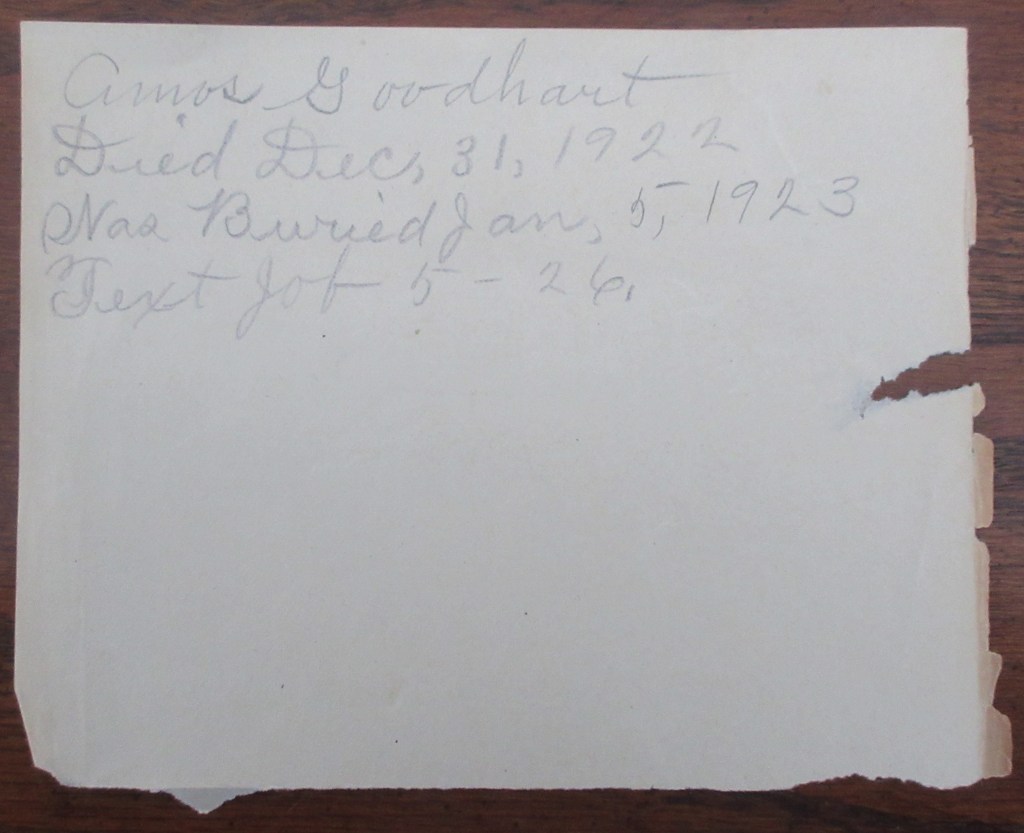
Amos’ ancestors had been living in Berks County, Pennsylvania, since at least 1754, when it was still a province. His 2nd great-grandfather Fredrick Goodhart was recorded as residing in the district (or township) of Alsace when a tax list was created for the first assessment of taxes of the newly organized Berks County (which had been carved out of Philadelphia County).1 Fredrick Goodhart’s son, Frederick, acquired a homestead in Exeter Township.2 At the time of Amos’ death, the Goodharts had been residing in Exeter Township for roughly 130-140 years. Amos K. Goodhart, born February 23, 1852, was the son of John Newkirk Goodhart (1821-1898) and Sophia Kline (1827-1902). As a child his family lived in Exeter Township3 and upon marrying Ellen Levan, they began raising their family on a farm in the township,4 remaining in Exeter Township their whole lives.
This handwritten note documents the dates of Amos’ death and burial, and very likely the text that was used at his funeral. He was buried in the Schwarzwald Cemetery on January 5, 1923, having died on December 31, 1922 of “complications” according to the death register of Schwarzwald Reformed Church.5 In addition to his death, the church records also have an entry about his baptism and confirmation, which didn’t occur until he was 43 years old.6 Having been catechized, Amos was baptized on October 12, 1895 and then confirmed on the following day. Amos’ son Victor and his daughter Sarah were confirmed on that very same day.

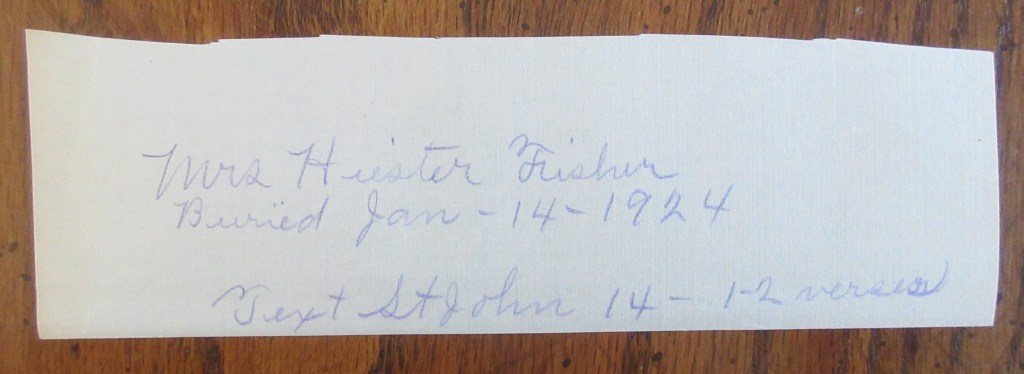
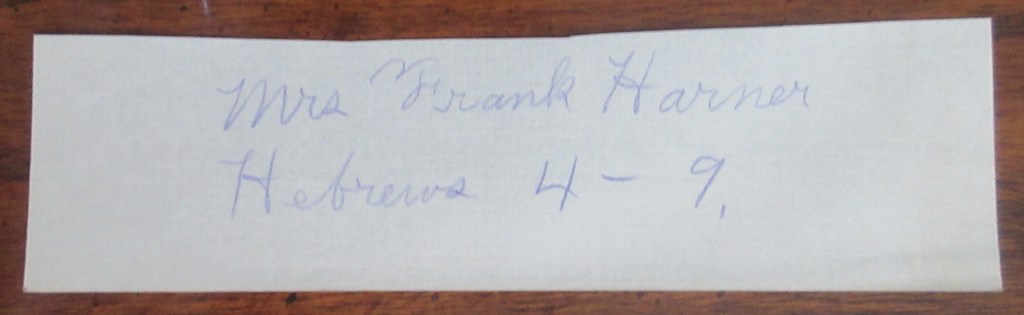
Of the two other handwritten notes in “The Breitenstein Bible,” one note gives the burial date of Mrs. Hiester Fisher and the reference to a scripture text. The other note simply states the name Mrs. Frank Harner and a scripture reference. Over the years, as I’ve compiled a genealogy of my husband’s family, I have never seen the name Fisher nor Harner. So, I proceeded to try to identify who Mrs. Hiester Fisher and Mrs. Frank Harner were.
In my search for someone named Hiester Fisher, I came up with no likely candidates. But a search using the spelling Heister (e before i) led me to someone that could be the husband of the woman commemorated in “The Breitenstein Bible.” In 1920, Sallie Breitenstein (Amos’ daughter) and her husband were living in Amity Township in Berks County.7 There was also living in this township a Heister Fisher with his wife Ellen.8 A few years later Ellen and subsequently Heister were buried in Saint Paul’s Church Cemetery in Amity Township. The date of death engraved on Ellen’s gravestone is January 10, 1924,9 which would correspond to the burial date listed on the handwritten note, January 14. A search in family trees on Ancestry.com leads to the conclusion that her maiden name was most likely Ellen Wise or Weise or Weiss. She would have been in the generation of Sallie’s mother. Incidentally, Saint Paul’s Church Cemetery is where Sallie and her husband would later be buried.

Since the handwritten note about Mrs. Frank Harner doesn’t have a death or burial date, it is difficult to determine with any certainty who she was. My guess is that she was Catherine (Kate) S. Rhoads who is buried in Saint Paul’s Church Cemetery with her husband, Franklin, but the last name on the gravestone is Herner, instead of Harner. Kate Rhoads was also of the generation of Sallie’s mother. Her death date was April 8, 1925.10 Kate’s sister, Rosa Ellen Rhoads, had married a man named Wellington Wise,11 who was possibly a relation of Ellen Wise (Mrs. Heister Fisher above.)

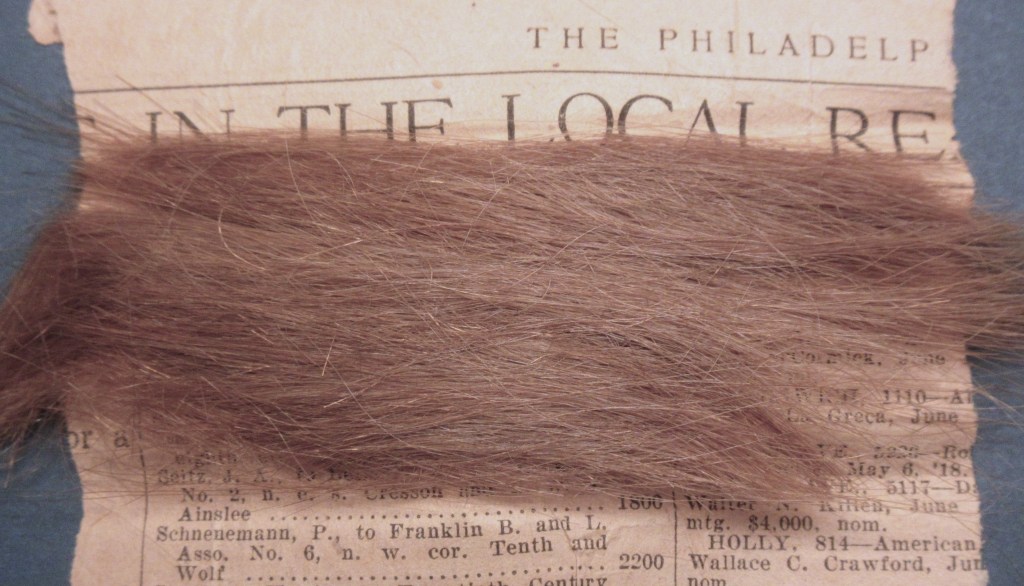
There is an item in “The Breitenstein Bible” that is older than the three handwritten notes. It is a lock of hair wrapped in a scrap of newsprint dated June 21, 1918. Perhaps this could be the hair of Ellen S. Goodhart, saved as a memento by her husband Amos or her daughter Sallie. Born March 29, 1849, Ellen was the daughter of Peter S. Levan (1822-1894) and Sarah E. Snyder (1825-1898). One historian of Berks County made this statement in 1886: “The Levan family have occupied a prominent position in [Exeter] township for one hundred and fifty years, having, during this time, owned a large area of farming land where the members of that family are now located. They gave much encouragement to the Schwartzwald Church by liberal contributions.”12 The Levan family can be traced back to three brothers whose father Daniel Levan was a French Huguenot. “The Huguenots were French Protestants most of whom eventually came to follow the teachings of John Calvin, and who, due to religious persecution, were forced to flee France to other countries in the sixteenth and seventeenth centuries.”13 Daniel Levan fled from France to Amsterdam, Holland, which is where Isaac Levan was born, Ellen Levan’s 4th great-grandfather.14 Isaac and his brothers emigrated from Amsterdam to America and Isaac eventually settled in Exeter Township about 1730.
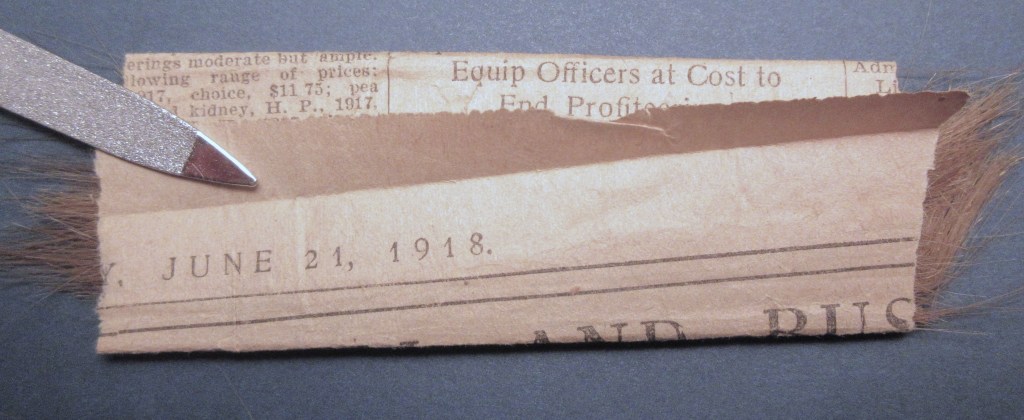
Ellen Goodhart died on October 19, 1918 and was buried in Schwarzwald Cemetery.15 Like her husband, her death was recorded in the death register of Schwarzwald Reformed Church. During that time period, the usual number of burials per month in that cemetery was one or two, or sometimes three. But in October 1918, the death register lists seven people dying between October 14 and October 27. Although the causes of death were recorded as heart disease, pneumonia, tuberculosis, and influenza, consideration should be given to an historic event that was taking place in Pennsylvania during the fall of 1918. An epidemic of influenza had begun in Philadelphia in late September and travelled from the city west through the state, reaching Berks County.
In The Great Influenza, author John M. Barry thoroughly relates the events and timelines of many of the outbreaks of influenza in the United States, and a few places abroad, from 1917 to 1919. He devotes a portion of his book to the rise of the epidemic in Philadelphia.16 The details and quotes below are from Barry’s book. In 1918 influenza spread to Pennsylvania when on “September 7, three hundred sailors arrived from Boston at the Philadelphia Navy Yard.” Four days later, “nineteen sailors reported ill with symptoms of influenza.” Knowing that influenza was wreaking havoc in Boston:
“Lieutenant Commander R. W. Plummer, a physician and chief health officer for the Philadelphia naval district … ordered the immediate quarantine of the men’s barracks and the meticulous disinfecting of everything the men had touched. …
“… The next day eighty-seven sailors reported ill. By September 15, … the virus had made six hundred sailors and marines sick enough to require hospitalization, and more men were reporting ill every few minutes”.
On September 18, “…the Evening Bulletin assured its readers that influenza posed no danger, was as old as history ….” The first two sailors dying of influenza in Philadelphia occurred the next day. “…Plummer declared, ‘The disease has about reached its crest. We believe the situation is well in hand. From now on the disease will decrease.’” The city’s director of public health, Dr. Wilmer Krusen insisted that “the dead were not victims of an epidemic; he said that they had died of influenza but insisted it was only ‘old-fashioned influenza or grip.’” The next day fourteen sailors died and the first civilian died. The following day there were more than twenty deaths.
On September 21, the city’s Board of Health “assured the city that it was ‘fully convinced that the statement issued by Director Krusen that no epidemic of influenza prevails in the civil population at the present time is absolutely correct.’”
“Seven days later, on September 28, a great Liberty Loan parade, designed to sell millions of dollars of war bonds, was scheduled. Weeks of organizing had gone into the event, and it was to be the greatest parade in Philadelphia history, with thousands marching in it and hundreds of thousands expected to watch it.“
Influenza continued spreading through the city, “… the day before the parade, hospitals admitted two hundred more people – 123 of them civilians ….” Even though several doctors urged Krusen to cancel the parade, “Krusen declared that the Liberty Loan parade and associated rallies would proceed.”
“On September 28, marchers in the greatest parade in the city’s history proudly stepped forward. The paraders stretched at least two miles, two miles of bands, flags, Boy Scouts, women’s auxiliaries, marines, sailors, crushing against each other to get a better look, the ranks behind shouting encouragement over shoulders and past faces to the brave young men. It was a grand sight indeed.
“Two days after the parade, Krusen issued a somber statement: ‘The epidemic is now present in the civilian population and is assuming the type found in naval stations and cantonments.’“
“… Within seventy-two hours after the parade, every single bed in each of the city’s thirty-one hospitals was filled. And people began dying.
“ … On October 1, the third day after the parade, the epidemic killed more than one hundred people – 117 – in a single day.“
From Philadelphia the epidemic spread west into Pennsylvania. Three weeks after the parade, people in Berks County were dying of influenza. The Schwarzwald Reformed Church death register documents that two of its members succumbed to influenza. A question lingers over the other five deaths recorded that month – was the influenza virus a contributing factor in their deaths; for example, in Ellen Goodhart’s death which was recorded as heart disease?
In October 2018 Surgeon General Rupert Blue of the U. S. Public Health Service issued the following information about the epidemic:
“The disease now occurring in this country and called ‘Spanish Influenza’ resembles a very contagious kind of ‘cold’ accompanied by fever, pains in the head, eyes, ears, back or other parts of the body and a feeling of severe sickness. In most of the cases the symptoms disappear after three or four days, the patient then rapidly recovering. Some of the patients, however, develop pneumonia, or inflammation of the ear, or meningitis, and many of these complicated cases die. …
“There is as yet no certain way in which a single case of ‘Spanish influenza’ can be recognized. On the other hand, recognition is easy where there is a group of cases. In contrast to the outbreaks of ordinary coughs and colds, which usually occur in the cold months, epidemics of influenza may occur at any season of the year. Thus the present epidemic raged most intensely in Europe in May, June and July. Moreover, in the case of ordinary colds, the general symptoms (fever, pain, depression) are by no means as severe or as sudden in their onset as they are in influenza. Finally, ordinary colds do not spread through the community so rapidly or so extensively as does influenza. …
“No matter what particular kind of germ causes the epidemic, it is now believed that influenza is always spread from person to person, the germs being carried with the air along with the very small droplets of mucus, expelled by coughing or sneezing, forceful talking, and the like by one who already has the germs of the disease. They may also be carried about in the air in the form of dust coming from dried mucus, from coughing and sneezing, or from careless people who spit on the floor and on the sidewalk. As in most other catching diseases, a person who has only a mild attack of the disease himself may give a very severe attack to others. …
“It is very important that every person who becomes sick with influenza should go home at once and go to bed. This will help keep away dangerous complications and will, at the same time, keep the patient from scattering the disease far and wide. It is highly desirable that no one be allowed to sleep in the same room with the patient. In fact, no one but the nurse should be allowed in the room. …
“… Only such medicine should be given as is prescribed by the doctor. It is foolish to ask the druggist to prescribe and may be dangerous to take the so-called ‘safe, sure and harmless’ remedies advertised by patent medicine manufacturers.
“If the patient is so situated that he can be attended only by some one who must also look after others in the family, it is advisable that such attendant wear a wrapper, apron or gown over the ordinary house clothes while in the sick room and slip this off when leaving to look after the others.
“Nurses and attendants will do well to guard against breathing in dangerous disease germs by wearing a simple fold of gauze or mask while near the patient. …
“When crowding is unavoidable, as in street cars, care should be taken to keep the face so turned as not to inhale directly the air breathed out by another person.
“It is especially important to beware of the person who coughs or sneezes without covering his mouth and nose. It also follows that one should keep out of crowds and stuffy places as much as possible, keep homes, offices and workshops well aired, spend some time out of doors each day, walk to work if at all practicable – in short, make every possible effort to breathe as much pure air as possible.
“In all health matters follow the advice of your doctor and obey the regulations of your local and state health officers.
“Cover up each cough and sneeze,
if you don’t you’ll spread disease.“17
1. __________, “Erection of County” in Historical and Biographical Annals of Berks County Pennsylvania, vol. 1, ed. Morton L. Montgomery (Chicago: J. H. Beers & Co., 1909), 8.
2. __________, “Daniel B. Keehn” in Historical and Biographical Annals of Berks County Pennsylvania, vol. 2, ed. Morton L. Montgomery (Chicago: J. H. Beers & Co., 1909), 999.
3. “United States Census, 1860”, , FamilySearch (https://www.familysearch.org/ark:/61903/1:1:MXPZ-BTN : Thu Mar 07 06:01:10 UTC 2024), Entry for John Newkirk Goodhart and Sufiah Goodhart, 1860.
4. “United States Census, 1880”, , FamilySearch (https://www.familysearch.org/ark:/61903/1:1:MW6B-F7D : Sun Mar 10 10:50:22 UTC 2024), Entry for Amos Goodhart and Ellen Goodhart, 1880.
5. Schwarzwald Reformed Church, Protocol of the German Reformed Church at Schwartzwald commencing with the ministry of Rev. Aaron S. Leinbach in Pennsylvania and New Jersey, Church and Town Records, 1708-1985 [microfilm collection of Historical Society of Pennsylvania] (Provo, UT, USA: Ancestry.com Operations, Inc., 2011), image 115, http://www.Ancestry.com.
6. Schwarzwald Reformed Church, German Reformed Church at Schwartzwald, image 75.
7. “United States Census, 1920”, , FamilySearch (https://www.familysearch.org/ark:/61903/1:1:M6BG-RV5 : Fri Mar 08 15:45:19 UTC 2024), Entry for Jacob Breitinstine and Sallie Breitinstine, 1920.
8. “United States Census, 1920”, , FamilySearch (https://www.familysearch.org/ark:/61903/1:1:M6BP-24K : Sat Mar 09 08:45:24 UTC 2024), Entry for Heister Fisher and Ellen Fisher, 1920.
9. Find a Grave, “Ellen G. Weiss Fisher,” https://www.findagrave.com/memorial/59396049/ellen-g-fisher.
10. Find a Grave, “Catherine S. “Kate” Rhoads Herner,” https://www.findagrave.com/memorial/59239221/catherine_s-herner.
11. __________, “Wellington L. Wise” in Historical and Biographical Annals of Berks County Pennsylvania, vol. 2, ed. Morton L. Montgomery (Chicago: J. H. Beers & Co., 1909), 1101.
12. M. L. M., “Townships of Berks County,” History of Berks County, Pennsylvania (location unknown: Everts, Peck & Richards, 1886), 973.
13. National Huguenot Society, Who Were the Huguenots? (2024), https://nationalhuguenotsociety.org/who-were-the-huguenots/.
14. __________, “Henry B. Levan” in Historical and Biographical Annals of Berks County Pennsylvania, vol. 1, ed. Morton L. Montgomery (Chicago: J. H. Beers & Co., 1909), 494.
15. Schwarzwald Reformed Church, German Reformed Church at Schwartzwald.
16. John M. Barry, The Great Influenza (New York: Viking Press, 2004): 197-220.
17. “Uncle Sam’s Advice on Flu,” Saturday News (Watertown, South Dakota), October 10, 1918, 5, Newspapers.com.







 city limits, ward line > image 3 of 24; citing Sixteenth Census of the United States, 1940, NARA digital publication T627. Records of the Bureau of the Census, 1790 – 2007, RG 29. Washington, D.C.: National Archives and Records Administration, 2012.


 Sojourners, Settlers & Other Legacy Conveyors
.svg)
