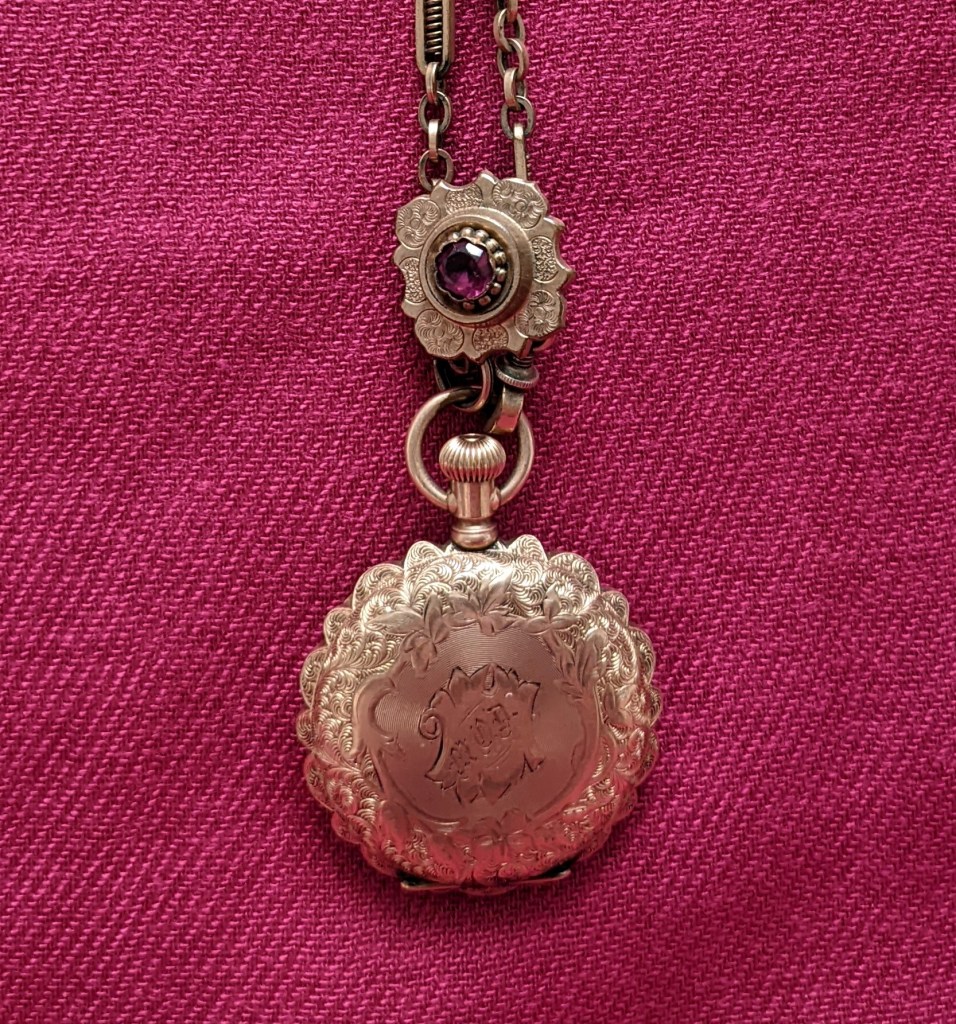
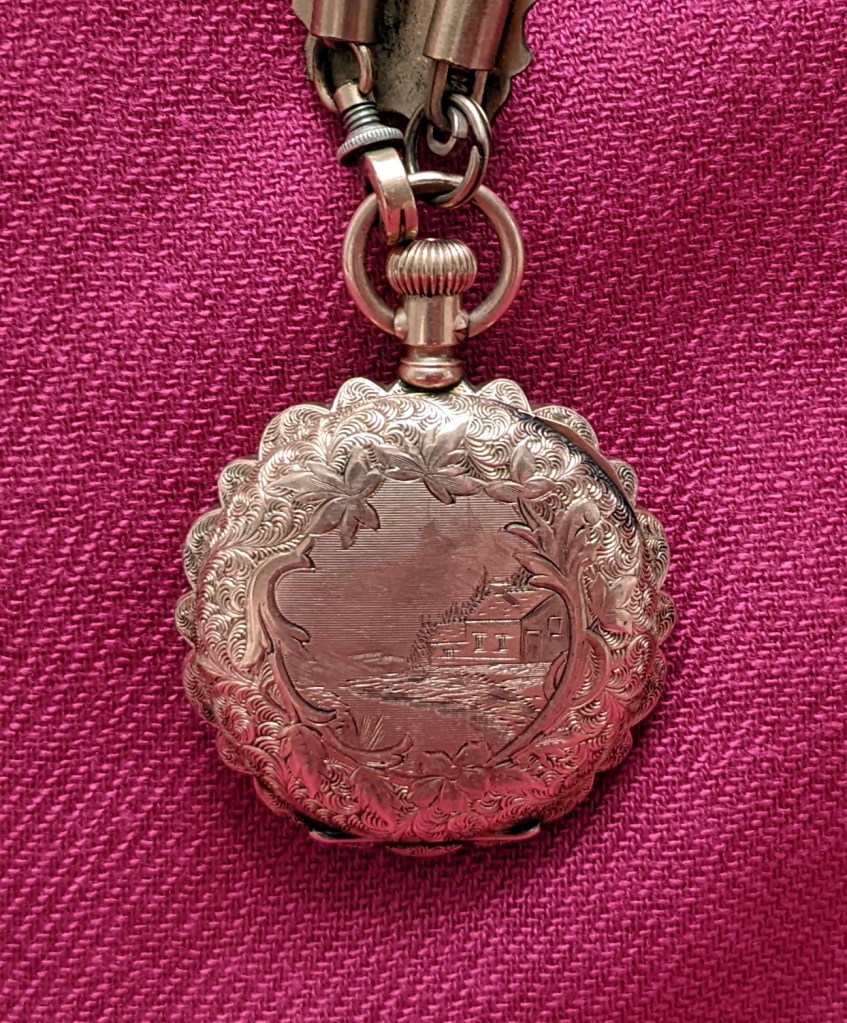
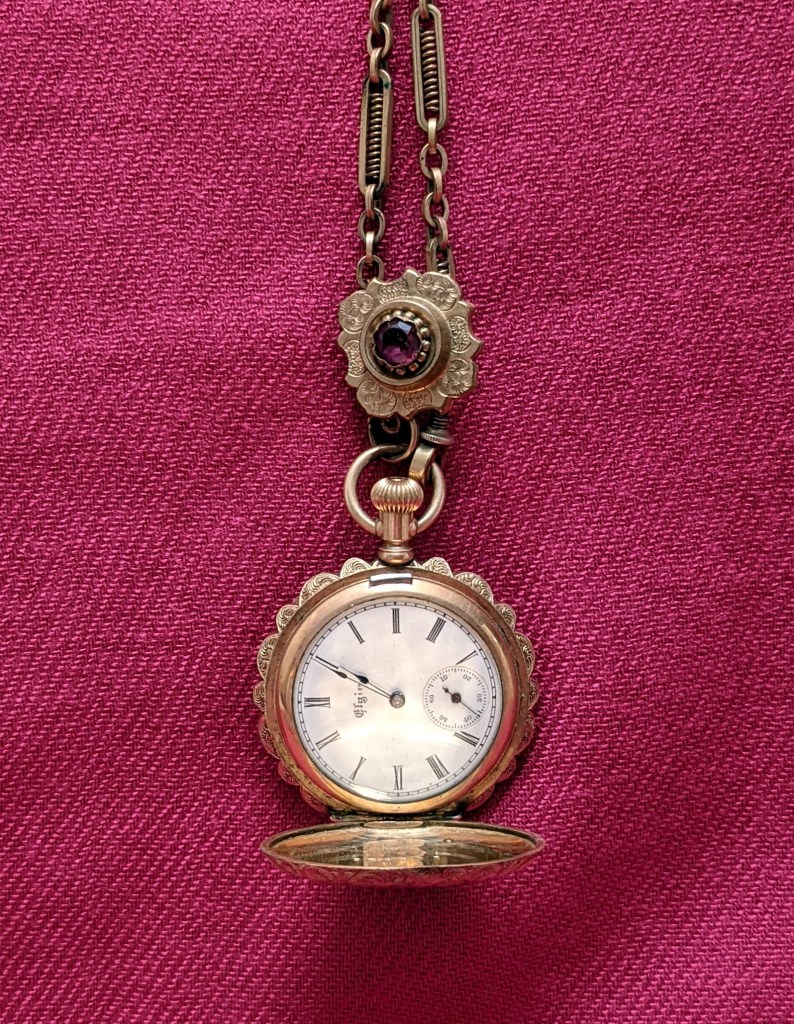
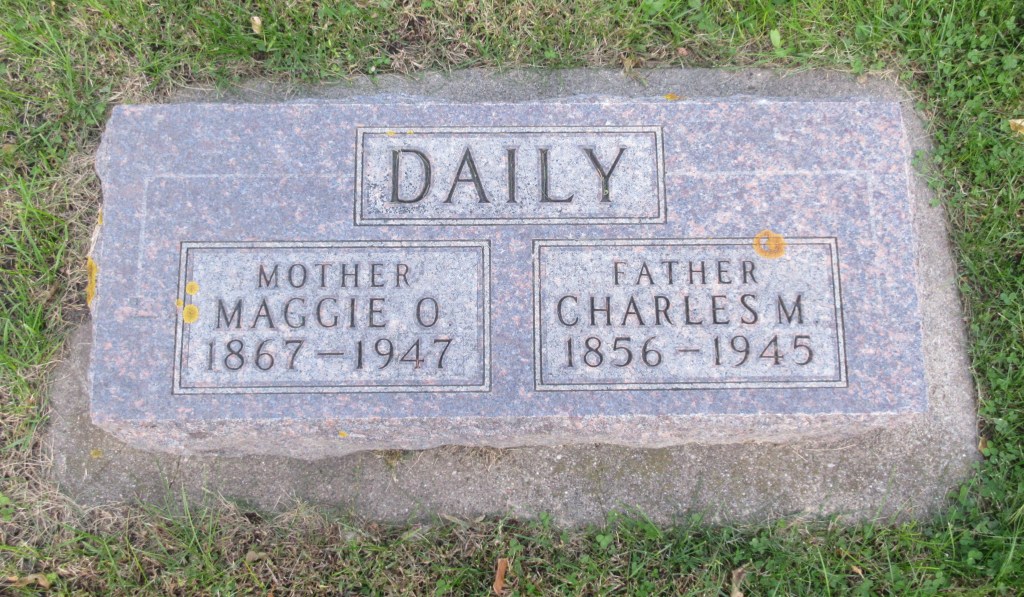
Aunt Gertie, An Active Methodist

Born in August 1872, Gertrude Mary Bevers was the eighth child of Alfred C. and Mary N. (nee Bridges) Bevers, although at the time of her birth only three of her siblings had lived past the age of one.  She was born in a small town in England and during her childhood her family moved every few years, including emigrating to the United States when she was 12 years old.  (A summary of the young lives of Gertrude and her sisters can be found in Ada, Gertie and Maude Bevers, and an article about her brother George is found in George C. Bevers, Bookkeeper.)

There is evidence that at a young age Gertrude began following in the footsteps of her parents.  One example is that at the age of 15, Gertrude along with her 20 year-old sister Ada embraced a tenet of her father and her father’s father, William Bevers, who “had been a total abstainer over 60 years … [and] was an ardent temperance advocate.”1  Gertrude’s father participated in the temperance movement in England by giving lectures, one of which proposed that alcohol gave no assistance to the health of one’s body.2  When Gertrude’s family was living in Wolsey, South Dakota, she and Ada were involved in the Hope of Wolsey, an offshoot of a temperance organization that had risen up in England called the Band of Hope.  (More about the Band of Hope’s history and mission can be found in Ada, Gertie and Maude Bevers.)  In April 1888, Gertrude was issued a certificate of membership in the Hope of Wolsey, which was signed by Ada.  It certified that she had made a pledge of temperance, which was printed on the certificate: “I hereby solemnly promise to abstain from the use of all intoxicating liquors, including wine, beer and cider, as a beverage, and from the use of tobacco in every form, and from all profanity.”  Appendix 1 below provides the text of the certificate.
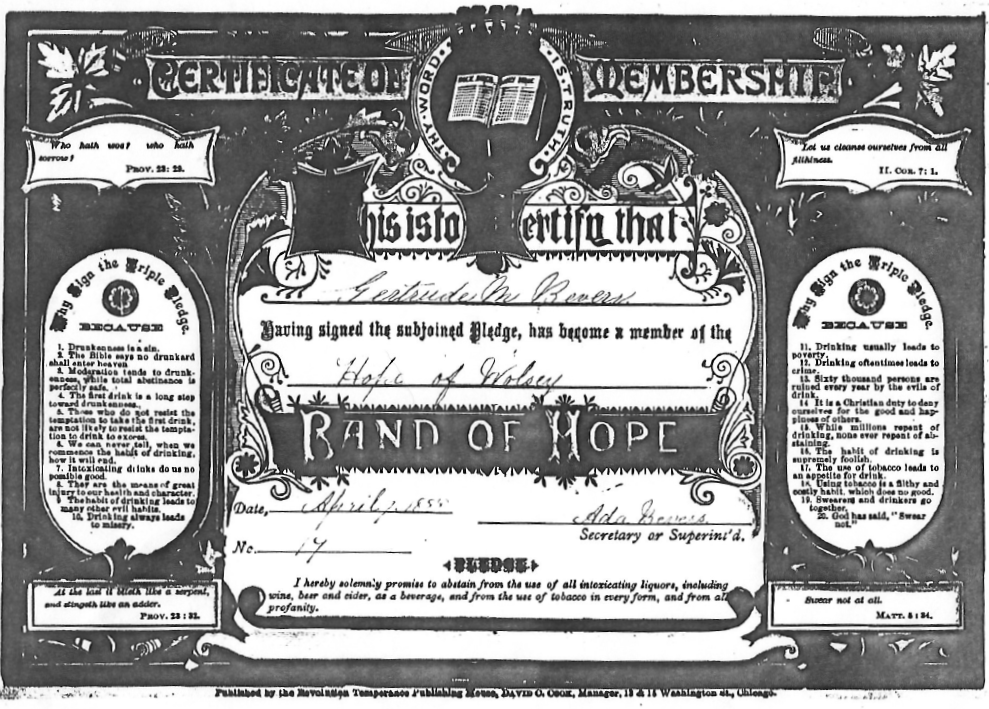
Gertrude’s certificate of membership in the temperance organization Hope of Wolsey

In the year that Gertrude turned 26 years-old, she moved with her parents and younger sister Maude to De Smet, South Dakota, where she would reside for the rest of her life, about 55 years.  Their residence in 1900 was on First Street.3  The town of De Smet had been established when the Dakota Central Railway Company laid tracks through Kingsbury County.  (Soon afterward, in 1881, the railroad was bought by Chicago Northwestern Railroad Company).4

“The first family of De Smet was that of Charles P. Ingalls.  He was the timekeeper for the railway construction crew at his camp on the shore of Silver Lake, a mile east of where De Smet was to be built.  As construction work ceased in the fall of 1879, he and his wife, along with four daughters remained in the timekeeper’s building through the winter and spring and built what was to become Ingalls’ store.

“By 1883, De Smet was a typical early prairie town.  De Smet had about 60 buildings including grocery and provision stores, wagon shops, lumber yards, banks, a drug store, newspaper companies, a flour mill, a church, a school, an elevator, two attorneys, a harness shop, one hotel and two real estate dealers.”5

One of the early real estate dealers was Alfred N. Waters, who would be a prominent land developer and citizen of the town.  Two decades after establishing himself in De Smet, he would marry Gertrude’s sister Maude.

On November 26, 1898, Gertude with her parents and sister were received, by letter from the Willow Lake congregation, into membership of First Methodist Episcopal Church of De Smet.6  The De Smet congregation was small, having dropped in size from 100 members in 1891 to 60 members in 1900.7  The history of the church traces its beginning to the founding of the town.

“In 1880, all of the Protestant people of this area met for their worship services in the Chicago & Northwestern Railway depot, part of the time in the town’s public school house.  Many families of the community cooperated to build a church edifice in 1882 under the chartered name of First Congregational Church and this was used by both Methodist and Baptist organizations for services, by alternating Sundays and hours.

“The Methodist organization, including the Ladies’ Aid Society, was formed in 1881 under the leadership of V. P. Neary.  A separate building was not erected until 1885.  It was then The Methodist Episcopal Church. …”8

Never marrying, Gertrude’s role would be housekeeper while living in her parent’s home, as well as while living in her sister’s home after her parents passed away.9,10  In the community, Gertrude was active in several organizations.  Some of what is known about her life has been extracted from minutes of meetings of women’s groups.  Known as Gertie in the records of the Ladies Aid Society, she is found on its membership roll as of May 19, 1899, along with her mother.  Sometimes Gertie served as the secretary or secretary pro tem of the aid society.  She also served as its treasurer in 1902.  Her name and her parents’ names were often mentioned in the minutes, as seen in these summarized examples:

July 11, 1899.    “The Ladies Aid of the First M. E. Church met with Mrs. Crane.”

The scripture reading was Psalm 115.  Mrs. Bevers gave the opening prayer.  It was moved “that the Ladies serve a gallon of ice-cream each day at the church, during Institute.”  Gertie seconded the motion and she signed the minutes of the meeting as the “sec pro tem.”  There were 21 in attendance, not including children.  Lastly, ice cream and cake were served.

August 23, 1899.    “The Ladies Aid met with Mrs. O. E. Sterns.”

Gertrude signed the minutes of the meeting as secretary.  The scripture reading, John 15:18, and opening prayer were given by Rev. Bevers.  It was moved and carried that the society give Brother Akers, their minister, $5.00 for his salary.  Rev. Bevers on behalf of the society presented Sister Akers, the minister’s wife, with a monetary gift ($5.00) for her birthday, and he sang a birthday song at the end of his presentation of the gift.  This was followed by music and a social time.  There were 10 members, seven visitors and eight children present.
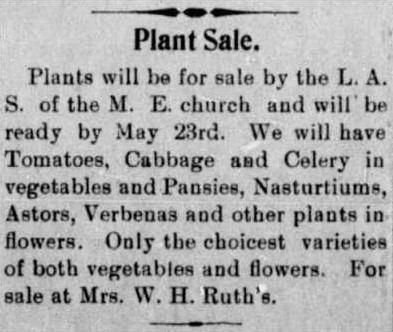
News item in Kingsbury County Independent
May 20, 1904

One of the aims of the Ladies Aid Society was to raise money for the church.  According to the 1965 history of the Methodist Church of De Smet: “The money paid in for the minister’s salary was never enough, so the Ladies’ Aid Society always put on big public chicken suppers.  The group published a cook book, Kitchen Echoes, in 1909 with tried recipes from the women of the town.  This brought in quite a bit of money for the church.”  Both Gertie and Maude contributed recipes which were printed in Kitchen Echoes, which sold for 50 cents per copy.

“Potato Salad.—Two teacups cold sliced potato, two hard boiled eggs, one good sized onion. Dressing for same: one egg, two tablespoons sugar, one-half cup vinegar, one tablespoon of butter, one teaspoon of mustard dissolved in a little milk, a pinch of salt. Heat until it thickens, but do not let it boil.—Gertie Bevers.”

“Sugar Cookies.—Two cups sugar, one cup butter, one cup sour cream, two eggs, one teaspoon soda, one teaspoon essence of lemon, flour to mix just stiff enough to roll easily.—Gertie Bevers”
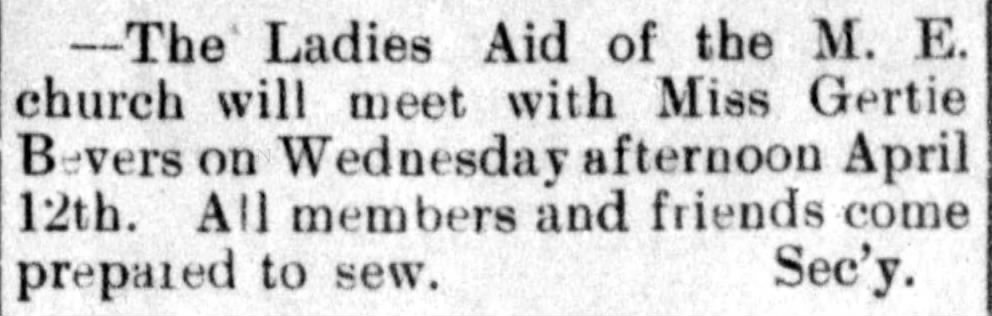
News item in Kingsbury County Independent
April 7, 1911

Another organization in which Gertie held an office was the Woman’s Christian Temperance Union (W. C. T. U.).  Although this organization was originally established to advocate for temperance, it later adopted the stance that local branches could advocate for other social causes, such as women’s suffrage.  In April 1905, the Kingsbury County Independent announced the re-organization of the chapter in De Smet by Miss Grace Van Vleet, who was the state secretary of Y. W. C. T. U. (the young women’s branch) and a temperance lecturer.  Gertie was elected to be the Correspondence Secretary of the local chapter.11  In March of the following year, the district convention of W. C. T. U. was held in De Smet.12  Most of the meetings on the 27th and 28th were held at the Methodist Episcopal Church.
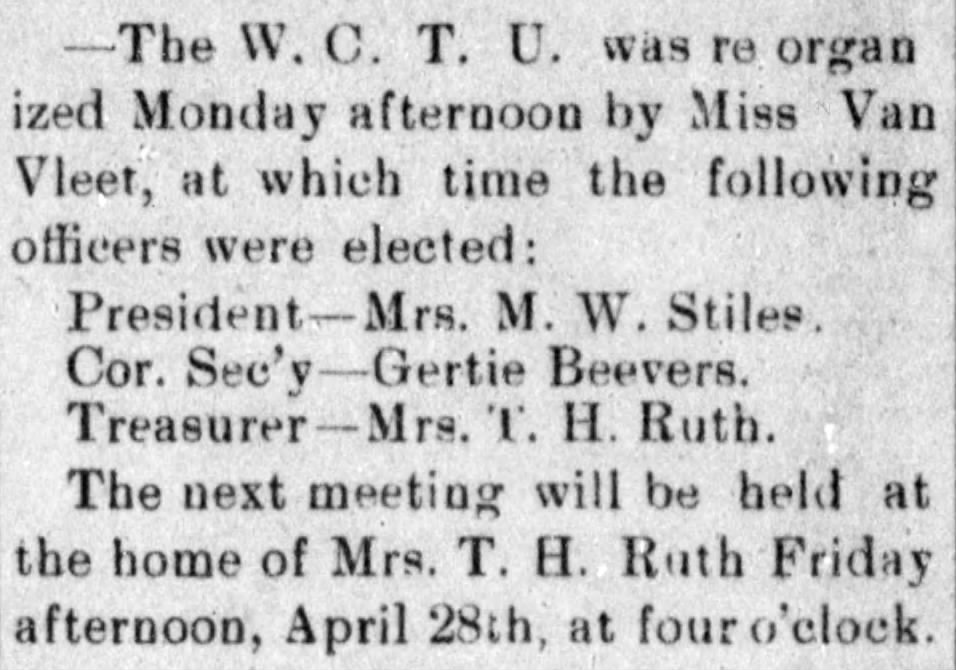
News item in Kingsbury County Independent
April 21, 1905

A third organization in which Gertie participated was the Epworth League, which had been founded in 1889 as a merger of several young people’s organizations of Methodist Episcopal churches.13  Epworth League was made up of primarily young adults.  There were six departments of social service: Spiritual Life, Social Work, Literary Work, Correspondence, Mercy and Help, and Finance.  At the Methodist Episcopal church in De Smet, there were two Epworth League meetings held on Sundays, one was called the junior league and the other was the senior league.14  Gertie at the age of 39 was a delegate to an Epworth League convention in Brookings, South Dakota in September 1911.15

Additionally, Gertie was a dues-paying member of the Methodist women’s group.  She served on a committee in 1902 and was assistant to the 1st Vice in 1905.  She held a supper at her house in December 1910 to raise funds, $4.60 was collected.  On December 26, 1911, the minutes recorded: “Resolved Miss Bevers assist Evelyn in social work.”  She held another supper in April 1912, which raised $3.85.


On May 11, 1904, Gertie was a bridesmaid at her sister’s wedding.  Maude married her employer Alfred N. Waters, whose first wife had passed away in 1900.16  One of the earliest businessmen of De Smet, Waters was the president of Waters Land and Loan, as well as being the mayor of De Smet.  He had hired Maude to be his stenographer in 1898.17  The groomsman at the wedding was Professor C. E. Swanson, who was the superintendent of the De Smet schools, and the officiating minister was Rev. Henry Preston of the Methodist church.  The wedding was held at Syndicate Hotel which had opened in De Smet in 1887.  After an addition to the hotel was constructed in 1902, it was one of the largest hotels in South Dakota.18

As of the date of this blogpost, digitized versions of the issues of Kingsbury County Independent are only available for the years 1904 to 1929, which is when the Independent merged with the De Smet News.19  The succeeding issues are not available online.  From the issues that are digitized some of Gertie’s personal life can be envisioned because the local newspapers often reported on the events and travels of the Bevers family. 

Sometimes Gertie’s sister Ada or her children made a trip to visit the Bevers family, but during the latter half of June 1906, Gertie spent two weeks with Ada, who lived with her husband William Mankey on a farm near Garden City, South Dakota.20  When the 1910 United States census was taken, Gertie was 37 years-old and still living with her parents who were 72 and 69.21  That year, Gertie’s mother passed away on July 14, and a lengthy obituary was published.22 It explained that Mary had had an operation six years earlier, from which she never fully recovered.  A couple of years later, she developed diabetes, and during this illness, Gertie and her family lovingly cared for Mary until her death.  Soon after the funeral, Gertie accompanied her father to Arlington, South Dakota to visit friends.23  And a month later, Mrs. James Bridges (the wife of Gertie’s mother’s nephew) came from Minneapolis to spend five days as a guest at the Bevers’ home.24 Shortly after that, both Gertie and her father took trips, in part separately and partly together. Gertie went to Arlington for two weeks, then joined her father at Ada’s home.25
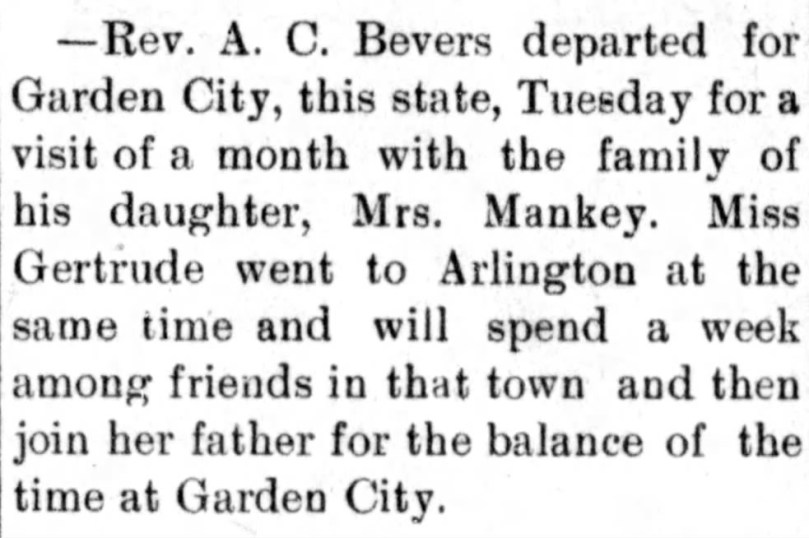
News item in Kingsbury County Independent
Aug. 26, 1910

In March 1911, Gertie went again to Arlington to visit friends,26 and in August 1911, Mrs. John Glendenning came from Arlington to visit Gertie.27  Mrs. Glendenning was the daughter of Mrs. James Bridges and the granddaughter of Mathias Bridges, who was Gertie’s mother’s brother. A month later, the newspaper reported about an experiment that Gertie conducted with an Easter lily she had purchased.28
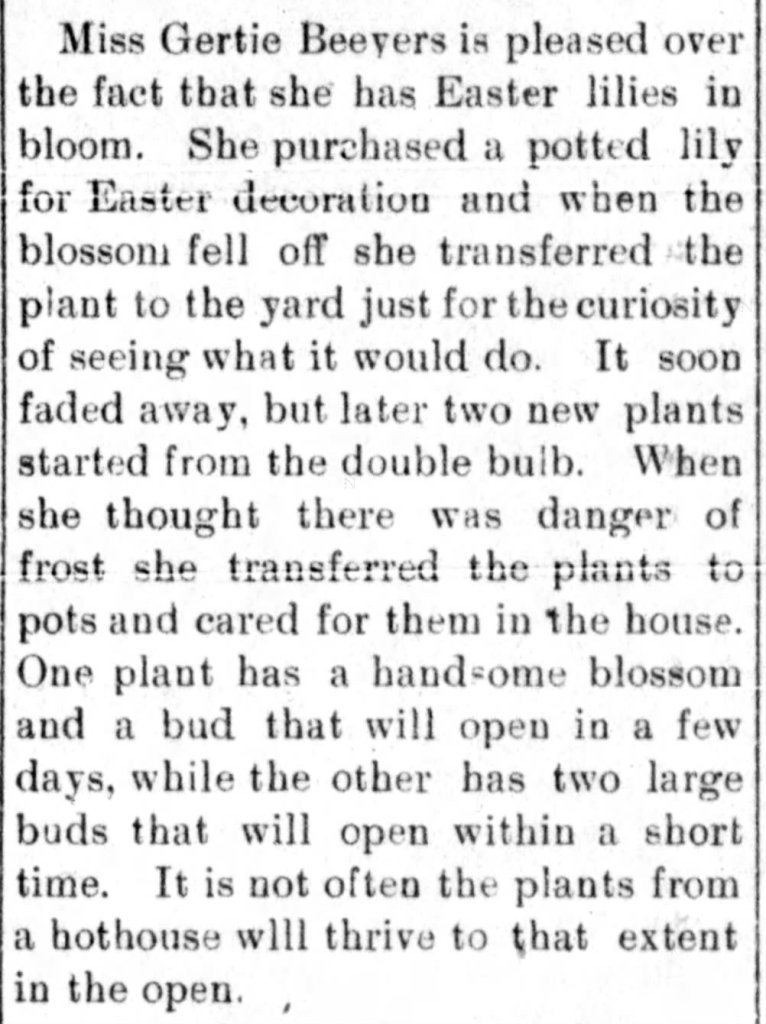
News item in Kingsbury County Independent, September 15, 1911

Gertie and Maude made a trip to Mitchell, South Dakota, in May 1916 to attend the wedding of their nephew W. Arthur Mankey, who was their sister Ada’s son.29  The wedding was held in the home of the bride, Birdella Carhart, and the officiating minister was the bride’s father, Rev. A. E. Carhart.  Also, in attendance were Arthur’s brother G. Floyd Mankey and his cousin Lester Mankey.


When Gertie was in her thirties and forties, suffrage for women was a fiercely contended political issue on both the state and federal levels.  In 1918, the men of South Dakota were asked to consider the question of amending the South Dakota state constitution, granting women the right to vote.  That November the amendment passed by approximately 63% of the vote.30  Six months later, the congress of the United States passed a suffrage amendment.  During subsequent months, the individual states either ratified or rejected the amendment.  South Dakota ratified it “without a dissenting vote in either house on Dec. 4, 1919, being the 21st state to act.”31  Ratification by the final state that was needed to adopt the 19th Amendment to the Constitution of the United States occurred on August 18, 1920.  The next day, a newspaper in Sioux Falls, South Dakota, declared, “Thus the political freedom for which women have contended since the founding of the republic has been attained and 27,000,000 women, half the population of the United States, accorded the right to vote under the constitution.”32


In January 1920 when the United States census was taken, 47-year-old Gertie and her 82-year-old father were living on Second Street in De Smet.33  Gertie’s father lived nearly two more years.  A news article dated September 23, 1921 included the following:

“For a number of years, the elderly gentleman had been in poor health, first being confined to a wheel chair, but later to his bed. His continued illness made it advisable for him to be moved from the Bevers home to A.N. Waters’ home, where his two daughters, Mrs. Waters and Gertrude Bevers, have cared for him.”34


A couple of Gertie’s correspondences have survived for about 100 years.  In December 1922, she mailed a postcard to her nephew Willis Bevers, son of her brother Herbert.  Willis and his parents and six of his siblings had gone to southern Texas in the fall of 1919. The travel log of Willis’ mother has also survived.  After finding that they didn’t like farming in Texas, his parents with most of his siblings returned to South Dakota in 1920.  Willis stayed in Texas for another year but also returned to South Dakota about 1921.
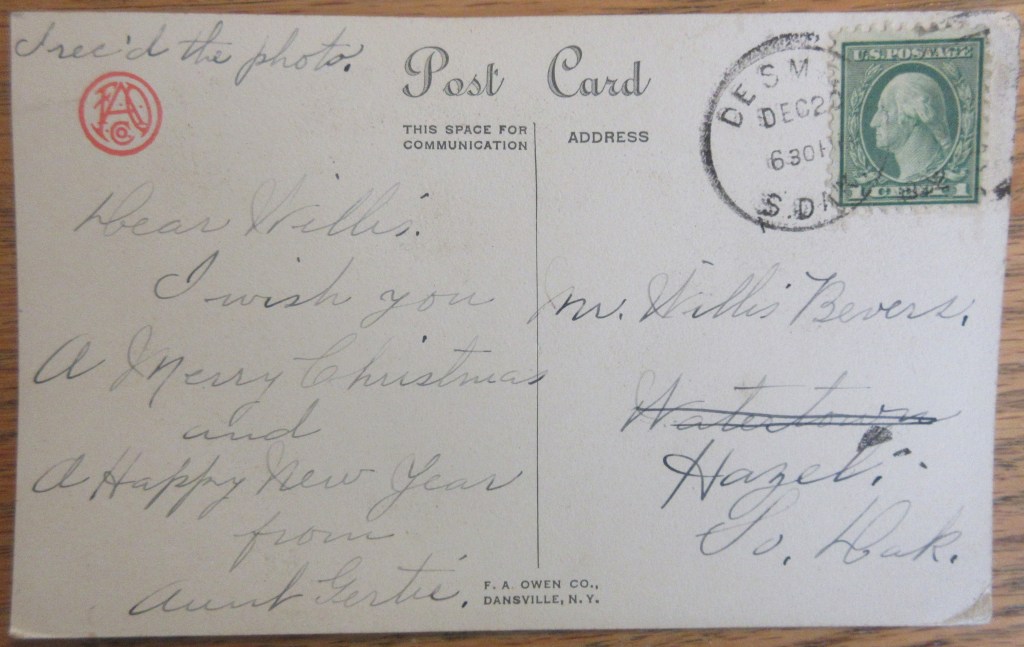
Front of a Christmas postcard mailed by Gertie in December 1922
Back of a Christmas postcard mailed by Gertie in December 1922

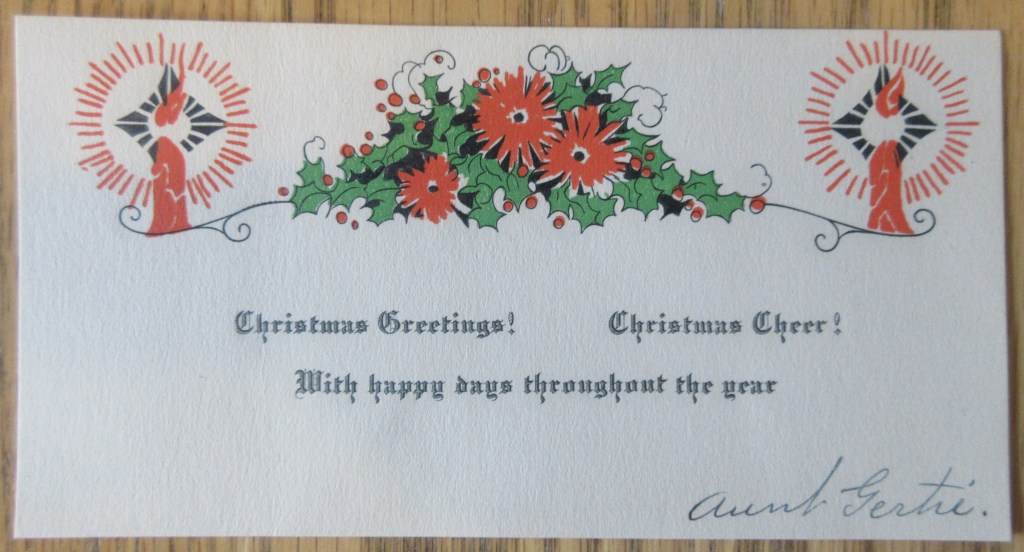
In 1927, apparently, Gertie made a cross-country trip to visit her sister Ada.  Ada with her husband and two daughters had moved to Virginia, near Remington, between 1915 and 1920.  Gertie’s trip is known because she mailed a Christmas greeting from Remington to Mr. and Mrs. Willis Bevers who were living in Hazel, South Dakota.  Postage for the letter was two cents and it took five days to travel from Virginia to Watertown, South Dakota.
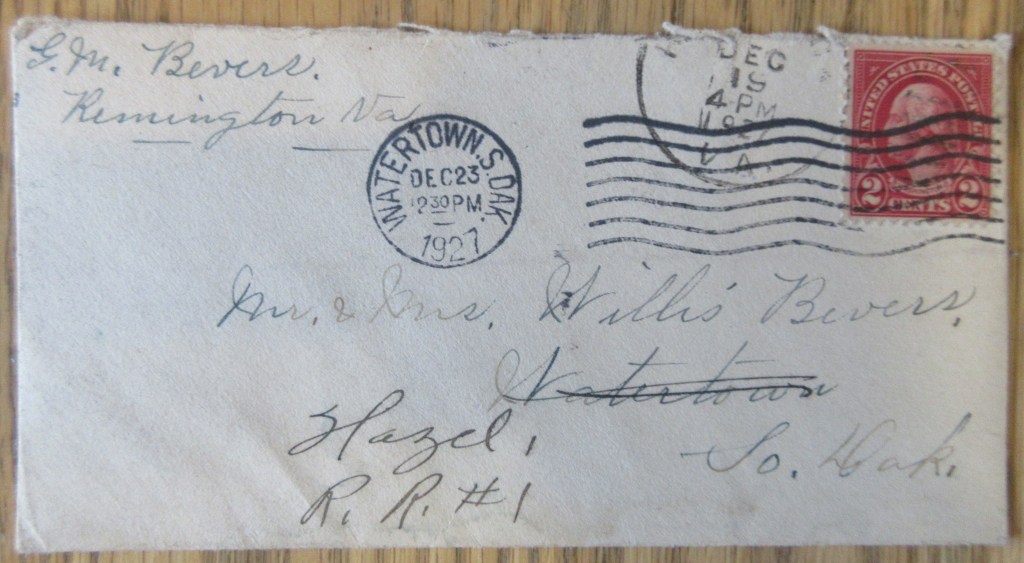
Small envelope addressed by Gertie in December 1927
Small greeting card enclosed in the envelope mailed in December 1927

Little is known about Gertie’s personal life during the remaining years of her life.  In 1930, 1940 and 1950, when the United States censuses were taken, she was living with her widowed sister Maude, whose house was on 3rd Street in De Smet.  In 1930, Gertie was 57 years-old, Maude was 54 years-old and both of them were naturalized citizens.35  In 1940, both of them were engaged in home housework and they both received “income of $50 or more from sources other than money wages or salary.”36  Gertie’s brother George passed away in June 1943 in Los Angeles, California, and a month later Ada passed away in Washington, D. C.  About a year and a half later, her brother Herbert died in November 1944 in Watertown, South Dakota.

One miscellaneous item known about Gertie is that she continued to be active in the community in her sixties and seventies. She and Maude were members of the Friendly Garden Club in De Smet. In May 1939, they each participated in the program of the garden club by reading papers to the group. Gertrude read “Garden Verse” and Maude read “Gardening in all Countries and All Ages.”37 Nearly 10 years later, the sisters hosted a garden club meeting at Maude’s house.38
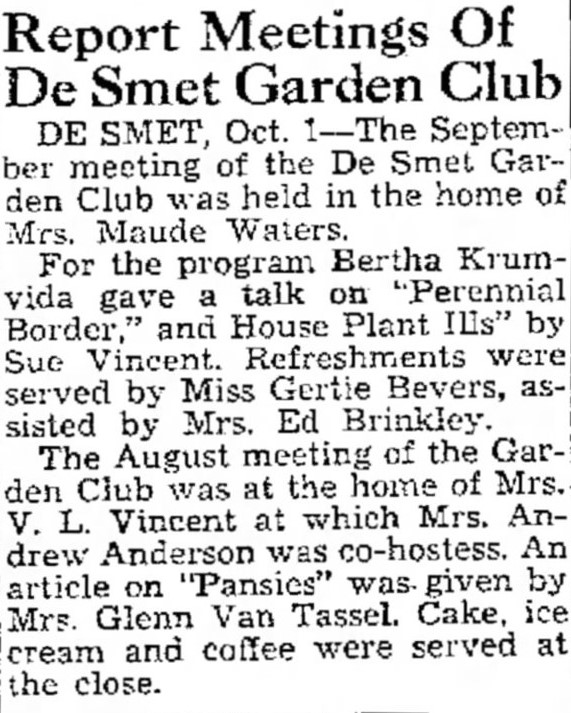
News item in The Daily Plainsman
October 1, 1948

In April 1950 the record of the United States census designates Gertie and Maude’s residence as Block 2 of “Original Town” of De Smet City.39  They were 77 and 74 years-old, respectively.  To the question, “What was this person doing most of last week – working, keeping house, or something else?” the answer for both of them was keeping house.  Gertie was selected to answer additional questions.  Her responses included that she was living in the same house a year earlier.  Her education level was recorded as “S7” (seventh grade), and she didn’t finish that grade.  She had not worked any weeks outside of her home in the previous year.  She didn’t receive money by working as an employee, or by working in her own business.  And to the question, “How much money did he receive from interest, dividends, veteran’s allowances, pensions, rents or other income (aside from earnings)?” she answered “none.”

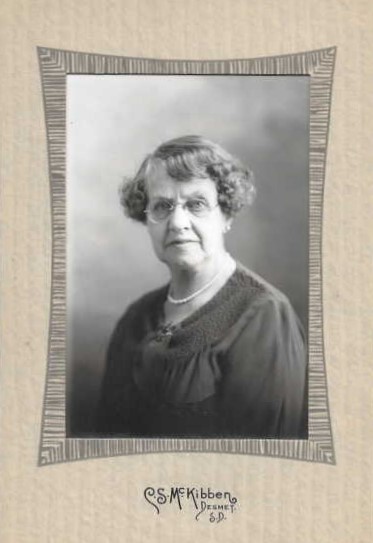
Aunt Gertie passed away in De Smet on October 3, 1953, at the age of 81, after a “lingering illness” of stomach cancer.40  Her remains are buried in De Smet Cemetery beside her parents. Nearby, her sister Maude and her brother-in-law Alfred N. Waters are also buried.

APPENDIX 1

Text of the certificate of membership of the Band of Wolsey:

Thy Word is Truth

This is to certify that

Gertrude M. Bevers

Having signed the subjoined Pledge, has become a member of the

Hope of Wolsey

BAND OF HOPE

PLEDGE

I hereby solemnly promise to abstain from the use of all intoxicating liquors, including wine, beer and cider, as a beverage, and from the use of tobacco in every form, and from all profanity.

Thy Sign the Triple Pledge

BECAUSE

  1. Drunkenness is a sin.
  2. The Bible says no drunkard shall enter heaven
  3. Moderation tends to drunkenness, while total abstinence is perfectly safe.
  4. The first drink is a long step toward drunkenness.
  5. Those who do not resist the temptation to take the first drink, are not likely to resist the temptation to drink to excess.
  6. We can never tell, when we commence the habit of drinking, how it will end.
  7. Intoxicating drinks do us no possible good.
  8. They are the means of great injury to our health and character.
  9. The habit of drinking leads to many other evil habits.
  10. Drinking always leads to misery.
  11. Drinking usually leads to poverty.
  12. Drinking oftentimes leads to crime.
  13. Sixty thousand persons are ruined every year by the evils of drink.
  14. It is a Christian duty to deny ourselves for the good and happiness of others.
  15. While millions repent of drinking, none ever repent of abstaining.
  16. The habit of drinking is supremely foolish.
  17. The use of tobacco leads to an appetite for drink.
  18. Using tobacco is a filthy and costly habit, which does no good.
  19. Swearers and drinkers go together.
  20. God has said, “Swear not.”

Published by the Revolution Temperance Publishing House, David C. Cook, Manager, 13 & 15 Washington st., Chicago.           

Bible verses printed in each corner of the certificate:

Proverbs 23:29   Who hath woe?  Who hath sorrow?

II Corinthians 7:1  Let us cleanse ourselves from all filthiness.

Proverbs 23:32  At the last it biteth like a serpent, and stingeth like an adder.

Matthew 5:34  Swear not at all.


1 “RIPON. Death of an Old Temperance Advocate,” The Yorkshire Herald and the York Herald (York, North Yorkshire, England), February 17, 1894, page 11, Newspapers.com.

2 “Longwood Temperance Society,” Weekly Examiner (Huddersfield, West Yorkshire, England), April 24, 1869, page 6, Newspapers.com.

3 “United States Census, 1900”, , FamilySearch (https://www.familysearch.org/ark:/61903/1:1:MMRW-TKS : Sat Aug 17 18:09:29 UTC 2024), Entry for Alfred C Peevers and Mary N Peevers, 1900.

4 City of De Smet, South Dakota, “Depot Museum / Harvey Dunn School,” https://cityofdesmet.com/depot-museum.

5 Caryl Lynn Meyer Poppen, ed., excerpt from De Smet Yesterday and Today “Little Town on the Prairie” in “History,” De Smet, South Dakota, https://desmetsd.com/history.

6 First Methodist Church of DeSmet, “Record of Members.”

7 First Methodist Church, “A History of the Church,” Consecration Service of the Remodeled First Methodist Church (De Smet, South Dakota: First Methodist Church, September 26, 1965).

8 First Methodist Church, “A History of the Church.”

9 “South Dakota State Census, 1905”, , FamilySearch (https://www.familysearch.org/ark:/61903/1:1:MM42-JWN : Sun Mar 10 20:39:28 UTC 2024), Entry for Gertrude M Bevers.

10 “United States Census, 1940”, , FamilySearch (https://www.familysearch.org/ark:/61903/1:1:V19L-5LM : Fri Mar 08 09:56:34 UTC 2024), Entry for Maude Waters and Gertrude Bevers, 1940.

11“Local News,” Kingsbury County Independent (De Smet, South Dakota), April 21, 1905, page 5, Newspapers.com.

12 Kingsbury County Independent (De Smet, South Dakota), March 23, 1906, page 4, Newspapers.com.

13 Case Western Reserve University, “Epworth League,” Encyclopedia of Cleveland History, https://case.edu/ech/articles/e/epworth-league.

14 “Church Services,” Kingsbury County Independent (De Smet, South Dakota), September 15, 1911, page 5, Newspapers.com.

15 “Local News,” Kingsbury County Independent (De Smet, South Dakota), September 15, 1911, page 5, Newspapers.com.

16 Nancy S. Cleaveland, “Alfred N. Waters,” Laura Ingalls Wilder A-Z, http://www.pioneergirl.com/blog/archives/7204.

17 “College News,” The Brookings Register (Brookings, South Dakota), March 29, 1898, page 2, Newspapers.com.

18 Nancy S. Cleaveland, “Syndicate Hotel,” Laura Ingalls Wilder A-Z, http://www.pioneergirl.com/blog/archives/9165.

19 Library of Congress, Kingsbury County Independent (Desmet, Kingsbury County, S.D.) 1894-1929, https://www.loc.gov/item/sn00065130/.

20 “Local News,” Kingsbury County Independent (De Smet, South Dakota), June 15, 1906, page 5, Newspapers.com.

21 “United States Census, 1910”, , FamilySearch (https://www.familysearch.org/ark:/61903/1:1:MPX1-9J6 : Sun Mar 10 11:44:32 UTC 2024), Entry for Alfred C Bevers and Mary N Bevers, 1910.

22 Kingsbury County Independent (De Smet, South Dakota), July 22, 1910, page 4, Newspapers.com.

23 “Local News,” Kingsbury County Independent (De Smet, South Dakota), July 22, 1910, page 5, Newspapers.com.

24 “Local News,” Kingsbury County Independent (De Smet, South Dakota), August 19, 1910, page 5, Newspapers.com.

25 “Local News,” Kingsbury County Independent (De Smet, South Dakota), August 26, 1910, page 5, Newspapers.com.

26 “Local News,” Kingsbury County Independent (De Smet, South Dakota), March 24, 1911, page 5, Newspapers.com.

27 Kingsbury County Independent (De Smet, South Dakota), August 11, 1911, page 4, Newspapers.com.

28 “Local News,” Kingsbury County Independent (De Smet, South Dakota), September 15, 1911, page 5, Newspapers.com.

29 “Society,” Mitchell Capital (Mitchell, South Dakota), May 4, 1916, page 5, Newspapers.com.

30 Forest City Press (Forest City, South Dakota), December 5, 1918, page 2, Newspapers.com.

31 Argus-Leader (Sioux Falls, South Dakota), August 19, 1920, page 4, Newspapers.com.

32 Argus-Leader, August 19, 1920.

33 “United States Census, 1920”, , FamilySearch (https://www.familysearch.org/ark:/61903/1:1:M6JQ-J85 : Thu Mar 07 04:17:06 UTC 2024), Entry for Alfred C Bevers and Gertrude Bevers, 1920.

34 Nancy Cleaveland and Gina Terrana, Waters (2015), http://www.pioneergirl.com/waters_cemetery.pdf.

35 “United States Census, 1930”, , FamilySearch (https://www.familysearch.org/ark:/61903/1:1:XQVH-29Z : Thu Jul 11 05:02:51 UTC 2024), Entry for Maude A Waters and Gertrude V Bevers, 1930.

36 “United States Census, 1940”, Entry for Maude Waters and Gertrude Bevers, 1940.

37 The Daily Plainsman, (Huron, South Dakota), May 12, 1939, page 5, Newspapers.com.

38 The Daily Plainsman, (Huron, South Dakota), October 1, 1948, page 5, Newspapers.com.

39 “United States Census, 1950”, , FamilySearch (https://www.familysearch.org/ark:/61903/1:1:6F9N-CQQP : Wed Oct 04 18:17:08 UTC 2023), Entry for Agnes Maude Katers and Gertrude M Bevers, 10 April 1950.

40 K. and M. Bevers, notes attached to Gertrude Mary Bevers in Ancestral Quest program file dated June 29, 2022.
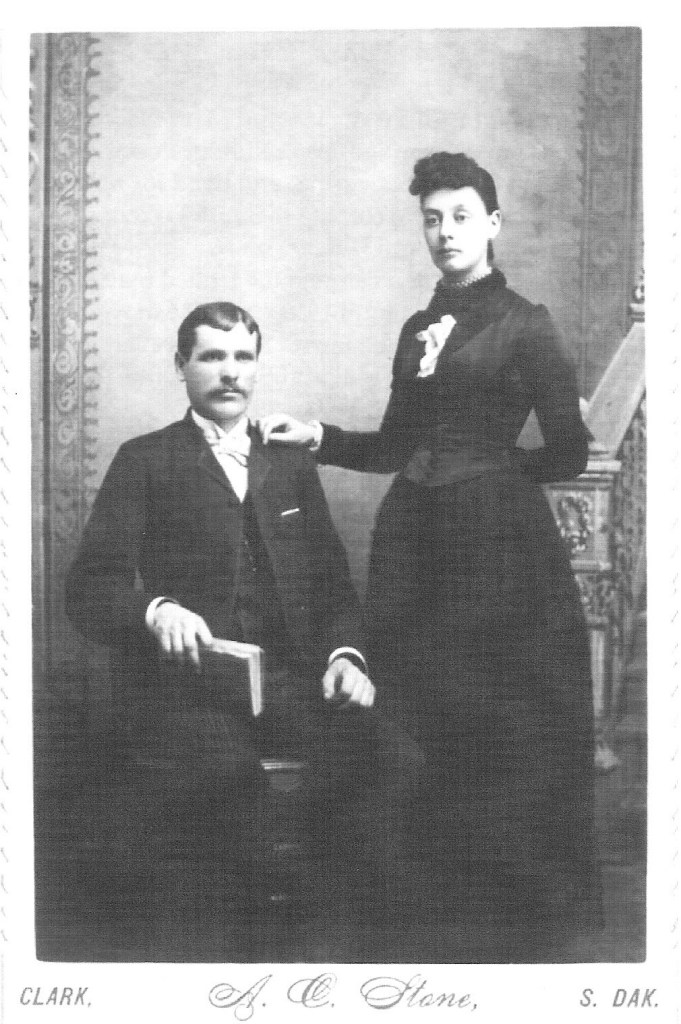
Ada and William Mankey

It was probably in the fall of 1885 that 18 year-old Ada Bevers met William Mankey.  Ada had immigrated from England only about 10 months prior.  William, having immigrated from England in 18751 and having worked (as of 1880) in a mine in Deer Park Township, La Salle County, Illinois,2 by 1882 had obtained a tract of land in Clark County, Dakota Territory.3  In October 1885 Ada’s father, Alfred C. Bevers, was assigned to be the supply pastor of the Henry Methodist Episcopal (M. E.) Church in southwestern Codington County, Dakota Territory.4  The charge may have included a congregation located in Garden City as well, which was about 12 miles to the northwest of Henry, over the county line in Clark County.  It is known that in 1888, William and his mother were members of the Garden City congregation and William was also a steward of the Henry Charge.5  

Ada’s family lived in Henry for two years, then her father was assigned to Wolsey M. E. Church and the following year he was assigned to Bradley M. E. Church.  Around this time period, Alfred submitted a claim for a homestead in Phipps Township, in western Codington County, about 10 miles northeast of Garden City.  When Alfred and his wife Mary celebrated their 25th wedding anniversary in September 1889 at their small home on the homestead, it is believed that William attended the gathering.  (See a photograph of the group attending the celebration in Ada, Gertie and Maude). 

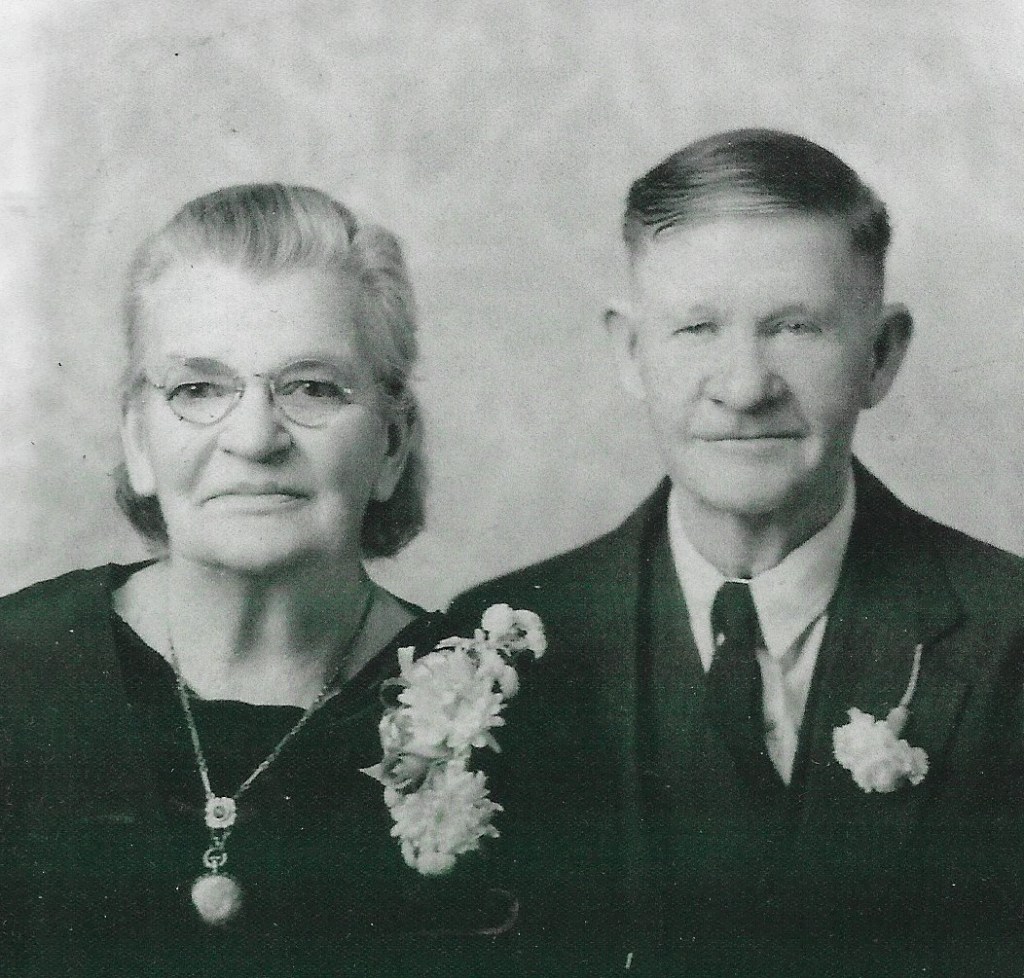
Ada and William would eventually marry on October 28, 1891.6  During the next decade, they lived on their farm in Clark County and they would have three children born to them.  Their first child, Florence Gertrude, was born on October 16, 1892.7  Her namesakes were Ada’s sisters, Florence who had died as an infant and Gertrude who was still living with Ada’s parents.  On April 13, 1894, Ada gave birth to William Arthur,8 named after his father of course and one of Ada’s deceased brothers Arthur.  On June 7, 1897, George Floyd was born, named after Ada’s eldest brother George, who was living in Philadelphia.9 By 1898, Ada’s parents and sisters Gertrude and Maude had moved to De Smet, the county seat of Kingsbury County, about 50 miles to the south of William and Ada’s farm.

William and Ada Mankey

When the 1900 United States census was taken, 32-year-old Ada and 42-year-old William had been married for eight years.10  They were living on the farm that they owned in Eden Township, Clark County.  William was a farmer and a naturalized citizen, having lived in the United States for 25 years.  The census recorded that Ada had immigrated in 1884 and had been in the United States for 16 years.  She was not a naturalized citizen (although she had submitted her intention to become a citizen in 1889.)11  Seven year-old Florence had attended five months of school that year.  W. Arthur was six years-old and G. Floyd was two years old.  On the section to the east of William and Ada’s farm, William’s mother Mary lived with his brother Tobias, his sister Margaret Minor and Margaret’s three children.12  William’s father Thomas had passed away in 1899 and is buried in Garden City Cemetery.13

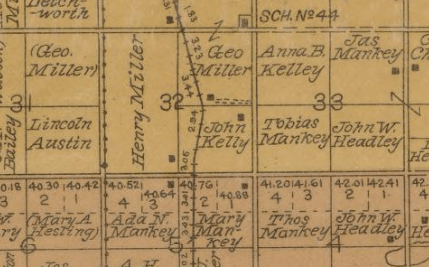
The quarter section in Eden Township that William and Ada owned can be found on a 1900 map of Clark County; the farm is about a mile north of Garden City and labeled with Ada’s name.14  Adjacent to Ada and William’s farm, the map shows the quarter section owned by Mary Mankey, and to the east of her farm, William’s brother Thomas Mankey held a quarter section.  Not far away in Maydell Township to the north were the farms of William’s brothers Tobias and James Mankey.

Cropped from a map of Clark County, South Dakota, dated ca. 1900.

William and Ada added another daughter to their family, Hazel Maude, on September 14, 1904.15  She was named after Ada’s youngest sister Maude.  When the South Dakota census was taken in 1905, the Mankey family was still living at the same location in Eden Township.  Four years later, William’s mother passed away in 1909 and was buried with his father in Garden City Cemetery.16

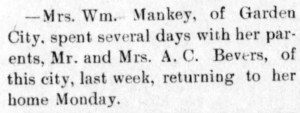
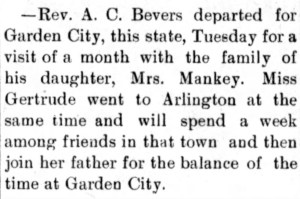
In late winter 1909, Ada made a trip to De Smet to visit her parents for several days.  Possibly she traveled by train.  The Chicago, Milwaukee and Saint Paul Railway had an extension which had stations at Garden City and Lake Preston, a town ten miles to the east of De Smet.  A year and a half after this visit, Ada’s mother, who had been afflicted with diabetes for nearly four years, passed away in July 1910.17  Shortly afterwards, Ada’s father spent a month at Ada’s home and her sister Gertrude joined them after visiting some friends.

Reported in Kingsbury County Independent, March 5, 1909
Reported in Kingsbury County Independent, August 26, 1910

When the 1910 United States census was taken, Ada and William were still living on a farm in Eden Township.18  Florence (age 17), W. Arthur (age 16) and G. Floyd (age 12) had all attended school that year.  Hazel at five years-old had not attended school.  While in high school, W. Arthur made a glider from plans published in the magazine Popular Mechanics.19

Both the 1900 and the 1910 censuses asked women how many children they had and how many of them were alive.  Ada had given birth to four children and all of them were alive.  This was unlike her mother, who had born 11 children, six of which passed away in their first or second year of life.  In England early childhood mortality (deaths of children between the age one and five) had begun to decline about 1870, but infant mortality (deaths of children before the age of one) didn’t decline until around the turn of the twentieth century.20  Ada’s mother was living in England and bearing children when infant mortality was high.  Ada’s children were born during a period of steady decline in child mortality in the United States.21

In 1915 when the South Dakota state census was taken, Florence and Hazel were at home with Ada and William.22  W. Arthur was attending his second year of college at Dakota Wesleyan University (DWU) in Mitchell, South Dakota.23  He was studying Engineering and Math.24  The census records identify the family’s religion as “M. E.” (Methodist Episcopal).  It is not known where G. Floyd was at the time of this census, but according to the 1930 United States census he was a veteran of “the World War,”25 which would be World War 1.  He was a seaman in the United States Navy from May to December 1918.26 

The first of William and Ada’s children to marry was W. Arthur.  He married Birdella A. Carhart in April 1916 in Mitchell,27 where they had met while he was attending DWU.  The officiating clergyman was Birdella’s father, A. E. Carhart, who was a minister in the M. E. Church.  A year and a half after their marriage, W. Arthur and Birdella had their first child, born in December 1917, giving William and Ada their first grandchild.  By then, W. Arthur and Birdella were living in Washington, D. C.28  They would give Ada and William their second and third grandchildren in July 1921 and January 1924. 

By the time the United States census was taken in January 1920, William and Ada had purchased and lived on a dairy farm outside of Remington, Fauquier County, Virginia, about 60 miles southwest of Washington, D. C.29  William was 61 years-old, a naturalized citizen and a dairy farmer.  Ada was 52 years-old and she was also naturalized.  Their 27 year-old daughter Florence and 15 year-old daughter Hazel were living with them, and Hazel was attending school.  W. Arthur, Birdella and their child were in a rented place in Washington, D. C.30  W. Arthur was a draftsman, working for the Navy Department.  G. Floyd was possibly lodging in Washington, D. C. and working as an automobile salesman.31  A year after the census was taken, back in DeSmet, South Dakota, Ada’s father passed away in September 1921.32 

In the early 1920s, W. Arthur would move to southern California and embark on a career in aviation engineering.  During the next several decades he would play a role in the advancement of the aviation field and in its regulation.  One of his first accomplishments was modifying an airplane wing which with one further modification became the wing of Colonel Charles Lindbergh’s plane, the Spirit of Saint Louis.33  In 1927, the Spirit of Saint Louis was the first plane to be successfully flown across the Atlantic Ocean.

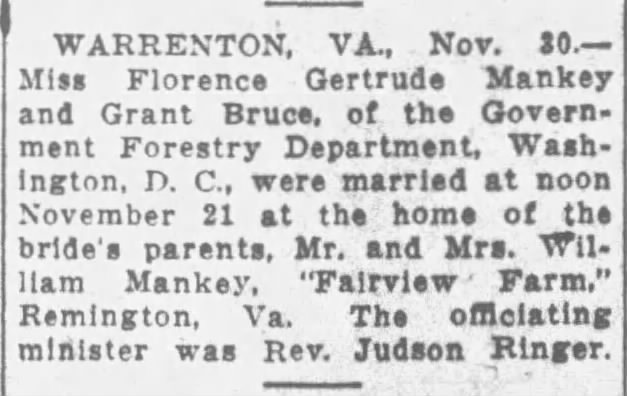
At noon on November 21, 1923, a wedding was performed at Ada and William’s “Fairview Farm.”34  Florence married Grant B. Bruce, a widower employed by the Government Forestry Department in Washington, D. C.  The city directory provides additional information:  He was a statistician for the Department of Agriculture.35  Upon settling in Grant’s home in northwest Washington, D. C., Florence would host lodgers in their home for the next couple of decades.  Many of the lodgers worked for the United States government. 

Reported in Richmond Times-Dispatch, December 1, 1923

Two more weddings occurred in the 1920s.  Hazel married James H. Weeks in October 1924,36 and G. Floyd, who had moved to San Francisco in the mid-1920s, married Lucia Neira, an Italian immigrant, in May 1927.37

In December 1927, Ada’s sister Gertrude mailed a Christmas greeting card from the town of Remington, Virginia.  The card was addressed to one of her brother Herbert’s sons and his wife, Willis and Elizabeth Bevers, in Hazel, South Dakota.  Presumably Gertrude was visiting Ada and her family.

According to the 1930 United States census, 61 year-old Ada and 71 year-old William were living on a dairy farm that they owned, still in Fauquier County.  William was a farmer and he had worked on the day before the census taker visited their home.38  He was not a veteran.  They did not own a radio set.  Florence and Grant were living at the same location in Washington, D. C.39  W. Arthur and his family had left California and were living in Detroit, Michigan.  W. Arthur was an aeronautical engineer, working in the auto products industry.40   George and Lucille were in San Francisco and George was working as an automobile salesman.41  They owned a radio set.  Hazel and James were living with her in-laws on her father-in-law’s dairy farm which was not far from Ada and William.42  They had two children by this time, giving Ada and William a total of five grandchildren.  Three years later, Florence would give them their sixth grandchild.

In 1935, Ada and William still lived on a farm outside of Remington.43  Florence and Grant with their child were living at the same address as previously in Washington, D. C.44  W. Arthur and his family had moved to Santa Monica, California.45  Hazel and James were on a farm in Lee, Virginia.46  George and Lucille still lived in San Francisco,47 but by 1937, they would move to southern California where Lucille gave birth to Ada and William’s seventh grandchild.48

Tragedy struck Ada and Florence within a single day of each other.  Florence’s husband died on April 30, 1938.  Grant had worked for the federal government for about 37 years and had been “in charge of all map records of the United States Forest Service” for 25 years before his retirement in May 1937.49  The day after Grant died, William at nearly 80 years-old passed away on May 1, 1938.  His death certificate states that he worked as a dairy farmer “to time of death.”50  William is buried in Remington Cemetery, Remington, Virginia.

The 1940 United States census record indicates that 72 year-old Ada was a lodger in Washington, D. C. and in the previous year she had received more than $50.00 that was not money wages or salary.51  Florence, at 46 years-old was continuing to live at the same residence which she owned in Washington, D. C.; also at the residence was her seven year-old child and three lodgers.52  W. Arthur had returned to the east coast, he and his family were living in Baltimore County, Maryland.53  He was an aeronautical engineer at an airplane factory.  George and Lucille had moved to Montebello, Los Angeles County and he was working as a house roofer.54  Hazel and her family were still living on a farm in Lee, Virginia.55  Her father-in-law lived with them and they had two children.  There was also a lodger and a servant living with them.

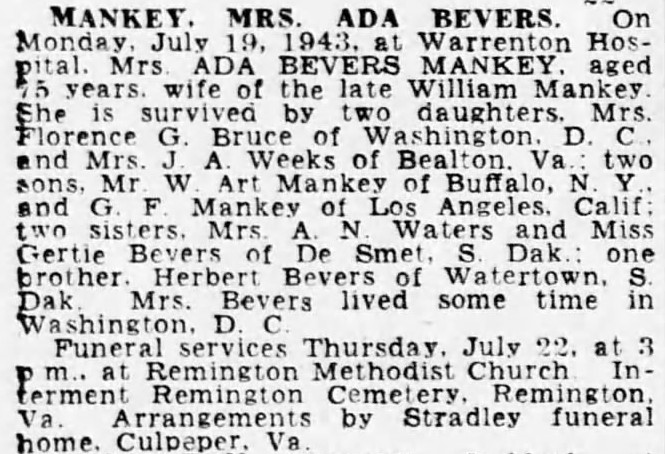
During the last years of Ada’s life, her eighth and ninth grandchildren were born, the children of Hazel and James, born in 194056 and 1943.57  At the age of 75, Ada’s last days were spent in Warrenton Hospital, Fauquier County and she died there on Monday, July 19, 1943.  She is buried in Remington Cemetery with her husband.

Reported in Washington, D. C.’s Evening Star, July 21, 1943

1 Ancestry.com, New York, Passenger Lists, 1820-1957 (Provo, Utah, USA: Ancestry.com Operations Inc, 2010): http://www.Ancestry.com.

2 “United States Census, 1880”, database with images, FamilySearch (https://www.familysearch.org/ark:/61903/1:1:MXV4-9J7 : Mon Sep 18 07:00:43 UTC 2023), Entry for Thomas Mankey and Mary Mankey, 1880.

3 “United States Bureau of Land Management Tract Books, 1800-c. 1955,” database with images, FamilySearch (https://familysearch.org/ark:/61903/3:1:3QS7-89WS-ZB44?cc=2074276&wc=M7WS-8ZC%3A356164401%2C356186301 : 14 October 2022), Dakota Territory > Vol 32 > image 54 of 254; Records Improvement, Bureau of Land Management, Washington D.C.”

4 United Methodist Church, Dakotas Conference, Commission on Archives and History, personal communication with M. R. Wilson (June 20, 1995).

5 J. G. Palmer, Palmer’s Directory of the Methodist Episcopal Church for Dakota Conference, “Henry” (1888): 128.

6 K. & M. Bevers, marriage note attached to William Mankey in Ancestral Quest program file dated June 29, 2022.
7 South Dakota Department of Health, “South Dakota Birth Records With Birth Dates Over 100 Years,” [Birth Information for Florence Mankey, State File Number: 599515]: https://apps.sd.gov/PH14Over100BirthRec/resultDetail.aspx?args=B7173D5000910C4994EA3F8456480222D6E12B84CB216B4C0933C9B568E36E1D0E715C23B1B77D480BE3E15CB8FC342C.

8 K. and M. Bevers, record of William Arthur Mankey, Ancestral Quest program file dated June 29, 2022.
9 South Dakota Department of Health, “South Dakota Birth Records With Birth Dates Over 100 Years,” [Birth Information for George Mankey, State File Number: 571260]: https://apps.sd.gov/PH14Over100BirthRec/resultDetail.aspx?args=B7173D5000910C4994EA3F8456480222567A6332A151C9247E16A4E0455BC1DD47D4462802BD74BF1CB49DF6E38B4573.

10 “United States Census, 1900,” database with images, FamilySearch (https://familysearch.org/ark:/61903/3:1:S3HY-6PQ9-455?cc=1325221&wc=9BW8-7MH%3A1031648401%2C1030694601%2C1032143801 : 5 August 2014), South Dakota > Clark > ED 89 Eden, Elrod & Maydell Townships > image 5 of 16; citing NARA microfilm publication T623 (Washington, D.C.: National Archives and Records Administration, n.d.).

11 United States of America, “First Naturalization Paper of Ada N. Bevers,” (Codington County, Dakota Territory: USA, May 22, 1889).

12 “United States Census, 1900,” database with images, FamilySearch (https://familysearch.org/ark:/61903/3:1:S3HY-6PQ9-QHQ?cc=1325221&wc=9BW8-7MH%3A1031648401%2C1030694601%2C1032143801 : 5 August 2014), South Dakota > Clark > ED 89 Eden, Elrod & Maydell Townships > image 6 of 16; citing NARA microfilm publication T623 (Washington, D.C.: National Archives and Records Administration, n.d.).

13 South Dakota State Historical Society, online cemetery search, “Thomas Mankey,“ https://apps.sd.gov/dt58cemetery/.

14 Peterson, E. F., and S. Wangersheim. Map of Clark County, South Dakota: compiled and drawn from a special survey and official records (Vermillion, S.D.: E. Frank Peterson, 1900): https://www.loc.gov/item/2012593005/.

15 South Dakota Department of Health, “South Dakota Birth Records With Birth Dates Over 100 Years,” [Birth Information for Hazel Mankey, State File Number: 599514]: https://apps.sd.gov/PH14Over100BirthRec/resultDetail.aspx?args=B7173D5000910C4994EA3F845648022241EB9E32217A5B880C0B80F399C73EA3C6FFD3355FD484F8AC6A0AC2E2AEC648.

16 South Dakota State Historical Society, online cemetery search, “Mary Mankey,“ https://apps.sd.gov/dt58cemetery/.

17 Kingsbury County Independent, “Mrs. Alfred C. Bevers,” (DeSmet, South Dakota: July 22, 1910): 4.

18 “United States Census, 1910,” database with images, FamilySearch (https://familysearch.org/ark:/61903/3:1:33S7-9TD2-CVC?cc=1727033&wc=QZZH-XC3%3A133638201%2C133675901%2C133835401%2C1589089262 : 24 June 2017), South Dakota > Clark > Eden > ED 108 > image 3 of 8; citing NARA microfilm publication T624 (Washington, D.C.: National Archives and Records Administration, n.d.).

19 K. & M. Bevers, biographical note attached to W. A. Mankey.

20 University of Cambridge, Populations Past – Atlas of Victorian and Edwardian Population, https://www.populationspast.org/about/.

21 Statista, Child mortality rate (under five years old) in the United States, from 1800 to 2020, https://www.statista.com/statistics/1041693/united-states-all-time-child-mortality-rate/.

22 “South Dakota State Census, 1915,” database with images, FamilySearch (https://familysearch.org/ark:/61903/3:1:S3HY-6917-3R9?cc=1476041&wc=MJQL-MNL%3A1041735101 : 21 May 2014), 004245361 > image 1948, 1970, 1972 & 1997 of 3079; State Historical Society, Pierre.

23 “South Dakota State Census, 1915,” database with images, FamilySearch (https://familysearch.org/ark:/61903/3:1:S3HY-691Q-K1F?cc=1476041&wc=MJQL-MNL%3A1041735101 : 21 May 2014), 004245361 > image 1953 of 3079; State Historical Society, Pierre.

24 K. & M. Bevers, biographical note attached to W. A. Mankey.

25 “United States Census, 1930,” database with images, FamilySearch (https://familysearch.org/ark:/61903/3:1:33SQ-GR4N-9Y7?cc=1810731&wc=QZFS-M82%3A648807101%2C651480501%2C651480502%2C1589283887 : 8 December 2015), California > San Francisco > San Francisco (Districts 1-250) > ED 134 > image 40 of 43; citing NARA microfilm publication T626 (Washington D.C.: National Archives and Records Administration, 2002).

26 “United States Headstone Applications for U.S. Military Veterans, 1925-1949,” database with images, FamilySearch (https://familysearch.org/ark:/61903/3:1:3QS7-994Q-YRD4?cc=1916249&wc=MDBG-K68%3A205942901%2C213448601 : 26 April 2021), 1941-1949 > Mangum, Tully-Marks, Edward > image 136 of 2371; citing NARA microfilm publication M1916 (Washington, D.C.: National Archives and Records Administration, n.d.).

27 Ancestry.com, South Dakota, U. S., Marriages, 1905-2018 (Ancestry.com Operations, Inc.: Lehi, Utah, USA, 2005).

28 The Mitchell Capital (Mitchell, South Dakota, December 13, 1917): 3.

29 “United States Census, 1920,” database with images, FamilySearch (https://familysearch.org/ark:/61903/3:1:33SQ-GRFW-4QZ?cc=1488411&wc=QZJT-FXV%3A1038215501%2C1038273601%2C1036505301%2C1589332367 : 14 September 2019), Virginia > Fauquier > Lee > ED 47 > image 19 of 42; citing NARA microfilm publication T625 (Washington, D.C.: National Archives and Records Administration, n.d.).

30 “United States Census, 1920,” database with images, FamilySearch (https://familysearch.org/ark:/61903/3:1:33S7-9R69-46Q?cc=1488411&wc=QZJG-FM7%3A1036474401%2C1036474402%2C1036476301%2C1589335824 : 10 September 2019), District of Columbia > Washington > Washington > ED 317 > image 18 of 28; citing NARA microfilm publication T625 (Washington, D.C.: National Archives and Records Administration, n.d.).

31 “United States Census, 1920”, , FamilySearch (https://www.familysearch.org/ark:/61903/1:1:MNLV-Z7N : Thu Oct 05 15:18:14 UTC 2023), Entry for George F Mauky, 1920.

32 The Tabor Independent (Tabor, South Dakota, October 6, 1921): 6.

33 The Los Angeles Times (Los Angeles, California, April 20, 1985): 61.

34 Richmond Times-Dispatch (Richmond, Virginia, December 1, 1923): 4.

35 Ancestry.com, Boyd’s Directory of the District of Columbia 1923, U.S., City Directories, 1822-1995 [database on-line] (Lehi, UT, USA: Ancestry.com Operations, Inc., 2011).

36 K. & M. Bevers, biographical note attached to Hazel Maude Mankey, Ancestral Quest program file dated June 29, 2022.
37 Ancestry.com, “California, U.S., Federal Naturalization Records, 1843-1999” [Naturalization record of Lucille Mankey, Naturalization Records/i. National Archives at Riverside, Peris, California] (Lehi, UT, USA: Ancestry.com Operations, Inc., 2014).

38 “United States Census, 1930,” database with images, FamilySearch (https://familysearch.org/ark:/61903/3:1:33SQ-GRZF-38K?cc=1810731&wc=QZFW-811%3A648805201%2C650224701%2C648825601%2C1589282415 : 8 December 2015), Virginia > Fauquier > Lee > ED 7 > image 30 of 38; citing NARA microfilm publication T626 (Washington D.C.: National Archives and Records Administration, 2002).

39 “United States Census, 1930,” database with images, FamilySearch (https://familysearch.org/ark:/61903/3:1:33SQ-GR4D-K8R?cc=1810731&wc=QZF9-L2Q%3A648806901%2C648806902%2C648806903%2C1589285158 : 8 December 2015), District of Columbia > Washington > Washington > ED 229 > image 29 of 34; citing NARA microfilm publication T626 (Washington D.C.: National Archives and Records Administration, 2002).

40 “United States Census, 1930,” database with images, FamilySearch (https://familysearch.org/ark:/61903/3:1:33SQ-GRHZ-Z3X?cc=1810731&wc=QZF3-G74%3A648805801%2C649542601%2C651567401%2C1589285374 : 8 December 2015), Michigan > Wayne > Detroit (Districts 0251-0500) > ED 304 > image 55 of 84; citing NARA microfilm publication T626 (Washington D.C.: National Archives and Records Administration, 2002).

41 “United States Census, 1930,” database with images, FamilySearch (8 December 2015), California > San Francisco > San Francisco (Districts 1-250) > ED 134 > image 40 of 43.

42 “United States Census, 1930,” database with images, FamilySearch (https://familysearch.org/ark:/61903/3:1:33SQ-GRZF-3ND?cc=1810731&wc=QZFW-DPK%3A648805201%2C650224701%2C648825601%2C1589282427 : 8 December 2015), Virginia > Fauquier > Lee > ED 8 > image 15 of 24; citing NARA microfilm publication T626 (Washington D.C.: National Archives and Records Administration, 2002).

43 “United States Census, 1940”, database with images, FamilySearch (ark:/61903/1:1:K73M-H7C : Fri Jun 09 01:27:49 UTC 2023), Entry for Ada N Mankey, 1940.

44 “United States Census, 1940,” database with images, FamilySearch (https://familysearch.org/ark:/61903/3:1:3QS7-L9M1-53H5?cc=2000219&wc=QZFM-7NZ%3A790105901%2C790105902%2C792841801%2C792851601 : accessed 11 November 2023), District of Columbia > District of Columbia > Police Precinct 13, District of Columbia, Tract 33 > 1-508 Police Precinct 13 (Tract 33 – part), District of Columbia > image 8 of 41; citing Sixteenth Census of the United States, 1940, NARA digital publication T627. Records of the Bureau of the Census, 1790 – 2007, RG 29. Washington, D.C.: National Archives and Records Administration, 2012.

45 “United States Census, 1940,” database with images, FamilySearch (https://familysearch.org/ark:/61903/3:1:3QS7-L9M1-HL5H?cc=2000219&wc=QZXB-4M5%3A790103401%2C790855101%2C790360501%2C951056401 : accessed 11 November 2023), Maryland > Baltimore > Election District 9 > 3-58 Election District 9 S of Joppa Rd, W of Forest Av, W and N of Stevenson Av, and E of York Rd and Dulaneys Valley Rd; Aigburth Manor, Towson (part) including Baltimore County Jail and Presbyterian Home of Maryland for Aged Women > image 55 of 67; citing Sixteenth Census of the United States, 1940, NARA digital publication T627. Records of the Bureau of the Census, 1790 – 2007, RG 29. Washington, D.C.: National Archives and Records Administration, 2012.

46 “United States Census, 1940,” database with images, FamilySearch (https://familysearch.org/ark:/61903/3:1:3QSQ-G9MR-37NM?cc=2000219&wc=QZXG-CKG%3A794217401%2C796669201%2C794293801%2C796711401 : accessed 12 November 2023), Virginia > Fauquier > Lee Magisterial District > 31-11 Lee Magisterial District outside Remington Town S of Southern Railway and W of State Road 17, Morrisville (part) > image 21 of 29; citing Sixteenth Census of the United States, 1940, NARA digital publication T627. Records of the Bureau of the Census, 1790 – 2007, RG 29. Washington, D.C.: National Archives and Records Administration, 2012.

47 “United States Census, 1940”, , FamilySearch (https://www.familysearch.org/ark:/61903/1:1:K9W9-D85 : Tue Nov 28 18:48:53 UTC 2023), Entry for George F Mankey and Lucille A Mankey, 1940.

48 Ancestry.com, “California, U.S., Federal Naturalization Records, 1843-1999.”

49 Evening Star (Washington, District of Columbia, May 1, 1938): 14.

50 Commonwealth of Virginia, Department of Health, Bureau of Vital Statistics, certificate of death of William Mankey.

51 “United States Census, 1940”, FamilySearch, Entry for Ada N Mankey.

52 “United States Census, 1940,” FamilySearch (https://familysearch.org/ark:/61903/3:1:3QS7-L9M1-53H5?cc=2000219&wc=QZFM-7NZ%3A790105901%2C790105902%2C792841801%2C792851601).

53 “United States Census, 1940,” FamilySearch (https://familysearch.org/ark:/61903/3:1:3QS7-L9M1-HL5H?cc=2000219&wc=QZXB-4M5%3A790103401%2C790855101%2C790360501%2C951056401).

54 “United States Census, 1940”, FamilySearch (https://www.familysearch.org/ark:/61903/1:1:K9W9-D85), Entry for G F Mankey and L A Mankey.

55 “United States Census, 1940,” database with images, FamilySearch (https://familysearch.org/ark:/61903/3:1:3QSQ-G9MR-37NM?cc=2000219&wc=QZXG-CKG%3A794217401%2C796669201%2C794293801%2C796711401}.

56 “Virginia, Marriage Certificates, 1936-1988,” database with images, FamilySearch (https://familysearch.org/ark:/61903/3:1:3Q9M-C9TN-K9CD?cc=2370234 : 10 January 2019), > image 1 of 1; from “Virginia, Marriage Records, 1700-1850,” database and images, Ancestry (http://www.ancestry.com : 2012); citing Virginia Department of Health, Richmond.

57 “Virginia, Marriage Certificates, 1936-1988,” database with images, FamilySearch (https://familysearch.org/ark:/61903/3:1:3Q9M-C9TF-G7KK-9?cc=2370234 : 10 January 2019), > image 1 of 1; from “Virginia, Marriage Records, 1700-1850,” database and images, Ancestry (http://www.ancestry.com : 2012); citing Virginia Department of Health, Richmond.

George C. Bevers, Bookkeeper

George Cockin Bevers was the first child born to Alfred Cockin Bevers and Mary Naomi Bridges.  They recorded his birth in their Family Bible as June 9, 1865 in Hull.  His birth is also recorded in the civil registration records of Hull, Yorkshire East Riding.1  The full name of this town is Kingston-Upon-Hull, the name it was given after King Edward I had purchased the town and gave it a royal charter.2  The name is a derivative of King’s Town upon Hull (referring to the river Hull.)3  A hundred years before George was born, Hull was the birthplace of William Wilberforce, the champion of the abolition of the slave trade and slavery in the British Empire.4

Kingston-Upon-Hull is a port city on the northeastern coast of England, situated at the mouth of the Hull River entering the Humber River.  At the time of George’s birth, the city had grown from 12,000 houses to over 20,000 houses during the previous 35 years, the growth being primarily outside the medieval old town.5  The expansion of the town was due to industrial advancement in the region and the resulting increase in importation. 

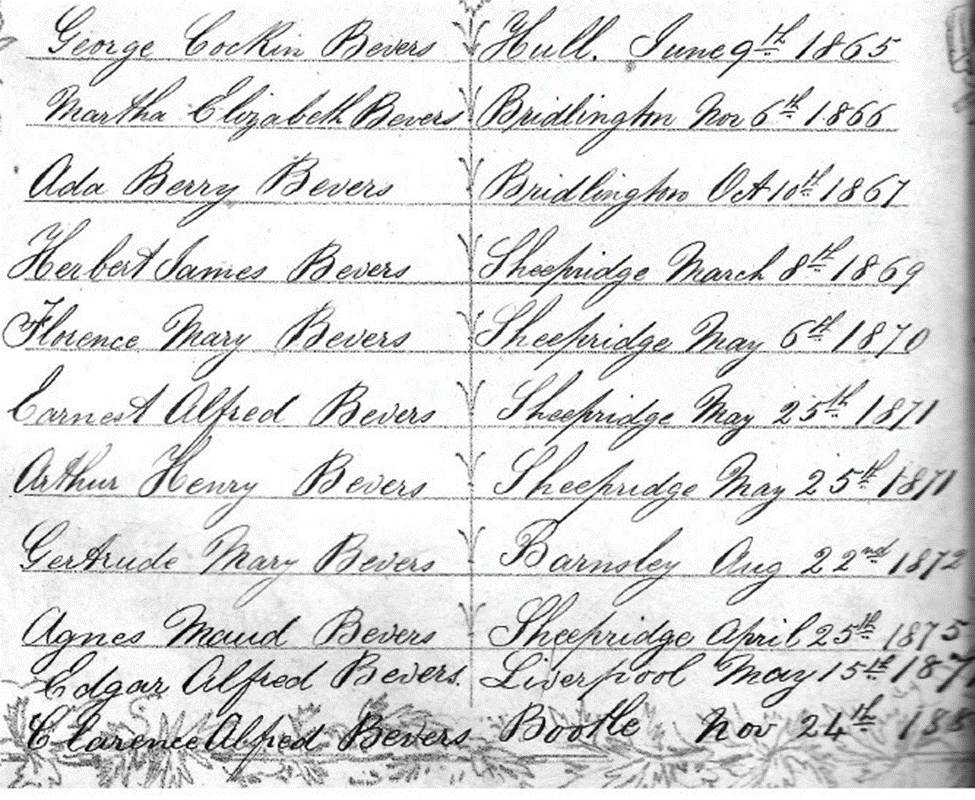
During George’s childhood Alfred and Mary Bevers moved their residence several times.  The locations are recorded in their Family Bible with every child’s birth, and sadly, with the deaths of some of George’s siblings.  By the time he was 17 years old, George had 10 siblings.  Six of his siblings died in their first year of life or shortly after.

List of “Children’s Names” with their birthplace and birthdate
in the Family Bible of Alfred C. and Mary N. Bevers

When George’s first and second sisters were born his family lived in Bridlington, Yorkshire.  The first one only lived 16 days; the second sister Ada would live to be 75 years-old.   At the next location, Sheepridge, Yorkshire, which is the town where George’s father had been born, four of George’s siblings were born: a brother, a sister and a set of twin boys.  The only one of these four who would survive was his brother Herbert and he would live to be 75 years-old.  When the 1871 census was recorded in Sheepridge, at the age of five George was a scholar and his father was a collector and canvasser for Prudential Insurance Company.6  Their next residence was south of Sheepridge in Barnsley, which is where his sister Gertrude was born.  Then the family returned to Sheepridge where George’s last sister Maude was born.  Gertrude would live to be 81 years-old and Maude would live to be 83.

On December 18, 1875, the Weekly Examiner, a newspaper published in Huddersfield, printed a lengthy article describing a concert performed by the school children of the Hillhouse School Board.  One of the students named in the article is a Master George Bevers.  Since Sheepridge, the town where the Bevers are known to have lived when Maude was baptized, is only about 1¼ mile from Hillhouse, it is possible that this article is referring to the subject of this blogpost.

CONCERT BY THE HILLHOUSE BOARD SCHOOL CHILDREN. – On Thursday night, the eighth annual concert by the children attending this school was given in the schoolroom, and the profit arising from it will be handed over to the Huddersfield Infirmary.  The room was very tastefully decorated for the occasion with mottoes and texts appropriate to the coming festival, and also with evergreens studded with artificial flowers, and a few pretty bannerets judiciously and effectively placed.  The concert was given by about seventy children, only those being chosen who could sing a little piece of music, chosen by Mr. Gaunt, their instructor, at sight, and one piece on the programme; and in making choice of the children to sing, neither their age nor the standard they were in was taken into account, but only their efficiency in the tonic sol fa method of singing.  The result was that, with the assistance of a few adults, a concert was given which, both for the quality of the music and the manner in which it was performed, would have done credit to much older scholars. …  The dialogues were well given, the accurate pronunciation of the words, and the absence of a “singing” style being very marked.  The first one was taken part in by the Misses Beatrice Waite, Clara Louisa Hirst, Clara Jane Brier, and Ellen Fisher, and Masters George Bevers, F. W. Thornton, Albert Victor Shaw ….  A very interesting part of the entertainment was the sight singing test, and before it took place, Mr. W. H. Bedford said some people had been under the misapprehension that it was to be a singing contest, but that was not the case; it was a test for the whole of the children together, to show that Mr. Gaunt’s teaching was real, and not that he had merely taught them to sing those pieces of music by ear.  He (Mr. Bedford), taking into account the ages of the children, had not gone in for anything very difficult or elaborate.  He had therefore written a long metre hymn tune.  The children would sol-fa it three times first, the treble part only, and then the other voices would join in.  Nobody present but himself had seen the music before that night.  Copies of the test piece were then given to each scholar, and they had to hold them with the print downwards till all had got a copy; then Mr. Gaunt gave the signal to start, and the tune (which is called Clara Street), was sol-faed three times by the children very accurately.  Next the other singers joined them, and it was sung through the use of the “la” only, and afterwards “Praise God from whom all blessings flow” was sung to the music, which, thus rendered, showed a simple grandeur of construction very commendable to the composer. … The room was crowded with the parents and friends of the children, and others who take an interest in the school, all of whom seemed to thoroughly appreciate and enjoy the concert, and they must have felt highly gratified with the successful manner in which Mr. Gaunt had trained the children, not in music merely, but musical knowledge.7

Sometime after Maude’s birth, the Bevers family made a long move west, across the country, to Liverpool where another brother was born.  Finally, Alfred and Mary would have their last child in Bootle, a town three miles north of Liverpool.  Both of these brothers passed away as infants.

In 1881, when the census of England was taken, the Bevers family resided at 97 Derby Road, Kirkdale, a ward of Liverpool.8  George, having completed his education through the 8th grade,9 at the age of 15, was a “pupil teacher” at a Church of England school and his father was a tailor’s cutter.10  When George was about 17 years-old, his father emigrated to America, and a year or two later, his mother and sisters followed George’s father.  Following the departure of their family, it is not known where George and his brother Herbert stayed.

Both brothers would also emigrate to the United States, and it is possible that they made the trip together in the fall of 1885.  Some of the details of an entry in a passenger list of the steamship, Lord Clive, correspond with information about George and Herbert, but some does not correspond.  This passenger list includes the names George Bevers and Herbert Bevers.11  The spelling is the correct spelling, but Ireland is recorded as their place of birth.  The Lord Clive departed from Liverpool, which would very likely be the port where the brothers would have departed.  This steamship arrived at the port of Philadelphia on December 1, 1885.  This date corresponds with information in the 1900 U. S. census which states that George C. Bevers immigrated in 1885.12 But the 1900 U. S. census record for Herbert J. Bevers indicates that he didn’t immigrate until 1888.13  The passenger list of the Lord Clive provides additional information about the men: they were both laborers, they had never been to the United States and they were not tourists.  Something that is missing on the ship manifest is the age of George and Herbert Bevers.  If that information had been recorded, there would have been additional information to confirm whether the record is about our families’ ancestors.

Passenger List of the Steamship “Lord Clive”

Upon immigrating to the USA, George settled in Philadelphia.  The first time there is an entry for him in the city directory of Philadelphia is in 1886 and he was the only Bevers listed in the directory that year.  He was a clerk and living at 1532 Herbine.14  This was the same residence as Arthur Wright, a tailor, who would the following year become George’s father-in-law.  Possibly, the Wright family and Bevers family were acquainted with each other in England.  Both families lived in wards of Liverpool in 1881 and both Alfred C. Bevers and Arthur Wright were tailors.

George and Evelina Bevers

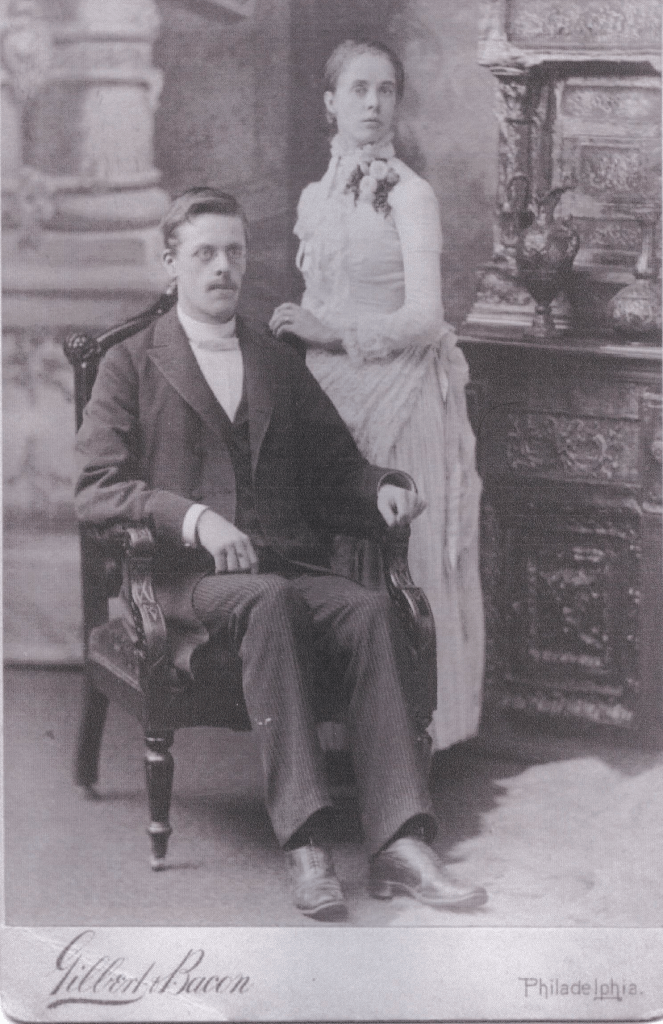
In 1887 and for a few years afterwards, the Philadelphia city directory would list George and Arthur at the same address: 47 Apsley in Germantown, which was a suburb northwest of Philadelphia.15  In that home on Friday September 2, 1887, George married Arthur’s daughter Evelina.16  The marriage record can be found in the marriage register of the Church of Saint John the Baptist, an Episcopal church.  One of the witnesses was Evelina’s brother Ernest Wright.  Two years later, the baptism register of this same church has a record of George and Evelina’s daughter Evelina.  The record documents her birth as September 8, 1889 and her baptism on Thursday, December 26, 1889.17  Two of the sponsors of the infant Evelina were her uncle Francis Wright and her aunt Louisa Wright, her mother’s brother and sister.  In July 1888, George had declared his intention to become a citizen of the United States.18


Above and below:
Marriage record of George C. Bevers and Evelina Wright,
Marriage register of the Church of Saint John the Baptist, Germantown, Pennsylvania


Above and below:
Baptismal record of Evelina Maude Bevers,
Baptism register of the Church of Saint John the Baptist, Germantown, Pennsylvania

The Philadelphia city directories of the 1890s give a few details of George’s life.

  • In 1891 and in following years, George’s occupation was listed as bookkeeper instead of clerk.19
  • In 1893, the address for George and Arthur was Old York Road, Milestown, a few miles northeast of Germantown.20  But the following year they returned to Germantown at “Pulaski a, N Apsley”21 and that year Evelina gave birth to a son, Arthur William Bevers on September 2, 1894.22
  • In 1895 and 1896, George and Arthur’s address would be 4460 Pulaski Avenue, Germantown.23 
  • Then in 1897, although George’s name was not listed in the directory, at the same address as in ’95 and ’96, Arthur’s name was listed along with Arthur’s newly widowed daughter-in-law Catherine Wright and his son Ernest G. Wright.24 
  • In 1899 George and Arthur were both living at 3308 N. Broad, Philadelphia.25 
  • In 1900 they would both change their residence again to 2211 Venango, Philadelphia,26 but the following year they would return to Germantown at 223 Apsley.27

From that point forward Arthur’s name would no longer be listed in the city directory.


“Originally a township independent of Philadelphia …. The establishment of Germantown as a permanent German settlement in America in 1683 put into place William Penn’s bold ideas of religious toleration of different faiths in one colony, bringing Quakers to Pennsylvania together with Mennonites, Dunkards, and other groups that had been unwelcome in England and Continental Europe.  In 1688 four Germantown settlers drafted a protest against slavery within the Dutch-German Quaker community that is considered to be the earliest antislavery document made public by whites in North America. …”28


The 1900 U. S. census tells us some information about George’s in-laws.  Arthur Wright was 63 years-old, born in England in August 1836.29  His occupation was “taylor-cutter.”  His wife was 69 year-old Eliza Wright, who was born in England in September 1830.  Arthur, Eliza and daughter Evelina had immigrated from England in 1883.  Arthur was renting a home and 35 year-old George with 38 year-old Evelina were living there, as well as their two children, 10 year-old Evelina and five year-old Arthur.  Also living in the household was another of Arthur Wright’s daughters.  She was 27 years-old and unmarried. A few years later, George’s in-laws would pass away. Eliza Ann Ventom Wright died on October 27, 190230 and Arthur died on March 18, 1904.31

From 1906 to 1911, the city directories of Philadelphia listed George’s address as 5607 Baynton, Germantown and the entries for 1909 and 1910 included his place of employment: “Mitchell & Bevers.”32  Apparently, George was in business with a man named Harry T. Mitchell.  In 1911, George’s occupation was listed simply as accountant, without the notation of his business.  This would be the last time that George’s name was printed in the Philadelphia city directory.

In July 1908, the Philadelphia Inquirer printed a news item about a meeting of the Artisans Order of Mutual Protection:

Germantown Assembly, No. 36, … on the 3d of July, held a unique entertainment for the enjoyment of the members.  Twenty-three questions in American history were propounded, and to the member answering the greatest number correctly was given a pair of beautiful American flags.  Strange to say, an Englishman, Bro. Geo. C. Bevers, won the prize with sixteen correct answers. …33

The Artisans Order of Mutual Protection was organized May 1, 1873, the result of gentlemen who desired “to devise a form of beneficial society, embracing improvement upon the old organizations as to death benefits, and a fraternal organization to give it strength and permanency.”34  The society is still in existence as of this writing, being “the second oldest fraternal insurance organization in the country.”  Its website explains its position in American society: “The role of fraternalism, along with the efforts of our schools and churches, is to form a powerful alliance with government to give us a more orderly, and economically successful society.”

As of the date of the above-mentioned Artisans fraternal meeting, July 3, 1908, the United States flag had 45 stars.  But beginning July 4, 1908, the flag had 46 stars because Oklahoma had been admitted to the union in November 1907.35  Most likely, George had been given two 46-star flags at the Artisans meeting.  The 46-star flag was flown until July 3, 1912, then it was replaced with a 48-star flag because New Mexico and Arizona had become states in the winter of 1912.  (See the flag of 1908 at https://en.m.wikipedia.org/wiki/File:Flag_of_the_United_States_(1908%E2%80%931912).svg)

The 1910 U. S. Census records that the Bevers family was living in a rented home at 5607 Baynton Street in Philadelphia,36 although the city directory indicates that this is in Germantown.   George was an accountant in private business working on his own account.  He was 44 years-old and Evelina was 48. They had been married for 23 years.  Their unmarried daughter Evelina was 19; she was not attending school and did not have an occupation.  Their son Arthur was 15 and attending school.

Two family events were held in Christ Church, an Episcopal church, in Germantown.  George and Evelina’s son was baptized on February 13, 1910.37 Then on December 2, 1911 their daughter was married to William P. Woodroffe.38  The Woodroffes would move to Brooklyn, New York where George and Evelina’s grandson Francis was born in 1914 and their granddaughter Mildred was born in 1919.39


Baptismal record of Arthur W. Bevers,
Baptism Register of Christ Church, Germantown, Pennsylvania

In 1917 the United States entered the great war which had been raging in Europe since 1914.  Arthur Bevers joined the Army and served in the Engineer Reserve Corps from September 1917 to December 1918.40   Upon entering the Army, he declared his residence as 39 Woodlawn Avenue, Aldan, Pennsylvania, which is the town where his parents were living when the 1920 U. S. census was taken.  Only a few months after Arthur’s entrance into the Army, George and Evelina made a trip to Camden, New Jersey to attend his marriage to Martha T. Severns on December 22, 1917.41  George and Evelina gained three more grandchildren when Dorothy was born in 1919, George was born in 1922 and William was born in 1923.

From this point forward the record trail for George and Evelina dwindles.  According to the 1920 U. S. census, they were living at 201 East Providence Road in Aldan, Pennsylvania, a small town west of Philadelphia.  George owned their house, he had a mortgage and he was a cashier at a mill.42  The census record also indicates that George had become a naturalized citizen of the United States in 1908 and that Evelina was naturalized as well, but no date is supplied in the record.

Only a couple of family events are known about George and Evelina’s life in the 1920s.  First, Evelina’s sister Louise Wright Millar died in 1924, and George submitted the information for her death certificate.43 Second, their daughter Evelina and her husband moved back to Philadelphia sometime after 1920 and in 1927 their third child Mary was born, George and Evelina’s sixth grandchild.44

When the U. S. census was taken in 1930, it appears that George and Evelina were still living in the same home in which they had lived 10 years earlier.  The home was valued at $10,000 and they owned a radio set.45  George at 64 years-old was a credit manager at a woolen goods establishment.  Evelina was 68 years-old.  A couple of family historians state that Evelina died on August 12, 1933 and one states that she was buried in Aldan on August 15, 1933, but documentation of Evelina’s death has not been located.  In the 1940 U. S. census, 74 year-old George was recorded as a widower, unable to work and he was living with his son Arthur in Inglewood, California at 520 W. Hillcrest Blvd.46  Arthur’s family included his wife Martha and their children Dorothy, George and William.  According to the census, five years earlier George had been living in Philadelphia.

Three years later Arthur supplied the information for George’s death certificate.  George had lived with Arthur for five years prior to his death and for the last five months of his life he stayed at Gray’s Sanitarium in Los Angeles, California.47  On June 21, 1943, twelve days after his 78th birthday, George succumbed to cardiac failure, having suffered from cardiac disease for a couple of years.  George’s body was cremated by Inglewood Park Cemetery, Inglewood, California.


1 FreeBMD, “Births registered in April, May, June 1865,” [vol. 9D, page 234] England & Wales, FreeBMD Birth Index, 1837-1915 (Provo, UT, USA: Ancestry.com Operations Inc, publisher, 2006): http://www.Ancestry.com.

2 V. Bettney, “Hull: A History,” The York Historian (August 8, 2017): https://theyorkhistorian.com/2017/08/08/hull-a-history/.

3 “Kingston upon Hull” (Wikipedia): https://en.wikipedia.org/wiki/Kingston_upon_Hull.

4 Encyclopaedia Britannica, editors, “William Wilberforce, British Politician,” Britannica (January 13, 2023): https://www.britannica.com/biography/William-Wilberforce.

5 V. Bettney, “Hull: A History”: https://theyorkhistorian.com/2017/08/08/hull-a-history/.

6 Ancestry.com, 1871 England Census [Class: RG10; Piece: 4372; Folio: 86; Page: 19; GSU roll: 848087], (Provo, Utah, USA: Ancestry.com Operations Inc., publisher, 2004): http://www.Ancestry.com.

7 Weekly Examiner (Huddersfield, West Yorkshire, England, December 18, 1875): 3.

8 Ancestry.com, 1881 England Census [Class: RG11; Piece: 3684; Folio: 133; Page: 23; GSU roll: 1341882] (Provo, Utah, USA: Ancestry.com Operations Inc., publisher, 2004): http://www.Ancestry.com.

9 “United States Census, 1940”, database with images, FamilySearch (ark:/61903/1:1:K975-B84 : Thu Mar 16 16:18:54 UTC 2023), Entry for Dorothy Bevers and George S Bevers, 1940.

10 Ancestry.com, 1881 England Census.

11 “Pennsylvania, Philadelphia Passenger Lists, 1883-1945,” database with images, FamilySearch (https://familysearch.org/ark:/61903/3:1:33SQ-GPBF-QKS?cc=1921481&wc=M616-JTP%3A214200701 : 21 May 2014), 006 – v. G, Jul 5, 1885-Dec 28, 1885 > image 393 of 448; citing NARA microfilm publication T840 (Washington, D.C.: National Archives and Records Administration, n.d.).

12 “United States Census, 1900,” database with images, FamilySearch (https://familysearch.org/ark:/61903/3:1:S3HY-DZV6-7M?cc=1325221&wc=9B7K-NQX%3A1030550501%2C1036056801%2C1036357801 : 5 August 2014), Pennsylvania > Philadelphia > ED 976 Philadelphia city Ward 38 > image 28 of 33; citing NARA microfilm publication T623 (Washington, D.C.: National Archives and Records Administration, n.d.).

13 “United States Census, 1900,” database with images, FamilySearch (https://familysearch.org/ark:/61903/3:1:S3HT-68DY-PH?cc=1325221&wc=9B7H-9LQ%3A1031648401%2C1033119401%2C1033119402 : 5 August 2014), South Dakota > Roberts > ED 282 Agency, One Road & Spring Grove Townships > image 4 of 11; citing NARA microfilm publication T623 (Washington, D.C.: National Archives and Records Administration, n.d.).

14 James Gopsill’s Sons, Publishers, Gopsill’s Street Index and City Guide of the City of Philadelphia (Philadelphia: James Gopsill’s Sons, Publishers, 1886): 182.

15 Gopsill’s Sons, Publishers, Gopsill’s Philadelphia City Directory (Philadelphia: Gopsill’s Sons, Publishers, 1887): 180 & 1843.

16 Historical Society of Pennsylvania, “St. John the Baptist Church, Germantown, 1876 to March 1891” in Pennsylvania and New Jersey, U.S., Church and Town Records, 1669-2013 [database on-line] (Lehi, UT, USA: Ancestry.com Operations, Inc., 2011): 200-01.

17 Historical Society of Pennsylvania, “St. John the Baptist Church, Germantown, 1876 to March 1891” in Pennsylvania and New Jersey, U.S., Church and Town Records, 1669-2013 [database on-line] (Lehi, UT, USA: Ancestry.com Operations, Inc., 2011): 100-01.

18 Ancestry.com, [Naturalization Petition of George C. Bevers], Pennsylvania, Federal Naturalization Records, 1795-1931 (Provo, UT, USA: Ancestry.com Operations, Inc., 2011).

19 James Gopsill’s Sons, Publishers, Gopsill’s Philadelphia City Directory (Philadelphia: James Gopsill’s Sons, 1891): 165.

20 James Gopsill’s Sons, Gopsill’s Philadelphia City Directory (Philadelphia: James Gopsill’s Sons, 1893): 169 & 2124.

21 James Gopsill’s Sons, Gopsill’s Philadelphia City Directory (Philadelphia: James Gopsill’s Sons, 1894): 173 & 2167.

22 Historical Society of Pennsylvania, “Christ Church and St Michaels Episcopal, Germantown, Philadelphia PA, 1899 to 1938” in Pennsylvania and New Jersey, U.S., Church and Town Records, 1669-2013 (Lehi, UT, USA: Ancestry.com Operations, Inc., 2011): 34-35.

23 James Gopsill’s Sons, Gopsill’s Philadelphia City Directory (Philadelphia: James Gopsill’s Sons, 1895): 164 & 2050.

24 James Gopsill’s Sons, Gopsill’s Philadelphia City Directory (Philadelphia: James Gopsill’s Sons, 1897): 2180.

25 James Gopsill’s Sons, Gopsill’s Philadelphia City Directory (Philadelphia: James Gopsill’s Sons, 1899): 197 & 2471.

26 James Gopsill’s Sons, Gopsill’s Philadelphia City Directory (Philadelphia: James Gopsill’s Sons, 1900): 197 & 2498.

27 James Gopsill’s Sons, Gopsill’s Philadelphia City Directory (Philadelphia: James Gopsill’s Sons, 1901): 215 & 2631.

28 D. W. Young, “Historic Germantown: New Knowledge in a Very Old Neighborhood,” The Encyclopedia of Greater Philadelphia: https://philadelphiaencyclopedia.org/essays/historic-germantown-new-knowledge-in-a-very-old-neighborhood-2/.

29 “United States Census, 1900”, database with images, FamilySearch (https://www.familysearch.org/ark:/61903/1:1:M3WT-MLY : 27 January 2023), Authur Wright, 1900.

30 Historical Society of Pennsylvania, “Kirk & Nice, Undertakers” [record books], in Pennsylvania and New Jersey, Church and Town Records, 1708-1985 (Provo, UT, USA: Ancestry.com Operations, Inc., 2011).

31 Historical Society of Pennsylvania, “Kirk & Nice, Undertakers” [record books].

32 C. E. Howe Co., Philadelphia City Register (Philadelphia: C. E. Howe Company, 1910): 213.

33 “Artisans Order of Mutual Protection,” Philadelphia Inquirer (Philadelphia, Pennsylvania, July 12, 1908): 3, Newspapers.com.

34 Artisans Order of Mutual Protection, “History”: http://www.artisansaomp.org/history.html.

35 Armed Forces History Collections, “Facts about the United States Flag,” Smithsonian Institution (Public Inquiry Services, September 2001): https://www.si.edu/spotlight/flag-day/flag-facts.

36 “United States Census, 1910,” database with images, FamilySearch (https://familysearch.org/ark:/61903/3:1:33S7-9RKV-WRB?cc=1727033&wc=QZZH-W5T%3A133638001%2C143194401%2C143376101%2C1589124991 : 24 June 2017), Pennsylvania > Philadelphia > Philadelphia Ward 22 > ED 407 > image 15 of 24; citing NARA microfilm publication T624 (Washington, D.C.: National Archives and Records Administration, n.d.).

37 Historical Society of Pennsylvania, “Christ Church and St Michaels Episcopal, Germantown, Philadelphia PA, 1899 to 1938”: 34-35.

38 Historical Society of Pennsylvania, “Christ Church and St Michaels Episcopal, Germantown, Philadelphia PA, 1899 to 1938”: 388-389.

39 The National Archives at Philadelphia, Philadelphia, Pennsylvania, “Petition of Naturalization” [of Evelina M. Woodroffe] in Pennsylvania, U.S., Federal Naturalization, 1795-1931 (Lehi, UT, USA: Ancestry.com Operations, Inc., 2011).

40 Ancestry.com, Pennsylvania, U.S., World War I Veterans Service and Compensation Files, 1917-1919, 1934-1948 (Lehi, UT, USA: Ancestry.com Operations, Inc., 2015).

41 Ancestry.com, “St. John’s Church, Camden, N. J. 2d Appendix to Volume 3, Marriages,” New Jersey, U. S., Episcopal Diocese of New Jersey, Church Records, 1700-1970 (Lehi, UT, USA: Ancestry.com Operations, Inc., 2021): 118.

42 “United States Census, 1920”, database with images, FamilySearch (https://www.familysearch.org/ark:/61903/1:1:M61K-TBX : 3 February 2021), George C Bever, 1920.

43 Ancestry.com, Pennsylvania, U.S., Death Certificates, 1906-1968 (Lehi, UT, USA: Ancestry.com Operations, Inc., 2014).

44 The National Archives at Philadelphia, Philadelphia, Pennsylvania, “Petition of Naturalization” [of Evelina M. Woodroffe].

45 “United States Census, 1930,” database with images, FamilySearch (https://familysearch.org/ark:/61903/3:1:33SQ-GRZH-HT?cc=1810731&wc=QZF7-YD9%3A649490601%2C649796601%2C649796602%2C1589282332 : 8 December 2015), Pennsylvania > Delaware > Aldan > ED 1 > image 14 of 22; citing NARA microfilm publication T626 (Washington D.C.: National Archives and Records Administration, 2002).

46 “United States Census, 1940”, database with images, FamilySearch (ark:/61903/1:1:K975-B84 : Thu Mar 16 16:18:54 UTC 2023), Entry for Dorothy Bevers and George S Bevers, 1940.

47 “California, County Birth and Death Records, 1800-1994,” database with images, FamilySearch (https://familysearch.org/ark:/61903/3:1:3QS7-89SV-Y9CV-J?cc=2001287&wc=FP4T-DP8%3A285176601%2C285575401 : 27 September 2019), Los Angeles, Los Angeles > Death certificates 1943 no 7540-9600 > image 2603 of 2794; California State Archives, Sacramento.

Reminiscences of Uncle Bob, Part Seven

In the late 1930s, Charles and Maggie Daily were living in Watertown, South Dakota, in a duplex that they had bought in 1935.  Their grandsons Lee and James Bevers, sons of their deceased daughter Gladys, came to live with them in order to attend high school.1  (As of 1935, the boys’ family was living on a farm about 15 miles southwest of Watertown.) Decades later, Lee remembered his grandmother as a tall woman, probably 5’ 9,’’ and he reported that when Lee was 15 years old, Maggie had given each of the boys a watch.

 When the U. S. Census was taken in 1940, Charles was 83 years old and Maggie was 72.2 Their daughter Oranna Mills, age 43, and her 14 year-old son George, who had been living with Charles and Maggie for at least 10 years, were still living with them.  The census record indicates that both Charles and Maggie were unable to work, and Oranna was engaged in home housework.  All three noted that in 1939 they had received $50.00 or more in income that was not wages or salary.  (Their son Robert Daily stated in an interview that Charles and Maggie received $10.00 per month for renting out the opposite half of the duplex that they owned.)3 George was in school and had completed 7th grade.  In addition to the regular census questions, Charles was selected to answer supplementary questions.  In answer to a question regarding his usual occupation during the previous 10 years, Charles stated he had been a common laborer and had worked on his own account.  Oranna’s eldest son Guy, who had been living with Charles and Maggie for much of his life, was working as a “hired worker” on a farm in Oxford Township, Hamlin County, South Dakota.4

At the time of the census, Charles and Maggie’s other three children were living in townships surrounding Watertown.  Robert and Ruby Daily had four children and were living in Lake Township, west of Watertown.5 Iona and Robert Zick also had four children.  They were living in Rauville Township, north of Watertown.6 Elizabeth and Willis Bevers had seven children and were living in Pelican Township,7 southwest of Watertown, which was not far from Arthur and Elsie Bevers who were living in Kampeska Township.8 Arthur had been the husband of Charles and Maggie’s eldest daughter Gladys who had died in 1934.  (Incidentally, Arthur’s eldest son Lee was living with Elizabeth and Willis and working as a farm hand.)  Thus, along with Arthur and Gladys’ eight children, Charles and Maggie had 25 living grandchildren.

In order to attend Watertown High School, in the fall of 1939 Charles and Maggie’s granddaughter Virginia, daughter of Elizabeth and Willis, moved in with her paternal grandparents, Herbert and Lena Bevers.  They were living just a few blocks away from the Dailys.  Two years later, still living with the Bevers, Virginia became ill and developed pneumonia.  Within two weeks she succumbed to the illness, passing away on November 13.  This tragedy occurred only a few days before Charles and Maggie were to celebrate a momentous occasion in their lives, the 50th anniversary of their wedding day, November 18, 1941.  To commemorate their 50th wedding anniversary, Maggie and Charles sat for a portrait.  The pendant watch that Maggie is wearing in the photograph below is in the possession of one of Maggie’s granddaughters.

50th Wedding Anniversary Portrait (November 18, 1941)
Pendant Watch with Maggie’s Initials, M. O. D., in the center
Back of Maggie’s Pendant Watch
Open Pendant Watch

Less than three weeks later, on December 7, 1941, Pearl Harbor in Hawaii was bombed by Japanese aircraft.  The next day the United States declared war on Japan.  A week later Germany declared war on the United States.  During the next several years, six of Charles and Maggie’s grandsons would serve in the military.  Their eldest grandson Guy Mills entered the army in September 1942, listing his home address as Charles and Maggie’s home.9 He served until November 1945.  Guy’s brother, George Mills, who also gave his home address as Charles and Maggie’s home, enlisted in the Navy in July 1943.10 He trained to be an aviation radioman and gunner, and was assigned to the aircraft carrier USS Bismarck Sea in the western Pacific.11 He flew on 23 combat missions from the flight deck of the Bismarck Sea, including observation patrols over Iwo Jima on D-Day (February 19, 1945).  When the Bismarck Sea was sunk by a Japanese aerial attack in February 1945, George survived and spent leave at his home in Watertown before resuming flying duty.


Over time, the term “D-Day” has become associated with the beginning of the World War II invasion of Normandy, France by the Allied Forces, because that military event turned the war in Europe in favor of the Allies.  But during both World War I and World War II, the term “D-Day” was a military term used for a variety of operations.  The definition of “D-Day” was in question even the week following the invasion of Normandy.  A reader of Time magazine wrote, “Everybody refers to D-Day, H-Hour. Can you please tell me what they stand for or how they originated?”  The Time editor replied:

D for Day, H for Hour means the undetermined (or secret) day and hour for the start of a military operation. Their use permits the entire timetable for the operation to be scheduled in detail and its various steps prepared by subordinate commanders long before a definite day and time for the attack have been set. When the day and time are fixed, subordinates are so informed.12


The other four grandsons that served in World War II were sons of Arthur Bevers:

Lee was in the Air Force in England, flying over Germany until he was shot down and spent the last year of the war in a prison camp.  James and Dale, in the Navy, saw action under fire of the Japanese in the Pacific.  James was on a mine sweeper while Dale served on a cruiser.  Arthur, Jr. was with the Army in Hawaii until the end of the war.13

When asked about his grandparents, Lee Bevers stated that when he was in the Army Air Corp, Maggie wrote to him every week.14  Lee himself was an avid letter writer as well, as evidenced in a diary that Lee kept when he was in the military.  The first entry is dated October 29, 1943 in Grand Island, Nebraska, from which he began traveling to the base he was assigned overseas.  On his way to the base in England, there were stops in Wilmington (Delaware), Newfoundland, Ireland, Scotland and a few towns in England.  It was December 6th when he finally arrived at the base from which he would fly over northern Europe.  Lee noted in his diary when he wrote letters and when he received letters.  Sometimes the mail was delayed, and when it was finally delivered, he would get more than one letter from the same person, though the letters had been written several days apart. On November 25, 1943, Thanksgiving Day, he wrote letters to both sets of grandparents, which would be Charles and Maggie Daily and Herbert and Lena Bevers.15  His diary indicates that he wrote to “Grandma D” on December 27, 1943, January 9, 14, 28, February 5, 11, 18, 27, March 4, 16, 26 and April 7, 1944.  In the March 4th letter which he sent to Maggie, he included $40.00.  The entries in Lee’s diary abruptly end on April 12, 1944.  The following day while he was flying his 26th mission, his plane was shot down and he was taken prisoner.  For the remainder of the war, Lee was held in a prison camp near Frankfort, Germany.


In the winter of 1945, Charles fractured his hip.  According to his granddaughter Phyllis (nee Bevers) DeBoer, he spent his last days in the living room of his home in a bed that was like a hospital bed (it was on wheels), while Maggie took care of him.16  He also developed bronchio-pneumonia which led to his death on March 9th.17  He was 88 years-old.  His funeral service was held on March 12 and he was buried in Mount Hope Cemetery in Watertown.


On Sundays, Elizabeth and her children would often go to dinner at her parents’ home.  One of Elizabeth’s children remembers regularly going to the Daily’s duplex after going to church.  All the children would sit on the open stairway of the front room to eat their mid-day dinner.18  During one of those Sunday visits in August 1946, Maggie enjoyed the company of her four living children and many of her grandchildren.  Everyone in attendance gathered in front of the house to take photographs.

Elizabeth Bevers, Iona Zick, Maggie Daily, Oranna Mills, Robert Daily
Written on the back of the above photograph
Maggie in center of top row with many of her descendants.

Between 1940 and 1946, Iona gave birth to her last child, and Elizabeth gave birth to three more children, the last one, Maggie’s 31st grandchild, arriving in November following the family gathering in the above photograph.  In April 1942, Robert’s first granddaughter was born, giving Charles and Maggie their first great-grandchild.  Lee Bevers had married in the summer of 1943 and a son was born to them in April 1944, only eight days after Lee had become a prisoner of war.  This was Charles and Maggie’s second great-grandchild.  Their third great-grandchild arrived when Robert’s second grandchild was born in January 1945.  Then in 1946, two of Robert’s daughters each had a baby – two more great-grandchildren.

During the fall of 1946 and winter of 1947, Maggie experienced “declining health,” eventually passing away at her home on March 11, 1947.19  She was 79 years-old.  The causes of death cited on her death certificate are melano carcinoma of the skin with metastasis to liver, pernicious anemia and senility.  She was survived by her daughters Oranna, Iona and Elizabeth and her son Robert and by twenty-eight grandchildren and five great-grandchildren.  Maggie was buried beside Charles in Mount Hope Cemetery in Watertown.

Maggie and Charles Daily are buried in Mount Hope Cemetery, Watertown, South Dakota

To conclude the series of blogposts about Charles and Maggie Daily which feature the reminiscences of their son Robert L. Daily, here is one more excerpt from the interview he gave about 1984:

Uncle Bob:  … well, Dad had made a deed out for Mother, when he bought the place.  Yeah, that’s the way he done it, handled things that way.  But he made a deed out –

Interviewer:  Um hmm.

Uncle Bob:  — for Mother to have.  So, when Mother lived alone …. Figured I’d talk to Willis and to Rob. An’ ‘course Arthur was otherwise ….

[These were Charles and Maggie’s sons-in-law who were married to Elizabeth, Iona and Gladys, respectively.]

Interviewer:  Um hm, um hm.

Uncle Bob:  … so Mother made a deed out for me.

Interviewer:  Um hm.

Uncle Bob:  An’ that helped like ev’rythin’ because when Mother passed away, instead of having a probate, or have to go through all that stuff that way, why, they had somebody to do –

Interviewer:  Yeah, then it was all taken care of.  Right.

Uncle Bob:  Yeah, … then I cleared up that debt.  An’ then I … modernized it after that.  In other words, I had to, I had the whole thing re-wired, top to bottom, because it was, when I went up in the attic an’ seen them, all bare wires up in the attic.

Interviewer:  Oh, I’m sure it was –

Uncle Bob:  Y’know in those days they didn’t, they didn’t have no plug-ins down at the bottom.

Interviewer:  No.

Uncle Bob:  Ever’thin’ come off one o’ them socket, see, an’ they put too many, too many appliances on a socket.  An’ it took the insulation off the wires up there.

Interviewer:  I remember the oil parlor furnace in the living room.

Uncle Bob:  Yeah, yeah.

Interviewer:  Yeah, that’s the only house I remember grandma being in.

Uncle Bob:  Then I had to, had to bring the water and sewer all in.

Interviewer:  Yah, we used a – there’s a cistern under there, isn’t there?

Uncle Bob:  Well, they, we had two uh, two uh, sand points.  One for each side.

Interviewer:  Okay, it was sand point, it was not cistern.

Uncle Bob:  No, no.  We had the out, the toilets outside.

Interviewer:  That’s right, that’s right. 

Uncle Bob:  Yeah, the toilets outside.  Sometime I brought that all in.  An’ I paid twenty-five hundred dollars for, for bringin’ the water in, the water – to modernize it, that way.

Interviewer:  Um hm, um hm.

Uncle Bob:  An’ paid Roger sixteen hundred dollars for, uh, to re-wire the whole thing.

Interviewer:  Oh, I’m sure that it cost quite a bit.20


  1. L. A. Bevers, interview with M. R. Wilson, August 2, 2010.
  2. “United States Census, 1940,” database with images, FamilySearch (https://familysearch.org/ark:/61903/3:1:3QSQ-G9M1-5855?cc=2000219&wc=QZFM-WRZ%3A791611401%2C793270701%2C793367301%2C793379401 : accessed 22 November 2021), South Dakota > Codington > Watertown City, Watertown, Ward 3 > 15-24B Watertown City Ward 3 bounded by (N) 4th Av S; (E) Maple, ward line; (S) city limits; (W) city limits, ward line > image 3 of 24; citing Sixteenth Census of the United States, 1940, NARA digital publication T627. Records of the Bureau of the Census, 1790 – 2007, RG 29. Washington, D.C.: National Archives and Records Administration, 2012.
  3. M. R. Wilson, transcription of Robert Lee Daily Interview by R. Thiele, recording (ca. 1984): 28.
  4. “United States Census, 1940,” database with images, FamilySearch (https://familysearch.org/ark:/61903/3:1:3QS7-L9M1-5833?cc=2000219&wc=QZFM-3CZ%3A791611401%2C795183601%2C790385801%2C795237102 : accessed 12 March 2022), South Dakota > Hamlin > Oxford Township > 29-19 Oxford Township (Township 115 Range 53 and Township 115 Range 54 (part)) > image 11 of 14; citing Sixteenth Census of the United States, 1940, NARA digital publication T627. Records of the Bureau of the Census, 1790 – 2007, RG 29. Washington, D.C.: National Archives and Records Administration, 2012.
  5. “United States Census, 1940,” database with images, FamilySearch (https://familysearch.org/ark:/61903/3:1:3QSQ-G9M1-588Q?cc=2000219&wc=QZFM-3RR%3A791611401%2C793270701%2C790542101%2C951343301 : accessed 16 December 2021), South Dakota > Codington > Lake Township > 15-12 Lake Township (Townships 117 and 118 Range 52 inside Old Sisseton and Wahpeton Indian Reservation and Township 117 Range 53 (part)) outside Watertown City > image 6 of 11; citing Sixteenth Census of the United States, 1940, NARA digital publication T627. Records of the Bureau of the Census, 1790 – 2007, RG 29. Washington, D.C.: National Archives and Records Administration, 2012.
  6. “United States Census, 1940,” database with images, FamilySearch (https://familysearch.org/ark:/61903/3:1:3QS7-89M1-588J?cc=2000219&wc=QZFM-3DS%3A791611401%2C793270701%2C793332701%2C951346101 : accessed 16 December 2021), South Dakota > Codington > Rauville Township > 15-16 Rauville Township (Township 118 Ranges 52 and 53 outside Old Sisseton and Wahpeton Indian Reservation Line and Townships 118 and 119 Range 52 (part) inside Old Sisseton and Wahpeton Indian Reservation Line) > image 8 of 11; citing Sixteenth Census of the United States, 1940, NARA digital publication T627. Records of the Bureau of the Census, 1790 – 2007, RG 29. Washington, D.C.: National Archives and Records Administration, 2012.
  7. “United States Census, 1940,” database with images, FamilySearch (https://familysearch.org/ark:/61903/3:1:3QS7-89M1-5864?cc=2000219&wc=QZFM-36G%3A791611401%2C793270701%2C793326301%2C793326302 : accessed 16 December 2021), South Dakota > Codington > Pelican Township > 15-14 Pelican Township (Township 116 Range 53 (part)) outside Watertown City > image 4 of 9; citing Sixteenth Census of the United States, 1940, NARA digital publication T627. Records of the Bureau of the Census, 1790 – 2007, RG 29. Washington, D.C.: National Archives and Records Administration, 2012.
  8. “United States Census, 1940,” database with images, FamilySearch (https://familysearch.org/ark:/61903/3:1:3QSQ-G9M1-588N?cc=2000219&wc=QZFM-QC9%3A791611401%2C793270701%2C793309301%2C793309302 : accessed 16 December 2021), South Dakota > Codington > Kampeska Township > 15-10 Kampeska Township (Township 116 Range 54) > image 4 of 13; citing Sixteenth Census of the United States, 1940, NARA digital publication T627. Records of the Bureau of the Census, 1790 – 2007, RG 29. Washington, D.C.: National Archives and Records Administration, 2012.
  9. “U. S., World War II Draft Cards Young Men, 1940-1947” (Ancestry.com Operations, Inc., Lehi, Utah, USA, 2011).
  10. “U. S., World War II Draft Cards Young Men, 1940-1947” (Ancestry.com Operations, Inc., Lehi, Utah, USA, 2011).
  11. __________, “Survives” (news article), source unknown.
  12. K. Moon, “What Does the ‘D’ in ‘D-Day’ Stand For? Experts Disagree With Eisenhower’s Answer,” Time (June 4, 2019): https://time.com/5599811/d-day-meaning/.
  13. Hamlin Historical Committee, “Bevers Family,” Hamlin County 1878-1979: 141.
  14. Bevers, interview with M. R. Wilson.
  15. L. A. Bevers, personal diary, October 29, 1943 – April 13, 1944.
  16. P. I. DeBoer, interview with M. R. Wilson, August 3, 2010.
  17. M. A. Bevers, notes about the death certificate of Charles M. Daily, accessed from “Bevers-Daily-McFerran-Nelson Families” on Ancestry.com.
  18. E. J. Jones, interview with M. R. Wilson, ca. July 2010.
  19. “Maggie Daily Dies At Home Here, Illness,” (published obituary, publication unknown).
  20. Wilson, Robert Lee Daily Interview: 29-30.