The Oldest Mementos of “The Breitenstein Bible”

“The Breitenstein Bible” came into possession of our family when my mother-in-law passed away.  For a dozen years, it remained packed away, undisturbed.  Finally, when down-sizing our belongings and upon deciding to pass the Bible on to our son, I took the time to look through the Bible.  Turning the leaves, I found news clippings, obituaries and funeral folders dispersed between its more than 2000 pages.  Another dozen years would pass before I had the opportunity to peruse those pages and mementos again.  In December 2023, I examined the Bible and photographed the mementos it has safe-guarded for decades, a few items for more than a century.  This blogpost is devoted to the oldest items in “The Breitenstein Bible” and the people with whom they are connected.  A description of the Bible itself, which was published about 1900, can be found on the Legacy Page entitled “The Breitenstein Bible.”

The Bible had been passed down to my mother-in-law through her father, who was a Breitenstein, but the oldest mementos would suggest that the Bible came to him from his mother’s line not his father’s. The oldest identifiable item is a handwritten note about Amos Goodhart. My mother-in-law’s ancestry can be traced to Amos K. Goodhart, so perhaps the Bible should be called “The Goodhart Bible.”

The original owner of the Bible is unknown.  None of the family register pages are filled in.  Besides the note about Amos Goodhart, there are two other handwritten notes which appear to be written in the same handwriting.  Since Amos’ wife had already passed away when he died, I propose that it was his daughter Sarah (Sallie) that wrote the notes.  Sallie married Jacob B. Breitenstein; they were my mother-in-law’s grandparents.
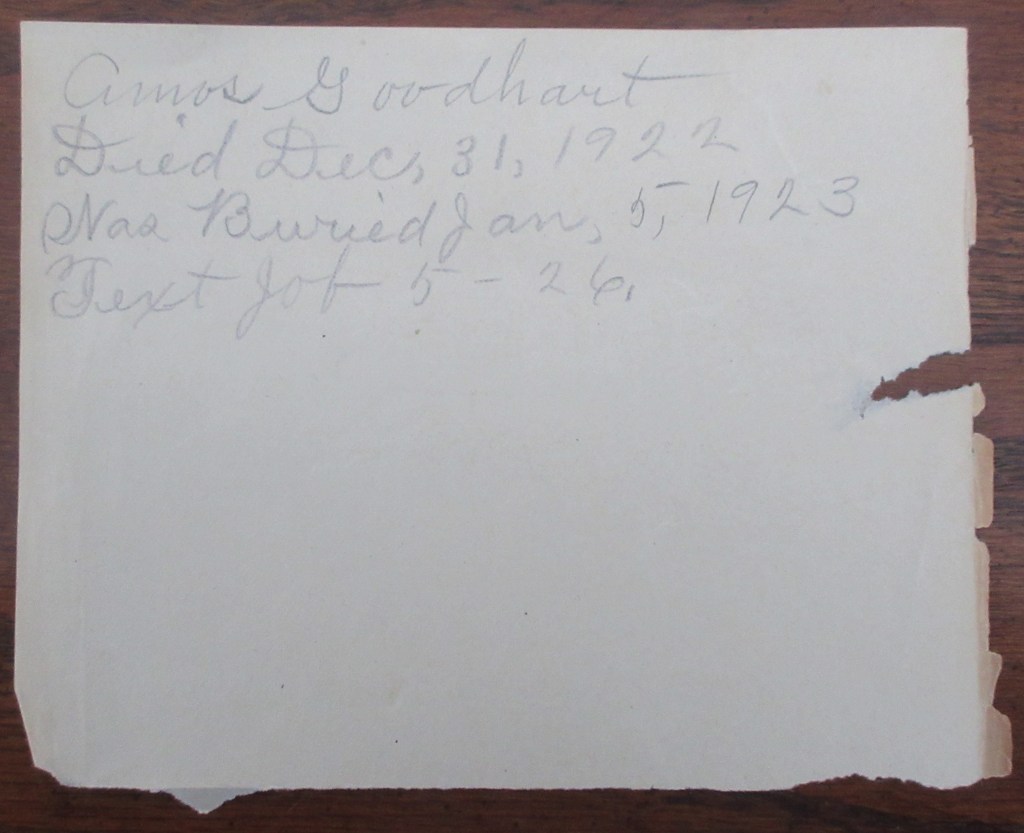
The oldest handwritten note found in “The Breitenstein Bible”

Amos’ ancestors had been living in Berks County, Pennsylvania, since at least 1754, when it was still a province.  His 2nd great-grandfather Fredrick Goodhart was recorded as residing in the district (or township) of Alsace when a tax list was created for the first assessment of taxes of the newly organized Berks County (which had been carved out of Philadelphia County).1  Fredrick Goodhart’s son, Frederick, acquired a homestead in Exeter Township.2  At the time of Amos’ death, the Goodharts had been residing in Exeter Township for roughly 130-140 years. Amos K. Goodhart, born February 23, 1852, was the son of John Newkirk Goodhart (1821-1898) and Sophia Kline (1827-1902).  As a child his family lived in Exeter Township3 and upon marrying Ellen Levan, they began raising their family on a farm in the township,4 remaining in Exeter Township their whole lives.

This handwritten note documents the dates of Amos’ death and burial, and very likely the text that was used at his funeral.  He was buried in the Schwarzwald Cemetery on January 5, 1923, having died on December 31, 1922 of “complications” according to the death register of Schwarzwald Reformed Church.5  In addition to his death, the church records also have an entry about his baptism and confirmation, which didn’t occur until he was 43 years old.6  Having been catechized, Amos was baptized on October 12, 1895 and then confirmed on the following day. Amos’ son Victor and his daughter Sarah were confirmed on that very same day. 

Job 5:26 as printed in “The Breitenstein Bible,” which is the text recorded along with Amos Goodhart’s death and burial dates.

Of the two other handwritten notes in “The Breitenstein Bible,” one note gives the burial date of Mrs. Hiester Fisher and the reference to a scripture text.  The other note simply states the name Mrs. Frank Harner and a scripture reference.  Over the years, as I’ve compiled a genealogy of my husband’s family, I have never seen the name Fisher nor Harner.  So, I proceeded to try to identify who Mrs. Hiester Fisher and Mrs. Frank Harner were.

In my search for someone named Hiester Fisher, I came up with no likely candidates.  But a search using the spelling Heister (e before i) led me to someone that could be the husband of the woman commemorated in “The Breitenstein Bible.”  In 1920, Sallie Breitenstein (Amos’ daughter) and her husband were living in Amity Township in Berks County.7  There was also living in this township a Heister Fisher with his wife Ellen.8  A few years later Ellen and subsequently Heister were buried in Saint Paul’s Church Cemetery in Amity Township.  The date of death engraved on Ellen’s gravestone is January 10, 1924,9 which would correspond to the burial date listed on the handwritten note, January 14.  A search in family trees on Ancestry.com leads to the conclusion that her maiden name was most likely Ellen Wise or Weise or Weiss.  She would have been in the generation of Sallie’s mother. Incidentally, Saint Paul’s Church Cemetery is where Sallie and her husband would later be buried. 
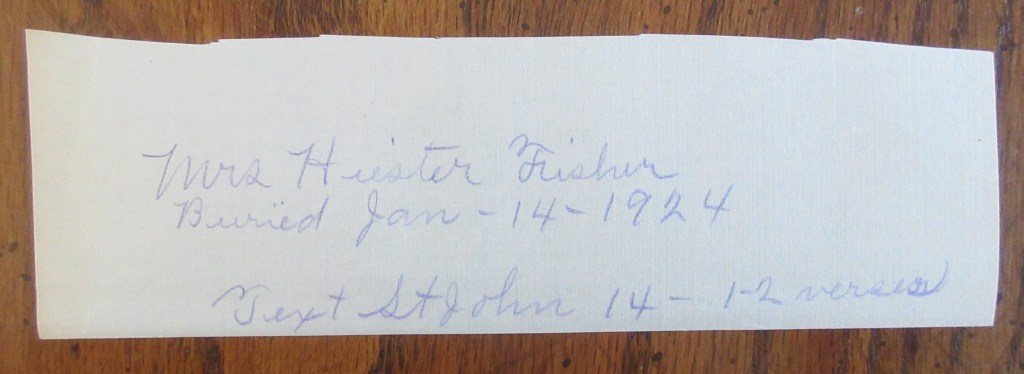
Presumably, the second-oldest handwritten note in “The Breitenstein Bible”
John 14:1-2 as printed in “The Breitenstein Bible,” which is the text recorded along with Mrs. Hiester Fisher’s burial date

Since the handwritten note about Mrs. Frank Harner doesn’t have a death or burial date, it is difficult to determine with any certainty who she was.  My guess is that she was Catherine (Kate) S. Rhoads who is buried in Saint Paul’s Church Cemetery with her husband, Franklin, but the last name on the gravestone is Herner, instead of Harner.  Kate Rhoads was also of the generation of Sallie’s mother.  Her death date was April 8, 1925.10  Kate’s sister, Rosa Ellen Rhoads, had married a man named Wellington Wise,11 who was possibly a relation of Ellen Wise (Mrs. Heister Fisher above.)
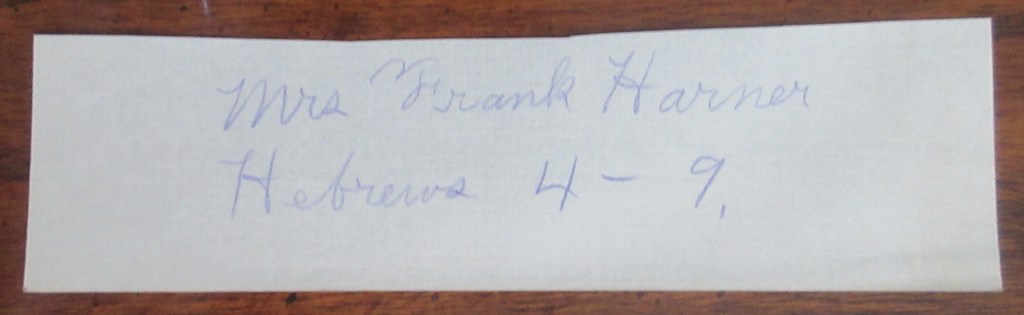

Presumably, the third-oldest handwritten note in “The Breitenstein Bible”
Hebrews 4:9 as printed in “The Breitenstein Bible,” which is the text noted with Mrs. Frank Harner’s name

There is an item in “The Breitenstein Bible” that is older than the three handwritten notes.  It is a lock of hair wrapped in a scrap of newsprint dated June 21, 1918.  Perhaps this could be the hair of Ellen S. Goodhart, saved as a memento by her husband Amos or her daughter Sallie.  Born March 29, 1849, Ellen was the daughter of Peter S. Levan (1822-1894) and Sarah E. Snyder (1825-1898).  One historian of Berks County made this statement in 1886: “The Levan family have occupied a prominent position in [Exeter] township for one hundred and fifty years, having, during this time, owned a large area of farming land where the members of that family are now located.  They gave much encouragement to the Schwartzwald Church by liberal contributions.”12  The Levan family can be traced back to three brothers whose father Daniel Levan was a French Huguenot.  “The Huguenots were French Protestants most of whom eventually came to follow the teachings of John Calvin, and who, due to religious persecution, were forced to flee France to other countries in the sixteenth and seventeenth centuries.”13  Daniel Levan fled from France to Amsterdam, Holland, which is where Isaac Levan was born, Ellen Levan’s 4th great-grandfather.14  Isaac and his brothers emigrated from Amsterdam to America and Isaac eventually settled in Exeter Township about 1730.
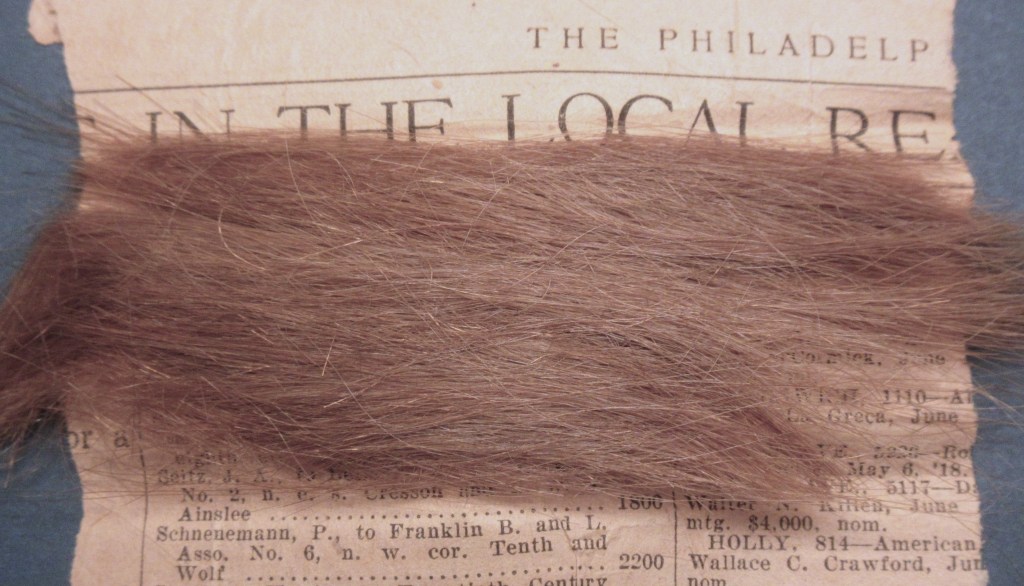
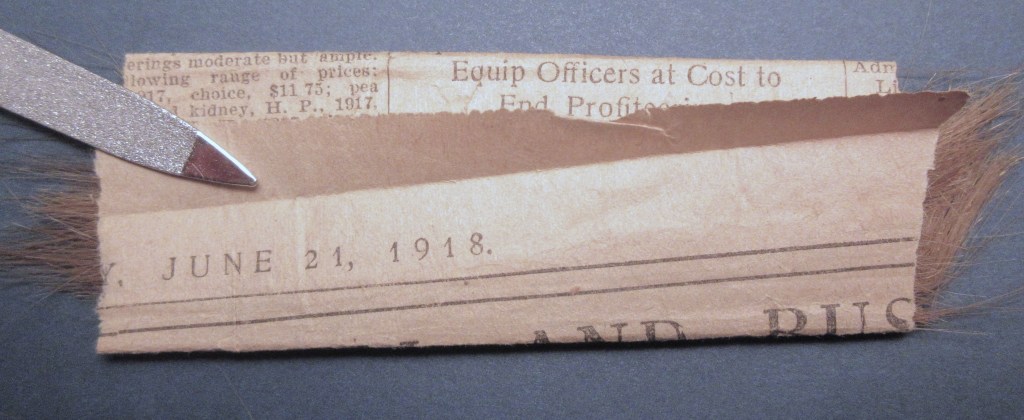
A lock of hair, which was wrapped in a scrap of newsprint, found in “The Breitenstein Bible”
The scrap of newsprint dated June 21, 1918

Ellen Goodhart died on October 19, 1918 and was buried in Schwarzwald Cemetery.15  Like her husband, her death was recorded in the death register of Schwarzwald Reformed Church.  During that time period, the usual number of burials per month in that cemetery was one or two, or sometimes three.  But in October 1918, the death register lists seven people dying between October 14 and October 27.  Although the causes of death were recorded as heart disease, pneumonia, tuberculosis, and influenza, consideration should be given to an historic event that was taking place in Pennsylvania during the fall of 1918.  An epidemic of influenza had begun in Philadelphia in late September and travelled from the city west through the state, reaching Berks County.

In The Great Influenza, author John M. Barry thoroughly relates the events and timelines of many of the outbreaks of influenza in the United States, and a few places abroad, from 1917 to 1919.  He devotes a portion of his book to the rise of the epidemic in Philadelphia.16  The details and quotes below are from Barry’s book.  In 1918 influenza spread to Pennsylvania when on “September 7, three hundred sailors arrived from Boston at the Philadelphia Navy Yard.”  Four days later, “nineteen sailors reported ill with symptoms of influenza.”  Knowing that influenza was wreaking havoc in Boston:

Lieutenant Commander R. W. Plummer, a physician and chief health officer for the Philadelphia naval district … ordered the immediate quarantine of the men’s barracks and the meticulous disinfecting of everything the men had touched. …

… The next day eighty-seven sailors reported ill.  By September 15, … the virus had made six hundred sailors and marines sick enough to require hospitalization, and more men were reporting ill every few minutes”.

On September 18, “…the Evening Bulletin assured its readers that influenza posed no danger, was as old as history ….”  The first two sailors dying of influenza in Philadelphia occurred the next day.  “…Plummer declared, ‘The disease has about reached its crest.  We believe the situation is well in hand.  From now on the disease will decrease.’”  The city’s director of public health, Dr. Wilmer Krusen insisted that “the dead were not victims of an epidemic; he said that they had died of influenza but insisted it was only ‘old-fashioned influenza or grip.’”  The next day fourteen sailors died and the first civilian died.  The following day there were more than twenty deaths.

On September 21, the city’s Board of Health “assured the city that it was ‘fully convinced that the statement issued by Director Krusen that no epidemic of influenza prevails in the civil population at the present time is absolutely correct.’”

Seven days later, on September 28, a great Liberty Loan parade, designed to sell millions of dollars of war bonds, was scheduled.  Weeks of organizing had gone into the event, and it was to be the greatest parade in Philadelphia history, with thousands marching in it and hundreds of thousands expected to watch it.

Influenza continued spreading through the city, “… the day before the parade, hospitals admitted two hundred more people – 123 of them civilians ….”  Even though several doctors urged Krusen to cancel the parade, “Krusen declared that the Liberty Loan parade and associated rallies would proceed.”

On September 28, marchers in the greatest parade in the city’s history proudly stepped forward.  The paraders stretched at least two miles, two miles of bands, flags, Boy Scouts, women’s auxiliaries, marines, sailors, crushing against each other to get a better look, the ranks behind shouting encouragement over shoulders and past faces to the brave young men.  It was a grand sight indeed.

Two days after the parade, Krusen issued a somber statement: ‘The epidemic is now present in the civilian population and is assuming the type found in naval stations and cantonments.’

… Within seventy-two hours after the parade, every single bed in each of the city’s thirty-one hospitals was filled.  And people began dying.

… On October 1, the third day after the parade, the epidemic killed more than one hundred people – 117 – in a single day.

From Philadelphia the epidemic spread west into Pennsylvania.  Three weeks after the parade, people in Berks County were dying of influenza.  The Schwarzwald Reformed Church death register documents that two of its members succumbed to influenza.  A question lingers over the other five deaths recorded that month – was the influenza virus a contributing factor in their deaths; for example, in Ellen Goodhart’s death which was recorded as heart disease?


In October 2018 Surgeon General Rupert Blue of the U. S. Public Health Service issued the following information about the epidemic:

The disease now occurring in this country and called ‘Spanish Influenza’ resembles a very contagious kind of ‘cold’ accompanied by fever, pains in the head, eyes, ears, back or other parts of the body and a feeling of severe sickness.  In most of the cases the symptoms disappear after three or four days, the patient then rapidly recovering.  Some of the patients, however, develop pneumonia, or inflammation of the ear, or meningitis, and many of these complicated cases die. …

There is as yet no certain way in which a single case of ‘Spanish influenza’ can be recognized.  On the other hand, recognition is easy where there is a group of cases.  In contrast to the outbreaks of ordinary coughs and colds, which usually occur in the cold months, epidemics of influenza may occur at any season of the year.  Thus the present epidemic raged most intensely in Europe in May, June and July.  Moreover, in the case of ordinary colds, the general symptoms (fever, pain, depression) are by no means as severe or as sudden in their onset as they are in influenza.  Finally, ordinary colds do not spread through the community so rapidly or so extensively as does influenza. …

No matter what particular kind of germ causes the epidemic, it is now believed that influenza is always spread from person to person, the germs being carried with the air along with the very small droplets of mucus, expelled by coughing or sneezing, forceful talking, and the like by one who already has the germs of the disease.  They may also be carried about in the air in the form of dust coming from dried mucus, from coughing and sneezing, or from careless people who spit on the floor and on the sidewalk.  As in most other catching diseases, a person who has only a mild attack of the disease himself may give a very severe attack to others. …

It is very important that every person who becomes sick with influenza should go home at once and go to bed.  This will help keep away dangerous complications and will, at the same time, keep the patient from scattering the disease far and wide.  It is highly desirable that no one be allowed to sleep in the same room with the patient.  In fact, no one but the nurse should be allowed in the room. …

… Only such medicine should be given as is prescribed by the doctor.  It is foolish to ask the druggist to prescribe and may be dangerous to take the so-called ‘safe, sure and harmless’ remedies advertised by patent medicine manufacturers.

If the patient is so situated that he can be attended only by some one who must also look after others in the family, it is advisable that such attendant wear a wrapper, apron or gown over the ordinary house clothes while in the sick room and slip this off when leaving to look after the others.

Nurses and attendants will do well to guard against breathing in dangerous disease germs by wearing a simple fold of gauze or mask while near the patient. …

When crowding is unavoidable, as in street cars, care should be taken to keep the face so turned as not to inhale directly the air breathed out by another person.

“It is especially important to beware of the person who coughs or sneezes without covering his mouth and nose.  It also follows that one should keep out of crowds and stuffy places as much as possible, keep homes, offices and workshops well aired, spend some time out of doors each day, walk to work if at all practicable – in short, make every possible effort to breathe as much pure air as possible.

In all health matters follow the advice of your doctor and obey the regulations of your local and state health officers.

Cover up each cough and sneeze,

 if you don’t you’ll spread disease.17


1. __________, “Erection of County” in Historical and Biographical Annals of Berks County Pennsylvania, vol. 1, ed. Morton L. Montgomery (Chicago: J. H. Beers & Co., 1909), 8.

2. __________, “Daniel B. Keehn” in Historical and Biographical Annals of Berks County Pennsylvania, vol. 2, ed. Morton L. Montgomery (Chicago: J. H. Beers & Co., 1909), 999.

3. “United States Census, 1860”, , FamilySearch (https://www.familysearch.org/ark:/61903/1:1:MXPZ-BTN : Thu Mar 07 06:01:10 UTC 2024), Entry for John Newkirk Goodhart and Sufiah Goodhart, 1860.

4. “United States Census, 1880”, , FamilySearch (https://www.familysearch.org/ark:/61903/1:1:MW6B-F7D : Sun Mar 10 10:50:22 UTC 2024), Entry for Amos Goodhart and Ellen Goodhart, 1880.

5. Schwarzwald Reformed Church, Protocol of the German Reformed Church at Schwartzwald commencing with the ministry of Rev. Aaron S. Leinbach in Pennsylvania and New Jersey, Church and Town Records, 1708-1985 [microfilm collection of Historical Society of Pennsylvania] (Provo, UT, USA: Ancestry.com Operations, Inc., 2011), image 115, http://www.Ancestry.com.

6. Schwarzwald Reformed Church, German Reformed Church at Schwartzwald, image 75.

7. “United States Census, 1920”, , FamilySearch (https://www.familysearch.org/ark:/61903/1:1:M6BG-RV5 : Fri Mar 08 15:45:19 UTC 2024), Entry for Jacob Breitinstine and Sallie Breitinstine, 1920.

8. “United States Census, 1920”, , FamilySearch (https://www.familysearch.org/ark:/61903/1:1:M6BP-24K : Sat Mar 09 08:45:24 UTC 2024), Entry for Heister Fisher and Ellen Fisher, 1920.

9. Find a Grave, “Ellen G. Weiss Fisher,” https://www.findagrave.com/memorial/59396049/ellen-g-fisher.

10. Find a Grave, “Catherine S. “Kate” Rhoads Herner,” https://www.findagrave.com/memorial/59239221/catherine_s-herner.

11. __________, “Wellington L. Wise” in Historical and Biographical Annals of Berks County Pennsylvania, vol. 2, ed. Morton L. Montgomery (Chicago: J. H. Beers & Co., 1909), 1101.

12. M. L. M., “Townships of Berks County,” History of Berks County, Pennsylvania (location unknown: Everts, Peck & Richards, 1886), 973.

13. National Huguenot Society, Who Were the Huguenots? (2024), https://nationalhuguenotsociety.org/who-were-the-huguenots/.

14. __________, “Henry B. Levan” in Historical and Biographical Annals of Berks County Pennsylvania, vol. 1, ed. Morton L. Montgomery (Chicago: J. H. Beers & Co., 1909), 494.

15. Schwarzwald Reformed Church, German Reformed Church at Schwartzwald

16. John M. Barry, The Great Influenza (New York: Viking Press, 2004): 197-220.

17. “Uncle Sam’s Advice on Flu,” Saturday News (Watertown, South Dakota), October 10, 1918, 5, Newspapers.com.

George C. Bevers, Bookkeeper

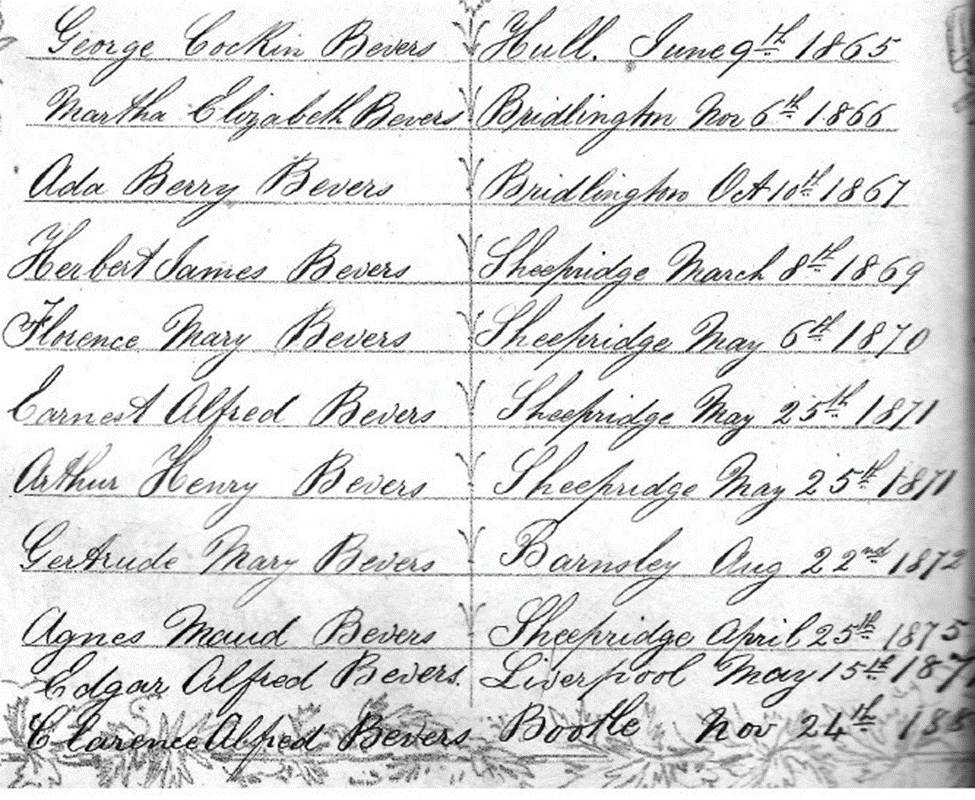
George Cockin Bevers was the first child born to Alfred Cockin Bevers and Mary Naomi Bridges.  They recorded his birth in their Family Bible as June 9, 1865 in Hull.  His birth is also recorded in the civil registration records of Hull, Yorkshire East Riding.1  The full name of this town is Kingston-Upon-Hull, the name it was given after King Edward I had purchased the town and gave it a royal charter.2  The name is a derivative of King’s Town upon Hull (referring to the river Hull.)3  A hundred years before George was born, Hull was the birthplace of William Wilberforce, the champion of the abolition of the slave trade and slavery in the British Empire.4

Kingston-Upon-Hull is a port city on the northeastern coast of England, situated at the mouth of the Hull River entering the Humber River.  At the time of George’s birth, the city had grown from 12,000 houses to over 20,000 houses during the previous 35 years, the growth being primarily outside the medieval old town.5  The expansion of the town was due to industrial advancement in the region and the resulting increase in importation. 

During George’s childhood Alfred and Mary Bevers moved their residence several times.  The locations are recorded in their Family Bible with every child’s birth, and sadly, with the deaths of some of George’s siblings.  By the time he was 17 years old, George had 10 siblings.  Six of his siblings died in their first year of life or shortly after.

List of “Children’s Names” with their birthplace and birthdate
in the Family Bible of Alfred C. and Mary N. Bevers

When George’s first and second sisters were born his family lived in Bridlington, Yorkshire.  The first one only lived 16 days; the second sister Ada would live to be 75 years-old.   At the next location, Sheepridge, Yorkshire, which is the town where George’s father had been born, four of George’s siblings were born: a brother, a sister and a set of twin boys.  The only one of these four who would survive was his brother Herbert and he would live to be 75 years-old.  When the 1871 census was recorded in Sheepridge, at the age of five George was a scholar and his father was a collector and canvasser for Prudential Insurance Company.6  Their next residence was south of Sheepridge in Barnsley, which is where his sister Gertrude was born.  Then the family returned to Sheepridge where George’s last sister Maude was born.  Gertrude would live to be 81 years-old and Maude would live to be 83.

On December 18, 1875, the Weekly Examiner, a newspaper published in Huddersfield, printed a lengthy article describing a concert performed by the school children of the Hillhouse School Board.  One of the students named in the article is a Master George Bevers.  Since Sheepridge, the town where the Bevers are known to have lived when Maude was baptized, is only about 1¼ mile from Hillhouse, it is possible that this article is referring to the subject of this blogpost.

CONCERT BY THE HILLHOUSE BOARD SCHOOL CHILDREN. – On Thursday night, the eighth annual concert by the children attending this school was given in the schoolroom, and the profit arising from it will be handed over to the Huddersfield Infirmary.  The room was very tastefully decorated for the occasion with mottoes and texts appropriate to the coming festival, and also with evergreens studded with artificial flowers, and a few pretty bannerets judiciously and effectively placed.  The concert was given by about seventy children, only those being chosen who could sing a little piece of music, chosen by Mr. Gaunt, their instructor, at sight, and one piece on the programme; and in making choice of the children to sing, neither their age nor the standard they were in was taken into account, but only their efficiency in the tonic sol fa method of singing.  The result was that, with the assistance of a few adults, a concert was given which, both for the quality of the music and the manner in which it was performed, would have done credit to much older scholars. …  The dialogues were well given, the accurate pronunciation of the words, and the absence of a “singing” style being very marked.  The first one was taken part in by the Misses Beatrice Waite, Clara Louisa Hirst, Clara Jane Brier, and Ellen Fisher, and Masters George Bevers, F. W. Thornton, Albert Victor Shaw ….  A very interesting part of the entertainment was the sight singing test, and before it took place, Mr. W. H. Bedford said some people had been under the misapprehension that it was to be a singing contest, but that was not the case; it was a test for the whole of the children together, to show that Mr. Gaunt’s teaching was real, and not that he had merely taught them to sing those pieces of music by ear.  He (Mr. Bedford), taking into account the ages of the children, had not gone in for anything very difficult or elaborate.  He had therefore written a long metre hymn tune.  The children would sol-fa it three times first, the treble part only, and then the other voices would join in.  Nobody present but himself had seen the music before that night.  Copies of the test piece were then given to each scholar, and they had to hold them with the print downwards till all had got a copy; then Mr. Gaunt gave the signal to start, and the tune (which is called Clara Street), was sol-faed three times by the children very accurately.  Next the other singers joined them, and it was sung through the use of the “la” only, and afterwards “Praise God from whom all blessings flow” was sung to the music, which, thus rendered, showed a simple grandeur of construction very commendable to the composer. … The room was crowded with the parents and friends of the children, and others who take an interest in the school, all of whom seemed to thoroughly appreciate and enjoy the concert, and they must have felt highly gratified with the successful manner in which Mr. Gaunt had trained the children, not in music merely, but musical knowledge.7

Sometime after Maude’s birth, the Bevers family made a long move west, across the country, to Liverpool where another brother was born.  Finally, Alfred and Mary would have their last child in Bootle, a town three miles north of Liverpool.  Both of these brothers passed away as infants.

In 1881, when the census of England was taken, the Bevers family resided at 97 Derby Road, Kirkdale, a ward of Liverpool.8  George, having completed his education through the 8th grade,9 at the age of 15, was a “pupil teacher” at a Church of England school and his father was a tailor’s cutter.10  When George was about 17 years-old, his father emigrated to America, and a year or two later, his mother and sisters followed George’s father.  Following the departure of their family, it is not known where George and his brother Herbert stayed.

Both brothers would also emigrate to the United States, and it is possible that they made the trip together in the fall of 1885.  Some of the details of an entry in a passenger list of the steamship, Lord Clive, correspond with information about George and Herbert, but some does not correspond.  This passenger list includes the names George Bevers and Herbert Bevers.11  The spelling is the correct spelling, but Ireland is recorded as their place of birth.  The Lord Clive departed from Liverpool, which would very likely be the port where the brothers would have departed.  This steamship arrived at the port of Philadelphia on December 1, 1885.  This date corresponds with information in the 1900 U. S. census which states that George C. Bevers immigrated in 1885.12 But the 1900 U. S. census record for Herbert J. Bevers indicates that he didn’t immigrate until 1888.13  The passenger list of the Lord Clive provides additional information about the men: they were both laborers, they had never been to the United States and they were not tourists.  Something that is missing on the ship manifest is the age of George and Herbert Bevers.  If that information had been recorded, there would have been additional information to confirm whether the record is about our families’ ancestors.

Passenger List of the Steamship “Lord Clive”

Upon immigrating to the USA, George settled in Philadelphia.  The first time there is an entry for him in the city directory of Philadelphia is in 1886 and he was the only Bevers listed in the directory that year.  He was a clerk and living at 1532 Herbine.14  This was the same residence as Arthur Wright, a tailor, who would the following year become George’s father-in-law.  Possibly, the Wright family and Bevers family were acquainted with each other in England.  Both families lived in wards of Liverpool in 1881 and both Alfred C. Bevers and Arthur Wright were tailors.

George and Evelina Bevers

In 1887 and for a few years afterwards, the Philadelphia city directory would list George and Arthur at the same address: 47 Apsley in Germantown, which was a suburb northwest of Philadelphia.15  In that home on Friday September 2, 1887, George married Arthur’s daughter Evelina.16  The marriage record can be found in the marriage register of the Church of Saint John the Baptist, an Episcopal church.  One of the witnesses was Evelina’s brother Ernest Wright.  Two years later, the baptism register of this same church has a record of George and Evelina’s daughter Evelina.  The record documents her birth as September 8, 1889 and her baptism on Thursday, December 26, 1889.17  Two of the sponsors of the infant Evelina were her uncle Francis Wright and her aunt Louisa Wright, her mother’s brother and sister.  In July 1888, George had declared his intention to become a citizen of the United States.18


Above and below:
Marriage record of George C. Bevers and Evelina Wright,
Marriage register of the Church of Saint John the Baptist, Germantown, Pennsylvania


Above and below:
Baptismal record of Evelina Maude Bevers,
Baptism register of the Church of Saint John the Baptist, Germantown, Pennsylvania

The Philadelphia city directories of the 1890s give a few details of George’s life.

  • In 1891 and in following years, George’s occupation was listed as bookkeeper instead of clerk.19
  • In 1893, the address for George and Arthur was Old York Road, Milestown, a few miles northeast of Germantown.20  But the following year they returned to Germantown at “Pulaski a, N Apsley”21 and that year Evelina gave birth to a son, Arthur William Bevers on September 2, 1894.22
  • In 1895 and 1896, George and Arthur’s address would be 4460 Pulaski Avenue, Germantown.23 
  • Then in 1897, although George’s name was not listed in the directory, at the same address as in ’95 and ’96, Arthur’s name was listed along with Arthur’s newly widowed daughter-in-law Catherine Wright and his son Ernest G. Wright.24 
  • In 1899 George and Arthur were both living at 3308 N. Broad, Philadelphia.25 
  • In 1900 they would both change their residence again to 2211 Venango, Philadelphia,26 but the following year they would return to Germantown at 223 Apsley.27

From that point forward Arthur’s name would no longer be listed in the city directory.


“Originally a township independent of Philadelphia …. The establishment of Germantown as a permanent German settlement in America in 1683 put into place William Penn’s bold ideas of religious toleration of different faiths in one colony, bringing Quakers to Pennsylvania together with Mennonites, Dunkards, and other groups that had been unwelcome in England and Continental Europe.  In 1688 four Germantown settlers drafted a protest against slavery within the Dutch-German Quaker community that is considered to be the earliest antislavery document made public by whites in North America. …”28


The 1900 U. S. census tells us some information about George’s in-laws.  Arthur Wright was 63 years-old, born in England in August 1836.29  His occupation was “taylor-cutter.”  His wife was 69 year-old Eliza Wright, who was born in England in September 1830.  Arthur, Eliza and daughter Evelina had immigrated from England in 1883.  Arthur was renting a home and 35 year-old George with 38 year-old Evelina were living there, as well as their two children, 10 year-old Evelina and five year-old Arthur.  Also living in the household was another of Arthur Wright’s daughters.  She was 27 years-old and unmarried. A few years later, George’s in-laws would pass away. Eliza Ann Ventom Wright died on October 27, 190230 and Arthur died on March 18, 1904.31

From 1906 to 1911, the city directories of Philadelphia listed George’s address as 5607 Baynton, Germantown and the entries for 1909 and 1910 included his place of employment: “Mitchell & Bevers.”32  Apparently, George was in business with a man named Harry T. Mitchell.  In 1911, George’s occupation was listed simply as accountant, without the notation of his business.  This would be the last time that George’s name was printed in the Philadelphia city directory.

In July 1908, the Philadelphia Inquirer printed a news item about a meeting of the Artisans Order of Mutual Protection:

Germantown Assembly, No. 36, … on the 3d of July, held a unique entertainment for the enjoyment of the members.  Twenty-three questions in American history were propounded, and to the member answering the greatest number correctly was given a pair of beautiful American flags.  Strange to say, an Englishman, Bro. Geo. C. Bevers, won the prize with sixteen correct answers. …33

The Artisans Order of Mutual Protection was organized May 1, 1873, the result of gentlemen who desired “to devise a form of beneficial society, embracing improvement upon the old organizations as to death benefits, and a fraternal organization to give it strength and permanency.”34  The society is still in existence as of this writing, being “the second oldest fraternal insurance organization in the country.”  Its website explains its position in American society: “The role of fraternalism, along with the efforts of our schools and churches, is to form a powerful alliance with government to give us a more orderly, and economically successful society.”

As of the date of the above-mentioned Artisans fraternal meeting, July 3, 1908, the United States flag had 45 stars.  But beginning July 4, 1908, the flag had 46 stars because Oklahoma had been admitted to the union in November 1907.35  Most likely, George had been given two 46-star flags at the Artisans meeting.  The 46-star flag was flown until July 3, 1912, then it was replaced with a 48-star flag because New Mexico and Arizona had become states in the winter of 1912.  (See the flag of 1908 at https://en.m.wikipedia.org/wiki/File:Flag_of_the_United_States_(1908%E2%80%931912).svg)

The 1910 U. S. Census records that the Bevers family was living in a rented home at 5607 Baynton Street in Philadelphia,36 although the city directory indicates that this is in Germantown.   George was an accountant in private business working on his own account.  He was 44 years-old and Evelina was 48. They had been married for 23 years.  Their unmarried daughter Evelina was 19; she was not attending school and did not have an occupation.  Their son Arthur was 15 and attending school.

Two family events were held in Christ Church, an Episcopal church, in Germantown.  George and Evelina’s son was baptized on February 13, 1910.37 Then on December 2, 1911 their daughter was married to William P. Woodroffe.38  The Woodroffes would move to Brooklyn, New York where George and Evelina’s grandson Francis was born in 1914 and their granddaughter Mildred was born in 1919.39


Baptismal record of Arthur W. Bevers,
Baptism Register of Christ Church, Germantown, Pennsylvania

In 1917 the United States entered the great war which had been raging in Europe since 1914.  Arthur Bevers joined the Army and served in the Engineer Reserve Corps from September 1917 to December 1918.40   Upon entering the Army, he declared his residence as 39 Woodlawn Avenue, Aldan, Pennsylvania, which is the town where his parents were living when the 1920 U. S. census was taken.  Only a few months after Arthur’s entrance into the Army, George and Evelina made a trip to Camden, New Jersey to attend his marriage to Martha T. Severns on December 22, 1917.41  George and Evelina gained three more grandchildren when Dorothy was born in 1919, George was born in 1922 and William was born in 1923.

From this point forward the record trail for George and Evelina dwindles.  According to the 1920 U. S. census, they were living at 201 East Providence Road in Aldan, Pennsylvania, a small town west of Philadelphia.  George owned their house, he had a mortgage and he was a cashier at a mill.42  The census record also indicates that George had become a naturalized citizen of the United States in 1908 and that Evelina was naturalized as well, but no date is supplied in the record.

Only a couple of family events are known about George and Evelina’s life in the 1920s.  First, Evelina’s sister Louise Wright Millar died in 1924, and George submitted the information for her death certificate.43 Second, their daughter Evelina and her husband moved back to Philadelphia sometime after 1920 and in 1927 their third child Mary was born, George and Evelina’s sixth grandchild.44

When the U. S. census was taken in 1930, it appears that George and Evelina were still living in the same home in which they had lived 10 years earlier.  The home was valued at $10,000 and they owned a radio set.45  George at 64 years-old was a credit manager at a woolen goods establishment.  Evelina was 68 years-old.  A couple of family historians state that Evelina died on August 12, 1933 and one states that she was buried in Aldan on August 15, 1933, but documentation of Evelina’s death has not been located.  In the 1940 U. S. census, 74 year-old George was recorded as a widower, unable to work and he was living with his son Arthur in Inglewood, California at 520 W. Hillcrest Blvd.46  Arthur’s family included his wife Martha and their children Dorothy, George and William.  According to the census, five years earlier George had been living in Philadelphia.

Three years later Arthur supplied the information for George’s death certificate.  George had lived with Arthur for five years prior to his death and for the last five months of his life he stayed at Gray’s Sanitarium in Los Angeles, California.47  On June 21, 1943, twelve days after his 78th birthday, George succumbed to cardiac failure, having suffered from cardiac disease for a couple of years.  George’s body was cremated by Inglewood Park Cemetery, Inglewood, California.


1 FreeBMD, “Births registered in April, May, June 1865,” [vol. 9D, page 234] England & Wales, FreeBMD Birth Index, 1837-1915 (Provo, UT, USA: Ancestry.com Operations Inc, publisher, 2006): http://www.Ancestry.com.

2 V. Bettney, “Hull: A History,” The York Historian (August 8, 2017): https://theyorkhistorian.com/2017/08/08/hull-a-history/.

3 “Kingston upon Hull” (Wikipedia): https://en.wikipedia.org/wiki/Kingston_upon_Hull.

4 Encyclopaedia Britannica, editors, “William Wilberforce, British Politician,” Britannica (January 13, 2023): https://www.britannica.com/biography/William-Wilberforce.

5 V. Bettney, “Hull: A History”: https://theyorkhistorian.com/2017/08/08/hull-a-history/.

6 Ancestry.com, 1871 England Census [Class: RG10; Piece: 4372; Folio: 86; Page: 19; GSU roll: 848087], (Provo, Utah, USA: Ancestry.com Operations Inc., publisher, 2004): http://www.Ancestry.com.

7 Weekly Examiner (Huddersfield, West Yorkshire, England, December 18, 1875): 3.

8 Ancestry.com, 1881 England Census [Class: RG11; Piece: 3684; Folio: 133; Page: 23; GSU roll: 1341882] (Provo, Utah, USA: Ancestry.com Operations Inc., publisher, 2004): http://www.Ancestry.com.

9 “United States Census, 1940”, database with images, FamilySearch (ark:/61903/1:1:K975-B84 : Thu Mar 16 16:18:54 UTC 2023), Entry for Dorothy Bevers and George S Bevers, 1940.

10 Ancestry.com, 1881 England Census.

11 “Pennsylvania, Philadelphia Passenger Lists, 1883-1945,” database with images, FamilySearch (https://familysearch.org/ark:/61903/3:1:33SQ-GPBF-QKS?cc=1921481&wc=M616-JTP%3A214200701 : 21 May 2014), 006 – v. G, Jul 5, 1885-Dec 28, 1885 > image 393 of 448; citing NARA microfilm publication T840 (Washington, D.C.: National Archives and Records Administration, n.d.).

12 “United States Census, 1900,” database with images, FamilySearch (https://familysearch.org/ark:/61903/3:1:S3HY-DZV6-7M?cc=1325221&wc=9B7K-NQX%3A1030550501%2C1036056801%2C1036357801 : 5 August 2014), Pennsylvania > Philadelphia > ED 976 Philadelphia city Ward 38 > image 28 of 33; citing NARA microfilm publication T623 (Washington, D.C.: National Archives and Records Administration, n.d.).

13 “United States Census, 1900,” database with images, FamilySearch (https://familysearch.org/ark:/61903/3:1:S3HT-68DY-PH?cc=1325221&wc=9B7H-9LQ%3A1031648401%2C1033119401%2C1033119402 : 5 August 2014), South Dakota > Roberts > ED 282 Agency, One Road & Spring Grove Townships > image 4 of 11; citing NARA microfilm publication T623 (Washington, D.C.: National Archives and Records Administration, n.d.).

14 James Gopsill’s Sons, Publishers, Gopsill’s Street Index and City Guide of the City of Philadelphia (Philadelphia: James Gopsill’s Sons, Publishers, 1886): 182.

15 Gopsill’s Sons, Publishers, Gopsill’s Philadelphia City Directory (Philadelphia: Gopsill’s Sons, Publishers, 1887): 180 & 1843.

16 Historical Society of Pennsylvania, “St. John the Baptist Church, Germantown, 1876 to March 1891” in Pennsylvania and New Jersey, U.S., Church and Town Records, 1669-2013 [database on-line] (Lehi, UT, USA: Ancestry.com Operations, Inc., 2011): 200-01.

17 Historical Society of Pennsylvania, “St. John the Baptist Church, Germantown, 1876 to March 1891” in Pennsylvania and New Jersey, U.S., Church and Town Records, 1669-2013 [database on-line] (Lehi, UT, USA: Ancestry.com Operations, Inc., 2011): 100-01.

18 Ancestry.com, [Naturalization Petition of George C. Bevers], Pennsylvania, Federal Naturalization Records, 1795-1931 (Provo, UT, USA: Ancestry.com Operations, Inc., 2011).

19 James Gopsill’s Sons, Publishers, Gopsill’s Philadelphia City Directory (Philadelphia: James Gopsill’s Sons, 1891): 165.

20 James Gopsill’s Sons, Gopsill’s Philadelphia City Directory (Philadelphia: James Gopsill’s Sons, 1893): 169 & 2124.

21 James Gopsill’s Sons, Gopsill’s Philadelphia City Directory (Philadelphia: James Gopsill’s Sons, 1894): 173 & 2167.

22 Historical Society of Pennsylvania, “Christ Church and St Michaels Episcopal, Germantown, Philadelphia PA, 1899 to 1938” in Pennsylvania and New Jersey, U.S., Church and Town Records, 1669-2013 (Lehi, UT, USA: Ancestry.com Operations, Inc., 2011): 34-35.

23 James Gopsill’s Sons, Gopsill’s Philadelphia City Directory (Philadelphia: James Gopsill’s Sons, 1895): 164 & 2050.

24 James Gopsill’s Sons, Gopsill’s Philadelphia City Directory (Philadelphia: James Gopsill’s Sons, 1897): 2180.

25 James Gopsill’s Sons, Gopsill’s Philadelphia City Directory (Philadelphia: James Gopsill’s Sons, 1899): 197 & 2471.

26 James Gopsill’s Sons, Gopsill’s Philadelphia City Directory (Philadelphia: James Gopsill’s Sons, 1900): 197 & 2498.

27 James Gopsill’s Sons, Gopsill’s Philadelphia City Directory (Philadelphia: James Gopsill’s Sons, 1901): 215 & 2631.

28 D. W. Young, “Historic Germantown: New Knowledge in a Very Old Neighborhood,” The Encyclopedia of Greater Philadelphia: https://philadelphiaencyclopedia.org/essays/historic-germantown-new-knowledge-in-a-very-old-neighborhood-2/.

29 “United States Census, 1900”, database with images, FamilySearch (https://www.familysearch.org/ark:/61903/1:1:M3WT-MLY : 27 January 2023), Authur Wright, 1900.

30 Historical Society of Pennsylvania, “Kirk & Nice, Undertakers” [record books], in Pennsylvania and New Jersey, Church and Town Records, 1708-1985 (Provo, UT, USA: Ancestry.com Operations, Inc., 2011).

31 Historical Society of Pennsylvania, “Kirk & Nice, Undertakers” [record books].

32 C. E. Howe Co., Philadelphia City Register (Philadelphia: C. E. Howe Company, 1910): 213.

33 “Artisans Order of Mutual Protection,” Philadelphia Inquirer (Philadelphia, Pennsylvania, July 12, 1908): 3, Newspapers.com.

34 Artisans Order of Mutual Protection, “History”: http://www.artisansaomp.org/history.html.

35 Armed Forces History Collections, “Facts about the United States Flag,” Smithsonian Institution (Public Inquiry Services, September 2001): https://www.si.edu/spotlight/flag-day/flag-facts.

36 “United States Census, 1910,” database with images, FamilySearch (https://familysearch.org/ark:/61903/3:1:33S7-9RKV-WRB?cc=1727033&wc=QZZH-W5T%3A133638001%2C143194401%2C143376101%2C1589124991 : 24 June 2017), Pennsylvania > Philadelphia > Philadelphia Ward 22 > ED 407 > image 15 of 24; citing NARA microfilm publication T624 (Washington, D.C.: National Archives and Records Administration, n.d.).

37 Historical Society of Pennsylvania, “Christ Church and St Michaels Episcopal, Germantown, Philadelphia PA, 1899 to 1938”: 34-35.

38 Historical Society of Pennsylvania, “Christ Church and St Michaels Episcopal, Germantown, Philadelphia PA, 1899 to 1938”: 388-389.

39 The National Archives at Philadelphia, Philadelphia, Pennsylvania, “Petition of Naturalization” [of Evelina M. Woodroffe] in Pennsylvania, U.S., Federal Naturalization, 1795-1931 (Lehi, UT, USA: Ancestry.com Operations, Inc., 2011).

40 Ancestry.com, Pennsylvania, U.S., World War I Veterans Service and Compensation Files, 1917-1919, 1934-1948 (Lehi, UT, USA: Ancestry.com Operations, Inc., 2015).

41 Ancestry.com, “St. John’s Church, Camden, N. J. 2d Appendix to Volume 3, Marriages,” New Jersey, U. S., Episcopal Diocese of New Jersey, Church Records, 1700-1970 (Lehi, UT, USA: Ancestry.com Operations, Inc., 2021): 118.

42 “United States Census, 1920”, database with images, FamilySearch (https://www.familysearch.org/ark:/61903/1:1:M61K-TBX : 3 February 2021), George C Bever, 1920.

43 Ancestry.com, Pennsylvania, U.S., Death Certificates, 1906-1968 (Lehi, UT, USA: Ancestry.com Operations, Inc., 2014).

44 The National Archives at Philadelphia, Philadelphia, Pennsylvania, “Petition of Naturalization” [of Evelina M. Woodroffe].

45 “United States Census, 1930,” database with images, FamilySearch (https://familysearch.org/ark:/61903/3:1:33SQ-GRZH-HT?cc=1810731&wc=QZF7-YD9%3A649490601%2C649796601%2C649796602%2C1589282332 : 8 December 2015), Pennsylvania > Delaware > Aldan > ED 1 > image 14 of 22; citing NARA microfilm publication T626 (Washington D.C.: National Archives and Records Administration, 2002).

46 “United States Census, 1940”, database with images, FamilySearch (ark:/61903/1:1:K975-B84 : Thu Mar 16 16:18:54 UTC 2023), Entry for Dorothy Bevers and George S Bevers, 1940.

47 “California, County Birth and Death Records, 1800-1994,” database with images, FamilySearch (https://familysearch.org/ark:/61903/3:1:3QS7-89SV-Y9CV-J?cc=2001287&wc=FP4T-DP8%3A285176601%2C285575401 : 27 September 2019), Los Angeles, Los Angeles > Death certificates 1943 no 7540-9600 > image 2603 of 2794; California State Archives, Sacramento.

Miss Maggie’s Early Life

When I was a child, occasionally I would ask my mother where our ancestors were from.  She would tell me that her father’s father was from England, her father’s mother was from Switzerland, her mother’s father was Irish and her mother’s mother was Pennsylvania Dutch.  It was not until I was well into adulthood that I learned that my mother’s grandmother Maggie was not actually born in Pennsylvania, nor were Maggie’s parents born there.  It was Maggie’s grandparents who were born in Pennsylvania.  Her paternal grandparents (John Adam Bonewitz and Mary Margaret Rider, also called Peggy) were already married when they moved from Pennsylvania to Ohio about 1820, but Maggie’s maternal grandparents (Harman Smith and Barbara Flora) were still children when they moved with their parents to Ohio about 1822 and 1815, respectively.

Subsequently, all of Maggie’s grandparents moved to Indiana.  When Harman and Barbara Smith moved from Ohio to Huntington County, Indiana (about 1843), their children were still young, which included Josephine Smith.  Late in life (about 1853), John Adam and Peggy Bonewitz moved to neighboring Wabash County, Indiana and their son John Esli Bonewitz moved with them.  Somehow, John Esli met Josephine and they married in 1856.  They lived in Indiana for a few years, then in the early 1860s, they moved to Fairfield, Iowa, which is where Maggie was born on November 9, 1867.1

When the 1870 U. S. census was taken in Fairfield, Iowa, Maggie, at nearly 3 years-old, was the youngest in a household of three adults and seven children.2  Maggie’s father was 35 years-old and her mother was 32 years-old.  She had two older brothers and two older sisters:  Orlando, age 13; Harman, age 11; Carrie, age 9 and Emma, age 5.  Maggie’s mother’s sister Malissa Griffith and Malissa’s two children William and Viola, age 8 and 7 respectively, were also living in the Bonewitz household.

Little is known of Maggie’s life as a child, but from what is recorded in the 1940 U. S. census it is known that she attended school through the fifth grade.3  Also, from the 1880 U. S. Census, we learn that two more brothers (Claudius and J. F.) were born after Maggie,4 one when she was eight or nine years-old and the other when she was twelve.  When Maggie was about ten years-old, her father and eldest brothers traveled 230 miles due west of Fairfield to Omaha, Nebraska and a few years later the entire family moved there. 

The annual Omaha city directories reveal information about the occupations and residences of the family.  Beginning with the 1878-79 city directory, entries can be found for John, Orlando and Harman Bonewitz.  When the 1880 U. S. census was taken, the Bonewitz family was listed in Fairfield, even though the 1880 Omaha city directory has an entry for John.

When Maggie’s family arrived in Omaha, she was 13 years-old.  Maggie’s teenage years were filled with many family events, including deaths, marriages and changing residences.  Sadly, two weeks after the census was taken in Fairfield, Maggie’s nearly six-month-old brother J. F. passed away.  His grave is in Omaha, not Fairfield.5  Less than 10 months later, Maggie’s other younger brother Claudius died at nearly five-years-old.6

Omaha, which “derived its name from a tribe of Indians that were formerly the owners of the soil,”7 was a booming city.  It was established in 1854 and immediately experienced rapid development.8  After a brief slowdown due to a financial crisis in the late 1850s, the city resumed its expansion as Omaha became the outfitting center for immigrants to Colorado, Utah, Idaho, Montana and Wyoming.9  An article in the 1870 Omaha city directory identified several factors which attributed to Omaha’s development:

“The mines of the west, the termination of the [Civil] war, and the initiation of the U. P. R. R. [Union Pacific Rail Road] brought back vitality.  Capitalists made homes here; railroads one after another came from the east, making Omaha their objective point; a fleet of steamers gave connection with the south; the Government established here headquarters for the army of the West; manufactures sprung into existence; the U. P. R. R. constructed workshops, employing hundreds of hands, and executing every description of work, and prosperity which has known no interruption, returned.”10

The population when John and his sons arrived in Omaha was about 26,215.11  When the Bonewitz family moved to Omaha in 1880, the census report gave it a population of 30,652.12  The population in 1884 was estimated at 55,23013 and in 1887 it was estimated at 96,717.14

According to the city directories the family moved several times.  Upon moving to Omaha, the first address of the family was 1314 Jackson.15  The first time that Maggie’s name is listed in the city directory is in 1884.  Her residence was at 1623 Dodge, which is the same address listed for her sister Carrie and her father.16  Her father’s entry notes that his occupation was “boarding.”  Maggie’s parents ran a boarding house and it is likely that Maggie assisted her parents in this endeavor.  In 1885, Maggie’s residence was at 1209 Georgia Avenue17 and in 1886 she lived at 1113 Georgia,18 both of these addresses were listed for her father and brother Harman also.

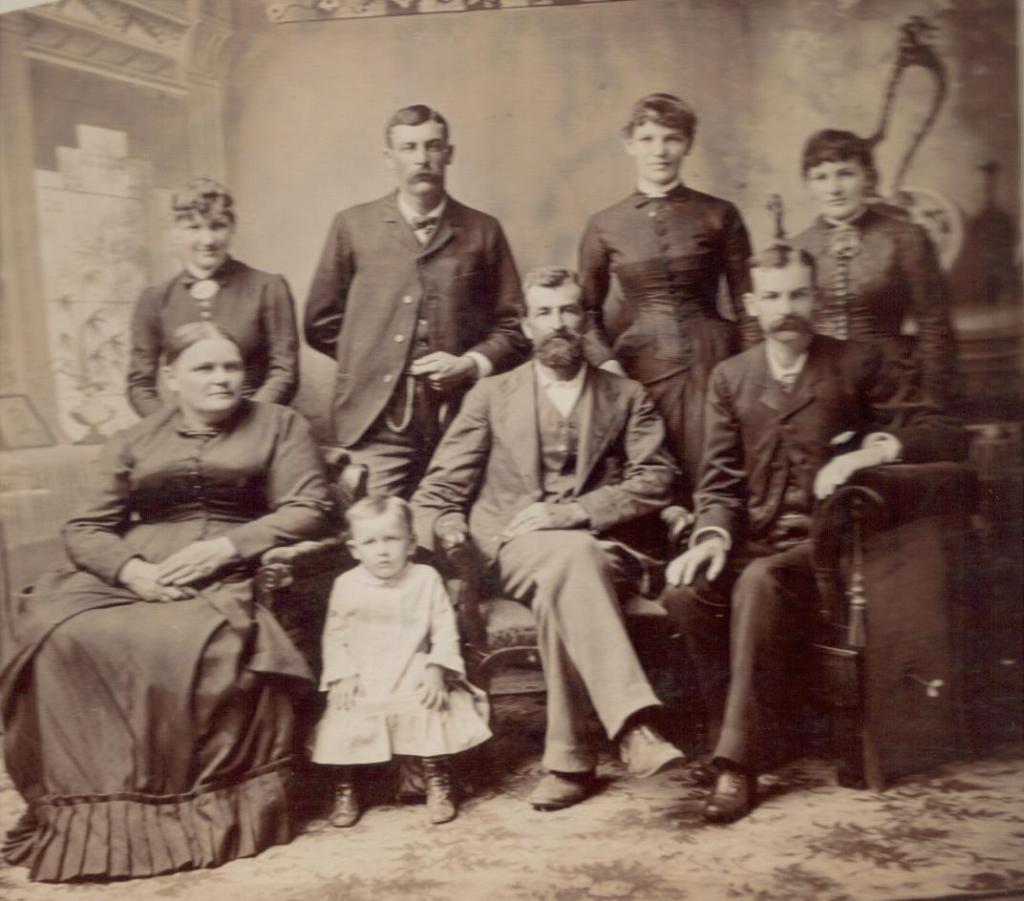
Other family events that occurred in the first half of the 1880s included the birth of another brother (Sidney) in January 1882.19  Maggie’s sister Emma married John C. Thompson in May 188320 and her sister Carrie married Charles P. White in 1884.21  The next year, tragically, Maggie’s eldest brother Orlando passed away.  In the Omaha city directory, he is in the list of “the most prominent persons who have died within the city of Omaha during the year 1885,” and is given the date of death of August 27.22  (This may actually have been the date of his burial.)  Not long before Orlando’s death the Bonewitz family posed for a family portrait.23  Based on how old Sidney appears to be, the photograph may have been taken in late 1884 or early 1885.  Maggie, standing on the left, would have been about 17 years-old.

The Bonewitz family (with their approximate ages):
Back Row: Maggie (17), Orlando (27), probably Emma (20), probably Carrie (23) (Emma and Carrie could be the opposite)
Front Row: Josephine (46), Sidney (3), John (49), Harman (25)

When the 1885 census of Nebraska was taken, Maggie along with her father, mother and three brothers lived on 28th street.24  Maggie’s sister Emma and brother-in-law also lived in the household and they had a daughter, Josephine, who was one year old.  In addition, there were five boarders in the household.  Another marriage took place in December 1886.  Maggie’s brother Harman married Cornelia Higley.25

In the newspaper Omaha Daily Bee, an announcement was placed describing Maggie’s 20th birthday:

“Wednesday evening a large number of young friends assembled at the residence of Mr. John E. Bonewitz, in West Side, and passed a very pleasant evening, the gathering being in honor of the twentieth birthday of his daughter, Miss Maggie.  Quite a number of invitations had been sent out and as a result the house was filled with merry, fun-loving young people.  Some very nice and costly presents were bestowed upon the young lady, who made an admirable hostess on this occasion.  At 11 o’clock a very fine lunch was served, after which the assembled friends were entertained with music and games.  Those in attendance were G. L. McIlvane and Miss Robertson, J. E. Hardy and Miss Emma Lyman, A. S. Gantz and Miss Anna Higley, Charles Roberts and Miss Hannah Roberts, George Ritchie and wife, T. W. Smith and wife, C. P. White and wife, H. N. Stump, Ernest Gantz, Mr. Christ, of Sac City, Ia.; John Collins, Rockport, Mo.; John C. Thompson and wife and the parents of the young lady.”26

Besides Maggie and her parents there were 20 people in attendance at her birthday party.  Some of the guests were:

  • A. S. Gantz (Argola) who was Maggie’s 18 year-old cousin, the son of her mother’s sister Joannah.  The Gantz family had been living in Fairfield, Iowa at the same time that the Bonewitz’ family lived there in 1880.27 
  • Ernest Gantz is possibly a relation of Argola.  There was another Gantz family that lived in Fairfield in 1880 which included a young person named Ernest.28
  • Argola accompanied Anna Higley who was probably the 17 year-old sister of Maggie’s sister-in-law Cornelia.  The Higley family was also living in Fairfield in 1880.29
  • C. P. White and wife were Maggie’s brother-in-law Charles and her sister Carrie.
  • John C. Thompson and wife were Maggie’s brother-in-law and her sister Emma.
  • H. N. Stump was a carpenter living in West Side.30  (Maggie’s father was a carpenter at the time.)31

The newspaper article notes that the Bonewitz family lived in West Side.  This was a newly developing area about three miles west from the post office and was near the West Side train depot grounds.  It would later be described as an area of workers’ cottages.32 This is the area that members of Maggie’s family would reside for the next 30 years.

Notes:

  1. Shaw-Messer Chapel, “In Memory of Maggie O. Daily” (Watertown, South Dakota: Shaw-Messer Chapel, March 15, 1947).
  2. “United States Census, 1870,” database with images, FamilySearch (https://familysearch.org/ark:/61903/1:1:MDVC-DFR : 17 October 2014), Maggie O Bonewits in household of John E Bonewits, Iowa, United States; citing p. 5, family 37, NARA microfilm publication M593 (Washington D.C.: National Archives and Records Administration, n.d.); FHL microfilm 545,898.
  3. “United States Census, 1940,” database with images, FamilySearch (https://familysearch.org/ark:/61903/3:1:3QSQ-G9M1-5855?cc=2000219&wc=QZFM-WRZ%3A791611401%2C793270701%2C793367301%2C793379401 : accessed 5 July 2020), South Dakota > Codington > Watertown City, Watertown, Ward 3 > 15-24B Watertown City Ward 3 bounded by (N) 4th Av S; (E) Maple, ward line; (S) city limits; (W) city limits, ward line > image 3 of 24; citing Sixteenth Census of the United States, 1940, NARA digital publication T627. Records of the Bureau of the Census, 1790 – 2007, RG 29. Washington, D.C.: National Archives and Records Administration, 2012.

  4. “United States Census, 1880,” database with images, FamilySearch (https://familysearch.org/ark:/61903/1:1:MD2G-RHC : 13 July 2016), Maggie Bonewitz in household of J E Bonewitz, Fairfield, Jefferson, Iowa, United States; citing enumeration district ED 81, sheet 409D, NARA microfilm publication T9 (Washington D.C.: National Archives and Records Administration, n.d.), roll 0347; FHL microfilm 1,254,347.
  5. Find a Grave, database and images (https://www.findagrave.com : accessed 19 July 2020), memorial page for Freddy Bonewitz (Jan 1880–Jul 1880), Find a Grave Memorial no. 170992635, citing Prospect Hill Cemetery, Omaha, Douglas County, Nebraska, USA ; Maintained by SRGF (contributor 47487065) .
  6. Find a Grave, database and images (https://www.findagrave.com : accessed 19 July 2020), memorial page for Claudius Coan Bonewitz (7 May 1876–23 Apr 1881), Find a Grave Memorial no. 170992581, citing Prospect Hill Cemetery, Omaha, Douglas County, Nebraska, USA ; Maintained by SRGF (contributor 47487065) .
  7. Collins’ Omaha Directory (Omaha, Nebraska: Charles Collins, Publisher, June 1866): 19.
  8. Collins’ Omaha Directory: 21.
  9. Collins’ Omaha Directory: 24.
  10. Omaha Directory for 1870 (Omaha, Nebraska: J. M. Wolfe, Publisher, 1870): 17.
  11. J. M. Wolfe, publisher, Wolfe’s Omaha City Directory 1878-1879 (Omaha, Nebraska: Herald Publishing House and Book Bindery, 1878): 27.
  12. J. M. Wolfe, publisher, Wolfe’s Omaha City Directory 1881-1882 (Omaha, Nebraska: Herald Printing, Binding and Electrotyping House, 1881): 11.
  13. J. M. Wolfe, publisher, Omaha City Directory 1884 (Omaha, Nebraska: Herald Printing, Binding and Electrotyping Establishment, 1884): 9.
  14. Omaha City and Douglas County Directory 1887 (Omaha, Nebraska: J. M. Wolfe & Co., Publishers, 1887): 2.
  15. J. M. Wolfe, Wolfe’s Omaha City Directory 1881-1882: 116.
  16. J. M. Wolfe, Omaha City Directory 1884: 100.
  17. J. M. Wolfe, publisher, Omaha City and Douglas County Directory 1885 (Omaha, Nebraska: Herald Printing, Binding and Electrotyping House, 1885): 102.
  18. Omaha City and Douglas County Directory 1886 (Omaha, Nebraska: J. M. Wolfe & Co., Publishers, 1886): 113.
  19. State of California, California Death Index, 1940-1997 (Sacramento: State of California Department of Health Services, Center for Health Statistics): http://search.ancestry.com/cgi-bin/sse.dll?db=cadeath1940&h=709689&ti=0&indiv=try&gss=pt .
  20. Marriage license of John C. Thompson and Emma V. Bonewitz (State of Nebraska, Douglas County, May 6, 1883).
  21. Marriage license of Charles P. White and Carrie Bonewitz (State of Nebraska, Douglas County, June 12, 1884).
  22. Omaha City and Douglas County Directory 1886: 15.
  23. A descendant of Josephine Smith Bonewitz’ brother Obediah Smith contacted the author through Ancestry.com and subsequently supplied this photograph which her grandmother had labeled John and Josephine Bonewitz.
  24. “Nebraska State Census Collection, 1860-1885,” (Online publication – Provo, UT: Ancestry.com Operations, Inc., 2009): http://search.ancestry.com/cgi-bin/sse.dll?db=nestatecensus&h=1420813&ti=0&indiv=try&gss=pt .
  25. Marriage license of Harman F. Bonewitz and Cornelia B. Higley (State of Nebraska, Douglas County, December 29, 1886).
  26. Omaha Daily Bee (Omaha, Nebraska, November 20, 1887): 11, https://www.newspapers.com/image/149885912.
  27. “United States Census, 1880,” database with images, FamilySearch (https://familysearch.org/ark:/61903/3:1:33S7-9YYV-9P9W?cc=1417683&wc=XHBX-4WL%3A1589394762%2C1589396075%2C1589395491%2C1589396321 : 24 December 2015), Iowa > Jefferson > Fairfield > ED 80 > image 17 of 23; citing NARA microfilm publication T9, (National Archives and Records Administration, Washington, D.C., n.d.)
  28. “United States Census, 1880,” database with images, FamilySearch (https://familysearch.org/ark:/61903/3:1:33SQ-GYYV-9R3L?cc=1417683&wc=XHBX-C68%3A1589394762%2C1589396075%2C1589395491%2C1589396695 : 24 December 2015), Iowa > Jefferson > Fairfield > ED 81 > image 60 of 64; citing NARA microfilm publication T9, (National Archives and Records Administration, Washington, D.C., n.d.)
  29. “United States Census, 1880,” database with images, FamilySearch (https://familysearch.org/ark:/61903/3:1:33SQ-GYYV-9RN5?cc=1417683&wc=XHBX-C68%3A1589394762%2C1589396075%2C1589395491%2C1589396695 : 24 December 2015), Iowa > Jefferson > Fairfield > ED 81 > image 19 of 64; citing NARA microfilm publication T9, (National Archives and Records Administration, Washington, D.C., n.d.)
  30. Omaha City and Douglas County Directory 1887: 660.
  31. Omaha City and Douglas County Directory 1887: 75.
  32. Dennis Mihelich, ed., Ribbon of Destruction (Omaha, Nebraska: Douglas County Historical Society, n. d.): 8.

The Early Life of Herbert J. Bevers

Herbert James Bevers’ life begins in the county of York, in central northern England, an area where it is likely that his ancestors had lived for hundreds of years.  Some information can be gleaned about his childhood from the Bible of his parents, Alfred Cockin Bevers and Mary Naomi Bridges.  Herbert was born on March 8, 1869 in Sheepridge, which is in Huddersfield Parish.  Three children had been born to his parents before Herbert’s birth, but one sister had died when she was 16 days old.  So, when Herbert was born, his brother George, who had been born in Hull, York County, was four years-old, and his sister Ada, who was born in Bridlington, York County, was one and a half years-old.  Two months after his birth, Herbert was baptized on May 16, 1869.1

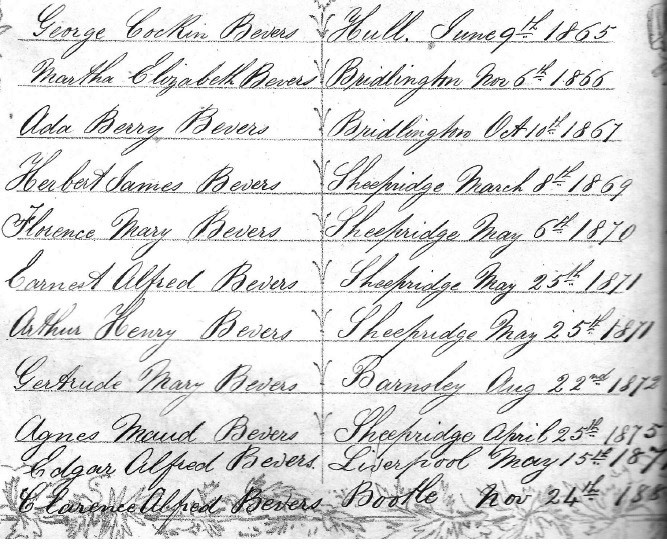
List of “Children’s Names” in the Family Bible of Alfred C. and Mary N. Bevers

Date — Child’s Name —    Parents’ Names    — Mother’s Parents’ Names      — Profession

Baptismal record of Herbert James Bevers, dated May 16, 1869

From the lists of births and deaths in the Bevers’ Bible we can follow where Herbert’s family was living during his childhood.  While living in Sheepridge, a sister and a set of twin boys were born, but none of them survived their first year of life.  The baby girl and one of the twins died while the family was in Sheepridge, but the second twin died in Barnsley.  It appears that the Bevers family had lived in Sheepridge for about four years.  The 1871 Census of England was taken while Herbert’s family was living in Sheepridge.  At that time, Herbert’s father was a “Collector and Canvasser for Prudential Insurance Company.”2

After moving to Barnsley, a town about 20 miles southeast of Sheepridge, another sister, Gertrude, was born when Herbert was three and a half years old.  Then about two and a half years later they would be in Sheepridge again for the birth of another sister, Agnes (but called by her middle name Maud).  At that time (April 1875) Herbert’s brother George was nearly 10 years-old, his sister Ada was 7 ½ years-old, Herbert was six years-old and Gertrude was about 2 ½ years-old.

The family made a longer move sometime before May 1877, for another son was born in Liverpool, on the west coast of England.  This son lived for about 14 months, dying in Bootle, a town three miles north of Liverpool.  In 1881, when the Census of England was taken, the Bevers family was located in Kirkdale, a ward of Liverpool.3  Herbert’s father was a “tailors cutter” and his brother George at the age of fifteen was a “pupil teacher.”  Herbert and his sisters were “scholars.”  At the end of 1881, another brother was born and the family was living in Bootle.  They were still living there nine months later when the baby died.  At that point (August 1882), George was 17 years-old, Ada nearly 15 years-old, Herbert was 13 ½ years-old, Gertrude 10 years-old and Maud was seven and a half years-old.

During the next several years, all the members of Herbert’s family would immigrate to the United States.  Resources give varying years for their arrivals in the USA, but I will report the years as they were recorded in the U. S. censuses.  Herbert’s father immigrated to the United States first, in 1883,4 leaving his family presumably in Bootle (Alfred’s daughter Maud wrote a letter to her father dated September 29, 1883 which identified her address as 13 Orlando Street.  An Internet search for this address locates it in Bootle, not Kirkdale nor Liverpool).  Then in 1884 Herbert’s mother and sisters immigrated5, joining Alfred in South Dakota.  Herbert would have been 15 years-old at that time.  It is not known why he stayed in England.  According to the 1940 U. S. Census, the highest grade that Herbert had completed was 6th grade,6 so he probably was no longer attending school.  His brother George immigrated in 1885,7  but Herbert didn’t immigrate until about 1888.8

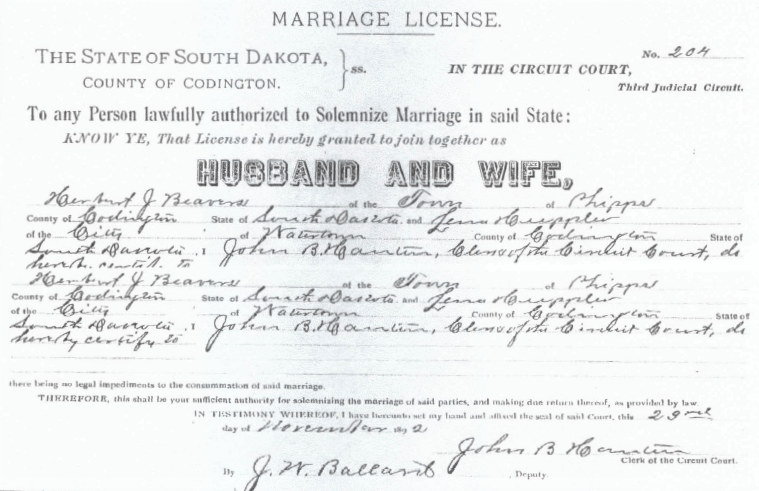
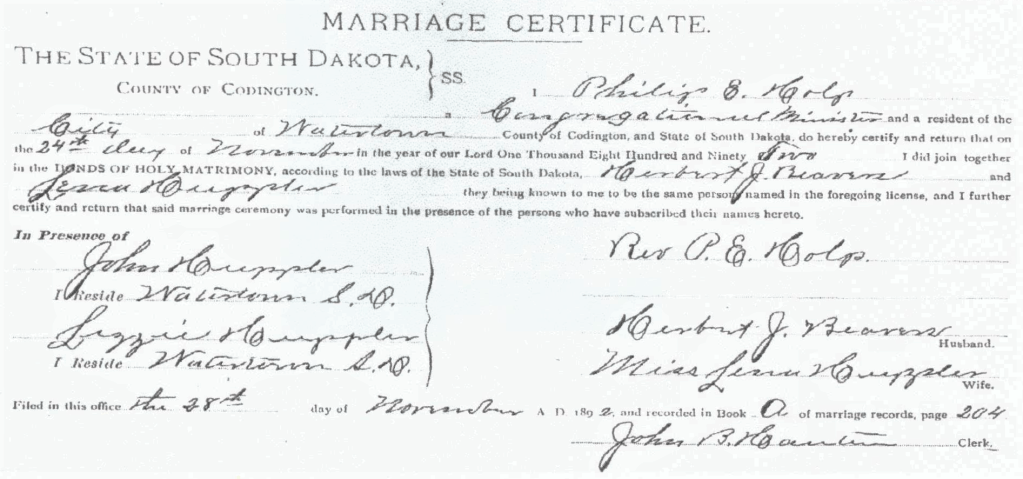
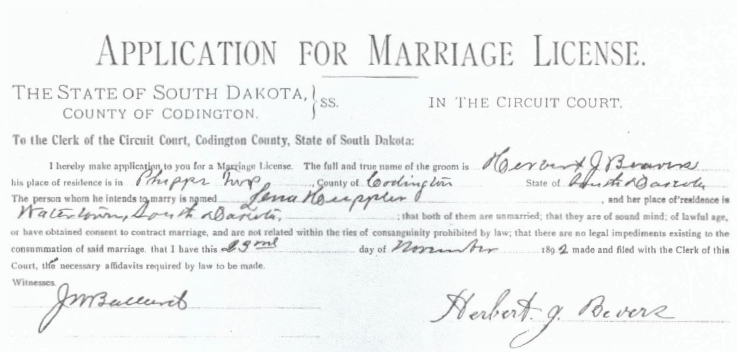
When George Bevers immigrated to the USA, he settled in Philadelphia.  The first time there is an entry for him in the Philadelphia City directory is in 1886.9  He lived there nearly all of the rest of his life.  One of Herbert’s grandsons believes that Herbert spent some time in Philadelphia,10 but Herbert’s name cannot be found in the city directory.  Another source states that Herbert went to Virginia for a time.11  I have found no documentation to corroborate this either.  After Herbert traveled to the USA, the first thing that is known for certain is that Herbert was a resident of Phipps Township in Codington County, South Dakota when he married Lena Huppler in 1892.12  It is a likely guess that Herbert had been living with his parents on their homestead in Phipps Township. The story of Herbert and Lena’s life together will have to wait for another time.

  1. “West Yorkshire, Non-Conformist Records, 1646-1985” (Provo, UT, USA: Ancestry.com Operations, Inc., 2011), http://www.Ancestry.com.
  2. “1871 England Census” [Class: RG10; Piece: 4372; Folio: 86; Page: 19; GSU roll: 848087]. In the repository of Ancestry.com (Provo, Utah, USA: Ancestry.com Operations Inc., 2004): https://www.ancestry.com/interactive/7619/WRYRG10_4369_4372-0637/25690148?backurl=https://www.ancestry.com/family-tree/person/tree/18041304/person/620842544/facts/citation/145258692549/edit/record.
  3. “1881 England Census” [Class: RG11; Piece: 3684; Folio: 133; Page: 23; GSU roll: 1341882]. In the repository of Ancestry.com (Provo, Utah, USA: Ancestry.com Operations Inc., 2004): https://www.ancestry.com/interactive/7572/LANRG11_3682_3686-0678/9137172?backurl=https://www.ancestry.com/family-tree/person/tree/18041304/person/620842544/facts/citation/140137474899/edit/record#?imageId=LANRG11_3682_3686-0679.
  4. “United States Census, 1910,” database with images, FamilySearch (https://familysearch.org/ark:/61903/3:1:33S7-9RGL-SS6B?cc=1727033&wc=QZZH-HGB%3A133638201%2C135920101%2C135948601%2C1589092018 : 24 June 2017), South Dakota > Kingsbury > De Smet Ward 2 > ED 257 > image 6 of 8; citing NARA microfilm publication T624 (Washington, D.C.: National Archives and Records Administration, n.d.).
  5. “United States Census, 1910,” database with images, FamilySearch, South Dakota > Kingsbury > De Smet Ward 2.
  6. “United States Census, 1940,” database with images, FamilySearch (https://familysearch.org/ark:/61903/3:1:3QSQ-G9M1-58J8?cc=2000219&wc=QZFM-WH1%3A791611401%2C793270701%2C793367301%2C951353501 : accessed 14 May 2020), South Dakota > Codington > Watertown City, Watertown, Ward 3 > 15-24A Watertown City Ward 3 bounded by (N) Kemp Av; (E) Maple; (S) 4th Av S; (W) ward line; also Barton Hospital, Codington County Jail, Watertown City Jail > image 17 of 42; citing Sixteenth Census of the United States, 1940, NARA digital publication T627. Records of the Bureau of the Census, 1790 – 2007, RG 29. Washington, D.C.: National Archives and Records Administration, 2012.
  7. “United States Census, 1900,” database with images, FamilySearch (https://familysearch.org/ark:/61903/3:1:S3HY-DZV6-7M?cc=1325221&wc=9B7K-NQX%3A1030550501%2C1036056801%2C1036357801 : 5 August 2014), Pennsylvania > Philadelphia > ED 976 Philadelphia city Ward 38 > image 28 of 33; citing NARA microfilm publication T623 (Washington, D.C.: National Archives and Records Administration, n.d.).
  8. “United States Census, 1900,” database with images, FamilySearch (https://familysearch.org/ark:/61903/3:1:S3HT-68DY-PH?cc=1325221&wc=9B7H-9LQ%3A1031648401%2C1033119401%2C1033119402 : 5 August 2014), South Dakota > Roberts > ED 282 Agency, One Road & Spring Grove Townships > image 4 of 11; citing NARA microfilm publication T623 (Washington, D.C.: National Archives and Records Administration, n.d.).
  9. James Gopsill’s Sons, Publishers, Gopsill’s Philadelphia Directory (Philadelphia: James Gopsill’s Sons, Publishers, 1886): 182.
  10. M. E. Bevers, Willis Bevers Family History Slideshow (Unpublished, n. d.): 6.
  11. “Herbert James Bevers Family,” In The First 100 Years in Codington County, South Dakota, 1879-1979, by Codington County History Book Committee (Watertown, South Dakota: Watertown Public Opinion Print, 1979): 116.
  12. “Application for Marriage License of Herbert J. Beavers” (Circuit Court, Codington County, South Dakota, November 23, 1982).