Maude and Alfred Waters, Part Two

The May 1904 news article announcing the marriage of Maude Bevers and Alfred N. Waters described the two of them as “prominent people” of the small town of De Smet, South Dakota.  (You can see the news article in Part One.) Each of them was involved in a variety of social groups and community pursuits.  For example, Maude was active in the Methodist Episcopal Church, the Red Cross and a philanthropic educational society.  Waters held civic roles and promoted improvements in their county (Kingsbury) and in their town, which as of 1906 had “a population a little in excess of 1,000 souls.”1

After her wedding, even though her husband was not a member of the church, Maude continued her activities in the Methodist church, having become a member in November 1898.  The records of the women’s group of the church noted that Maude served as secretary and 4th Vice in 1904 and 1905, respectively.  Another role in which she served was the leader of the choir, this she did for years before and after her marriage.2  In addition, “… for many years [she] was a member of a mixed quartet that sang for funerals in various churches of the town and area.”3

On a Friday night in March 1907, there was a Demorest medal contest held at the church, six young ladies competing for a Silver medal.4  Throughout the evening, musical selections were performed as well as the orations by the contestants.  One of the selections, which was entitled “David and Goliath,” was performed by a ladies’ quartette in which Maude sang a part. 


The Demorest Medal program was an educational program through which young people and community members learned about the tenets of the prohibition movement.  In 1886, W. Jennings Demorest inaugurated oratory contests, utilizing subject matter promoting the prohibition of liquor traffic.  The work began in New York City, then was introduced in California and within three years had spread throughout the United States and into several foreign nations.

Six to eight contestants competed at the local level and the winner would be awarded a Silver medal.  At the next level, six Silver medalists would compete for a Gold medal, then six Gold medalists would compete for a Grand Gold medal.  At the highest level six Grand Gold medalists competed for a Diamond medal.

In 1895, the Woman’s Christian Temperance Union (W. C. T. U.) adopted the Demorest Medal program and in the following years expanded the topics of the oratory books.  “Recitation books, embracing orations on Prohibition, Total Abstinence, Scientific Temperance, Anti-Narcotics, Franchise, Social Purity, etc., were published; medals were designed with mottoes and emblems of the W. C. T. U., and circulars setting forth the plans of this new system sent out to all the States in the Union.”5  As of January 1907, the contest publications had been disseminated into Australia, South Africa, India, Canada, Mexico and the Philippine Islands as well.
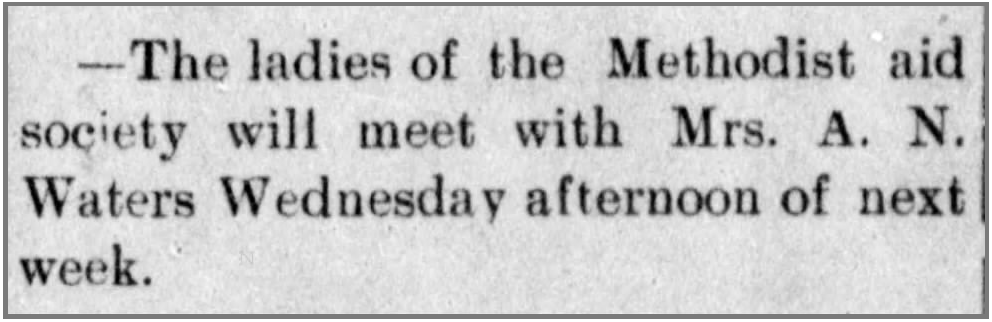

News clipping from the January 29, 1909 issue of Kingsbury County Independent

The Ladies Aid Society of the Methodist church rotated its meetings among its members.  In the first week of February 1909 the society met at Maude’s home.6  For a fundraising project that year, they produced a cookbook, entitled Kitchen Echoes.  “The venture was a very profitable one,”7 as it included advertisements for local businesses in addition to its recipe entries.  Waters Land and Loan Company, the real estate company of Maude’s husband, was one of the business sponsors, advertising that the company had the “Best Bargains in Grain, Dairy and Stock Farms.”  Maude and her sister Gertrude both submitted recipes.  Gertrude’s recipes were for Potato Salad and Sugar Cookies.  (See Gertrude’s recipes in Aunt Gertie.)  Maude’s entries were for Angel Custard and Mrs. Power’s Ginger Snaps.  The recipe for Ginger Snaps honored Elizabeth Power, a former resident and pioneer settler of De Smet, arriving in June 1880 along with her husband and four children.  Shortly before the recipe was published in Kitchen Echoes, Mrs. Power had passed away on February 11, 1909.  Her obituary stated: “Mrs. Power was one of those motherly women who everybody likes, always ready to answer sick calls, and never so happy as when doing some kind deed.  She was a life long and consistent member of the Roman Catholic church, and her remains lie in the Catholic cemetery at Bellingham [Washington].”8  Two years later, in January 1911, the Methodist aid society met again at Maude’s house.9  An entry in the treasurer’s book of the church’s women’s group indicates that Maude hosted a supper in that same month which brought in $6.60.  In 2025, an equivalent amount of money is approximately $225.00.


Angel Custard.—Separate the yolks and whites of two eggs, beat the whites to a stiff froth, adding a few drops of flavoring.  Beat the yolks, add two teaspoons corn starch wet with a little cold milk, and stir into a pint of boiling milk which has been sweetened to taste (about two-thirds cup of sugar), adding a pinch of salt the last thing.  When thickened and boiling pour the custard over the beaten whites of eggs and stir rapidly a few moments.  Delicious either hot or cold.—Maude Waters.

Mrs. Powers’ Ginger Snaps.—One-half cup butter (scant), one-half cup lard (scant), one cup white sugar, one cup molasses, one teaspoon soda dissolved in one tablespoon water, one egg, one tablespoon ginger, a pinch of salt.  Flour to mix quite stiff.—Maude Waters.
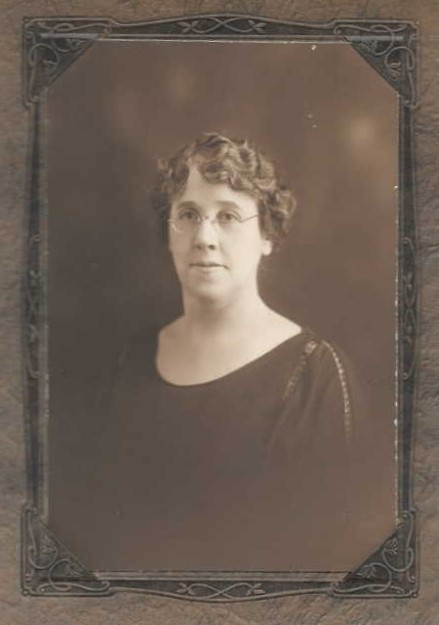
Maude (nee Bevers) Waters, estimated date 1910

From the time that A. N. Waters settled in De Smet, he served in numerous civic capacities and promoted improvements in the town, county and state.  A few of his responsibilities during the year 1905 give us a glimpse of his involvements in the local community at that time, as well as in the broader region.

  • April 1905 – At a meeting of the stockholders, Waters was elected to be a director on the board of the Athletic Association.10  Two years later, he was elected to be the president of the association, which was reported to have a large membership.11
  • August 1905 – While serving as mayor of De Smet, Waters was appointed by the South Dakota governor to be a delegate to the Trans-Mississippi Commercial Congress which met at Portland, Oregon from August 16 to 19.12  This congress was organized to promote the commercial interests of the states and territories west of the Mississippi River.  The following year, Waters was appointed again to the congress which met November 20 to 23 in Kansas City, Missouri.13
  • September 1905 – The county commissioners made Waters the chairman of a committee for the purpose of creating an agricultural exhibit to represent Kingsbury County at the state fair held in Huron, South Dakota.14  He consented to procure the materials for the exhibit and was authorized to appoint members to the committee from different parts of the county.  Waters and the committee members did not receive a salary, but the county commissioners authorized payment for the cost of transporting the materials for the exhibit to Huron.  
  • November 1905 – A real estate dealers association was formed to which Waters was elected secretary of the board.  The purpose of the association was “promoting and advancing the interests of [South Dakota] by devising ways and means to advertise its resources and encourage immigration, etc.”15  Four months later, at the March 1906 meeting of the association, which had about 250 member firms by that time, Waters gave a speech during the evening banquet which was entitled, “Had We Better Hang Together or Hang Seperate.“ [sp.]16  Moving ahead with their aims, in March 1907, Waters and about 25 members of the association met with the governor of South Dakota and the Immigration Commissioner “to consider co-operative advertisement of the state. … The association indorsed a proposition made by the Minneapolis and St. Louis railway to furnish a car and superintend and bear the expense of making a traveling exhibit of products of South Dakota farms on its line, provided the exhibit be furnished by the real estate men.”17

Waters had begun his career in real estate investment in 1880 when he arrived in De Smet, the same year that the town was founded. Thirty years later, he was continuing his career in that profession. A few of Waters’ transactions are noteworthy:

  • On April 16, 1909, Waters Land and Loan Company made a ten-year lease with the United States for the use of “the first floor of the one story … brick premises, known as ‘Waters Building’ situated on the North side of Second Street between Calumet and Joliet avenues.”18 (The consideration was $325.00 per annum in quarter yearly payments.) The Waters Building had been built in 1888-89 by the Kingsbury Abstract Company and Waters Land and Loan Company had purchased it in 1906. (More about this transfer is in Part One.) The De Smet post office had occupied a space in the building since at least 1893.19 In 1909, an extension was built onto the Waters building and the post office moved into it. The lease described above commenced the occupation of the post office in the extension. “The new post office was of fireproof construction, 25×45 feet and fitted with the latest style of furnishings. The building was heated by steam and supplied with gas and water….”20
  • About 1910, Waters owned a house at the corner of Lyle Avenue and Front Street NE.  It was the former home of Fred Dow but had been relocated from its original site.  Fred Dow had sold his farmstead and grove of trees to Waters in the early 1900s.  Waters had moved the house from the Dow farm to the corner lot across the road on Front Street NE.21 Fred Dow’s farmstead was the location of the “surveyors house” in which the Charles Ingalls’ family lived when Ingalls was hired by Dakota Central Railway in 1879. The surveyors’ house was moved in 188422 to its current site in the town of De Smet. Therefore, it had not been sitting on the property when Waters purchased the Dow farm. The surveyors’ house was purchased by the Laura Ingalls Wilder Memorial Society in 1967 and placed on the National Register of Historic Places in 1974.23
  • On September 28, 1915, Alfred purchased lot #32 of De Smet from Caroline A. Swanzey (formerly Caroline A. Ingalls) for $62.50.24  This was author Laura Ingalls Wilder’s sister, known as Carrie in Wilder’s Little House books.  In Standard Atlas of Kingsbury County, South Dakota, published in 1909, the owner of lot #32 of De Smet is noted as C. P. Ingalls, Caroline’s father who had passed away in 1902.
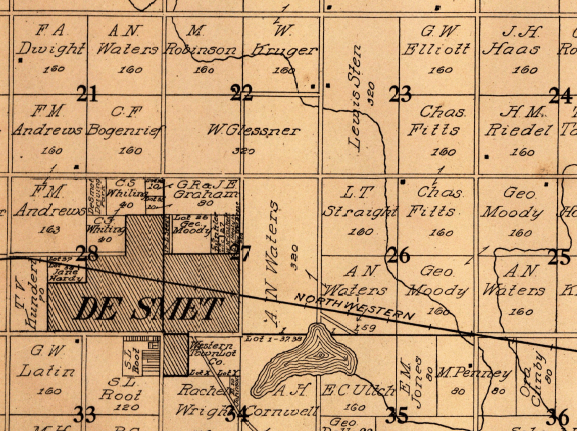
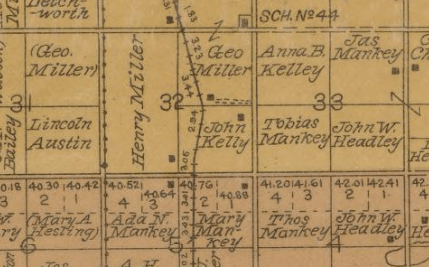
The above clipping is from a map in the 1909 edition of Standard Atlas of Kingsbury County, South Dakota.  It shows that Waters owned 320 acres directly east of De Smet.  The lower half of this property had been a tree claim filed by Fred N. Dow, and to the east of F. N. Dow’s claim, his father, James C. Dow, had filed a claim on a quarter section, which in 1909 Waters also owned.25  Through a cursory examination of the 1909 atlas, 14 properties in the county were found with Waters’ name on them (in the townships of Le Seur, Spirit, Manchester, De Smet, Esmond and Mathews).  One of the properties that Waters owned had been the homestead of Almanzo Wilder (Laura Ingalls Wilder’s husband); Wilder had sold the property to Dakota Loan and Investment in 1891, a company in which Waters was a partner.26  It is not known at this time when Waters became the sole owner.  That property can be seen on the above clipping in the upper left corner.  In addition to her husband’s properties, the atlas also indicated that Maude owned two adjoining quarters in Manchester Township.


The United States census taken in April 1910 recorded Alfred as 54 years old and working on his own account in his own real estate office.27  Maude was 35 years old and did not have an occupation.  In the record, besides Maude and Alfred, there was a housekeeper living in their home, named Izora Youmans [sp.], who was 37 years old, single and had been born in New York.

For six years, Maude’s mother, who lived a half block to the east of the Waters home with Maude’s father and sister Gertrude, had been impaired following an operation from which she did not completely heal.  Two years after the operation, her mother developed diabetes.  “All during her illness, and especially during the last months when almost helpless and suffering great pain everything that could be done to relieve and give pleasure was done for her by loving hands of her own family and friends.”28  No doubt Maude had been involved in her mother’s care until her passing on July 14, 1910.29


On the last Saturday of May 1910, Waters was invited to dine at the home of Mr. and Mrs. Charles H. Tinkham. Along with Waters and Tinkham, the other five guests were men of De Smet who had lived through the “hard winter” of 1880-81. They all had arrived in Kingsbury County in the winter and spring of 1880, except Waters who hadn’t arrived until August. When early snow storms commenced in the fall, the men stayed in the newly built buildings of the fledgling town, which had about 14 businesses.30 Recurring blizzards would cover the railroad tracks that winter, eventually closing the track altogether from January to May. About 50 families (including single men) wintered in the town. Thirty years later at the gathering held in the Tinkham home:
The varied experiences of that hard winter were all recounted. Of one thing our readers can be certain, however, and that is the dinner served on this occasion was not on the half-ration plan of some of the dinners eaten by the gentleman [sp.]during that never to be forgotten winter of [1880-81]when supplies ran low and wheat had to be ground in coffee mills, and when sugar for coffee was kept in a jewel case.31

During that trying winter, Waters boarded in the home of Arthur and Jennie Sherwood. A. S. Sherwood “is mentioned in the Laura Ingalls Wilder book The Long Winter as one of the few families wintered in for that historic experience. He and his wife … were among the few married couples in the town that winter. Some of the bachelors roomed and boarded there including A. N. Waters, in a house so small that blankets separated the beds in a sleeping room.”32 Waters himself was not mentioned in Wilder’s The Long Winter but he was mentioned in her autobiographical manuscript, Pioneer Girl, which relates the following story:
There was in town a lawyer named Waters who had expected to go east early in the winter to be married but had got caught by the storms.

Now the wedding day was drawing near and no way to get transportation out. He decided to walk and … he started before daylight one morning as the blizzard wind was dying down and the sky cleared.

It was a scant day’s calm this time and we were afraid he was caught in the next storm, but he walked the miles to Brookins [sic] safely and after resting walked on to Tracy.

The next spring we learned that he arrived safely in time for his wedding, but both feet were so badly frozen that he was unable to walk on that day. However his feet recovered and he came back in the spring, bringing his wife with him.33

The above story, of course, refers to Waters’ first wife, Josephine E. Humphrey, whereas Maude was his second wife. Waters obituary adds details to this account of the winter of 1881:
… he boarded with the Arthur Sherwood family, “Sixteen of them in a house sixteen feet square,” [Waters] called it. He lived here through the Hard Winter and in the spring of 1881 made his famed hike along the railroad track in company with a brother of Mrs. Arthur Sherwood. The whole country had been snow-bound for months and the two young men struck out for the East, hauling a sled, and in four days reached Tracy, secured a team and floundered thru to Sleepy Eye, where they were again disappointed in train service and Mr. Waters continued on alone to New Ulm.34

Another perspective on this event was recounted by the editor of De Smet News in 1921:
… The big snows of the winter of 1880-1881 caused such a blockade thruout the country that after the first of January there was no train from De Smet east until the following May. Along in March Mr. Waters became anxious to get out of the country and keep a date in the east, so he started on foot over the snow banks, carrying a hundred letters from De Smet people to their relatives and friends back home. He walked as far as Tracy, covering the distance in four days. There a team of mules hitched to a sleigh was secured and several men made use of the outfit to get as far as Sleepy Eye. At that point a train was boarded and they were scheduled to leave next morning; but a storm prevented and they were there a whole week. Mr. Waters became uneasy at the delay and started out alone, hoofing it to New Ulm. There the road was open and he was soon on his way east.35

Charles H. Tinkham, the host of the 1910 gathering of De Smet pioneers, had arrived in De Smet in the spring of 1880.  Soon after his arrival Tinkham opened a furniture and houseware store, and he also engaged in undertaking.36   During the “hard winter,” “Tinkham was a member of the ‘bachelor’s club’ who lived with William Crook, sleeping on boards laid across the ceiling joists.”37 

Among the guests attending the dinner was Charles L. Dawley, who settled in De Smet in May 1880.  As an agent for a lumber company, he began “selling loads of lumber to the new settlers. He set up an office tent and sold lumber from railroad cars until an office and shed could be built. During the Hard Winter, he boarded with Mrs. Garland, and began courting her daughter Florence.”38  Florence was Laura Ingalls Wilder’s teacher during that winter.  Within a few years, Dawley left the lumber business to go into real estate with Waters, a partnership which lasted 15 years.  Waters, Dawley and Alfred Thomas were associates who established the Dakota Loan and Investment Company, “which continued the loan business previously run by Alfred Waters, doing a general real estate and chattel loan business.”39 Waters and Dawley took full control of the business in 1887.

The other guests were Charles E. Ely, Edward H. Couse, Daniel H. Loftus and John H. Carroll.  About April 1880, Ely was a lumber agent also, selling lumber in De Smet from a rail car.  Subsequently, he established the town’s first lumber yard.40  He was married, but had not yet moved his family to De Smet when the winter storms came later that year.  Couse, who was also married when he came to De Smet and a Civil War veteran, was the owner of a hardware store.41  Loftus was a partner in a general merchandise store in 1880, and in February 1881 in the midst of the “hard winter”, a local newspaper reported, “the first grist of wheat was ground in De Smet on the 5th, by Dan Loftus. Dan makes a fine miller.”42

John H. Carroll was the first clerk of courts in Kingsbury County (April 1880) and he was the first postmaster, later he would become the first mayor of De Smet.43 His homestead adjoined the town of De Smet. On that property, Carroll would plat 10 blocks as residence blocks which became an addition to the original town. Waters would eventually purchase lots in Carroll’s addition, and on those lots, in 1905, build the home in which he and Maude would live. Another property that Carroll at one point owned was the northeast corner lot at Calumet Avenue and Second Street. Waters and his partners of the Kingsbury Abstract Company purchased it from Carroll and then constructed the building that many years later, through a series of transactions, would be owned by Waters Land and Loan in 1906. (See more about the Waters residence and the business building in Part One.)

Part Three will continue the community activities of Maude and Alfred Waters.


1 “The Growth of De Smet,” Sioux Falls (South Dakota) Argus-Leader, March 23, 1906.

2 Caryl Lynn Meyer Poppen, ed., “A History of the Methodist Church,” De Smet Yesterday and Today (De Smet, South Dakota: De Smet News, printer, 1976): 144.

3 “Mrs. A. N. Waters, Native of England, Resident 60 Years,” De Smet (South Dakota) News (July 10, 1958) in Nancy S. Cleaveland and Gina Terrana, Waters (2015): http://www.pioneergirl.com/waters_cemetery.pdf.

4 “Items from De Smet,” Sioux Falls (South Dakota) Argus-Leader, March 22, 1907, 3, Newspapers.com.

5 Cornelia T. Jewett, “History of Contest Work,” The National Advocate (New York, January 1907): 1-2, https://books.google.com/books?id=HwFQAAAAYAAJ&pg=RA1#v=onepage&q&f=false.

6 Kingsbury County Independent (De Smet, South Dakota), January 29, 1909, 5, Newspapers.com.

7 Poppen, “A History of the Methodist Church,” 144.

8 Gina Terrana, “Biography of Thomas P. Power,” http://www.pioneergirl.com/blog/archives/7859.

9 Kingsbury County Independent (De Smet, South Dakota), December 30, 1910, 8, Newspapers.com.

10 Kingsbury County Independent (De Smet, South Dakota), April 21, 1905, 5, Newspapers.com.

11 Citizen-Republican (Scotland, South Dakota), April 4, 1907, 2, Newspapers.com.

12 Kingsbury County Independent (De Smet, South Dakota), August 11, 1905, 5, Newspapers.com.

13 Hot Springs (South Dakota) Weekly Star, November 9, 1906, 2, Newspapers.com.

14 Kingsbury County Independent (De Smet, South Dakota), September 15, 1905, 4, Newspapers.com.

15 “Real Estate Dealers,” Sioux Falls (South Dakota) Argus-Leader, January 5, 1906, 3, Newspapers.com.

16 “Real Estate Men Meet,” Sioux Falls (South Dakota) Argus-Leader, March 15, 1906, 3, Newspapers.com.

17 “To Exhibit Car Load of South Dakota Products,” Citizen-Republican (Scotland, South Dakota), April 4, 1907, 2, Newspapers.com.

18 The Heritage House, LLC, “Abstract of Title,” Transfer Number 31.

19 Nancy S. Cleaveland, “post office/post-office,” Laura Ingalls Wilder A-Z, http://www.pioneergirl.com/blog/archives/13454.

20 Cleaveland, “post office/post-office.”

21 “Life’s End Comes at 103 for Mrs. Fred Dow, Oldest Resident County,” De Smet (South Dakota) News (April 26, 1973) in Nancy Cleaveland and Gina Terrana, Dow/Glover (2015): http://www.pioneergirl.com/dow_f_cemetery.pdf.

22 De Smet Leader (March 22, 1884) in Nancy S. Cleaveland, “surveyors’ house,” Laura Ingalls Wilder A-Z, http://www.pioneergirl.com/blog/archives/13817.

23 Cleaveland, “surveyors’ house.”

24 State of South Dakota, Kingsbury County, Deed Record No. 50, 77.

25 Nancy S. Cleaveland, “surveyors’ house.”

26 Nancy S. Cleaveland, “claim,” Laura Ingalls Wilder A-Z, http://www.pioneergirl.com/blog/archives/10912.

27 “United States, Census, 1910”, FamilySearch (https://www.familysearch.org/ark:/61903/1:1:MPXB-BGS : Wed Oct 15 05:57:53 UTC 2025), Entry for Alfred N Waters and Maud Waters, 1910.

28 Kingsbury County Independent (De Smet, South Dakota), July 22, 1910, 4, Newspapers.com.  

29 Ancestry.com. South Dakota, U.S., Death Index, 1879-1955 [database on-line]. Provo, UT, USA: Ancestry.com Operations, Inc., 2004.

30 Nancy S. Cleaveland, “The Long Winter – historical perspective,” Laura Ingalls Wilder A-Z, http://www.pioneergirl.com/blog/archives/5096.
31 Kingsbury County Independent (De Smet, South Dakota), June 3, 1910, 5, Newspapers.com.
32 Aubrey Sherwood, “The Sherwoods of De Smet” in De Smet Yesterday and Today by Caryl Lynn Meyer Poppen, ed. (De Smet, South Dakota: De Smet Bicentennial Committee, 1976): 116.
33 Laura Ingalls Wilder, “Hard Winter,” Pioneer Girl (unpublished manuscript) in Nancy S. Cleaveland and Gina Terrana, Waters (2015): http://www.pioneergirl.com/waters_cemetery.pdf.
34 “A. N. Waters, Pioneer, Laid to Rest Here Sunday,” De Smet (South Dakota) News (September 2, 1927) in Nancy S. Cleaveland and Gina Terrana, Waters (2015): http://www.pioneergirl.com/waters_cemetery.pdf.
35 Carter Sherwood, ed., De Smet (South Dakota) News (November 4, 1921) in Nancy S. Cleaveland and Gina Terrana, Waters (2015): http://www.pioneergirl.com/waters_cemetery.pdf.

36 “Charles H. Tinkham,” Memorial and Biographical Record (Chicago: George A. Ogle and Co., publisher, 1898): 435.

37 Nancy S. Cleaveland and Gina Terrana, Tinkham (2015): http://www.pioneergirl.com/tinkham_cemetery.pdf.

38 Nancy S. Cleaveland and Gina Terrana, Dawley (2015): http://www.pioneergirl.com/dawley_cemetery.pdf.

39 Nancy S. Cleaveland, “bank,” Laura Ingalls Wilder A-Z, http://www.pioneergirl.com/blog/archives/15076.

40 De Smet (South Dakota) News (August 25, 1916) in Nancy S. Cleaveland and Gina Terrana, Ely (2015): http://www.pioneergirl.com/ely_cemetery.pdf.

41 George W. Kingsbury, “Edward H. Couse,” History of Dakota Territory, vol. 4 (Chicago: S. J. Clarke Publishing Co., 1915): 1048.

42 Kingsbury County (South Dakota) News (February 24, 1881) in Nancy S. Cleaveland and Gina Terrana, Loftus / Fritzel (2015): http://www.pioneergirl.com/loftus_cemetery.pdf.

43 Nancy S. Cleaveland and Gina Terrana, Carroll/Imus (2015): http://pioneergirl.com/carroll_cemetery.pdf.
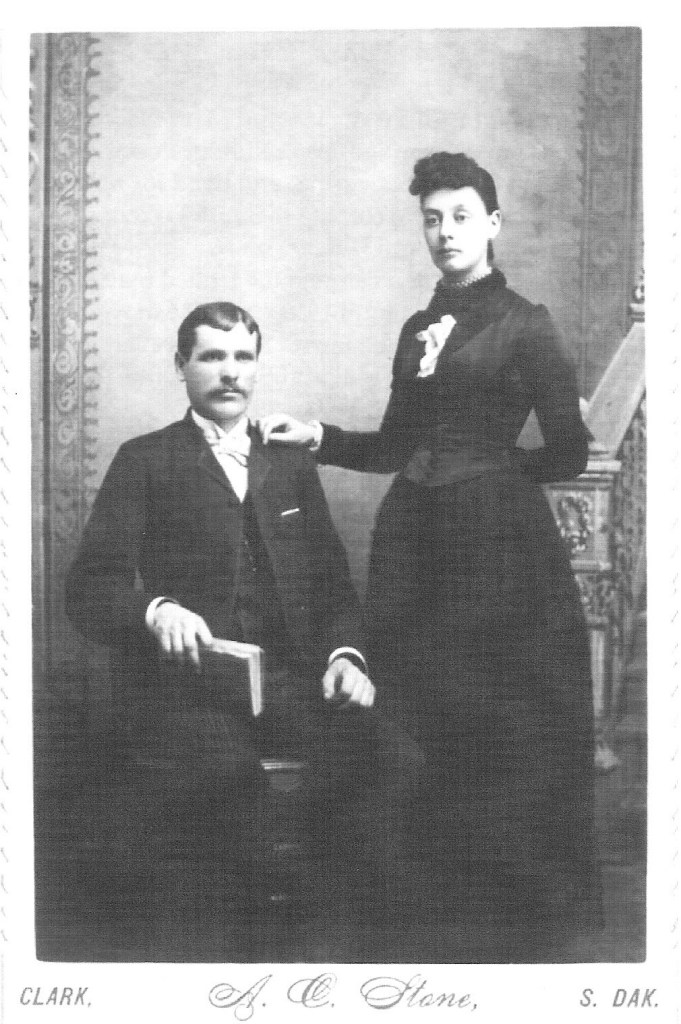
Ada and William Mankey

It was probably in the fall of 1885 that 18 year-old Ada Bevers met William Mankey.  Ada had immigrated from England only about 10 months prior.  William, having immigrated from England in 18751 and having worked (as of 1880) in a mine in Deer Park Township, La Salle County, Illinois,2 by 1882 had obtained a tract of land in Clark County, Dakota Territory.3  In October 1885 Ada’s father, Alfred C. Bevers, was assigned to be the supply pastor of the Henry Methodist Episcopal (M. E.) Church in southwestern Codington County, Dakota Territory.4  The charge may have included a congregation located in Garden City as well, which was about 12 miles to the northwest of Henry, over the county line in Clark County.  It is known that in 1888, William and his mother were members of the Garden City congregation and William was also a steward of the Henry Charge.5  

Ada’s family lived in Henry for two years, then her father was assigned to Wolsey M. E. Church and the following year he was assigned to Bradley M. E. Church.  Around this time period, Alfred submitted a claim for a homestead in Phipps Township, in western Codington County, about 10 miles northeast of Garden City.  When Alfred and his wife Mary celebrated their 25th wedding anniversary in September 1889 at their small home on the homestead, it is believed that William attended the gathering.  (See a photograph of the group attending the celebration in Ada, Gertie and Maude). 

Ada and William would eventually marry on October 28, 1891.6  During the next decade, they lived on their farm in Clark County and they would have three children born to them.  Their first child, Florence Gertrude, was born on October 16, 1892.7  Her namesakes were Ada’s sisters, Florence who had died as an infant and Gertrude who was still living with Ada’s parents.  On April 13, 1894, Ada gave birth to William Arthur,8 named after his father of course and one of Ada’s deceased brothers Arthur.  On June 7, 1897, George Floyd was born, named after Ada’s eldest brother George, who was living in Philadelphia.9 By 1898, Ada’s parents and sisters Gertrude and Maude had moved to De Smet, the county seat of Kingsbury County, about 50 miles to the south of William and Ada’s farm.

William and Ada Mankey

When the 1900 United States census was taken, 32-year-old Ada and 42-year-old William had been married for eight years.10  They were living on the farm that they owned in Eden Township, Clark County.  William was a farmer and a naturalized citizen, having lived in the United States for 25 years.  The census recorded that Ada had immigrated in 1884 and had been in the United States for 16 years.  She was not a naturalized citizen (although she had submitted her intention to become a citizen in 1889.)11  Seven year-old Florence had attended five months of school that year.  W. Arthur was six years-old and G. Floyd was two years old.  On the section to the east of William and Ada’s farm, William’s mother Mary lived with his brother Tobias, his sister Margaret Minor and Margaret’s three children.12  William’s father Thomas had passed away in 1899 and is buried in Garden City Cemetery.13

The quarter section in Eden Township that William and Ada owned can be found on a 1900 map of Clark County; the farm is about a mile north of Garden City and labeled with Ada’s name.14  Adjacent to Ada and William’s farm, the map shows the quarter section owned by Mary Mankey, and to the east of her farm, William’s brother Thomas Mankey held a quarter section.  Not far away in Maydell Township to the north were the farms of William’s brothers Tobias and James Mankey.

Cropped from a map of Clark County, South Dakota, dated ca. 1900.

William and Ada added another daughter to their family, Hazel Maude, on September 14, 1904.15  She was named after Ada’s youngest sister Maude.  When the South Dakota census was taken in 1905, the Mankey family was still living at the same location in Eden Township.  Four years later, William’s mother passed away in 1909 and was buried with his father in Garden City Cemetery.16

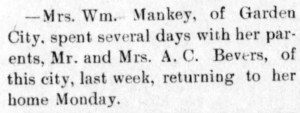
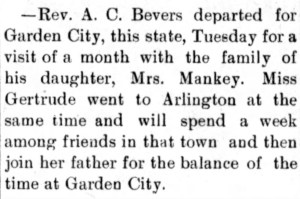
In late winter 1909, Ada made a trip to De Smet to visit her parents for several days.  Possibly she traveled by train.  The Chicago, Milwaukee and Saint Paul Railway had an extension which had stations at Garden City and Lake Preston, a town ten miles to the east of De Smet.  A year and a half after this visit, Ada’s mother, who had been afflicted with diabetes for nearly four years, passed away in July 1910.17  Shortly afterwards, Ada’s father spent a month at Ada’s home and her sister Gertrude joined them after visiting some friends.

Reported in Kingsbury County Independent, March 5, 1909
Reported in Kingsbury County Independent, August 26, 1910

When the 1910 United States census was taken, Ada and William were still living on a farm in Eden Township.18  Florence (age 17), W. Arthur (age 16) and G. Floyd (age 12) had all attended school that year.  Hazel at five years-old had not attended school.  While in high school, W. Arthur made a glider from plans published in the magazine Popular Mechanics.19

Both the 1900 and the 1910 censuses asked women how many children they had and how many of them were alive.  Ada had given birth to four children and all of them were alive.  This was unlike her mother, who had born 11 children, six of which passed away in their first or second year of life.  In England early childhood mortality (deaths of children between the age one and five) had begun to decline about 1870, but infant mortality (deaths of children before the age of one) didn’t decline until around the turn of the twentieth century.20  Ada’s mother was living in England and bearing children when infant mortality was high.  Ada’s children were born during a period of steady decline in child mortality in the United States.21

In 1915 when the South Dakota state census was taken, Florence and Hazel were at home with Ada and William.22  W. Arthur was attending his second year of college at Dakota Wesleyan University (DWU) in Mitchell, South Dakota.23  He was studying Engineering and Math.24  The census records identify the family’s religion as “M. E.” (Methodist Episcopal).  It is not known where G. Floyd was at the time of this census, but according to the 1930 United States census he was a veteran of “the World War,”25 which would be World War 1.  He was a seaman in the United States Navy from May to December 1918.26 

The first of William and Ada’s children to marry was W. Arthur.  He married Birdella A. Carhart in April 1916 in Mitchell,27 where they had met while he was attending DWU.  The officiating clergyman was Birdella’s father, A. E. Carhart, who was a minister in the M. E. Church.  A year and a half after their marriage, W. Arthur and Birdella had their first child, born in December 1917, giving William and Ada their first grandchild.  By then, W. Arthur and Birdella were living in Washington, D. C.28  They would give Ada and William their second and third grandchildren in July 1921 and January 1924. 

By the time the United States census was taken in January 1920, William and Ada had purchased and lived on a dairy farm outside of Remington, Fauquier County, Virginia, about 60 miles southwest of Washington, D. C.29  William was 61 years-old, a naturalized citizen and a dairy farmer.  Ada was 52 years-old and she was also naturalized.  Their 27 year-old daughter Florence and 15 year-old daughter Hazel were living with them, and Hazel was attending school.  W. Arthur, Birdella and their child were in a rented place in Washington, D. C.30  W. Arthur was a draftsman, working for the Navy Department.  G. Floyd was possibly lodging in Washington, D. C. and working as an automobile salesman.31  A year after the census was taken, back in DeSmet, South Dakota, Ada’s father passed away in September 1921.32 

In the early 1920s, W. Arthur would move to southern California and embark on a career in aviation engineering.  During the next several decades he would play a role in the advancement of the aviation field and in its regulation.  One of his first accomplishments was modifying an airplane wing which with one further modification became the wing of Colonel Charles Lindbergh’s plane, the Spirit of Saint Louis.33  In 1927, the Spirit of Saint Louis was the first plane to be successfully flown across the Atlantic Ocean.

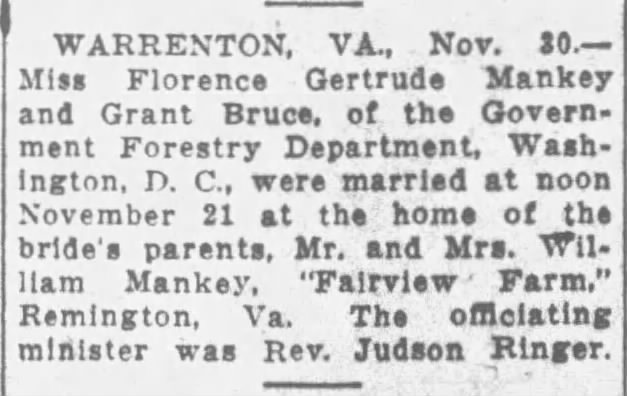
At noon on November 21, 1923, a wedding was performed at Ada and William’s “Fairview Farm.”34  Florence married Grant B. Bruce, a widower employed by the Government Forestry Department in Washington, D. C.  The city directory provides additional information:  He was a statistician for the Department of Agriculture.35  Upon settling in Grant’s home in northwest Washington, D. C., Florence would host lodgers in their home for the next couple of decades.  Many of the lodgers worked for the United States government. 

Reported in Richmond Times-Dispatch, December 1, 1923

Two more weddings occurred in the 1920s.  Hazel married James H. Weeks in October 1924,36 and G. Floyd, who had moved to San Francisco in the mid-1920s, married Lucia Neira, an Italian immigrant, in May 1927.37

In December 1927, Ada’s sister Gertrude mailed a Christmas greeting card from the town of Remington, Virginia.  The card was addressed to one of her brother Herbert’s sons and his wife, Willis and Elizabeth Bevers, in Hazel, South Dakota.  Presumably Gertrude was visiting Ada and her family.

According to the 1930 United States census, 61 year-old Ada and 71 year-old William were living on a dairy farm that they owned, still in Fauquier County.  William was a farmer and he had worked on the day before the census taker visited their home.38  He was not a veteran.  They did not own a radio set.  Florence and Grant were living at the same location in Washington, D. C.39  W. Arthur and his family had left California and were living in Detroit, Michigan.  W. Arthur was an aeronautical engineer, working in the auto products industry.40   George and Lucille were in San Francisco and George was working as an automobile salesman.41  They owned a radio set.  Hazel and James were living with her in-laws on her father-in-law’s dairy farm which was not far from Ada and William.42  They had two children by this time, giving Ada and William a total of five grandchildren.  Three years later, Florence would give them their sixth grandchild.

In 1935, Ada and William still lived on a farm outside of Remington.43  Florence and Grant with their child were living at the same address as previously in Washington, D. C.44  W. Arthur and his family had moved to Santa Monica, California.45  Hazel and James were on a farm in Lee, Virginia.46  George and Lucille still lived in San Francisco,47 but by 1937, they would move to southern California where Lucille gave birth to Ada and William’s seventh grandchild.48

Tragedy struck Ada and Florence within a single day of each other.  Florence’s husband died on April 30, 1938.  Grant had worked for the federal government for about 37 years and had been “in charge of all map records of the United States Forest Service” for 25 years before his retirement in May 1937.49  The day after Grant died, William at nearly 80 years-old passed away on May 1, 1938.  His death certificate states that he worked as a dairy farmer “to time of death.”50  William is buried in Remington Cemetery, Remington, Virginia.

The 1940 United States census record indicates that 72 year-old Ada was a lodger in Washington, D. C. and in the previous year she had received more than $50.00 that was not money wages or salary.51  Florence, at 46 years-old was continuing to live at the same residence which she owned in Washington, D. C.; also at the residence was her seven year-old child and three lodgers.52  W. Arthur had returned to the east coast, he and his family were living in Baltimore County, Maryland.53  He was an aeronautical engineer at an airplane factory.  George and Lucille had moved to Montebello, Los Angeles County and he was working as a house roofer.54  Hazel and her family were still living on a farm in Lee, Virginia.55  Her father-in-law lived with them and they had two children.  There was also a lodger and a servant living with them.

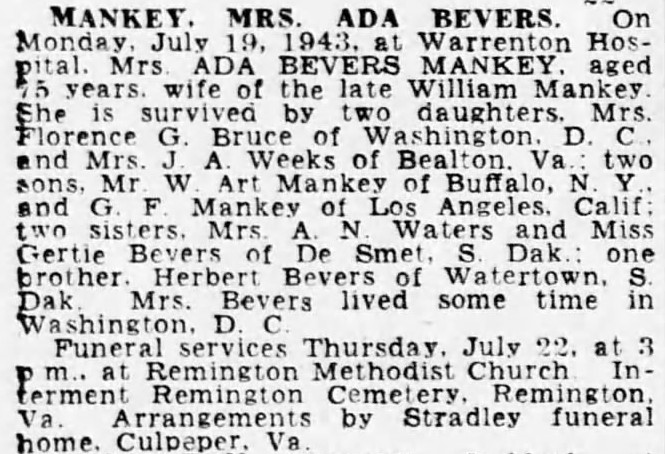
During the last years of Ada’s life, her eighth and ninth grandchildren were born, the children of Hazel and James, born in 194056 and 1943.57  At the age of 75, Ada’s last days were spent in Warrenton Hospital, Fauquier County and she died there on Monday, July 19, 1943.  She is buried in Remington Cemetery with her husband.

Reported in Washington, D. C.’s Evening Star, July 21, 1943

1 Ancestry.com, New York, Passenger Lists, 1820-1957 (Provo, Utah, USA: Ancestry.com Operations Inc, 2010): http://www.Ancestry.com.

2 “United States Census, 1880”, database with images, FamilySearch (https://www.familysearch.org/ark:/61903/1:1:MXV4-9J7 : Mon Sep 18 07:00:43 UTC 2023), Entry for Thomas Mankey and Mary Mankey, 1880.

3 “United States Bureau of Land Management Tract Books, 1800-c. 1955,” database with images, FamilySearch (https://familysearch.org/ark:/61903/3:1:3QS7-89WS-ZB44?cc=2074276&wc=M7WS-8ZC%3A356164401%2C356186301 : 14 October 2022), Dakota Territory > Vol 32 > image 54 of 254; Records Improvement, Bureau of Land Management, Washington D.C.”

4 United Methodist Church, Dakotas Conference, Commission on Archives and History, personal communication with M. R. Wilson (June 20, 1995).

5 J. G. Palmer, Palmer’s Directory of the Methodist Episcopal Church for Dakota Conference, “Henry” (1888): 128.

6 K. & M. Bevers, marriage note attached to William Mankey in Ancestral Quest program file dated June 29, 2022.

7 South Dakota Department of Health, “South Dakota Birth Records With Birth Dates Over 100 Years,” [Birth Information for Florence Mankey, State File Number: 599515]: https://apps.sd.gov/PH14Over100BirthRec/resultDetail.aspx?args=B7173D5000910C4994EA3F8456480222D6E12B84CB216B4C0933C9B568E36E1D0E715C23B1B77D480BE3E15CB8FC342C.

8 K. and M. Bevers, record of William Arthur Mankey, Ancestral Quest program file dated June 29, 2022.

9 South Dakota Department of Health, “South Dakota Birth Records With Birth Dates Over 100 Years,” [Birth Information for George Mankey, State File Number: 571260]: https://apps.sd.gov/PH14Over100BirthRec/resultDetail.aspx?args=B7173D5000910C4994EA3F8456480222567A6332A151C9247E16A4E0455BC1DD47D4462802BD74BF1CB49DF6E38B4573.

10 “United States Census, 1900,” database with images, FamilySearch (https://familysearch.org/ark:/61903/3:1:S3HY-6PQ9-455?cc=1325221&wc=9BW8-7MH%3A1031648401%2C1030694601%2C1032143801 : 5 August 2014), South Dakota > Clark > ED 89 Eden, Elrod & Maydell Townships > image 5 of 16; citing NARA microfilm publication T623 (Washington, D.C.: National Archives and Records Administration, n.d.).

11 United States of America, “First Naturalization Paper of Ada N. Bevers,” (Codington County, Dakota Territory: USA, May 22, 1889).

12 “United States Census, 1900,” database with images, FamilySearch (https://familysearch.org/ark:/61903/3:1:S3HY-6PQ9-QHQ?cc=1325221&wc=9BW8-7MH%3A1031648401%2C1030694601%2C1032143801 : 5 August 2014), South Dakota > Clark > ED 89 Eden, Elrod & Maydell Townships > image 6 of 16; citing NARA microfilm publication T623 (Washington, D.C.: National Archives and Records Administration, n.d.).

13 South Dakota State Historical Society, online cemetery search, “Thomas Mankey,“ https://apps.sd.gov/dt58cemetery/.

14 Peterson, E. F., and S. Wangersheim. Map of Clark County, South Dakota: compiled and drawn from a special survey and official records (Vermillion, S.D.: E. Frank Peterson, 1900): https://www.loc.gov/item/2012593005/.

15 South Dakota Department of Health, “South Dakota Birth Records With Birth Dates Over 100 Years,” [Birth Information for Hazel Mankey, State File Number: 599514]: https://apps.sd.gov/PH14Over100BirthRec/resultDetail.aspx?args=B7173D5000910C4994EA3F845648022241EB9E32217A5B880C0B80F399C73EA3C6FFD3355FD484F8AC6A0AC2E2AEC648.

16 South Dakota State Historical Society, online cemetery search, “Mary Mankey,“ https://apps.sd.gov/dt58cemetery/.

17 Kingsbury County Independent, “Mrs. Alfred C. Bevers,” (DeSmet, South Dakota: July 22, 1910): 4.

18 “United States Census, 1910,” database with images, FamilySearch (https://familysearch.org/ark:/61903/3:1:33S7-9TD2-CVC?cc=1727033&wc=QZZH-XC3%3A133638201%2C133675901%2C133835401%2C1589089262 : 24 June 2017), South Dakota > Clark > Eden > ED 108 > image 3 of 8; citing NARA microfilm publication T624 (Washington, D.C.: National Archives and Records Administration, n.d.).

19 K. & M. Bevers, biographical note attached to W. A. Mankey.

20 University of Cambridge, Populations Past – Atlas of Victorian and Edwardian Population, https://www.populationspast.org/about/.

21 Statista, Child mortality rate (under five years old) in the United States, from 1800 to 2020, https://www.statista.com/statistics/1041693/united-states-all-time-child-mortality-rate/.

22 “South Dakota State Census, 1915,” database with images, FamilySearch (https://familysearch.org/ark:/61903/3:1:S3HY-6917-3R9?cc=1476041&wc=MJQL-MNL%3A1041735101 : 21 May 2014), 004245361 > image 1948, 1970, 1972 & 1997 of 3079; State Historical Society, Pierre.

23 “South Dakota State Census, 1915,” database with images, FamilySearch (https://familysearch.org/ark:/61903/3:1:S3HY-691Q-K1F?cc=1476041&wc=MJQL-MNL%3A1041735101 : 21 May 2014), 004245361 > image 1953 of 3079; State Historical Society, Pierre.

24 K. & M. Bevers, biographical note attached to W. A. Mankey.

25 “United States Census, 1930,” database with images, FamilySearch (https://familysearch.org/ark:/61903/3:1:33SQ-GR4N-9Y7?cc=1810731&wc=QZFS-M82%3A648807101%2C651480501%2C651480502%2C1589283887 : 8 December 2015), California > San Francisco > San Francisco (Districts 1-250) > ED 134 > image 40 of 43; citing NARA microfilm publication T626 (Washington D.C.: National Archives and Records Administration, 2002).

26 “United States Headstone Applications for U.S. Military Veterans, 1925-1949,” database with images, FamilySearch (https://familysearch.org/ark:/61903/3:1:3QS7-994Q-YRD4?cc=1916249&wc=MDBG-K68%3A205942901%2C213448601 : 26 April 2021), 1941-1949 > Mangum, Tully-Marks, Edward > image 136 of 2371; citing NARA microfilm publication M1916 (Washington, D.C.: National Archives and Records Administration, n.d.).

27 Ancestry.com, South Dakota, U. S., Marriages, 1905-2018 (Ancestry.com Operations, Inc.: Lehi, Utah, USA, 2005).

28 The Mitchell Capital (Mitchell, South Dakota, December 13, 1917): 3.

29 “United States Census, 1920,” database with images, FamilySearch (https://familysearch.org/ark:/61903/3:1:33SQ-GRFW-4QZ?cc=1488411&wc=QZJT-FXV%3A1038215501%2C1038273601%2C1036505301%2C1589332367 : 14 September 2019), Virginia > Fauquier > Lee > ED 47 > image 19 of 42; citing NARA microfilm publication T625 (Washington, D.C.: National Archives and Records Administration, n.d.).

30 “United States Census, 1920,” database with images, FamilySearch (https://familysearch.org/ark:/61903/3:1:33S7-9R69-46Q?cc=1488411&wc=QZJG-FM7%3A1036474401%2C1036474402%2C1036476301%2C1589335824 : 10 September 2019), District of Columbia > Washington > Washington > ED 317 > image 18 of 28; citing NARA microfilm publication T625 (Washington, D.C.: National Archives and Records Administration, n.d.).

31 “United States Census, 1920”, , FamilySearch (https://www.familysearch.org/ark:/61903/1:1:MNLV-Z7N : Thu Oct 05 15:18:14 UTC 2023), Entry for George F Mauky, 1920.

32 The Tabor Independent (Tabor, South Dakota, October 6, 1921): 6.

33 The Los Angeles Times (Los Angeles, California, April 20, 1985): 61.

34 Richmond Times-Dispatch (Richmond, Virginia, December 1, 1923): 4.

35 Ancestry.com, Boyd’s Directory of the District of Columbia 1923, U.S., City Directories, 1822-1995 [database on-line] (Lehi, UT, USA: Ancestry.com Operations, Inc., 2011).

36 K. & M. Bevers, biographical note attached to Hazel Maude Mankey, Ancestral Quest program file dated June 29, 2022.

37 Ancestry.com, “California, U.S., Federal Naturalization Records, 1843-1999” [Naturalization record of Lucille Mankey, Naturalization Records/i. National Archives at Riverside, Peris, California] (Lehi, UT, USA: Ancestry.com Operations, Inc., 2014).

38 “United States Census, 1930,” database with images, FamilySearch (https://familysearch.org/ark:/61903/3:1:33SQ-GRZF-38K?cc=1810731&wc=QZFW-811%3A648805201%2C650224701%2C648825601%2C1589282415 : 8 December 2015), Virginia > Fauquier > Lee > ED 7 > image 30 of 38; citing NARA microfilm publication T626 (Washington D.C.: National Archives and Records Administration, 2002).

39 “United States Census, 1930,” database with images, FamilySearch (https://familysearch.org/ark:/61903/3:1:33SQ-GR4D-K8R?cc=1810731&wc=QZF9-L2Q%3A648806901%2C648806902%2C648806903%2C1589285158 : 8 December 2015), District of Columbia > Washington > Washington > ED 229 > image 29 of 34; citing NARA microfilm publication T626 (Washington D.C.: National Archives and Records Administration, 2002).

40 “United States Census, 1930,” database with images, FamilySearch (https://familysearch.org/ark:/61903/3:1:33SQ-GRHZ-Z3X?cc=1810731&wc=QZF3-G74%3A648805801%2C649542601%2C651567401%2C1589285374 : 8 December 2015), Michigan > Wayne > Detroit (Districts 0251-0500) > ED 304 > image 55 of 84; citing NARA microfilm publication T626 (Washington D.C.: National Archives and Records Administration, 2002).

41 “United States Census, 1930,” database with images, FamilySearch (8 December 2015), California > San Francisco > San Francisco (Districts 1-250) > ED 134 > image 40 of 43.

42 “United States Census, 1930,” database with images, FamilySearch (https://familysearch.org/ark:/61903/3:1:33SQ-GRZF-3ND?cc=1810731&wc=QZFW-DPK%3A648805201%2C650224701%2C648825601%2C1589282427 : 8 December 2015), Virginia > Fauquier > Lee > ED 8 > image 15 of 24; citing NARA microfilm publication T626 (Washington D.C.: National Archives and Records Administration, 2002).

43 “United States Census, 1940”, database with images, FamilySearch (ark:/61903/1:1:K73M-H7C : Fri Jun 09 01:27:49 UTC 2023), Entry for Ada N Mankey, 1940.

44 “United States Census, 1940,” database with images, FamilySearch (https://familysearch.org/ark:/61903/3:1:3QS7-L9M1-53H5?cc=2000219&wc=QZFM-7NZ%3A790105901%2C790105902%2C792841801%2C792851601 : accessed 11 November 2023), District of Columbia > District of Columbia > Police Precinct 13, District of Columbia, Tract 33 > 1-508 Police Precinct 13 (Tract 33 – part), District of Columbia > image 8 of 41; citing Sixteenth Census of the United States, 1940, NARA digital publication T627. Records of the Bureau of the Census, 1790 – 2007, RG 29. Washington, D.C.: National Archives and Records Administration, 2012.

45 “United States Census, 1940,” database with images, FamilySearch (https://familysearch.org/ark:/61903/3:1:3QS7-L9M1-HL5H?cc=2000219&wc=QZXB-4M5%3A790103401%2C790855101%2C790360501%2C951056401 : accessed 11 November 2023), Maryland > Baltimore > Election District 9 > 3-58 Election District 9 S of Joppa Rd, W of Forest Av, W and N of Stevenson Av, and E of York Rd and Dulaneys Valley Rd; Aigburth Manor, Towson (part) including Baltimore County Jail and Presbyterian Home of Maryland for Aged Women > image 55 of 67; citing Sixteenth Census of the United States, 1940, NARA digital publication T627. Records of the Bureau of the Census, 1790 – 2007, RG 29. Washington, D.C.: National Archives and Records Administration, 2012.

46 “United States Census, 1940,” database with images, FamilySearch (https://familysearch.org/ark:/61903/3:1:3QSQ-G9MR-37NM?cc=2000219&wc=QZXG-CKG%3A794217401%2C796669201%2C794293801%2C796711401 : accessed 12 November 2023), Virginia > Fauquier > Lee Magisterial District > 31-11 Lee Magisterial District outside Remington Town S of Southern Railway and W of State Road 17, Morrisville (part) > image 21 of 29; citing Sixteenth Census of the United States, 1940, NARA digital publication T627. Records of the Bureau of the Census, 1790 – 2007, RG 29. Washington, D.C.: National Archives and Records Administration, 2012.

47 “United States Census, 1940”, , FamilySearch (https://www.familysearch.org/ark:/61903/1:1:K9W9-D85 : Tue Nov 28 18:48:53 UTC 2023), Entry for George F Mankey and Lucille A Mankey, 1940.

48 Ancestry.com, “California, U.S., Federal Naturalization Records, 1843-1999.”

49 Evening Star (Washington, District of Columbia, May 1, 1938): 14.

50 Commonwealth of Virginia, Department of Health, Bureau of Vital Statistics, certificate of death of William Mankey.

51 “United States Census, 1940”, FamilySearch, Entry for Ada N Mankey.

52 “United States Census, 1940,” FamilySearch (https://familysearch.org/ark:/61903/3:1:3QS7-L9M1-53H5?cc=2000219&wc=QZFM-7NZ%3A790105901%2C790105902%2C792841801%2C792851601).

53 “United States Census, 1940,” FamilySearch (https://familysearch.org/ark:/61903/3:1:3QS7-L9M1-HL5H?cc=2000219&wc=QZXB-4M5%3A790103401%2C790855101%2C790360501%2C951056401).

54 “United States Census, 1940”, FamilySearch (https://www.familysearch.org/ark:/61903/1:1:K9W9-D85), Entry for G F Mankey and L A Mankey.

55 “United States Census, 1940,” database with images, FamilySearch (https://familysearch.org/ark:/61903/3:1:3QSQ-G9MR-37NM?cc=2000219&wc=QZXG-CKG%3A794217401%2C796669201%2C794293801%2C796711401}.

56 “Virginia, Marriage Certificates, 1936-1988,” database with images, FamilySearch (https://familysearch.org/ark:/61903/3:1:3Q9M-C9TN-K9CD?cc=2370234 : 10 January 2019), > image 1 of 1; from “Virginia, Marriage Records, 1700-1850,” database and images, Ancestry (http://www.ancestry.com : 2012); citing Virginia Department of Health, Richmond.

57 “Virginia, Marriage Certificates, 1936-1988,” database with images, FamilySearch (https://familysearch.org/ark:/61903/3:1:3Q9M-C9TF-G7KK-9?cc=2370234 : 10 January 2019), > image 1 of 1; from “Virginia, Marriage Records, 1700-1850,” database and images, Ancestry (http://www.ancestry.com : 2012); citing Virginia Department of Health, Richmond.