Maude and Alfred Waters, Part Two

The May 1904 news article announcing the marriage of Maude Bevers and Alfred N. Waters described the two of them as “prominent people” of the small town of De Smet, South Dakota.  (You can see the news article in Part One.) Each of them was involved in a variety of social groups and community pursuits.  For example, Maude was active in the Methodist Episcopal Church, the Red Cross and a philanthropic educational society.  Waters held civic roles and promoted improvements in their county (Kingsbury) and in their town, which as of 1906 had “a population a little in excess of 1,000 souls.”1

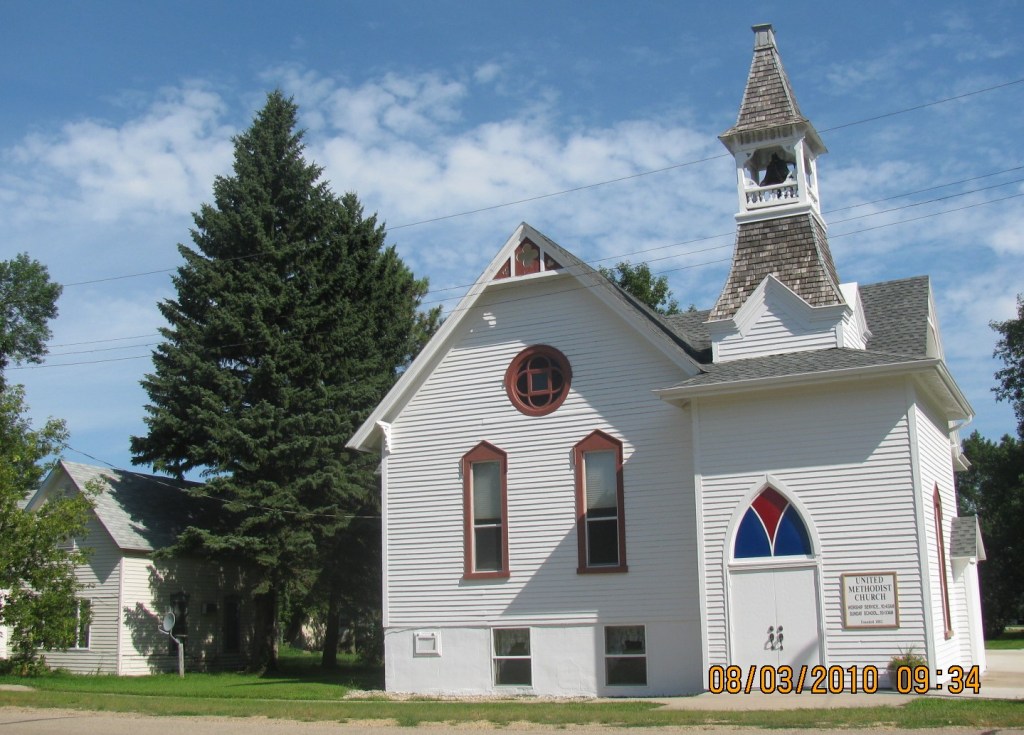
After her wedding, even though her husband was not a member of the church, Maude continued her activities in the Methodist church, having become a member in November 1898.  The records of the women’s group of the church noted that Maude served as secretary and 4th Vice in 1904 and 1905, respectively.  Another role in which she served was the leader of the choir, this she did for years before and after her marriage.2  In addition, “… for many years [she] was a member of a mixed quartet that sang for funerals in various churches of the town and area.”3

On a Friday night in March 1907, there was a Demorest medal contest held at the church, six young ladies competing for a Silver medal.4  Throughout the evening, musical selections were performed as well as the orations by the contestants.  One of the selections, which was entitled “David and Goliath,” was performed by a ladies’ quartette in which Maude sang a part. 


The Demorest Medal program was an educational program through which young people and community members learned about the tenets of the prohibition movement.  In 1886, W. Jennings Demorest inaugurated oratory contests, utilizing subject matter promoting the prohibition of liquor traffic.  The work began in New York City, then was introduced in California and within three years had spread throughout the United States and into several foreign nations.

Six to eight contestants competed at the local level and the winner would be awarded a Silver medal.  At the next level, six Silver medalists would compete for a Gold medal, then six Gold medalists would compete for a Grand Gold medal.  At the highest level six Grand Gold medalists competed for a Diamond medal.

In 1895, the Woman’s Christian Temperance Union (W. C. T. U.) adopted the Demorest Medal program and in the following years expanded the topics of the oratory books.  “Recitation books, embracing orations on Prohibition, Total Abstinence, Scientific Temperance, Anti-Narcotics, Franchise, Social Purity, etc., were published; medals were designed with mottoes and emblems of the W. C. T. U., and circulars setting forth the plans of this new system sent out to all the States in the Union.”5  As of January 1907, the contest publications had been disseminated into Australia, South Africa, India, Canada, Mexico and the Philippine Islands as well.
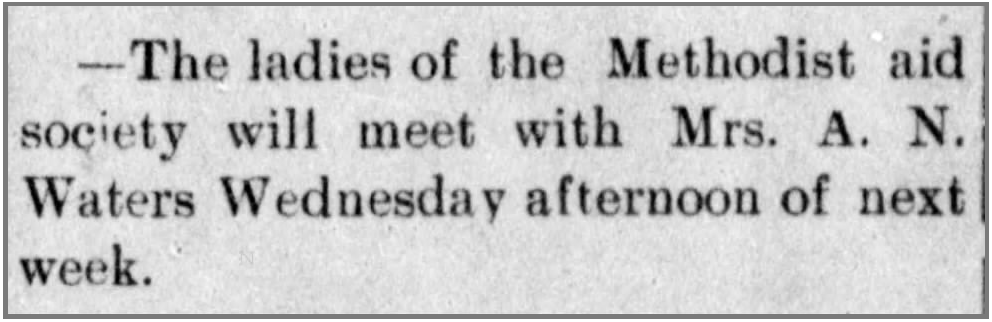

News clipping from the January 29, 1909 issue of Kingsbury County Independent

The Ladies Aid Society of the Methodist church rotated its meetings among its members.  In the first week of February 1909 the society met at Maude’s home.6  For a fundraising project that year, they produced a cookbook, entitled Kitchen Echoes.  “The venture was a very profitable one,”7 as it included advertisements for local businesses in addition to its recipe entries.  Waters Land and Loan Company, the real estate company of Maude’s husband, was one of the business sponsors, advertising that the company had the “Best Bargains in Grain, Dairy and Stock Farms.”  Maude and her sister Gertrude both submitted recipes.  Gertrude’s recipes were for Potato Salad and Sugar Cookies.  (See Gertrude’s recipes in Aunt Gertie.)  Maude’s entries were for Angel Custard and Mrs. Power’s Ginger Snaps.  The recipe for Ginger Snaps honored Elizabeth Power, a former resident and pioneer settler of De Smet, arriving in June 1880 along with her husband and four children.  Shortly before the recipe was published in Kitchen Echoes, Mrs. Power had passed away on February 11, 1909.  Her obituary stated: “Mrs. Power was one of those motherly women who everybody likes, always ready to answer sick calls, and never so happy as when doing some kind deed.  She was a life long and consistent member of the Roman Catholic church, and her remains lie in the Catholic cemetery at Bellingham [Washington].”8  Two years later, in January 1911, the Methodist aid society met again at Maude’s house.9  An entry in the treasurer’s book of the church’s women’s group indicates that Maude hosted a supper in that same month which brought in $6.60.  In 2025, an equivalent amount of money is approximately $225.00.


Angel Custard.—Separate the yolks and whites of two eggs, beat the whites to a stiff froth, adding a few drops of flavoring.  Beat the yolks, add two teaspoons corn starch wet with a little cold milk, and stir into a pint of boiling milk which has been sweetened to taste (about two-thirds cup of sugar), adding a pinch of salt the last thing.  When thickened and boiling pour the custard over the beaten whites of eggs and stir rapidly a few moments.  Delicious either hot or cold.—Maude Waters.

Mrs. Powers’ Ginger Snaps.—One-half cup butter (scant), one-half cup lard (scant), one cup white sugar, one cup molasses, one teaspoon soda dissolved in one tablespoon water, one egg, one tablespoon ginger, a pinch of salt.  Flour to mix quite stiff.—Maude Waters.
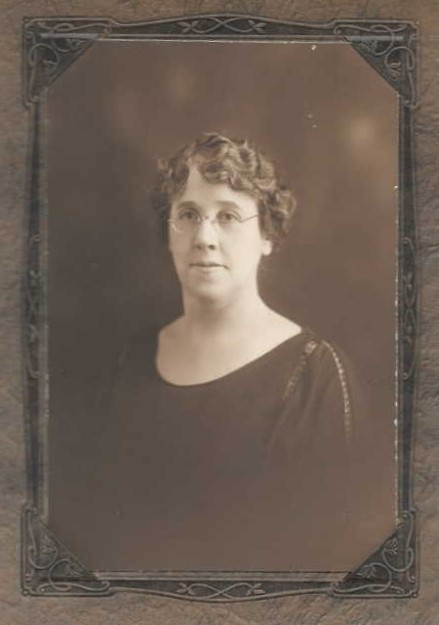
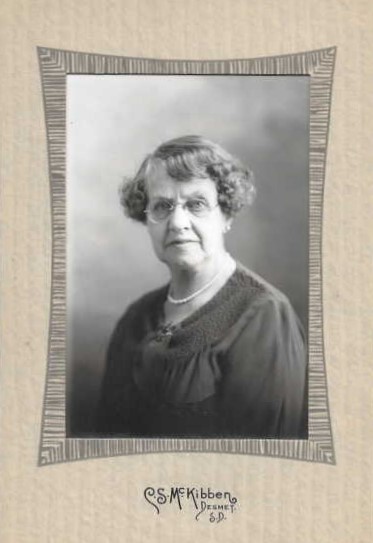
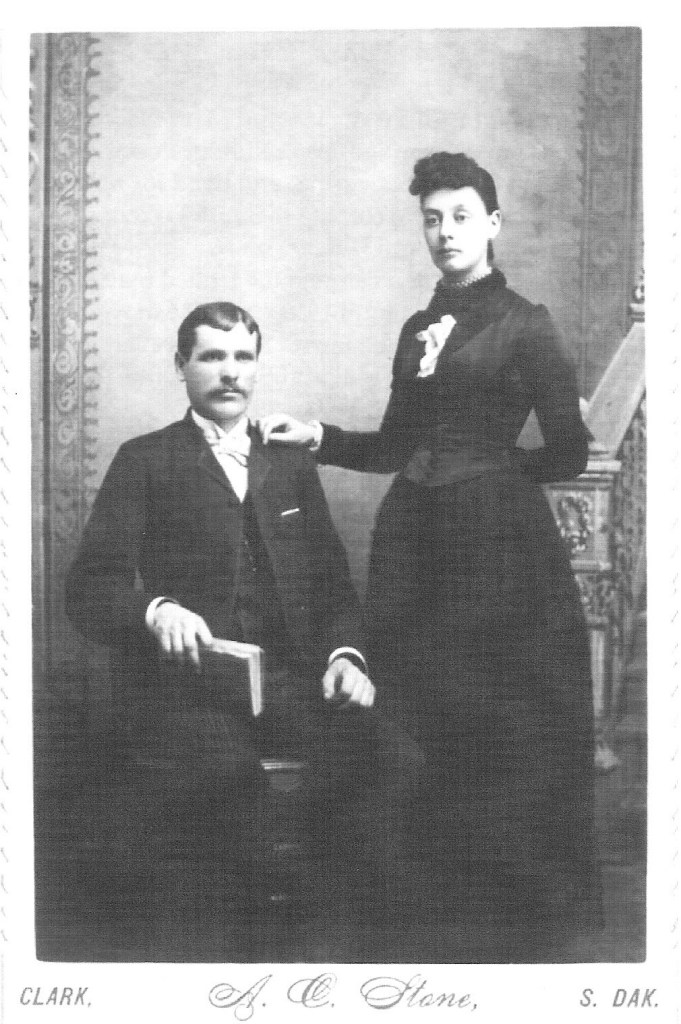
Maude (nee Bevers) Waters, estimated date 1910

From the time that A. N. Waters settled in De Smet, he served in numerous civic capacities and promoted improvements in the town, county and state.  A few of his responsibilities during the year 1905 give us a glimpse of his involvements in the local community at that time, as well as in the broader region.

  • April 1905 – At a meeting of the stockholders, Waters was elected to be a director on the board of the Athletic Association.10  Two years later, he was elected to be the president of the association, which was reported to have a large membership.11
  • August 1905 – While serving as mayor of De Smet, Waters was appointed by the South Dakota governor to be a delegate to the Trans-Mississippi Commercial Congress which met at Portland, Oregon from August 16 to 19.12  This congress was organized to promote the commercial interests of the states and territories west of the Mississippi River.  The following year, Waters was appointed again to the congress which met November 20 to 23 in Kansas City, Missouri.13
  • September 1905 – The county commissioners made Waters the chairman of a committee for the purpose of creating an agricultural exhibit to represent Kingsbury County at the state fair held in Huron, South Dakota.14  He consented to procure the materials for the exhibit and was authorized to appoint members to the committee from different parts of the county.  Waters and the committee members did not receive a salary, but the county commissioners authorized payment for the cost of transporting the materials for the exhibit to Huron.  
  • November 1905 – A real estate dealers association was formed to which Waters was elected secretary of the board.  The purpose of the association was “promoting and advancing the interests of [South Dakota] by devising ways and means to advertise its resources and encourage immigration, etc.”15  Four months later, at the March 1906 meeting of the association, which had about 250 member firms by that time, Waters gave a speech during the evening banquet which was entitled, “Had We Better Hang Together or Hang Seperate.“ [sp.]16  Moving ahead with their aims, in March 1907, Waters and about 25 members of the association met with the governor of South Dakota and the Immigration Commissioner “to consider co-operative advertisement of the state. … The association indorsed a proposition made by the Minneapolis and St. Louis railway to furnish a car and superintend and bear the expense of making a traveling exhibit of products of South Dakota farms on its line, provided the exhibit be furnished by the real estate men.”17

Waters had begun his career in real estate investment in 1880 when he arrived in De Smet, the same year that the town was founded. Thirty years later, he was continuing his career in that profession. A few of Waters’ transactions are noteworthy:

  • On April 16, 1909, Waters Land and Loan Company made a ten-year lease with the United States for the use of “the first floor of the one story … brick premises, known as ‘Waters Building’ situated on the North side of Second Street between Calumet and Joliet avenues.”18 (The consideration was $325.00 per annum in quarter yearly payments.) The Waters Building had been built in 1888-89 by the Kingsbury Abstract Company and Waters Land and Loan Company had purchased it in 1906. (More about this transfer is in Part One.) The De Smet post office had occupied a space in the building since at least 1893.19 In 1909, an extension was built onto the Waters building and the post office moved into it. The lease described above commenced the occupation of the post office in the extension. “The new post office was of fireproof construction, 25×45 feet and fitted with the latest style of furnishings. The building was heated by steam and supplied with gas and water….”20
  • About 1910, Waters owned a house at the corner of Lyle Avenue and Front Street NE.  It was the former home of Fred Dow but had been relocated from its original site.  Fred Dow had sold his farmstead and grove of trees to Waters in the early 1900s.  Waters had moved the house from the Dow farm to the corner lot across the road on Front Street NE.21 Fred Dow’s farmstead was the location of the “surveyors house” in which the Charles Ingalls’ family lived when Ingalls was hired by Dakota Central Railway in 1879. The surveyors’ house was moved in 188422 to its current site in the town of De Smet. Therefore, it had not been sitting on the property when Waters purchased the Dow farm. The surveyors’ house was purchased by the Laura Ingalls Wilder Memorial Society in 1967 and placed on the National Register of Historic Places in 1974.23
  • On September 28, 1915, Alfred purchased lot #32 of De Smet from Caroline A. Swanzey (formerly Caroline A. Ingalls) for $62.50.24  This was author Laura Ingalls Wilder’s sister, known as Carrie in Wilder’s Little House books.  In Standard Atlas of Kingsbury County, South Dakota, published in 1909, the owner of lot #32 of De Smet is noted as C. P. Ingalls, Caroline’s father who had passed away in 1902.
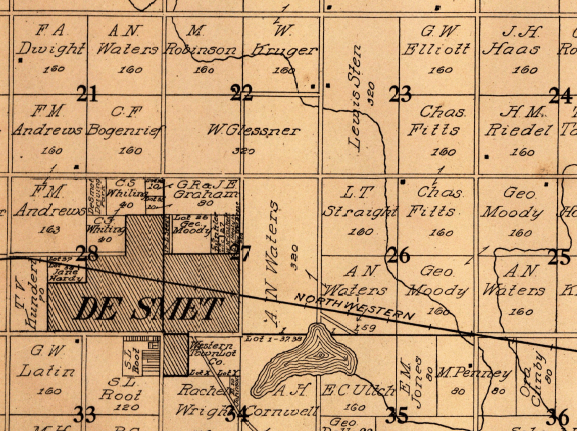
The above clipping is from a map in the 1909 edition of Standard Atlas of Kingsbury County, South Dakota.  It shows that Waters owned 320 acres directly east of De Smet.  The lower half of this property had been a tree claim filed by Fred N. Dow, and to the east of F. N. Dow’s claim, his father, James C. Dow, had filed a claim on a quarter section, which in 1909 Waters also owned.25  Through a cursory examination of the 1909 atlas, 14 properties in the county were found with Waters’ name on them (in the townships of Le Seur, Spirit, Manchester, De Smet, Esmond and Mathews).  One of the properties that Waters owned had been the homestead of Almanzo Wilder (Laura Ingalls Wilder’s husband); Wilder had sold the property to Dakota Loan and Investment in 1891, a company in which Waters was a partner.26  It is not known at this time when Waters became the sole owner.  That property can be seen on the above clipping in the upper left corner.  In addition to her husband’s properties, the atlas also indicated that Maude owned two adjoining quarters in Manchester Township.


The United States census taken in April 1910 recorded Alfred as 54 years old and working on his own account in his own real estate office.27  Maude was 35 years old and did not have an occupation.  In the record, besides Maude and Alfred, there was a housekeeper living in their home, named Izora Youmans [sp.], who was 37 years old, single and had been born in New York.

For six years, Maude’s mother, who lived a half block to the east of the Waters home with Maude’s father and sister Gertrude, had been impaired following an operation from which she did not completely heal.  Two years after the operation, her mother developed diabetes.  “All during her illness, and especially during the last months when almost helpless and suffering great pain everything that could be done to relieve and give pleasure was done for her by loving hands of her own family and friends.”28  No doubt Maude had been involved in her mother’s care until her passing on July 14, 1910.29


On the last Saturday of May 1910, Waters was invited to dine at the home of Mr. and Mrs. Charles H. Tinkham. Along with Waters and Tinkham, the other five guests were men of De Smet who had lived through the “hard winter” of 1880-81. They all had arrived in Kingsbury County in the winter and spring of 1880, except Waters who hadn’t arrived until August. When early snow storms commenced in the fall, the men stayed in the newly built buildings of the fledgling town, which had about 14 businesses.30 Recurring blizzards would cover the railroad tracks that winter, eventually closing the track altogether from January to May. About 50 families (including single men) wintered in the town. Thirty years later at the gathering held in the Tinkham home:
The varied experiences of that hard winter were all recounted. Of one thing our readers can be certain, however, and that is the dinner served on this occasion was not on the half-ration plan of some of the dinners eaten by the gentleman [sp.]during that never to be forgotten winter of [1880-81]when supplies ran low and wheat had to be ground in coffee mills, and when sugar for coffee was kept in a jewel case.31

During that trying winter, Waters boarded in the home of Arthur and Jennie Sherwood. A. S. Sherwood “is mentioned in the Laura Ingalls Wilder book The Long Winter as one of the few families wintered in for that historic experience. He and his wife … were among the few married couples in the town that winter. Some of the bachelors roomed and boarded there including A. N. Waters, in a house so small that blankets separated the beds in a sleeping room.”32 Waters himself was not mentioned in Wilder’s The Long Winter but he was mentioned in her autobiographical manuscript, Pioneer Girl, which relates the following story:
There was in town a lawyer named Waters who had expected to go east early in the winter to be married but had got caught by the storms.

Now the wedding day was drawing near and no way to get transportation out. He decided to walk and … he started before daylight one morning as the blizzard wind was dying down and the sky cleared.

It was a scant day’s calm this time and we were afraid he was caught in the next storm, but he walked the miles to Brookins [sic] safely and after resting walked on to Tracy.

The next spring we learned that he arrived safely in time for his wedding, but both feet were so badly frozen that he was unable to walk on that day. However his feet recovered and he came back in the spring, bringing his wife with him.33

The above story, of course, refers to Waters’ first wife, Josephine E. Humphrey, whereas Maude was his second wife. Waters obituary adds details to this account of the winter of 1881:
… he boarded with the Arthur Sherwood family, “Sixteen of them in a house sixteen feet square,” [Waters] called it. He lived here through the Hard Winter and in the spring of 1881 made his famed hike along the railroad track in company with a brother of Mrs. Arthur Sherwood. The whole country had been snow-bound for months and the two young men struck out for the East, hauling a sled, and in four days reached Tracy, secured a team and floundered thru to Sleepy Eye, where they were again disappointed in train service and Mr. Waters continued on alone to New Ulm.34

Another perspective on this event was recounted by the editor of De Smet News in 1921:
… The big snows of the winter of 1880-1881 caused such a blockade thruout the country that after the first of January there was no train from De Smet east until the following May. Along in March Mr. Waters became anxious to get out of the country and keep a date in the east, so he started on foot over the snow banks, carrying a hundred letters from De Smet people to their relatives and friends back home. He walked as far as Tracy, covering the distance in four days. There a team of mules hitched to a sleigh was secured and several men made use of the outfit to get as far as Sleepy Eye. At that point a train was boarded and they were scheduled to leave next morning; but a storm prevented and they were there a whole week. Mr. Waters became uneasy at the delay and started out alone, hoofing it to New Ulm. There the road was open and he was soon on his way east.35

Charles H. Tinkham, the host of the 1910 gathering of De Smet pioneers, had arrived in De Smet in the spring of 1880.  Soon after his arrival Tinkham opened a furniture and houseware store, and he also engaged in undertaking.36   During the “hard winter,” “Tinkham was a member of the ‘bachelor’s club’ who lived with William Crook, sleeping on boards laid across the ceiling joists.”37 

Among the guests attending the dinner was Charles L. Dawley, who settled in De Smet in May 1880.  As an agent for a lumber company, he began “selling loads of lumber to the new settlers. He set up an office tent and sold lumber from railroad cars until an office and shed could be built. During the Hard Winter, he boarded with Mrs. Garland, and began courting her daughter Florence.”38  Florence was Laura Ingalls Wilder’s teacher during that winter.  Within a few years, Dawley left the lumber business to go into real estate with Waters, a partnership which lasted 15 years.  Waters, Dawley and Alfred Thomas were associates who established the Dakota Loan and Investment Company, “which continued the loan business previously run by Alfred Waters, doing a general real estate and chattel loan business.”39 Waters and Dawley took full control of the business in 1887.

The other guests were Charles E. Ely, Edward H. Couse, Daniel H. Loftus and John H. Carroll.  About April 1880, Ely was a lumber agent also, selling lumber in De Smet from a rail car.  Subsequently, he established the town’s first lumber yard.40  He was married, but had not yet moved his family to De Smet when the winter storms came later that year.  Couse, who was also married when he came to De Smet and a Civil War veteran, was the owner of a hardware store.41  Loftus was a partner in a general merchandise store in 1880, and in February 1881 in the midst of the “hard winter”, a local newspaper reported, “the first grist of wheat was ground in De Smet on the 5th, by Dan Loftus. Dan makes a fine miller.”42

John H. Carroll was the first clerk of courts in Kingsbury County (April 1880) and he was the first postmaster, later he would become the first mayor of De Smet.43 His homestead adjoined the town of De Smet. On that property, Carroll would plat 10 blocks as residence blocks which became an addition to the original town. Waters would eventually purchase lots in Carroll’s addition, and on those lots, in 1905, build the home in which he and Maude would live. Another property that Carroll at one point owned was the northeast corner lot at Calumet Avenue and Second Street. Waters and his partners of the Kingsbury Abstract Company purchased it from Carroll and then constructed the building that many years later, through a series of transactions, would be owned by Waters Land and Loan in 1906. (See more about the Waters residence and the business building in Part One.)

Part Three will continue the community activities of Maude and Alfred Waters.


1 “The Growth of De Smet,” Sioux Falls (South Dakota) Argus-Leader, March 23, 1906.

2 Caryl Lynn Meyer Poppen, ed., “A History of the Methodist Church,” De Smet Yesterday and Today (De Smet, South Dakota: De Smet News, printer, 1976): 144.

3 “Mrs. A. N. Waters, Native of England, Resident 60 Years,” De Smet (South Dakota) News (July 10, 1958) in Nancy S. Cleaveland and Gina Terrana, Waters (2015): http://www.pioneergirl.com/waters_cemetery.pdf.

4 “Items from De Smet,” Sioux Falls (South Dakota) Argus-Leader, March 22, 1907, 3, Newspapers.com.

5 Cornelia T. Jewett, “History of Contest Work,” The National Advocate (New York, January 1907): 1-2, https://books.google.com/books?id=HwFQAAAAYAAJ&pg=RA1#v=onepage&q&f=false.

6 Kingsbury County Independent (De Smet, South Dakota), January 29, 1909, 5, Newspapers.com.

7 Poppen, “A History of the Methodist Church,” 144.

8 Gina Terrana, “Biography of Thomas P. Power,” http://www.pioneergirl.com/blog/archives/7859.

9 Kingsbury County Independent (De Smet, South Dakota), December 30, 1910, 8, Newspapers.com.

10 Kingsbury County Independent (De Smet, South Dakota), April 21, 1905, 5, Newspapers.com.

11 Citizen-Republican (Scotland, South Dakota), April 4, 1907, 2, Newspapers.com.

12 Kingsbury County Independent (De Smet, South Dakota), August 11, 1905, 5, Newspapers.com.

13 Hot Springs (South Dakota) Weekly Star, November 9, 1906, 2, Newspapers.com.

14 Kingsbury County Independent (De Smet, South Dakota), September 15, 1905, 4, Newspapers.com.

15 “Real Estate Dealers,” Sioux Falls (South Dakota) Argus-Leader, January 5, 1906, 3, Newspapers.com.

16 “Real Estate Men Meet,” Sioux Falls (South Dakota) Argus-Leader, March 15, 1906, 3, Newspapers.com.

17 “To Exhibit Car Load of South Dakota Products,” Citizen-Republican (Scotland, South Dakota), April 4, 1907, 2, Newspapers.com.

18 The Heritage House, LLC, “Abstract of Title,” Transfer Number 31.

19 Nancy S. Cleaveland, “post office/post-office,” Laura Ingalls Wilder A-Z, http://www.pioneergirl.com/blog/archives/13454.

20 Cleaveland, “post office/post-office.”

21 “Life’s End Comes at 103 for Mrs. Fred Dow, Oldest Resident County,” De Smet (South Dakota) News (April 26, 1973) in Nancy Cleaveland and Gina Terrana, Dow/Glover (2015): http://www.pioneergirl.com/dow_f_cemetery.pdf.

22 De Smet Leader (March 22, 1884) in Nancy S. Cleaveland, “surveyors’ house,” Laura Ingalls Wilder A-Z, http://www.pioneergirl.com/blog/archives/13817.

23 Cleaveland, “surveyors’ house.”

24 State of South Dakota, Kingsbury County, Deed Record No. 50, 77.

25 Nancy S. Cleaveland, “surveyors’ house.”

26 Nancy S. Cleaveland, “claim,” Laura Ingalls Wilder A-Z, http://www.pioneergirl.com/blog/archives/10912.

27 “United States, Census, 1910”, FamilySearch (https://www.familysearch.org/ark:/61903/1:1:MPXB-BGS : Wed Oct 15 05:57:53 UTC 2025), Entry for Alfred N Waters and Maud Waters, 1910.

28 Kingsbury County Independent (De Smet, South Dakota), July 22, 1910, 4, Newspapers.com.  

29 Ancestry.com. South Dakota, U.S., Death Index, 1879-1955 [database on-line]. Provo, UT, USA: Ancestry.com Operations, Inc., 2004.

30 Nancy S. Cleaveland, “The Long Winter – historical perspective,” Laura Ingalls Wilder A-Z, http://www.pioneergirl.com/blog/archives/5096.
31 Kingsbury County Independent (De Smet, South Dakota), June 3, 1910, 5, Newspapers.com.
32 Aubrey Sherwood, “The Sherwoods of De Smet” in De Smet Yesterday and Today by Caryl Lynn Meyer Poppen, ed. (De Smet, South Dakota: De Smet Bicentennial Committee, 1976): 116.
33 Laura Ingalls Wilder, “Hard Winter,” Pioneer Girl (unpublished manuscript) in Nancy S. Cleaveland and Gina Terrana, Waters (2015): http://www.pioneergirl.com/waters_cemetery.pdf.
34 “A. N. Waters, Pioneer, Laid to Rest Here Sunday,” De Smet (South Dakota) News (September 2, 1927) in Nancy S. Cleaveland and Gina Terrana, Waters (2015): http://www.pioneergirl.com/waters_cemetery.pdf.
35 Carter Sherwood, ed., De Smet (South Dakota) News (November 4, 1921) in Nancy S. Cleaveland and Gina Terrana, Waters (2015): http://www.pioneergirl.com/waters_cemetery.pdf.

36 “Charles H. Tinkham,” Memorial and Biographical Record (Chicago: George A. Ogle and Co., publisher, 1898): 435.

37 Nancy S. Cleaveland and Gina Terrana, Tinkham (2015): http://www.pioneergirl.com/tinkham_cemetery.pdf.

38 Nancy S. Cleaveland and Gina Terrana, Dawley (2015): http://www.pioneergirl.com/dawley_cemetery.pdf.

39 Nancy S. Cleaveland, “bank,” Laura Ingalls Wilder A-Z, http://www.pioneergirl.com/blog/archives/15076.

40 De Smet (South Dakota) News (August 25, 1916) in Nancy S. Cleaveland and Gina Terrana, Ely (2015): http://www.pioneergirl.com/ely_cemetery.pdf.

41 George W. Kingsbury, “Edward H. Couse,” History of Dakota Territory, vol. 4 (Chicago: S. J. Clarke Publishing Co., 1915): 1048.

42 Kingsbury County (South Dakota) News (February 24, 1881) in Nancy S. Cleaveland and Gina Terrana, Loftus / Fritzel (2015): http://www.pioneergirl.com/loftus_cemetery.pdf.

43 Nancy S. Cleaveland and Gina Terrana, Carroll/Imus (2015): http://pioneergirl.com/carroll_cemetery.pdf.
Aunt Gertie, An Active Methodist

Born in August 1872, Gertrude Mary Bevers was the eighth child of Alfred C. and Mary N. (nee Bridges) Bevers, although at the time of her birth only three of her siblings had lived past the age of one.  She was born in a small town in England and during her childhood her family moved every few years, including emigrating to the United States when she was 12 years old.  (A summary of the young lives of Gertrude and her sisters can be found in Ada, Gertie and Maude Bevers, and an article about her brother George is found in George C. Bevers, Bookkeeper.)

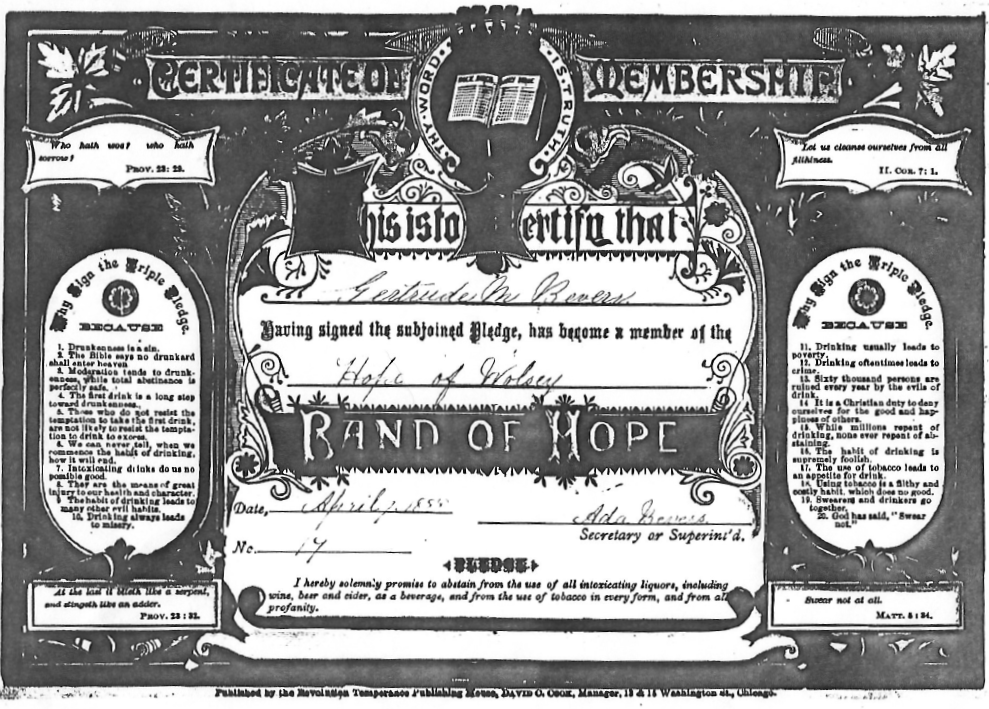
There is evidence that at a young age Gertrude began following in the footsteps of her parents.  One example is that at the age of 15, Gertrude along with her 20 year-old sister Ada embraced a tenet of her father and her father’s father, William Bevers, who “had been a total abstainer over 60 years … [and] was an ardent temperance advocate.”1  Gertrude’s father participated in the temperance movement in England by giving lectures, one of which proposed that alcohol gave no assistance to the health of one’s body.2  When Gertrude’s family was living in Wolsey, South Dakota, she and Ada were involved in the Hope of Wolsey, an offshoot of a temperance organization that had risen up in England called the Band of Hope.  (More about the Band of Hope’s history and mission can be found in Ada, Gertie and Maude Bevers.)  In April 1888, Gertrude was issued a certificate of membership in the Hope of Wolsey, which was signed by Ada.  It certified that she had made a pledge of temperance, which was printed on the certificate: “I hereby solemnly promise to abstain from the use of all intoxicating liquors, including wine, beer and cider, as a beverage, and from the use of tobacco in every form, and from all profanity.”  Appendix 1 below provides the text of the certificate.

Gertrude’s certificate of membership in the temperance organization Hope of Wolsey

In the year that Gertrude turned 26 years-old, she moved with her parents and younger sister Maude to De Smet, South Dakota, where she would reside for the rest of her life, about 55 years.  Their residence in 1900 was on First Street.3  The town of De Smet had been established when the Dakota Central Railway Company laid tracks through Kingsbury County.  (Soon afterward, in 1881, the railroad was bought by Chicago Northwestern Railroad Company).4

“The first family of De Smet was that of Charles P. Ingalls.  He was the timekeeper for the railway construction crew at his camp on the shore of Silver Lake, a mile east of where De Smet was to be built.  As construction work ceased in the fall of 1879, he and his wife, along with four daughters remained in the timekeeper’s building through the winter and spring and built what was to become Ingalls’ store.

“By 1883, De Smet was a typical early prairie town.  De Smet had about 60 buildings including grocery and provision stores, wagon shops, lumber yards, banks, a drug store, newspaper companies, a flour mill, a church, a school, an elevator, two attorneys, a harness shop, one hotel and two real estate dealers.”5

One of the early real estate dealers was Alfred N. Waters, who would be a prominent land developer and citizen of the town.  Two decades after establishing himself in De Smet, he would marry Gertrude’s sister Maude.

On November 26, 1898, Gertude with her parents and sister were received, by letter from the Willow Lake congregation, into membership of First Methodist Episcopal Church of De Smet.6  The De Smet congregation was small, having dropped in size from 100 members in 1891 to 60 members in 1900.7  The history of the church traces its beginning to the founding of the town.

“In 1880, all of the Protestant people of this area met for their worship services in the Chicago & Northwestern Railway depot, part of the time in the town’s public school house.  Many families of the community cooperated to build a church edifice in 1882 under the chartered name of First Congregational Church and this was used by both Methodist and Baptist organizations for services, by alternating Sundays and hours.

“The Methodist organization, including the Ladies’ Aid Society, was formed in 1881 under the leadership of V. P. Neary.  A separate building was not erected until 1885.  It was then The Methodist Episcopal Church. …”8

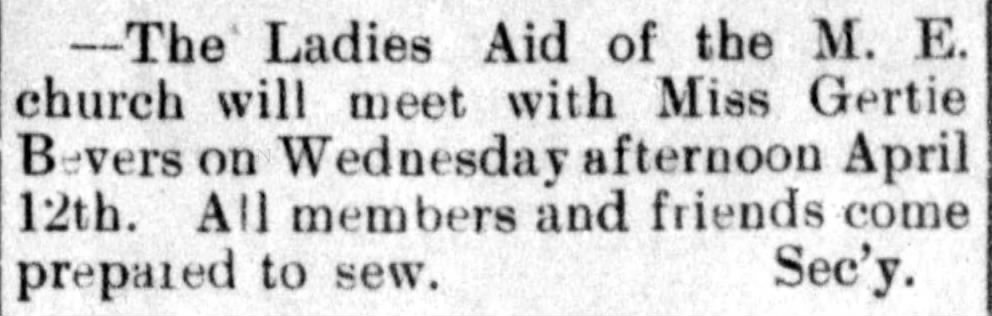
Never marrying, Gertrude’s role would be housekeeper while living in her parent’s home, as well as while living in her sister’s home after her parents passed away.9,10  In the community, Gertrude was active in several organizations.  Some of what is known about her life has been extracted from minutes of meetings of women’s groups.  Known as Gertie in the records of the Ladies Aid Society, she is found on its membership roll as of May 19, 1899, along with her mother.  Sometimes Gertie served as the secretary or secretary pro tem of the aid society.  She also served as its treasurer in 1902.  Her name and her parents’ names were often mentioned in the minutes, as seen in these summarized examples:

July 11, 1899.    “The Ladies Aid of the First M. E. Church met with Mrs. Crane.”

The scripture reading was Psalm 115.  Mrs. Bevers gave the opening prayer.  It was moved “that the Ladies serve a gallon of ice-cream each day at the church, during Institute.”  Gertie seconded the motion and she signed the minutes of the meeting as the “sec pro tem.”  There were 21 in attendance, not including children.  Lastly, ice cream and cake were served.

August 23, 1899.    “The Ladies Aid met with Mrs. O. E. Sterns.”

Gertrude signed the minutes of the meeting as secretary.  The scripture reading, John 15:18, and opening prayer were given by Rev. Bevers.  It was moved and carried that the society give Brother Akers, their minister, $5.00 for his salary.  Rev. Bevers on behalf of the society presented Sister Akers, the minister’s wife, with a monetary gift ($5.00) for her birthday, and he sang a birthday song at the end of his presentation of the gift.  This was followed by music and a social time.  There were 10 members, seven visitors and eight children present.

News item in Kingsbury County Independent
May 20, 1904

One of the aims of the Ladies Aid Society was to raise money for the church.  According to the 1965 history of the Methodist Church of De Smet: “The money paid in for the minister’s salary was never enough, so the Ladies’ Aid Society always put on big public chicken suppers.  The group published a cook book, Kitchen Echoes, in 1909 with tried recipes from the women of the town.  This brought in quite a bit of money for the church.”  Both Gertie and Maude contributed recipes which were printed in Kitchen Echoes, which sold for 50 cents per copy.

“Potato Salad.—Two teacups cold sliced potato, two hard boiled eggs, one good sized onion. Dressing for same: one egg, two tablespoons sugar, one-half cup vinegar, one tablespoon of butter, one teaspoon of mustard dissolved in a little milk, a pinch of salt. Heat until it thickens, but do not let it boil.—Gertie Bevers.”

“Sugar Cookies.—Two cups sugar, one cup butter, one cup sour cream, two eggs, one teaspoon soda, one teaspoon essence of lemon, flour to mix just stiff enough to roll easily.—Gertie Bevers”

News item in Kingsbury County Independent
April 7, 1911

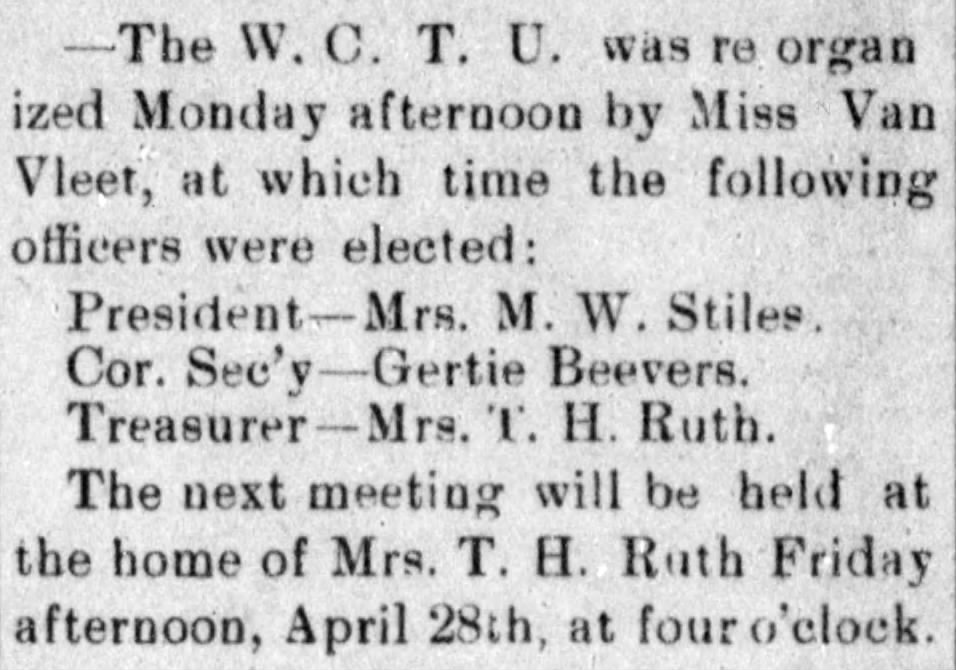
Another organization in which Gertie held an office was the Woman’s Christian Temperance Union (W. C. T. U.).  Although this organization was originally established to advocate for temperance, it later adopted the stance that local branches could advocate for other social causes, such as women’s suffrage.  In April 1905, the Kingsbury County Independent announced the re-organization of the chapter in De Smet by Miss Grace Van Vleet, who was the state secretary of Y. W. C. T. U. (the young women’s branch) and a temperance lecturer.  Gertie was elected to be the Correspondence Secretary of the local chapter.11  In March of the following year, the district convention of W. C. T. U. was held in De Smet.12  Most of the meetings on the 27th and 28th were held at the Methodist Episcopal Church.

News item in Kingsbury County Independent
April 21, 1905

A third organization in which Gertie participated was the Epworth League, which had been founded in 1889 as a merger of several young people’s organizations of Methodist Episcopal churches.13  Epworth League was made up of primarily young adults.  There were six departments of social service: Spiritual Life, Social Work, Literary Work, Correspondence, Mercy and Help, and Finance.  At the Methodist Episcopal church in De Smet, there were two Epworth League meetings held on Sundays, one was called the junior league and the other was the senior league.14  Gertie at the age of 39 was a delegate to an Epworth League convention in Brookings, South Dakota in September 1911.15

Additionally, Gertie was a dues-paying member of the Methodist women’s group.  She served on a committee in 1902 and was assistant to the 1st Vice in 1905.  She held a supper at her house in December 1910 to raise funds, $4.60 was collected.  On December 26, 1911, the minutes recorded: “Resolved Miss Bevers assist Evelyn in social work.”  She held another supper in April 1912, which raised $3.85.


On May 11, 1904, Gertie was a bridesmaid at her sister’s wedding.  Maude married her employer Alfred N. Waters, whose first wife had passed away in 1900.16  One of the earliest businessmen of De Smet, Waters was the president of Waters Land and Loan, as well as being the mayor of De Smet.  He had hired Maude to be his stenographer in 1898.17  The groomsman at the wedding was Professor C. E. Swanson, who was the superintendent of the De Smet schools, and the officiating minister was Rev. Henry Preston of the Methodist church.  The wedding was held at Syndicate Hotel which had opened in De Smet in 1887.  After an addition to the hotel was constructed in 1902, it was one of the largest hotels in South Dakota.18

As of the date of this blogpost, digitized versions of the issues of Kingsbury County Independent are only available for the years 1904 to 1929, which is when the Independent merged with the De Smet News.19  The succeeding issues are not available online.  From the issues that are digitized some of Gertie’s personal life can be envisioned because the local newspapers often reported on the events and travels of the Bevers family. 

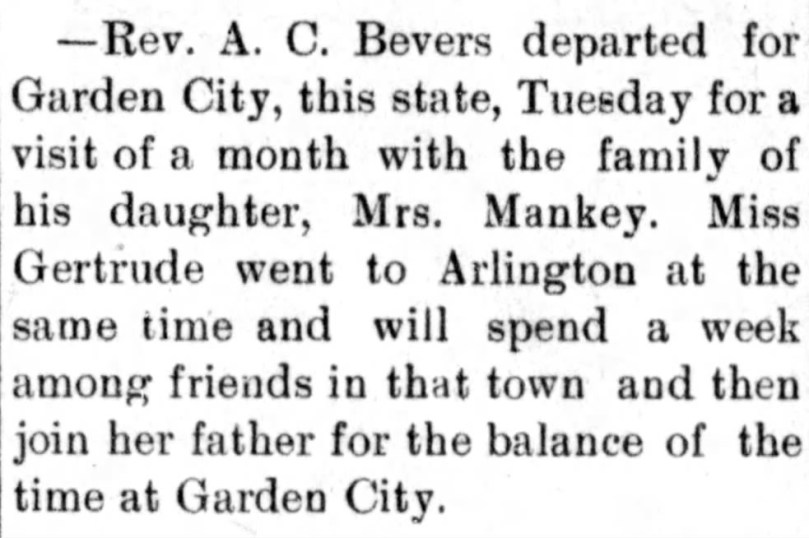
Sometimes Gertie’s sister Ada or her children made a trip to visit the Bevers family, but during the latter half of June 1906, Gertie spent two weeks with Ada, who lived with her husband William Mankey on a farm near Garden City, South Dakota.20  When the 1910 United States census was taken, Gertie was 37 years-old and still living with her parents who were 72 and 69.21  That year, Gertie’s mother passed away on July 14, and a lengthy obituary was published.22 It explained that Mary had had an operation six years earlier, from which she never fully recovered.  A couple of years later, she developed diabetes, and during this illness, Gertie and her family lovingly cared for Mary until her death.  Soon after the funeral, Gertie accompanied her father to Arlington, South Dakota to visit friends.23  And a month later, Mrs. James Bridges (the wife of Gertie’s mother’s nephew) came from Minneapolis to spend five days as a guest at the Bevers’ home.24 Shortly after that, both Gertie and her father took trips, in part separately and partly together. Gertie went to Arlington for two weeks, then joined her father at Ada’s home.25

News item in Kingsbury County Independent
Aug. 26, 1910

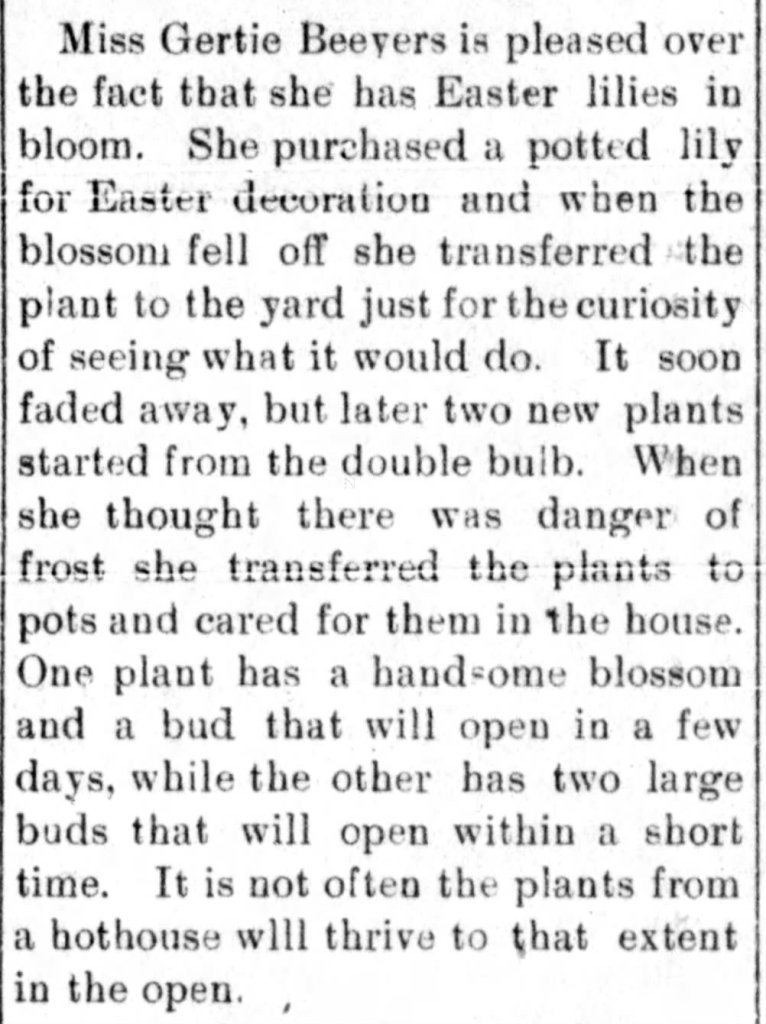
In March 1911, Gertie went again to Arlington to visit friends,26 and in August 1911, Mrs. John Glendenning came from Arlington to visit Gertie.27  Mrs. Glendenning was the daughter of Mrs. James Bridges and the granddaughter of Mathias Bridges, who was Gertie’s mother’s brother. A month later, the newspaper reported about an experiment that Gertie conducted with an Easter lily she had purchased.28

News item in Kingsbury County Independent, September 15, 1911

Gertie and Maude made a trip to Mitchell, South Dakota, in May 1916 to attend the wedding of their nephew W. Arthur Mankey, who was their sister Ada’s son.29  The wedding was held in the home of the bride, Birdella Carhart, and the officiating minister was the bride’s father, Rev. A. E. Carhart.  Also, in attendance were Arthur’s brother G. Floyd Mankey and his cousin Lester Mankey.


When Gertie was in her thirties and forties, suffrage for women was a fiercely contended political issue on both the state and federal levels.  In 1918, the men of South Dakota were asked to consider the question of amending the South Dakota state constitution, granting women the right to vote.  That November the amendment passed by approximately 63% of the vote.30  Six months later, the congress of the United States passed a suffrage amendment.  During subsequent months, the individual states either ratified or rejected the amendment.  South Dakota ratified it “without a dissenting vote in either house on Dec. 4, 1919, being the 21st state to act.”31  Ratification by the final state that was needed to adopt the 19th Amendment to the Constitution of the United States occurred on August 18, 1920.  The next day, a newspaper in Sioux Falls, South Dakota, declared, “Thus the political freedom for which women have contended since the founding of the republic has been attained and 27,000,000 women, half the population of the United States, accorded the right to vote under the constitution.”32


In January 1920 when the United States census was taken, 47-year-old Gertie and her 82-year-old father were living on Second Street in De Smet.33  Gertie’s father lived nearly two more years.  A news article dated September 23, 1921 included the following:

“For a number of years, the elderly gentleman had been in poor health, first being confined to a wheel chair, but later to his bed. His continued illness made it advisable for him to be moved from the Bevers home to A.N. Waters’ home, where his two daughters, Mrs. Waters and Gertrude Bevers, have cared for him.”34


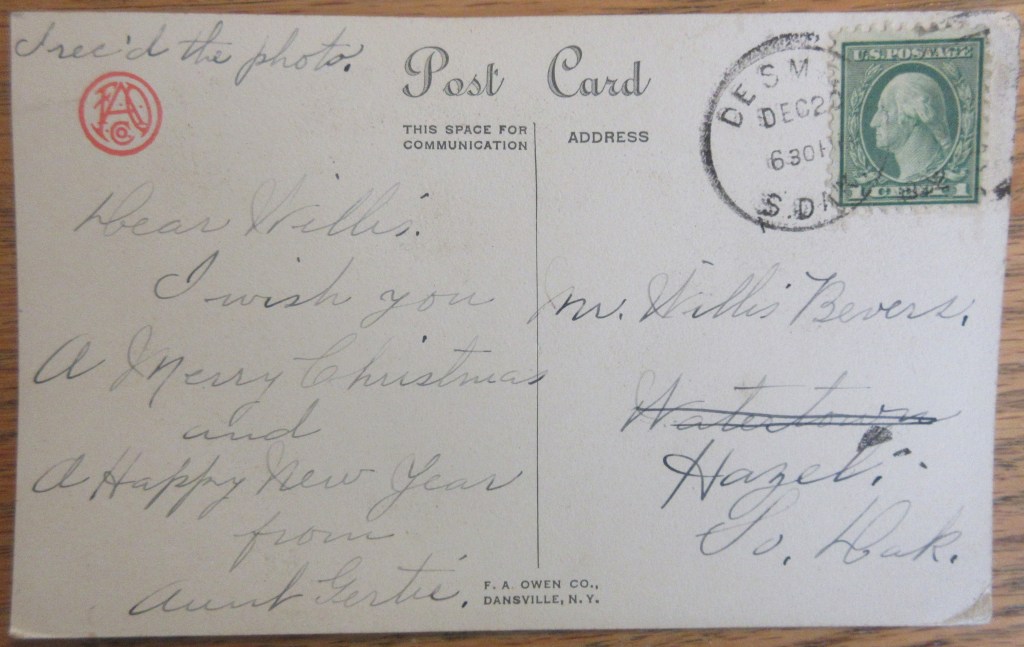
A couple of Gertie’s correspondences have survived for about 100 years.  In December 1922, she mailed a postcard to her nephew Willis Bevers, son of her brother Herbert.  Willis and his parents and six of his siblings had gone to southern Texas in the fall of 1919. The travel log of Willis’ mother has also survived.  After finding that they didn’t like farming in Texas, his parents with most of his siblings returned to South Dakota in 1920.  Willis stayed in Texas for another year but also returned to South Dakota about 1921.

Front of a Christmas postcard mailed by Gertie in December 1922
Back of a Christmas postcard mailed by Gertie in December 1922

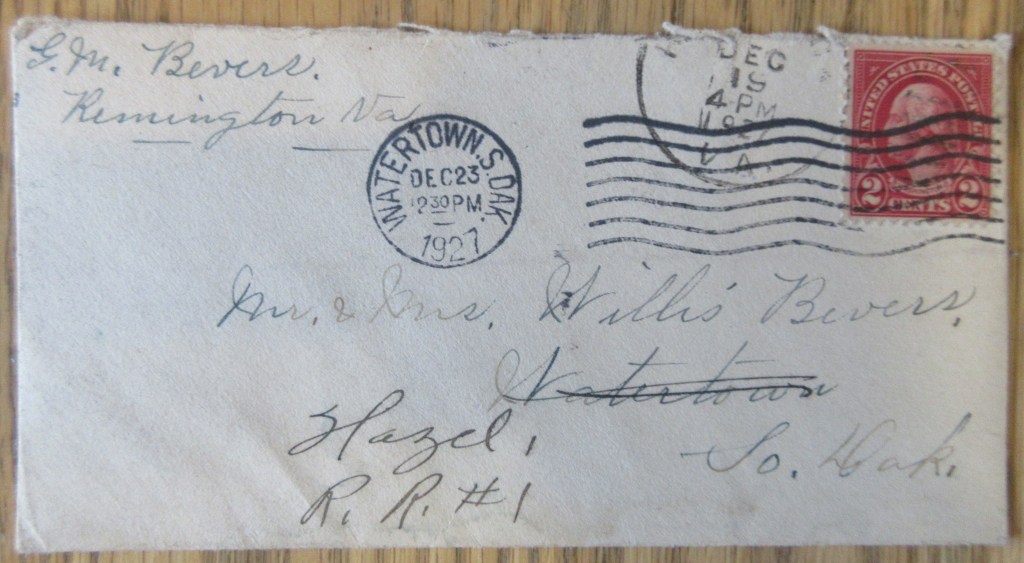
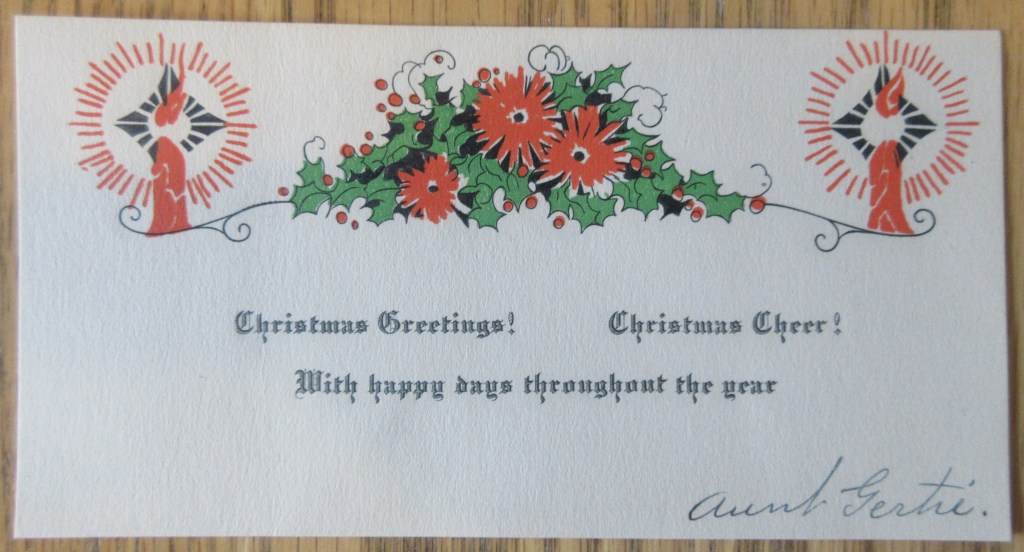
In 1927, apparently, Gertie made a cross-country trip to visit her sister Ada.  Ada with her husband and two daughters had moved to Virginia, near Remington, between 1915 and 1920.  Gertie’s trip is known because she mailed a Christmas greeting from Remington to Mr. and Mrs. Willis Bevers who were living in Hazel, South Dakota.  Postage for the letter was two cents and it took five days to travel from Virginia to Watertown, South Dakota.

Small envelope addressed by Gertie in December 1927
Small greeting card enclosed in the envelope mailed in December 1927

Little is known about Gertie’s personal life during the remaining years of her life.  In 1930, 1940 and 1950, when the United States censuses were taken, she was living with her widowed sister Maude, whose house was on 3rd Street in De Smet.  In 1930, Gertie was 57 years-old, Maude was 54 years-old and both of them were naturalized citizens.35  In 1940, both of them were engaged in home housework and they both received “income of $50 or more from sources other than money wages or salary.”36  Gertie’s brother George passed away in June 1943 in Los Angeles, California, and a month later Ada passed away in Washington, D. C.  About a year and a half later, her brother Herbert died in November 1944 in Watertown, South Dakota.

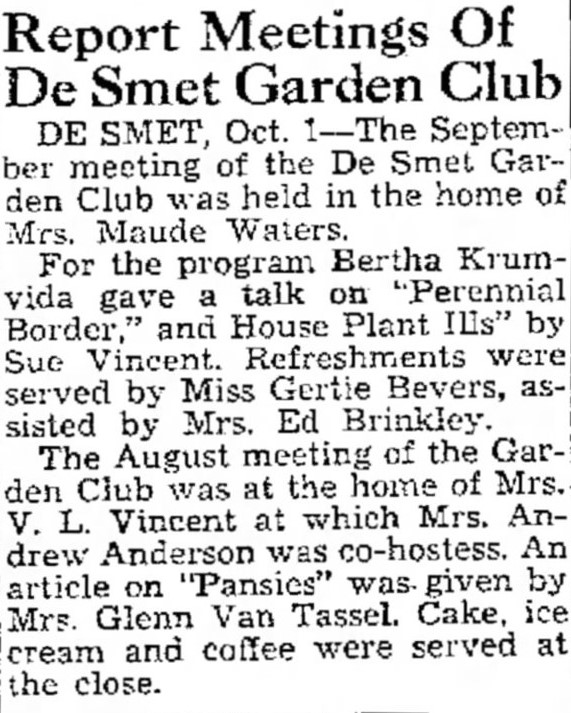
One miscellaneous item known about Gertie is that she continued to be active in the community in her sixties and seventies. She and Maude were members of the Friendly Garden Club in De Smet. In May 1939, they each participated in the program of the garden club by reading papers to the group. Gertrude read “Garden Verse” and Maude read “Gardening in all Countries and All Ages.”37 Nearly 10 years later, the sisters hosted a garden club meeting at Maude’s house.38

News item in The Daily Plainsman
October 1, 1948

In April 1950 the record of the United States census designates Gertie and Maude’s residence as Block 2 of “Original Town” of De Smet City.39  They were 77 and 74 years-old, respectively.  To the question, “What was this person doing most of last week – working, keeping house, or something else?” the answer for both of them was keeping house.  Gertie was selected to answer additional questions.  Her responses included that she was living in the same house a year earlier.  Her education level was recorded as “S7” (seventh grade), and she didn’t finish that grade.  She had not worked any weeks outside of her home in the previous year.  She didn’t receive money by working as an employee, or by working in her own business.  And to the question, “How much money did he receive from interest, dividends, veteran’s allowances, pensions, rents or other income (aside from earnings)?” she answered “none.”

Aunt Gertie passed away in De Smet on October 3, 1953, at the age of 81, after a “lingering illness” of stomach cancer.40  Her remains are buried in De Smet Cemetery beside her parents. Nearby, her sister Maude and her brother-in-law Alfred N. Waters are also buried.


APPENDIX 1

Text of the certificate of membership of the Band of Wolsey:

Thy Word is Truth

This is to certify that

Gertrude M. Bevers

Having signed the subjoined Pledge, has become a member of the

Hope of Wolsey

BAND OF HOPE

PLEDGE

I hereby solemnly promise to abstain from the use of all intoxicating liquors, including wine, beer and cider, as a beverage, and from the use of tobacco in every form, and from all profanity.

Thy Sign the Triple Pledge

BECAUSE

  1. Drunkenness is a sin.
  2. The Bible says no drunkard shall enter heaven
  3. Moderation tends to drunkenness, while total abstinence is perfectly safe.
  4. The first drink is a long step toward drunkenness.
  5. Those who do not resist the temptation to take the first drink, are not likely to resist the temptation to drink to excess.
  6. We can never tell, when we commence the habit of drinking, how it will end.
  7. Intoxicating drinks do us no possible good.
  8. They are the means of great injury to our health and character.
  9. The habit of drinking leads to many other evil habits.
  10. Drinking always leads to misery.
  11. Drinking usually leads to poverty.
  12. Drinking oftentimes leads to crime.
  13. Sixty thousand persons are ruined every year by the evils of drink.
  14. It is a Christian duty to deny ourselves for the good and happiness of others.
  15. While millions repent of drinking, none ever repent of abstaining.
  16. The habit of drinking is supremely foolish.
  17. The use of tobacco leads to an appetite for drink.
  18. Using tobacco is a filthy and costly habit, which does no good.
  19. Swearers and drinkers go together.
  20. God has said, “Swear not.”

Published by the Revolution Temperance Publishing House, David C. Cook, Manager, 13 & 15 Washington st., Chicago.           

Bible verses printed in each corner of the certificate:

Proverbs 23:29   Who hath woe?  Who hath sorrow?

II Corinthians 7:1  Let us cleanse ourselves from all filthiness.

Proverbs 23:32  At the last it biteth like a serpent, and stingeth like an adder.

Matthew 5:34  Swear not at all.


1 “RIPON. Death of an Old Temperance Advocate,” The Yorkshire Herald and the York Herald (York, North Yorkshire, England), February 17, 1894, page 11, Newspapers.com.

2 “Longwood Temperance Society,” Weekly Examiner (Huddersfield, West Yorkshire, England), April 24, 1869, page 6, Newspapers.com.

3 “United States Census, 1900”, , FamilySearch (https://www.familysearch.org/ark:/61903/1:1:MMRW-TKS : Sat Aug 17 18:09:29 UTC 2024), Entry for Alfred C Peevers and Mary N Peevers, 1900.

4 City of De Smet, South Dakota, “Depot Museum / Harvey Dunn School,” https://cityofdesmet.com/depot-museum.

5 Caryl Lynn Meyer Poppen, ed., excerpt from De Smet Yesterday and Today “Little Town on the Prairie” in “History,” De Smet, South Dakota, https://desmetsd.com/history.

6 First Methodist Church of DeSmet, “Record of Members.”

7 First Methodist Church, “A History of the Church,” Consecration Service of the Remodeled First Methodist Church (De Smet, South Dakota: First Methodist Church, September 26, 1965).

8 First Methodist Church, “A History of the Church.”

9 “South Dakota State Census, 1905”, , FamilySearch (https://www.familysearch.org/ark:/61903/1:1:MM42-JWN : Sun Mar 10 20:39:28 UTC 2024), Entry for Gertrude M Bevers.

10 “United States Census, 1940”, , FamilySearch (https://www.familysearch.org/ark:/61903/1:1:V19L-5LM : Fri Mar 08 09:56:34 UTC 2024), Entry for Maude Waters and Gertrude Bevers, 1940.

11“Local News,” Kingsbury County Independent (De Smet, South Dakota), April 21, 1905, page 5, Newspapers.com.

12 Kingsbury County Independent (De Smet, South Dakota), March 23, 1906, page 4, Newspapers.com.

13 Case Western Reserve University, “Epworth League,” Encyclopedia of Cleveland History, https://case.edu/ech/articles/e/epworth-league.

14 “Church Services,” Kingsbury County Independent (De Smet, South Dakota), September 15, 1911, page 5, Newspapers.com.

15 “Local News,” Kingsbury County Independent (De Smet, South Dakota), September 15, 1911, page 5, Newspapers.com.

16 Nancy S. Cleaveland, “Alfred N. Waters,” Laura Ingalls Wilder A-Z, http://www.pioneergirl.com/blog/archives/7204.

17 “College News,” The Brookings Register (Brookings, South Dakota), March 29, 1898, page 2, Newspapers.com.

18 Nancy S. Cleaveland, “Syndicate Hotel,” Laura Ingalls Wilder A-Z, http://www.pioneergirl.com/blog/archives/9165.

19 Library of Congress, Kingsbury County Independent (Desmet, Kingsbury County, S.D.) 1894-1929, https://www.loc.gov/item/sn00065130/.

20 “Local News,” Kingsbury County Independent (De Smet, South Dakota), June 15, 1906, page 5, Newspapers.com.

21 “United States Census, 1910”, , FamilySearch (https://www.familysearch.org/ark:/61903/1:1:MPX1-9J6 : Sun Mar 10 11:44:32 UTC 2024), Entry for Alfred C Bevers and Mary N Bevers, 1910.

22 Kingsbury County Independent (De Smet, South Dakota), July 22, 1910, page 4, Newspapers.com.

23 “Local News,” Kingsbury County Independent (De Smet, South Dakota), July 22, 1910, page 5, Newspapers.com.

24 “Local News,” Kingsbury County Independent (De Smet, South Dakota), August 19, 1910, page 5, Newspapers.com.

25 “Local News,” Kingsbury County Independent (De Smet, South Dakota), August 26, 1910, page 5, Newspapers.com.

26 “Local News,” Kingsbury County Independent (De Smet, South Dakota), March 24, 1911, page 5, Newspapers.com.

27 Kingsbury County Independent (De Smet, South Dakota), August 11, 1911, page 4, Newspapers.com.

28 “Local News,” Kingsbury County Independent (De Smet, South Dakota), September 15, 1911, page 5, Newspapers.com.

29 “Society,” Mitchell Capital (Mitchell, South Dakota), May 4, 1916, page 5, Newspapers.com.

30 Forest City Press (Forest City, South Dakota), December 5, 1918, page 2, Newspapers.com.

31 Argus-Leader (Sioux Falls, South Dakota), August 19, 1920, page 4, Newspapers.com.

32 Argus-Leader, August 19, 1920.

33 “United States Census, 1920”, , FamilySearch (https://www.familysearch.org/ark:/61903/1:1:M6JQ-J85 : Thu Mar 07 04:17:06 UTC 2024), Entry for Alfred C Bevers and Gertrude Bevers, 1920.

34 Nancy Cleaveland and Gina Terrana, Waters (2015), http://www.pioneergirl.com/waters_cemetery.pdf.

35 “United States Census, 1930”, , FamilySearch (https://www.familysearch.org/ark:/61903/1:1:XQVH-29Z : Thu Jul 11 05:02:51 UTC 2024), Entry for Maude A Waters and Gertrude V Bevers, 1930.

36 “United States Census, 1940”, Entry for Maude Waters and Gertrude Bevers, 1940.

37 The Daily Plainsman, (Huron, South Dakota), May 12, 1939, page 5, Newspapers.com.

38 The Daily Plainsman, (Huron, South Dakota), October 1, 1948, page 5, Newspapers.com.

39 “United States Census, 1950”, , FamilySearch (https://www.familysearch.org/ark:/61903/1:1:6F9N-CQQP : Wed Oct 04 18:17:08 UTC 2023), Entry for Agnes Maude Katers and Gertrude M Bevers, 10 April 1950.

40 K. and M. Bevers, notes attached to Gertrude Mary Bevers in Ancestral Quest program file dated June 29, 2022.

Ada, Gertie and Maude Bevers, Daughters of a Methodist Supply Pastor

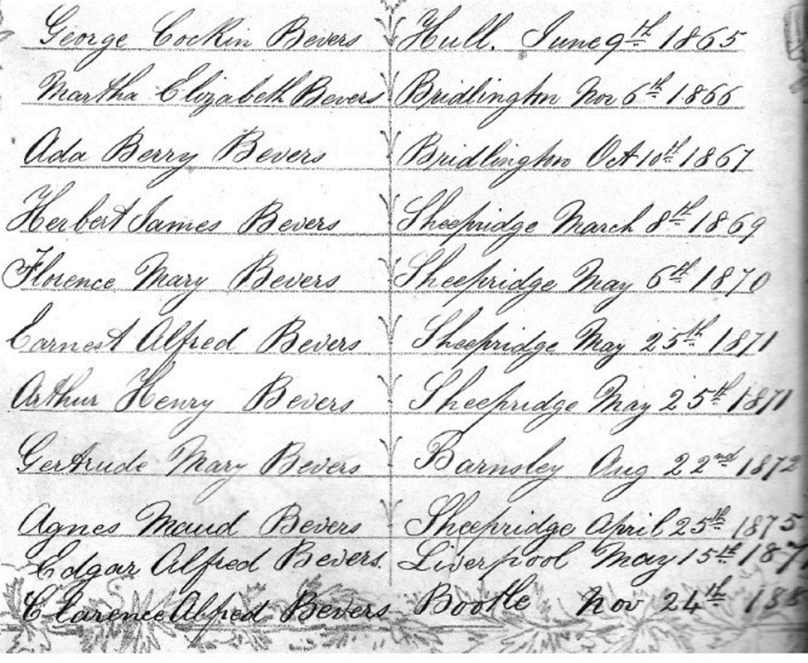
On the northeast coast of England lies the town of Bridlington.  Alfred C. Bevers and his wife Mary (nee Bridges) with their infant son George (see George C. Bevers, Bookkeeper) arrived in the town sometime between late 1865 and late 1866.  Mary gave birth to a daughter in November 1866 but the newborn only lived 16 days.  The following fall, on October 10, 1867, she gave birth to another daughter, which they named Ada Berry Bevers, according to the entry in Alfred and Mary Bevers’ Family Bible (see Alfred and Mary Bevers’ Family Bible).  The name Berry was the maiden name of the second wife of Ada’s grandfather William Bevers.  William had married Susanna Berry in the first quarter of 1865.1  Even though the Family Bible indicates that her name was Ada Berry Bevers, most of Ada’s genealogical records use a middle initial of “N” which stands for Naomi, her mother’s middle name.

Within a year and a half of Ada’s birth, her family moved to a village called Sheepridge in the township of Huddersfield in central northern England, which was the birthplace of Ada’s father.  In March 1869 Ada’s mother gave birth to her brother Herbert (see An Introduction to Herbert James Bevers).  Three more siblings would be born in Sheepridge, but none of them survived past their first year of life.  When the 1871 census was recorded in the ecclesiastical district of Christ Church Woodhouse, Ada’s 33-year-old father was a collector and canvasser for Prudential Insurance Company.2  Her mother was 30 years-old and Herbert was two years-old.  Ada at the age of three and George at the age of five were listed as scholars.

By the time Ada was five years-old, her family had moved to Barnsley, an agricultural market and coal-mining town southeast of Sheepridge.  Barnsley is the hometown of J. Hudson Taylor, a missionary who spent many years in China in the mid-1800s and upon his return to England he founded China Inland Mission; then in 1866, Taylor and his wife traveled to China with 20 missionaries to establish Christian missions in every province of China.3  In Barnsley Ada gained a sister on August 22, 1872 when Gertrude Mary was born.  Before two years had passed, the Bevers family returned to Sheepridge, and on April 25, 1875 Agnes Maude was born.  She was baptized in June of that year at Christ Church in Woodhouse Parish.4

Within a couple of years, the family had relocated to the city of Liverpool, on the northwest coast of England.  The port of Liverpool was the second largest in the country, the largest being at London.  In Liverpool, another brother was born in May 1877 and lived for about 14 months.  On July 22, 1877, Gertrude was baptized at St. Mary, Kirkdale,5 which was a ward of Liverpool. In a town three miles north of Liverpool called Bootle, one more brother was born in November 1881, who lived about 9 months.  In total, there had been 11 children born to Alfred and Mary, only five of which survived past infancy.

List of “Children’s Names” with their birthplace and birthdate in the Family Bible of Alfred C. and Mary N. Bevers

When the census was taken in 1881, the Bevers family resided at 97 Derby Road, Kirkdale.6  Forty-three year-old Alfred was a tailor’s cutter.  Tailoring had been a trade of the Bevers family for generations.  Mary was 40 years-old and George, at 15 years-old and having completed his education through the 8th grade,7 was a “pupil teacher” at a Church of England school.  Ada was 13 years-old and she would also complete the 8th grade.8  She and her younger siblings were scholars.  Herbert was 12, Gertrude was eight and Maude was five years-old.

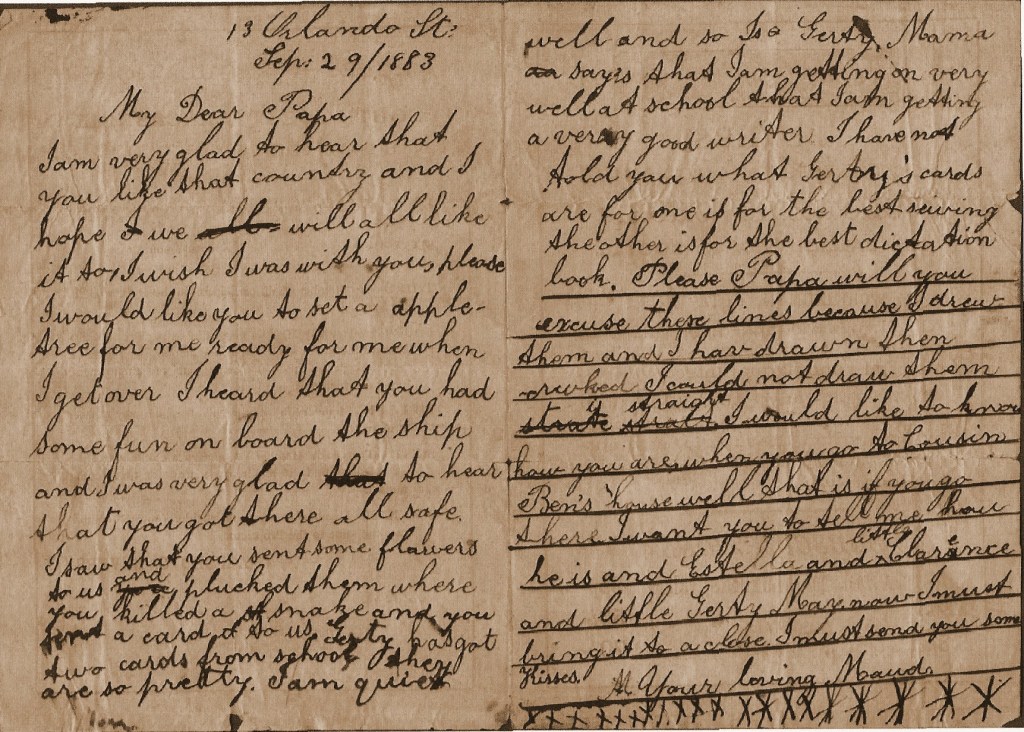
In 1883 Alfred decided to travel to America “to determine if they would like it.”9  He made his way to Dakota Territory and wrote to his family about his experiences on board the ship and in the new country, which included killing a snake.  On September 29, eight year-old Maude replied to her father’s letter:

13 Orlando St.

Sep. 29/1883

My Dear Papa

I am very glad to hear that you like that country and I hope we will all like it to, I wish I was with you, please I would like you to set a apple-tree for me ready for me when I get over   I heard that you had some fun on board the ship and I was very glad to hear that you got there all safe.  I saw that you sent some flowers to us and plucked them where you killed a snake and you sent a card to us.  Gerty has got two cards from school   they are so pretty.  I am quiet well and so Is Gerty.  Mama say’s that I am getting on very well at school   that I am getting a very good writer   I have not told you what Gerty’s cards are for   one is for the best sewing   the other is for the best dictation book.  Please Papa will you excuse these lines because I drew them and I hav drawn them crooked   I could not draw them straight.  I would like to know how you are.  when you go to Cousin Ben’s house   well that is if you go there   I want you to tell me how he is and Estella and little Clarence and little Gerty May.  now I must bring it to a close.  I must send you some Kisses.

                Your loving Maud

The letter eight year-old Maude wrote to her father when he went to Dakota Territory ahead of his family

The person Maude identified in her letter as “Cousin Ben” was probably Benjamin T. Bridges, a son of Mathias Bridges, Maude’s mother’s brother.  In 1895, it was recorded that Benjamin had moved to Minnesota in 1872 and he had lived in Minneapolis since about 1882.10  His wife was Helen Estella (nee Huntley) and they had a son Clarence, a daughter Gertie and a daughter Nellie.  At the time of Maude’s letter Clarence would have been about two years-old and Gertie would have been just months old.

A year and a half after their father’s departure, Ada, Gertrude and Maude emigrated with their mother, arriving at the port of Philadelphia on December 17, 1884,11 and subsequently joining their father in Dakota Territory.  The girls were 17, 12 and nine years-old, respectively.  Their brother George would emigrate to the United States in 1885 but he settled in Philadelphia.  Later, their brother Herbert also emigrated, which is recorded as occurring in 1888.12  Herbert may have spent time in Philadelphia and in Virginia but eventually he would settle in South Dakota.

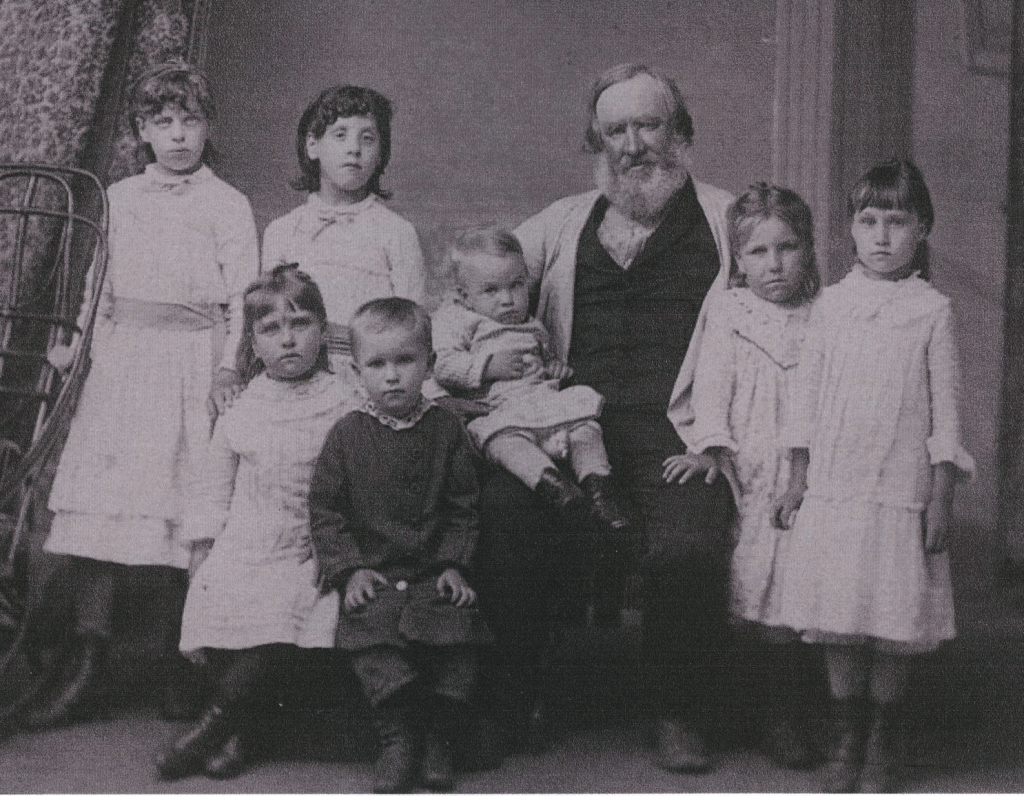
Not long after arriving in the United States, Gertrude and Maude were photographed with an elderly man and other youngsters.  These were possibly their uncle Mathias Bridges and his grandchildren.  It is believed that the portrait was taken in Worthington, Minnesota. 

Standing on left are Gertrude and Maude Bevers. The man is probably their mother’s brother Mathias Bridges. (The photograph is believed to have been taken in Worthington, Minnesota; estimated date of 1885.)

When Ada, Gertrude and Maude arrived in Dakota Territory, their father had been assigned, as of October 1884, as a supply pastor to the Methodist Episcopal Church in Castlewood,13 which that year had become the county seat of Hamlin County. A short history of Castlewood M. E. Church includes the following:

… it was the Northwestern Railway which built a branch line through the Big Sioux Valley to a point 40 miles north and a little west of Brookings.  Here they built a turn table so that the engines which had been backing up to Brookings could turn around at this spot and so here is the beginning of Castlewood.  This was in 1882 and the railway built a depot here too.  That started the wealthy men coming to this spot and homesteading and also building business places.  The building boom had started, soon hotels, livery stables, horses and rigs for rent for persons to look over the land.  Many homesteaded and also set up business places.  The Depot was used as a gathering place for religious services and in summer tents were set up near [the] depot to hold services as well.  When a store building was built on [the] south side of main street this was [the] first two story one so [the] upstairs room was used for church services and the first school held here in 1883. … Before any church was built services were also held in school houses.  Methodist E. people held services in Caverhill School House and Swift School House.14

Due to their father’s assignments to many Methodist congregations in Dakota Territory (and in South Dakota after it gained statehood), Ada, Gertrude and Maude lived in many small towns.  It is uncertain whether Gertrude attended school in any of these small towns. There are conflicting statements in the 1940 and 1950 United States censuses which reveal that Gertrude completed either seventh or eighth grade. Possibly she had completed her education in England before immigrating. On the other hand, Maude would have attended school after immigrating. She went on to complete high school.

Following the one-year assignment in Castlewood, their father served as the pastor of Henry M. E. Church, Codington County, for two years (October 1885 to October 1887).15  There is the possibility that their father was simultaneously serving as the pastor of the Garden City congregation which was about 10 miles away.  In 1886, the town of Henry had 149 inhabitants.16  While the family lived in Henry, the girls’ father secured a parsonage for the church for $500.00.17

In about May 1886, Alfred chaired the committee that organized a Sunday School at Henry M. E. Church.18  Each week Sunday School was opened with singing a hymn and with prayer, often followed by a responsive reading from a scripture lesson sheet.  A scripture lesson was given and the meeting was closed with singing a hymn.  According to the minutes of the Sunday School dated March 6, 1887, it appears that an essay was read by the secretary discussing the use of questions and answers in Sunday School classes.  The following week the minutes state: “Question given out who were punished for lying and how.”  On March 20, 1887, it is recorded in the minutes: “Last Sunday’s question answered by Gertie Bevers  Acts 5 for Ananias and Sapphira.”  Gertie was 14 years-old at this time.  During the summer months of 1887, each week a different word was assigned and the attendees were expected to find a text of scripture that had that word in it.  On the following Sunday, the texts were read by individuals or by class groups.  For example, on June 26, the texts contained the word “Holiness” and on September 11, the word was “Kingdom.”

Henry United Methodist Church (formerly Henry Methodist Episcopal Church); the building to the left appears to be the original parsonage (Photographed by MRW August 2010)

Following the Henry appointment, the girls’ father was appointed for one year (October 1887 to October 1888)19 to Wolsey M. E. Church, a church of 67 members.20  Then he was assigned to the Bradley Charge for an unknown period beginning in October 1888.21  While in Wolsey, Ada and Gertrude were involved in an association called the Band of Wolsey, a local branch of a temperance organization that had its origins in England called Band of Hope.  Temperance was a lifestyle that had been followed by their grandfather William Bevers, who has been described as “an ardent temperance advocate” and at his death he “had been a total abstainer over 60 years.”22


An explanation of the setting of the Temperance Movement and the birth of the Band of Hope follows:

One of the evils of Victorian society was cheap and grossly abused child labour – small children were regarded as ideal for working in coal mines, in cotton mills and as chimney sweeps. Some children, employed as chimney sweeps, were as young as 8 years. Life, both for them and their parents, was wretched; physical and emotional pain oppressed them all the time, prospects of escaping from this drudgery were nil – and their only solace was in the alehouse. Beer was cheap, spirits were plentiful and there were no restrictions on children visiting alehouses. …

For many children, the alehouse was the only place where they could escape from the wretchedness of their environment. Some Sunday schools existed in fashionable churches but most of the prosperous city churches catered for the children of gentry rather than for the scruffy, dirty urchins who frequented the gin palaces, and they would certainly not have been welcomed into these fashionable churches.

It was against this backdrop of juvenile misery and deprivation that the Temperance Movement was born. …

The pioneer of the Temperance Movement in England was Joseph Livesey, himself from poor surroundings. He was orphaned and worked as a cottage weaver as a child. Livesey was concerned by the excessive drinking he saw in Preston and founded both an adults’ and a children’s Sunday School in the town. In 1832, he, together with six other men, founded the Preston Temperance Society. The seven men felt that they had to be totally committed to abstinence and on September 1st 1832 they all signed the following pledge; “We agree to abstain from all liquor of an intoxicating quality whether ale, porter, wine or ardent spirits, except as medicines.” Others joined them in this pledge and one of the seven, Dicky Turner, blurted out “Nothing but the tee-total will do” – and the expression tee-total stuck.

The idea of total abstinence quickly gained popularity. Mrs Ann Carlile, the widow of a Presbyterian Minister, was challenged by the dreadful conditions of the women in Newgate Prison, Dublin, most of whom blamed cheap whiskey for their downfall. At the mature age of 72, she resolved to devote the rest of her life to total abstinence. She joined forces with the Reverend Jabez Tunnicliff, who in 1842 became minister of the influential South Parade Baptist Church in Leeds. On one occasion he was asked to visit a former Sunday School teacher dying from a sickness brought about by alcohol. Turning to Mr Tunnicliff, he pleaded with him “Warn young people against the danger of the first glass”. Jabez Tunnicliff persuaded Ann Carlile to come to Leeds in 1847 to address a number of mass meetings. This was the providential meeting that saw the birth of the ‘Band of Hope’ (a name for which both Ann Jane and the Rev Tunnicliff took credit), a temperance organisation specifically for children who suffered as much as adults from the consequences of unregulated alcohol consumption. She is supposed to have said, “What a happy Band these children are – they are the Hope for the future.” …

Band of Hope meetings used techniques that aimed to press home their strong belief in total abstinence. Their meetings were lively, child-centred (in a Victorian context!), involved much singing, often including the Band of Hope theme song “Come, all ye children, sing a song”, Magic Lantern slides were always popular; many a Band of Hope speaker took with him a Magic Lantern carbide for producing a strong beam and a set of slides. The children were shown slides illustrating the dreadful ways in which alcohol could affect their lives and the stability of their family lives, not to mention the damage to their own health, and this would have been accompanied by stirring speeches from the team. The climax of most meetings would have been an invitation to the children to sign the pledge of total abstinence. This part of the Band of Hope service would always be taken very seriously (parents were sometimes asked to sign their permission for this act of public commitment to total abstinence). Other popular activities might have included model making, spelling tests, an annual Temperance Knowledge exam, and a wide circulation of books and pamphlets.23


On May 22, 1889, at the age of 21, Ada appeared before the Clerk of the District Court in Codington County, Dakota Territory.  She declared her intention to become a citizen of the United States of America.  Near the end of that year, Dakota Territory was divided and two states were accepted into the United States, North Dakota and South Dakota.

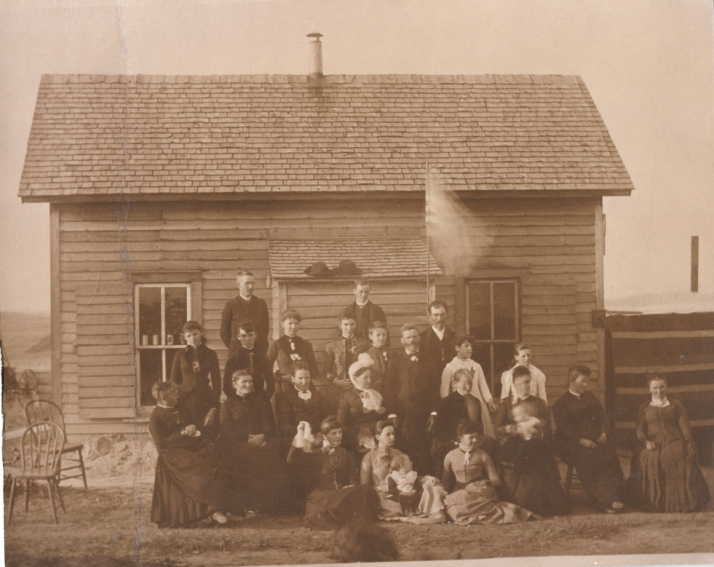
Late in the 1880s, the girls’ father filed a claim for a homestead a few miles northeast of Henry in Phipps Township, Codington County.  In front of the small frontier house that was built on the homestead, family and friends gathered to celebrate the 25th wedding anniversary of their parents which occurred on September 19, 1889.  A photograph was taken of the gathering.  Maude (age 14) and Gertrude (age 17) can be seen standing in white dresses on the right of the group.  Ada (age 21) is sitting on the ground on the left.  Their parents are in the center, Mary wearing a white hat with Alfred standing to the right of her.  Their brother Herbert is standing in the back row on the far left.  It is believed that Lena Huppler, who would become Herbert’s wife, is standing on the far left in the row in front of Herbert.   It is also believed that William Mankey, who would become Ada’s husband, is standing in the back row on the far right.

The 25th wedding anniversary of Alfred and Mary Bevers (1889), photo taken on their homestead in Phipps Township, Codington County.  Sitting on the ground on the left is Ada, standing on the right in white dresses are Maude and Gertrude, to the left of Maude is Alfred and sitting in the center with a white hat is Mary.

On October 28, 1891, 24 year-old Ada married William Mankey.24 Quite certainly, she had met William during the time that her father was the supply pastor of the Henry M. E. Church.  In 1887-88, William was involved in the church in a few capacities.  He was approved as one of the Sunday School Superintendents, he was appointed to the Missions Committee, and he was a Steward.25  William had emigrated from England to the United States in 1875 with his mother and siblings,26 presumably his father had arrived prior to their emigration.  When the 1871 census of England was taken, William was a tin miner at the age of 12 years old,27 and in 1880 he was a coal miner in Illinois, along with his father and younger brother James.28

William Mankey and Ada N. Bevers

After several years of improving the land of his homestead, in January 1893 Gertrude and Maude’s father submitted his final proof for his claim.  Three years later the homestead was sold.  At the time of the sale, their parents’ residence was recorded as Clark County.  Their father had once again begun serving as a supply pastor, being assigned to Waubay in Day County in October 1895.29  Then from October 1896 to October 1899, he served the Willow Lake (Clark County), Hazel (Hamlin County) and Vienna (Clark County) congregations.

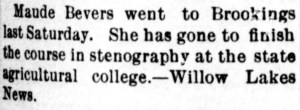
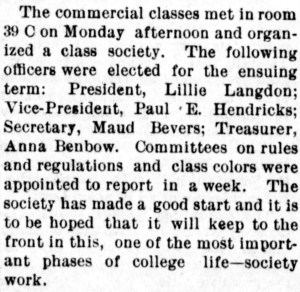
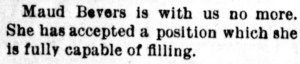
In May 1897 the local newspaper reported that Maude had gone to Brookings to finish a stenography course at the state agricultural college.30  That fall, Maude was elected Secretary of a class society at the college.31  Several months later, it was reported that Maude had left the college and accepted a position.32  Family historians of the Bevers family have stated that Maude began working as a secretary for Alfred N. Waters, a prominent businessman of De Smet in Kingsbury County.33  Possibly that is the position she took when she left the college.  In 1898, Gertrude and Maude moved with their parents to De Smet.  That year Gertrude turned 26 years-old and Maude turned 23.  They would spend the rest of their lives, over half a century, in De Smet.

The Brookings Register news clipping dated May 8, 1897
The Brookings Register news clipping dated October 2, 1897
The Brookings Register news clipping dated March 29, 1898

1 FreeBMD, England & Wales, FreeBMD Marriage Index, 1837-1915, (Provo, Utah, USA: Ancestry.com Operations Inc., 2006): 138.

2 Ancestry.com, 1871 England Census [Class: RG10; Piece: 4372; Folio: 86; Page: 19; GSU roll: 848087], (Provo, Utah, USA: Ancestry.com Operations Inc., publisher, 2004): http://www.Ancestry.com.

3 G. H. Anderson, “Taylor, James Hudson (1832-1905),” Biographical Dictionary of Christian Missions (New York: MacMillan Reference USA, 1998): https://www.bu.edu/missiology/missionary-biography/t-u-v/taylor-j-hudson-1832-1905/.

4 Ancestry.com, West Yorkshire, England, Church of England Births and Baptisms, 1813-1910 [database on-line] (Provo, UT, USA: Ancestry.com Operations, Inc., 2011): http://www.Ancestry.com.

5 Ancestry.com, England, Select Births and Christenings, 1538-1975 [database on-line] (Provo, UT, USA: Ancestry.com Operations, Inc., 2014): http://www.Ancestry.com.

6 Ancestry.com, 1881 England Census [Class: RG11; Piece: 3684; Folio: 133; Page: 23; GSU roll: 1341882] (Provo, Utah, USA: Ancestry.com Operations Inc., publisher, 2004): http://www.Ancestry.com.

7 “United States Census, 1940”, database with images, FamilySearch (ark:/61903/1:1:K975-B84 : Thu Mar 16 16:18:54 UTC 2023), Entry for Dorothy Bevers and George S Bevers, 1940.

8 “United States Census, 1940”, database with images, FamilySearch (ark:/61903/1:1:K73M-H7C : Fri Jun 09 01:27:49 UTC 2023), Entry for Ada N Mankey, 1940.

9 “Mrs. Alfred C. Bevers,” Kingsbury County Independent, Jul 22, 1910 [accessed from Newspapers.com].

10 Ancestry.com, Minnesota, U.S., Territorial and State Censuses, 1849-1905 [database on-line] (Provo, UT, USA: Ancestry.com Operations Inc, 2007): http://www.Ancestry.com.

11 United States of America [1st Naturalization Paper of Ada N. Bevers], (Codington County, Dakota Territory: District Court, May 22, 1889).

12 “United States Census, 1900,” database with images, FamilySearch (https://familysearch.org/ark:/61903/3:1:S3HT-68DY-PH?cc=1325221&wc=9B7H-9LQ%3A1031648401%2C1033119401%2C1033119402 : 5 August 2014), South Dakota > Roberts > ED 282 Agency, One Road & Spring Grove Townships > image 4 of 11; citing NARA microfilm publication T623 (Washington, D.C.: National Archives and Records Administration, n.d.).

13 Annual Conference of Dakota Mission, Minutes of the Fifth Session of the Annual Conference of Dakota Mission of the Methodist Episcopal Church (Mitchell, Dakota Territory, USA: S. D. Cook, Printer and Binder, 1884): 61.

14 __________, History of the Methodist Episcopal Church – Castlewood So. Dak. (The First Methodist Episcopal Church of Castlewood, n. d.).

15 United Methodist Church, Dakotas Conference, Commission on Archives and History, personal communication with M. R. Wilson, June 20, 1995.

16 Henry Historical Book Committee, Glimpses of our Town 1882-1982 (1982): 4.

17 J. G. Palmer, “Henry,” Palmer’s Directory of the Methodist Episcopal Church for Dakota Conference (1888): 127-8.

18 Minutes of Henry E. M. Church Sunday School (Henry, South Dakota: Henry Episcopal Methodist Church, May 1886-October 1887).

19 Dakota Conference, Minutes of the Third Session of the Dakota Conference (Sioux Falls, Dakota Territory, USA: Dakota Bell Publishing Co., 1887): 136.

20 J. G. Palmer, “Wolsey,” Palmer’s Directory of the Methodist Episcopal Church for Dakota Conference (1888): 63.

21 Dakota Conference, Minutes of the Fourth Session of the Dakota Conference (Yankton, Dakota Territory, USA: Press and Dakotaian, 1888): 176.

22 __________, The Yorkshire Herald and the York Herald, 17 Feb 1894 [accessed from Newspapers.com].

23 D. Edgington, Hope UK – a walk through history (2010):1-3, https://www.hopeuk.org/wp-content/uploads/Walk-Through-History-PDF.pdf

24 A. & M. Bevers Family Bible, “Marriages.”

25 Minutes of the Fourth Quarterly Conference for Henry, Huron District, Dakota Conference (August 20, 1887).

26 Ancestry.com, New York, Passenger Lists, 1820-1957 (Provo, Utah, USA: Ancestry.com Operations Inc, 2010): http://www.Ancestry.com.

27 Ancestry.com, 1871 England Census (Provo, Utah, USA: Ancestry.com Operations Inc, 2004). [Original data – Census Returns of England and Wales, 1871. Kew, Surrey, England: The National Archives of the UK (TNA): Public Record Office (PRO), 1871.]

28 “United States Census, 1880”, database with images, FamilySearch (https://www.familysearch.org/ark:/61903/1:1:MXV4-9J7 : Thu Aug 03 04:50:54 UTC 2023), Entry for Thomas Mankey and Mary Mankey, 1880.

29 United Methodist Church, personal communication with M. R. Wilson.

30 The Brookings Register, May 8, 1897.

31 The Brookings Register, October 2, 1897.

32 The Brookings Register, March 29, 1898.

33 K. and M. Bevers, notes attached to Agnes Maude Bevers in Ancestral Quest program file dated June 29, 2022.