In March 1913, Charles and Maggie Daily moved their family from a farm near Topeka, Kansas (see Reminiscences of Uncle Bob, Part 3) back to Omaha, Nebraska. Charles probably took employment at a company he had worked for previously, in the 1890s. Whether he started working there immediately or later in the year, by the time the 1914 Omaha city directory was issued, he was a foreman at West Omaha Coal and Ice Company.1 When the Dailys arrived in Omaha, they intended to move into the home that they owned in the neighborhood called West Side. Renters were still living in their house so they had to wait until the first of April to move into it. During the interim, tragedy struck the city. At about age 84, their son Robert recounted the event:
Interviewer: … Let’s see, the tornado in Omaha —
Uncle Bob: That was on the 23rd of March.
Interviewer: And I believe your house was damaged?
Uncle Bob: Yeah, it was. Our home was completely gone except one side wall of our own home. We were, we moved up there just, see, 10 days before the, uh, tornado and we had to wait till the first of the month. Easter Sunday, see, uh, the tornado was on Easter Sunday, and we had to wait till the first of the month to be able to get in our own home. So, we stored all our household goods in Grandma’s basement. She had a 13-room house, a full basement apartment underneath. An’ o’ course, when the storm hit, why, it took a lot. But when it finally did move, why it just crushed the foundation down and we just lost all our household goods, see.
Interviewer: Ohhh!
Uncle Bob: It set that big house down. An’ our own home was two blocks north of there and all that was left was just one side wall. The house went completely away from there. We never found it, see.2
The following photographs of damaged homes are from the interviewer’s collection. They are not labeled, so it is not known whose homes these are.
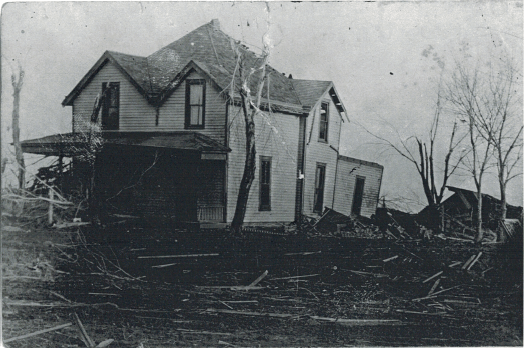
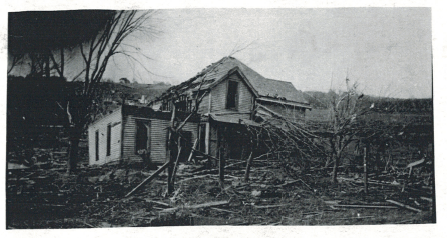
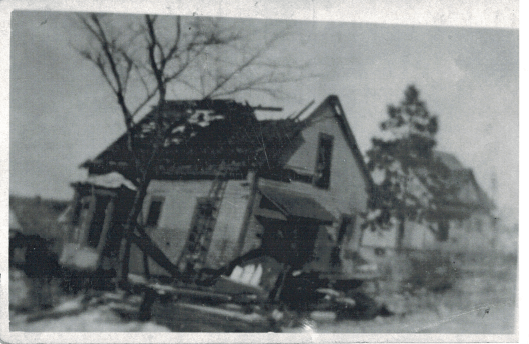
On the evening of Easter Sunday, six tornadoes struck eastern Nebraska and southwestern Iowa. The most destructive of these raced through Omaha, striking 2000 homes and demolishing 750 of them, thus displacing over 2000 residents and killing 94 people.3 The tornado entered the city from the southwest, immediately striking the workers’ cottage area of West Side where the Daily home was located as well as the homes of relations of the Dailys:
As the whirlwind raced over West Lawn and the Bohemian cemeteries toppling tombstones, it struck the worker cottage area from 53rd and Francis to 51st and Center and on to Leavenworth Street. It splintered a long strip of houses, killing eight people in the 48th and Pacific neighborhood. A score of fires broke out due to ruptured gas lines. The amount of debris in the streets, at times concealing fire hydrants, prevented firefighters from responding effectively. Fortuitously, evening rains squelched the fires throughout the city.4
Within the path of the twister were the homes of:
Charles and Maggie Daily at 1022 S. 46th.5
Maggie’s brother Harman Bonewitz at 1048 S. 48th with his wife Cornelia and son Roscoe.6
Maggie’s mother Josephine (nee Smith) Bonewitz at 4817 Pacific (where Maggie’s brother Sidney Bonewitz was also living).7
Maggie’s aunt Joanna Gantz at 4909 Hickory with her husband John and daughter Adda.8
Joanna Gantz’ son, J. Harmon Gantz at 4850 Hickory, with his wife Helen and two daughters, Dorothy and Bernice.9
Thankfully, none of these families lost lives to the whirlwind. But unfortunately, West Omaha Coal and Ice, Charles’ employer, which was located at 4801 Leavenworth10 would also have been in the path of the tornado.
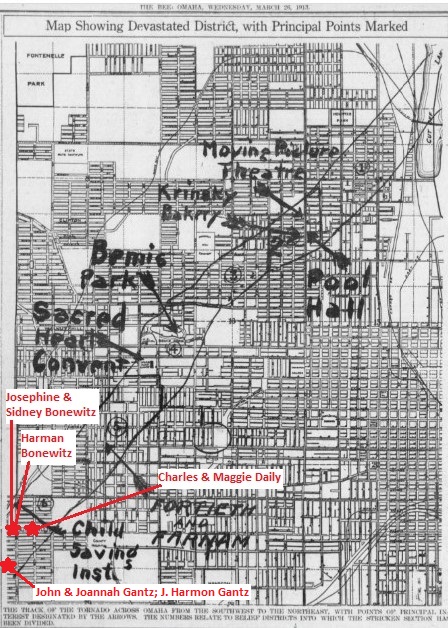
published by The Omaha Daily Bee11
Soon after the tornado passed through the city, Omaha’s Mayor James C. Dahlman issued a proclamation:
To the People of Omaha: A great calamity has struck our city. Many lives and homes have been destroyed. The authorities, with the assistance of Major C. F. Hartman of Fort Omaha, with 200 troops, are doing all that can be done tonight in guarding property and rescuing the dead and injured.
Tomorrow it will be necessary to properly patrol this district, which extends over several miles of territory, and until matters can be adjusted, so that property may be protected and men have an opportunity to clear the wreckage. No one will be allowed inside the lines unless properly authorized, so I call on the public generally to be patient.
Thousands of volunteers are doing all they can tonight. I appeal to the people in this hour of distress to house and feed all that need help until other arrangements can be made.“12
Throughout the night, reporters were busy gathering information and by the time the printing presses started at about 4:00 A. M., the front page of the Morning World-Herald was full of descriptions of the destruction caused by the tornado, as well as preliminary lists of the deceased and the injured, stating where the injured were recovering. Portions of the front-page article follows:
Cyclonic conditions, unknown to all, prevailed over the Missouri valley during the day, and a gigantic twister suddenly appeared, at 5:45 o’clock, as a manifestation of this disturbance.
The wind demon came careening over the prairies from the southwest and drove a diagonal course through the residence district to the north east ….
The huge, fashionable residences of the denizens of West Farnam hill suffered alike with the simple cottages of West Side and the substantial homes of Bemis Park and northern Omaha. …
Omaha has long been regarded as tornado-proof, on account of its barricade of surrounding hills, but this imaginary protection was swiftly proven a flimsy fabric indeed. The twister, reaping a harvest over half a mile wide, swept over the hilltops and down the valleys with the neat and deadly precision of some omnipotent mowing machine. …
… Streets and boulevards are so enmeshed in wreckage that travel, even on foot, is practically impossible, while street car and telephone service is almost nil. Automobiles and other vehicles are likewise nearly helpless ….13
Relief efforts began immediately, including the organization of a Citizens Relief Committee, which had the responsibility of disbursing funds and supplies, such as food, clothing, fuel and other necessities. “A sub-committee investigated aid requests using vehicles donated by wealthy Omahans; upon verification, requisitions sped to the destination in trucks loaned by businesses and in horse-drawn wagons lent by the Army.”14 During the following months, over $350,000 in aid was dispensed.
The city established neighborhood relief stations to distribute donated food and clothing; teachers opened additional stations in schools for relief and to act as shelters and congregants did so in their churches. The state contributed $100,000, some of which went for low-interest reconstruction loans. The Omaha World-Herald resurrected its “Tow Line” appeal and collected approximately $50,000 towards the relief effort. Several hotels offered free lodging to the poor, and the Real Estate Exchange worked to prevent gouging on rents.15
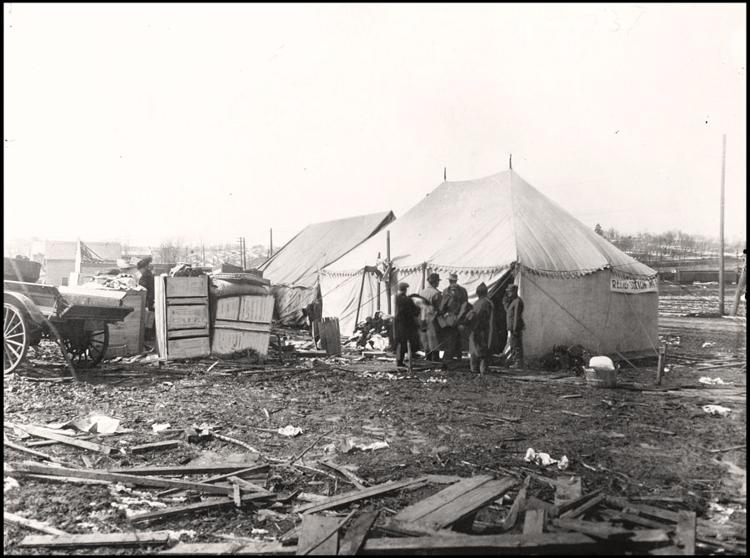
Everyone in the city was involved in cleaning up after the tornado because of “a fine, brownish dust that entered homes through the smallest of openings and settled on furniture and carpets.”17 Organized clean-up efforts began the first weekend of April in order to remove the wreckage in the streets and lots:
Over 10,000 volunteers met at 27 locations in the affected areas to pitch debris into trucks that removed it to designated dumping areas. Groups volunteered in units of college students, school children and factory workers. The newspapers praised the heroic effort that cleared the ruble, made the streets passable and precipitated a rapid rebuilding effort.18
A Restoration Committee handled the reconstruction effort:
This body secured large amounts of money from local financiers and likewise made trips to Chicago, where they secured additional funds from the railroads running into Omaha. For the purposes of restoration they loaned money without interest for a term of years and in some instances practically gave it away.19
Robert explained how his family rebuilt their homes:
Uncle Bob: So, Uncle Finley, that’s mother’s brother, older brother, he was a carpenter. [Harman was his first name, Finley was his middle name.] Always had carpentry. In the first place was, we had to build up Grandma’s home, see.
Interviewer: Um hmm.
Uncle Bob: Build up a cottage, we built up a cottage for Grandma. An’ that’s where I worked all the time that summer, ten cents an hour, cleaning bricks and cleaning – [chuckling]
Interviewer: You’d’ve been 13?
Uncle Bob: Yeah, I was coming on 13, not til May, see. … Built Grandma’s house. And uh, then built, well, first we built a, uh, called it a barn, but when it come right down, it was just about the size of a one stall garage, see.
Interviewer: Mmm. Um hmm.
Uncle Bob: We lived in it. There was a loft in it …. An’ that’s where we lived while uncle was building Grandma’s house, and then built our house. … We had a nine-room house. Took that out, see.
Interviewer: So, you left a new house in Omaha when you moved up here?
Uncle Bob: Well, it [wasn’t] that new. From 1913 to 1915. Yeah.
Interviewer: Two years.
Uncle Bob: … An’ we built another house in 1914 there. Uncle had a, had a house in lot, just in the second lot, uh, can’t tell you the direction, got different direction down there. But then there was a house in between our home and his, one that he rented. Of course, it [the tornado] damaged that one there, so he sold it to dad an’ then he tore that down to build a cottage up there, jus’ small four-room cottage.20
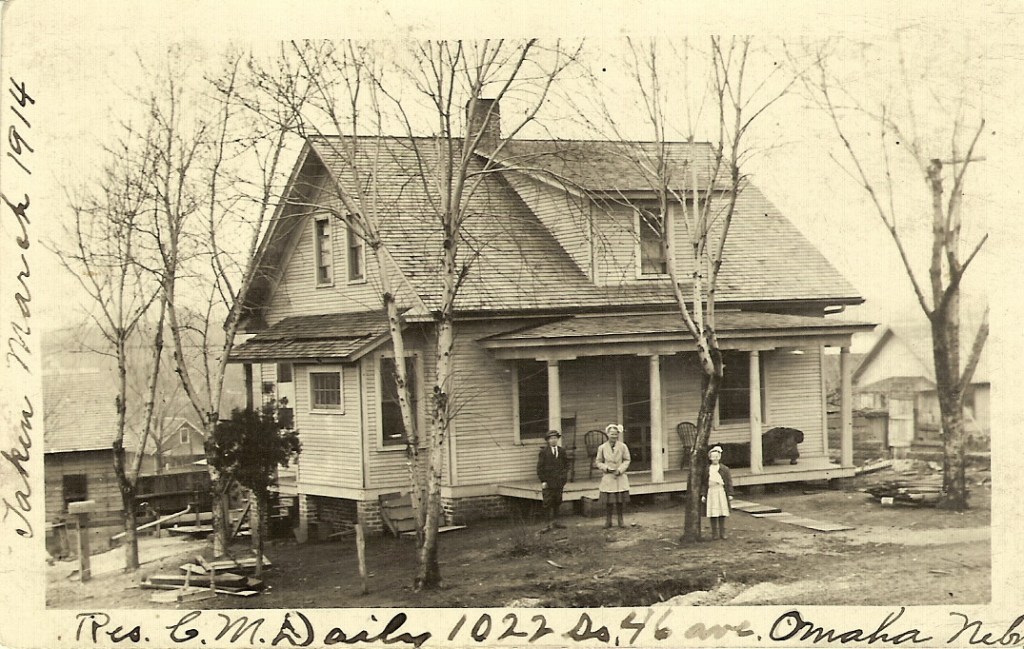
Besides helping to re-build homes, Robert continued attending public school. Robert related the difficulties he encountered during his schooling because the curriculums of various schools were not comparable.
Interviewer: Now, would you, you would have been through school, or you would have been through 8th grade?
Uncle Bob: No, I’d been through so much, I’d had so much free schooling, see. I didn’t, I didn’t graduate until 1915 from the seventh grade. …
Interviewer: I see. Okay.
Uncle Bob: ‘Cause I’d had free schooling. From moving in from the farm, coming into town, they sent me back. [The Dailys moved from a farm west of Omaha into the city in 1908 when Robert was 7 years old.]
Interviewer: Um hmm.
Uncle Bob: Well, I was only in there 15 months, and then we moved to Kansas. When we moved to Kansas, Kansas had a different set up, see. So, I had to pick up that. Well, I was [down there] four years, an’ then come back to Omaha, and they sent me back again, because I didn’t have the education …. I had lots of free schooling, though.
Interviewer: Did you, did you ever finish eighth grade?
Uncle Bob: No.
Interviewer: You didn’t.
Uncle Bob: Just 7th grade. … after I graduated from the 7th grade, I did put in from September until 1st of March, that’s how much, in 8th grade.
…
Uncle Bob: And Oranna, she started in – at that time we had a two-year high school and a four-year high school. One was more of a business [school] and Oranna wasn’t cut out for that kind of work. After she went there, well, she wasn’t interested in educating, she was always interested in more, want’n t’raise a family and –
Interviewer: Housework.
Uncle Bob: That was her turf.21
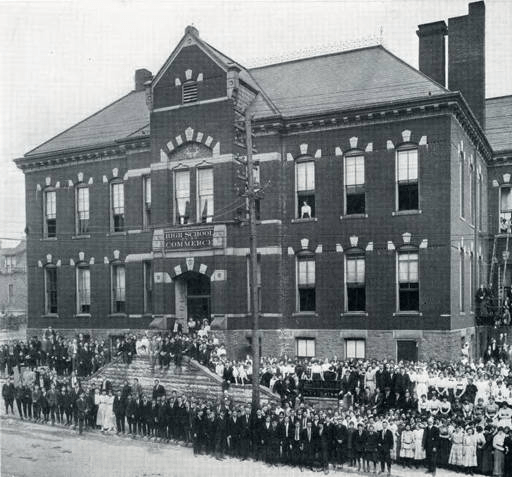
A high school Robert’s older sister Oranna may have attended was the High School of Commerce.
At this time, many students’ school careers ended with eighth grade graduation. Students who went on to high school were preparing to enter a profession that required college and generally came from more well-to-do families. The High School of Commerce offered classes in typing, stenography, telegraphy, bookkeeping, commerce law, etc., that prepared students for opportunities for better paying jobs in the business field. The program originated in the basement of Omaha’s Central High School in 1911, but the response was so great that within a year, classes were moved to the old Leavenworth Elementary School building at 17th and Leavenworth Streets. The school quickly became overcrowded and was replaced in 1922 by Technical High School.22
After the Dailys had lived in Omaha for two years, at Maggie’s urging Charles found another farm for them and on April 10, 1915, the family headed to northeast South Dakota.23 Robert’s reminiscences will continue.
- __________, Omaha City Directory Including South Omaha 1914 (Omaha, Nebraska: Omaha Directory Co., 1914): 250.
- M. R. Wilson, transcription of Robert Lee Uncle Bob Interview by R. Thiele, recording (ca. 1984): 7-8.
- D. Mihelich (Ed.), Ribbon of Destruction (Omaha, Nebraska: Douglas County Historical Society, n. d.): 3.
- Mihelich, Ribbon of Destruction: 8.
- Omaha City Directory 1914: 250.
- __________, Omaha City Directory Including South Omaha 1913 (Omaha, Nebraska: Omaha Directory Co., 1913): 133.
- Omaha City Directory 1913: 133-134.
- Omaha City Directory 1913: 333.
- Omaha City Directory 1913: 333.
- Omaha City Directory 1913: 954.
- “Map Showing Devastated District, with Principal Points Marked,” The Omaha Daily Bee, March 26, 1913, morning edition, https://nebnewspapers.unl.edu/lccn/sn99021999/1913-03-26/ed-1/seq-2/.
- J. C. Dahlman, “Mayor’s proclamation,” Morning World-Herald, March 24, 1913.
- __________, “Tornado kills 60, injures 152, in Omaha,” Morning World-Herald, March 24, 1913.
- Mihelich, Ribbon of Destruction: 46.
- Mihelich, Ribbon of Destruction: 42.
- S. Jones, “Back in the day, March 23, 1913: Monster tornado rips a scar across Omaha on Easter,” Omaha World-Herald, Mar. 23, 2021, https://omaha.com/news/local/history/back-in-the-day-march-23-1913-monster-tornado-rips-a-scar-across-omaha-on/article_53e17c40-74b1-11eb-a848-4b45501f7435.html.
- Mihelich, Ribbon of Destruction: 46.
- Mihelich, Ribbon of Destruction: 46.
- Mihelich, Ribbon of Destruction: 47.
- Wilson, Robert Lee Daily Interview: 8.
- Wilson, Robert Lee Daily Interview: 9-10.
- Nebraska Memories, “Omaha High School of Commerce,” http://memories.nebraska.gov/cdm/singleitem/collection/ops/id/2/rec/13.
- Wilson, Robert Lee Daily Interview: 9.


[…] months after Maggie’s father passed away, the Daily family moved back to Omaha again. In the next blogpost, Uncle Bob will continue his reminiscences of the next two years while they resumed living […]
LikeLike
[…] tornado destroyed their Omaha home on Easter Sunday […]
LikeLike
[…] Easter Sunday, March 23, 1913, a tornado drove through the west side of Omaha, destroying Maggie and Charles’ […]
LikeLike
[…] the 10th of April, 1915, Charles and Maggie Daily left Omaha and headed with their family to South Dakota because Maggie “wanted to get back to the farm” […]
LikeLike