George Cockin Bevers was the first child born to Alfred Cockin Bevers and Mary Naomi Bridges. They recorded his birth in their Family Bible as June 9, 1865 in Hull. His birth is also recorded in the civil registration records of Hull, Yorkshire East Riding.1 The full name of this town is Kingston-Upon-Hull, the name it was given after King Edward I had purchased the town and gave it a royal charter.2 The name is a derivative of King’s Town upon Hull (referring to the river Hull.)3 A hundred years before George was born, Hull was the birthplace of William Wilberforce, the champion of the abolition of the slave trade and slavery in the British Empire.4
Kingston-Upon-Hull is a port city on the northeastern coast of England, situated at the mouth of the Hull River entering the Humber River. At the time of George’s birth, the city had grown from 12,000 houses to over 20,000 houses during the previous 35 years, the growth being primarily outside the medieval old town.5 The expansion of the town was due to industrial advancement in the region and the resulting increase in importation.
During George’s childhood Alfred and Mary Bevers moved their residence several times. The locations are recorded in their Family Bible with every child’s birth, and sadly, with the deaths of some of George’s siblings. By the time he was 17 years old, George had 10 siblings. Six of his siblings died in their first year of life or shortly after.
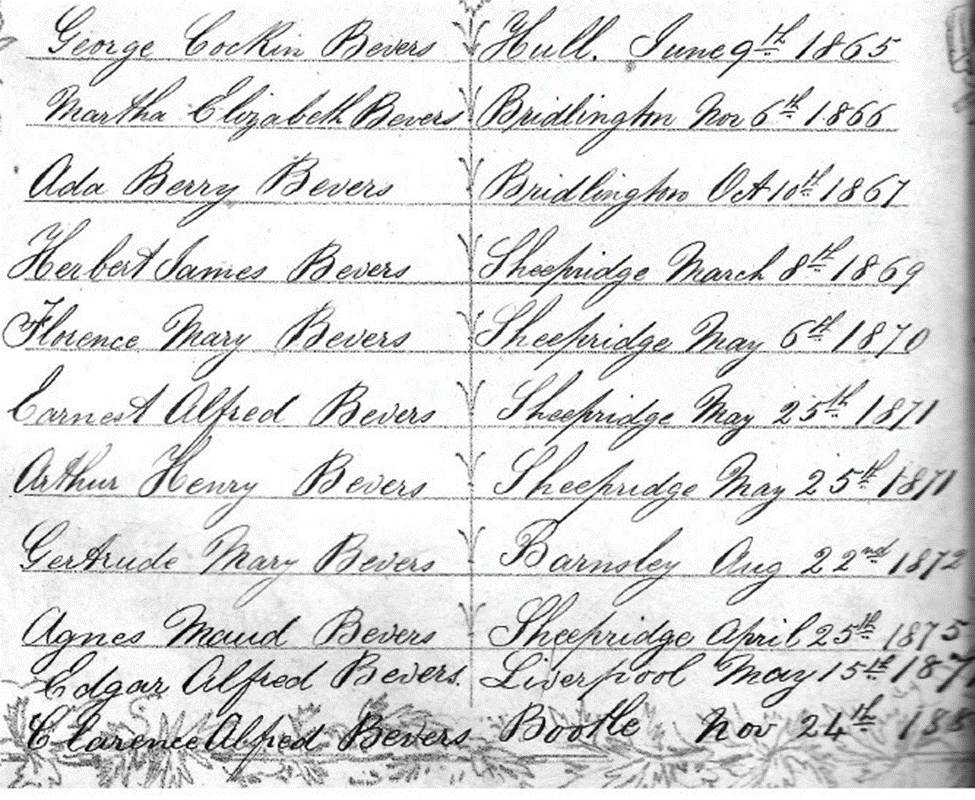
in the Family Bible of Alfred C. and Mary N. Bevers
When George’s first and second sisters were born his family lived in Bridlington, Yorkshire. The first one only lived 16 days; the second sister Ada would live to be 75 years-old. At the next location, Sheepridge, Yorkshire, which is the town where George’s father had been born, four of George’s siblings were born: a brother, a sister and a set of twin boys. The only one of these four who would survive was his brother Herbert and he would live to be 75 years-old. When the 1871 census was recorded in Sheepridge, at the age of five George was a scholar and his father was a collector and canvasser for Prudential Insurance Company.6 Their next residence was south of Sheepridge in Barnsley, which is where his sister Gertrude was born. Then the family returned to Sheepridge where George’s last sister Maude was born. Gertrude would live to be 81 years-old and Maude would live to be 83.
On December 18, 1875, the Weekly Examiner, a newspaper published in Huddersfield, printed a lengthy article describing a concert performed by the school children of the Hillhouse School Board. One of the students named in the article is a Master George Bevers. Since Sheepridge, the town where the Bevers are known to have lived when Maude was baptized, is only about 1¼ mile from Hillhouse, it is possible that this article is referring to the subject of this blogpost.
CONCERT BY THE HILLHOUSE BOARD SCHOOL CHILDREN. – On Thursday night, the eighth annual concert by the children attending this school was given in the schoolroom, and the profit arising from it will be handed over to the Huddersfield Infirmary. The room was very tastefully decorated for the occasion with mottoes and texts appropriate to the coming festival, and also with evergreens studded with artificial flowers, and a few pretty bannerets judiciously and effectively placed. The concert was given by about seventy children, only those being chosen who could sing a little piece of music, chosen by Mr. Gaunt, their instructor, at sight, and one piece on the programme; and in making choice of the children to sing, neither their age nor the standard they were in was taken into account, but only their efficiency in the tonic sol fa method of singing. The result was that, with the assistance of a few adults, a concert was given which, both for the quality of the music and the manner in which it was performed, would have done credit to much older scholars. … The dialogues were well given, the accurate pronunciation of the words, and the absence of a “singing” style being very marked. The first one was taken part in by the Misses Beatrice Waite, Clara Louisa Hirst, Clara Jane Brier, and Ellen Fisher, and Masters George Bevers, F. W. Thornton, Albert Victor Shaw …. A very interesting part of the entertainment was the sight singing test, and before it took place, Mr. W. H. Bedford said some people had been under the misapprehension that it was to be a singing contest, but that was not the case; it was a test for the whole of the children together, to show that Mr. Gaunt’s teaching was real, and not that he had merely taught them to sing those pieces of music by ear. He (Mr. Bedford), taking into account the ages of the children, had not gone in for anything very difficult or elaborate. He had therefore written a long metre hymn tune. The children would sol-fa it three times first, the treble part only, and then the other voices would join in. Nobody present but himself had seen the music before that night. Copies of the test piece were then given to each scholar, and they had to hold them with the print downwards till all had got a copy; then Mr. Gaunt gave the signal to start, and the tune (which is called Clara Street), was sol-faed three times by the children very accurately. Next the other singers joined them, and it was sung through the use of the “la” only, and afterwards “Praise God from whom all blessings flow” was sung to the music, which, thus rendered, showed a simple grandeur of construction very commendable to the composer. … The room was crowded with the parents and friends of the children, and others who take an interest in the school, all of whom seemed to thoroughly appreciate and enjoy the concert, and they must have felt highly gratified with the successful manner in which Mr. Gaunt had trained the children, not in music merely, but musical knowledge.7
Sometime after Maude’s birth, the Bevers family made a long move west, across the country, to Liverpool where another brother was born. Finally, Alfred and Mary would have their last child in Bootle, a town three miles north of Liverpool. Both of these brothers passed away as infants.
In 1881, when the census of England was taken, the Bevers family resided at 97 Derby Road, Kirkdale, a ward of Liverpool.8 George, having completed his education through the 8th grade,9 at the age of 15, was a “pupil teacher” at a Church of England school and his father was a tailor’s cutter.10 When George was about 17 years-old, his father emigrated to America, and a year or two later, his mother and sisters followed George’s father. Following the departure of their family, it is not known where George and his brother Herbert stayed.
Both brothers would also emigrate to the United States, and it is possible that they made the trip together in the fall of 1885. Some of the details of an entry in a passenger list of the steamship, Lord Clive, correspond with information about George and Herbert, but some does not correspond. This passenger list includes the names George Bevers and Herbert Bevers.11 The spelling is the correct spelling, but Ireland is recorded as their place of birth. The Lord Clive departed from Liverpool, which would very likely be the port where the brothers would have departed. This steamship arrived at the port of Philadelphia on December 1, 1885. This date corresponds with information in the 1900 U. S. census which states that George C. Bevers immigrated in 1885.12 But the 1900 U. S. census record for Herbert J. Bevers indicates that he didn’t immigrate until 1888.13 The passenger list of the Lord Clive provides additional information about the men: they were both laborers, they had never been to the United States and they were not tourists. Something that is missing on the ship manifest is the age of George and Herbert Bevers. If that information had been recorded, there would have been additional information to confirm whether the record is about our families’ ancestors.


Upon immigrating to the USA, George settled in Philadelphia. The first time there is an entry for him in the city directory of Philadelphia is in 1886 and he was the only Bevers listed in the directory that year. He was a clerk and living at 1532 Herbine.14 This was the same residence as Arthur Wright, a tailor, who would the following year become George’s father-in-law. Possibly, the Wright family and Bevers family were acquainted with each other in England. Both families lived in wards of Liverpool in 1881 and both Alfred C. Bevers and Arthur Wright were tailors.
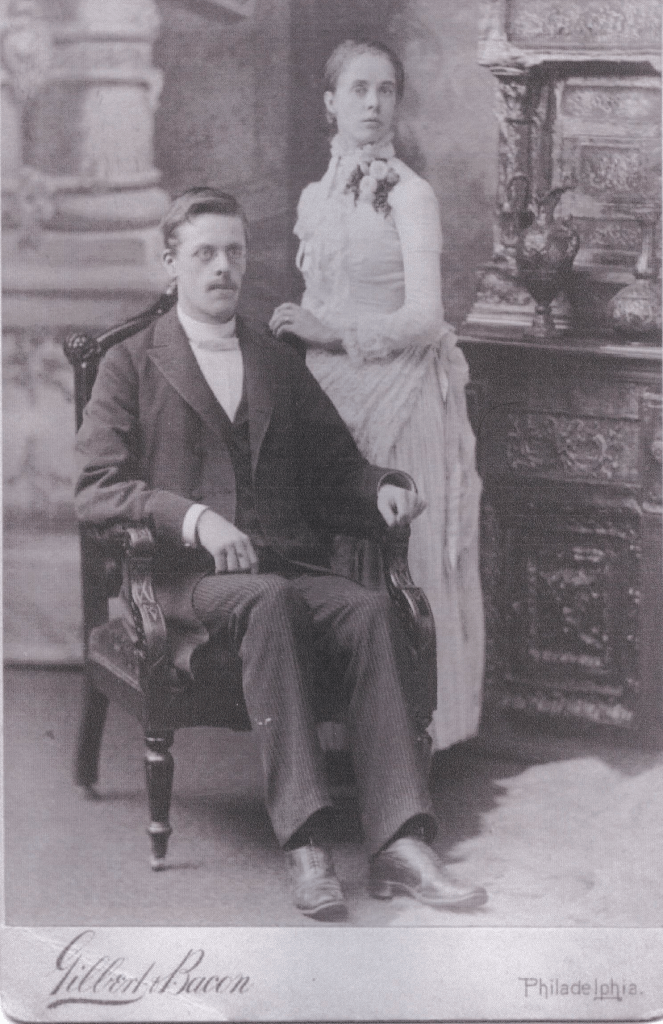
In 1887 and for a few years afterwards, the Philadelphia city directory would list George and Arthur at the same address: 47 Apsley in Germantown, which was a suburb northwest of Philadelphia.15 In that home on Friday September 2, 1887, George married Arthur’s daughter Evelina.16 The marriage record can be found in the marriage register of the Church of Saint John the Baptist, an Episcopal church. One of the witnesses was Evelina’s brother Ernest Wright. Two years later, the baptism register of this same church has a record of George and Evelina’s daughter Evelina. The record documents her birth as September 8, 1889 and her baptism on Thursday, December 26, 1889.17 Two of the sponsors of the infant Evelina were her uncle Francis Wright and her aunt Louisa Wright, her mother’s brother and sister. In July 1888, George had declared his intention to become a citizen of the United States.18

Marriage record of George C. Bevers and Evelina Wright,
Marriage register of the Church of Saint John the Baptist, Germantown, Pennsylvania


Baptismal record of Evelina Maude Bevers,
Baptism register of the Church of Saint John the Baptist, Germantown, Pennsylvania

The Philadelphia city directories of the 1890s give a few details of George’s life.
- In 1891 and in following years, George’s occupation was listed as bookkeeper instead of clerk.19
- In 1893, the address for George and Arthur was Old York Road, Milestown, a few miles northeast of Germantown.20 But the following year they returned to Germantown at “Pulaski a, N Apsley”21 and that year Evelina gave birth to a son, Arthur William Bevers on September 2, 1894.22
- In 1895 and 1896, George and Arthur’s address would be 4460 Pulaski Avenue, Germantown.23
- Then in 1897, although George’s name was not listed in the directory, at the same address as in ’95 and ’96, Arthur’s name was listed along with Arthur’s newly widowed daughter-in-law Catherine Wright and his son Ernest G. Wright.24
- In 1899 George and Arthur were both living at 3308 N. Broad, Philadelphia.25
- In 1900 they would both change their residence again to 2211 Venango, Philadelphia,26 but the following year they would return to Germantown at 223 Apsley.27
From that point forward Arthur’s name would no longer be listed in the city directory.
“Originally a township independent of Philadelphia …. The establishment of Germantown as a permanent German settlement in America in 1683 put into place William Penn’s bold ideas of religious toleration of different faiths in one colony, bringing Quakers to Pennsylvania together with Mennonites, Dunkards, and other groups that had been unwelcome in England and Continental Europe. In 1688 four Germantown settlers drafted a protest against slavery within the Dutch-German Quaker community that is considered to be the earliest antislavery document made public by whites in North America. …”28
The 1900 U. S. census tells us some information about George’s in-laws. Arthur Wright was 63 years-old, born in England in August 1836.29 His occupation was “taylor-cutter.” His wife was 69 year-old Eliza Wright, who was born in England in September 1830. Arthur, Eliza and daughter Evelina had immigrated from England in 1883. Arthur was renting a home and 35 year-old George with 38 year-old Evelina were living there, as well as their two children, 10 year-old Evelina and five year-old Arthur. Also living in the household was another of Arthur Wright’s daughters. She was 27 years-old and unmarried. A few years later, George’s in-laws would pass away. Eliza Ann Ventom Wright died on October 27, 190230 and Arthur died on March 18, 1904.31
From 1906 to 1911, the city directories of Philadelphia listed George’s address as 5607 Baynton, Germantown and the entries for 1909 and 1910 included his place of employment: “Mitchell & Bevers.”32 Apparently, George was in business with a man named Harry T. Mitchell. In 1911, George’s occupation was listed simply as accountant, without the notation of his business. This would be the last time that George’s name was printed in the Philadelphia city directory.
In July 1908, the Philadelphia Inquirer printed a news item about a meeting of the Artisans Order of Mutual Protection:
Germantown Assembly, No. 36, … on the 3d of July, held a unique entertainment for the enjoyment of the members. Twenty-three questions in American history were propounded, and to the member answering the greatest number correctly was given a pair of beautiful American flags. Strange to say, an Englishman, Bro. Geo. C. Bevers, won the prize with sixteen correct answers. …33
The Artisans Order of Mutual Protection was organized May 1, 1873, the result of gentlemen who desired “to devise a form of beneficial society, embracing improvement upon the old organizations as to death benefits, and a fraternal organization to give it strength and permanency.”34 The society is still in existence as of this writing, being “the second oldest fraternal insurance organization in the country.” Its website explains its position in American society: “The role of fraternalism, along with the efforts of our schools and churches, is to form a powerful alliance with government to give us a more orderly, and economically successful society.”
As of the date of the above-mentioned Artisans fraternal meeting, July 3, 1908, the United States flag had 45 stars. But beginning July 4, 1908, the flag had 46 stars because Oklahoma had been admitted to the union in November 1907.35 Most likely, George had been given two 46-star flags at the Artisans meeting. The 46-star flag was flown until July 3, 1912, then it was replaced with a 48-star flag because New Mexico and Arizona had become states in the winter of 1912. (See the flag of 1908 at https://en.m.wikipedia.org/wiki/File:Flag_of_the_United_States_(1908%E2%80%931912).svg)
The 1910 U. S. Census records that the Bevers family was living in a rented home at 5607 Baynton Street in Philadelphia,36 although the city directory indicates that this is in Germantown. George was an accountant in private business working on his own account. He was 44 years-old and Evelina was 48. They had been married for 23 years. Their unmarried daughter Evelina was 19; she was not attending school and did not have an occupation. Their son Arthur was 15 and attending school.
Two family events were held in Christ Church, an Episcopal church, in Germantown. George and Evelina’s son was baptized on February 13, 1910.37 Then on December 2, 1911 their daughter was married to William P. Woodroffe.38 The Woodroffes would move to Brooklyn, New York where George and Evelina’s grandson Francis was born in 1914 and their granddaughter Mildred was born in 1919.39

Baptism Register of Christ Church, Germantown, Pennsylvania
In 1917 the United States entered the great war which had been raging in Europe since 1914. Arthur Bevers joined the Army and served in the Engineer Reserve Corps from September 1917 to December 1918.40 Upon entering the Army, he declared his residence as 39 Woodlawn Avenue, Aldan, Pennsylvania, which is the town where his parents were living when the 1920 U. S. census was taken. Only a few months after Arthur’s entrance into the Army, George and Evelina made a trip to Camden, New Jersey to attend his marriage to Martha T. Severns on December 22, 1917.41 George and Evelina gained three more grandchildren when Dorothy was born in 1919, George was born in 1922 and William was born in 1923.
From this point forward the record trail for George and Evelina dwindles. According to the 1920 U. S. census, they were living at 201 East Providence Road in Aldan, Pennsylvania, a small town west of Philadelphia. George owned their house, he had a mortgage and he was a cashier at a mill.42 The census record also indicates that George had become a naturalized citizen of the United States in 1908 and that Evelina was naturalized as well, but no date is supplied in the record.
Only a couple of family events are known about George and Evelina’s life in the 1920s. First, Evelina’s sister Louise Wright Millar died in 1924, and George submitted the information for her death certificate.43 Second, their daughter Evelina and her husband moved back to Philadelphia sometime after 1920 and in 1927 their third child Mary was born, George and Evelina’s sixth grandchild.44
When the U. S. census was taken in 1930, it appears that George and Evelina were still living in the same home in which they had lived 10 years earlier. The home was valued at $10,000 and they owned a radio set.45 George at 64 years-old was a credit manager at a woolen goods establishment. Evelina was 68 years-old. A couple of family historians state that Evelina died on August 12, 1933 and one states that she was buried in Aldan on August 15, 1933, but documentation of Evelina’s death has not been located. In the 1940 U. S. census, 74 year-old George was recorded as a widower, unable to work and he was living with his son Arthur in Inglewood, California at 520 W. Hillcrest Blvd.46 Arthur’s family included his wife Martha and their children Dorothy, George and William. According to the census, five years earlier George had been living in Philadelphia.
Three years later Arthur supplied the information for George’s death certificate. George had lived with Arthur for five years prior to his death and for the last five months of his life he stayed at Gray’s Sanitarium in Los Angeles, California.47 On June 21, 1943, twelve days after his 78th birthday, George succumbed to cardiac failure, having suffered from cardiac disease for a couple of years. George’s body was cremated by Inglewood Park Cemetery, Inglewood, California.
1 FreeBMD, “Births registered in April, May, June 1865,” [vol. 9D, page 234] England & Wales, FreeBMD Birth Index, 1837-1915 (Provo, UT, USA: Ancestry.com Operations Inc, publisher, 2006): http://www.Ancestry.com.
2 V. Bettney, “Hull: A History,” The York Historian (August 8, 2017): https://theyorkhistorian.com/2017/08/08/hull-a-history/.
3 “Kingston upon Hull” (Wikipedia): https://en.wikipedia.org/wiki/Kingston_upon_Hull.
4 Encyclopaedia Britannica, editors, “William Wilberforce, British Politician,” Britannica (January 13, 2023): https://www.britannica.com/biography/William-Wilberforce.
5 V. Bettney, “Hull: A History”: https://theyorkhistorian.com/2017/08/08/hull-a-history/.
6 Ancestry.com, 1871 England Census [Class: RG10; Piece: 4372; Folio: 86; Page: 19; GSU roll: 848087], (Provo, Utah, USA: Ancestry.com Operations Inc., publisher, 2004): http://www.Ancestry.com.
7 Weekly Examiner (Huddersfield, West Yorkshire, England, December 18, 1875): 3.
8 Ancestry.com, 1881 England Census [Class: RG11; Piece: 3684; Folio: 133; Page: 23; GSU roll: 1341882] (Provo, Utah, USA: Ancestry.com Operations Inc., publisher, 2004): http://www.Ancestry.com.
9 “United States Census, 1940”, database with images, FamilySearch (ark:/61903/1:1:K975-B84 : Thu Mar 16 16:18:54 UTC 2023), Entry for Dorothy Bevers and George S Bevers, 1940.
10 Ancestry.com, 1881 England Census.
11 “Pennsylvania, Philadelphia Passenger Lists, 1883-1945,” database with images, FamilySearch (https://familysearch.org/ark:/61903/3:1:33SQ-GPBF-QKS?cc=1921481&wc=M616-JTP%3A214200701 : 21 May 2014), 006 – v. G, Jul 5, 1885-Dec 28, 1885 > image 393 of 448; citing NARA microfilm publication T840 (Washington, D.C.: National Archives and Records Administration, n.d.).
12 “United States Census, 1900,” database with images, FamilySearch (https://familysearch.org/ark:/61903/3:1:S3HY-DZV6-7M?cc=1325221&wc=9B7K-NQX%3A1030550501%2C1036056801%2C1036357801 : 5 August 2014), Pennsylvania > Philadelphia > ED 976 Philadelphia city Ward 38 > image 28 of 33; citing NARA microfilm publication T623 (Washington, D.C.: National Archives and Records Administration, n.d.).
13 “United States Census, 1900,” database with images, FamilySearch (https://familysearch.org/ark:/61903/3:1:S3HT-68DY-PH?cc=1325221&wc=9B7H-9LQ%3A1031648401%2C1033119401%2C1033119402 : 5 August 2014), South Dakota > Roberts > ED 282 Agency, One Road & Spring Grove Townships > image 4 of 11; citing NARA microfilm publication T623 (Washington, D.C.: National Archives and Records Administration, n.d.).
14 James Gopsill’s Sons, Publishers, Gopsill’s Street Index and City Guide of the City of Philadelphia (Philadelphia: James Gopsill’s Sons, Publishers, 1886): 182.
15 Gopsill’s Sons, Publishers, Gopsill’s Philadelphia City Directory (Philadelphia: Gopsill’s Sons, Publishers, 1887): 180 & 1843.
16 Historical Society of Pennsylvania, “St. John the Baptist Church, Germantown, 1876 to March 1891” in Pennsylvania and New Jersey, U.S., Church and Town Records, 1669-2013 [database on-line] (Lehi, UT, USA: Ancestry.com Operations, Inc., 2011): 200-01.
17 Historical Society of Pennsylvania, “St. John the Baptist Church, Germantown, 1876 to March 1891” in Pennsylvania and New Jersey, U.S., Church and Town Records, 1669-2013 [database on-line] (Lehi, UT, USA: Ancestry.com Operations, Inc., 2011): 100-01.
18 Ancestry.com, [Naturalization Petition of George C. Bevers], Pennsylvania, Federal Naturalization Records, 1795-1931 (Provo, UT, USA: Ancestry.com Operations, Inc., 2011).
19 James Gopsill’s Sons, Publishers, Gopsill’s Philadelphia City Directory (Philadelphia: James Gopsill’s Sons, 1891): 165.
20 James Gopsill’s Sons, Gopsill’s Philadelphia City Directory (Philadelphia: James Gopsill’s Sons, 1893): 169 & 2124.
21 James Gopsill’s Sons, Gopsill’s Philadelphia City Directory (Philadelphia: James Gopsill’s Sons, 1894): 173 & 2167.
22 Historical Society of Pennsylvania, “Christ Church and St Michaels Episcopal, Germantown, Philadelphia PA, 1899 to 1938” in Pennsylvania and New Jersey, U.S., Church and Town Records, 1669-2013 (Lehi, UT, USA: Ancestry.com Operations, Inc., 2011): 34-35.
23 James Gopsill’s Sons, Gopsill’s Philadelphia City Directory (Philadelphia: James Gopsill’s Sons, 1895): 164 & 2050.
24 James Gopsill’s Sons, Gopsill’s Philadelphia City Directory (Philadelphia: James Gopsill’s Sons, 1897): 2180.
25 James Gopsill’s Sons, Gopsill’s Philadelphia City Directory (Philadelphia: James Gopsill’s Sons, 1899): 197 & 2471.
26 James Gopsill’s Sons, Gopsill’s Philadelphia City Directory (Philadelphia: James Gopsill’s Sons, 1900): 197 & 2498.
27 James Gopsill’s Sons, Gopsill’s Philadelphia City Directory (Philadelphia: James Gopsill’s Sons, 1901): 215 & 2631.
28 D. W. Young, “Historic Germantown: New Knowledge in a Very Old Neighborhood,” The Encyclopedia of Greater Philadelphia: https://philadelphiaencyclopedia.org/essays/historic-germantown-new-knowledge-in-a-very-old-neighborhood-2/.
29 “United States Census, 1900”, database with images, FamilySearch (https://www.familysearch.org/ark:/61903/1:1:M3WT-MLY : 27 January 2023), Authur Wright, 1900.
30 Historical Society of Pennsylvania, “Kirk & Nice, Undertakers” [record books], in Pennsylvania and New Jersey, Church and Town Records, 1708-1985 (Provo, UT, USA: Ancestry.com Operations, Inc., 2011).
31 Historical Society of Pennsylvania, “Kirk & Nice, Undertakers” [record books].
32 C. E. Howe Co., Philadelphia City Register (Philadelphia: C. E. Howe Company, 1910): 213.
33 “Artisans Order of Mutual Protection,” Philadelphia Inquirer (Philadelphia, Pennsylvania, July 12, 1908): 3, Newspapers.com.
34 Artisans Order of Mutual Protection, “History”: http://www.artisansaomp.org/history.html.
35 Armed Forces History Collections, “Facts about the United States Flag,” Smithsonian Institution (Public Inquiry Services, September 2001): https://www.si.edu/spotlight/flag-day/flag-facts.
36 “United States Census, 1910,” database with images, FamilySearch (https://familysearch.org/ark:/61903/3:1:33S7-9RKV-WRB?cc=1727033&wc=QZZH-W5T%3A133638001%2C143194401%2C143376101%2C1589124991 : 24 June 2017), Pennsylvania > Philadelphia > Philadelphia Ward 22 > ED 407 > image 15 of 24; citing NARA microfilm publication T624 (Washington, D.C.: National Archives and Records Administration, n.d.).
37 Historical Society of Pennsylvania, “Christ Church and St Michaels Episcopal, Germantown, Philadelphia PA, 1899 to 1938”: 34-35.
38 Historical Society of Pennsylvania, “Christ Church and St Michaels Episcopal, Germantown, Philadelphia PA, 1899 to 1938”: 388-389.
39 The National Archives at Philadelphia, Philadelphia, Pennsylvania, “Petition of Naturalization” [of Evelina M. Woodroffe] in Pennsylvania, U.S., Federal Naturalization, 1795-1931 (Lehi, UT, USA: Ancestry.com Operations, Inc., 2011).
40 Ancestry.com, Pennsylvania, U.S., World War I Veterans Service and Compensation Files, 1917-1919, 1934-1948 (Lehi, UT, USA: Ancestry.com Operations, Inc., 2015).
41 Ancestry.com, “St. John’s Church, Camden, N. J. 2d Appendix to Volume 3, Marriages,” New Jersey, U. S., Episcopal Diocese of New Jersey, Church Records, 1700-1970 (Lehi, UT, USA: Ancestry.com Operations, Inc., 2021): 118.
42 “United States Census, 1920”, database with images, FamilySearch (https://www.familysearch.org/ark:/61903/1:1:M61K-TBX : 3 February 2021), George C Bever, 1920.
43 Ancestry.com, Pennsylvania, U.S., Death Certificates, 1906-1968 (Lehi, UT, USA: Ancestry.com Operations, Inc., 2014).
44 The National Archives at Philadelphia, Philadelphia, Pennsylvania, “Petition of Naturalization” [of Evelina M. Woodroffe].
45 “United States Census, 1930,” database with images, FamilySearch (https://familysearch.org/ark:/61903/3:1:33SQ-GRZH-HT?cc=1810731&wc=QZF7-YD9%3A649490601%2C649796601%2C649796602%2C1589282332 : 8 December 2015), Pennsylvania > Delaware > Aldan > ED 1 > image 14 of 22; citing NARA microfilm publication T626 (Washington D.C.: National Archives and Records Administration, 2002).
46 “United States Census, 1940”, database with images, FamilySearch (ark:/61903/1:1:K975-B84 : Thu Mar 16 16:18:54 UTC 2023), Entry for Dorothy Bevers and George S Bevers, 1940.
47 “California, County Birth and Death Records, 1800-1994,” database with images, FamilySearch (https://familysearch.org/ark:/61903/3:1:3QS7-89SV-Y9CV-J?cc=2001287&wc=FP4T-DP8%3A285176601%2C285575401 : 27 September 2019), Los Angeles, Los Angeles > Death certificates 1943 no 7540-9600 > image 2603 of 2794; California State Archives, Sacramento.
 Sojourners, Settlers & Other Legacy Conveyors
.svg)
[…] Bridlington. Alfred C. Bevers and his wife Mary (nee Bridges) with their infant son George (see George C. Bevers, Bookkeeper) arrived in the town sometime between late 1865 and late 1866. Mary gave birth to a daughter in […]
LikeLike
[…] brothers Arthur. On June 7, 1897, George Floyd was born, named after Ada’s eldest brother George, who was living in Philadelphia.9 By 1898, Ada’s parents and sisters Gertrude and Maude had moved […]
LikeLike
[…] Born in August 1872, Gertrude Mary Bevers was the eighth child of Alfred C. and Mary N. (nee Bridges) Bevers, although at the time of her birth only three of her siblings had lived past the age of one. She was born in a small town in England and during her childhood her family moved every few years, including emigrating to the United States when she was 12 years old. (A summary of the young lives of Gertrude and her sisters can be found in Ada, Gertie and Maude Bevers, and an article about her brother George is found in George C. Bevers, Bookkeeper.) […]
LikeLike
Michelle, do you know what to ‘sol-fa’ a song means?
LikeLike
I didn’t know what Tonic Sol-fa was before you asked your question, but you have motivated me to do a little research. I found thorough explanations on the following webpages: https://raltetonicsolfaseries.wordpress.com/about/ and https://www.classical-music.com/features/musical-terms/tonic-sol-fa. A simple answer is: Tonic Sol-fa is a method of teaching singing, which was originally developed by a Benedictine monk around 1000 A. D. in Italy. The method is characterized by the use of monosyllables to identify tones. In the early 1800s, in England, Sarah Ann Glover designed a system of musical notations based on the anglicized syllables: do, re, mi, fa, so, la, ti. The Weekly Examiner news article in the blogpost uses the phrase, “the children would sol-fa [the hymn tune] three times.” I gather that to sol-fa a song is to sing the song according to these musical syllables and tones.
LikeLike